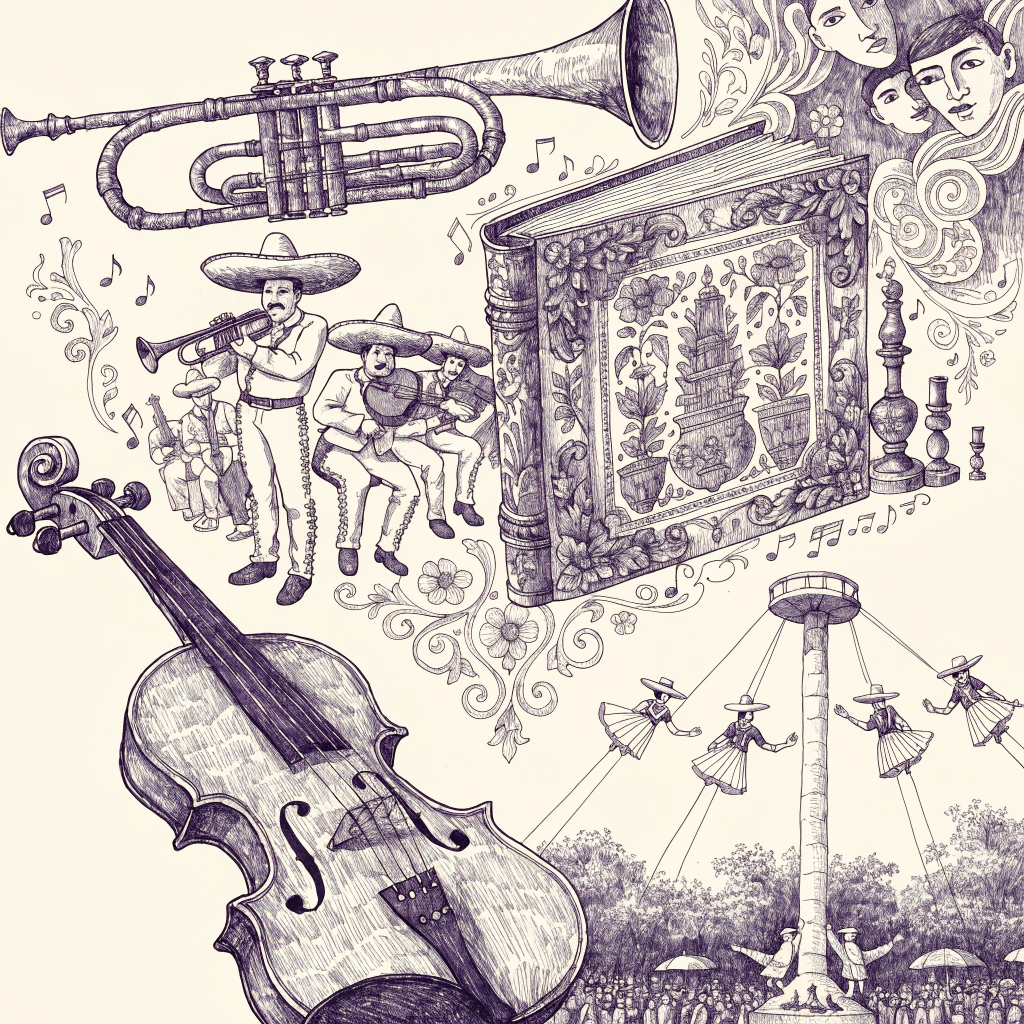
The Flying Men of Mexico
The Voladores are from Mexico. They have a special dance. It is a very old tradition. Five men go up a very tall pole. The pole is thirty meters high.
One man sits at the top. He plays music. He has a flute and a small drum. The other four men tie ropes to their legs. They jump and fly in the air. They look like birds.
The men wear beautiful red and white clothes. This dance is for the rain. It is a beautiful ceremony. People love to see the flyers in the sky.
文法スポットライト
パターン: Present Simple (to be)
"The Voladores are from Mexico."
We use 'are' with plural subjects like 'the Voladores'. It describes a fact or a state about who they are or where they are from.
パターン: Adjectives before Nouns
"The men wear beautiful red and white clothes."
In English, we put describing words like 'beautiful' and 'red' before the noun 'clothes'. This helps the reader imagine the object clearly.
理解度をチェック
10 問 · A1 初級 · 無料プレビュー 1回
この記事で学んだことをテストしよう。全問正解してXPを獲得!
Where are the Voladores from?
問題の内訳
Where are the Voladores from?
あなたの回答:
正解: Mexico
There are ten men on the pole.
あなたの回答:
正解: 間違い
What does 'tall' mean?
あなたの回答:
正解: Having a great height
One man sits at the _____.
あなたの回答:
正解: top
The Amazing Flying Dancers of Mexico
In Mexico, there is a very old and beautiful tradition. It is called the Ritual Ceremony of the Voladores, or the 'Dance of the Flyers.' This tradition started because people wanted to ask the gods for rain. Long ago, there was a big drought, and the people were hungry. They performed this dance to make the gods happy.
Today, five men climb a very tall pole. The pole is often 30 meters high. One man stays at the top. He plays a flute and a small drum. The other four men tie ropes to their bodies and jump. They fly in circles around the pole until they reach the ground. It is more exciting than a modern circus!
The dancers wear colorful clothes with red and white colors. These colors represent the sun and the birds. People in the Totonac group still practice this dance today. It is important because it connects the people to their history and the earth. Many tourists visit Veracruz to see this amazing ceremony.
文法スポットライト
パターン: Past Simple
"This tradition started because people wanted to ask the gods for rain."
We use the past simple to talk about finished actions in the past. For regular verbs, we usually add '-ed' to the base verb.
パターン: Comparatives
"It is more exciting than a modern circus!"
We use 'more' + adjective + 'than' to compare two things when the adjective is long (two or more syllables).
理解度をチェック
11 問 · A2 初級 · 無料プレビュー 1回
この記事で学んだことをテストしよう。全問正解してXPを獲得!
Where can you see this ceremony?
問題の内訳
Where can you see this ceremony?
あなたの回答:
正解: Mexico
Five men climb the tall pole during the ceremony.
あなたの回答:
正解: 正しい
What does 'drought' mean?
あなたの回答:
正解: A long time with no rain
The man at the top plays a _____ and a drum.
あなたの回答:
正解: flute
Why did the tradition start long ago?
あなたの回答:
正解: To ask the gods for rain
The Dance of the Flyers: An Ancient Mexican Tradition
The Ritual Ceremony of the Voladores, also known as the 'Dance of the Flyers,' is one of Mexico's most famous and breathtaking traditions. It has been practiced for hundreds of years by various ethnic groups, but it is most closely associated with the Totonac people of Papantla in the state of Veracruz. Historically, this breathtaking event is performed to ask the gods for rain during a long drought.
The ceremony starts with five men who climb a wooden pole that is 30 meters high. One man, who is called the Caporal, stays at the top of the pole. He plays a flute and a small drum while the other four men tie ropes to their feet. These men are the 'flyers.' After the music begins, they jump backwards into the air. While they are flying, the ropes slowly unwind, and the men circle the pole 13 times each. In total, they make 52 circles, which represents the cycle of the ancient Mexican calendar.
This ritual is not just a show for tourists; it is a deep spiritual experience that has been passed down through generations. The four flyers represent the four elements: earth, air, fire, and water. For many years, these traditions have been preserved by local communities who take great pride in their history. In 2009, the ceremony was named a UNESCO Intangible Cultural Heritage. Today, visitors can still see this unique dance in places like Papantla. It remains a beautiful example of how ancient history is still alive and respected in modern Mexico.
文法スポットライト
パターン: Passive Voice
"Historically, this breathtaking event is performed to ask the gods for rain."
The passive voice is formed with 'be' + past participle. It is used here because the action (the ceremony) is more important than who is performing it.
パターン: Relative Clauses
"The ceremony starts with five men who climb a wooden pole."
Relative clauses start with words like 'who' or 'which' to give more information about a noun. 'Who' is used here to describe the 'five men'.
理解度をチェック
11 問 · B1 中級 · 無料プレビュー 1回
この記事で学んだことをテストしよう。全問正解してXPを獲得!
Why was the ceremony originally performed?
問題の内訳
Why was the ceremony originally performed?
あなたの回答:
正解: To ask the gods for rain
The wooden pole used in the ceremony is 100 meters high.
あなたの回答:
正解: 間違い
What does 'drought' mean?
あなたの回答:
正解: A long period without rain
The men jump _____ into the air after the music begins.
あなたの回答:
正解: backwards
What does the total number of 52 circles represent?
あなたの回答:
正解: The ancient Mexican calendar
The Soaring Tradition: Understanding the Ritual Ceremony of the Voladores
The Ritual Ceremony of the Voladores, commonly referred to as the 'Dance of the Flyers', represents one of Mexico's most profound cultural treasures. This ancient pre-Hispanic tradition, which has been preserved for centuries, combines breathtaking physical skill with intricate spiritual symbolism. Although it is practiced by several ethnic groups across Mesoamerica, it is most closely associated with the Totonac people of Papantla, located in the state of Veracruz.
Historically, the ceremony is believed to have originated as a fertility ritual. According to legend, a severe drought once devastated the region, threatening the survival of the community. In an attempt to appease the gods and bring rain to the parched earth, the elders instructed five young men to perform a ritual at the top of a tall pole. This 'cosmic dance' was intended to symbolize the descent of the gods and the renewal of life.
The performance itself is a marvel of coordination and bravery. It begins with the participants, dressed in vibrant costumes, climbing a pole that can reach heights of up to 30 meters. One performer stays at the summit, playing a flute and a small drum while standing on a tiny platform. Meanwhile, the other four flyers, tied by ropes, launch themselves backward into the air. As they descend, they circle the pole exactly 13 times each, totaling 52 revolutions—a number that corresponds to the cycle of the ancient Mesoamerican calendar.
From a contemporary perspective, the ceremony has evolved from a local religious rite into a globally recognized symbol of indigenous identity. In 2009, UNESCO inscribed the ritual on the Representative List of the Intangible Cultural Heritage of Humanity. This recognition highlights the importance of protecting such traditions in an era of rapid globalization. Critics argue that tourism has commercialized the practice; however, many community members believe that the increased visibility ensures the survival of their ancestral knowledge.
In conclusion, the Ritual Ceremony of the Voladores serves as a powerful testament to the resilience of Totonac culture. It is not merely a spectacle for observers but a profound expression of the relationship between humanity and the natural world. By maintaining this tradition, the Totonac people continue to honor their history while navigating the complexities of the modern world.
文法スポットライト
パターン: Passive Voice with Infinitive
"the ceremony is believed to have originated as a fertility ritual."
This structure is used to report general beliefs or historical theories. It combines the passive 'is believed' with a perfect infinitive 'to have originated' to refer to a past action.
パターン: Non-defining Relative Clause
"Totonac people of Papantla, located in the state of Veracruz."
This clause adds extra information about a specific noun (Papantla) that is already identified. It is separated from the main sentence by commas.
パターン: Contrastive Discourse Markers
"Critics argue that tourism has commercialized the practice; however, many community members believe..."
The word 'however' is used to introduce a statement that contrasts with or contradicts what has been previously mentioned, common in formal writing.
理解度をチェック
11 問 · B2 中上級 · 無料プレビュー 1回
この記事で学んだことをテストしよう。全問正解してXPを獲得!
What was the primary original purpose of the Voladores ceremony?
問題の内訳
What was the primary original purpose of the Voladores ceremony?
あなたの回答:
正解: To ask the gods for rain during a drought
The number of total revolutions performed by the flyers has a connection to the ancient calendar.
あなたの回答:
正解: 正しい
What does 'resilience' mean in the context of the article?
あなたの回答:
正解: The ability of a culture to survive and recover
The pole used in the ceremony can reach _____ of up to 30 meters.
あなたの回答:
正解: heights
Which organization recognized the ritual as part of the world's intangible heritage?
あなたの回答:
正解: UNESCO
The Cosmic Descent: Navigating the Sanctity and Commodification of the Voladores Ritual
Deeply rooted in the Totonac culture of Papantla, Veracruz, the Ritual Ceremony of the Voladores stands as a testament to Mesoamerican spiritual endurance. Rarely does a tradition so viscerally bridge the chasm between the terrestrial and the celestial. This 'Dance of the Flyers' is not merely an acrobatic feat; it is a profound cosmological supplication. Historically, the ceremony emerged during a period of catastrophic drought, intended to appease the gods and beckon the life-giving rains. By launching themselves from a thirty-meter pole, the participants enact a symbolic descent of the gods to the earth, a performance that requires both physical bravery and spiritual purity.
What the ceremony fundamentally represents is a cosmic petition for fertility and equilibrium. At the heart of the ritual is the pole, representing the axis mundi, the center of the universe. Atop this precipice stands the caporal, playing a flute and drum—a melody that echoes the voices of birds and the whispers of the divine. Four flyers, tied by ropes, launch themselves into the void, spinning thirteen times each to reach a collective total of fifty-two—the number of years in the Great Century of the Mesoamerican calendar. This meticulous synchronicity is not for the faint of heart; it is a calculated risk taken in service of communal well-being.
It is this profound spiritual resonance that earned the ceremony its place on the UNESCO Intangible Cultural Heritage list. However, the preservation of such traditions is fraught with modern complexities. The increasing commodification of the ritual for tourism purposes has sparked a nuanced debate regarding the potential diminution of its sanctity. While some argue that global visibility ensures the survival of the practice, others contend that the transition from a sacred rite to a commercial spectacle risks diluting its original spiritual intent. In tourist hubs, the ritual is often stripped of its temporal context, performed multiple times a day for audiences who may lack the cultural literacy to grasp its gravity.
Furthermore, the socio-economic resilience of the Totonac people is inextricably linked to the survival of this rite. The transmission of knowledge from elders to the youth involves more than just physical training; it requires an immersion in an ancestral worldview that emphasizes reciprocity with nature. Before the pole is even erected, the participants perform rituals to ask the earth for forgiveness, reflecting a worldview where nature is a sentient entity. Despite the pressures of globalization, the Voladores continue to assert their identity through this aerial dance. Only by acknowledging the profound historical weight of the ceremony can an outsider truly appreciate the courage of those who defy gravity to maintain their link with the heavens. Ultimately, the Ritual Ceremony of the Voladores remains a vibrant vestige of a world that refuses to be forgotten.
文法スポットライト
パターン: Inversion with Negative Adverbials
"Rarely does a tradition so viscerally bridge the chasm between the terrestrial and the celestial."
When using negative or restrictive adverbials like 'rarely' or 'seldom' at the start of a sentence for emphasis, the auxiliary verb moves before the subject. This creates a formal and dramatic tone suitable for advanced writing.
パターン: Pseudo-cleft Sentences
"What the ceremony fundamentally represents is a cosmic petition for fertility and equilibrium."
Pseudo-clefts use a 'what-clause' to focus on specific information. It is used here to emphasize the underlying meaning of the ritual rather than the physical act itself.
パターン: Nominalization
"The increasing commodification of the ritual for tourism purposes has sparked a nuanced debate."
Nominalization involves turning verbs (commodify) into nouns (commodification). This allows for a higher density of information and a more objective, academic tone characteristic of C1 English.
理解度をチェック
12 問 · C1 上級 · 無料プレビュー 1回
この記事で学んだことをテストしよう。全問正解してXPを獲得!
What was the original primary purpose of the Voladores ritual?
問題の内訳
What was the original primary purpose of the Voladores ritual?
あなたの回答:
正解: To petition the gods for rain during a drought
The number of spins performed by the flyers corresponds to the Mesoamerican calendar cycle.
あなたの回答:
正解: 正しい
Which word describes the process of turning a sacred tradition into a commercial product?
あなたの回答:
正解: Commodification
The ceremony is considered a vibrant _____ of an ancient world that persists today.
あなたの回答:
正解: vestige
According to the article, what is a negative consequence of tourism on the ritual?
あなたの回答:
正解: It risks reducing the ritual's spiritual sanctity
The participants ask the earth for forgiveness before beginning the ritual.
あなたの回答:
正解: 正しい
メソアメリカの天空舞踏:ボラドーレスの儀式に宿る宇宙論的意味
メキシコに深く根差した「ボラドーレスの儀式」、即ち「空飛ぶ人々の舞踏」は、単なる見世物ではなく、太古のメソアメリカ文明が育んだ宇宙観と、人間が自然と共生せんとする切実な願いとが、見事に融合した生きた遺産である。この儀式は、アクロバティックな妙技と深遠な精神的象徴性が織りなす、息をのむような光景として知られるが、その起源は、干ばつが頻発した時代に、神々を宥め、雨を招来せんがための豊穣祈願に遡る。とりわけ、ベラクルス州パパントラ地方のトトナカ族によって継承されてきたこの儀式は、生命の再生と宇宙の循環を象徴する、まさに「天空の舞踏」に他ならない。
儀式の核心を成すのは、「パロ・ボラドール」と呼ばれる高さ数十メートルに及ぶ巨大な柱である。この柱は、天と地を結ぶ宇宙軸、あるいは生命の木を象徴すると解釈され、その頂上には、カポラルと呼ばれる音楽奏者が着座し、笛と太鼓の音色で儀式の始まりを告げる。彼の奏でる音楽は、しばしば鳥の鳴き声や風の音を模倣し、神聖な空間を創造する役割を担うのである。その後、四人のボラドーレス(飛行者)が柱をよじ登り、頂上部の台座に到達する。彼らの装束は、しばしば鳥の羽や鮮やかな色彩で飾られ、神聖な鳥、即ち神の使者としての役割を暗示しているかのようである。
頂上に到達したボラドーレスは、それぞれが足首をロープで固定し、台座から身を投げ出す。彼らは頭を下にして、ゆっくりと、しかし確実に螺旋を描きながら降下していく。この降下の動きは、太陽が天頂から地上へと降りてくる様、あるいは生命が天から地へと授けられる過程を表現しているとされる。各ボラドールが13回転を繰り返すことにより、四人の合計で52回転となる。この「52」という数字は、メソアメリカの長期暦における一周期、即ち52年周期と合致しており、時間の終わりと始まり、宇宙の絶え間ない再生という、深遠な宇宙論的意味を内包していることは想像に難くない。彼らの舞踏は、単なる空中技ではなく、生命の循環、宇宙の秩序、そして時間の連続性を体現する、生きたカレンダーなのである。
この儀式は、単に豊穣を願うという実用的な目的を超越し、人間と自然、そして宇宙との間に存在する普遍的な繋がりを再認識させる、形而上学的な意味合いを帯びている。現代社会における物質主義的価値観が蔓延する中にあって、ボラドーレスの儀式は、我々が忘れかけているであろう精神的豊かさや、自然への畏敬の念を喚起する。それは、過去の知恵が未来へと継承されるべきであるという、雄弁なメッセージを発していると言えよう。2009年にはユネスコの無形文化遺産に登録され、その文化的価値は国際的にも認められている。このことは、ボラドーレスの儀式が、特定の民族コミュニティに留まらず、全人類にとって貴重な文化財たる所以を物語るものに他ならない。
結論として、ボラドーレスの儀式は、太古の信仰、卓越した身体能力、そして深遠な宇宙論が融合した、他に類を見ない文化現象である。その螺旋状の降下は、単なる物理的な動きではなく、神話的な時間の流れと生命の再生を象徴する寓意に満ちている。現代に生きる我々がこの儀式を鑑みるに、それは先人たちの自然への深い洞察力と、それを芸術的に昇華させる能力に、改めて畏敬の念を抱かずにはいられない。この壮大な舞踏は、メキシコの豊かな歴史と文化の象徴として、今後も世代を超えて語り継がれていくことだろう。
文法スポットライト
パターン: ~に他ならない
"それは、生命の再生と宇宙の循環を象徴する、まさに「天空の舞踏」に他ならない。"
「~に他ならない」は、「~であると断定できる」「~以外の何物でもない」という強い肯定を表す表現です。話し手の確信や断言を伝え、しばしば結論や強調の文脈で用いられます。名詞や名詞句の後に続きます。
パターン: ~ならんとする
"人間が自然と共生せんとする切実な願いとが、見事に融合した生きた遺産である。"
「~ならんとする」は、「~しようとする」「~になろうとする」という意図や試み、または差し迫った状況を表す古風で格式ばった表現です。「んとする」は、「むとする」の撥音便化した形で、意志や目標に向かう強い姿勢を示します。主に書き言葉や演説などで用いられます。
パターン: ~を鑑みるに
"現代に生きる我々がこの儀式を鑑みるに、それは先人たちの自然への深い洞察力と、それを芸術的に昇華させる能力に、改めて畏敬の念を抱かずにはいられない。"
「~を鑑みるに」は、「~を考慮すると」「~に照らしてみると」という意味で、ある事柄や状況を深く検討した結果、何らかの判断や結論に至る際に用いる表現です。客観的な視点から物事を評価し、その根拠を示す際に使われます。主に書き言葉で、比較的硬い文脈で使われます。
理解度をチェック
12 問 · C2 マスター · 無料プレビュー 1回
この記事で学んだことをテストしよう。全問正解してXPを獲得!
ボラドーレスの儀式が始まった主な目的は何ですか?
問題の内訳
ボラドーレスの儀式が始まった主な目的は何ですか?
あなたの回答:
正解: 神々を宥め、雨を招来するため
ボラドーレスの儀式は、メキシコのトトナカ族だけでなく、他の多くのメソアメリカの民族によっても行われています。
あなたの回答:
正解: 正しい
「畏敬の念」の最も適切な意味は何ですか?
あなたの回答:
正解: 尊敬と同時に恐れを伴う感情
「パロ・ボラドール」と呼ばれる巨大な柱は、天と地を結ぶ宇宙軸、あるいは生命の_____を象徴すると解釈されます。
あなたの回答:
正解: 木
各ボラドールが13回転、合計で52回転を繰り返すことには、どのような宇宙論的意味が内包されていると述べられていますか?
あなたの回答:
正解: メソアメリカの長期暦における一周期
ボラドーレスの儀式は、現代社会の物質主義的価値観とは無関係であり、精神的なメッセージは含まれていません。
あなたの回答:
正解: 間違い

