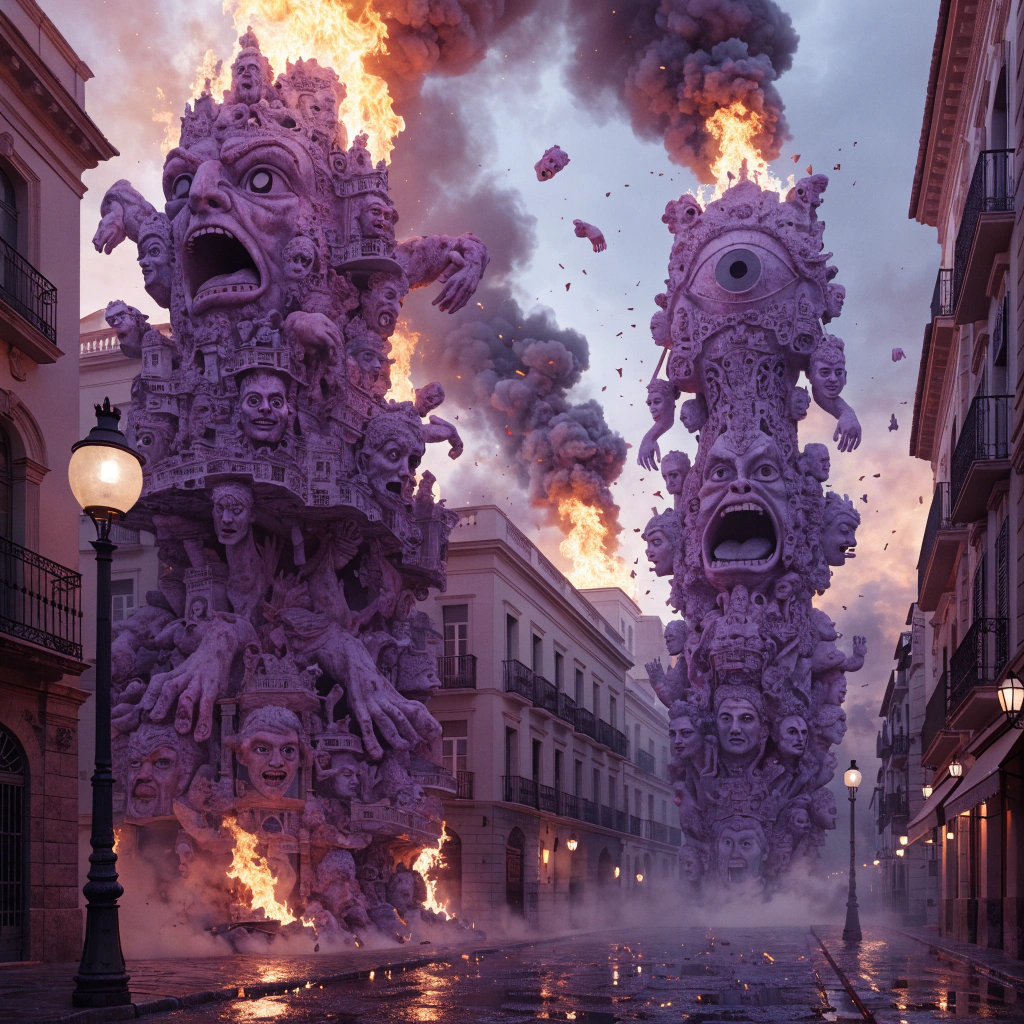
The Big Fire Festival in Spain
Valencia is a beautiful city in Spain. Every March, there is a big festival. It is called Las Fallas. It is for Saint Joseph. He is the patron of carpenters.
People make huge statues. They are very tall and colorful. These statues are called "fallas". They look like funny people or famous people.
There is loud music and fire. People wear traditional clothes. On the last night, they burn the statues. It is a very exciting party for everyone.
Gramática em destaque
Padrão: Present Simple (Be verb)
"Valencia is a beautiful city in Spain."
We use the verb 'to be' (am/is/are) to describe people, places, and things. In the singular form for a city, we use 'is'.
Padrão: Plural Nouns
"People make huge statues."
To make a noun plural in English, we usually add -s to the end of the word. For example, one statue becomes many statues.
Teste sua compreensão
10 perguntas · A1 Iniciante · 1 pré-visualização grátis
Teste o que aprendeu neste artigo. Responda todas as perguntas para ganhar XP!
Where is the festival of Las Fallas?
Quer finalizar o quiz?
9 perguntas a mais estão esperando por você. Cadastre-se grátis para desbloquear o quiz completo e ganhar XP!
Cadastrar grátisJá tem conta? Entrar
Detalhamento das perguntas
Where is the festival of Las Fallas?
Sua resposta:
Resposta correta: In Spain
The festival is in December.
Sua resposta:
Resposta correta: Falso
What does the word 'statue' mean?
Sua resposta:
Resposta correta: A large model of a person
Every March, there is a big _____.
Sua resposta:
Resposta correta: festival
The Amazing Fire Festival of Valencia
In March, the city of Valencia in Spain becomes a very noisy and beautiful place. People celebrate "Las Fallas" to honor Saint Joseph. He was the patron saint of carpenters. This festival is famous all over the world because it is full of fire, art, and music.
Artists build giant monuments called "fallas." These structures are taller than houses! On the monuments, there are smaller figures called "ninots." These figures often look like famous people or politicians. They are very funny and colorful. Visitors walk around the city to see these amazing statues.
The festival ends with a big event called "La Cremà." On the last night, people burn all the fallas. The fire is very big, but the firefighters are always there to help. This festival is louder than other Spanish festivals because there are many fireworks. People feel happy but also a bit sad when the statues burn. It is a unique tradition that brings the community together.
Gramática em destaque
Padrão: Comparatives
"These structures are taller than houses!"
We use comparatives to compare two things. For short adjectives, we add '-er' and the word 'than' to show the difference.
Padrão: Past Simple of 'To Be'
"He was the patron saint of carpenters."
We use 'was' for the singular past tense of 'to be' (I, he, she, it). It describes a state or identity in the past.
Teste sua compreensão
11 perguntas · A2 Elementar · 1 pré-visualização grátis
Teste o que aprendeu neste artigo. Responda todas as perguntas para ganhar XP!
Where does the Las Fallas festival take place?
Quer finalizar o quiz?
10 perguntas a mais estão esperando por você. Cadastre-se grátis para desbloquear o quiz completo e ganhar XP!
Cadastrar grátisJá tem conta? Entrar
Detalhamento das perguntas
Where does the Las Fallas festival take place?
Sua resposta:
Resposta correta: Valencia
The festival happens during the month of December.
Sua resposta:
Resposta correta: Falso
What does 'carpenter' mean?
Sua resposta:
Resposta correta: A person who works with wood
The festival ends with a big _____ called La Cremà.
Sua resposta:
Resposta correta: event
Why is Las Fallas louder than other festivals?
Sua resposta:
Resposta correta: Because of the many fireworks
The Fire and Art of Valencia: Las Fallas
Every March, the Mediterranean city of Valencia is filled with noise, fire, and incredible art. This festival, which is known as Las Fallas, has been celebrated for many years to honor Saint Joseph, the patron saint of carpenters. It is a unique event that attracts thousands of tourists who want to experience Spanish culture.
The city is transformed into an open-air museum where giant monuments called 'fallas' are displayed in every neighborhood. These structures are made of wood and paper, and they often reach several stories in height. On these monuments, you can see smaller figures called 'ninots.' Most ninots are designed to be satirical, which means they use humor to criticize politicians or famous people. For months, talented artists have worked hard to create these colorful masterpieces.
During the festival week, the 'Mascletà' takes place every day at 2:00 PM. This is a loud show where thousands of firecrackers are exploded in the city center. The noise is so powerful that the ground is felt shaking under your feet. It is a tradition that has become very popular with local residents and visitors alike. Another beautiful event is the flower offering, where people wear traditional clothes and carry bouquets to the city square.
The festival ends with 'La Cremà' on the final night. During this event, all the monuments are burned in huge bonfires. Although it seems sad to destroy such beautiful art, the fire is seen as a symbol of starting something new for the spring. Only one small ninot is saved from the fire because it has been voted the best by the public. This lucky figure is kept in a museum so it can be remembered forever.
Gramática em destaque
Padrão: Passive Voice
"The city is transformed into an open-air museum..."
The passive voice is used here because the action (transforming the city) is more important than who does it. It is formed using the verb 'to be' and the past participle.
Padrão: Present Perfect
"This festival... has been celebrated for many years..."
The present perfect is used to describe an action that started in the past and continues to the present. It is formed with 'has/have' and the past participle.
Teste sua compreensão
11 perguntas · B1 Intermediário · 1 pré-visualização grátis
Teste o que aprendeu neste artigo. Responda todas as perguntas para ganhar XP!
Who is the patron saint honored during Las Fallas?
Quer finalizar o quiz?
10 perguntas a mais estão esperando por você. Cadastre-se grátis para desbloquear o quiz completo e ganhar XP!
Cadastrar grátisJá tem conta? Entrar
Detalhamento das perguntas
Who is the patron saint honored during Las Fallas?
Sua resposta:
Resposta correta: Saint Joseph
The 'ninots' are usually serious figures that never use humor.
Sua resposta:
Resposta correta: Falso
What is the definition of a 'masterpiece'?
Sua resposta:
Resposta correta: A work of outstanding artistry
The festival ends with La Cremà on the final _____.
Sua resposta:
Resposta correta: night
What time does the 'Mascletà' show happen every day?
Sua resposta:
Resposta correta: 2:00 PM
The Fiery Tradition of Valencia: Art, Satire, and Ash
Every March, the Mediterranean city of Valencia undergoes a dramatic transformation as it prepares for Las Fallas, a festival of fire that has been celebrated for centuries. Primarily held to commemorate Saint Joseph, the patron saint of carpenters, the event has evolved from a simple tradition into a world-renowned display of art and social commentary. Historically, carpenters would burn old wood and scraps at the end of winter; today, this practice has manifested as a sophisticated urban gallery.
The heart of the festival lies in the creation of the 'fallas'—monumental structures made of wood and papier-mâché. These figures, often reaching several stories in height, are populated by 'ninots,' which are smaller individual puppets. These ninots frequently depict politicians and celebrities, serving as satirical critiques of contemporary society. Despite the immense craftsmanship required to build them, these structures are ultimately ephemeral, designed for a singular, explosive purpose. The artists, known as 'falleros,' spend months in workshops meticulously painting and sculpting these figures, which often address controversial themes with a biting sense of humor.
Throughout the week, the city is filled with the thunderous sound of the 'mascletà,' a daily pyrotechnic display that emphasizes rhythm and acoustic power over visual color. While tourists might find the noise overwhelming, locals consider the vibrations an essential part of the Valencian identity. Furthermore, the streets are crowded with participants wearing elaborate traditional costumes, reinforcing the sense of community heritage. This period is characterized by a constant sensory bombardment, from the smell of gunpowder to the sight of millions of flowers offered to the Virgin Mary.
The festival reaches its climax on the night of March 19th during the 'Cremà.' In a symbolic act of renewal, every monument in the city is set ablaze. Having spent an entire year meticulously planning and constructing these masterpieces, the artists must stand by as their work is incinerated. This ritual represents the transition from winter to spring and the rejection of the old to make way for the new. Although only one 'ninot' is spared from the flames each year by public vote, the spirit of the festival remains unextinguished.
In 2016, UNESCO recognized Las Fallas as part of the Intangible Cultural Heritage of Humanity. This status highlights the festival’s importance not just as a tourist attraction, but as a complex social phenomenon that combines traditional craftsmanship with modern artistic expression. Consequently, Valencia continues to draw global crowds who are eager to witness this unique intersection of art, satire, and ash.
Gramática em destaque
Padrão: Present Perfect Continuous
"a festival of fire that has been celebrated for centuries."
This tense is used to describe an action that started in the past and is still continuing or has a strong connection to the present. It is formed using 'has/have been' + the '-ing' form of the verb.
Padrão: Passive Voice
"every monument in the city is set ablaze."
The passive voice is used when the focus is on the action or the object being acted upon, rather than the person performing the action. It is formed with the verb 'to be' and the past participle.
Padrão: Perfect Participle Clause
"Having spent an entire year meticulously planning and constructing these masterpieces, the artists must stand by..."
This structure is used to show that one action was completed before another began. It adds a formal tone and provides context or reasons for the following clause.
Teste sua compreensão
11 perguntas · B2 Intermediário superior · 1 pré-visualização grátis
Teste o que aprendeu neste artigo. Responda todas as perguntas para ganhar XP!
What is the primary symbolic reason for burning the monuments during the Cremà?
Quer finalizar o quiz?
10 perguntas a mais estão esperando por você. Cadastre-se grátis para desbloquear o quiz completo e ganhar XP!
Cadastrar grátisJá tem conta? Entrar
Detalhamento das perguntas
What is the primary symbolic reason for burning the monuments during the Cremà?
Sua resposta:
Resposta correta: To represent renewal and the transition to spring
Ninots are exclusively used to depict religious figures and saints.
Sua resposta:
Resposta correta: Falso
What does 'ephemeral' mean?
Sua resposta:
Resposta correta: Lasting for a very short time
The festival reaches its _____ on the night of March 19th during the 'Cremà.'
Sua resposta:
Resposta correta: climax
What distinguishes the 'mascletà' from typical firework displays?
Sua resposta:
Resposta correta: It focuses on rhythm and sound rather than color
Ephemeral Grandeur: The Socio-Political Tapestry of Las Fallas
As March descends upon Valencia, the city undergoes a metamorphosis that defies conventional urban logic. Las Fallas is not merely a festival; it is a profound manifestation of communal identity and artistic defiance. The transformation of the cityscape into an open-air gallery of towering, satirical monuments—known as fallas—represents a culmination of year-long labor and significant financial investment. What began as a humble commemoration of Saint Joseph by the carpenters' guild has metamorphosed into a sophisticated critique of contemporary existence. The sensory experience is further heightened by the 'mascletà', a daily rhythmic explosion of gunpowder that vibrates through the very foundations of the city. This auditory assault is not mere noise; it is a meticulously choreographed symphony of percussion that demands absolute presence from its audience.
Central to this spectacle are the 'ninots', individual figures that inhabit these monumental structures. These are not benign puppets but rather pointed caricatures designed to expose the foibles of politicians and celebrities alike. Seldom does a public figure escape the biting wit of the falleros. Through the use of grotesque exaggeration, these artists facilitate a collective catharsis, allowing the public to laugh at the very structures of power that often constrain them. The satirical nature of the event serves as a vital democratic outlet, where the ephemeral nature of the art mirrors the fleeting power of those it mocks. Beyond the pyrotechnics lies the intricate social fabric of the 'casal faller'. These neighborhood associations function as the heartbeat of the festival, fostering a sense of belonging that spans generations. It is within these hubs that resources are pooled, demonstrating a level of communal organization that is increasingly rare in the modern world.
The climax of the festival, known as La Cremà, presents a fascinating philosophical paradox. The intentional destruction of these masterpieces by fire might, to the uninitiated, seem a tragic waste of artistry. However, for the Valencian people, it is the act of burning that imbues the work with its ultimate meaning. It is a celebration of the cycle of renewal and the evanescence of life. Only through the complete eradication of the old can the new be welcomed. This ritualistic purging serves as a powerful metaphor for the human capacity to transcend past grievances and begin anew. Nevertheless, the festival is not without its detractors. Modern critiques often center on the environmental impact of burning massive structures composed of synthetic materials. The tension between preserving cultural heritage and adhering to contemporary ecological standards creates a nuanced debate within the community.
Ultimately, Las Fallas remains a testament to the enduring power of public art. It is a catalyst for social cohesion, drawing millions into a shared experience of awe and reflection. Whether viewed as a riotous celebration or a sophisticated sociopolitical commentary, the festival's grandeur is undeniable. In the heart of the flames, Valencia finds its voice, proving that even the most ephemeral of creations can leave an indelible mark on the soul of a city.
Gramática em destaque
Padrão: Cleft Sentences
"What began as a humble commemoration of Saint Joseph by the carpenters' guild has metamorphosed into a sophisticated critique of contemporary existence."
Cleft sentences are used to focus on specific information by dividing a clause into two parts. They often start with 'What' or 'It is' to emphasize the subject or the cause of an action.
Padrão: Negative Inversion
"Seldom does a public figure escape the biting wit of the falleros."
When a sentence starts with a negative or restrictive adverb like 'seldom' or 'hardly', the subject and the auxiliary verb are inverted. This is used in formal writing to add emphasis and dramatic flair.
Padrão: Nominalisation
"The intentional destruction of these masterpieces by fire might, to the uninitiated, seem a tragic waste of artistry."
Nominalisation involves turning verbs (destroy) or adjectives into nouns (destruction). This technique is common in C1-level writing to make the text more academic, dense, and objective.
Teste sua compreensão
12 perguntas · C1 Avançado · 1 pré-visualização grátis
Teste o que aprendeu neste artigo. Responda todas as perguntas para ganhar XP!
What is the primary function of the 'ninots' according to the article?
Quer finalizar o quiz?
11 perguntas a mais estão esperando por você. Cadastre-se grátis para desbloquear o quiz completo e ganhar XP!
Cadastrar grátisJá tem conta? Entrar
Detalhamento das perguntas
What is the primary function of the 'ninots' according to the article?
Sua resposta:
Resposta correta: To expose societal and political foibles
The 'mascletà' is described as a random, unorganized noise meant to startle tourists.
Sua resposta:
Resposta correta: Falso
Which word describes something that is fleeting or short-lived?
Sua resposta:
Resposta correta: Ephemeral
The intentional _____ of these masterpieces by fire serves as a philosophical paradox.
Sua resposta:
Resposta correta: destruction
What does the author suggest is a modern critique of Las Fallas?
Sua resposta:
Resposta correta: The environmental impact of burning synthetic materials
The 'casal faller' associations are described as the heartbeat of the festival.
Sua resposta:
Resposta correta: Verdadeiro
The Ephemeral Metamorphosis of Valencia: An Analytical Inquiry into the Socio-Cultural Tapestry of Las Fallas
Should one venture into the labyrinthine streets of Valencia during the vernal equinox, one is confronted with a spectacle that defies mundane classification. Las Fallas is not merely a festival; it is a profound socio-political exorcism, an ephemeral metamorphosis where the city is reclaimed by its populace through the medium of fire and satire. At its core, the celebration commemorates Saint Joseph, the patron saint of carpenters, yet its contemporary manifestation has evolved into a sophisticated critique of the global zeitgeist. To understand Las Fallas is to acknowledge the intrinsic human proclivity for creation and destruction, a cycle that finds its most visceral expression in the towering monuments known as fallas.
These structures, often reaching dizzying heights of several stories, are populated by ninots—caricatured figures that serve as the primary vehicles for iconoclasm. These are not merely artistic endeavors; they are sharp-tongued commentaries on the political landscape, celebrities, and social archetypes. The craftsmanship involved is staggering, requiring months of labor by specialized artisans who blend traditional carpentry with modern materials. Yet, there is a poignant irony inherent in the process: the more exquisite the detail, the more profound the loss when the entire structure is eventually consigned to the flames. It is imperative that the observer recognize this as a deliberate act of detachment, a rejection of the permanence that modern society so desperately seeks to commodify.
The sensory experience of Las Fallas is dominated by a rhythmic cacophony. The Mascletà, a daily pyrotechnic display, is perhaps the most misunderstood element by the uninitiated. It is not a fireworks show in the visual sense, but rather a composition of sound—a percussive architecture that vibrates through the very marrow of the spectators. This auditory onslaught serves as a precursor to the final act of the festival. One might argue that the collective adrenaline fostered by these explosions acts as a psychological priming for the catharsis of the final night.
On the night of San José, the city undergoes La Cremà. It is through this destruction that the festival achieves its ultimate purpose. As the fallas are engulfed in fire, the satirical effigy of the past year’s grievances is purged. This is not a mournful event; rather, it is a celebratory release. The flames do not signify an end, but a necessary clearing of the slate for the following year's innovations. Critics might view the ecological and financial cost as excessive, but for the Valencian people, the sovereignty of tradition over utilitarian logic remains absolute.
Furthermore, the festival functions as a vital organ of community cohesion. The 'comissions falleres'—neighborhood associations—work year-round to fund and organize their respective monuments. This grassroots involvement ensures that the festival remains insulated from total commercialization, preserving a sense of local identity in an increasingly homogenized world. Even if the evanescent nature of the art seems paradoxical in an era of digital archiving, Las Fallas persists as a testament to the power of the tangible and the temporal. It is a reminder that some truths are best expressed through their own disappearance, leaving behind only the ash of memory and the anticipation of renewal.
Gramática em destaque
Padrão: Inverted Conditionals
"Should one venture into the labyrinthine streets of Valencia during the vernal equinox, one is confronted with a spectacle that defies mundane classification."
This formal structure replaces 'if' by inverting the subject and the auxiliary verb 'should'. It is used in C2 level prose to add a scholarly or literary tone to hypothetical situations.
Padrão: Subjunctive Mood
"It is imperative that the observer recognize this as a deliberate act of detachment."
The subjunctive 'recognize' (rather than 'recognizes') is used after adjectives of urgency or importance. It emphasizes the necessity of the action in a formal context.
Padrão: Cleft Sentences
"It is through this destruction that the festival achieves its ultimate purpose."
This structure focuses on a specific part of the sentence (the method of destruction) by starting with 'It is... that'. It is a rhetorical device used to emphasize the most important information.
Teste sua compreensão
12 perguntas · C2 Domínio · 1 pré-visualização grátis
Teste o que aprendeu neste artigo. Responda todas as perguntas para ganhar XP!
What is the author's primary perspective on the destruction of the 'fallas'?
Quer finalizar o quiz?
11 perguntas a mais estão esperando por você. Cadastre-se grátis para desbloquear o quiz completo e ganhar XP!
Cadastrar grátisJá tem conta? Entrar
Detalhamento das perguntas
What is the author's primary perspective on the destruction of the 'fallas'?
Sua resposta:
Resposta correta: It is a necessary act of socio-political catharsis and renewal.
The Mascletà is described as a visual fireworks display intended for entertainment.
Sua resposta:
Resposta correta: Falso
Which word describes the defining spirit or mood of a particular historical period?
Sua resposta:
Resposta correta: Zeitgeist
The author argues that the festival remains insulated from commercialization due to _____ involvement.
Sua resposta:
Resposta correta: grassroots
How does the author characterize the 'ninots'?
Sua resposta:
Resposta correta: As satirical vehicles for criticizing contemporary society.
The 'comissions falleres' are neighborhood associations that work throughout the year.
Sua resposta:
Resposta correta: Verdadeiro

