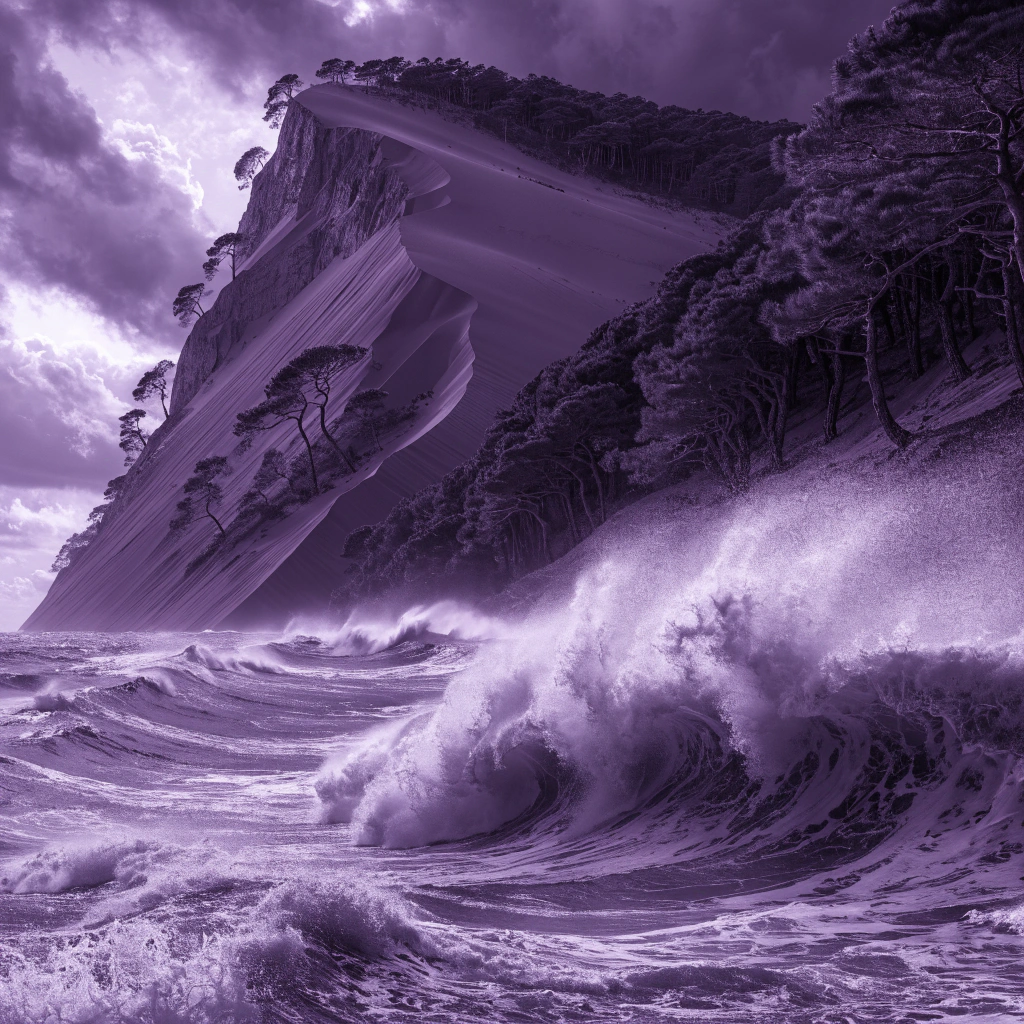
The Big Sand Mountain in France
The Dune of Pilat is in France. It is a very big mountain of sand. It is near the ocean and the city of Bordeaux. This dune is the tallest in Europe. It is more than 100 meters high.
The sand is beautiful and yellow. Many people visit the dune every year. They walk to the top and look at the sea. From the top, you can see green trees and blue water.
The dune is special because it moves. Every year, the wind moves the sand. It moves a few meters into the forest. It is a very interesting place in nature.
Grammar Spotlight
Pattern: Present Simple (to be)
"The Dune of Pilat is in France."
We use 'is' with singular subjects to state facts. It describes what something is or where it is located.
Pattern: Superlative Adjectives
"This dune is the tallest in Europe."
We add '-est' to short adjectives to show that something is 'the most' of a group. We always use 'the' before the adjective.
Test Your Understanding
10 questions · A1 Beginner · 1 free preview
Test what you learned from this article. Answer all questions to earn XP!
Where is the Dune of Pilat?
Want to finish the quiz?
9 more questions are waiting for you. Sign up free to unlock the full quiz and earn XP!
Sign Up FreeAlready have an account? Sign In
Question Breakdown
Where is the Dune of Pilat?
Your answer:
Correct answer: France
The dune is in Italy.
Your answer:
Correct answer: False
What is a 'forest'?
Your answer:
Correct answer: A large area with trees
The dune is _____ than 100 meters high.
Your answer:
Correct answer: more
The Tallest Sand Dune in Europe
The Dune of Pilat is a famous place in southwest France. It is near the city of Bordeaux and the Arcachon Bay. It is the tallest sand dune in Europe. Currently, the dune is more than 100 meters high. From the top, you can see the green forest on one side and the blue Atlantic Ocean on the other side.
This dune is very special because it is always moving. Every year, the wind moves the sand inland by about five meters. Because of this movement, the dune is slowly covering the trees in the forest. Scientists say it is like a living thing.
Many tourists visit the Dune of Pilat every year. They like to climb to the top because the view is amazing. Climbing the sand is more difficult than walking on a road, but there are stairs in the summer to help people. It is a beautiful natural wonder that everyone should see.
Grammar Spotlight
Pattern: Superlative Adjectives
"It is the tallest sand dune in Europe."
We use the + adjective + -est to compare one thing with all others in a group. For short adjectives like 'tall', we add -est.
Pattern: Comparative Adjectives
"Climbing the sand is more difficult than walking on a road."
We use 'more' + long adjective + 'than' to compare two things. 'Difficult' is a long word, so we do not add -er.
Test Your Understanding
11 questions · A2 Elementary · 1 free preview
Test what you learned from this article. Answer all questions to earn XP!
Where is the Dune of Pilat located?
Want to finish the quiz?
10 more questions are waiting for you. Sign up free to unlock the full quiz and earn XP!
Sign Up FreeAlready have an account? Sign In
Question Breakdown
Where is the Dune of Pilat located?
Your answer:
Correct answer: In southwest France
The Dune of Pilat is the tallest sand dune in Europe.
Your answer:
Correct answer: True
What does the word 'difficult' mean?
Your answer:
Correct answer: Not easy to do
Every year, the wind moves the _____ inland.
Your answer:
Correct answer: sand
What can you see from the top of the dune?
Your answer:
Correct answer: A forest and the ocean
Exploring the Dune of Pilat: Europe's Moving Mountain of Sand
The Dune of Pilat is a majestic natural phenomenon that is located on the Atlantic coast of France, near Bordeaux. It is famous because it is the tallest sand dune in Europe, reaching a height of over 100 meters. However, its size is not constant. The dune is a living landscape that has moved inland by several meters every year.
This movement is caused by strong winds which blow from the ocean. As the sand migrates, it slowly covers the trees of the nearby forest. Scientists have studied this movement for decades to understand how the environment changes. For many people, the way the sand swallows the forest is truly fascinating.
Visitors who climb to the summit are rewarded with a spectacular view. On one side, the blue waters of the Atlantic Ocean stretch to the horizon. On the other side, there is a huge green forest. During the summer months, a staircase is built to help tourists reach the top more easily. However, many adventurous people prefer to walk up the steep sand instead.
Various outdoor activities have been organized for visitors, including paragliding and nature tours. Whether you want to exercise or just enjoy the scenery, the Dune of Pilat offers an unforgettable experience. It is a place where the power of nature can be seen and felt by everyone.
Grammar Spotlight
Pattern: Relative Clauses with 'that' or 'who'
"The Dune of Pilat is a majestic natural phenomenon that is located on the Atlantic coast of France."
Relative clauses give us more information about a noun. We use 'that' for things or places and 'who' for people to connect two sentences together.
Pattern: Passive Voice (Present Simple)
"During the summer months, a staircase is built to help tourists reach the top."
The passive voice is used when the action itself is more important than the person doing it. It is formed with the verb 'to be' and the past participle.
Test Your Understanding
11 questions · B1 Intermediate · 1 free preview
Test what you learned from this article. Answer all questions to earn XP!
Where is the Dune of Pilat located?
Want to finish the quiz?
10 more questions are waiting for you. Sign up free to unlock the full quiz and earn XP!
Sign Up FreeAlready have an account? Sign In
Question Breakdown
Where is the Dune of Pilat located?
Your answer:
Correct answer: On the Atlantic coast of France
The Dune of Pilat moves several meters every year.
Your answer:
Correct answer: True
What does 'summit' mean?
Your answer:
Correct answer: The highest point
During the summer, a _____ is built to help visitors reach the top.
Your answer:
Correct answer: staircase
What can you see from the top of the dune?
Your answer:
Correct answer: The ocean and a forest
The Shifting Giant: Understanding the Dune of Pilat
Situated at the entrance of the Arcachon Bay, the Dune of Pilat stands as a testament to the dynamic forces of nature. Rising to a height of over 100 meters, it is officially recognized as the tallest sand dune in Europe. However, what makes this site truly remarkable is its status as a mobile geological phenomenon. Rather than remaining static, the dune is constantly migrating inland, a process driven by the prevailing westerly winds that sweep across the Atlantic Ocean.
This movement, while visually stunning, presents significant environmental challenges. As the sand advances, it gradually consumes the adjacent maritime pine forests, burying trees that have stood for decades. This relentless encroachment has been documented for over a century, with researchers estimating that the dune moves between one and five meters every year. Consequently, the landscape is in a state of perpetual fluctuation, meaning that the maps drawn today may become obsolete within a generation.
The dune’s height is also subject to change. Depending on weather conditions and wind patterns, the summit can fluctuate by several meters annually. Despite its shifting nature, or perhaps because of it, the Dune of Pilat attracts millions of tourists each year. Visitors are often overwhelmed by the sheer scale of the golden slopes, which offer a panoramic view of the Atlantic on one side and a vast emerald forest on the other.
Nevertheless, the popularity of the site necessitates a delicate balance between tourism and conservation. The local authorities have implemented measures to protect the fragile ecosystem from erosion caused by human activity. While the dune itself is resilient, the surrounding flora and fauna are increasingly vulnerable to the shifting sands. In conclusion, the Dune of Pilat is far more than a mere tourist attraction; it is a living entity that challenges our perception of stability. It serves as a powerful reminder that our planet is characterized by constant change, allowing us to appreciate the intricate relationship between the elements and the natural world.
Grammar Spotlight
Pattern: Passive Voice
"it is officially recognized as the tallest sand dune in Europe."
Used here to focus on the object (the dune) rather than the person recognizing it. Formed with the verb 'to be' and the past participle.
Pattern: Present Perfect Passive
"This relentless encroachment has been documented for over a century."
Used to describe an action that began in the past and continues to the present, focusing on the result. Formed with 'has/have been' + past participle.
Pattern: Non-defining Relative Clauses
"the golden slopes, which offer a panoramic view of the Atlantic."
Provides extra information about the 'slopes' without being essential to the sentence's meaning. It is separated by commas and starts with 'which'.
Test Your Understanding
11 questions · B2 Upper Intermediate · 1 free preview
Test what you learned from this article. Answer all questions to earn XP!
What is the primary cause of the dune's inland migration?
Want to finish the quiz?
10 more questions are waiting for you. Sign up free to unlock the full quiz and earn XP!
Sign Up FreeAlready have an account? Sign In
Question Breakdown
What is the primary cause of the dune's inland migration?
Your answer:
Correct answer: Prevailing westerly winds
The height of the Dune of Pilat remains constant throughout the year.
Your answer:
Correct answer: False
What does 'encroachment' mean in the context of the article?
Your answer:
Correct answer: A gradual advance beyond limits
The dune is constantly _____ inland toward the pine forests.
Your answer:
Correct answer: migrating
Why are maps of the area likely to become obsolete?
Your answer:
Correct answer: Because the landscape is in perpetual fluctuation
The Aeolian Majesty: Deciphering the Shifting Sands of the Dune of Pilat
Nestled at the mouth of the Arcachon Bay, the Dune of Pilat stands as a testament to the raw, unbridled power of geomorphological forces. To the uninitiated, it might appear as a static monument of silica; however, beneath its serene exterior lies a restless giant. Rarely in the European landscape does one encounter such a dramatic juxtaposition of maritime and terrestrial ecosystems. The dune, currently soaring to heights exceeding 100 meters, represents the pinnacle of aeolian processes in the region. The relentless migration of this sand mass—moving inland by several meters annually—poses a significant challenge to local infrastructure. It is the persistent action of the prevailing westerly winds that drives this encroachment, effectively swallowing the adjacent pine forests of the Landes. Such is the scale of this geological phenomenon that it necessitates constant recalibration of topographical maps. The encroachment is not merely a physical shift but a profound ecological transformation, where the verdant canopy of the forest is gradually replaced by a sterile, yet mesmerizing, desert-like expanse. What makes the Dune of Pilat particularly compelling for scholars is the complexity of its formation. It is not merely the wind that dictates its form, but a delicate equilibrium between tidal cycles and sediment supply. The accretion of sand is an ongoing process, influenced by the oscillation of the Atlantic tides. Through the lens of nominalisation, we can view the migration and accumulation not as simple verbs, but as complex conceptual entities that define the region's identity. Seldom has a natural landmark evoked such a blend of awe and apprehension. While tourists flock to its summit to witness the panoramic vista of the Atlantic, local authorities grapple with the dune's appetite for land. The economic benefits of tourism are undeniable, yet they are tethered to a landscape that refuses to remain stationary. It is this inherent instability that underscores the dune’s allure. Furthermore, the dune serves as a stratigraphic record of the past. Beneath the layers of sand lie ancient soils, known as paleosols, which offer a glimpse into the climatic conditions of millennia past. The preservation of these layers is a testament to the unique environmental conditions of the Aquitaine coast. Ultimately, the Dune of Pilat is a living laboratory, a place where the ephemeral nature of our world is laid bare against the backdrop of the eternal ocean.
Grammar Spotlight
Pattern: Inversion with Negative Adverbials
"Rarely in the European landscape does one encounter such a dramatic juxtaposition of maritime and terrestrial ecosystems."
When using negative or restrictive adverbs like 'rarely' or 'seldom' at the beginning of a sentence for emphasis, the auxiliary verb comes before the subject.
Pattern: Cleft Sentences
"It is the persistent action of the prevailing westerly winds that drives this encroachment."
Cleft sentences (It is + [noun] + that...) are used to focus on a specific piece of information, highlighting the cause (the winds) rather than the action.
Pattern: Nominalisation
"The relentless migration of this sand mass poses a significant challenge."
Nominalisation turns verbs (migrate) into nouns (migration) to create a more formal, academic tone and to pack more information into a single noun phrase.
Test Your Understanding
12 questions · C1 Advanced · 1 free preview
Test what you learned from this article. Answer all questions to earn XP!
What is the primary driver of the dune's movement inland?
Want to finish the quiz?
11 more questions are waiting for you. Sign up free to unlock the full quiz and earn XP!
Sign Up FreeAlready have an account? Sign In
Question Breakdown
What is the primary driver of the dune's movement inland?
Your answer:
Correct answer: Westerly winds
The height of the Dune of Pilat remains constant throughout the year.
Your answer:
Correct answer: False
Which word describes something that lasts for a very short duration?
Your answer:
Correct answer: Ephemeral
The dune is described as a _____ giant because it is constantly moving.
Your answer:
Correct answer: restless
What are 'paleosols' as mentioned in the text?
Your answer:
Correct answer: Ancient soils buried under sand
The dune is moving toward the Atlantic Ocean.
Your answer:
Correct answer: False
The Dune of Pilat: A Study in Aeolian Impermanence and Geomorphological Flux
Situated at the hiatus between the maritime expanse of the Atlantic and the verdant density of the Landes forest, the Dune of Pilat stands as a testament to the inexorable power of wind-driven transformation. To characterize this colossal sand structure as a mere landmark would be to ignore its ontological essence as a living entity. It is an ephemeral monument, one that undergoes constant reconfiguration through aeolian processes, migrating landward with a persistence that challenges human notions of topographical permanence. Should an observer stand atop its crest, they might perceive the dune as a geological palimpsest, where layers of history are perpetually overwritten by the shifting sands. This geomorphological giant, soaring over a hundred meters, is not a static relic of a bygone era but a dynamic system in a state of precarious equilibrium.
The accretion of sand, facilitated by the prevailing westerly winds, ensures that the dune’s silhouette remains in a state of flux. Were the wind to cease its rhythmic dance, the dune’s identity as a 'living' structure would vanish, yet the likelihood of such a cessation is virtually non-existent in this climatic corridor. Beneath the undulating surface of the sand lie several paleosols—ancient soil horizons that provide a chronological record of the region’s environmental history. These buried layers reveal that the dune’s current iteration is but the latest chapter in a long saga of climatic shifts and anthropogenic influence. Archaeological excavations have unearthed vestiges of human presence dating back to the Bronze Age, suggesting that our ancestors also grappled with the dune’s capricious nature. This historical depth transforms the Dune of Pilat into a vertical archive, where the passage of time is measured not in years, but in the depth of the sand.
The encroachment of the dune upon the adjacent forest is a phenomenon of significant scholarly interest. As the sand advances, it consumes the pine canopies, leaving behind a skeletal landscape that serves as a memento mori for the vegetation. This relentless march, averaging several meters per annum, underscores the futility of anthropogenic efforts to tether the dune to a fixed coordinate. While engineering interventions have been contemplated, the sheer scale of the dune’s mass renders most mitigation strategies largely ineffective. It is, perhaps, this very refusal to be domesticated that elevates the Dune of Pilat from a mere tourist attraction to a subject of profound philosophical inquiry.
Furthermore, the dune’s existence is inextricably linked to the complex hydrology of the Arcachon Bay. The interplay between tidal currents and wind patterns dictates the supply of sediment, creating a feedback loop that sustains the dune’s stature. Rarely has a natural formation so elegantly illustrated the intersection of disparate environmental forces. The topographical variance observed from year to year serves as a reminder that the Earth is not a finished product but an ongoing process. In an age of increasing environmental anxiety, the Dune of Pilat offers a unique perspective on the beauty of change, provided that we are willing to accept the transitory nature of our surroundings. Ultimately, the Dune of Pilat demands a shift in our perceptual framework. It requires us to acknowledge that stability is often an illusion and that the most enduring structures are those that are most amenable to change. Lest we forget our own insignificance in the face of such geological grandeur, the dune continues its silent, sandy odyssey, an inexorable force of nature that mocks the rigid boundaries of human cartography.
Grammar Spotlight
Pattern: Inverted Conditional with 'Should'
"Should an observer stand atop its crest, they might perceive the dune as a geological palimpsest..."
This is a formal alternative to 'If an observer should stand...'. It is used in C2 academic writing to express a hypothetical situation with a touch of elegance and detachment.
Pattern: Second Conditional with Subjunctive 'Were'
"Were the wind to cease its rhythmic dance, the dune’s identity as a 'living' structure would vanish..."
The 'Were + subject + to-infinitive' structure is a highly formal way of expressing a hypothetical future or present condition. It emphasizes the unlikely or purely theoretical nature of the condition.
Pattern: Negative Inversion
"Rarely has a natural formation so elegantly illustrated the intersection of disparate environmental forces."
When a negative or restrictive adverbial (like 'Rarely') starts a sentence, the auxiliary verb and subject are inverted. This provides rhetorical emphasis and is a hallmark of sophisticated literary style.
Test Your Understanding
12 questions · C2 Mastery · 1 free preview
Test what you learned from this article. Answer all questions to earn XP!
What does the author suggest by calling the dune an 'ontological living entity'?
Want to finish the quiz?
11 more questions are waiting for you. Sign up free to unlock the full quiz and earn XP!
Sign Up FreeAlready have an account? Sign In
Question Breakdown
What does the author suggest by calling the dune an 'ontological living entity'?
Your answer:
Correct answer: Its constant movement and change define its very existence.
The author believes that human engineering can effectively stop the dune's landward migration.
Your answer:
Correct answer: False
Which word describes the gradual intrusion of the sand into the forest?
Your answer:
Correct answer: Encroachment
The ______ power of the wind makes the dune's movement impossible to prevent.
Your answer:
Correct answer: inexorable
What is the significance of the 'paleosols' mentioned in the text?
Your answer:
Correct answer: They serve as a historical record of past climates and human presence.
The dune's height remains constant despite the wind.
Your answer:
Correct answer: False
