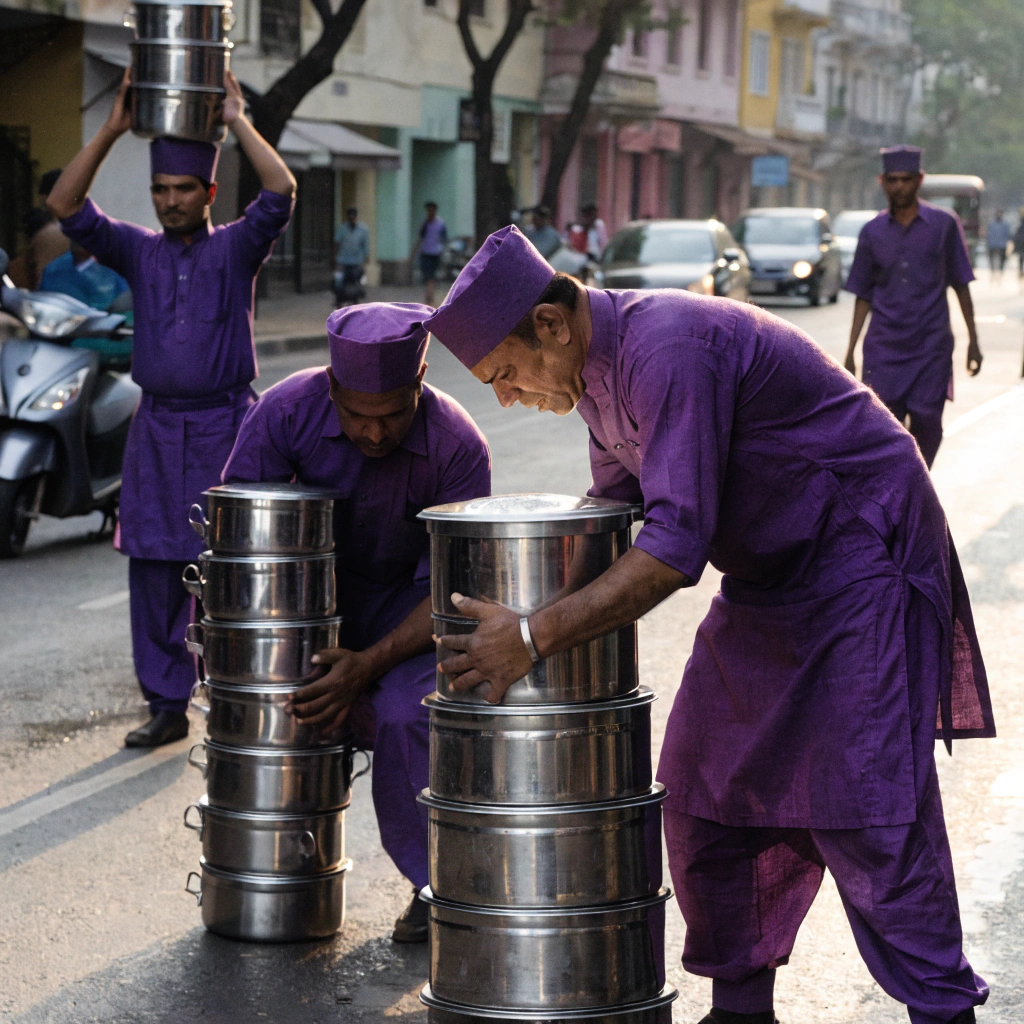
Lunch in Mumbai
Mumbai is a big city in India. Many people work in offices. They want to eat home food for lunch. The Dabbawalas help them.
Dabbawalas are delivery men. There are 5,000 Dabbawalas in Mumbai. They go to people's houses. They take lunch boxes. These boxes are called "tiffins."
The Dabbawalas travel on trains and bicycles. They take the food to the offices. They are very fast and they do not make mistakes. They do not use computers. This service is 130 years old. It is a famous part of Mumbai.
Grammar Spotlight
Pattern: Present Simple (to be)
"Mumbai is a big city in India."
We use 'is' with singular subjects like 'Mumbai'. It is used to describe facts or permanent states.
Pattern: Present Simple (regular verbs)
"They take lunch boxes."
We use the base form of the verb for plural subjects like 'they'. This shows a daily routine or habit.
Test Your Understanding
10 questions · A1 Beginner · 1 free preview
Test what you learned from this article. Answer all questions to earn XP!
Where is the city of Mumbai?
Want to finish the quiz?
9 more questions are waiting for you. Sign up free to unlock the full quiz and earn XP!
Sign Up FreeAlready have an account? Sign In
Question Breakdown
Where is the city of Mumbai?
Your answer:
Correct answer: India
The Dabbawalas use computers to work.
Your answer:
Correct answer: False
What is a 'tiffin'?
Your answer:
Correct answer: A lunch box
The Dabbawalas travel on _____ and bicycles.
Your answer:
Correct answer: trains
The Dabbawalas of Mumbai: A Century of Precision and Service
Mumbai is a very big and busy city in India. In this city, there are special people called Dabbawalas. Their story began in 1890. A Parsi banker wanted to eat home-cooked food at his office, so he hired a man to bring it. Today, more than 5,000 Dabbawalas work every day.
They carry lunch boxes, also called tiffins, from homes to offices. They use bicycles and trains because the city is very crowded. The Dabbawalas are faster than cars in the heavy traffic. They do not use computers or mobile phones to organize the deliveries. Instead, they use a simple system of colors and numbers on the boxes.
This system is very old, but it is better than many modern systems. They make very few mistakes. They work in the rain and in the heat. They are famous because they provide a great service for a long time. People in Mumbai love them because their food is always warm and on time.
Grammar Spotlight
Pattern: Past Simple
"Their story began in 1890."
We use the past simple to talk about finished actions in the past. For irregular verbs like 'begin', the form changes to 'began'.
Pattern: Comparatives
"The Dabbawalas are faster than cars in the heavy traffic."
We use comparatives to compare two things. For short adjectives, we add '-er' and use the word 'than'.
Test Your Understanding
11 questions · A2 Elementary · 1 free preview
Test what you learned from this article. Answer all questions to earn XP!
When did the Dabbawala service start?
Want to finish the quiz?
10 more questions are waiting for you. Sign up free to unlock the full quiz and earn XP!
Sign Up FreeAlready have an account? Sign In
Question Breakdown
When did the Dabbawala service start?
Your answer:
Correct answer: 1890
Dabbawalas use computers to organize their work.
Your answer:
Correct answer: False
What is a 'tiffin'?
Your answer:
Correct answer: A lunch box
They use _____ and trains to move around the city.
Your answer:
Correct answer: bicycles
Why are the Dabbawalas famous?
Your answer:
Correct answer: Because they make very few mistakes
The Dabbawalas of Mumbai: A Century of Precision and Service
In the busy streets of Mumbai, a city that never stops, there is a group of people who have achieved something incredible. These are the Dabbawalas. For more than 130 years, they have delivered home-cooked meals to thousands of office workers every day. This unique system has become a symbol of the city's culture and hard work.
The process is simple but remarkably perfect. Every morning, a Dabbawala collects a lunch box, known as a 'tiffin,' from a customer’s home. These boxes are then transported by bicycle and train to the city center. What makes this service special is that no computers or modern technology are used. Instead, a system of colors, letters, and symbols is painted on the boxes to show where they need to go. This traditional method has been praised by experts around the world for its efficiency.
The history of the Dabbawalas began in 1890 during the British Raj. It started when a Parsi banker, who wanted to eat a fresh meal from home at his office, hired a young man to deliver his lunch. Since then, the small service has grown into a huge network of over 5,000 workers. These men, who are often from the same community, work together like a big family.
Although Mumbai is a modern metropolis, the Dabbawalas still use the same reliable techniques. They have become famous for their precision. It is said that they only make one mistake in every six million deliveries. This level of accuracy is why they have been studied by famous universities like Harvard. Even though the world is changing quickly, the Dabbawalas continue to provide a vital service. They prove that traditional ways, which are based on trust and hard work, can still be the most effective in our modern lives.
Grammar Spotlight
Pattern: Present Perfect
"For more than 130 years, they have delivered home-cooked meals to thousands of office workers every day."
The present perfect (have/has + past participle) is used to talk about actions that started in the past and continue to the present. It emphasizes the duration of the Dabbawalas' service.
Pattern: Passive Voice
"This traditional method has been praised by experts around the world for its efficiency."
The passive voice is used when the action or the receiver of the action is more important than the person doing it. It is formed using 'be' + past participle.
Test Your Understanding
11 questions · B1 Intermediate · 1 free preview
Test what you learned from this article. Answer all questions to earn XP!
How long have the Dabbawalas been operating in Mumbai?
Want to finish the quiz?
10 more questions are waiting for you. Sign up free to unlock the full quiz and earn XP!
Sign Up FreeAlready have an account? Sign In
Question Breakdown
How long have the Dabbawalas been operating in Mumbai?
Your answer:
Correct answer: Over 130 years
The Dabbawalas use modern computer software to track the lunch boxes.
Your answer:
Correct answer: False
What does 'efficiency' mean?
Your answer:
Correct answer: Working well without wasting time or energy
In India, a lunch box is commonly known as a _____.
Your answer:
Correct answer: tiffin
Who started the first delivery service in 1890?
Your answer:
Correct answer: A Parsi banker
The Dabbawalas of Mumbai: A Century of Precision and Service
In the heart of Mumbai, a city known for its relentless pace and dense population, exists a logistical marvel that has fascinated business schools worldwide for decades. Known as Dabbawalas, these five thousand individuals coordinate the delivery of over 200,000 lunchboxes, or 'tiffins,' every single day. Despite the digital revolution transforming global logistics, this system relies entirely on manual labor and a sophisticated, non-technological color-coding method.
The tradition originated in 1890 during the British Raj. It is said that a Parsi banker, wishing for a home-cooked meal while at work, hired the first Dabbawala to bring a tiffin from his home. What began as a solitary service soon evolved into a vast, decentralized network of deliverymen. This network ensures that workers across the metropolis receive fresh, hot meals prepared by their families, maintaining a vital cultural link between the domestic and professional spheres in a rapidly modernizing society.
What makes the Dabbawalas particularly noteworthy is their extraordinary precision. Statistical studies have shown that they make fewer than one mistake in every six million deliveries, earning them a 'Six Sigma' rating—a level of efficiency usually reserved for high-tech manufacturing firms and elite corporations. This level of accuracy is achieved without any digital documentation, GPS tracking, or mobile applications. Instead, a complex system of alphanumeric characters and colors is painted on the lids of the tiffins, indicating the source, the destination station, and the final delivery point.
The journey of a tiffin is a collaborative effort involving multiple handovers throughout the morning. Tiffins are collected from suburban homes, transported via Mumbai’s extensive railway network, and finally delivered to offices by bicycle or on foot. This process is repeated in reverse every afternoon to return the empty containers. The Dabbawalas themselves are part of a semi-literate workforce, yet their organizational structure is a model of horizontal management. Each member is a stakeholder, sharing in the profits and responsibilities of the association, which fosters a high degree of loyalty.
In an era dominated by automated delivery apps and algorithmic logistics, the Dabbawalas represent a sustainable and reliable alternative. Their success is rooted in a deep sense of commitment and a shared cultural value of providing food. As Mumbai continues to expand, the Dabbawalas remain an enduring symbol of the city’s resilience and its unique ability to blend ancient tradition with the demands of a modern global economy.
Grammar Spotlight
Pattern: Present Perfect Simple
"In the heart of Mumbai... exists a logistical marvel that has fascinated business schools worldwide for decades."
This tense is used here to describe an action or state that started in the past and continues to have relevance or continue in the present. It is formed using 'has/have' + the past participle.
Pattern: Present Participle Clause
"It is said that a Parsi banker, wishing for a home-cooked meal while at work, hired the first Dabbawala."
This clause acts like an adjective to provide more information about the subject (the banker). It is used here to explain the reason or background for the action in the main clause.
Pattern: Passive Voice
"This level of accuracy is achieved without any digital documentation."
The passive voice is used when the focus is on the action or the result (the accuracy) rather than who is performing the action. It is formed with the verb 'to be' + past participle.
Test Your Understanding
11 questions · B2 Upper Intermediate · 1 free preview
Test what you learned from this article. Answer all questions to earn XP!
What triggered the beginning of the Dabbawala service in 1890?
Want to finish the quiz?
10 more questions are waiting for you. Sign up free to unlock the full quiz and earn XP!
Sign Up FreeAlready have an account? Sign In
Question Breakdown
What triggered the beginning of the Dabbawala service in 1890?
Your answer:
Correct answer: A Parsi banker's desire for a home-cooked lunch
The Dabbawalas use GPS tracking and mobile apps to ensure their high delivery accuracy.
Your answer:
Correct answer: False
What does 'precision' mean in the context of the article?
Your answer:
Correct answer: A high level of accuracy
Each member of the Dabbawala organization is a _____, meaning they share in the profits and responsibilities.
Your answer:
Correct answer: stakeholder
What is the 'Six Sigma' rating mentioned in the text used to describe?
Your answer:
Correct answer: An extremely high level of operational efficiency
Logistics of the Soul: The Paradoxical Precision of Mumbai’s Dabbawalas
In the sprawling, high-octane metropolis of Mumbai, a city frequently defined by its frantic pace and topographical constraints, a 130-year-old logistical marvel operates with a precision that continues to baffle modern supply-chain theorists. These are the Dabbawalas—a community of approximately 5,000 deliverymen who facilitate the daily transit of home-cooked meals, known as tiffins, from suburban kitchens to downtown offices and back again. Seldom does one encounter such a seamless integration of tradition and efficiency in a landscape increasingly dominated by digital disruption.
The historical trajectory of this system is as fascinating as its current operation. It was a Parsi banker who first conceived of this idiosyncratic delivery service in 1890, driven by a simple yet profound yearning for the comforts of a home-cooked lunch while at work. What began as a singular request has since evolved into a robust social and economic network. The intricacy of their coding system—a sophisticated series of colors, numbers, and symbols—allows a largely semi-literate workforce to achieve a near-perfect success rate. Erroneous deliveries are treated as statistical anomalies; indeed, various international studies have suggested an error rate of just one in six million, earning the organization a prestigious Six Sigma certification.
The manifestation of this collective discipline is particularly striking given the absence of modern technology. Unlike contemporary tech giants that rely on complex algorithms and GPS tracking, the Dabbawalas eschew digital intervention, relying instead on bicycles, local trains, and sheer physical stamina. This reliance on human capital over automated systems offers a compelling paradigm for sustainable and resilient logistics. The resilience of the Dabbawalas is not merely a matter of mechanical efficiency; it is deeply rooted in 'Varkari' values, a religious tradition that emphasizes service to others as a form of devotion.
However, the ubiquity of their service is currently facing unprecedented socio-economic challenges. The rise of digital food delivery platforms, coupled with shifting culinary habits among the younger generation, has begun to threaten the long-term viability of the traditional tiffin system. Furthermore, the expansion of the Mumbai Metro and changing urban infrastructure pose physical hurdles to their established routes. Yet, despite these pressures, the Dabbawalas remain undeterred, maintaining their role as the city’s most reliable lifeline.
In an era where technology is often touted as the universal panacea for all logistical hurdles, the Dabbawalas serve as a poignant reminder that human coordination, meticulous planning, and a shared sense of purpose are the true foundations of enduring service. Their story is not just one of delivery, but a testament to the power of community-driven solutions in a rapidly globalizing world. To analyze the Dabbawalas is to understand that efficiency does not always require silicon; sometimes, it only requires a bicycle and an unwavering commitment to one's craft.
Grammar Spotlight
Pattern: Negative Inversion
"Seldom does one encounter such a seamless integration of tradition and efficiency."
Inversion is used after negative or restrictive adverbs (like 'seldom') to create emphasis. The auxiliary verb 'does' moves before the subject 'one'.
Pattern: Cleft Sentences
"It was a Parsi banker who first conceived of this idiosyncratic delivery service."
Cleft sentences focus on a specific part of the sentence (the Parsi banker) using the 'It + be + [subject] + relative clause' structure.
Pattern: Nominalisation
"The manifestation of this collective discipline is particularly striking."
Nominalisation turns verbs or adjectives into nouns (manifest -> manifestation) to create a more formal, academic tone typical of C1 writing.
Test Your Understanding
12 questions · C1 Advanced · 1 free preview
Test what you learned from this article. Answer all questions to earn XP!
What is the primary factor attributed to the Dabbawalas' near-perfect delivery record?
Want to finish the quiz?
11 more questions are waiting for you. Sign up free to unlock the full quiz and earn XP!
Sign Up FreeAlready have an account? Sign In
Question Breakdown
What is the primary factor attributed to the Dabbawalas' near-perfect delivery record?
Your answer:
Correct answer: A sophisticated manual coding system and human coordination
The Dabbawala service was originally established by the British colonial government.
Your answer:
Correct answer: False
Which word describes the Dabbawalas' refusal to use modern digital tools?
Your answer:
Correct answer: Eschew
Because the workforce is largely semi-literate, they rely on a complex _____ of colors and symbols.
Your answer:
Correct answer: system
How does the article characterize the impact of modern food delivery apps on the Dabbawalas?
Your answer:
Correct answer: They pose a significant threat to the system's long-term viability.
The error rate of the Dabbawalas is statistically estimated at one in six million.
Your answer:
Correct answer: True
The Alphanumeric Alchemy of Mumbai’s Dabbawalas: A Socio-Logistical Paradigm
In the sprawling, cacophonous palimpsest that is Mumbai, where temporal constraints and spatial density converge to create an environment of perpetual flux, there exists a logistical phenomenon that defies the conventional logic of modern supply chain management. This is the domain of the Dabbawalas—a guild of approximately five thousand couriers whose operational efficiency has garnered international acclaim, including a purported Six Sigma certification from Forbes. Should one venture into the labyrinthine railway stations during the meridian rush, one would witness a choreography of movement so precise that it borders on the transcendental. This system, established in 1890 during the British Raj, was ostensibly born from a singular Parsi banker’s desire for home-cooked sustenance, yet it has evolved into a cornerstone of the city’s social infrastructure.
Central to the Dabbawalas' success is an idiosyncratic, yet profoundly effective, semiotic system. Bereft of digital interfaces or algorithmic optimization, the couriers rely on a rudimentary yet sophisticated arrangement of colors, letters, and symbols painted onto the lids of the tiffins (lunchboxes). This alphanumeric vernacular allows for the seamless traversal of thousands of canisters through a multi-tiered relay system involving trains, bicycles, and handcarts. It is a testament to the fact that efficiency need not be synonymous with technological complexity; rather, it can be the byproduct of a collective cognitive consensus and an unwavering commitment to a shared objective. The sheer scale of the operation—delivering roughly 200,000 lunches daily—necessitates a level of synchronization that most corporate entities struggle to achieve even with the aid of enterprise resource planning software.
Furthermore, the sociological underpinnings of this enterprise merit scholarly scrutiny. The Dabbawalas are not merely employees but shareholders in a decentralized cooperative, bound by a shared ethos known as 'Anna-daan'—the service of providing food as a sacred duty. This spiritual dimension imbues their labor with a sense of purpose that transcends mere economic remuneration. Were it not for this profound sense of duty, the system might have succumbed to the myriad pressures of urbanization and the encroachment of gig-economy food delivery platforms. Instead, it persists as a resilient bastion of communal trust in an increasingly atomized society. This cultural cohesion acts as a buffer against the volatility of the modern market, ensuring that the human element remains at the forefront of their logistical triumphs.
Academic observers, ranging from Harvard Business School researchers to the British monarchy, have sought to deconstruct the Dabbawalas' methodology, often marveling at the negligible error rate—estimated at one in six million deliveries. This precision is achieved through a decentralized management structure where each unit operates autonomously yet remains intrinsically linked to the broader network. The Dabbawalas’ refusal to incorporate high-tech solutions is not a rejection of modernity per se, but rather a pragmatic recognition that their current model is perfectly calibrated to the specific geographical and infrastructural constraints of Mumbai. In an era where 'disruption' is the buzzword of the day, the Dabbawalas offer a counter-narrative of stability and incremental refinement.
In conclusion, the Dabbawalas represent a compelling synthesis of tradition and efficiency. Their longevity suggests that human-centric systems, predicated on trust, community, and meticulous manual processes, can hold their own against the relentless march of automation. As cities worldwide grapple with the complexities of urban logistics and the social costs of technological displacement, the Dabbawalas offer a poignant reminder that the most sophisticated solutions are often those that remain rooted in the fundamental human need for connection and nourishment. Their legacy is not merely one of delivery, but of the enduring power of human synergy in an age of mechanical artifice.
Grammar Spotlight
Pattern: Subjunctive Mood for Hypothetical Situations
"Should one venture into the labyrinthine railway stations during the meridian rush, one would witness a choreography of movement..."
This uses 'Should' to express a hypothetical condition in a formal, C2-level literary style. It functions similarly to 'If one were to venture', but provides a more sophisticated tone.
Pattern: Mixed Conditional with Inversion
"Were it not for this profound sense of duty, the system might have succumbed to the myriad pressures of urbanization..."
This structure uses an inverted second-conditional 'if' clause ('Were it not for' instead of 'If it were not for') followed by a third-conditional result ('might have succumbed') to link a present state to a hypothetical past outcome.
Pattern: Academic Hedging
"...efficiency has garnered international acclaim, including a purported Six Sigma certification from Forbes."
The word 'purported' is used here to distance the writer from the claim, signaling that the certification is claimed by others but not necessarily verified by the author. This is a hallmark of analytical and academic prose.
Test Your Understanding
12 questions · C2 Mastery · 1 free preview
Test what you learned from this article. Answer all questions to earn XP!
What is the primary reason the author mentions the 'Six Sigma' certification?
Want to finish the quiz?
11 more questions are waiting for you. Sign up free to unlock the full quiz and earn XP!
Sign Up FreeAlready have an account? Sign In
Question Breakdown
What is the primary reason the author mentions the 'Six Sigma' certification?
Your answer:
Correct answer: To highlight the international recognition of their efficiency.
The Dabbawalas' system was originally created to serve the entire city of Mumbai in 1890.
Your answer:
Correct answer: False
Which word is synonymous with 'apparently but perhaps not really' in the text?
Your answer:
Correct answer: Ostensibly
The Dabbawalas are not just employees; they are _____ in a decentralized cooperative.
Your answer:
Correct answer: shareholders
What does the 'Anna-daan' philosophy imply about the Dabbawalas' work?
Your answer:
Correct answer: It is viewed as a sacred duty to provide food.
The author suggests that technological complexity is a requirement for high efficiency.
Your answer:
Correct answer: False
