孟买的达巴瓦拉:送饭人
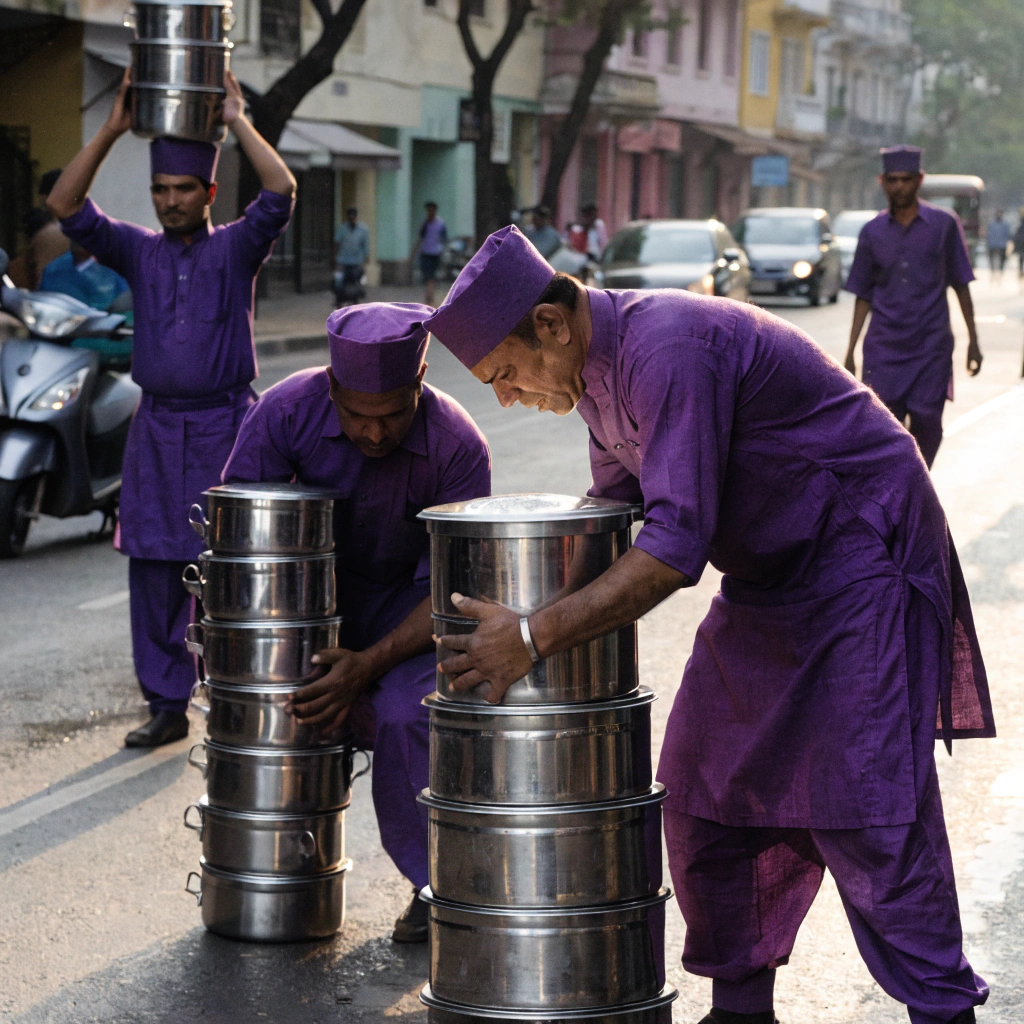
孟买是一个大城市。这里有很多人工作。有一个特别的服务叫“达巴瓦拉”。达巴瓦拉是送饭的人。他们把家里的饭送到办公室。这个服务有很长的历史,已经有130年了。它在1890年开始。有五千多个人做这个工作。他们每天送很多饭。他们不用电脑,但是工作非常准确。他们的服务帮助很多人吃到家里的饭。这是孟买一个很棒的故事。
语法聚焦
句型: 是… (shì...)
"孟买是一个大城市。"
“是”用来连接两个名词或代词,表示“A是B”。它告诉我们一个事物是什么。
句型: 有… (yǒu...)
"这里有很多人工作。"
“有”表示存在或拥有。它告诉我们某个地方有什么东西,或者谁有什么东西。
The Dabbawalas of Mumbai: A Century of Precision and Service
Mumbai is a very big and busy city in India. In this city, there are special people called Dabbawalas. Their story began in 1890. A Parsi banker wanted to eat home-cooked food at his office, so he hired a man to bring it. Today, more than 5,000 Dabbawalas work every day.
They carry lunch boxes, also called tiffins, from homes to offices. They use bicycles and trains because the city is very crowded. The Dabbawalas are faster than cars in the heavy traffic. They do not use computers or mobile phones to organize the deliveries. Instead, they use a simple system of colors and numbers on the boxes.
This system is very old, but it is better than many modern systems. They make very few mistakes. They work in the rain and in the heat. They are famous because they provide a great service for a long time. People in Mumbai love them because their food is always warm and on time.
语法聚焦
句型: Past Simple
"Their story began in 1890."
We use the past simple to talk about finished actions in the past. For irregular verbs like 'begin', the form changes to 'began'.
句型: Comparatives
"The Dabbawalas are faster than cars in the heavy traffic."
We use comparatives to compare two things. For short adjectives, we add '-er' and use the word 'than'.
测试你的理解
11 个问题 · A2 基础 · 1 次免费预览
测试你从这篇文章中学到的知识。回答所有问题即可获得经验值!
When did the Dabbawala service start?
题目详情
When did the Dabbawala service start?
你的回答:
正确答案: 1890
Dabbawalas use computers to organize their work.
你的回答:
正确答案: 错误
What is a 'tiffin'?
你的回答:
正确答案: A lunch box
They use _____ and trains to move around the city.
你的回答:
正确答案: bicycles
Why are the Dabbawalas famous?
你的回答:
正确答案: Because they make very few mistakes
The Dabbawalas of Mumbai: A Century of Precision and Service
In the busy streets of Mumbai, a city that never stops, there is a group of people who have achieved something incredible. These are the Dabbawalas. For more than 130 years, they have delivered home-cooked meals to thousands of office workers every day. This unique system has become a symbol of the city's culture and hard work.
The process is simple but remarkably perfect. Every morning, a Dabbawala collects a lunch box, known as a 'tiffin,' from a customer’s home. These boxes are then transported by bicycle and train to the city center. What makes this service special is that no computers or modern technology are used. Instead, a system of colors, letters, and symbols is painted on the boxes to show where they need to go. This traditional method has been praised by experts around the world for its efficiency.
The history of the Dabbawalas began in 1890 during the British Raj. It started when a Parsi banker, who wanted to eat a fresh meal from home at his office, hired a young man to deliver his lunch. Since then, the small service has grown into a huge network of over 5,000 workers. These men, who are often from the same community, work together like a big family.
Although Mumbai is a modern metropolis, the Dabbawalas still use the same reliable techniques. They have become famous for their precision. It is said that they only make one mistake in every six million deliveries. This level of accuracy is why they have been studied by famous universities like Harvard. Even though the world is changing quickly, the Dabbawalas continue to provide a vital service. They prove that traditional ways, which are based on trust and hard work, can still be the most effective in our modern lives.
语法聚焦
句型: Present Perfect
"For more than 130 years, they have delivered home-cooked meals to thousands of office workers every day."
The present perfect (have/has + past participle) is used to talk about actions that started in the past and continue to the present. It emphasizes the duration of the Dabbawalas' service.
句型: Passive Voice
"This traditional method has been praised by experts around the world for its efficiency."
The passive voice is used when the action or the receiver of the action is more important than the person doing it. It is formed using 'be' + past participle.
测试你的理解
11 个问题 · B1 中级 · 1 次免费预览
测试你从这篇文章中学到的知识。回答所有问题即可获得经验值!
How long have the Dabbawalas been operating in Mumbai?
题目详情
How long have the Dabbawalas been operating in Mumbai?
你的回答:
正确答案: Over 130 years
The Dabbawalas use modern computer software to track the lunch boxes.
你的回答:
正确答案: 错误
What does 'efficiency' mean?
你的回答:
正确答案: Working well without wasting time or energy
In India, a lunch box is commonly known as a _____.
你的回答:
正确答案: tiffin
Who started the first delivery service in 1890?
你的回答:
正确答案: A Parsi banker
孟买达巴瓦拉:混乱都市中的精准奇迹
在印度这座繁华而混乱的特大城市孟买,一个延续了130年之久的社会与物流奇迹正在悄然运作。令人惊叹的是,这套系统在没有任何电脑辅助的情况下,却能展现出瑞士钟表般的精准度。我们所说的,正是孟买著名的“达巴瓦拉”(Dabbawala)——一个由超过五千名送餐员组成的社群。他们的任务是每天将新鲜烹制的家常午餐,从顾客家中准时送达他们的办公室,并在午餐结束后将空饭盒送回。
这项独特的社会实践始于1890年的英属印度时期。据说,当时一位帕西银行家渴望在办公室享用家常饭菜,因此雇佣了一名送餐员。这项服务最初只是单一的配送,然而,随着需求的增长,它逐渐发展成一个庞大而复杂的网络。如今,达巴瓦拉每天要处理约20万份午餐的配送,其错误率据称低至每六百万次配送仅出现一次,这简直是近乎完美的表现。
达巴瓦拉的运作模式基于一套精妙的编码系统。每个午餐盒上都会被标记上颜色、数字和字母的组合,这些代码详细指示了取餐地点、送餐目的地以及负责各个环节的达巴瓦拉。他们通常步行、骑自行车或乘坐火车,穿越孟买拥挤的街道和繁忙的交通枢纽。整个过程分为几个阶段:上午,达巴瓦拉从顾客家中收集饭盒;中午,这些饭盒被集中并重新分发,运往各自的目的地;下午,空饭盒则被收回并送返家中。
达巴瓦拉社群的成员大多来自马哈拉施特拉邦的农村地区,他们通过这种方式在城市中谋生。他们的成功不仅在于其惊人的效率和可靠性,更在于其深厚的社会文化根基。这份工作不仅为他们提供了稳定的收入,也维系了孟买市民对家常饭菜的传统需求。在快节奏的都市生活中,一顿热腾腾的家常饭菜,不仅仅是食物,更承载着家的味道和温情。
尽管现代科技日新月异,达巴瓦拉的传统运作模式却依然坚韧不拔。许多管理学专家和物流公司都曾研究过他们的体系,试图从中汲取经验。这不仅证明了其模式的卓越性,也彰显了人类智慧在面对复杂挑战时所能爆发出的巨大潜力。达巴瓦拉的故事,不仅仅是关于送餐,更是关于信任、社区和在看似混乱中创造秩序的独特范例。
语法聚焦
句型: 尽管...却/但是...
"尽管现代科技日新月异,达巴瓦拉的传统运作模式却依然坚韧不拔。"
这个句式用来表达转折关系,表示虽然承认前一个事实或情况,但后面仍有出乎意料或相反的结果。“尽管”引导让步状语从句,“却”或“但是”引导主句,强调转折。
句型: 不仅...更/而且...
"他们的成功不仅在于其惊人的效率和可靠性,更在于其深厚的社会文化根基。"
这个句式表示递进关系,说明两件事物或两个方面都存在,并且后者比前者更进一步或更重要。“不仅”引出第一个方面,“更”或“而且”引出第二个更深层次的方面。
句型: 之所以...是因为...
"达巴瓦拉之所以能够实现近乎完美的配送,是因为他们基于一套精妙的编码系统运作。"
这个句式用来解释某个现象或结果的原因。“之所以”放在句首,引出被解释的现象或结果,“是因为”则引出造成该现象或结果的具体原因。
测试你的理解
11 个问题 · B2 中高级 · 1 次免费预览
测试你从这篇文章中学到的知识。回答所有问题即可获得经验值!
题目详情
达巴瓦拉的送餐系统有什么独特之处?
你的回答:
正确答案: C. 在没有电脑辅助下实现精准运作
达巴瓦拉的服务始于现代印度独立后。
你的回答:
正确答案: 错误
在文章中,“精准”一词最接近哪个意思?
你的回答:
正确答案: B. 非常准确,没有偏差
达巴瓦拉每天要处理约_____万份午餐的配送。
你的回答:
正确答案: 二十
达巴瓦拉的成功主要归因于什么?
你的回答:
正确答案: C. 惊人的效率、可靠性及其深厚的社会文化根基
Logistics of the Soul: The Paradoxical Precision of Mumbai’s Dabbawalas
In the sprawling, high-octane metropolis of Mumbai, a city frequently defined by its frantic pace and topographical constraints, a 130-year-old logistical marvel operates with a precision that continues to baffle modern supply-chain theorists. These are the Dabbawalas—a community of approximately 5,000 deliverymen who facilitate the daily transit of home-cooked meals, known as tiffins, from suburban kitchens to downtown offices and back again. Seldom does one encounter such a seamless integration of tradition and efficiency in a landscape increasingly dominated by digital disruption.
The historical trajectory of this system is as fascinating as its current operation. It was a Parsi banker who first conceived of this idiosyncratic delivery service in 1890, driven by a simple yet profound yearning for the comforts of a home-cooked lunch while at work. What began as a singular request has since evolved into a robust social and economic network. The intricacy of their coding system—a sophisticated series of colors, numbers, and symbols—allows a largely semi-literate workforce to achieve a near-perfect success rate. Erroneous deliveries are treated as statistical anomalies; indeed, various international studies have suggested an error rate of just one in six million, earning the organization a prestigious Six Sigma certification.
The manifestation of this collective discipline is particularly striking given the absence of modern technology. Unlike contemporary tech giants that rely on complex algorithms and GPS tracking, the Dabbawalas eschew digital intervention, relying instead on bicycles, local trains, and sheer physical stamina. This reliance on human capital over automated systems offers a compelling paradigm for sustainable and resilient logistics. The resilience of the Dabbawalas is not merely a matter of mechanical efficiency; it is deeply rooted in 'Varkari' values, a religious tradition that emphasizes service to others as a form of devotion.
However, the ubiquity of their service is currently facing unprecedented socio-economic challenges. The rise of digital food delivery platforms, coupled with shifting culinary habits among the younger generation, has begun to threaten the long-term viability of the traditional tiffin system. Furthermore, the expansion of the Mumbai Metro and changing urban infrastructure pose physical hurdles to their established routes. Yet, despite these pressures, the Dabbawalas remain undeterred, maintaining their role as the city’s most reliable lifeline.
In an era where technology is often touted as the universal panacea for all logistical hurdles, the Dabbawalas serve as a poignant reminder that human coordination, meticulous planning, and a shared sense of purpose are the true foundations of enduring service. Their story is not just one of delivery, but a testament to the power of community-driven solutions in a rapidly globalizing world. To analyze the Dabbawalas is to understand that efficiency does not always require silicon; sometimes, it only requires a bicycle and an unwavering commitment to one's craft.
语法聚焦
句型: Negative Inversion
"Seldom does one encounter such a seamless integration of tradition and efficiency."
Inversion is used after negative or restrictive adverbs (like 'seldom') to create emphasis. The auxiliary verb 'does' moves before the subject 'one'.
句型: Cleft Sentences
"It was a Parsi banker who first conceived of this idiosyncratic delivery service."
Cleft sentences focus on a specific part of the sentence (the Parsi banker) using the 'It + be + [subject] + relative clause' structure.
句型: Nominalisation
"The manifestation of this collective discipline is particularly striking."
Nominalisation turns verbs or adjectives into nouns (manifest -> manifestation) to create a more formal, academic tone typical of C1 writing.
测试你的理解
12 个问题 · C1 高级 · 1 次免费预览
测试你从这篇文章中学到的知识。回答所有问题即可获得经验值!
What is the primary factor attributed to the Dabbawalas' near-perfect delivery record?
题目详情
What is the primary factor attributed to the Dabbawalas' near-perfect delivery record?
你的回答:
正确答案: A sophisticated manual coding system and human coordination
The Dabbawala service was originally established by the British colonial government.
你的回答:
正确答案: 错误
Which word describes the Dabbawalas' refusal to use modern digital tools?
你的回答:
正确答案: Eschew
Because the workforce is largely semi-literate, they rely on a complex _____ of colors and symbols.
你的回答:
正确答案: system
How does the article characterize the impact of modern food delivery apps on the Dabbawalas?
你的回答:
正确答案: They pose a significant threat to the system's long-term viability.
The error rate of the Dabbawalas is statistically estimated at one in six million.
你的回答:
正确答案: 正确
The Alphanumeric Alchemy of Mumbai’s Dabbawalas: A Socio-Logistical Paradigm
In the sprawling, cacophonous palimpsest that is Mumbai, where temporal constraints and spatial density converge to create an environment of perpetual flux, there exists a logistical phenomenon that defies the conventional logic of modern supply chain management. This is the domain of the Dabbawalas—a guild of approximately five thousand couriers whose operational efficiency has garnered international acclaim, including a purported Six Sigma certification from Forbes. Should one venture into the labyrinthine railway stations during the meridian rush, one would witness a choreography of movement so precise that it borders on the transcendental. This system, established in 1890 during the British Raj, was ostensibly born from a singular Parsi banker’s desire for home-cooked sustenance, yet it has evolved into a cornerstone of the city’s social infrastructure.
Central to the Dabbawalas' success is an idiosyncratic, yet profoundly effective, semiotic system. Bereft of digital interfaces or algorithmic optimization, the couriers rely on a rudimentary yet sophisticated arrangement of colors, letters, and symbols painted onto the lids of the tiffins (lunchboxes). This alphanumeric vernacular allows for the seamless traversal of thousands of canisters through a multi-tiered relay system involving trains, bicycles, and handcarts. It is a testament to the fact that efficiency need not be synonymous with technological complexity; rather, it can be the byproduct of a collective cognitive consensus and an unwavering commitment to a shared objective. The sheer scale of the operation—delivering roughly 200,000 lunches daily—necessitates a level of synchronization that most corporate entities struggle to achieve even with the aid of enterprise resource planning software.
Furthermore, the sociological underpinnings of this enterprise merit scholarly scrutiny. The Dabbawalas are not merely employees but shareholders in a decentralized cooperative, bound by a shared ethos known as 'Anna-daan'—the service of providing food as a sacred duty. This spiritual dimension imbues their labor with a sense of purpose that transcends mere economic remuneration. Were it not for this profound sense of duty, the system might have succumbed to the myriad pressures of urbanization and the encroachment of gig-economy food delivery platforms. Instead, it persists as a resilient bastion of communal trust in an increasingly atomized society. This cultural cohesion acts as a buffer against the volatility of the modern market, ensuring that the human element remains at the forefront of their logistical triumphs.
Academic observers, ranging from Harvard Business School researchers to the British monarchy, have sought to deconstruct the Dabbawalas' methodology, often marveling at the negligible error rate—estimated at one in six million deliveries. This precision is achieved through a decentralized management structure where each unit operates autonomously yet remains intrinsically linked to the broader network. The Dabbawalas’ refusal to incorporate high-tech solutions is not a rejection of modernity per se, but rather a pragmatic recognition that their current model is perfectly calibrated to the specific geographical and infrastructural constraints of Mumbai. In an era where 'disruption' is the buzzword of the day, the Dabbawalas offer a counter-narrative of stability and incremental refinement.
In conclusion, the Dabbawalas represent a compelling synthesis of tradition and efficiency. Their longevity suggests that human-centric systems, predicated on trust, community, and meticulous manual processes, can hold their own against the relentless march of automation. As cities worldwide grapple with the complexities of urban logistics and the social costs of technological displacement, the Dabbawalas offer a poignant reminder that the most sophisticated solutions are often those that remain rooted in the fundamental human need for connection and nourishment. Their legacy is not merely one of delivery, but of the enduring power of human synergy in an age of mechanical artifice.
语法聚焦
句型: Subjunctive Mood for Hypothetical Situations
"Should one venture into the labyrinthine railway stations during the meridian rush, one would witness a choreography of movement..."
This uses 'Should' to express a hypothetical condition in a formal, C2-level literary style. It functions similarly to 'If one were to venture', but provides a more sophisticated tone.
句型: Mixed Conditional with Inversion
"Were it not for this profound sense of duty, the system might have succumbed to the myriad pressures of urbanization..."
This structure uses an inverted second-conditional 'if' clause ('Were it not for' instead of 'If it were not for') followed by a third-conditional result ('might have succumbed') to link a present state to a hypothetical past outcome.
句型: Academic Hedging
"...efficiency has garnered international acclaim, including a purported Six Sigma certification from Forbes."
The word 'purported' is used here to distance the writer from the claim, signaling that the certification is claimed by others but not necessarily verified by the author. This is a hallmark of analytical and academic prose.
测试你的理解
12 个问题 · C2 精通 · 1 次免费预览
测试你从这篇文章中学到的知识。回答所有问题即可获得经验值!
What is the primary reason the author mentions the 'Six Sigma' certification?
题目详情
What is the primary reason the author mentions the 'Six Sigma' certification?
你的回答:
正确答案: To highlight the international recognition of their efficiency.
The Dabbawalas' system was originally created to serve the entire city of Mumbai in 1890.
你的回答:
正确答案: 错误
Which word is synonymous with 'apparently but perhaps not really' in the text?
你的回答:
正确答案: Ostensibly
The Dabbawalas are not just employees; they are _____ in a decentralized cooperative.
你的回答:
正确答案: shareholders
What does the 'Anna-daan' philosophy imply about the Dabbawalas' work?
你的回答:
正确答案: It is viewed as a sacred duty to provide food.
The author suggests that technological complexity is a requirement for high efficiency.
你的回答:
正确答案: 错误

