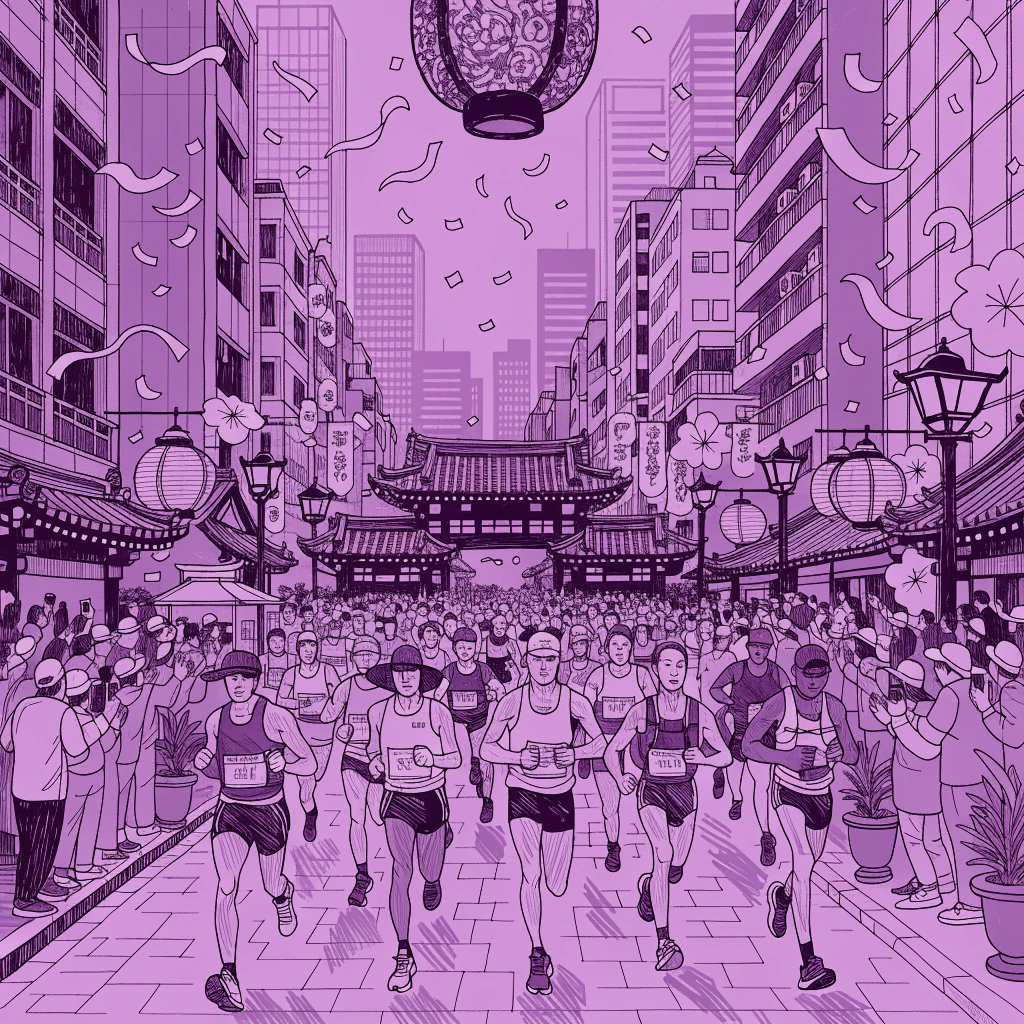
The Big Race in Tokyo
Tokyo is a big city in Japan. Every year, many people run a long race there. This race is the Tokyo Marathon. It is very famous. More than 38,000 people run in the race. Some people are professional athletes. Other people are just happy to run. They wear colorful clothes. People from many countries come to Japan for this day. They run past beautiful buildings. Families watch the race and shout. It is a very happy day for the city.
Grammar Spotlight
Pattern: Present Simple with 'Be'
"Tokyo is a big city in Japan."
We use 'is' for singular subjects like Tokyo. It helps us describe facts or states of being.
Pattern: Present Simple (Plural Subject)
"Many people run a long race there."
With plural subjects like 'people', we use the base form of the verb without adding 's'.
Test Your Understanding
10 questions · A1 Beginner · 1 free preview
Test what you learned from this article. Answer all questions to earn XP!
Where is the marathon?
Want to finish the quiz?
9 more questions are waiting for you. Sign up free to unlock the full quiz and earn XP!
Sign Up FreeAlready have an account? Sign In
Question Breakdown
Where is the marathon?
Your answer:
Correct answer: Tokyo
The race is in China.
Your answer:
Correct answer: False
What does 'city' mean?
Your answer:
Correct answer: A large and important town
They wear _____ clothes.
Your answer:
Correct answer: colorful
The Exciting Tokyo Marathon
The Tokyo Marathon is a very popular sporting event in Japan. It started in 2007, so it is younger than the marathons in London or Boston. However, it quickly became one of the most famous races in the world. Every year, more than 38,000 people run through the streets of Tokyo.
Professional athletes and normal people run together in this race. Some people run because they want to win, but others run for charity. The runners see many beautiful places like the Tokyo Skytree and the Imperial Palace. Thousands of people stand on the streets to cheer and shout for the runners.
In 2013, the Tokyo Marathon joined the World Marathon Majors. This group includes the biggest races in the world. Today, the Tokyo Marathon is more popular than ever. It is a special day because the city is full of energy and happy faces. It is a great way to see the capital of Japan.
Grammar Spotlight
Pattern: Comparative Adjectives
"It is younger than the marathons in London or Boston."
We use 'adjective + er + than' to compare two things. For short words like 'young', we add '-er' to show the difference.
Pattern: Past Simple
"The Tokyo Marathon joined the World Marathon Majors."
We use the past simple to talk about finished actions in the past. For regular verbs, we add '-ed' to the base verb.
Test Your Understanding
11 questions · A2 Elementary · 1 free preview
Test what you learned from this article. Answer all questions to earn XP!
When did the Tokyo Marathon first start?
Want to finish the quiz?
10 more questions are waiting for you. Sign up free to unlock the full quiz and earn XP!
Sign Up FreeAlready have an account? Sign In
Question Breakdown
When did the Tokyo Marathon first start?
Your answer:
Correct answer: 2007
More than 38,000 people run in the Tokyo Marathon every year.
Your answer:
Correct answer: True
What does 'athlete' mean?
Your answer:
Correct answer: A person who is good at sports
The Tokyo Marathon is _____ than the London Marathon.
Your answer:
Correct answer: younger
Why do some people run the marathon besides wanting to win?
Your answer:
Correct answer: For charity
Running Through the Heart of Japan: The Tokyo Marathon
The Tokyo Marathon has become one of the most famous long-distance races in the world. Since its first event in 2007, it has grown rapidly in popularity. In 2013, it was added to the Abbott World Marathon Majors, which is an elite group of races that includes London, Berlin, and New York. This status has turned the event into a global phenomenon that attracts thousands of international visitors.
Every year, more than 38,000 runners travel to Japan to take part in this massive event. The streets of Tokyo are filled with people who have prepared for this challenge for many months. While world-class professional athletes compete for medals, many amateurs run to raise money for charity. The race has been completed by thousands of people who want to experience the unique atmosphere of the city while testing their physical limits.
The event is organized with great attention to detail by the city authorities. The course passes through historical areas and modern districts, such as the Imperial Palace and the Ginza shopping area. Because so many people want to join, a lottery system is used to select the participants. This makes getting a place in the race very difficult, but it also makes the experience more special for those who are chosen.
Spectators also play an essential role in the day's success. Millions of people stand along the route to cheer for the runners. Volunteers provide water and traditional Japanese snacks, which are enjoyed by the tired participants. The marathon is not just a sports race; it is a cultural celebration that has helped Tokyo show its hospitality to the rest of the world.
Grammar Spotlight
Pattern: Present Perfect Tense
"The Tokyo Marathon has become one of the most famous long-distance races in the world."
The present perfect (have/has + past participle) is used to talk about an action that happened at an unspecified time in the past or started in the past and continues now.
Pattern: Passive Voice
"The streets of Tokyo are filled with people who have prepared for this challenge."
The passive voice (be + past participle) is used when the focus is on the person or thing affected by the action, rather than the person performing it.
Test Your Understanding
11 questions · B1 Intermediate · 1 free preview
Test what you learned from this article. Answer all questions to earn XP!
When was the Tokyo Marathon first held?
Want to finish the quiz?
10 more questions are waiting for you. Sign up free to unlock the full quiz and earn XP!
Sign Up FreeAlready have an account? Sign In
Question Breakdown
When was the Tokyo Marathon first held?
Your answer:
Correct answer: 2007
The marathon only allows professional athletes to run.
Your answer:
Correct answer: False
What does 'essential' mean in the context of the article?
Your answer:
Correct answer: Extremely important
Because many people want to join, a _____ system is used to select runners.
Your answer:
Correct answer: lottery
What do volunteers provide to the runners during the race?
Your answer:
Correct answer: Water and snacks
The Tokyo Marathon: A Modern Pillar of Global Athletics
Since its inception in 2007, the Tokyo Marathon has undergone a remarkable evolution, transitioning from a local race into one of the most prestigious long-distance events on the planet. While it is significantly younger than its counterparts in Boston or London, the race has rapidly ascended the ranks of international sports. In 2013, it was officially incorporated into the Abbott World Marathon Majors, joining an elite circle that includes Berlin, Chicago, and New York. This inclusion reflects not only the rigorous standards of the event but also the unique cultural significance it holds within the global running community.
Every year, the metropolitan streets of Tokyo are transformed into a vibrant stage for over 38,000 participants. These runners represent a diverse spectrum of society, ranging from world-class professional athletes seeking unprecedented records to enthusiastic amateurs driven by personal goals or charitable causes. The atmosphere is characterized by a profound sense of inclusivity, as the city unites to support individuals from all walks of life. Furthermore, the event serves as a massive cultural showcase, highlighting the Japanese concept of 'Omotenashi,' or wholehearted hospitality. This is evidenced by the thousands of volunteers who meticulously organize the hydration stations and provide unwavering encouragement to the exhausted runners.
The course itself is a journey through Tokyo’s history and modernity. Runners pass by iconic landmarks, such as the Imperial Palace and the Tokyo Tower, navigating a route that requires immense physical endurance and mental fortitude. For many, completing the race is a transformative experience, representing the culmination of months of disciplined training. Consequently, the marathon is not merely a test of speed; it is an evaluation of human resilience and a celebration of international cooperation. In an era where global connections are increasingly vital, the Tokyo Marathon stands as a testament to how sport can bridge cultural divides and foster a shared sense of achievement.
Grammar Spotlight
Pattern: Present Perfect Passive
"In 2013, it was officially incorporated into the Abbott World Marathon Majors."
This structure is used to focus on the action and the object rather than the subject performing the action. It is formed using 'has/have been' or 'was' plus the past participle.
Pattern: Present Perfect Continuous
"the Tokyo Marathon has undergone a remarkable evolution"
This tense is used to describe an action that started in the past and has continued up to the present moment, emphasizing the process of change.
Pattern: Relative Clauses
"This is evidenced by the thousands of volunteers who meticulously organize the hydration stations."
Relative clauses provide essential or extra information about a noun. Here, 'who' introduces a clause that defines the specific role of the volunteers.
Test Your Understanding
11 questions · B2 Upper Intermediate · 1 free preview
Test what you learned from this article. Answer all questions to earn XP!
Which group of elite races did the Tokyo Marathon join in 2013?
Want to finish the quiz?
10 more questions are waiting for you. Sign up free to unlock the full quiz and earn XP!
Sign Up FreeAlready have an account? Sign In
Question Breakdown
Which group of elite races did the Tokyo Marathon join in 2013?
Your answer:
Correct answer: The Abbott World Marathon Majors
The Tokyo Marathon is older than the Boston and London marathons.
Your answer:
Correct answer: False
What is the meaning of 'meticulously'?
Your answer:
Correct answer: With extreme attention to detail
The marathon serves as a showcase for the Japanese concept of 'Omotenashi,' which means _____.
Your answer:
Correct answer: hospitality
What does the article suggest about the marathon's course?
Your answer:
Correct answer: It takes runners through both historical and modern areas.
Beyond the Finish Line: The Metamorphosis of the Tokyo Marathon
Seldom has a sporting event ascended from its nascent stages to global dominance with the celerity exhibited by the Tokyo Marathon. Inaugurated as recently as 2007, its swift incorporation into the elite Abbott World Marathon Majors in 2013 serves as a testament to Japan’s organizational prowess. What distinguishes this race from its long-standing counterparts in London or Boston is not merely the flat, record-breaking course, but the profound manifestation of 'Omotenashi'—the Japanese spirit of selfless hospitality. The meticulous orchestration of such a mammoth undertaking, involving over 38,000 runners and a legion of volunteers, reflects a broader societal commitment to collective excellence.
It is the seamless integration of professional athleticism and amateur altruism that defines the race's unique identity. While elite runners chase world records, thousands of charity runners raise substantial funds for local and international causes, illustrating the marathon's role as a catalyst for social change. However, the event is more than a display of physical endurance; it represents a complex dichotomy between the ultra-modern urban landscape and the deeply ingrained traditions of the host city. As participants traverse the route from the burgeoning skyscrapers of Shinjuku to the historic epicenter of Tokyo Station, they engage in a silent dialogue with the city’s past and future.
The burgeoning popularity of the marathon has also catalyzed a significant shift in Japan’s sporting culture, elevating long-distance running from a niche pursuit to a national obsession. This cultural shift is not without its detractors, however. Critics argue that the commercialization of such events might dilute their intrinsic value, potentially prioritizing economic gain over the authentic spirit of the sport. Yet, the overwhelming sense of camaraderie among participants, regardless of their competitive level, suggests that the human element remains at the heart of the race. The logistical feat of closing major arteries in one of the world's most populous metropolises without causing total paralysis is, in itself, a marvel of modern planning.
Ultimately, the Tokyo Marathon stands as a logistical marvel, proving that the pursuit of personal bests can coexist harmoniously with a grand-scale celebration of human resilience and community spirit. It serves as a annual reminder that the strength of a city lies not just in its infrastructure, but in the collective heartbeat of its people moving toward a common goal. As Tokyo continues to refine this spectacle, the marathon will undoubtedly remain a cornerstone of the global racing calendar, challenging athletes to transcend their limits while fostering a spirit of global unity.
Grammar Spotlight
Pattern: Inversion with negative/restrictive adverbials
"Seldom has a sporting event ascended from its nascent stages to global dominance with the celerity exhibited by the Tokyo Marathon."
When words like 'seldom', 'never', or 'rarely' are placed at the beginning of a sentence for emphasis, the subject and auxiliary verb are inverted.
Pattern: Cleft Sentences
"It is the seamless integration of professional athleticism and amateur altruism that defines the race's unique identity."
Cleft sentences use 'It is/was... that' to focus on a specific part of the sentence, highlighting the most important information.
Pattern: Nominalisation
"The meticulous orchestration of such a mammoth undertaking, involving over 38,000 runners and a legion of volunteers, reflects a broader societal commitment to collective excellence."
Nominalisation involves turning verbs or adjectives into nouns (e.g., 'orchestration', 'commitment') to create a more formal, academic tone typical of C1 writing.
Test Your Understanding
12 questions · C1 Advanced · 1 free preview
Test what you learned from this article. Answer all questions to earn XP!
What is cited as a primary reason for the Tokyo Marathon's rapid entry into the World Marathon Majors?
Want to finish the quiz?
11 more questions are waiting for you. Sign up free to unlock the full quiz and earn XP!
Sign Up FreeAlready have an account? Sign In
Question Breakdown
What is cited as a primary reason for the Tokyo Marathon's rapid entry into the World Marathon Majors?
Your answer:
Correct answer: Japan's exceptional organizational skill
The article suggests that the marathon's commercialization is universally accepted as a positive development.
Your answer:
Correct answer: False
What does 'celerity' mean in the context of the article?
Your answer:
Correct answer: Rapid speed and efficiency
The marathon represents a complex _____ between modern urban life and tradition.
Your answer:
Correct answer: dichotomy
Which concept refers to the Japanese spirit of selfless hospitality mentioned in the text?
Your answer:
Correct answer: Omotenashi
The marathon route starts in Shinjuku and ends at Tokyo Station.
Your answer:
Correct answer: True
The Tokyo Marathon: A Socio-Athletic Paradigm of Urban Resiliency and Global Integration
The Tokyo Marathon, a burgeoning titan within the pantheon of the Abbott World Marathon Majors, represents more than a mere display of cardiovascular endurance; it is a profound socio-athletic paradigm of urban resiliency and global integration. Established as recently as 2007, the event’s rapid ascent to global prestige is nothing short of extraordinary. Seldom has a sporting event achieved such institutional maturity in so truncated a timeframe, joining the elite ranks of London, Berlin, Chicago, Boston, and New York by 2013. This meteoric rise necessitates a scholarly examination of the synergy between meticulous Japanese planning—often referred to as 'omotenashi'—and the universal, primal appeal of long-distance running.
Were one to scrutinize the logistical framework of the race, one would find an infrastructure that is both robust and remarkably fluid. Navigating over 38,000 participants through the labyrinthine streets of a global metropole requires a level of precision that borders on the symphonic. It is arguably the case that the race’s success is predicated on a philosophy of wholehearted hospitality, ensuring that the logistical hurdles, which might otherwise prove insurmountable in a city of Tokyo's density, are handled with a grace that elevates the event from a mere competition to a communal celebration. The course itself, transitioning from the bureaucratic skyscrapers of Shinjuku to the historical elegance of the Imperial Palace, serves as a chronological narrative of Japan’s modernization.
The marathon also presents a fascinating dichotomy between the elite professional athlete and the amateur charity runner. While the former seeks to shave seconds off a world-record pace in an environment of clinical efficiency, the latter often participates as an act of altruism or personal catharsis. This juxtaposition is ubiquitous throughout the 42.195-kilometer course, where the ephemeral struggle of the individual runner is mirrored by the enduring spirit of the cheering throngs. Such a confluence of motives enriches the sociocultural tapestry of the city, transforming Tokyo into a living stage where the human condition is played out in its most visceral form. Scholars of urban sociology might argue that such events provide a necessary 'safety valve' for the stresses of high-density living, offering a moment of collective effervescence.
Furthermore, the economic and infrastructural ramifications of the event are significant, extending far beyond the immediate influx of tourism revenue. The marathon serves as a catalyst for urban renewal and a showcase for the city’s technological prowess, from real-time biometric tracking to advanced waste management systems. Yet, the race is not merely a commercial endeavor; it is a testament to the power of sport to foster global integration. By attracting participants from every corner of the globe, the Tokyo Marathon transcends linguistic and political barriers, offering a moment of collective purpose in an increasingly fragmented world. The event acts as a soft-power instrument, projecting an image of Japan that is simultaneously hyper-modern and deeply rooted in tradition.
Should the weather conditions prove suboptimal, as is occasionally the case during the Japanese late winter, the resolve of the participants only seems to intensify, reflecting a stoicism that is deeply ingrained in the local psyche. This resilience is commensurate with the city’s historical narrative of rebirth and transformation. Ultimately, the Tokyo Marathon is not just a test of physical limits; it is a sophisticated manifestation of urban synergy, where the heartbeat of the runner and the pulse of the city become indistinguishable. As the event continues to evolve, it will undoubtedly remain a cornerstone of the international sporting calendar, a burgeoning symbol of what can be achieved when logistical excellence meets the indomitable human spirit. It stands as a beacon of how a modern city can harmonize the chaotic energy of mass participation with the rigid requirements of elite performance.
Grammar Spotlight
Pattern: Negative Inversion
"Seldom has a sporting event achieved such institutional maturity in so truncated a timeframe."
When a sentence starts with a negative or restrictive adverb like 'seldom', the subject and auxiliary verb are inverted. This is used in formal, academic writing to add emphasis and dramatic effect.
Pattern: Second Conditional with Subjunctive Inversion
"Were one to scrutinize the logistical framework of the race, one would find an infrastructure that is both robust and remarkably fluid."
Using 'were' at the beginning of the clause replaces 'if' in a hypothetical condition. It sounds more formal and scholarly than 'If one were to scrutinize'.
Pattern: Academic Hedging
"It is arguably the case that the race’s success is predicated on a philosophy of wholehearted hospitality."
Phrases like 'It is arguably the case that' allow the writer to present a claim without asserting it as an absolute, incontrovertible fact. This is a hallmark of C2-level analytical prose.
Test Your Understanding
12 questions · C2 Mastery · 1 free preview
Test what you learned from this article. Answer all questions to earn XP!
According to the article, what is one reason for the Tokyo Marathon's rapid rise to global prominence?
Want to finish the quiz?
11 more questions are waiting for you. Sign up free to unlock the full quiz and earn XP!
Sign Up FreeAlready have an account? Sign In
Question Breakdown
According to the article, what is one reason for the Tokyo Marathon's rapid rise to global prominence?
Your answer:
Correct answer: The synergy between meticulous Japanese planning and the appeal of running
The Tokyo Marathon joined the Abbott World Marathon Majors only six years after its inception.
Your answer:
Correct answer: True
What does the word 'ephemeral' imply about the struggle of the runner?
Your answer:
Correct answer: The struggle is temporary and short-lived.
How does the author describe the relationship between elite and amateur runners?
Your answer:
Correct answer: As a fascinating dichotomy of motives and efficiency
The author suggests that suboptimal weather conditions diminish the resolve of the participants.
Your answer:
Correct answer: False
The author characterizes the race as a burgeoning _____ within the pantheon of World Marathon Majors.
Your answer:
Correct answer: titan
