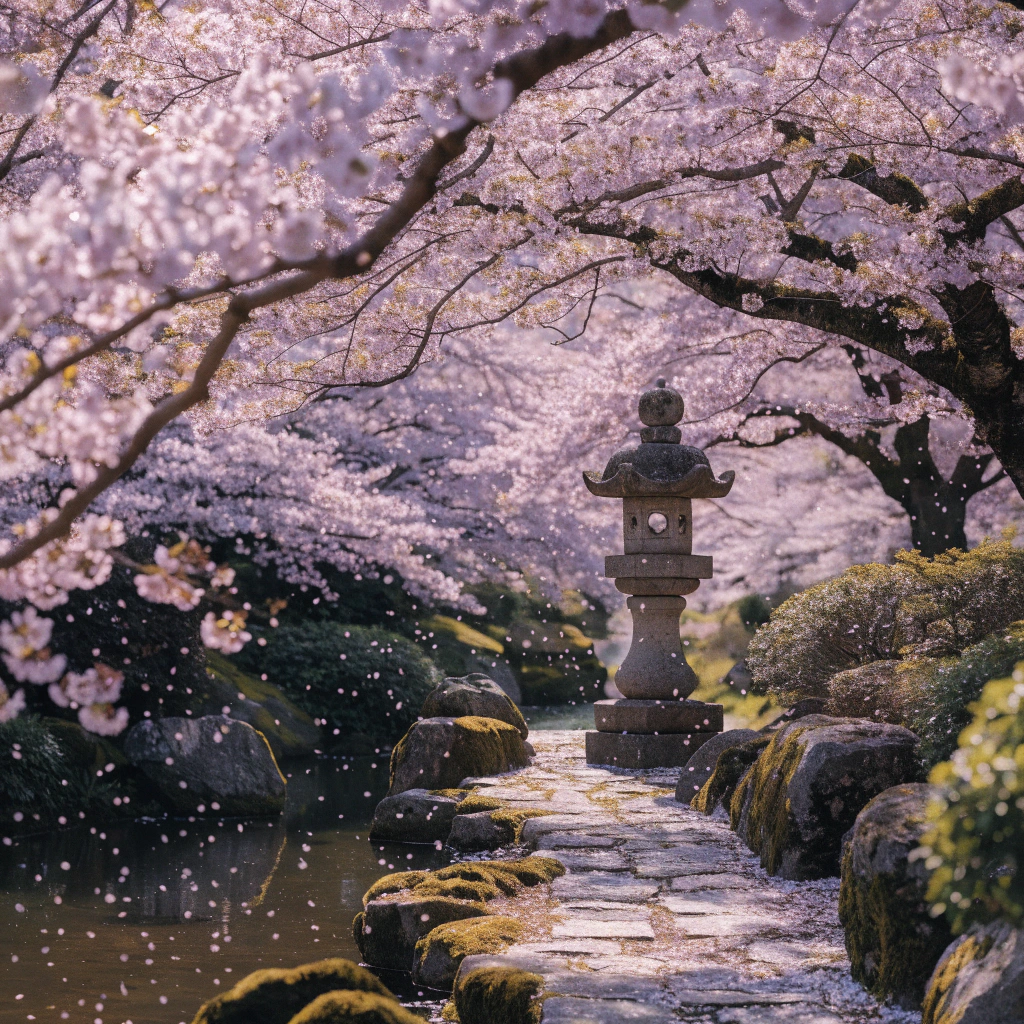
Spring in Japan: The Pink Flowers
Japan is very beautiful in the spring. Every year, many people visit parks to see the flowers. These flowers are called cherry blossoms. In Japan, the name for these flowers is "sakura." They are light pink and white.
Families and friends have picnics under the trees. They eat delicious food and talk together. They are very happy. The flowers are only there for a short time. This is a special tradition. It is called Hanami. People look at the trees and enjoy the day. It is a great time for everyone.
Grammar Spotlight
Pattern: Present Simple (to be)
"Japan is very beautiful in the spring."
We use 'is' with singular subjects like Japan to describe a state or quality. It is the most common verb in English for descriptions.
Pattern: Present Simple (plural verbs)
"Families and friends have picnics under the trees."
With plural subjects like 'families and friends', we use the base form of the verb without adding an 's'. This shows a regular activity.
Test Your Understanding
10 questions · A1 Beginner · 1 free preview
Test what you learned from this article. Answer all questions to earn XP!
Where do people go to see the flowers?
Want to finish the quiz?
9 more questions are waiting for you. Sign up free to unlock the full quiz and earn XP!
Sign Up FreeAlready have an account? Sign In
Question Breakdown
Where do people go to see the flowers?
Your answer:
Correct answer: To the parks
The cherry blossoms are blue and yellow.
Your answer:
Correct answer: False
What is a 'picnic'?
Your answer:
Correct answer: A meal you eat outside
The flowers are light pink and _____.
Your answer:
Correct answer: white
Cherry Blossom Season in Japan
Every spring, Japan becomes very beautiful. People celebrate a special tradition called Hanami. The word Hanami means "looking at flowers." Millions of people wait for the cherry blossoms, or "sakura," to open.
These flowers are pink and white. They are more beautiful than other spring flowers, but they do not live long. They usually stay on the trees for only one or two weeks. Because the flowers fall quickly, people want to see them every day.
Families and friends go to parks together. They sit under the trees and have picnics. They eat traditional food and talk for many hours. Last year, many people visited Tokyo for the festival. It was busier than usual because the weather was warm.
Hanami is a happy time because it is the start of spring. It also teaches people that life is short and special. This tradition is very important in Japanese culture.
Grammar Spotlight
Pattern: Comparatives
"They are more beautiful than other spring flowers."
We use 'more' + adjective + 'than' to compare two things. For short adjectives like 'busy', we change 'y' to 'i' and add 'er' to make 'busier'.
Pattern: Past Simple
"Last year, many people visited Tokyo for the festival."
We use the past simple for finished actions in the past. Regular verbs like 'visit' add 'ed' to the end.
Test Your Understanding
11 questions · A2 Elementary · 1 free preview
Test what you learned from this article. Answer all questions to earn XP!
What does the word 'Hanami' mean?
Want to finish the quiz?
10 more questions are waiting for you. Sign up free to unlock the full quiz and earn XP!
Sign Up FreeAlready have an account? Sign In
Question Breakdown
What does the word 'Hanami' mean?
Your answer:
Correct answer: Looking at flowers
Cherry blossoms stay on the trees for several months.
Your answer:
Correct answer: False
What does 'quickly' mean?
Your answer:
Correct answer: At a fast speed
Families and friends sit under the trees and have _____.
Your answer:
Correct answer: picnics
Why is Hanami a happy time?
Your answer:
Correct answer: Because it is the start of spring
Hanami: Celebrating the Pink Petals of Spring
Every year, spring in Japan is welcomed with a very special tradition called Hanami. The word literally means "flower viewing," but for Japanese people, it is much more than just looking at plants. It is a celebration of the cherry blossoms, known as sakura, which have become a symbol of the country.
The blooming season has always been an important time. Because the blossoms only last for a week or two, people must plan their trips carefully. The "cherry blossom front" is tracked by experts who predict exactly when the flowers will open in different regions. This movement, which starts in the warm south and travels to the cold north, is followed by millions of people on the news.
During Hanami, parks are filled with families and friends who sit on blue plastic sheets under the trees. Traditional food and drinks are shared while everyone enjoys the view. In many places, paper lanterns are hung from the branches so that the beauty of the petals can be seen at night. This evening version of the festival is called Yozakura.
Hanami is also a time for reflection. The blossoms are admired because they are beautiful but also because they are transient. This means they do not last long, which reminds people that life is short and should be enjoyed. Since ancient times, poems have been written about these delicate flowers. Today, the tradition continues to bring people together to appreciate nature’s temporary gift.
Grammar Spotlight
Pattern: Passive Voice
"In many places, paper lanterns are hung from the branches."
The passive voice is used when the action is more important than the person doing it. It is formed by using the verb 'to be' followed by the past participle of the main verb.
Pattern: Relative Clauses
"The 'cherry blossom front' is tracked by experts who predict exactly when the flowers will open."
Relative clauses give more information about a person or thing mentioned earlier. We use 'who' for people and 'which' or 'that' for things and animals.
Test Your Understanding
11 questions · B1 Intermediate · 1 free preview
Test what you learned from this article. Answer all questions to earn XP!
What does the word 'Hanami' literally mean?
Want to finish the quiz?
10 more questions are waiting for you. Sign up free to unlock the full quiz and earn XP!
Sign Up FreeAlready have an account? Sign In
Question Breakdown
What does the word 'Hanami' literally mean?
Your answer:
Correct answer: Flower viewing
The cherry blossoms usually last for several months.
Your answer:
Correct answer: False
What does 'transient' mean?
Your answer:
Correct answer: Lasting a short time
Parks are filled with families who sit on blue _____ sheets.
Your answer:
Correct answer: plastic
What is the name for the evening version of the festival?
Your answer:
Correct answer: Yozakura
The Fleeting Splendor: Understanding the Cultural Significance of Hanami
As the winter chill begins to fade, a wave of anticipation sweeps across the Japanese archipelago. This seasonal shift marks the arrival of Hanami, a traditional custom that translates literally to 'flower viewing.' While the term could technically apply to any blossom, it is almost exclusively associated with the sakura, or cherry blossoms. This practice is not merely a casual picnic; it is a cultural cornerstone that has been meticulously observed for over a millennium, serving as a poignant reminder of the transient nature of life. This phenomenon is treated with significant importance, often featuring prominently in national news broadcasts.
Meteorologists track the 'cherry blossom front' as it migrates from the subtropical south of Kyushu to the subarctic north of Hokkaido. Consequently, people plan their gatherings weeks in advance, hoping to catch the trees at 'mankai,' or full bloom. Having secured prime spots beneath the blooming canopies, families, friends, and colleagues gather to share traditional snacks. These social gatherings are known for their inclusive atmosphere, where the rigid social hierarchies typically found in Japanese workplaces are temporarily set aside in favor of communal celebration.
Beyond the festivities, Hanami is deeply rooted in a philosophical concept known as 'mono no aware.' This term describes a bittersweet awareness of the impermanence of things. The cherry blossoms are the perfect symbol for this aesthetic, as they reach the peak of their beauty only to be scattered by the wind within a few days. This fleeting splendor encourages observers to appreciate the present moment and reflect on the cycle of life. Despite the rapid urbanization of modern Japan, Hanami remains a vital link to the natural world, allowing citizens to pause their busy lives and reconnect with the seasons.
In the evenings, the celebration continues under the name 'yozakura.' Parks are often illuminated by paper lanterns, transforming the petals into a glowing, ethereal canopy. This nocturnal perspective offers a different, perhaps more mysterious, aesthetic experience. Ultimately, Hanami is more than just a seasonal event; it is a testament to the enduring human desire to find beauty in the temporary and to celebrate the inevitable transitions that define our existence.
Grammar Spotlight
Pattern: Present Perfect Passive
"This practice is not merely a casual picnic; it is a cultural cornerstone that has been meticulously observed for over a millennium."
This is formed with 'has/have + been + past participle.' It is used here to describe an action that started in the past and continues to be relevant, focusing on the tradition rather than the people performing it.
Pattern: Perfect Participle Clause
"Having secured prime spots beneath the blooming canopies, families, friends, and colleagues gather to share traditional snacks."
Formed with 'Having + past participle,' this structure indicates that one action was completed before another started. It is a more formal way to link two sentences with the same subject.
Pattern: Only to + Infinitive
"The cherry blossoms are the perfect symbol for this aesthetic, as they reach the peak of their beauty only to be scattered by the wind within a few days."
This structure is used to express a result that is surprising, unexpected, or often disappointing. It adds a sense of drama or inevitability to the narrative.
Test Your Understanding
11 questions · B2 Upper Intermediate · 1 free preview
Test what you learned from this article. Answer all questions to earn XP!
What is the primary focus of the 'cherry blossom front' (sakura zensen)?
Want to finish the quiz?
10 more questions are waiting for you. Sign up free to unlock the full quiz and earn XP!
Sign Up FreeAlready have an account? Sign In
Question Breakdown
What is the primary focus of the 'cherry blossom front' (sakura zensen)?
Your answer:
Correct answer: Tracking the movement of blooming trees across Japan
Hanami is a modern tradition that began in the late 20th century.
Your answer:
Correct answer: False
What does the word 'transient' mean in the context of the article?
Your answer:
Correct answer: Lasting for a very short time
Hanami serves as a ______ reminder of the transient nature of life.
Your answer:
Correct answer: poignant
What does the philosophical concept 'mono no aware' describe?
Your answer:
Correct answer: A bittersweet awareness of impermanence
Impermanence Under the Petals: The Philosophical Resonance of Hanami
Seldom does a natural phenomenon command such national preoccupation as the arrival of the cherry blossoms in Japan. Known as Hanami, or 'flower viewing,' this practice transcends mere horticulture, serving as a profound cultural ritual that navigates the delicate intersection of celebration and contemplation. As the 'cherry blossom front' (sakura zensen) migrates from the subtropical south of Kyushu to the cooler climes of Hokkaido, millions of people converge under the pink and white canopies, participating in a collective acknowledgment of spring's arrival.
It is this profound awareness of the ephemeral nature of life that lies at the heart of the Japanese aesthetic. The blossoms, or sakura, are celebrated not in spite of their fragility, but precisely because of it. Their existence is fleeting; a sudden gust of wind or a heavy downpour can strip the trees of their splendor in an instant. This transience is encapsulated in the concept of 'mono no aware'—a poignant appreciation of the impermanent nature of things. In this context, Hanami is not merely a picnic; it is a meditation on the human condition, reminding participants that beauty and life are inherently transient.
The meticulous observation of the cherry blossom front underscores a collective anticipation that binds the nation together. From a sociological perspective, Hanami fosters a unique sense of social cohesion. In a society often characterized by rigid hierarchies and professional stoicism, the informal nature of these gatherings provides a necessary outlet for communal relaxation. Colleagues, families, and strangers alike share space on blue tarps, momentarily dissolving the barriers that typically define Japanese social interaction.
However, the modern manifestation of Hanami is not without its critics. Some argue that the increasing commercialization of the season—marked by limited-edition cherry-blossom-flavored products and aggressive marketing—threatens to overshadow the spiritual resonance of the practice. The transformation of a quiet, contemplative ritual into a boisterous, often alcohol-fueled social event has led to debates regarding the preservation of traditional values. Is the essence of Hanami being lost to the noise of contemporary consumerism? Or is the adaptability of the ritual a testament to its enduring relevance?
Despite these tensions, the zenith of the blooming period remains a time of unparalleled beauty. To witness the 'sakura snow' (sakurafubuki), where falling petals carpet the ground, is to experience a moment of sublime clarity. Ultimately, Hanami serves as a reminder that while the blossoms will inevitably fade, their cyclical return offers a sense of continuity in an ever-changing world. It is a celebration of the present moment, an invitation to pause and appreciate the transient beauty that surrounds us before it vanishes into the ether.
Grammar Spotlight
Pattern: Inversion with negative/restrictive adverbs
"Seldom does a natural phenomenon command such national preoccupation as the arrival of the cherry blossoms in Japan."
When using restrictive words like 'seldom' or 'rarely' at the beginning of a sentence for emphasis, the auxiliary verb is placed before the subject. This is common in formal C1 writing to add dramatic weight.
Pattern: Cleft Sentences for Emphasis
"It is this profound awareness of the ephemeral nature of life that lies at the heart of the Japanese aesthetic."
Cleft sentences (It + is/was + [emphasized part] + that/who) are used to focus on specific information. Here, it emphasizes that 'awareness' is the specific reason for the aesthetic.
Pattern: Nominalization
"The meticulous observation of the cherry blossom front underscores a collective anticipation that binds the nation together."
Nominalization turns verbs (observe) into nouns (observation). This creates a more formal, academic tone by focusing on the concept rather than the action or the person doing it.
Test Your Understanding
12 questions · C1 Advanced · 1 free preview
Test what you learned from this article. Answer all questions to earn XP!
What is the primary philosophical concept associated with Hanami in the text?
Want to finish the quiz?
11 more questions are waiting for you. Sign up free to unlock the full quiz and earn XP!
Sign Up FreeAlready have an account? Sign In
Question Breakdown
What is the primary philosophical concept associated with Hanami in the text?
Your answer:
Correct answer: The appreciation of impermanence (mono no aware)
The author suggests that Hanami gatherings help temporarily break down social hierarchies in Japan.
Your answer:
Correct answer: True
Which word describes the peak or highest point of the blooming period?
Your answer:
Correct answer: Zenith
The author notes that the _____ of the season through marketing might threaten its spiritual meaning.
Your answer:
Correct answer: commercialization
According to the article, why are the cherry blossoms celebrated specifically for their fragility?
Your answer:
Correct answer: Because their short life mirrors the transient nature of existence
The 'cherry blossom front' moves from the north of Japan to the south.
Your answer:
Correct answer: False
Ephemeral Splendour: A Phenomenological Inquiry into Hanami and the Aesthetic of Impermanence
The arrival of spring in Japan is not merely a meteorological shift; it is a profound ontological awakening that permeates the very fabric of the nation's identity. Hanami, literally "flower viewing," is an ancient tradition that transcends the simple act of observation, evolving into a complex socio-cultural liturgy. Seldom does a natural phenomenon command such a collective psychological investment as the blooming of the Sakura (cherry blossoms). This annual event, which tracks the "Sakura Zensen" or cherry blossom front from the subtropical south to the boreal north, serves as a poignant reminder of the evanescence of life. The pervasive beauty of the blossoms is inextricably linked to their fragility, embodying the aesthetic principle of 'mono no aware'—the pathos of things.
Historically, the origins of Hanami can be traced back to the Nara period (710–794), though it was the ume (plum) blossoms that initially garnered aristocratic admiration. It was during the subsequent Heian period that the cherry blossom ascended to its current status of cultural supremacy. Were one to traverse the Japanese archipelago during this era, one would find the imperial court engaged in sophisticated poetry competitions and banquets beneath the weeping boughs. This transition from plum to cherry reflected a shift in the Japanese aesthetic sensibility, favoring the delicate, short-lived bloom of the Sakura over the more resilient plum. The cherry blossom became a metaphor for the samurai's life—brilliant, yet ready to fall at the peak of its beauty.
In the contemporary era, Hanami manifests as a fascinating dichotomy between quiet contemplation and exuberant celebration. While some seek the solitude of ancient temples to reflect upon the myriad petals drifting like snow, others congregate in urban parks for enkai (festive picnics). This juxtaposition of the sacred and the profane highlights the multifaceted nature of the ritual. The meticulous tracking of the bloom by the Japan Meteorological Agency provides a sense of scientific verisimilitude to an event that remains deeply spiritual. Should the blossoms wither prematurely due to inclement weather, the collective sense of loss is often palpable, underscoring the nation's deep-seated connection to the seasonal cycle.
Philosophically, Hanami serves as a bridge between the tangible world and the metaphysical. The act of viewing is not passive; it is an engagement with the concept of impermanence. The blossoms, in their ephemeral glory, demand that the observer remain present in the moment. This focus on the "now" is a central tenet of Japanese thought, influenced by both Shintoism and Buddhism. The last vestige of winter is swept away by the pink tide, yet this renewal is tempered by the knowledge that the beauty is fleeting. It is this very tension between life and death, presence and absence, that imbues Hanami with its unique emotional weight.
Ultimately, Hanami is a testament to the enduring power of nature to shape human culture. Despite the rapid modernization of Japan, this tradition remains an essential anchor, providing a space for reflection in an increasingly frenetic world. Whether viewed through the lens of history, philosophy, or social gathering, the cherry blossom remains a potent symbol of hope and transience. As the petals eventually fall, they do not signify an end, but rather a graceful acceptance of the natural order. To participate in Hanami is to acknowledge one's own place within this cycle, celebrating the beauty of the present while acknowledging the inevitability of change.
Grammar Spotlight
Pattern: Inversion for Emphasis
"Seldom does a natural phenomenon command such a collective psychological investment as the blooming of the Sakura."
When using negative or restrictive adverbs like 'seldom' at the beginning of a sentence, the auxiliary verb and subject are inverted. This structure is used in formal or academic writing to add emphasis to the rarity or significance of an event.
Pattern: Past Subjunctive for Hypotheticals
"Were one to traverse the Japanese archipelago during this era, one would find the imperial court engaged in sophisticated poetry competitions."
The 'were' subjunctive is used to discuss hypothetical or imaginary situations in the present or future. It replaces 'if one were to' and is highly common in C2-level formal prose to maintain a scholarly tone.
Pattern: Inverted Conditional (Should)
"Should the blossoms wither prematurely due to inclement weather, the collective sense of loss is often palpable."
This is a formal alternative to 'If the blossoms should wither.' Using 'should' at the start of a conditional clause makes the possibility sound more formal and academic, often used when discussing potential risks or outcomes.
Test Your Understanding
12 questions · C2 Mastery · 1 free preview
Test what you learned from this article. Answer all questions to earn XP!
What does the concept of 'mono no aware' primarily signify in the context of Hanami?
Want to finish the quiz?
11 more questions are waiting for you. Sign up free to unlock the full quiz and earn XP!
Sign Up FreeAlready have an account? Sign In
Question Breakdown
What does the concept of 'mono no aware' primarily signify in the context of Hanami?
Your answer:
Correct answer: The pathos and beauty found in the impermanence of things
Cherry blossoms have been the primary focus of Hanami since the Nara period.
Your answer:
Correct answer: False
What does 'evanescence' mean?
Your answer:
Correct answer: The quality of vanishing or being fleeting
The blooming of the Sakura serves as a _____ reminder of the fleeting nature of life.
Your answer:
Correct answer: poignant
How does the author describe the 'Sakura Zensen'?
Your answer:
Correct answer: The cherry blossom front moving from south to north
Modern Hanami is characterized only by quiet, spiritual contemplation.
Your answer:
Correct answer: False
