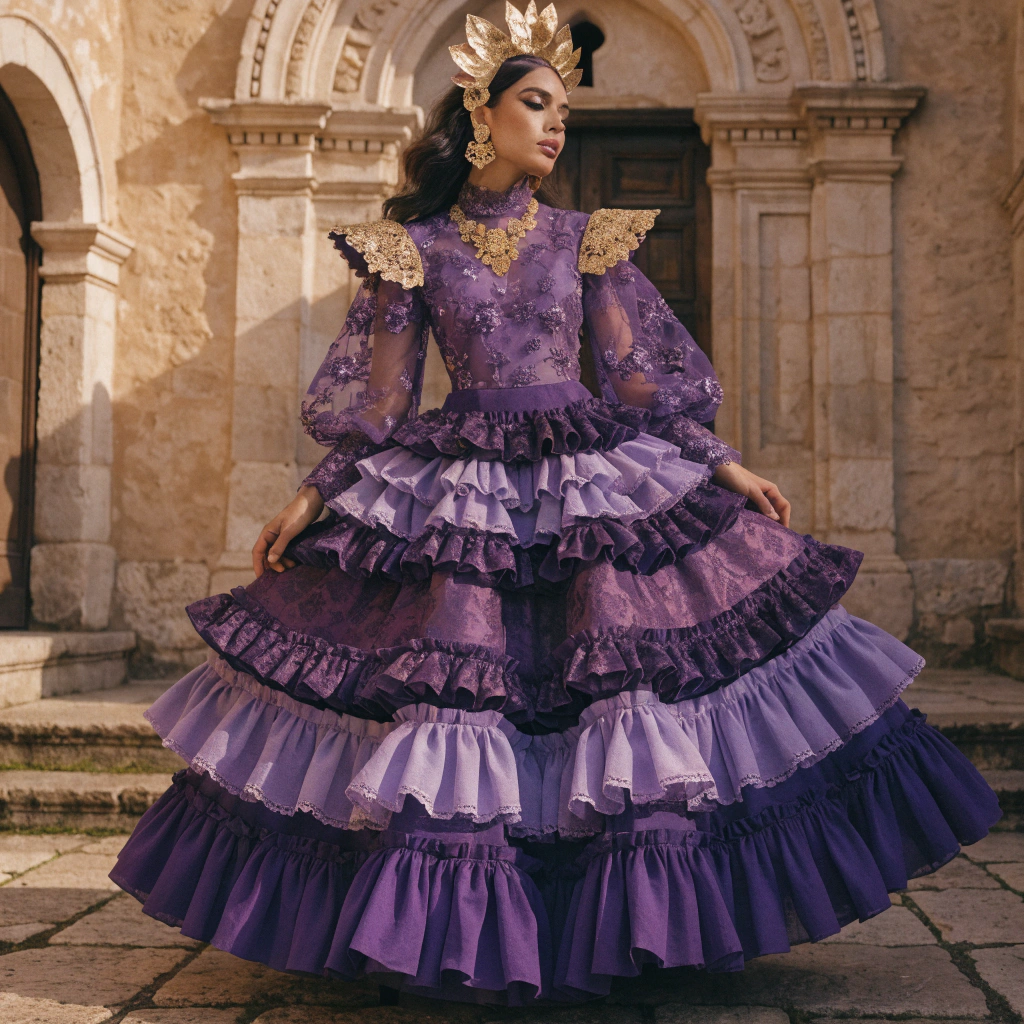
A Beautiful Dress from Portugal
In the north of Portugal, there is a special dress. It is called the Traje à Vianesa. Women in the city of Viana do Castelo wear this beautiful costume for festivals.
The dress has many colors. It has red, white, and blue embroidery. The patterns are flowers and hearts. Women also wear gold jewelry. The gold is very heavy and bright.
This dress is a symbol of pride. People make the clothes by hand. Today, many young people love this tradition. It is a part of Portuguese history.
Grammar Spotlight
Pattern: Present Simple (to be)
"It is a part of Portuguese history."
We use 'is' with 'it', 'he', or 'she' to describe facts or states. It helps us give information about things.
Pattern: Present Simple (plural verbs)
"Women in the city of Viana do Castelo wear this beautiful costume for festivals."
With plural subjects like 'women', we use the base form of the verb. We do not add an 's' to the verb.
Test Your Understanding
10 questions · A1 Beginner · 1 free preview
Test what you learned from this article. Answer all questions to earn XP!
Where is the special dress from?
Want to finish the quiz?
9 more questions are waiting for you. Sign up free to unlock the full quiz and earn XP!
Sign Up FreeAlready have an account? Sign In
Question Breakdown
Where is the special dress from?
Your answer:
Correct answer: Portugal
The dress has patterns of flowers and hearts.
Your answer:
Correct answer: True
What is 'gold'?
Your answer:
Correct answer: A yellow metal
People make the clothes by _____.
Your answer:
Correct answer: hand
The Beautiful Traditional Dress of Portugal
In Portugal, people usually wear modern clothes today. However, the Traje à Vianesa is a very special and famous costume. It comes from the Minho region in the north of the country. Many years ago, women in the 19th century wore these beautiful clothes for festivals and weddings. These were their best clothes for important days.
The costume is famous for its bright colors and embroidery. The most popular color is red, but some dresses are blue or black. Women also wear white shirts with handmade flowers. The embroidery is very detailed and beautiful. It takes a long time to make one dress because the work is difficult.
The most important part of the costume is the gold. Women wear many gold necklaces and earrings. These gold pieces are often older than the dresses. They show that the family is proud of their history. Today, people still wear the Traje à Vianesa during big summer festivals. It is more colorful than modern fashion and it is a symbol of Portuguese culture.
Grammar Spotlight
Pattern: Past Simple
"Many years ago, women in the 19th century wore these beautiful clothes for festivals and weddings."
We use the past simple to talk about finished actions in the past. 'Wore' is the irregular past form of the verb 'wear'.
Pattern: Comparatives
"It is more colorful than modern fashion."
To compare two things with long adjectives, we use 'more' + adjective + 'than'. It shows the difference between the costume and modern clothes.
Test Your Understanding
11 questions · A2 Elementary · 1 free preview
Test what you learned from this article. Answer all questions to earn XP!
Where does the Traje à Vianesa come from?
Want to finish the quiz?
10 more questions are waiting for you. Sign up free to unlock the full quiz and earn XP!
Sign Up FreeAlready have an account? Sign In
Question Breakdown
Where does the Traje à Vianesa come from?
Your answer:
Correct answer: The Minho region in the north
Women only wore these clothes for work in the fields.
Your answer:
Correct answer: False
What does 'handmade' mean?
Your answer:
Correct answer: Made by a person, not a machine
The most popular color for the dress is _____.
Your answer:
Correct answer: red
What is the most important part of the costume?
Your answer:
Correct answer: The gold jewelry
The Traje à Vianesa: Portugal’s Golden Tradition
Portugal is a country with many traditions, but the Traje à Vianesa is perhaps the most famous. This beautiful costume, which comes from the Minho region, has been worn by women for centuries. Although people wear modern clothes today, this traditional dress is still a symbol of regional pride.
In the 19th century, these garments were used as 'Sunday best' clothes. They were worn for weddings and religious festivals by peasant women. The most famous festival is the Romaria de Nossa Senhora d'Agonia in Viana do Castelo. During this event, hundreds of women walk through the streets wearing their colorful outfits.
The costume is made of several parts. It includes a white shirt with hand-made embroidery, a colorful skirt, and an apron. The patterns on the fabric usually show flowers or hearts, which are very popular in Portuguese art. The colors are also important. Red is usually worn by young women, while older women often wear blue or black.
However, the most impressive part of the Traje à Vianesa is the gold. Portuguese filigree, which is a delicate style of jewelry, is worn around the neck and on the ears. These gold pieces have been passed down through families for generations.
Today, the Traje à Vianesa has been recognized as an important part of Portuguese heritage. It is not just a historical object; it is a living tradition that connects the past with the present.
Grammar Spotlight
Pattern: Relative Clauses
"This beautiful costume, which comes from the Minho region, has been worn by women for centuries."
Relative clauses use 'which' or 'who' to give extra information about a noun. They help combine two sentences into one longer, more complex sentence.
Pattern: Present Perfect Passive
"Today, the Traje à Vianesa has been recognized as an important part of Portuguese heritage."
This is formed using 'has/have been' + the past participle. It describes an action that happened at an unspecified time in the past and affects the present, focusing on the object.
Test Your Understanding
11 questions · B1 Intermediate · 1 free preview
Test what you learned from this article. Answer all questions to earn XP!
Where does the Traje à Vianesa originate?
Want to finish the quiz?
10 more questions are waiting for you. Sign up free to unlock the full quiz and earn XP!
Sign Up FreeAlready have an account? Sign In
Question Breakdown
Where does the Traje à Vianesa originate?
Your answer:
Correct answer: The Minho region
Older women in the Minho region traditionally wear bright red costumes.
Your answer:
Correct answer: False
What does 'embroidery' mean?
Your answer:
Correct answer: Patterns sewn onto cloth with thread
The patterns on the fabric usually show _____ or hearts.
Your answer:
Correct answer: flowers
What is the name of the delicate gold jewelry worn with the costume?
Your answer:
Correct answer: Filigree
The Living Legacy of the Traje à Vianesa: Embroidery and Gold
In the heart of northern Portugal lies the lush Minho region, a place where history is not merely preserved in dusty museums but is instead worn with immense pride on the streets. The Traje à Vianesa, an intricate ensemble originating from the coastal city of Viana do Castelo, represents the absolute pinnacle of Portuguese folk heritage. While contemporary fashion often tends toward global homogenization, this traditional attire remains a prestigious symbol of regional identity, standing as a testament to the enduring power of local culture.
Historically, these garments served as the 'Sunday best' for peasant women during the 19th century. Far from being simple work clothes, they were meticulously crafted for the most significant life events, such as weddings and grand religious festivals. The ensemble is most famous for its vibrant color palette—predominantly a striking red for younger, marriageable women, and deep blue or black for those who were in mourning or of a more advanced age. The embroidery, which is laboriously stitched by hand, often features complex floral motifs that carry specific cultural meanings, reflecting the natural beauty of the Portuguese countryside.
However, the most striking feature of the Traje à Vianesa is undoubtedly the abundance of gold jewelry. Known as 'Ouro de Viana,' the heavy gold necklaces and the iconic heart-shaped pendants, called 'Coração de Viana,' are world-renowned examples of exquisite filigree work. This gold was traditionally not just for mere adornment; it effectively represented a family's accumulated wealth and financial security. During the 'Desfile da Mordomia'—the undisputed highlight of the annual Romaria de Nossa Senhora d'Agonia festival—hundreds of women parade through the cobblestone streets, displaying their family's gold with immense dignity and poise.
If the local communities had not maintained these strict standards of craftsmanship, the authenticity of the costume would have likely diminished over the decades. Today, the garment is strictly protected by a certification process, ensuring that every stitch and every piece of gold jewelry adheres to historical accuracy. This dedication demonstrates that traditional culture can successfully coexist with modernity, provided there is a deep-seated respect for one's ancestral roots.
In conclusion, the Traje à Vianesa is far more than just a costume; it is a living narrative of the Minho people. It reflects a complex social hierarchy, a history of female empowerment through domestic labor, and an artistic legacy that continues to flourish in the 21st century. For any visitor to Portugal, witnessing this breathtaking display of color and gold offers a profound insight into the resilient soul of the north.
Grammar Spotlight
Pattern: Third Conditional
"If the local communities had not maintained these strict standards of craftsmanship, the authenticity of the costume would have likely diminished over the decades."
This is used to talk about an unreal situation in the past and its hypothetical result. It is formed using 'if + past perfect' and 'would have + past participle'.
Pattern: Non-defining Relative Clause
"The embroidery, which is laboriously stitched by hand, often features complex floral motifs that carry specific cultural meanings."
This pattern provides extra information about a noun that is already clearly identified. It is separated by commas and uses the relative pronoun 'which' for objects.
Pattern: Passive Voice (Present Simple)
"Today, the garment is strictly protected by a certification process."
The passive voice is used when the focus is on the action or the object receiving the action rather than the person performing it. It is formed with 'be + past participle'.
Test Your Understanding
11 questions · B2 Upper Intermediate · 1 free preview
Test what you learned from this article. Answer all questions to earn XP!
What did the 'Ouro de Viana' jewelry symbolize for families in the 19th century?
Want to finish the quiz?
10 more questions are waiting for you. Sign up free to unlock the full quiz and earn XP!
Sign Up FreeAlready have an account? Sign In
Question Breakdown
What did the 'Ouro de Viana' jewelry symbolize for families in the 19th century?
Your answer:
Correct answer: Financial security and wealth
Younger women traditionally wore blue or black versions of the Traje à Vianesa.
Your answer:
Correct answer: False
What does 'meticulously' mean in the context of the article?
Your answer:
Correct answer: With extreme attention to detail
The annual festival mentioned where women display their gold is called the _____ d'Agonia.
Your answer:
Correct answer: Romaria
Why is the garment currently subject to a certification process?
Your answer:
Correct answer: To ensure historical accuracy and authenticity
Woven Heritage: The Semiotics of the Traje à Vianesa
Few cultural artifacts in the Iberian Peninsula command as much reverence as the Traje à Vianesa. Originating from the verdant landscapes of the Minho region, this attire transcends mere sartorial choice, functioning instead as a complex semiotic system of social standing and regional lineage. Historically, the costume served as the 'Sunday best' for peasant women in the 19th century, yet its complexity belies its humble origins. Not only does the Traje à Vianesa embody the meticulous craftsmanship of northern Portugal, but it also serves as a testament to the resilience of local identity amidst the encroaching tides of globalization. The aesthetic idiosyncrasies of the garment are dictated by the specific parish of the wearer, with variations in embroidery patterns signaling a woman’s marital status or village of origin.
Central to the allure of the costume is the evocative use of color and texture. The quintessential 'Red Costume' of Viana do Castelo, characterized by its vibrant wool skirts and hand-embroidered waistcoats, is arguably the most emblematic. It is through the intricate floral motifs, often featuring stylized camellias or hearts, that the artisan’s skill is truly manifested. The labor-intensive nature of this embroidery reflects a dedication to tradition that has been passed down through generations. However, the costume is incomplete without the ostentatious display of gold. The 'Ourivesaria Tradicional'—traditional gold jewelry—is not merely decorative; it historically functioned as a portable dowry and a visible manifestation of a family’s financial solvency. The iconic 'Viana Heart' (Coração de Viana), crafted from delicate gold filigree, remains a pinnacle of Portuguese goldsmithing.
Critically, the Traje à Vianesa should not be viewed as a vestigial relic of a bygone era. While modern Portugal follows contemporary global fashion trends, the costume remains a living tradition, most notably during the Romaria de Nossa Senhora da Agonia. During this festival, hundreds of women parading through the streets demonstrate that the preservation of such intricate techniques is a deliberate act of cultural defiance. There is, however, a nuanced argument regarding the commercialization of these garments. As the Traje becomes a symbol of national branding, some critics worry that the spiritual and social depth of the attire may be eclipsed by its aesthetic appeal. Nevertheless, the enduring popularity of the Traje à Vianesa suggests that its role as a vessel for regional pride is far from diminished. It is the fusion of textile artistry and precious metalwork that ensures its status as the crown jewel of Portuguese folklore.
Grammar Spotlight
Pattern: Negative Inversion
"Not only does the Traje à Vianesa embody the meticulous craftsmanship of northern Portugal, but it also serves as a testament to the resilience of local identity."
Inversion is used here for rhetorical emphasis. When a sentence starts with 'Not only', the auxiliary verb 'does' precedes the subject 'the Traje à Vianesa'.
Pattern: Cleft Sentences
"It is through the intricate floral motifs, often featuring stylized camellias or hearts, that the artisan’s skill is truly manifested."
A cleft sentence (It is + [focus] + that/who) is used to emphasize a specific part of the sentence. Here, the focus is on 'the intricate floral motifs'.
Pattern: Nominalisation
"The preservation of such intricate techniques is a deliberate act of cultural defiance."
Nominalisation involves turning verbs or adjectives into nouns (e.g., 'preserve' to 'preservation'). This makes the writing more formal and objective, a hallmark of C1 academic style.
Test Your Understanding
12 questions · C1 Advanced · 1 free preview
Test what you learned from this article. Answer all questions to earn XP!
What is the primary function of the Traje à Vianesa according to the text?
Want to finish the quiz?
11 more questions are waiting for you. Sign up free to unlock the full quiz and earn XP!
Sign Up FreeAlready have an account? Sign In
Question Breakdown
What is the primary function of the Traje à Vianesa according to the text?
Your answer:
Correct answer: To act as a semiotic system of social and regional identity
The gold jewelry worn with the costume was historically used as a form of financial security.
Your answer:
Correct answer: True
What does 'filigree' refer to in the context of the article?
Your answer:
Correct answer: Delicate ornamental work made from fine gold wire
The 'Viana Heart' is considered a _____ of Portuguese goldsmithing.
Your answer:
Correct answer: pinnacle
What concern do some critics have regarding the modern use of the Traje?
Your answer:
Correct answer: Commercialization might overshadow its social and spiritual depth
Variations in the costume's embroidery can indicate a woman's marital status.
Your answer:
Correct answer: True
The Semiotics of the Sartorial: An Analytical Inquiry into the Traje à Vianesa
To the casual observer, the Traje à Vianesa might appear as a mere relic of Portuguese folklore, a vestiary fossil preserved for the sake of tourism. However, such a reductionist view fails to account for the profound semiotic weight and historical resonance of this Minho region attire. Originating in the 19th century amongst the peasant women of Viana do Castelo, the costume serves as a sophisticated medium of social communication, articulating nuances of wealth, marital status, and regional identity through a complex interplay of embroidery and gold. Should one deconstruct the chromatic choices of the ensemble, one would find that the dominant reds and whites are not arbitrary; they symbolize vitality and purity, respectively, while the darker variations denote mourning or matronly austerity.
Central to the aesthetic prowess of the Traje is the ‘ponto de cruz’ (cross-stitch) embroidery. These patterns, meticulously hand-rendered, often feature stylized floral motifs that border on the geometric, reflecting a vernacular artistic tradition that has remained remarkably resistant to the ephemeral shifts of global fashion. It is not merely the fabric that captivates, but rather the historical weight it carries. The embroidery acts as a narrative thread, weaving together the individual biography of the wearer with the collective memory of the Minho. Were the gold to be removed, the costume would lose its ontological anchor, for it is the ‘Ouro de Viana’—the exquisite filigree jewelry—that elevates the garment from regional dress to a display of conspicuous status.
The gold, often inherited through matrilineal lines, represents a tangible manifestation of familial security. The ‘Coração de Viana’ (Heart of Viana), with its intricate filigree, is perhaps the most iconic element. This delicate metalwork is a testament to the technical prowess of Portuguese goldsmiths, whose ability to manipulate fine gold wire into ethereal structures remains unparalleled. During the ‘Romaria de Nossa Senhora d’Agonia’, the streets of Viana do Castelo witness the ‘Desfile da Mordomia’, where hundreds of women parade their family’s wealth. In this context, the ostentation of the gold is not perceived as vanity but as a liturgical celebration of heritage. The sheer volume of necklaces and earrings worn by the ‘mordomas’ creates a visual and auditory spectacle, as the clinking of metal accompanies their rhythmic stride.
Critics might argue that such traditions risk becoming ossified, trapped in a performative loop that serves the ‘tourist gaze’. Yet, the Traje à Vianesa exhibits a surprising resilience. It is a living idiosyncrasy of Portuguese culture, one that refuses to be relegated to the museum shelf. While modern life in the Minho has undergone radical transformation, the ritual of dressing in the Traje remains a rite of passage. The meticulous nature of the assembly—the wrapping of the headscarf, the precise layering of the skirt and apron—requires a level of patience that stands in stark contrast to the ‘fast fashion’ ethos of the 21st century.
Ultimately, the Traje à Vianesa is an exercise in vestimentary sovereignty. It asserts that despite the homogenizing forces of globalization, regional specificity can endure through the conscious preservation of craftsmanship. The costume is a dialogue between the past and the present, a scholarly text written in silk, wool, and gold. It remains a quintessential emblem of northern Portugal, proving that the most profound expressions of identity are often those that are worn on one’s sleeve—or, in this case, embroidered upon one’s chest.
Grammar Spotlight
Pattern: Inverted Conditionals (Subjunctive)
"Should one deconstruct the chromatic choices of the ensemble, one would find that the dominant reds and whites are not arbitrary."
In formal English, 'should' can be used in an inverted structure to replace 'if'. This expresses a hypothetical or formal condition without using the word 'if'.
Pattern: Cleft Sentences for Emphasis
"It is not merely the fabric that captivates, but rather the historical weight it carries."
Cleft sentences (It + is/was + subject + relative clause) are used to focus on specific information. Here, it emphasizes the 'historical weight' over the 'fabric'.
Pattern: Second Conditional Inversion
"Were the gold to be removed, the costume would lose its ontological anchor."
This is a highly formal version of 'If the gold were to be removed'. It uses the subjunctive 'were' in an inverted position to create a more academic and hypothetical tone.
Test Your Understanding
12 questions · C2 Mastery · 1 free preview
Test what you learned from this article. Answer all questions to earn XP!
What is the author's primary argument regarding the Traje à Vianesa?
Want to finish the quiz?
11 more questions are waiting for you. Sign up free to unlock the full quiz and earn XP!
Sign Up FreeAlready have an account? Sign In
Question Breakdown
What is the author's primary argument regarding the Traje à Vianesa?
Your answer:
Correct answer: It is a complex semiotic system that communicates social and cultural identity.
The gold jewelry worn with the costume is typically passed down through the father's side of the family.
Your answer:
Correct answer: False
Which word describes something that is short-lived or fleeting?
Your answer:
Correct answer: Ephemeral
The intricate gold metalwork mentioned in the text is known as _____.
Your answer:
Correct answer: filigree
According to the text, what do the dominant red and white colors in the embroidery symbolize?
Your answer:
Correct answer: Vitality and purity
The author suggests that the Traje à Vianesa is a form of resistance against globalized 'fast fashion'.
Your answer:
Correct answer: True
