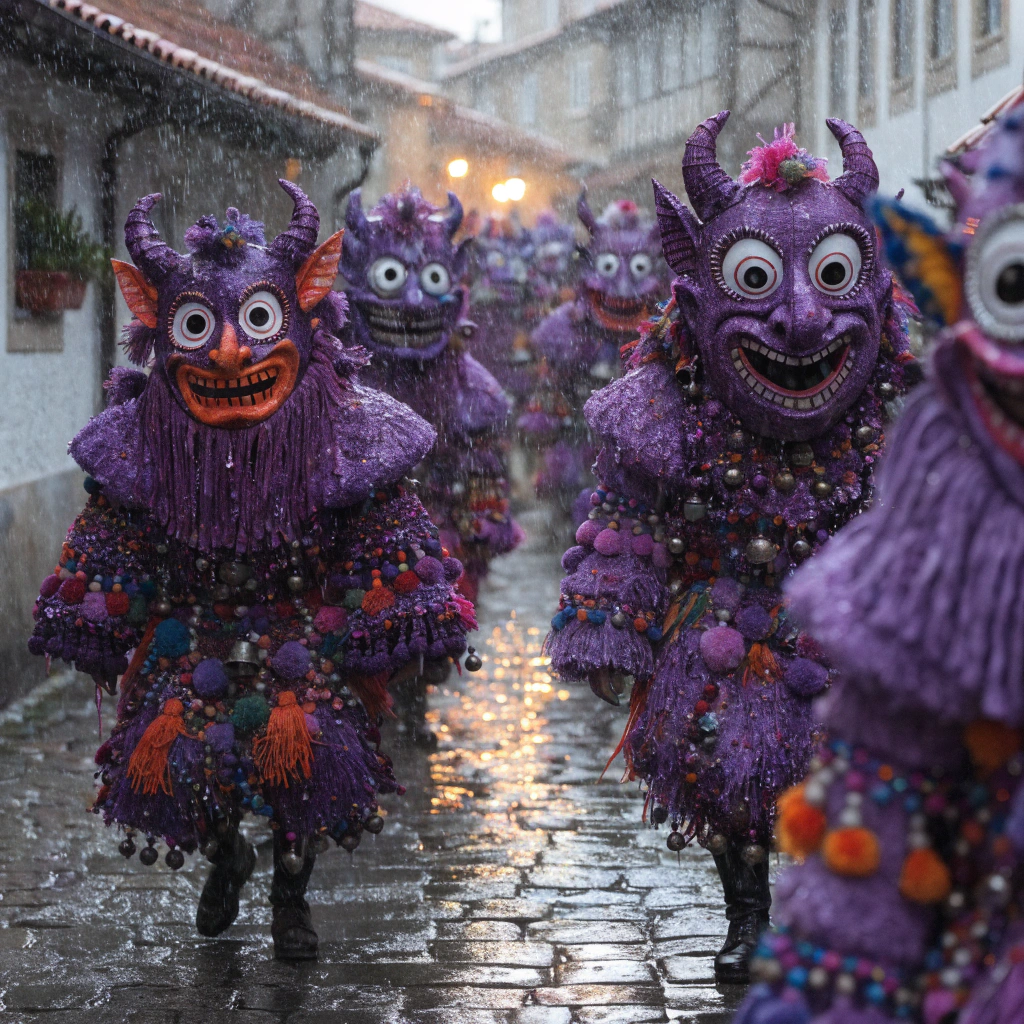
The Colorful Festival of Podence
Podence is a small village in Portugal. Every winter, there is a big festival. This festival is very old. It is famous and special.
The men in the village wear colorful clothes. They wear masks and bells. These men are the Caretos. They wear red, yellow, and green colors. The bells make a lot of noise.
The Caretos run in the streets. They dance and jump. They visit people in the village. It is a happy time. The festival celebrates the end of winter and the start of spring. It is a beautiful tradition.
Grammar Spotlight
Pattern: Present Simple (to be)
"Podence is a small village in Portugal."
We use 'is' with singular subjects like Podence to describe facts. It is the most common verb for descriptions.
Pattern: Present Simple (Plural Verbs)
"The Caretos run in the streets."
When the subject is plural (The Caretos), we use the base form of the verb (run) without an 's'.
Test Your Understanding
10 questions · A1 Beginner · 1 free preview
Test what you learned from this article. Answer all questions to earn XP!
Where is the village of Podence?
Want to finish the quiz?
9 more questions are waiting for you. Sign up free to unlock the full quiz and earn XP!
Sign Up FreeAlready have an account? Sign In
Question Breakdown
Where is the village of Podence?
Your answer:
Correct answer: Portugal
The festival in Podence is new.
Your answer:
Correct answer: False
What are 'masks'?
Your answer:
Correct answer: Things to cover the face
The Caretos _____ in the streets.
Your answer:
Correct answer: run
The Colorful Monsters of Podence
Podence is a small village in the north of Portugal. Every winter, the village celebrates a very old and famous festival. The main characters are the Caretos. They are men dressed in colorful suits made of red, yellow, and green wool. They also wear masks and carry heavy metal bells around their waists.
The Caretos are louder than other people in the festival because they want to wake up the spring. They run through the streets and jump near the visitors. It is a tradition from a long time ago. People say it is older than the Roman Empire.
In the past, the festival was only for local people, but now many tourists visit Podence. In 2019, UNESCO said this tradition is very important for the world. Today, the festival is bigger than before, but the spirit is the same. It is a special time for the community because they celebrate their history together.
Grammar Spotlight
Pattern: Comparative Adjectives
"The Caretos are louder than other people in the festival because they want to wake up the spring."
We use comparative adjectives to compare two things or people. To form them, we usually add '-er' to short adjectives followed by 'than'.
Pattern: Past Simple
"In 2019, UNESCO said this tradition is very important for the world."
We use the Past Simple to talk about completed actions in the past. Irregular verbs like 'say' change to 'said' instead of adding '-ed'.
Test Your Understanding
11 questions · A2 Elementary · 1 free preview
Test what you learned from this article. Answer all questions to earn XP!
What colors are the Caretos' suits?
Want to finish the quiz?
10 more questions are waiting for you. Sign up free to unlock the full quiz and earn XP!
Sign Up FreeAlready have an account? Sign In
Question Breakdown
What colors are the Caretos' suits?
Your answer:
Correct answer: Red, yellow, and green
The Caretos wear metal bells around their waists.
Your answer:
Correct answer: True
What does 'tradition' mean?
Your answer:
Correct answer: A custom from a long time ago
The Caretos want to wake up the _____.
Your answer:
Correct answer: spring
When did UNESCO recognize this tradition?
Your answer:
Correct answer: In 2019
The Caretos of Podence: A Primal Carnival Tradition
Every year, in the small village of Podence in northern Portugal, a very special festival takes place. This celebration, which is called 'Entrudo Chocalheiro,' has been part of the local culture for centuries. It is famous for the 'Caretos,' who are mysterious masked figures that represent ancient spirits.
The Caretos wear colorful costumes made of red, yellow, and green wool. They also wear metal masks and carry cowbells, which are known as 'chocalhos,' around their waists. During the festival, these figures run through the streets, jumping and making a lot of noise. They often play jokes on the people they meet, especially young women. This behavior is allowed because the festival is a time for social freedom before the spring begins.
This tradition has been influenced by Celtic rituals that are thousands of years old. In the past, these rituals were performed to celebrate the end of winter and the arrival of new life. Recently, the Caretos of Podence have been recognized by UNESCO as an important part of the world's cultural heritage. This means the tradition will be protected for many years.
Many tourists have visited Podence lately to see this unique event. Although the village is small, it becomes full of life during the carnival. It is a place where history and modern life come together in a beautiful way. If you visit, you will see that the local people are very proud of their masks and their history.
Grammar Spotlight
Pattern: Passive Voice
"This celebration, which is called 'Entrudo Chocalheiro,' has been part of the local culture for centuries."
The passive voice is used when the action is more important than the person doing it. It is formed using 'to be' and the past participle.
Pattern: Present Perfect
"Many tourists have visited Podence lately to see this unique event."
The present perfect connects the past to the present. It is used here with 'lately' to describe an action that happened in the recent past.
Test Your Understanding
11 questions · B1 Intermediate · 1 free preview
Test what you learned from this article. Answer all questions to earn XP!
Where does the 'Entrudo Chocalheiro' festival take place?
Want to finish the quiz?
10 more questions are waiting for you. Sign up free to unlock the full quiz and earn XP!
Sign Up FreeAlready have an account? Sign In
Question Breakdown
Where does the 'Entrudo Chocalheiro' festival take place?
Your answer:
Correct answer: In northern Portugal
The Caretos wear masks made of metal.
Your answer:
Correct answer: True
What does 'ancient' mean?
Your answer:
Correct answer: Very old
The Caretos wear colorful _____ made of wool.
Your answer:
Correct answer: costumes
Why is the Caretos' behavior allowed during the festival?
Your answer:
Correct answer: Because it is a time for social freedom
The Caretos of Podence: A Primal Carnival Tradition
Deep in the remote mountains of the Trás-os-Montes region in northeastern Portugal, the village of Podence hosts a spectacle that seems to belong to a forgotten era. Known as the 'Entrudo Chocalheiro,' this ancient winter festival is centered around the Caretos—mysterious figures who embody a pre-Roman, Celtic-influenced ritual of spring renewal. While many modern carnivals have become commercialized, the tradition in Podence remains a raw and enigmatic expression of cultural identity.
The Caretos are easily recognized by their striking costumes, which consist of thick, multi-colored wool suits adorned with long fringes. They wear menacing masks made of brass or leather, often featuring pointed noses or horns. However, their most defining characteristic is the 'chocalhos'—cowbells tied around their waists. As they run through the narrow stone streets, the rhythmic clanging of these bells creates a chaotic soundscape that signals the temporary suspension of social order.
Historically, the Caretos represent the transition from the darkness of winter to the vitality of spring. Their behavior is characterized by social transgression; by hiding their faces, the men lose their individual identities and gain the freedom to act provocatively. They playfully 'attack' villagers, specifically targeting young women in a symbolic fertility ritual. While this behavior might appear aggressive to an outsider, it is understood by the locals as a necessary release of energy, a form of communal catharsis before the arrival of the solemn season of Lent.
In 2019, the cultural significance of this practice was formally acknowledged when UNESCO inscribed the Winter Festivities of the Caretos of Podence onto the Representative List of the Intangible Cultural Heritage of Humanity. This prestigious recognition has not only boosted local tourism but has also ensured that the tradition is preserved for future generations. Younger villagers, who might have otherwise moved to larger cities, are now finding renewed pride in their ancestors' heritage.
Ultimately, the Caretos of Podence serve as a bridge between the ancient and the contemporary. Despite the rapid changes of the 21st century, this ritual continues to thrive, proving that humanity still feels a deep-seated need for mystery, masks, and the celebration of nature's cycles. The festival is a powerful reminder that beneath the surface of modern life, the primal rhythms of the past are still beating.
Grammar Spotlight
Pattern: Passive Voice (Present and Past)
"The Caretos are easily recognized by their striking costumes."
The passive voice is used here to focus on the Caretos (the object of recognition) rather than who is recognizing them, which is common in formal descriptions.
Pattern: Modal Verbs for Hypothesis
"While this behavior might appear aggressive to an outsider, it is understood by the locals."
'Might' is used to express a possibility or a hypothetical perspective from a specific viewpoint (the outsider).
Pattern: Relative Clauses
"Younger villagers, who might have otherwise moved to larger cities, are now finding renewed pride."
This non-defining relative clause adds extra information about the subject (younger villagers) using 'who'.
Test Your Understanding
11 questions · B2 Upper Intermediate · 1 free preview
Test what you learned from this article. Answer all questions to earn XP!
What is the primary significance of the cowbells (chocalhos) worn by the Caretos?
Want to finish the quiz?
10 more questions are waiting for you. Sign up free to unlock the full quiz and earn XP!
Sign Up FreeAlready have an account? Sign In
Question Breakdown
What is the primary significance of the cowbells (chocalhos) worn by the Caretos?
Your answer:
Correct answer: To create a soundscape that signals a break from social norms
The Careto tradition is a modern invention created to increase tourism in Podence.
Your answer:
Correct answer: False
Which word describes the process of releasing strong emotions through the festival?
Your answer:
Correct answer: Catharsis
In 2019, UNESCO _____ the festivities onto the Representative List of the Intangible Cultural Heritage of Humanity.
Your answer:
Correct answer: inscribed
How do the masks affect the behavior of the men during the festival?
Your answer:
Correct answer: They allow the men to lose their identity and act provocatively.
The Caretos of Podence: An Atavistic Symphony of Social Subversion
Rarely does one encounter a spectacle as jarring yet profoundly evocative as the Entrudo Chocalheiro in Podence. Nestled within the windswept plateaus of northeastern Portugal, this remote village becomes the stage for an atavistic display of social subversion. The Caretos, garbed in fringed suits of wool and brandishing wooden masks, represent more than mere masquerade; they are the embodiment of a pre-Roman, Celtic-infused heritage that has survived centuries of ecclesiastical disapproval and rural depopulation. Had the region been more accessible, the idiosyncratic nature of the Entrudo might have been smoothed over by the homogenizing forces of the Enlightenment.
It is the rhythmic, discordant cacophony of the 'chocalhos'—cowbells strapped to their waists—that defines the sensory experience. As the Caretos lunge through the narrow cobblestone streets, their primary objective is the 'rattling' of women, a symbolic act of fertility and seasonal renewal. This ritualistic transgression, far from being perceived as genuine aggression, is understood as a necessary disruption of the social order. The nominalization of these chaotic interactions into a structured festival allows the community to process the transition from the dormancy of winter to the vitality of spring.
What makes the Caretos particularly compelling is their role as conduits for communal catharsis. By donning the mask, the individual is subsumed by the archetype, granted a temporary reprieve from the constraints of polite society. Only through this anonymity can the Careto perform his duty: the mocking of authority and the playful upending of decorum. This duality between the individual and the persona underscores the complexity of the tradition, suggesting that the mask does not merely hide the face, but reveals a deeper, more primal identity.
In 2019, UNESCO’s inscription of the tradition onto the Representative List of the Intangible Cultural Heritage of Humanity brought unprecedented global scrutiny. Such recognition is a double-edged sword. On one hand, it facilitates the preservation of a vestige of European folklore that might otherwise have succumbed to the pressures of globalization. On the other, the specter of commodification looms large. The challenge facing Podence is the delicate balancing act between maintaining the ritual’s raw, unscripted intensity and catering to the influx of cultural tourists.
Ultimately, the resilience of the Caretos of Podence speaks to an enduring human need for ritualized chaos. Despite the encroaching homogeneity of the modern world, the 'Entrudo Chocalheiro' remains a testament to the power of local identity. Whether viewed as an anthropological curiosity or a living piece of history, the tradition continues to thrive, proving that some shadows of the past are far too vibrant to be extinguished.
Grammar Spotlight
Pattern: Negative Inversion
"Rarely does one encounter a spectacle as jarring yet profoundly evocative as the Entrudo Chocalheiro in Podence."
In formal English, when a sentence begins with a negative or restrictive adverb like 'rarely', the subject and auxiliary verb are inverted. This adds emphasis and a sophisticated tone to the narrative.
Pattern: Cleft Sentences
"It is the rhythmic, discordant cacophony of the 'chocalhos'—cowbells strapped to their waists—that defines the sensory experience."
Cleft sentences use the 'It is/was... that' structure to focus on a specific part of the sentence. Here, it emphasizes that the sound of the bells, specifically, is the defining feature.
Pattern: Inverted Conditional (Third Conditional)
"Had the region been more accessible, the idiosyncratic nature of the Entrudo might have been smoothed over..."
This formal structure replaces 'If the region had been' with 'Had the region been'. It is used to discuss hypothetical past situations and their potential consequences.
Test Your Understanding
12 questions · C1 Advanced · 1 free preview
Test what you learned from this article. Answer all questions to earn XP!
What is the primary symbolic purpose of the Caretos' 'rattling' activity?
Want to finish the quiz?
11 more questions are waiting for you. Sign up free to unlock the full quiz and earn XP!
Sign Up FreeAlready have an account? Sign In
Question Breakdown
What is the primary symbolic purpose of the Caretos' 'rattling' activity?
Your answer:
Correct answer: To represent fertility and seasonal renewal
The tradition of the Caretos is strictly a Roman practice introduced in the 18th century.
Your answer:
Correct answer: False
Which word describes the process of treating a cultural tradition as a commercial product?
Your answer:
Correct answer: Commodification
The specter of _____ looms large as the festival faces increased tourism and global recognition.
Your answer:
Correct answer: commodification
According to the article, what does the mask allow the participant to do?
Your answer:
Correct answer: Adopt an archetype and escape social constraints
The author suggests that UNESCO recognition has both positive and negative implications for the tradition.
Your answer:
Correct answer: True
Echoes of the Primordial: The Atavistic Resonance of the Caretos of Podence
Were one to traverse the rugged, undulating terrain of Trás-os-Montes during the waning days of winter, one might encounter a spectacle that defies the sanitised veneer of modern European festivities. In the village of Podence, the 'Entrudo Chocalheiro' unfolds not as a mere parade, but as a vestigial eruption of pre-Roman ritualism. The protagonists of this subterranean drama are the Caretos: masked figures draped in thick, multi-coloured woolen fringes, their faces concealed behind rudimentary tin or leather masks that evoke a sense of the uncanny. To the uninitiated, their presence might seem a chaotic intrusion, yet it represents a sophisticated socio-cultural safety valve, inextricably linked to the cycles of the earth and the liminality of the shifting seasons.
Central to the Careto’s persona is the 'chocalho'—the cowbell. Dozens of these bells are strapped to their waists, creating a cacophony that serves an apotropaic function, supposedly warding off the malevolent spirits of winter. However, the ritual’s most striking element is its sanctioned transgression. The Caretos move with an atavistic energy, darting through the narrow cobblestone streets to 'rattle' the village women. This act, far from being a contemporary transgression of personal space, is an ancient fertility rite, a symbolic transfer of vitality intended to ensure the fecundity of the community and its land. Seldom does a tradition so explicitly embrace the chaotic subversion of social hierarchy while simultaneously reaffirming communal bonds.
From an anthropological perspective, the Caretos embody the concept of the 'Lord of Misrule.' During the Carnival period, the usual strictures of rural life are suspended. It is essential that these ephemeral moments of transgression be viewed not as mere hooliganism, but as a necessary recalibration of the collective psyche. The mask provides a protective anonymity, allowing the wearer to bypass the idiosyncrasies of their daily identity and become a vessel for a primordial force. This juxtaposition of the individual and the archetype is what lends the Podence tradition its profound gravity, distinguishing it from the commercialised spectacles found elsewhere.
In recent years, the global gaze has turned toward this remote corner of Portugal. In 2019, UNESCO inscribed the Winter Festivities of the Caretos of Podence onto the Representative List of the Intangible Cultural Heritage of Humanity. While such recognition provides a bulwark against the ossification of local culture, it also presents a paradox. Should the tradition become overly self-conscious or performative for the benefit of tourism, it risks losing the raw, spontaneous energy that defines its existence. The challenge for the inhabitants of Podence lies in maintaining the delicate equilibrium between cultural preservation and the authentic, lived experience of the ritual.
Ultimately, the Caretos represent a bridge to a forgotten past, a reminder that beneath the layers of technological advancement, the human spirit still craves the catharsis of the primal. To witness the Caretos is to acknowledge the enduring power of myth and the necessity of chaos in the maintenance of cosmic order. As long as the bells of Podence continue to ring out across the cold hills of Trás-os-Montes, the ancient pact between man and nature remains intact, ensuring that the spring renewal is not merely a seasonal change, but a spiritual rebirth.
Grammar Spotlight
Pattern: Inversion with Negative Adverbs
"Seldom does a tradition so explicitly embrace the chaotic subversion of social hierarchy while simultaneously reaffirming communal bonds."
When negative or restrictive adverbs like 'seldom', 'never', or 'hardly' start a sentence, the auxiliary verb and subject are inverted for rhetorical emphasis and formal tone.
Pattern: Subjunctive Mood in Passive Clauses
"It is essential that these ephemeral moments of transgression be viewed not as mere hooliganism, but as a sophisticated socio-cultural safety valve."
The subjunctive 'be viewed' is used after adjectives of necessity (essential, imperative, vital) to express a requirement or a desired state rather than a fact.
Pattern: Inverted Conditionals (Were-Inversion)
"Were one to traverse the rugged, undulating terrain of Trás-os-Montes during the waning days of winter, one might encounter a spectacle..."
Using 'Were' at the start of a conditional sentence replaces 'If' and makes the hypothetical situation sound more formal and academic.
Test Your Understanding
12 questions · C2 Mastery · 1 free preview
Test what you learned from this article. Answer all questions to earn XP!
What is the primary anthropological function of the Caretos' 'rattling' of women mentioned in the text?
Want to finish the quiz?
11 more questions are waiting for you. Sign up free to unlock the full quiz and earn XP!
Sign Up FreeAlready have an account? Sign In
Question Breakdown
What is the primary anthropological function of the Caretos' 'rattling' of women mentioned in the text?
Your answer:
Correct answer: A symbolic fertility rite intended to ensure community vitality.
The author suggests that UNESCO recognition might unintentionally lead to the tradition becoming too performative.
Your answer:
Correct answer: True
What does the word 'apotropaic' refer to in the context of the cowbells?
Your answer:
Correct answer: The ability to ward off evil spirits.
The Caretos serve as a bridge to a _____ past, reminding us of the human need for catharsis.
Your answer:
Correct answer: forgotten
How does the mask affect the wearer's identity according to the article?
Your answer:
Correct answer: It allows them to transcend their daily identity and become a vessel for primal forces.
The 'Entrudo Chocalheiro' is described as a modern invention created for tourism in the Trás-os-Montes region.
Your answer:
Correct answer: False
