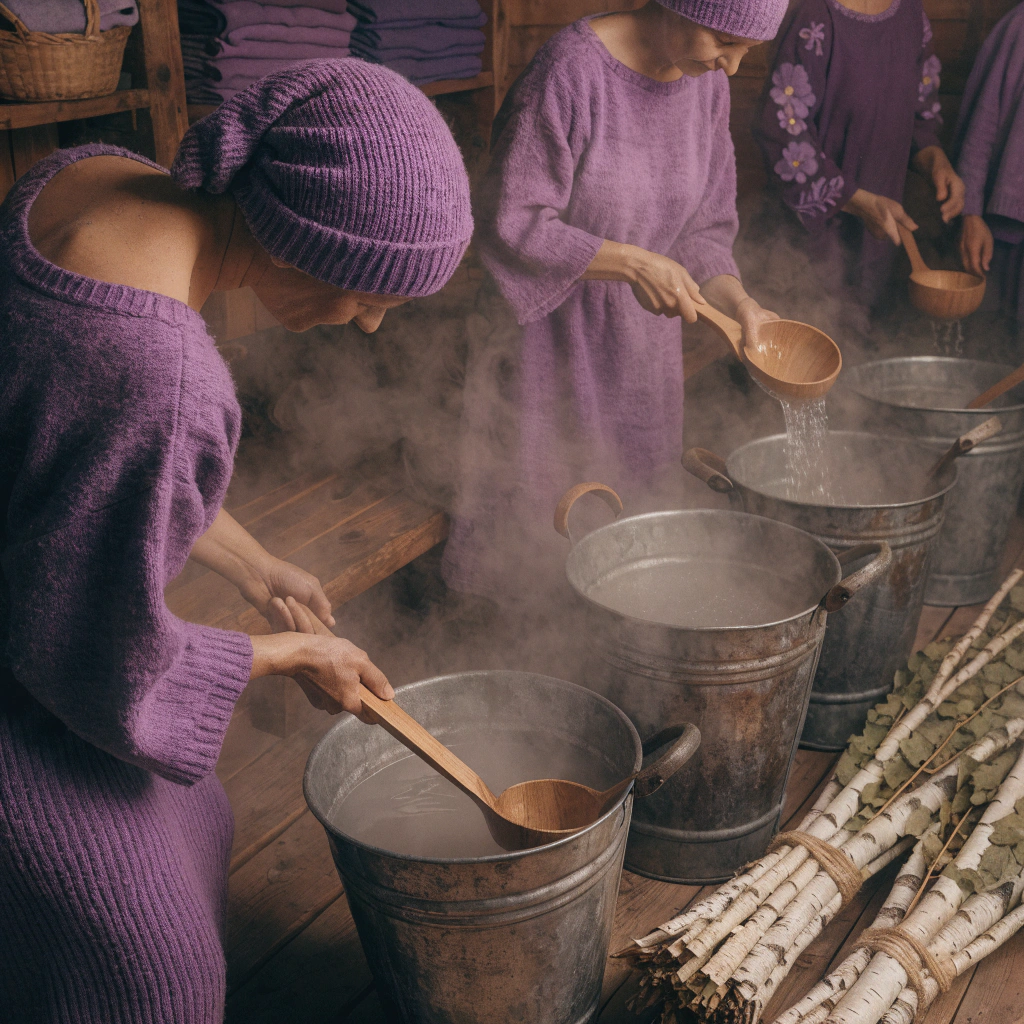
The Traditional Russian Banya
The Russian banya is a very old tradition. It is a special steam bath in Russia. Many people go to the banya with their friends or family.
The banya is very hot. There is a large stove with stones inside. People pour water on the hot stones. This makes a lot of steam. The air is warm and wet.
People use a venik in the banya. A venik is a small bundle of tree branches with leaves. They hit their bodies gently with the venik. This helps the skin and the blood.
After the banya, people feel very clean. They also feel happy and relaxed. It is a great Russian ritual.
Grammatik-Spotlight
Muster: Present Simple (to be)
"The Russian banya is a very old tradition."
We use 'is' with singular subjects like 'banya' to describe facts or states. It is the most common verb in English for descriptions.
Muster: Present Simple (regular verbs)
"People pour water on the hot stones."
We use the base form of the verb (pour) with plural subjects like 'people' to talk about habits or regular actions.
Teste dein Verständnis
10 Fragen · A1 Anfänger · 1 kostenlose Vorschau
Teste, was du aus diesem Artikel gelernt hast. Beantworte alle Fragen und sammle XP!
Where is the banya tradition from?
Möchtest du das Quiz beenden?
9 weitere Fragen warten auf dich. Registriere dich kostenlos, um das vollständige Quiz freizuschalten und XP zu sammeln!
Kostenlos registrierenHast du schon ein Konto? Anmelden
Gut gemacht!
Weiter üben!
Bereits abgeschlossen — keine zusätzlichen XP
Registriere dich, um XP zu verdienenFragenübersicht
Where is the banya tradition from?
Deine Antwort:
Richtige Antwort: Russia
The banya is a cold place.
Deine Antwort:
Richtige Antwort: Falsch
What is a venik?
Deine Antwort:
Richtige Antwort: A bundle of tree branches
People pour _____ on the hot stones.
Deine Antwort:
Richtige Antwort: water
The Russian Banya: A Special Steam Bath
The Russian banya is a special kind of steam bath. It is very important in Russian culture. People go there to clean their bodies and relax with friends. It is much hotter than a regular bathroom because there is a large stone stove.
Inside the banya, people throw water on the hot stones to make steam. This makes the air very wet and hot. Some people use a 'venik.' This is a bundle of dried branches from birch or oak trees. They hit their bodies gently with the venik. This helps the blood move better and makes the skin healthy.
After the hot room, many people jump into cold water or even snow! This is because the change in temperature is good for the heart. The banya is not just for washing. It is a place to talk and feel happy. Many Russians believe the banya cleans the spirit too. It is a great tradition that people still love today.
Grammatik-Spotlight
Muster: Comparatives
"It is much hotter than a regular bathroom because there is a large stone stove."
We use 'hotter than' to compare two things. For short adjectives, we add '-er' and use 'than' after it.
Muster: Conjunction: because
"This is because the change in temperature is good for the heart."
We use 'because' to give a reason for something. It connects a result with its cause.
Teste dein Verständnis
11 Fragen · A2 Grundkenntnisse · 1 kostenlose Vorschau
Teste, was du aus diesem Artikel gelernt hast. Beantworte alle Fragen und sammle XP!
Why do people go to the Russian banya?
Möchtest du das Quiz beenden?
10 weitere Fragen warten auf dich. Registriere dich kostenlos, um das vollständige Quiz freizuschalten und XP zu sammeln!
Kostenlos registrierenHast du schon ein Konto? Anmelden
Gut gemacht!
Weiter üben!
Bereits abgeschlossen — keine zusätzlichen XP
Registriere dich, um XP zu verdienenFragenübersicht
Why do people go to the Russian banya?
Deine Antwort:
Richtige Antwort: To clean their bodies and relax
The air inside a banya is very dry.
Deine Antwort:
Richtige Antwort: Falsch
What is a 'venik'?
Deine Antwort:
Richtige Antwort: A bundle of dried branches
People throw _____ on hot stones to make steam.
Deine Antwort:
Richtige Antwort: water
What do people sometimes jump into after the hot room?
Deine Antwort:
Richtige Antwort: Cold water or snow
The Russian Banya: A Ritual of Physical and Spiritual Purity
The Russian banya is a tradition that has been part of life in Russia for centuries. It is not just a place to wash; it is a ritual which cleans both the body and the soul. Many Russians believe that visiting a banya can cure illnesses and reduce stress. For this reason, it remains a central part of the culture even in modern cities.
The heat in a banya is created by a large stone stove. Water is splashed onto the hot stones to produce a thick, wet steam. This high humidity makes the banya different from a Finnish sauna, which is usually much drier. Inside the steam room, the temperature can become very high, so people often wear special felt hats to protect their heads from the intense heat.
One of the most interesting parts of the experience is the use of the 'venik.' This is a bundle of dried branches, usually made from birch or oak trees, which is used to massage the skin. Sometimes, a professional person called a 'banshik' is hired to hit the skin gently with the venik. Although it might look painful to a stranger, it actually helps to improve blood circulation and relax the muscles.
After spending time in the heat, people often jump into a cold pool or even run outside into the snow. This sudden change in temperature is thought to be very healthy for the heart and the immune system. Finally, the banya is a social place where friends meet to talk and drink herbal tea. It is a unique experience that has remained popular because it connects people to their history and nature.
Grammatik-Spotlight
Muster: Present Perfect
"The Russian banya is a tradition that has been part of life in Russia for centuries."
The present perfect (has/have + past participle) is used here to describe an action or state that started in the past and continues to the present.
Muster: Passive Voice
"The heat in a banya is created by a large stone stove."
The passive voice (is + past participle) is used when the focus is on the action or the object rather than who is performing the action.
Teste dein Verständnis
11 Fragen · B1 Mittelstufe · 1 kostenlose Vorschau
Teste, was du aus diesem Artikel gelernt hast. Beantworte alle Fragen und sammle XP!
What is the main difference between a banya and a Finnish sauna mentioned in the text?
Möchtest du das Quiz beenden?
10 weitere Fragen warten auf dich. Registriere dich kostenlos, um das vollständige Quiz freizuschalten und XP zu sammeln!
Kostenlos registrierenHast du schon ein Konto? Anmelden
Gut gemacht!
Weiter üben!
Bereits abgeschlossen — keine zusätzlichen XP
Registriere dich, um XP zu verdienenFragenübersicht
What is the main difference between a banya and a Finnish sauna mentioned in the text?
Deine Antwort:
Richtige Antwort: The banya has higher humidity and wet steam
People wear felt hats in the banya to keep their heads warm because the room is cold.
Deine Antwort:
Richtige Antwort: Falsch
What does the word 'venik' refer to?
Deine Antwort:
Richtige Antwort: A bundle of branches used for massage
The banya is a _____ place where friends meet to talk and drink tea.
Deine Antwort:
Richtige Antwort: social
What do people often do immediately after the hot steam room?
Deine Antwort:
Richtige Antwort: They jump into a cold pool or snow
The Russian Banya: A Ritual of Physical and Spiritual Purity
For centuries, the Russian banya has long been regarded as a cornerstone of national identity and a vital sanctuary for the soul. Far from being a mere facility for hygiene, the banya represents a profound ritual of purification that seeks to transcend the physical realm. To understand the Russian character, one must eventually step into this traditional steam bath, where the boundaries between physical health and spiritual clarity often blur. While the Finnish sauna is renowned for its dry heat, the banya is characterized by its intense humidity, achieved by splashing water onto a massive stone stove, known as a 'pech'. This creates a thick, heavy steam that envelops the participants in a warm embrace.
One of the most distinctive features of this experience is the use of the 'venik', which consists of a bundle of leafy branches—usually birch, oak, or eucalyptus. During the bathing process, a professional 'banshik' or a companion uses the venik to gently lash the body. Although this may sound aggressive to the uninitiated, the process is actually incredibly invigorating. The rhythmic striking of the leaves helps to stimulate blood circulation and open the pores, allowing for a deeper level of detoxification. If a visitor were to enter the steam room without such preparation, the intensity of the heat might prove overwhelming. However, with the venik, the body undergoes a process of rejuvenation that many practitioners describe as life-altering.
Furthermore, the banya is fundamentally a communal space. Historically, it was a place where villagers gathered to discuss politics, share news, or negotiate business deals. This social aspect remains prevalent today, as friends often spend several hours cycling between the hot steam room and a cold plunge pool or a pile of snow. This ritualistic contrast between extreme temperatures is believed to strengthen the immune system and promote longevity. Despite the modernization of urban life, the tradition continues to endure because it offers a rare opportunity for digital detoxification and genuine human connection. Ultimately, the banya is not just about washing the body; it is an enduring cultural institution that fosters a sense of belonging and inner peace through a shared, multisensory experience.
Grammatik-Spotlight
Muster: Present Perfect Passive
"The Russian banya has long been regarded as a cornerstone of national identity."
This pattern is used to describe an action that started in the past and continues to the present, focusing on the object receiving the action. It is formed using 'has/have + been + past participle'.
Muster: Second Conditional
"If a visitor were to enter the steam room without such preparation, the intensity of the heat might prove overwhelming."
The second conditional is used to talk about hypothetical or unlikely situations in the present or future. It uses 'if + past subjunctive (were to)' and 'would/might + verb'.
Muster: Non-defining Relative Clauses
"One of the most distinctive features of this experience is the use of the 'venik', which consists of a bundle of leafy branches."
These clauses provide extra information about a noun but are not essential for the sentence to make sense. They are always separated by commas and use relative pronouns like 'which' or 'who'.
Teste dein Verständnis
11 Fragen · B2 Obere Mittelstufe · 1 kostenlose Vorschau
Teste, was du aus diesem Artikel gelernt hast. Beantworte alle Fragen und sammle XP!
What is the primary difference between a Finnish sauna and a Russian banya according to the text?
Möchtest du das Quiz beenden?
10 weitere Fragen warten auf dich. Registriere dich kostenlos, um das vollständige Quiz freizuschalten und XP zu sammeln!
Kostenlos registrierenHast du schon ein Konto? Anmelden
Gut gemacht!
Weiter üben!
Bereits abgeschlossen — keine zusätzlichen XP
Registriere dich, um XP zu verdienenFragenübersicht
What is the primary difference between a Finnish sauna and a Russian banya according to the text?
Deine Antwort:
Richtige Antwort: The banya uses high humidity, whereas the sauna is known for dry heat.
The use of the venik is intended to be a painful punishment for the bather.
Deine Antwort:
Richtige Antwort: Falsch
What does the word 'rejuvenation' mean in the context of the article?
Deine Antwort:
Richtige Antwort: The process of feeling younger and more vital.
The banya is described as a _____ space where people historically shared news and discussed politics.
Deine Antwort:
Richtige Antwort: communal
What is the purpose of the 'ritualistic contrast' mentioned in the text?
Deine Antwort:
Richtige Antwort: To strengthen the immune system and promote longevity.
The Alchemical Vapor: Deconstructing the Sociocultural Significance of the Russian Banya
Seldom does one encounter a cultural institution so deeply embedded in the national psyche as the Russian banya. To the uninitiated, it might appear to be a mere variant of the steam bath, yet for the Russian people, it represents the pinnacle of physical and spiritual purification. Unlike the arid atmosphere of a Finnish sauna or the gentle, aromatic mist of a Turkish hammam, the banya is defined by its labyrinthine complexity of heat and moisture. The process involves splashing water onto a massive stone stove, creating a dense, ‘heavy’ steam that demands a visceral level of endurance from its participants.
The preservation of these ancient rituals serves as a poignant reminder of Russia’s historical continuity. Central to this experience is the 'venik'—a bundle of dried birch, oak, or eucalyptus branches. It is through the rhythmic application of the venik that the banya achieves its most profound physiological impact. Whether performed by a companion or a professional 'banshik,' this process, which may resemble a gentle lashing, is designed to stimulate blood circulation and precipitate a deep sense of catharsis. The heat, combined with the botanical oils released from the leaves, facilitates a metamorphosis of the body, purging toxins and invigorating the senses.
Furthermore, the banya functions as a vital communal sanctuary. In a society often characterized by its formal hierarchies, the banya serves as a great equalizer; within its timber walls, social distinctions dissolve into the steam. Not only does the banya facilitate the expulsion of toxins, but it also fosters a profound sense of egalitarianism. Discussions held in the heat range from the mundane to the philosophical, reinforcing social bonds through shared vulnerability. This communal aspect is as vital as the physical cleansing, providing a psychological reprieve from the rigors of modern life.
There is something inherently paradoxical about the banya’s enduring popularity in an age of clinical hygiene and private luxury. Despite the availability of modern showers, the ritualistic nature of the banya remains unchallenged. The transition from the sweltering heat of the steam room to a plunge in an icy pool or a pile of fresh snow is not merely a shock to the system; it is a symbolic rebirth. This cycle of thermal extremes allows the individual to transcend the physical self, achieving a state of clarity that is both rare and highly coveted. Ultimately, the banya is not just a bath; it is a holistic endeavor that seeks to harmonize the body with the spirit, ensuring that the ancient traditions of purity continue to flourish in the contemporary world.
Grammatik-Spotlight
Muster: Negative Inversion
"Seldom does one encounter a cultural institution so deeply embedded in the national psyche as the Russian banya."
Inversion occurs when the verb comes before the subject, often after negative adverbs like 'seldom' or 'rarely' to add emphasis. This structure is common in formal C1-level writing.
Muster: Cleft Sentences
"It is through the rhythmic application of the venik that the banya achieves its most profound physiological impact."
Cleft sentences use the structure 'It is/was + [emphasized part] + that/who...' to focus on a specific piece of information. This highlights the 'venik' as the primary cause of the effect.
Muster: Nominalisation
"The preservation of these ancient rituals serves as a poignant reminder of Russia’s historical continuity."
Nominalisation involves turning verbs or adjectives into nouns (e.g., 'preserve' to 'preservation'). It makes writing more objective, formal, and concise, which is a hallmark of advanced English.
Teste dein Verständnis
12 Fragen · C1 Fortgeschritten · 1 kostenlose Vorschau
Teste, was du aus diesem Artikel gelernt hast. Beantworte alle Fragen und sammle XP!
What is the primary difference between a banya and a Finnish sauna as described in the text?
Möchtest du das Quiz beenden?
11 weitere Fragen warten auf dich. Registriere dich kostenlos, um das vollständige Quiz freizuschalten und XP zu sammeln!
Kostenlos registrierenHast du schon ein Konto? Anmelden
Gut gemacht!
Weiter üben!
Bereits abgeschlossen — keine zusätzlichen XP
Registriere dich, um XP zu verdienenFragenübersicht
What is the primary difference between a banya and a Finnish sauna as described in the text?
Deine Antwort:
Richtige Antwort: The banya utilizes high humidity and a stone stove.
The banya is viewed only as a method for physical hygiene in modern Russia.
Deine Antwort:
Richtige Antwort: Falsch
Which word describes a place of safety or refuge?
Deine Antwort:
Richtige Antwort: Sanctuary
The banya remains a _____ of spiritual and physical purity.
Deine Antwort:
Richtige Antwort: sanctuary
What sociological role does the banya play according to the article?
Deine Antwort:
Richtige Antwort: It acts as an equalizer where social distinctions disappear.
The transition from extreme heat to extreme cold is described as a 'symbolic rebirth'.
Deine Antwort:
Richtige Antwort: Richtig
The Ontological Steam: Deciphering the Russian Banya as a Locus of Purity
To delve into the intricacies of the Russian psyche without acknowledging the 'banya' would be an exercise in futility. For centuries, this traditional steam bath has served as more than a mere utility for hygiene; it is a sanctuary of ontological recalibration, where the profane is shed and the spiritual is ostensibly renewed. Were one to bypass the threshold of a traditional banya, one would effectively overlook the very essence of Slavic resilience and communal identity. Unlike the Finnish sauna, which prioritizes a dry, searing heat, or the Turkish hammam’s gentle humidity, the banya utilizes a volatile thermodynamics known as 'par'—a dense, saturating steam generated by splashing water onto igneous rocks.
This visceral environment is defined by its intensity. To the uninitiated, the heat may seem insurmountable, yet it is precisely this extremity that facilitates a profound physiological homeostasis. Central to this experience is the 'venik', a bundle of dried birch, oak, or eucalyptus branches. While the term 'flagellation' might suggest a punitive act, the rhythmic application of the venik by a 'banshik'—a professional bathmaster—is a therapeutic art. It stimulates micro-circulation and exfoliates the skin, but its primary function is to direct the steam toward the body, enveloping the bather in a fragrant, botanical heat. Lest the ritual be misconstrued as a purely physical endeavor, one must consider the historical and folkloric weight it carries. In pre-revolutionary Russia, the banya was the site of births, weddings, and even political negotiations, acting as a liminal space where the boundaries between the physical and the metaphysical blurred.
Furthermore, the banya fosters a unique form of egalitarianism. Within its timbered walls, social hierarchies are rendered obsolete. Stripped of the trappings of status, participants engage in a communal vulnerability that is increasingly rare in the modern era. Scarcely has the bather entered the steam room before the rigid structures of societal stratification begin to dissolve. It is a space of radical honesty, where conversations range from the trivial to the deeply philosophical. This social aspect is complemented by the subsequent cooling ritual—often a plunge into a freezing river or a roll in the snow. This thermal shock is intended to provide a catharsis that is as psychological as it is physical, a primordial reset for the nervous system.
In contemporary Russia, despite the ubiquity of modern plumbing, the banya remains a steadfast cultural pillar. It represents the apotheosis of Russian stoicism, a testament to the belief that true purity can only be attained through endurance and heat. The experience is often described as ineffable, a sensory overload that somehow results in a state of quietude. It is an idiosyncratic tradition that has survived urbanization and globalization, largely because it provides an ephemeral escape from the relentless pace of 21st-century life. Ultimately, the banya is not merely about washing the body; it is a ritualistic reclamation of the self, ensuring that both the physical and spiritual vessels are cleansed of the grime of existence.
Grammatik-Spotlight
Muster: Inverted Conditionals (Subjunctive)
"Were one to bypass the threshold of a traditional banya, one would effectively overlook the very essence of Slavic resilience."
This structure replaces 'If one were to...' with an inverted verb-subject order for a more formal, academic tone. It is used to discuss hypothetical or unlikely situations in the present or future.
Muster: Negative Inversion for Emphasis
"Scarcely has the bather entered the steam room before the rigid structures of societal stratification begin to dissolve."
When using negative or restrictive adverbs like 'scarcely', 'hardly', or 'never' at the start of a sentence, the auxiliary verb precedes the subject. This emphasizes the immediacy or rarity of the action.
Muster: The Subjunctive 'Lest'
"Lest the ritual be misconstrued as a purely physical endeavor, one must consider the historical and folkloric weight it carries."
The word 'lest' is followed by the base form of the verb (the subjunctive) to express a negative purpose or to prevent an undesirable outcome. It translates to 'for fear that' or 'to avoid the risk of'.
Teste dein Verständnis
12 Fragen · C2 Meisterschaft · 1 kostenlose Vorschau
Teste, was du aus diesem Artikel gelernt hast. Beantworte alle Fragen und sammle XP!
What is the primary difference between the Russian banya and the Finnish sauna according to the text?
Möchtest du das Quiz beenden?
11 weitere Fragen warten auf dich. Registriere dich kostenlos, um das vollständige Quiz freizuschalten und XP zu sammeln!
Kostenlos registrierenHast du schon ein Konto? Anmelden
Gut gemacht!
Weiter üben!
Bereits abgeschlossen — keine zusätzlichen XP
Registriere dich, um XP zu verdienenFragenübersicht
What is the primary difference between the Russian banya and the Finnish sauna according to the text?
Deine Antwort:
Richtige Antwort: The banya utilizes high humidity through 'par' while the sauna is dry.
The use of the 'venik' is described as a punitive measure for those entering the banya.
Deine Antwort:
Richtige Antwort: Falsch
Which word describes something that is too extreme to be expressed in words?
Deine Antwort:
Richtige Antwort: Ineffable
The banya acts as a _____ space where the physical and metaphysical boundaries are blurred.
Deine Antwort:
Richtige Antwort: liminal
How does the banya promote egalitarianism?
Deine Antwort:
Richtige Antwort: By stripping individuals of their status symbols and social trappings.
The text suggests that modern plumbing has made the banya culturally irrelevant in contemporary Russia.
Deine Antwort:
Richtige Antwort: Falsch

