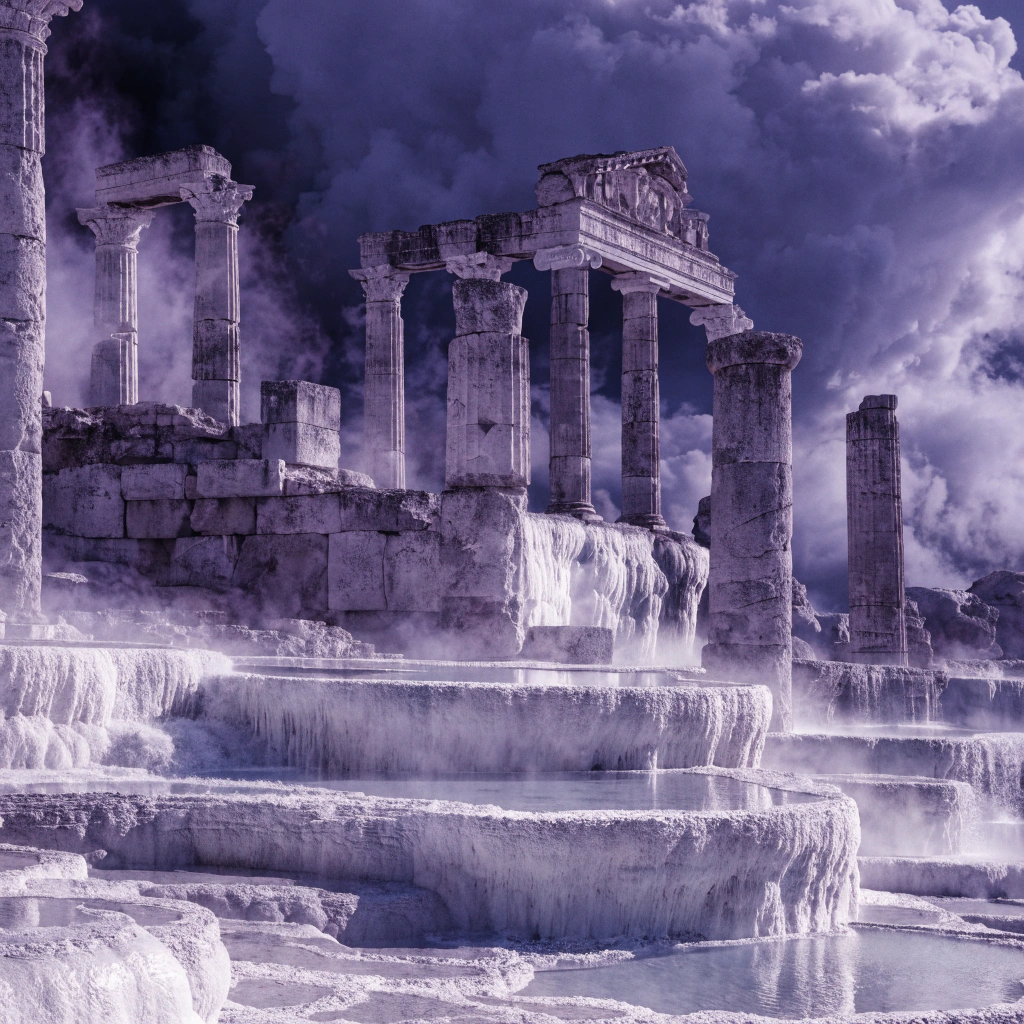
Beautiful Pamukkale
Pamukkale is a famous place in Turkey. It is very beautiful. In English, the name means "Cotton Castle." It looks like a big white mountain with snow. But it is not snow. It is white rock.
There is hot water in Pamukkale. The water comes from the ground. It is warm and good for your body. Many people visit this place. They walk on the white rocks and swim in the water.
The sun is bright here. You can take many photos. It is a special place for a holiday.
Grammatik-Spotlight
Muster: Present Simple 'to be'
"Pamukkale is a famous place in Turkey."
We use 'is' for one person or thing. It helps us describe what something is or where it is located.
Muster: There is / There are
"There is hot water in Pamukkale."
We use 'there is' to show that one thing exists in a place. It is a common way to start a description.
Teste dein Verständnis
10 Fragen · A1 Anfänger · 1 kostenlose Vorschau
Teste, was du aus diesem Artikel gelernt hast. Beantworte alle Fragen und sammle XP!
Where is Pamukkale?
Möchtest du das Quiz beenden?
9 weitere Fragen warten auf dich. Registriere dich kostenlos, um das vollständige Quiz freizuschalten und XP zu sammeln!
Kostenlos registrierenHast du schon ein Konto? Anmelden
Gut gemacht!
Weiter üben!
Bereits abgeschlossen — keine zusätzlichen XP
Registriere dich, um XP zu verdienenFragenübersicht
Where is Pamukkale?
Deine Antwort:
Richtige Antwort: Turkey
The name 'Pamukkale' means 'Cotton Castle' in English.
Deine Antwort:
Richtige Antwort: Richtig
What does 'special' mean?
Deine Antwort:
Richtige Antwort: Not usual or different in a good way
The water comes from the _____.
Deine Antwort:
Richtige Antwort: ground
Pamukkale: The Beautiful Cotton Castle
Pamukkale is a very famous place in southwestern Turkey. In the Turkish language, the name means "Cotton Castle." When you look at it, you see big white hills that look like snow or frozen waterfalls. It is a beautiful natural wonder.
The white hills are not made of ice. They are made of minerals from the hot thermal water. This water comes from the ground and it is very warm. For thousands of years, the water flowed over the cliffs and left white minerals behind. These minerals formed small pools called terraces.
In the past, people built an ancient city called Hierapolis at the top of the hill. Many people visited the city because the thermal water was good for their health. Today, Pamukkale is more popular than it was in the past. Thousands of tourists come every year to swim in the warm water.
Visitors must be careful because the site is very special. You cannot wear shoes on the white terraces because they are delicate. It is a wonderful place to take photos and enjoy nature.
Grammatik-Spotlight
Muster: Comparatives
"Today, Pamukkale is more popular than it was in the past."
We use 'more + adjective + than' to compare two things or times. This helps show how something has changed or how it is different from another thing.
Muster: Past Simple
"In the past, people built an ancient city called Hierapolis at the top of the hill."
The past simple is used for actions that finished in the past. For irregular verbs like 'build', the form changes to 'built'.
Teste dein Verständnis
11 Fragen · A2 Grundkenntnisse · 1 kostenlose Vorschau
Teste, was du aus diesem Artikel gelernt hast. Beantworte alle Fragen und sammle XP!
What does the name 'Pamukkale' mean in English?
Möchtest du das Quiz beenden?
10 weitere Fragen warten auf dich. Registriere dich kostenlos, um das vollständige Quiz freizuschalten und XP zu sammeln!
Kostenlos registrierenHast du schon ein Konto? Anmelden
Gut gemacht!
Weiter üben!
Bereits abgeschlossen — keine zusätzlichen XP
Registriere dich, um XP zu verdienenFragenübersicht
What does the name 'Pamukkale' mean in English?
Deine Antwort:
Richtige Antwort: Cotton Castle
The white hills of Pamukkale are made of real ice.
Deine Antwort:
Richtige Antwort: Falsch
What does 'ancient' mean?
Deine Antwort:
Richtige Antwort: From a long time ago
Visitors cannot wear _____ on the white terraces.
Deine Antwort:
Richtige Antwort: shoes
Why did people visit Hierapolis in the past?
Deine Antwort:
Richtige Antwort: Because the water was good for health
Discovering the Cotton Castle of Turkey
Pamukkale, which literally translates to 'Cotton Castle' in Turkish, is one of the most incredible natural wonders in the world. Located in southwestern Turkey, this site has attracted visitors for thousands of years because of its surreal appearance. The landscape looks like a giant, frozen waterfall or a field of soft white cotton, but it is actually made of carbonate minerals left by flowing thermal spring water.
The warm water has emerged from the earth at high temperatures for centuries. It is heavily saturated with calcium, which creates the famous white terraces. As the water spills over the edge of the plateau, carbon dioxide escapes, and the minerals stay behind to form the hard white stone. These natural pools have been used as a healing spa since the time of the Romans. In fact, the ancient city of Hierapolis was built on top of this 'white castle,' and many of its ruins are still visible today.
In recent years, Pamukkale has been protected as a UNESCO World Heritage site to preserve its beauty. To keep the terraces white and clean, strict rules have been introduced. For example, visitors must take off their shoes before they walk on the mineral surfaces. Many tourists have described the experience as walking on a soft, warm cloud, though the ground is actually quite hard.
If you visit, you can also swim in the 'Antique Pool,' which is filled with warm mineral water. Ancient marble columns have fallen into this pool over time, allowing you to swim among history. Pamukkale has become a popular destination for travelers who want to see a place where history and nature are combined perfectly. It is truly a unique location that everyone should experience at least once.
Grammatik-Spotlight
Muster: Present Perfect Tense
"this site has attracted visitors for thousands of years"
We use the present perfect (has/have + past participle) to talk about an action that started in the past and continues to the present. It emphasizes the connection between the past and now.
Muster: Passive Voice
"the ancient city of Hierapolis was built on top of this 'white castle'"
The passive voice is used when the action or the object (the city) is more important than who did it. It is formed using the verb 'to be' and the past participle of the main verb.
Teste dein Verständnis
11 Fragen · B1 Mittelstufe · 1 kostenlose Vorschau
Teste, was du aus diesem Artikel gelernt hast. Beantworte alle Fragen und sammle XP!
Why is the site called 'Pamukkale'?
Möchtest du das Quiz beenden?
10 weitere Fragen warten auf dich. Registriere dich kostenlos, um das vollständige Quiz freizuschalten und XP zu sammeln!
Kostenlos registrierenHast du schon ein Konto? Anmelden
Gut gemacht!
Weiter üben!
Bereits abgeschlossen — keine zusätzlichen XP
Registriere dich, um XP zu verdienenFragenübersicht
Why is the site called 'Pamukkale'?
Deine Antwort:
Richtige Antwort: Because its appearance resembles white cotton
Visitors are allowed to wear shoes while walking on the white terraces.
Deine Antwort:
Richtige Antwort: Falsch
What does 'ancient' mean?
Deine Antwort:
Richtige Antwort: Very old and from the distant past
Pamukkale is located in _____ Turkey.
Deine Antwort:
Richtige Antwort: southwestern
What created the white terraces over centuries?
Deine Antwort:
Richtige Antwort: Carbonate minerals from thermal water
The Timeless Allure of Pamukkale: Turkey’s Cotton Castle
Situated in the Denizli Province of southwestern Turkey, Pamukkale presents one of the most spectacular natural sights in the world. Often referred to as the 'Cotton Castle' due to its fluffy appearance, this geological phenomenon consists of a series of white travertine terraces that appear to cascade down the mountainside like a frozen waterfall. This unique landscape was formed over millennia as thermal spring water, emerging from the earth at temperatures between 35 and 100 degrees Celsius, flowed over the cliffs. As the water spilled over the plateau and the carbon dioxide escaped, calcium carbonate was deposited as a soft gel, eventually hardening into the brilliant white limestone structures that visitors marvel at today.
Historically, Pamukkale has been recognized not only for its aesthetic beauty but also for its therapeutic properties. The ancient Greco-Roman city of Hierapolis was established atop the white 'castle' during the second century BC, allowing citizens to benefit from the mineral-rich waters which were believed to cure various ailments. Even today, the archaeological ruins of Hierapolis, including a remarkably well-preserved theater, a grand colonnaded street, and a vast necropolis, stand as a testament to the region's historical significance. Consequently, the site was designated a UNESCO World Heritage site in 1988, acknowledging both its natural and cultural importance as a bridge between the physical world and human antiquity.
Nevertheless, the immense popularity of Pamukkale has brought significant challenges regarding its preservation. In the mid-20th century, the site faced a crisis when the construction of hotels and roads directly on the travertines led to severe damage and discoloration. The delicate ecosystem was nearly destroyed by unregulated tourism and the diversion of thermal waters for hotel pools. Since then, the Turkish government has implemented strict measures to ensure sustainable tourism. For instance, visitors are now required to remove their shoes before walking on the terraces to prevent erosion and pollution. Furthermore, the flow of water is now carefully managed by a computerized system to ensure that the terraces maintain their iconic white color and do not turn grey due to algae growth.
In conclusion, Pamukkale represents a delicate balance between natural wonder and human history. While the site continues to attract millions of tourists seeking the healing power of its thermal springs, the ongoing efforts to protect the environment are crucial. If the authorities had not intervened decades ago, the 'Cotton Castle' might have lost its luster entirely. Today, it remains a breathtaking symbol of how geological processes and human civilization can coexist, provided that preservation remains a top priority for future generations.
Grammatik-Spotlight
Muster: Passive Voice
"This unique landscape was formed over millennia as thermal spring water... flowed over the cliffs."
The passive voice is used here to focus on the action (the formation of the landscape) rather than the agent. It is formed using 'was/were' followed by the past participle.
Muster: Relative Clauses
"The ancient Greco-Roman city of Hierapolis was established atop the white 'castle' during the second century BC, allowing citizens to benefit from the mineral-rich waters which were believed to cure various ailments."
The word 'which' introduces a relative clause that provides additional information about the 'waters'. In B2 English, these are used to combine ideas and add detail to nouns.
Muster: Third Conditional
"If the authorities had not intervened decades ago, the 'Cotton Castle' might have lost its luster entirely."
This pattern is used to talk about an imaginary situation in the past and its imaginary result. It uses 'if + past perfect' and 'might/would have + past participle'.
Teste dein Verständnis
11 Fragen · B2 Obere Mittelstufe · 1 kostenlose Vorschau
Teste, was du aus diesem Artikel gelernt hast. Beantworte alle Fragen und sammle XP!
What is the main chemical component responsible for the white terraces?
Möchtest du das Quiz beenden?
10 weitere Fragen warten auf dich. Registriere dich kostenlos, um das vollständige Quiz freizuschalten und XP zu sammeln!
Kostenlos registrierenHast du schon ein Konto? Anmelden
Gut gemacht!
Weiter üben!
Bereits abgeschlossen — keine zusätzlichen XP
Registriere dich, um XP zu verdienenFragenübersicht
What is the main chemical component responsible for the white terraces?
Deine Antwort:
Richtige Antwort: Calcium carbonate
The city of Hierapolis was built primarily for military defense purposes.
Deine Antwort:
Richtige Antwort: Falsch
What does 'sustainable' mean in the context of tourism?
Deine Antwort:
Richtige Antwort: Meeting current needs without compromising future generations
To prevent damage to the terraces, visitors are required to remove their _____.
Deine Antwort:
Richtige Antwort: shoes
Why is the water flow currently managed by a computerized system?
Deine Antwort:
Richtige Antwort: To prevent algae growth and maintain the white color
The Ephemeral Splendour of the Cotton Castle: Geological Marvels and Environmental Imperatives
The sheer visual impact of Pamukkale’s travertine terraces is unparalleled in the natural world. Nestled in the Menderes River valley in southwestern Turkey, this 'Cotton Castle' presents a landscape so surreal it appears almost otherworldly. Seldom does nature manifest its chemical processes with such overt aesthetic brilliance. The formation of these white cascades is a masterclass in geochemistry: thermal waters, heavily saturated with calcium bicarbonate, surge from the earth at temperatures ranging from 35 to 100 degrees Celsius. As this water spills over the plateau’s edge, the subsequent release of carbon dioxide triggers the precipitation of calcium carbonate, which eventually hardens into the crystalline travertine we see today.
However, the site is far more than a geological curiosity; it is a palimpsest of human history. It was the therapeutic allure of these thermal springs that prompted the Romans to establish the spa city of Hierapolis atop the plateau. For centuries, the site served as a sanctuary for those seeking the purported healing properties of the mineral-rich waters. Today, the ruins of Hierapolis—including its vast necropolis and well-preserved theatre—stand in silent testimony to the enduring human fascination with this ephemeral landscape. The juxtaposition of ancient stone and white mineral deposits creates a visual dialogue between the permanence of human architecture and the fluid, evolving nature of the earth.
Yet, the very popularity that brings global recognition to Pamukkale also poses its greatest threat. The encroachment of modern infrastructure and the sheer volume of foot traffic have necessitated stringent conservation measures. In the late 20th century, the site suffered significant degradation due to unregulated hotel construction and the diversion of thermal waters for swimming pools. Only through the implementation of rigorous management plans, including the demolition of hotels and the restriction of visitor access to certain areas, has the site begun to recover its pristine character. The restoration process highlights the fragility of such natural wonders when faced with the demands of mass tourism.
Striking a balance between the preservation of this delicate ecosystem and its accessibility as a global heritage site remains a contentious issue. While tourism provides the economic impetus for conservation, it simultaneously exerts pressure on the fragile mineral formations. The imperative to protect Pamukkale is not merely an aesthetic one; it is a duty to preserve a unique record of the Earth's history. As we navigate the complexities of sustainable travel, Pamukkale serves as a poignant reminder that even the most seemingly solid structures are, in fact, vulnerable to the passage of time and the impact of human presence. To visit Pamukkale today is to witness a landscape in constant flux, a testament to the power of water to both build and erode.
Grammatik-Spotlight
Muster: Negative Inversion
"Seldom does nature manifest its chemical processes with such overt aesthetic brilliance."
Inversion is used after negative or restrictive adverbs (like 'seldom') to add emphasis. The auxiliary verb comes before the subject.
Muster: Cleft Sentence
"It was the therapeutic allure of these thermal springs that prompted the Romans to establish the spa city of Hierapolis atop the plateau."
Cleft sentences (It + is/was + subject + that/who) are used to focus on a specific piece of information, in this case, the reason for the city's location.
Muster: Nominalisation
"The encroachment of modern infrastructure and the sheer volume of foot traffic have necessitated stringent conservation measures."
Nominalisation turns verbs (encroach) into nouns (encroachment) to create a more formal, academic tone typical of C1 level writing.
Teste dein Verständnis
12 Fragen · C1 Fortgeschritten · 1 kostenlose Vorschau
Teste, was du aus diesem Artikel gelernt hast. Beantworte alle Fragen und sammle XP!
What primary chemical process leads to the formation of the white terraces at Pamukkale?
Möchtest du das Quiz beenden?
11 weitere Fragen warten auf dich. Registriere dich kostenlos, um das vollständige Quiz freizuschalten und XP zu sammeln!
Kostenlos registrierenHast du schon ein Konto? Anmelden
Gut gemacht!
Weiter üben!
Bereits abgeschlossen — keine zusätzlichen XP
Registriere dich, um XP zu verdienenFragenübersicht
What primary chemical process leads to the formation of the white terraces at Pamukkale?
Deine Antwort:
Richtige Antwort: The precipitation of calcium carbonate as CO2 escapes
The city of Hierapolis was built primarily for military defense due to its high plateau location.
Deine Antwort:
Richtige Antwort: Falsch
Which word best describes something that is controversial and likely to cause disagreement?
Deine Antwort:
Richtige Antwort: Contentious
The release of carbon dioxide triggers the _____ of calcium carbonate.
Deine Antwort:
Richtige Antwort: precipitation
What led to the significant degradation of the site in the late 20th century?
Deine Antwort:
Richtige Antwort: Unregulated hotel construction and water diversion
Current conservation efforts include the demolition of some hotels previously built on the site.
Deine Antwort:
Richtige Antwort: Richtig
The Petrification of Time: An Ontological Inquiry into the Travertines of Pamukkale
Looming over the Menderes Valley, the calcified terraces of Pamukkale present a tableau so starkly ethereal that they seem to defy the very laws of terrestrial geology. Known colloquially as the 'Cotton Castle,' this site is not merely a topographical anomaly but a profound testament to the intricate interplay between subterranean thermal activity and atmospheric chemistry. Were one to scrutinize the genesis of these travertines, one would find a process of sedimentary precipitation that has unfolded over millennia, whereby hyper-saturated thermal waters, emerging from the earth's crust at temperatures exceeding 35 degrees Celsius, undergo a rapid loss of carbon dioxide upon exposure to the air. This chemical shift facilitates the deposition of calcium carbonate, which, in its nascent form, manifests as a soft gel before eventually hardening into the resilient, gleaming white limestone that characterizes the plateau.
The allure of Pamukkale is further augmented by its juxtaposition with the ruins of Hierapolis, a Greco-Roman spa city established atop the terraces. It is imperative that we recognize the symbiotic relationship between the geological provenance of the site and its historical significance. The ancients, perceiving the therapeutic potential of the mineral-laden waters, sought to harness these natural springs, thereby creating a locus of healing and intellectual exchange. However, the contemporary observer might well ponder whether the anthropogenic pressures of modern tourism have not inadvertently compromised the very integrity of the site. Had the authorities not intervened in the late 20th century to restrict pedestrian access and remove deleterious infrastructure, the pristine whiteness of the travertines might have been irrevocably tarnished by pollution and erosion.
Delving deeper into the chemical idiosyncrasies of the site, the transformation of calcium bicarbonate into calcium carbonate is a quintessential example of equilibrium shift in nature. The thermal springs, emerging from the depths through a fault line, are saturated with dissolved minerals. As the water cascades down the mountain, the decrease in pressure and the turbulence of the flow facilitate the degasification of carbon dioxide. This phenomenon, which can be described as an aqueous exhalation, triggers the precipitation of the mineral deposits. It is a process that defies the conventional speed of geological change, creating a landscape that is ostensibly static yet perpetually in flux. Scholars have hypothesized that the rate of deposition is influenced by seasonal variations in atmospheric humidity and temperature, suggesting a complex feedback loop between the lithosphere and the atmosphere.
The historical narrative of Hierapolis is inextricably woven into the fabric of the travertines. The city, whose name translates to 'Holy City,' was renowned throughout the ancient world for its thermal springs, which were believed to possess curative properties for a myriad of ailments, ranging from rheumatism to digestive disorders. The presence of the Plutonium—a sanctuary dedicated to Pluto, the god of the underworld—highlights the mystical aura that the site commanded. Here, noxious gases emerging from a cavern were utilized by priests to demonstrate divine power, a practice that underscores the intersection of geological reality and mythological interpretation. The sheer architectural grandeur of the Roman theatre, overlooking the white terraces, serves as a poignant reminder of the hubris and sophistication of past civilizations that sought to domesticate this wild, mineralized landscape.
Academic discourse regarding Pamukkale often adopts a tone of cautious optimism, employing hedging to acknowledge the precarious balance between preservation and accessibility. It is argued that while the restoration of the water flow has mitigated some of the damage, the long-term viability of the ecosystem remains subject to the vicissitudes of climate change and regional water management. Furthermore, the ontological status of Pamukkale—as both a natural monument and a cultural artifact—demands a multi-disciplinary approach to its stewardship. Little did the early excavators realize that the preservation of the limestone would require such a sophisticated understanding of hydrogeology.
In conclusion, Pamukkale stands as a palimpsest of geological and human history. It serves as a reminder that the most seemingly enduring landscapes are often the most fragile. Should we fail to uphold our collective responsibility toward this UNESCO World Heritage site, we risk losing a unique window into the Earth's transformative power. The ethereal beauty of the 'Cotton Castle' invites us not only to marvel at its aesthetic splendor but also to reflect upon the temporal nature of our own existence within the vast expanse of geological time.
Grammatik-Spotlight
Muster: Inverted Conditional
"Were one to scrutinize the genesis of these travertines, one would find a process of sedimentary precipitation..."
This is a formal alternative to 'If one were to scrutinize'. It uses inversion by placing the verb before the subject to convey a hypothetical or formal tone.
Muster: Negative Inversion
"Little did the early excavators realize that the preservation of the limestone would require such a sophisticated understanding of hydrogeology."
Starting a sentence with a negative adverbial like 'Little' requires the auxiliary verb to come before the subject. This structure is used for rhetorical emphasis.
Muster: Subjunctive Mood
"It is imperative that we recognize the symbiotic relationship between the geological provenance of the site and its historical significance."
The subjunctive mood is used after adjectives of necessity (imperative, vital, essential). It uses the base form of the verb regardless of the subject.
Teste dein Verständnis
12 Fragen · C2 Meisterschaft · 1 kostenlose Vorschau
Teste, was du aus diesem Artikel gelernt hast. Beantworte alle Fragen und sammle XP!
What primary chemical process results in the formation of the white terraces?
Möchtest du das Quiz beenden?
11 weitere Fragen warten auf dich. Registriere dich kostenlos, um das vollständige Quiz freizuschalten und XP zu sammeln!
Kostenlos registrierenHast du schon ein Konto? Anmelden
Gut gemacht!
Weiter üben!
Bereits abgeschlossen — keine zusätzlichen XP
Registriere dich, um XP zu verdienenFragenübersicht
What primary chemical process results in the formation of the white terraces?
Deine Antwort:
Richtige Antwort: The precipitation of calcium carbonate following CO2 degasification
The city of Hierapolis was founded primarily for its military strategic location.
Deine Antwort:
Richtige Antwort: Falsch
What does 'deleterious' mean in the context of the article?
Deine Antwort:
Richtige Antwort: Harmful or damaging
The allure of Pamukkale is further _____ by its juxtaposition with the ruins of Hierapolis.
Deine Antwort:
Richtige Antwort: augmented
What does the term 'aqueous exhalation' refer to in the text?
Deine Antwort:
Richtige Antwort: The release of carbon dioxide from the water
Government intervention in the late 20th century was necessary to prevent the permanent discoloration of the site.
Deine Antwort:
Richtige Antwort: Richtig

