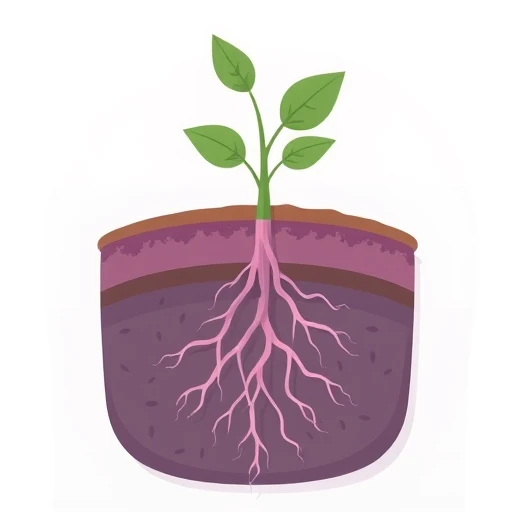
root in 30 Sekunden
- Root primarily refers to the underground part of a plant that provides stability and nutrients, but it is also used metaphorically to describe origins and causes.
- As a verb, 'root' can mean to cheer for a team (root for), to search through items (root around), or for a plant to grow roots.
- It is a common term in mathematics (square root), computing (root access), and linguistics (word roots), making it highly versatile across many different fields.
- Common idioms include 'taking root' (becoming established) and 'putting down roots' (settling in a place), emphasizing the concept of foundation and permanence.
The word root is a multifaceted term that serves as a cornerstone in both biological sciences and metaphorical language. At its most fundamental level, a root is the part of a plant that typically grows underground, anchoring the plant to the soil and absorbing essential water and nutrients. However, the utility of the word extends far beyond the garden. In a broader sense, it refers to the fundamental source, origin, or basis of something. Whether you are discussing the root of a problem, your ancestral roots, or the root of a word, you are identifying the core element from which everything else develops. This versatility makes it an indispensable part of the English lexicon, appearing in contexts ranging from mathematics and computing to sports and social justice.
- Biological Foundation
- In botany, the root is the first organ to appear when a seed germinates. It provides stability, ensuring the plant isn't swept away by wind or rain, and acts as a complex hydraulic system for the entire organism. Without a healthy root system, the visible parts of the plant—the stem, leaves, and flowers—cannot survive.
- Metaphorical Origin
- Metaphorically, we use 'root' to describe the beginning of an idea, a conflict, or a tradition. When we say 'money is the root of all evil,' we are suggesting that the desire for money is the primary cause of many bad actions. Similarly, 'getting to the root of the matter' means finding the underlying truth behind a complex situation.
- Cultural Identity
- People often speak of their 'roots' to refer to their heritage, family history, or the place where they grew up. This usage emphasizes a sense of belonging and the historical factors that shape an individual's identity today.
To solve the conflict, we must first address the root causes of the inequality that exists in the community.
In addition to its role as a noun, 'root' functions as a dynamic verb. It can describe the physical act of a plant taking hold in the soil, or it can be used colloquially in sports and competitions. To root for someone is to cheer them on, showing enthusiastic support for their success. This phrasal verb is ubiquitous in American English, especially during baseball or football seasons. Furthermore, the verb can mean to search or rummage through something, often followed by 'around' or 'through,' as in 'rooting through a drawer for a lost key.'
The gardener was happy to see the new cuttings finally start to root in the damp soil.
- Mathematics and Logic
- In mathematics, a 'square root' is a value that, when multiplied by itself, gives the original number. This concept is foundational to algebra and geometry. In logic and computer science, the 'root' is the top-level node in a tree structure, such as a file system's root directory.
The fans were rooting for the underdog team to win the championship against all odds.
Ultimately, 'root' is a word that connects the physical world of nature with the abstract world of human thought and social structures. It reminds us that everything—from a towering oak tree to a complex political movement—has a beginning and a foundation that sustains it. Understanding the 'root' of something is the first step toward truly understanding the thing itself.
Using the word root correctly requires an understanding of its grammatical roles as both a noun and a verb, as well as its various idiomatic applications. Because it can describe physical objects, abstract concepts, and specific actions, the sentence structure often changes to accommodate the intended meaning. Below, we explore how to integrate 'root' into your writing and speech across different contexts.
- As a Concrete Noun
- When referring to plants, 'root' is a countable noun. You might describe the length, depth, or health of a root. In a sentence: 'The roots of the ancient willow tree had cracked the pavement.' Here, the noun is the subject performing an action on the environment.
- As an Abstract Noun
- When discussing causes or origins, 'root' is often used in the singular and followed by the preposition 'of.' For example: 'Jealousy was the root of their constant arguments.' It can also be used as an adjective-like modifier in the phrase 'root cause,' which is very common in professional and academic settings.
The detective worked tirelessly to find the root of the conspiracy that had paralyzed the city's government.
The verb forms of 'root' are particularly interesting because they often require specific prepositions to change their meaning. These are known as phrasal verbs. Understanding these pairings is essential for natural-sounding English.
- 'Root for' (Support)
- This is used to show support for a person or team. 'I am rooting for you to get that job!' It is almost always used in the continuous tense ('rooting') when expressing active support.
- 'Root out' (Eliminate)
- This means to find and remove something harmful or unwanted. 'The new CEO promised to root out corruption within the company.' It implies a deep, thorough search and removal process.
- 'Root around/through' (Search)
- This describes a physical search, often messy or unorganized. 'She was rooting around in her purse for her lipstick.' This usage evokes the image of an animal digging in the dirt.
Even though they were the visiting team, many local fans began to root for them because of their incredible sportsmanship.
In academic writing, 'root' often appears in discussions of linguistics or history. You might write about the 'Latin roots of English words' or the 'historical roots of a conflict.' In these cases, the word is almost always a noun and is used to provide depth and context to the subject matter.
The professor explained that the root of the word 'education' comes from the Latin 'educere,' meaning to lead out.
Whether you are cheering for a friend, analyzing a complex problem, or planting a garden, 'root' provides a strong, evocative way to describe the foundations of our world. By mastering its various forms and prepositions, you can communicate with greater precision and emotional resonance.
The word root is a linguistic chameleon, blending into various environments from the casual chatter of a sports bar to the precise language of a laboratory or a boardroom. Understanding these contexts will help you recognize the word's nuances and use it more naturally in your own conversations.
- In Sports and Entertainment
- Perhaps the most common place to hear 'root' as a verb is in the context of sports. Fans will ask, 'Who are you rooting for tonight?' This implies a deep emotional investment in the outcome of a game. You'll also hear it in movies or talent shows where an audience is encouraged to support an underdog character.
- In Professional and Business Settings
- In the workplace, 'root' is frequently used in 'root cause analysis' (RCA). This is a systematic process for identifying the origins of problems or events. Managers might say, 'We need to get to the root of why this project is over budget.' It suggests a desire for a permanent solution rather than a quick fix.
- In Technology and Computing
- For tech enthusiasts and software engineers, 'root' has a very specific meaning. It refers to the 'root user' or 'superuser' who has total control over an operating system. To 'root' a phone (especially Android devices) means to gain administrative access to the system files, allowing for deep customization.
'If you want to customize your operating system beyond the factory settings, you'll need root access,' the technician explained.
In everyday life, you'll encounter 'root' in many idiomatic expressions that have become part of the common vernacular. These phrases often use the concept of a plant's foundation to describe human behavior or social phenomena.
- 'Grassroots' Movements
- This term describes political or social movements that start from the local level with ordinary people, rather than being organized by traditional power structures. You'll hear this often in news reports about community organizing or political campaigns.
- 'Deep-rooted' Beliefs
- When someone has a belief or a habit that is very difficult to change, we say it is 'deep-rooted.' This evokes the image of a tree with roots so deep they cannot be easily pulled out. You might hear this in discussions about psychology, culture, or prejudice.
The candidate's success was largely attributed to a powerful grassroots campaign that mobilized thousands of first-time voters.
From the soil of a garden to the code of a computer, 'root' is everywhere. By paying attention to these different domains, you'll start to see how this simple word provides the structural framework for much of our language and thought.
While root is a common word, its multiple meanings and similar-sounding counterparts can lead to several frequent errors. Avoiding these mistakes will make your English sound more professional and precise.
- Confusing 'Root' and 'Route'
- This is the most common mistake. A root is an origin or plant part. A route is a path or way to travel. In some American dialects, both are pronounced like 'root' (rhyming with 'boot'), while in others, 'route' rhymes with 'out.'
Incorrect: 'What is the fastest root to the airport?'
Correct: 'What is the fastest route to the airport?' - Misusing 'Root For' vs. 'Root Out'
- These phrasal verbs have opposite connotations. 'Root for' is positive (supporting), while 'root out' is negative (eliminating something bad).
Incorrect: 'I am rooting out my brother in his race today.' (This sounds like you want to eliminate him!)
Correct: 'I am rooting for my brother in his race today.'
Common Error: Using root when you mean a journey path. Remember: Plants have roots; travelers take routes.
Another area of confusion involves the pluralization of 'root' when referring to heritage. While 'root' can be singular when referring to a specific cause, it is almost always plural when referring to a person's background.
- Singular vs. Plural for Heritage
- When talking about where your family comes from, use 'roots.'
Incorrect: 'I went back to Italy to find my root.'
Correct: 'I went back to Italy to find my roots.' - Spelling: 'Root' vs. 'Rout'
- 'Rout' (without the second 'o') means a decisive defeat or a disorganized retreat. It is pronounced like 'out.'
Incorrect: 'The team suffered a total root.'
Correct: 'The team suffered a total rout.'
Finally, be careful with the verb 'root' in British English. While 'rooting for' is understood, 'root' can sometimes have a vulgar slang meaning in Australia and New Zealand. If you are in those regions, 'cheering for' or 'supporting' might be safer alternatives to avoid unintended double meanings.
To truly master the word root, it is helpful to understand its synonyms and how they differ in nuance. Choosing the right alternative can make your writing more specific and sophisticated.
- Root vs. Source
- 'Source' is often used for where something physical comes from (like a source of water) or where information originates. 'Root' implies a deeper, more foundational cause. You find the source of a river, but the root of a problem.
- Root vs. Origin
- 'Origin' is more formal and often refers to the point in time or space where something began. 'Root' suggests that the beginning is still connected to and influencing the present. The origin of the universe is a moment; the roots of a culture are ongoing influences.
- Root vs. Foundation
- 'Foundation' is typically used for buildings or structured systems of thought. 'Root' is more organic. You build a foundation for a house, but a community's traditions have roots.
While the source of the leak was a broken pipe, the root of the issue was poor maintenance over several years.
When using 'root' as a verb, there are also several alternatives depending on the specific action you are describing.
- Alternatives for 'Root for'
- Cheer for, support, back, advocate for, champion. 'Champion' is more formal and implies active defense of a cause.
- Alternatives for 'Root out'
- Eradicate, eliminate, weed out, extirpate. 'Eradicate' is very strong and often used in medical or social contexts (e.g., eradicating a disease).
- Alternatives for 'Root through'
- Rummage, forage, delve, scavenge. 'Forage' is often used for animals looking for food, while 'rummage' is common for people looking through drawers.
By expanding your vocabulary with these alternatives, you can avoid repetition and ensure that your language perfectly matches the tone and precision required for any situation.
How Formal Is It?
Wusstest du?
The word 'radical' actually comes from the Latin word for root, 'radix'. To be radical originally meant to go to the root of a matter.
Aussprachehilfe
- Pronouncing it like 'rout' (rhyming with 'out').
- Confusing it with the American pronunciation of 'route' (which can be identical).
- Shortening the vowel too much in the UK accent.
- Adding a 'w' sound (e.g., 'rwut').
- Swapping the 't' for a 'd' sound ('rood').
Schwierigkeitsgrad
Easy to recognize in context.
Requires knowledge of phrasal verbs.
Pronunciation can be tricky with 'route'.
Commonly used and clear.
Was du als Nächstes lernen solltest
Voraussetzungen
Als Nächstes lernen
Fortgeschritten
Wichtige Grammatik
Phrasal Verbs
Root for, root out, root through.
Compound Adjectives
Deep-rooted, long-rooted.
Metaphorical Nouns
The root of the problem.
Transitive vs Intransitive
The plant rooted (intransitive); the storm uprooted the tree (transitive).
Gerunds
Rooting for the team is my favorite weekend activity.
Beispiele nach Niveau
The plant has a long root.
La plante a une longue racine.
Singular noun.
Roots grow under the ground.
Les racines poussent sous la terre.
Plural noun.
Water the roots of the flower.
Arrosez les racines de la fleur.
Object of the sentence.
This tree has very strong roots.
Cet arbre a des racines très fortes.
Descriptive adjective + noun.
A carrot is a type of root.
Une carotte est un type de racine.
Predicate nominative.
The root is brown.
La racine est brune.
Simple subject-verb-adjective.
Do not cut the root.
Ne coupez pas la racine.
Imperative negative.
The root drinks water.
La racine boit de l'eau.
Personification for simplicity.
My family roots are in Italy.
Mes racines familiales sont en Italie.
Metaphorical plural noun.
I am rooting for my favorite team.
Je soutiens mon équipe préférée.
Present continuous phrasal verb.
Who do you root for in the World Cup?
Qui soutiens-tu pendant la Coupe du Monde ?
Interrogative phrasal verb.
She wants to find her roots.
Elle veut retrouver ses racines.
Infinitive phrase.
The plant is starting to root.
La plante commence à prendre racine.
Intransitive verb.
We are rooting for you to pass the test!
Nous croisons les doigts pour que tu réussisses l'examen !
Phrasal verb with object.
He has deep roots in this town.
Il a des racines profondes dans cette ville.
Adjective + plural noun.
The root of the tree broke the pipe.
La racine de l'arbre a cassé le tuyau.
Subject of a past tense verb.
What is the root of the problem?
Quelle est la racine du problème ?
Abstract noun.
We need to find the root cause of the error.
Nous devons trouver la cause profonde de l'erreur.
Compound noun 'root cause'.
The tradition has its roots in the 18th century.
La tradition tire ses racines du XVIIIe siècle.
Possessive + plural noun.
I was rooting through my bag for my keys.
Je fouillais dans mon sac pour mes clés.
Phrasal verb 'root through'.
The conflict has very deep roots.
Le conflit a des racines très profondes.
Metaphorical usage.
Money is often called the root of all evil.
L'argent est souvent appelé la racine de tous les maux.
Common proverb.
The square root of nine is three.
La racine carrée de neuf est trois.
Mathematical term.
He rooted around in the drawer.
Il a fouillé dans le tiroir.
Phrasal verb 'root around'.
The government is trying to root out corruption.
Le gouvernement essaie d'extirper la corruption.
Phrasal verb 'root out'.
These beliefs are deep-rooted in our culture.
Ces croyances sont profondément ancrées dans notre culture.
Compound adjective 'deep-rooted'.
The new policy took root very quickly.
La nouvelle politique a pris racine très rapidement.
Idiom 'take root'.
You need to find the root directory of the server.
Vous devez trouver le répertoire racine du serveur.
Computing term.
The linguist studied the Latin roots of the word.
Le linguiste a étudié les racines latines du mot.
Linguistic term.
She has finally decided to put down roots in this city.
Elle a enfin décidé de s'installer durablement dans cette ville.
Idiom 'put down roots'.
The pig was rooting for truffles in the forest.
Le cochon cherchait des truffes dans la forêt.
Literal verb meaning 'to dig'.
The root of the tooth was infected.
La racine de la dent était infectée.
Medical/Dental term.
The systemic inequality is rooted in centuries of history.
L'inégalité systémique est enracinée dans des siècles d'histoire.
Passive voice 'is rooted in'.
The company performed a thorough root-cause analysis.
L'entreprise a effectué une analyse approfondie des causes profondes.
Hyphenated compound noun.
His anxiety was rooted in a childhood trauma.
Son anxiété était ancrée dans un traumatisme d'enfance.
Metaphorical passive.
The movement was a grassroots effort by local farmers.
Le mouvement était un effort populaire des agriculteurs locaux.
Compound adjective 'grassroots'.
The philosopher explored the metaphysical roots of existence.
Le philosophe a exploré les racines métaphysiques de l'existence.
Abstract academic usage.
They attempted to root out the spies within the organization.
Ils ont tenté de débusquer les espions au sein de l'organisation.
Phrasal verb 'root out'.
The music has its roots in traditional folk melodies.
La musique tire ses racines des mélodies folkloriques traditionnelles.
Cultural origin usage.
The scandal uprooted the entire political establishment.
Le scandale a bouleversé tout l'establishment politique.
Related verb 'uproot'.
The report suggested a root-and-branch reform of the healthcare system.
Le rapport suggérait une réforme radicale du système de santé.
Idiom 'root-and-branch'.
Her cynicism was so deep-rooted that no argument could sway her.
Son cynisme était si profondément ancré qu'aucun argument ne pouvait la faire fléchir.
Intensified compound adjective.
The etymological root of the term provides insight into its current usage.
La racine étymologique du terme donne un aperçu de son usage actuel.
Technical linguistic usage.
The protagonist felt completely uprooted after the war.
Le protagoniste se sentait complètement déraciné après la guerre.
Metaphorical 'uprooted'.
The radical ideology took root in the fertile ground of economic despair.
L'idéologie radicale a pris racine sur le terrain fertile du désespoir économique.
Complex metaphorical imagery.
We must address the root causes rather than just treating the symptoms.
Nous devons nous attaquer aux causes profondes plutôt que de simplement traiter les symptômes.
Common academic/medical metaphor.
The software requires root privileges to execute the command.
Le logiciel nécessite des privilèges root pour exécuter la commande.
Technical computing usage.
The poet spoke of the rootless cosmopolitanism of the modern era.
Le poète parlait du cosmopolitisme sans racines de l'ère moderne.
Adjective 'rootless'.
Synonyme
Gegenteile
Häufige Kollokationen
Häufige Phrasen
— The most important part of a situation.
Let's get to the root of the matter.
— To settle in a place and make it your home.
After years of traveling, they finally put down roots in Oregon.
— The primary cause of bad things happening.
Some say greed is the root of all evil.
— To move away from your home and start over somewhere else.
She had to uproot her life when she lost her job.
— Based on or influenced by historical events.
Their traditions are deeply rooted in the past.
— Unable to move because of fear or shock.
He stood rooted to the spot when he saw the bear.
— The most basic level of an organization or society.
Change must happen at the grassroots level.
— The base part of a word to which prefixes and suffixes are added.
The root of 'unhappiness' is 'happy'.
Wird oft verwechselt mit
A path or way. Pronounced 'root' or 'rowt'.
A total defeat. Pronounced like 'out'.
Impolite. Sounds similar but has a 'd' at the end.
Redewendungen & Ausdrücke
— To become established or fixed.
The suspicion began to take root in his mind.
Neutral— To settle down and live in one place for a long time.
They are looking for a house to put down roots.
Neutral— The fundamental cause of a difficulty.
Communication is often the root of the problem.
Neutral— To support the person or team that is expected to lose.
I always root for the underdog.
Informal— So shocked or scared that you cannot move.
She was rooted to the spot with terror.
Neutral— Greed for money causes many problems.
He believes that money is the root of all evil.
Neutral— To find and remove something completely.
We must root out the cause of the infection.
Neutral— To leave the place where you have been living.
They pulled up roots and moved to Australia.
Neutral— Being the main cause of something.
A misunderstanding was at the root of their argument.
NeutralLeicht verwechselbar
Identical pronunciation in some US dialects.
Route is a path; root is an origin or plant part.
Take the scenic route to see the tree roots.
Similar spelling.
Rout is a defeat; root is a base.
The game was a rout for the team I root for.
A person who roots.
Often used for a tool (plumbing) or a fan (rarely).
The plumber used a rooter to clear the pipes.
Related but different action.
Root is to establish; uproot is to remove.
Don't uproot the flowers while they are rooting.
Etymologically the same.
Radical is an adjective for extreme change; root is the noun base.
A radical change goes to the root of the problem.
Satzmuster
The [noun] has [adjective] roots.
The tree has big roots.
I am rooting for [team/person].
I am rooting for Sarah.
What is the root of [problem]?
What is the root of the noise?
It is time to put down roots in [place].
It is time to put down roots in London.
The issue is rooted in [history/concept].
The issue is rooted in old laws.
A root-and-branch [noun] is required.
A root-and-branch review is required.
He was rooting through [object] for [object].
He was rooting through the box for a pen.
We must root out [negative noun].
We must root out the corruption.
Wortfamilie
Substantive
Verben
Adjektive
Verwandt
So verwendest du es
Very common in both daily speech and specialized fields.
-
Using 'root' instead of 'route' for a path.
→
What is the best route?
A route is a path; a root is a plant part.
-
Saying 'I am rooting out you' to mean support.
→
I am rooting for you.
'Root out' means to eliminate; 'root for' means to support.
-
Using 'root' singular for heritage.
→
I am looking for my roots.
Heritage is almost always referred to as 'roots' in the plural.
-
Spelling it 'rout' for the plant part.
→
The plant has a root.
'Rout' is a defeat; 'root' is the plant part.
-
Confusing 'root' with 'rude'.
→
That was a root (plant) / That was rude (impolite).
They sound similar but have different endings and meanings.
Tipps
Gardening Context
Always use 'root' when talking about the health of your plants' underground systems.
Cheering
Use 'rooting for' when you want to show you are a fan of someone.
Analysis
Use 'root cause' to show you are looking for deep solutions, not just quick fixes.
Equations
Remember the symbol √ is called the root symbol.
Heritage
Use 'roots' in the plural when talking about your ancestors.
Admin Access
In Linux or Android, 'root' is the most powerful user account.
Finding Things
Use 'rooting around' for a messy search in a drawer or bag.
Settling Down
Use 'put down roots' when you decide to stay in a city forever.
Double O
Remember 'root' has two 'o's like 'boot'.
Regional Slang
Avoid using 'root' as a verb in Australia unless you mean 'cheer for'.
Einprägen
Eselsbrücke
Roots are the 'Room' of the plant under the 'Outdoors' (R-O-O-T).
Visuelle Assoziation
Imagine a giant tree with roots that look like the veins in a human heart, connecting the earth to the sky.
Word Web
Herausforderung
Write three sentences using 'root' as a noun, a verb for cheering, and a verb for searching.
Wortherkunft
Derived from the Old English 'rōt', which comes from Old Norse 'rót'. It is related to the Latin 'radix' and the Greek 'rhiza'.
Ursprüngliche Bedeutung: The underground part of a plant.
GermanicKultureller Kontext
Be aware of the Australian slang meaning (sexual intercourse) to avoid embarrassment in casual conversation there.
In the US, 'rooting for' is standard. In the UK, 'supporting' is more common, though 'rooting' is understood.
Im Alltag üben
Kontexte aus dem Alltag
Gardening
- Healthy roots
- Root rot
- Deep-rooted
- Rooting powder
Sports
- Root for the home team
- Rooting interest
- Fan support
- Cheer on
Problem Solving
- Root cause analysis
- Get to the root
- Underlying issue
- Core problem
Mathematics
- Square root
- Cube root
- Find the root
- Root of an equation
Computing
- Root access
- Root directory
- Root user
- Rooting a device
Gesprächseinstiege
"Who are you rooting for in the upcoming playoffs?"
"Have you ever tried to trace your family roots back several generations?"
"What do you think is the root cause of the current housing crisis?"
"Do you find it easy to put down roots in a new city, or do you prefer moving around?"
"Can you explain the difference between a square root and a cube root to me?"
Tagebuch-Impulse
Describe a time you had to root through your belongings to find something important. What was the outcome?
Write about your cultural roots. How have they shaped the person you are today?
Reflect on a problem you solved by finding its root cause rather than just fixing the symptoms.
If you could put down roots anywhere in the world, where would it be and why?
Discuss a belief you have that is deep-rooted. Where did it come from?
Häufig gestellte Fragen
10 FragenIt is both! As a noun, it's a plant part or an origin. As a verb, it means to cheer for someone or to search through things.
In the UK, it rhymes with 'boot'. In the US, it usually rhymes with 'boot' but can sometimes rhyme with 'foot'.
It means to support or cheer for a person or a team in a competition.
It is the primary, underlying reason why something happened, especially a problem.
Yes, you can use 'roots' (plural) to talk about your heritage or where your family comes from.
In math, it is a number that, when multiplied by itself, gives a specific result (e.g., 3 is the square root of 9).
It means an idea or a plant has become established and started to grow.
In Australia and New Zealand, it is vulgar slang for sex. Be careful using it there!
In computers, it is the top-level folder that contains all other folders and files.
It means to find and completely remove something bad, like corruption or a disease.
Teste dich selbst 180 Fragen
Describe the roots of a tree you have seen.
Well written! Good try! Check the sample answer below.
Who do you root for in sports and why?
Well written! Good try! Check the sample answer below.
Explain the 'root cause' of a common problem like being late.
Well written! Good try! Check the sample answer below.
Describe your family roots in five sentences.
Well written! Good try! Check the sample answer below.
What does it mean to 'put down roots' in a new city?
Well written! Good try! Check the sample answer below.
How can a government 'root out' corruption?
Well written! Good try! Check the sample answer below.
Discuss a 'deep-rooted' tradition in your country.
Well written! Good try! Check the sample answer below.
Explain the importance of 'grassroots' movements in politics.
Well written! Good try! Check the sample answer below.
Analyze the etymological root of a word of your choice.
Well written! Good try! Check the sample answer below.
Compare 'root' and 'source' in a short paragraph.
Well written! Good try! Check the sample answer below.
Write a story about someone who was 'rooted to the spot'.
Well written! Good try! Check the sample answer below.
Describe the process of a plant taking root.
Well written! Good try! Check the sample answer below.
What are the pros and cons of 'uprooting' your life?
Well written! Good try! Check the sample answer below.
Explain the concept of a 'square root' to a child.
Well written! Good try! Check the sample answer below.
How do 'roots' define our identity?
Well written! Good try! Check the sample answer below.
Describe a time you had to root through a messy room.
Well written! Good try! Check the sample answer below.
What is the 'root of all evil' in modern society?
Well written! Good try! Check the sample answer below.
Write a dialogue between two fans rooting for different teams.
Well written! Good try! Check the sample answer below.
How does 'root access' change how someone uses a phone?
Well written! Good try! Check the sample answer below.
Discuss the 'root-and-branch' changes needed in education.
Well written! Good try! Check the sample answer below.
Talk about your favorite sports team and why you root for them.
Read this aloud:
Du hast gesagt:
Speech recognition is not supported in your browser. Try Chrome or Edge.
Describe where your family roots are.
Read this aloud:
Du hast gesagt:
Speech recognition is not supported in your browser. Try Chrome or Edge.
Explain a problem you had and how you found the root cause.
Read this aloud:
Du hast gesagt:
Speech recognition is not supported in your browser. Try Chrome or Edge.
Discuss the importance of roots for a plant's survival.
Read this aloud:
Du hast gesagt:
Speech recognition is not supported in your browser. Try Chrome or Edge.
Debate the phrase 'Money is the root of all evil'.
Read this aloud:
Du hast gesagt:
Speech recognition is not supported in your browser. Try Chrome or Edge.
Tell a story about a time you were rooted to the spot.
Read this aloud:
Du hast gesagt:
Speech recognition is not supported in your browser. Try Chrome or Edge.
Describe a grassroots movement you support.
Read this aloud:
Du hast gesagt:
Speech recognition is not supported in your browser. Try Chrome or Edge.
Explain how to calculate a square root.
Read this aloud:
Du hast gesagt:
Speech recognition is not supported in your browser. Try Chrome or Edge.
Talk about the pros and cons of rooting a smartphone.
Read this aloud:
Du hast gesagt:
Speech recognition is not supported in your browser. Try Chrome or Edge.
Discuss how traditions take root in a society.
Read this aloud:
Du hast gesagt:
Speech recognition is not supported in your browser. Try Chrome or Edge.
Describe a time you had to root through a messy closet.
Read this aloud:
Du hast gesagt:
Speech recognition is not supported in your browser. Try Chrome or Edge.
Talk about a person you know who has deep roots in their community.
Read this aloud:
Du hast gesagt:
Speech recognition is not supported in your browser. Try Chrome or Edge.
Explain the etymology of a word you find interesting.
Read this aloud:
Du hast gesagt:
Speech recognition is not supported in your browser. Try Chrome or Edge.
Discuss the feeling of being uprooted.
Read this aloud:
Du hast gesagt:
Speech recognition is not supported in your browser. Try Chrome or Edge.
How do you root out bad habits?
Read this aloud:
Du hast gesagt:
Speech recognition is not supported in your browser. Try Chrome or Edge.
Describe the different parts of a plant including the root.
Read this aloud:
Du hast gesagt:
Speech recognition is not supported in your browser. Try Chrome or Edge.
Who are you rooting for in the next World Cup?
Read this aloud:
Du hast gesagt:
Speech recognition is not supported in your browser. Try Chrome or Edge.
What is the root of your motivation to learn English?
Read this aloud:
Du hast gesagt:
Speech recognition is not supported in your browser. Try Chrome or Edge.
Discuss 'root-and-branch' changes in your workplace.
Read this aloud:
Du hast gesagt:
Speech recognition is not supported in your browser. Try Chrome or Edge.
Explain the role of roots in preventing soil erosion.
Read this aloud:
Du hast gesagt:
Speech recognition is not supported in your browser. Try Chrome or Edge.
Listen to a gardener talk about root health and answer questions.
Listen to a sports commentary and identify the team being rooted for.
Listen to a lecture on root cause analysis.
Listen to a podcast about genealogy and family roots.
Listen to a tech tutorial on root access.
Listen to a news report on a grassroots political movement.
Listen to a poem and identify metaphorical uses of 'root'.
Listen to a math teacher explaining square roots.
Listen to a dental patient's experience with a root canal.
Listen to a debate on the roots of social inequality.
Listen to a conversation about 'rooting through' old photos.
Listen to a fan cheering and identify the phrasal verb used.
Listen to a description of a 'deep-rooted' belief.
Listen to a scientist talk about root systems in the rainforest.
Listen to a speech about 'rooting out' inefficiency.
I am rooting out my team to win.
'Root out' means to eliminate; 'root for' means to support.
The tree has many routes.
Routes are paths; roots are plant parts.
He was rooted to the spot with joy.
'Rooted to the spot' is usually for negative or overwhelming shock.
Write a sentence using 'root' as a verb meaning 'to search'.
Well written! Good try! Check the sample answer below.
Explain the idiom 'root and branch'.
Read this aloud:
Du hast gesagt:
Speech recognition is not supported in your browser. Try Chrome or Edge.
/ 180 correct
Perfect score!
Summary
The word 'root' connects physical foundations with abstract origins. Whether you are gardening, solving a problem, or cheering at a game, 'root' describes the essential base of an action or object. Example: 'Finding the root cause of the leak saved the company thousands of dollars.'
- Root primarily refers to the underground part of a plant that provides stability and nutrients, but it is also used metaphorically to describe origins and causes.
- As a verb, 'root' can mean to cheer for a team (root for), to search through items (root around), or for a plant to grow roots.
- It is a common term in mathematics (square root), computing (root access), and linguistics (word roots), making it highly versatile across many different fields.
- Common idioms include 'taking root' (becoming established) and 'putting down roots' (settling in a place), emphasizing the concept of foundation and permanence.
Gardening Context
Always use 'root' when talking about the health of your plants' underground systems.
Cheering
Use 'rooting for' when you want to show you are a fan of someone.
Analysis
Use 'root cause' to show you are looking for deep solutions, not just quick fixes.
Equations
Remember the symbol √ is called the root symbol.