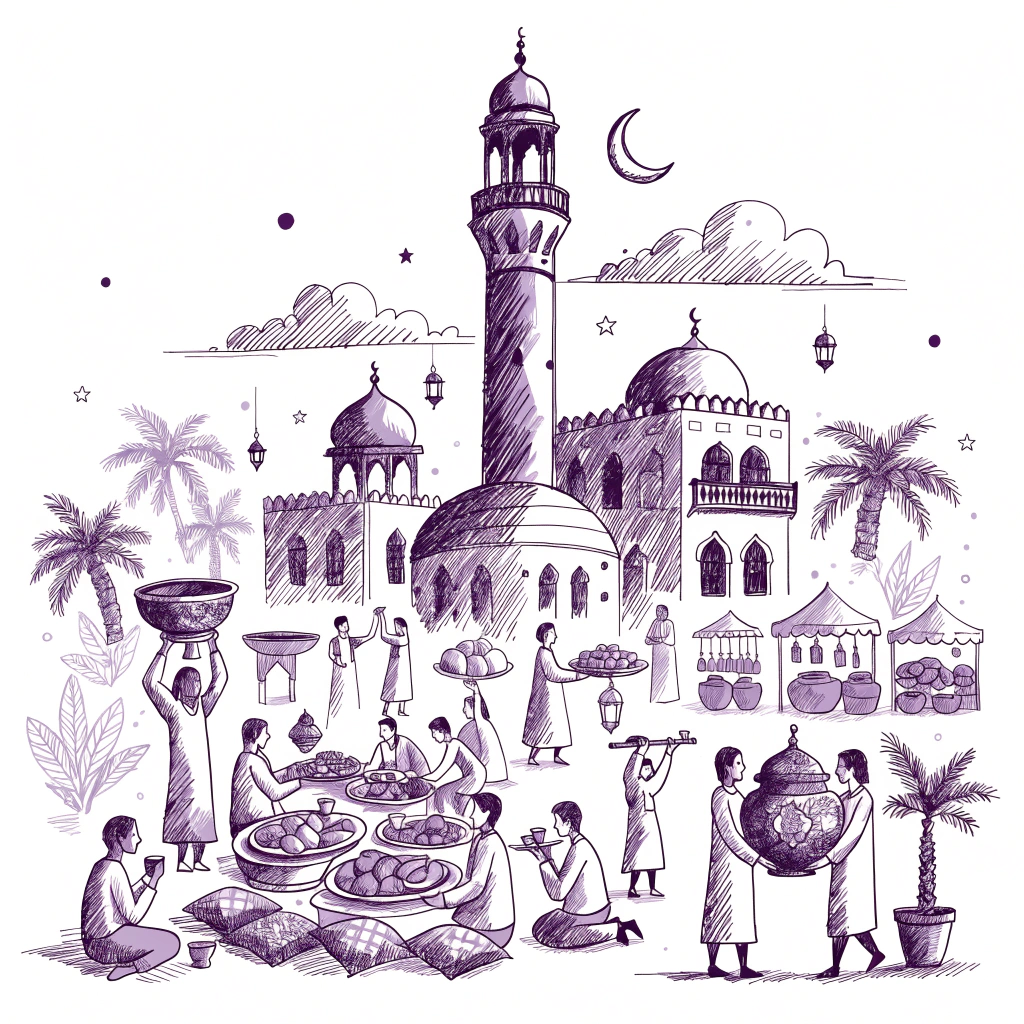
Ramadan and Eid in the UAE
Ramadan is a special month in the UAE. Muslims do not eat or drink from sunrise to sunset. This is called fasting. It is a time for prayer and family.
People give money to the poor. They eat a big meal with friends at night. This meal is called Iftar. The city is very quiet during the day.
After Ramadan, there is a big festival. It is Eid Al Fitr. People wear new clothes. They visit their families. Children get gifts and sweets. It is a happy time.
نکته دستوری
الگو: Present Simple (Verb to be)
"Ramadan is a special month in the UAE."
We use 'is' with singular subjects like Ramadan to describe facts. This pattern is Subject + is + noun/adjective.
الگو: Present Simple (Negative)
"Muslims do not eat or drink from sunrise to sunset."
We use 'do not' before the verb to make a negative sentence. We use this for habits or things that are not true.
درک خود را بسنجید
10 سوال · A1 مبتدی · 1 پیشنمایش رایگان
آنچه از این مقاله آموختید را بسنجید. به همه سؤالات پاسخ دهید و XP کسب کنید!
What is the big meal at night called?
آیا میخواهید آزمون را تمام کنید؟
9 سؤال دیگر منتظر شماست. ثبتنام رایگان کنید تا آزمون کامل را باز کنید و XP کسب کنید!
ثبتنام رایگانقبلاً ثبتنام کردی؟ ورود
جزئیات سؤالات
What is the big meal at night called?
پاسخ شما:
پاسخ درست: Iftar
People eat and drink during the day in Ramadan.
پاسخ شما:
پاسخ درست: نادرست
What is a festival?
پاسخ شما:
پاسخ درست: A special day for celebration
People wear new ____ during Eid.
پاسخ شما:
پاسخ درست: clothes
Ramadan and Eid Al Fitr in the UAE
Ramadan is a special time in the United Arab Emirates. It is the holiest month for Muslims. During this month, people do not eat or drink from sunrise until sunset. This is called fasting. People fast because they want to focus on their religion and help others.
In the UAE, the streets are quieter during the day. However, the cities become more beautiful at night with many lights. Last year, my family and I went to a large Iftar tent in Dubai. We ate dates and drank water first, and then we had a big dinner. People are kinder and more generous during this month. They often give money or food to those who need help.
After thirty days of Ramadan, there is a big celebration called Eid Al Fitr. It is a very happy time. Children usually wear new clothes and receive gifts or money. Families visit each other and eat delicious traditional food. Eid is more exciting than regular days because everyone celebrates together. It is a time of joy and peace.
نکته دستوری
الگو: Past Simple
"Last year, my family and I went to a large Iftar tent in Dubai."
We use the past simple to talk about finished actions in the past. In this sentence, 'went' is the past form of the irregular verb 'go'.
الگو: Comparatives
"Eid is more exciting than regular days because everyone celebrates together."
We use 'more' + adjective + 'than' for long adjectives to compare two things. It shows that one thing has more of a quality than the other.
درک خود را بسنجید
11 سوال · A2 مقدماتی · 1 پیشنمایش رایگان
آنچه از این مقاله آموختید را بسنجید. به همه سؤالات پاسخ دهید و XP کسب کنید!
Why do people fast during Ramadan?
آیا میخواهید آزمون را تمام کنید؟
10 سؤال دیگر منتظر شماست. ثبتنام رایگان کنید تا آزمون کامل را باز کنید و XP کسب کنید!
ثبتنام رایگانقبلاً ثبتنام کردی؟ ورود
جزئیات سؤالات
Why do people fast during Ramadan?
پاسخ شما:
پاسخ درست: To focus on religion and help others
People in the UAE eat and drink during the day in Ramadan.
پاسخ شما:
پاسخ درست: نادرست
What does 'generous' mean?
پاسخ شما:
پاسخ درست: Being willing to give money or help
Families and friends meet for a meal called _____.
پاسخ شما:
پاسخ درست: Iftar
What do children usually receive during Eid Al Fitr?
پاسخ شما:
پاسخ درست: New clothes and gifts
A Special Time: Ramadan and Eid in the UAE
Ramadan is a holy month that is observed by millions of Muslims in the United Arab Emirates every year. It is a special time for spiritual reflection, prayer, and community. During this month, many people have changed their daily routines to focus more on their faith and family. Because the lunar calendar determines the dates, the start of Ramadan moves slightly every year.
From dawn until sunset, Muslims abstain from all food and drink. This practice, which is called fasting, helps people to understand the lives of those who are less fortunate. Acts of charity, known as Zakat, are also performed frequently during this period. While the pace of life has slowed down during the day, the cities become very lively after the sun goes down. In the UAE, a traditional cannon is often fired to signal the end of the fast.
The fast is broken with a meal called Iftar. Traditionally, dates and water are eaten first because this follows the practice of the Prophet. Large tents have been set up across the country where free meals are shared with neighbors and workers. Before the sun rises, another small meal called Suhoor is eaten to prepare the body for the long day ahead.
When the month of Ramadan ends, the festival of Eid Al Fitr begins. It is a joyful celebration that usually lasts for three days. New clothes are worn by everyone, and special gifts are often given to children by their relatives. Families gather in large groups to share delicious traditional food and celebrate their successful spiritual journey. This beautiful tradition has been kept alive for many generations in the Emirates, and it continues to bring the community together in peace and harmony.
نکته دستوری
الگو: Passive Voice
"Large tents have been set up across the country where free meals are shared with neighbors and workers."
The passive voice is used when the action is more important than the person doing it. It is formed using the verb 'to be' and the past participle.
الگو: Relative Clauses
"This practice, which is called fasting, helps people to understand the lives of those who are less fortunate."
Relative clauses give more information about a noun. 'Which' is used for things, and 'who' is used for people.
درک خود را بسنجید
11 سوال · B1 متوسط · 1 پیشنمایش رایگان
آنچه از این مقاله آموختید را بسنجید. به همه سؤالات پاسخ دهید و XP کسب کنید!
What is one reason people fast during Ramadan according to the text?
آیا میخواهید آزمون را تمام کنید؟
10 سؤال دیگر منتظر شماست. ثبتنام رایگان کنید تا آزمون کامل را باز کنید و XP کسب کنید!
ثبتنام رایگانقبلاً ثبتنام کردی؟ ورود
جزئیات سؤالات
What is one reason people fast during Ramadan according to the text?
پاسخ شما:
پاسخ درست: To understand the lives of less fortunate people
Life in UAE cities becomes more active during the day than at night in Ramadan.
پاسخ شما:
پاسخ درست: نادرست
What does the word 'abstain' mean?
پاسخ شما:
پاسخ درست: To choose not to do something
The meal eaten to break the fast at sunset is called _____.
پاسخ شما:
پاسخ درست: Iftar
What signal is traditionally used in the UAE to mark the end of the daily fast?
پاسخ شما:
پاسخ درست: A traditional cannon
The Spiritual and Cultural Significance of Ramadan and Eid Al Fitr in the UAE
Ramadan, the ninth month of the Islamic lunar calendar, represents a period of immense spiritual significance in the United Arab Emirates. As one of the Five Pillars of Islam, it is observed by millions as a time for fasting, prayer, and deep reflection. During this sacred month, the atmosphere across the seven emirates undergoes a remarkable transformation, characterized by a sense of tranquility and communal solidarity. From dawn until sunset, individuals abstain from all food and drink, focusing their energy on spiritual growth and the practice of Zakat, or charity. Observing this period of self-discipline is not merely an individual endeavor but a collective experience that strengthens social bonds.
In the UAE, the pace of daily life slows down significantly to accommodate those who are fasting. Working hours are typically reduced, and the streets become quieter during the day. However, as the sun sets, the Iftar meal brings families and friends together to break their fast. This communal gathering is often followed by Taraweeh prayers at the local mosque, where the sound of recitation echoes through the night. The spirit of hospitality is further exemplified by the numerous Iftar tents established across the country, providing free meals to everyone, regardless of their background. Consequently, the month serves as an educational opportunity for expatriates to gain a deeper understanding of Islamic values.
Furthermore, the cultural impact of Ramadan is profound for residents and visitors alike. While non-Muslims are not expected to fast, they are encouraged to show respect by avoiding eating or drinking in public places during daylight hours. This mutual respect fosters a harmonious environment where tradition and modernity coexist. The conclusion of Ramadan is marked by the celebration of Eid Al Fitr, a joyous festival that translates to the Festival of Breaking the Fast. It begins with a special congregational prayer in the early morning, followed by visits to relatives and neighbors.
During these festivities, children often receive Eidiya, which is a small gift of money, and families share elaborate meals together. It is a time for gratitude, forgiveness, and wishing for continued prosperity. Ultimately, the transition from the introspective nature of Ramadan to the vibrant celebrations of Eid reflects the balance of faith and community life that defines the UAE's identity. This cycle of devotion and celebration remains a cornerstone of the nation’s cultural fabric.
نکته دستوری
الگو: Passive Voice
"Ramadan is observed by millions as a time for fasting, prayer, and deep reflection."
The passive voice is used here to focus on the action (observing Ramadan) rather than the specific people doing it. It is formed using the verb 'to be' plus the past participle.
الگو: Relative Clauses with 'where'
"This communal gathering is often followed by Taraweeh prayers at the local mosque, where the sound of recitation echoes through the night."
The word 'where' introduces a relative clause that provides more information about a place (the mosque). It connects two ideas smoothly within a single complex sentence.
الگو: Gerunds as Subjects
"Observing this period of self-discipline is not merely an individual endeavor but a collective experience."
A gerund (the -ing form of a verb) can function as a noun and act as the subject of a sentence. It allows for a more formal and academic tone when discussing concepts or actions.
درک خود را بسنجید
11 سوال · B2 بالاتر از متوسط · 1 پیشنمایش رایگان
آنچه از این مقاله آموختید را بسنجید. به همه سؤالات پاسخ دهید و XP کسب کنید!
What is the primary focus of Muslims during the daylight hours of Ramadan?
آیا میخواهید آزمون را تمام کنید؟
10 سؤال دیگر منتظر شماست. ثبتنام رایگان کنید تا آزمون کامل را باز کنید و XP کسب کنید!
ثبتنام رایگانقبلاً ثبتنام کردی؟ ورود
جزئیات سؤالات
What is the primary focus of Muslims during the daylight hours of Ramadan?
پاسخ شما:
پاسخ درست: Spiritual growth and self-discipline
Non-Muslims in the UAE are expected to fast alongside their Muslim colleagues.
پاسخ شما:
پاسخ درست: نادرست
What does 'hospitality' mean in the context of the article?
پاسخ شما:
پاسخ درست: Generous treatment of guests
The meal eaten after sunset to break the fast is called _____.
پاسخ شما:
پاسخ درست: Iftar
What does the word 'Eidiya' refer to?
پاسخ شما:
پاسخ درست: A small gift of money for children
The Spiritual Metamorphosis: Navigating Ramadan and Eid Al Fitr in the Modern Emirates
Seldom does a modern metropolis undergo such a profound metamorphosis as that experienced by the United Arab Emirates during the holy month of Ramadan. In a region often defined by its rapid architectural expansion and globalized commerce, the arrival of the Islamic lunar calendar’s ninth month precipitates a shift toward introspection and communal sanctity. It is the collective adherence to abstinence from dawn until dusk that fosters a sense of shared purpose, transcending the disparate backgrounds of the UAE’s multifaceted population. This period is not merely a ritualistic obligation but a quintessential cultural cornerstone that reshapes the very rhythm of urban life.
Throughout the month, the legislative and social landscape adjusts to accommodate the spiritual needs of the faithful. Reduced working hours and a general deceleration of pace allow for increased devotion and the practice of Zakat, or altruism. The atmosphere is one of pervasive tranquility, yet it is punctuated by the vibrant traditions that define the Emirati experience. As the sun dips below the horizon, the silence of the afternoon is broken by the thunderous roar of the Iftar cannon—a historical signifier that the fast has ended. What follows is the act of commensality, where families and strangers alike gather to share dates and water before the evening prayer, reinforcing the bonds of brotherhood and social cohesion.
However, the significance of Ramadan extends beyond the physical act of fasting. It is through the lens of charity and self-discipline that the community reflects on its values. The proliferation of 'Ramadan Tents' and public banquets serves as a testament to the nation’s commitment to hospitality. Despite the ephemeral nature of the month, its impact on the collective psyche is enduring. The focus shifts from individualistic acquisition to communal well-being, a necessary recalibration in an era of relentless modernization.
The transition from the introspective nature of Ramadan to the celebratory atmosphere of Eid Al Fitr is both marked and joyous. As the new moon is sighted, the period of pious restraint gives way to three days of unbridled jubilation. Eid in the UAE is characterized by the donning of traditional attire, the exchange of gifts, and the gathering of extended families. It is during these festivities that the inviolable link between heritage and contemporary identity is most visible. While the skyscrapers of Dubai and Abu Dhabi continue to gleam in the background, the emphasis remains firmly on the age-old customs of visiting relatives and offering 'Eidiya' to children.
Ultimately, the observation of Ramadan and Eid Al Fitr in the Emirates provides a nuanced counter-narrative to the perception of the UAE as a purely materialistic society. By prioritizing spiritual growth over economic momentum, the country demonstrates a unique ability to harmonize its religious roots with its global aspirations. This annual cycle serves as a reminder that even in the most forward-looking nations, the preservation of sacred traditions remains a vital component of national resilience and social harmony.
نکته دستوری
الگو: Negative Inversion
"Seldom does a modern metropolis undergo such a profound metamorphosis..."
When a sentence begins with a negative or restrictive adverb like 'seldom' or 'never', the auxiliary verb comes before the subject. This is used in formal English to add emphasis.
الگو: It-Cleft Sentences
"It is the collective adherence to abstinence from dawn until dusk that fosters a sense of shared purpose..."
This structure (It + be + focus + relative clause) is used to emphasize a specific part of the sentence, in this case, the cause of the shared purpose.
الگو: Nominalisation
"The transition from the introspective nature of Ramadan to the celebratory atmosphere of Eid Al Fitr is both marked and joyous."
Nominalisation involves using a noun phrase ('The transition from...') instead of a verb ('When the month transitions...'). This is a hallmark of C1/C2 writing, making the text more objective and dense.
درک خود را بسنجید
12 سوال · C1 پیشرفته · 1 پیشنمایش رایگان
آنچه از این مقاله آموختید را بسنجید. به همه سؤالات پاسخ دهید و XP کسب کنید!
What is the primary effect of Ramadan on the UAE's urban rhythm according to the text?
آیا میخواهید آزمون را تمام کنید؟
11 سؤال دیگر منتظر شماست. ثبتنام رایگان کنید تا آزمون کامل را باز کنید و XP کسب کنید!
ثبتنام رایگانقبلاً ثبتنام کردی؟ ورود
جزئیات سؤالات
What is the primary effect of Ramadan on the UAE's urban rhythm according to the text?
پاسخ شما:
پاسخ درست: A shift toward introspection and communal sanctity
The text suggests that the UAE's legislative landscape remains unchanged during Ramadan.
پاسخ شما:
پاسخ درست: نادرست
What does the word 'commensality' refer to in the context of the article?
پاسخ شما:
پاسخ درست: The practice of eating together
The thunderous roar of the Iftar _____ is a historical signifier that the fast has ended.
پاسخ شما:
پاسخ درست: cannon
What does the author suggest about the relationship between modernity and tradition in the UAE?
پاسخ شما:
پاسخ درست: The nation harmonizes religious roots with global aspirations.
Eid Al Fitr is described as a period of pious restraint.
پاسخ شما:
پاسخ درست: نادرست
The Metaphysical Tapestry: Asceticism and Communal Catharsis in the Emirati Ramadan
The observation of Ramadan within the United Arab Emirates transcends mere religious ritual, manifesting instead as a profound socio-cultural paradigm shift that recalibrates the very rhythm of the nation. To the uninitiated, the month might appear as a period of simple dietary restriction; however, for the practitioner and the discerning observer alike, it represents a sophisticated exercise in collective abnegation and spiritual introspection. Rarely does a modern metropolis, typically characterized by the relentless pursuit of commercial acceleration, undergo such a profound metamorphosis as that seen in Abu Dhabi or Dubai during this holy month.
The diurnal stillness that pervades the UAE during Ramadan is not merely a byproduct of reduced working hours, but rather an intentional cultivation of a liminal space. It is within this quietude that the asceticism of the fast finds its purpose. By abstaining from sustenance from dawn until dusk, the individual is compelled to confront the ephemeral nature of material desires. This period of restraint is ostensibly designed to foster 'Taqwa'—a heightened state of God-consciousness—yet its societal implications are equally significant. The juxtaposition of the modern, high-tech infrastructure of the Emirates with the ancient, rhythmic traditions of the fast creates a unique cultural synthesis.
Central to the social fabric during this period is the Iftar, the breaking of the fast. In the UAE, this event often takes place in communal tents or within the traditional Majlis, serving as a powerful social equalizer. Whether in the shadow of the Burj Khalifa or in a modest neighborhood mosque, the act of sharing dates and water at sunset bridges the gap between various strata of society. It is imperative that the individual contemplate their place within the collective, as the Iftar is less about the consumption of food than it is about the restoration of communal harmony. This sense of togetherness is further amplified by the 'Tarawih' prayers, where the rhythmic recitation of the Quran provides a meditative soundtrack to the Emirati night.
Furthermore, the practice of 'Zakat' and general acts of charity during this period serve as a critical corrective to the perceived opulence of the region. It is imperative that the affluent acknowledge their social responsibilities, ensuring that the communal bond is reinforced through the redistribution of wealth. This philanthropic impulse reaches its zenith during the final ten days of the month, as the search for 'Laylat al-Qadr'—the Night of Power—intensifies the spiritual fervor. The UAE government and various NGOs coordinate massive logistical operations to ensure that the spirit of giving is manifested in tangible support for the less fortunate, both domestically and internationally.
The transition from the rigors of the fast to the festivities of Eid Al Fitr is characterized by a sense of communal catharsis. Were one to traverse the neighborhoods of the UAE on the first morning of Eid, the atmosphere would be one of exuberant relief and gratitude. Eid Al Fitr is the quintessential celebration of the human spirit's capacity for discipline and subsequent joy. It is a time when the dichotomy between the private struggle of the fast and the public celebration of the feast is resolved. The streets, once hushed during the daylight hours of the preceding month, erupt in a symphony of color, fragrance, and social visitation.
In conclusion, Ramadan and Eid Al Fitr in the UAE provide a scholarly lens through which one may examine the intersection of tradition and modernity. The month serves as a necessary pause—a societal 'Sabbath'—that allows for a recalibration of values. While the rapid development of the Emirates continues unabated, the enduring adherence to these spiritual practices ensures that the nation’s cultural bedrock remains unshaken. The experience is, in essence, a testament to the enduring power of faith to shape the temporal and spatial dimensions of contemporary life. To witness this period is to observe a nation simultaneously looking inward toward its soul and outward toward its community, achieving a rare equilibrium in an increasingly fragmented world.
نکته دستوری
الگو: Negative Inversion
"Rarely does a modern metropolis, typically characterized by the relentless pursuit of commercial acceleration, undergo such a profound metamorphosis."
When a sentence begins with a negative or restrictive adverb like 'rarely', the subject and auxiliary verb are inverted to create emphasis. This is common in formal, high-level academic or literary English.
الگو: Subjunctive Mood
"It is imperative that the individual contemplate their place within the collective."
The subjunctive mood is used here after the adjective 'imperative' to express necessity or importance. Notice the base form of the verb 'contemplate' is used regardless of the subject.
الگو: Inverted Conditional (Were)
"Were one to traverse the neighborhoods of the UAE on the first morning of Eid, the atmosphere would be one of exuberant relief and gratitude."
This is a formal alternative to 'If one were to traverse...'. By inverting the 'were' and the subject, the sentence gains a more scholarly and hypothetical tone.
درک خود را بسنجید
12 سوال · C2 تسلط · 1 پیشنمایش رایگان
آنچه از این مقاله آموختید را بسنجید. به همه سؤالات پاسخ دهید و XP کسب کنید!
According to the article, how does the atmosphere of a UAE city change during Ramadan?
آیا میخواهید آزمون را تمام کنید؟
11 سؤال دیگر منتظر شماست. ثبتنام رایگان کنید تا آزمون کامل را باز کنید و XP کسب کنید!
ثبتنام رایگانقبلاً ثبتنام کردی؟ ورود
جزئیات سؤالات
According to the article, how does the atmosphere of a UAE city change during Ramadan?
پاسخ شما:
پاسخ درست: It undergoes a profound metamorphosis characterized by diurnal stillness.
The author suggests that the Iftar serves as a mechanism to reinforce social hierarchies.
پاسخ شما:
پاسخ درست: نادرست
What does the term 'ephemeral' refer to in the context of the text?
پاسخ شما:
پاسخ درست: The short-lived nature of material desires.
The transition to Eid Al Fitr is described as a sense of communal _____.
پاسخ شما:
پاسخ درست: catharsis
What role does 'Zakat' play in the Emirati context according to the text?
پاسخ شما:
پاسخ درست: It serves as a critical corrective to the region's perceived opulence.
The text argues that the rapid development of the UAE has weakened its cultural bedrock.
پاسخ شما:
پاسخ درست: نادرست

