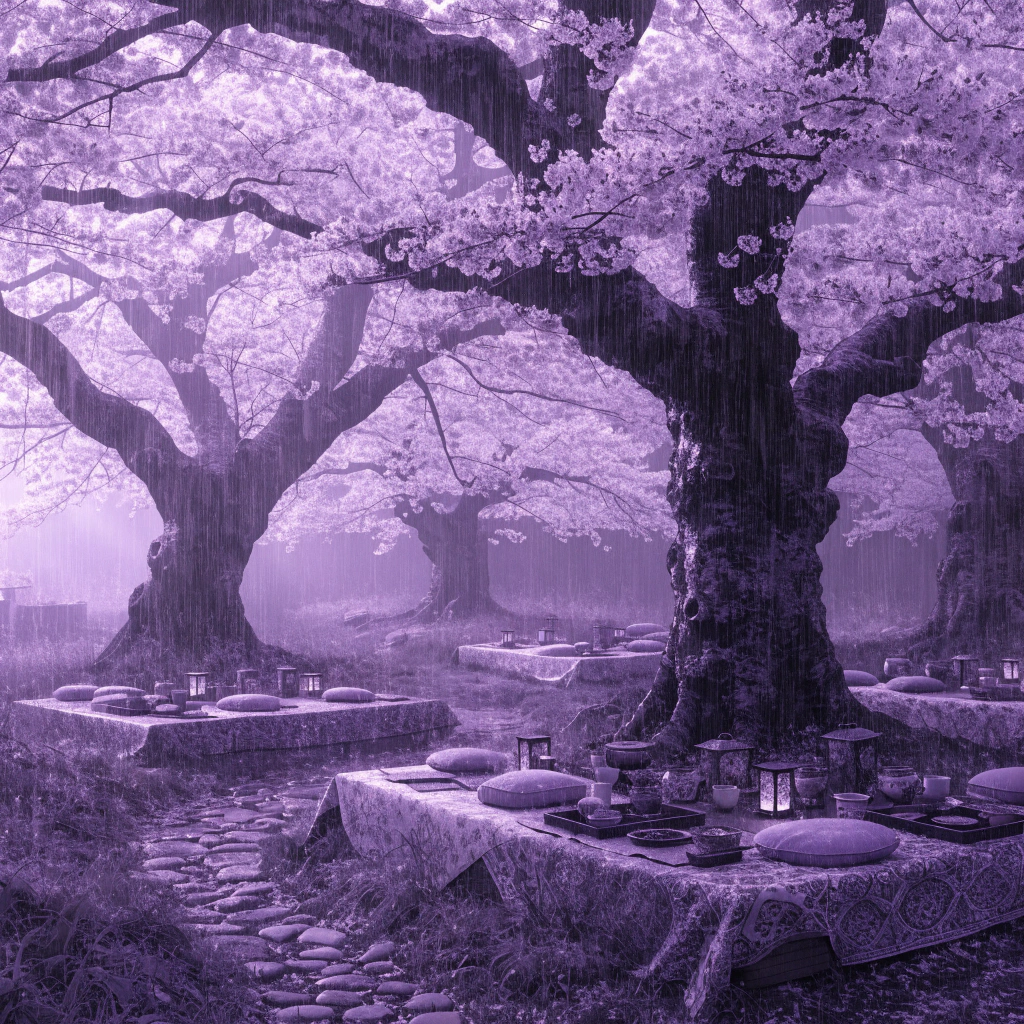
Spring in Japan: The Cherry Blossom Festival
Spring is a beautiful time in Japan. In March and April, the cherry blossom trees have pink flowers. These flowers are called "Sakura." Many people go to the parks to see them. This tradition is called "Hanami."
Families and friends sit under the trees. They eat food and drink tea. They talk and laugh together. It is a very happy festival.
The flowers are very pretty, but they do not stay for a long time. They fall after one or two weeks. People love this short season because it is special.
Point grammaire
Structure: Present Simple (to be)
"Spring is a beautiful time in Japan."
We use the verb 'to be' (am, is, are) to describe facts and states. In this sentence, 'is' connects the subject 'Spring' to a description.
Structure: Plural Nouns
"Families and friends sit under the trees."
To make most English nouns plural, we add '-s' to the end. Here, 'family' becomes 'families', 'friend' becomes 'friends', and 'tree' becomes 'trees'.
Teste ta compréhension
10 questions · A1 Débutant · 1 aperçu gratuit
Teste ce que tu as appris dans cet article. Réponds à toutes les questions pour gagner des XP !
When do the cherry blossoms bloom in Japan?
Tu veux terminer le quiz ?
9 questions supplémentaires t'attendent. Inscris-toi gratuitement pour débloquer le quiz complet et gagner des XP !
S'inscrire gratuitementTu as dj un compte ? Connexion
Bien joué !
Continue à pratiquer !
Déjà terminé — pas de XP supplémentaire
Inscris-toi pour gagner des XPDétail des questions
When do the cherry blossoms bloom in Japan?
Ta réponse:
Bonne réponse: In March and April
Sakura flowers stay on the trees for many months.
Ta réponse:
Bonne réponse: Faux
What does the word 'Parks' mean?
Ta réponse:
Bonne réponse: Large public gardens for relaxing
Families and friends sit under the _____.
Ta réponse:
Bonne réponse: trees
Hanami: The Beautiful Cherry Blossom Festival
Hanami is a very famous festival in Japan. It happens every spring when the cherry blossom trees, or 'Sakura', start to flower. This tradition is very old because it started hundreds of years ago. People love these flowers because they are beautiful, but they only stay for a short time.
During Hanami, families and friends go to parks together. They sit under the trees and eat delicious food. They also talk and laugh. Many people think spring is more beautiful than winter because of the pink and white flowers. In the past, people only looked at plum blossoms, but later they changed to cherry blossoms.
Today, people check the weather reports to see when the flowers will open. It is a happy time for everyone. You can see many people taking photos of the trees. It is one of the most popular times to visit Japan.
Point grammaire
Structure: Comparative Adjectives
"Many people think spring is more beautiful than winter because of the pink and white flowers."
We use 'more + adjective + than' to compare two things. This is used for long adjectives like 'beautiful' to show how one thing is different from another.
Structure: Past Simple (Regular Verbs)
"In the past, people only looked at plum blossoms, but later they changed to cherry blossoms."
We use the past simple to talk about finished actions in the past. Regular verbs like 'look' and 'change' add '-ed' or '-d' at the end.
Teste ta compréhension
11 questions · A2 mentaire · 1 aperçu gratuit
Teste ce que tu as appris dans cet article. Réponds à toutes les questions pour gagner des XP !
Where is the Hanami festival famous?
Tu veux terminer le quiz ?
10 questions supplémentaires t'attendent. Inscris-toi gratuitement pour débloquer le quiz complet et gagner des XP !
S'inscrire gratuitementTu as dj un compte ? Connexion
Bien joué !
Continue à pratiquer !
Déjà terminé — pas de XP supplémentaire
Inscris-toi pour gagner des XPDétail des questions
Where is the Hanami festival famous?
Ta réponse:
Bonne réponse: Japan
Hanami happens during the winter season.
Ta réponse:
Bonne réponse: Faux
What is the meaning of 'Sakura'?
Ta réponse:
Bonne réponse: Cherry blossoms
Families sit under the _____ and eat delicious food.
Ta réponse:
Bonne réponse: trees
Why do people check the weather reports?
Ta réponse:
Bonne réponse: To know when the flowers will open
Hanami: The Beauty of Japan's Cherry Blossom Festival
Spring in Japan is a magical time when the country turns pink and white. This is because of the cherry blossoms, known as 'Sakura'. The tradition of 'Hanami', which literally means 'flower viewing', has been celebrated by Japanese people for over a thousand years. The custom started during the Nara period, which was originally inspired by Chinese plum blossoms. Later, the focus changed to cherry blossoms.
These flowers are very special because they only bloom for a week or two. This short life represents the beauty and the temporary nature of human life. Because the flowers are ephemeral, people try to enjoy every moment of the season. Every year, the weather forecast includes a 'cherry blossom map'. This map is followed carefully by millions of people who want to know when the flowers will open in their city.
When the blossoms finally appear, parks are filled with families and friends. They sit on blue mats under the trees to enjoy picnics. Special food and drinks are prepared for these parties, and people often stay until late at night. In addition to the parks, many rivers are lined with Sakura trees, creating beautiful tunnels of flowers. People often take boat trips to see the petals falling onto the water like snow.
In the evening, the trees are often decorated with paper lanterns. This is called 'Yozakura', or night sakura. The white flowers look beautiful against the dark sky. Hanami is more than just a picnic; it is a time to appreciate nature and spend time with loved ones. If you have ever visited Japan in April, you have probably seen how much this tradition means to the local people. It remains one of the most iconic parts of Japanese culture today.
Point grammaire
Structure: Present Perfect (Passive)
"The tradition of 'Hanami'... has been celebrated by Japanese people for over a thousand years."
The present perfect passive (has/have been + past participle) describes an action that started in the past and continues to the present. We use it when we want to focus on the tradition itself rather than the people doing it.
Structure: Relative Clauses with 'Which'
"The custom started during the Nara period, which was originally inspired by Chinese plum blossoms."
Relative clauses provide extra information about a noun. 'Which' is used to add details about objects, ideas, or time periods mentioned earlier in the sentence.
Teste ta compréhension
11 questions · B1 Intermédiaire · 1 aperçu gratuit
Teste ce que tu as appris dans cet article. Réponds à toutes les questions pour gagner des XP !
What does the word 'Hanami' literally mean?
Tu veux terminer le quiz ?
10 questions supplémentaires t'attendent. Inscris-toi gratuitement pour débloquer le quiz complet et gagner des XP !
S'inscrire gratuitementTu as dj un compte ? Connexion
Bien joué !
Continue à pratiquer !
Déjà terminé — pas de XP supplémentaire
Inscris-toi pour gagner des XPDétail des questions
What does the word 'Hanami' literally mean?
Ta réponse:
Bonne réponse: Flower viewing
Cherry blossoms bloom for several months every year.
Ta réponse:
Bonne réponse: Faux
What is the meaning of 'forecast'?
Ta réponse:
Bonne réponse: A prediction of future conditions like weather
Special food and _____ are prepared for these parties.
Ta réponse:
Bonne réponse: drinks
What is the specific name for viewing cherry blossoms at night?
Ta réponse:
Bonne réponse: Yozakura
The Ephemeral Splendor: Evaluating the Cultural Significance of Hanami
As winter recedes, Japan undergoes a profound cultural and environmental transformation known as Hanami. Literally translated as 'flower viewing,' this tradition is far more than a simple appreciation of nature; it is a complex social phenomenon that bridges the gap between ancient philosophy and contemporary urban life. While the practice was initially inspired by Chinese customs involving plum blossoms during the Nara period, by the Heian period, the focus had shifted toward the cherry blossom, or Sakura, which became the definitive symbol of the season.
The cultural resonance of Hanami lies in the aesthetic concept of 'mono no aware,' which refers to the bittersweet realization that all things are impermanent. The blossoms are notoriously ephemeral, reaching full bloom and then falling within a mere week or two. For the Japanese, this fleeting beauty serves as a poignant reminder of the inevitable cycle of existence. Consequently, the festival is not merely an excuse for a picnic, but a period of reflection on the transition of time. Had the weather been colder in early March, the blooming season would undoubtedly have been delayed, causing significant logistical disruptions for those planning their celebrations.
In modern Japan, the logistics of Hanami are handled with scientific precision. The 'Sakura Front' is meticulously tracked by meteorologists, and their forecasts are followed with an intensity usually reserved for major sporting events. Once the trees begin to bloom, people flock to parks and riverbanks to engage in 'yozakura' (night viewing) or daytime picnics. These gatherings foster a sense of camaraderie, allowing colleagues and families to bond in a relaxed environment that contrasts sharply with the rigid structures of the Japanese workplace.
Furthermore, the economic impact of the festival cannot be overstated. From cherry-themed snacks to specialized travel packages, Hanami stimulates significant domestic and international tourism. Critics might argue that the commercialization of the event has diluted its spiritual roots; however, the sheer scale of participation suggests that the underlying appreciation for nature’s transience remains intact. Ultimately, Hanami continues to be a vital expression of Japanese identity, demonstrating how a society can honor its historical predecessors while adapting to the demands of the twenty-first century.
Point grammaire
Structure: Past Perfect
"By the Heian period, the focus had shifted toward the cherry blossom."
The past perfect is used to show that one action happened before another specific time in the past. It is formed using 'had' + past participle.
Structure: Passive Voice
"The 'Sakura Front' is meticulously tracked by meteorologists."
The passive voice is used when the action itself or the object receiving the action is more important than the person performing it. It is formed with 'to be' + past participle.
Structure: Third Conditional (Inverted)
"Had the weather been colder in early March, the blooming season would undoubtedly have been delayed."
This formal structure replaces 'If the weather had been...' to discuss hypothetical past situations and their results. It implies that the weather was actually not that cold.
Teste ta compréhension
11 questions · B2 Intermédiaire supérieur · 1 aperçu gratuit
Teste ce que tu as appris dans cet article. Réponds à toutes les questions pour gagner des XP !
What was the original inspiration for Hanami during the Nara period?
Tu veux terminer le quiz ?
10 questions supplémentaires t'attendent. Inscris-toi gratuitement pour débloquer le quiz complet et gagner des XP !
S'inscrire gratuitementTu as dj un compte ? Connexion
Bien joué !
Continue à pratiquer !
Déjà terminé — pas de XP supplémentaire
Inscris-toi pour gagner des XPDétail des questions
What was the original inspiration for Hanami during the Nara period?
Ta réponse:
Bonne réponse: Chinese customs involving plum blossoms
The concept of 'mono no aware' focuses on the permanence and eternal nature of beauty.
Ta réponse:
Bonne réponse: Faux
What does 'meticulously' mean in the context of tracking the Sakura Front?
Ta réponse:
Bonne réponse: With extreme attention to detail
The blossoms are described as _____ because they only last for a week or two.
Ta réponse:
Bonne réponse: ephemeral
How does Hanami affect the Japanese workplace according to the text?
Ta réponse:
Bonne réponse: It provides a relaxed environment for bonding
Ephemeral Splendour: The Sociocultural Resonance of Hanami in Contemporary Japan
Rarely does a seasonal transition evoke such profound collective introspection as the arrival of the cherry blossom in Japan. Known as Hanami, this practice transcends mere aesthetic appreciation, embedding itself into the very fabric of Japanese identity. Central to this observance is the concept of 'mono no aware'—a poignant awareness of the impermanence of things, often described as a gentle pathos toward the fleeting. It is this philosophical underpinning that elevates the act of flower viewing from a simple outing to a profound cultural ritual. The blossoms, or Sakura, represent the ephemeral nature of life, a theme that resonates deeply within the national psyche.
Historically, the tradition traces its lineage back to the Nara period (710–794), though it was the plum blossom—a custom imported from China—that initially captivated the aristocracy. However, by the Heian era, the cherry blossom had supplanted its predecessor, becoming the definitive symbol of spring. This shift marked the beginning of a centuries-long fascination with the transient beauty of the Sakura. The meticulous tracking of the 'Sakura Front' by the Japan Meteorological Agency today is but a modern manifestation of this ancient preoccupation, reflecting a society that remains tethered to its seasonal rhythms despite rapid industrialisation.
In contemporary Japan, Hanami manifests as a striking juxtaposition of the ancient and the modern. While the contemplative aspect remains, the festival has undergone significant commodification. Corporate sponsors and mass-produced goods now accompany the blooming trees, leading some critics to argue that the spiritual essence of the practice is being overshadowed by rampant consumerism. Blue tarps and loud celebrations in urban parks like Ueno or Yoyogi present a stark contrast to the quiet reflection of the past. Nevertheless, the communal aspect of Hanami remains steadfast; it serves as a vital social lubricant. Families, friends, and colleagues gather under the canopy of pink and white, reaffirming social bonds in an increasingly fragmented society.
Furthermore, the pervasive influence of Hanami extends beyond the physical act of viewing. It permeates Japanese literature, art, and even modern media, serving as an evocative shorthand for new beginnings and the bittersweet passage of time. The sheer ubiquity of Sakura-themed products—from seasonal lattes to limited-edition stationery—underscores the economic culmination of this cultural phenomenon. Yet, to dismiss Hanami as a mere commercial opportunity would be to overlook its psychological utility. In a culture often characterised by rigorous work ethics and social conformity, Hanami provides a sanctioned space for emotional release and collective leisure.
The allure of Hanami lies in its inherent contradiction: the celebration of life through the lens of its inevitable end. The petals, which bloom with such vigour only to be scattered by the wind within days, serve as a potent metaphor for human existence. Seldom is the fragility of life so beautifully articulated as it is during these few weeks in April. It is not merely the sight of the blossoms that draws millions; rather, it is the shared experience of witnessing a beauty that refuses to last. This acceptance of transience is perhaps the most enduring legacy of Hanami, offering a moment of pause in a world obsessed with permanence. Ultimately, Hanami remains a poignant reminder that beauty, however fleeting, is what gives life its profound resonance.
Point grammaire
Structure: Negative Inversion
"Rarely does a seasonal transition evoke such profound collective introspection as the arrival of the cherry blossom in Japan."
When a sentence starts with a negative or restrictive adverb like 'rarely' or 'seldom', the auxiliary verb comes before the subject. This is used in formal writing to add emphasis.
Structure: Cleft Sentence
"It is this philosophical underpinning that elevates the act of flower viewing from a simple outing to a profound cultural ritual."
Cleft sentences use the structure 'It is/was + [emphasized part] + that/who...' to focus on specific information. It highlights the importance of the 'philosophical underpinning' over other possible factors.
Structure: Nominalization
"The meticulous tracking of the 'Sakura Front' by the Japan Meteorological Agency today is but a modern manifestation of this ancient preoccupation..."
Nominalization involves turning verbs or adjectives into nouns (e.g., 'tracking', 'manifestation', 'preoccupation'). This makes writing more abstract, concise, and formal, which is characteristic of C1 level texts.
Teste ta compréhension
12 questions · C1 Avancé · 1 aperçu gratuit
Teste ce que tu as appris dans cet article. Réponds à toutes les questions pour gagner des XP !
What is the primary philosophical concept associated with Hanami according to the text?
Tu veux terminer le quiz ?
11 questions supplémentaires t'attendent. Inscris-toi gratuitement pour débloquer le quiz complet et gagner des XP !
S'inscrire gratuitementTu as dj un compte ? Connexion
Bien joué !
Continue à pratiquer !
Déjà terminé — pas de XP supplémentaire
Inscris-toi pour gagner des XPDétail des questions
What is the primary philosophical concept associated with Hanami according to the text?
Ta réponse:
Bonne réponse: A poignant awareness of impermanence
The cherry blossom was the original focus of flower viewing during the Nara period.
Ta réponse:
Bonne réponse: Faux
Which word describes the act of turning a cultural practice into a commercial product?
Ta réponse:
Bonne réponse: Commodification
The petals serve as a potent _____ for human existence.
Ta réponse:
Bonne réponse: metaphor
How does the author characterize the modern Hanami experience in urban parks?
Ta réponse:
Bonne réponse: As a striking juxtaposition of ancient and modern elements
The Japan Meteorological Agency is involved in tracking the blooming of cherry blossoms.
Ta réponse:
Bonne réponse: Vrai
The Ephemeral Aesthetics of Sakura: A Socio-Cultural Analysis of Hanami
To the uninitiated observer, the Japanese custom of Hanami might appear as a mere vernal picnic, yet to dismiss it as such would be to overlook a profound cultural phenomenon that encapsulates the very ethos of the Japanese psyche. For over a millennium, the blossoming of the Prunus serrulata has served as more than a seasonal marker; it is a poignant meditation on transience, a concept deeply embedded in the nation's spiritual and artistic heritage. Were one to trace the historical lineage of this tradition, one would find its nascent roots in the Nara period (710–794). During this era, the precursor to the cherry blossom obsession was actually the Chinese-imported plum blossom, or 'ume'. However, by the Heian period (794–1185), a distinct cultural shift occurred. The aristocratic classes began to favor the indigenous cherry blossom, finding in its rapid flowering and subsequent fall a more fitting metaphor for the human condition. This transition was not merely a matter of aesthetic preference but a philosophical alignment with the concept of 'mono no aware'—a term often translated as the 'pathos of things.' It suggests a heightened sensitivity to the ephemeral nature of reality, where beauty is inextricably linked to its own evanescence. It is precisely because the petals must fall within a week of blooming that they are cherished with such intensity.
In contemporary Japan, this meticulously orchestrated synchronization with nature has evolved into a national preoccupation, tracked with scientific rigor by the Japanese Meteorological Agency. The 'Sakura Zensen', or cherry blossom front, is a map updated daily, indicating the northward progression of the bloom across the archipelago. Not only does this forecast dictate the travel plans of millions, but it also underscores the ubiquitous nature of the festival. From the northern reaches of Hokkaido to the subtropical climes of Okinawa, the entire nation is gripped by a feverish anticipation. The economic impact is equally staggering, as tourism and retail sectors experience a significant 'sakura effect'. Notwithstanding the commercialization of the event, the core ritual of Hanami remains remarkably consistent. Whether it be the rowdy 'enkai' (parties) under the neon-lit boughs of Tokyo's Ueno Park or the solitary contemplation of a single weeping cherry in a secluded Kyoto temple, the practice serves as a vital social lubricant and a moment of collective pause.
The duality of Hanami is perhaps its most fascinating aspect. On one hand, there is the high-brow, scholarly appreciation of the blossom's form, celebrated in the 'Manyoshu'—Japan's oldest poetry anthology. On the other, there is the more pragmatic 'hana-yori-dango' (dumplings over flowers) attitude, which prioritizes the conviviality of food and drink. This cacophony of celebration—where ancient poetry meets modern karaoke—might seem like a jarring anachronism to some. However, it is this very resilience that allows Hanami to thrive in a hyper-technological age. The festival bridges the gap between an ancient agrarian past, where the blossoms signaled the time to plant rice, and a modern urban existence. Should the blossoms fail to appear or be prematurely destroyed by a 'hana-arashi' (flower storm), the psychological impact on the collective consciousness would be palpable. The sakura represent a perennial renewal, a chance to shed the metaphorical weight of winter and embrace the possibilities of spring. Thus, Hanami is no mere vestige of the past; it is a living, breathing testament to the human need to find transcendence in the fleeting. As the delicate petals descend in a 'sakura-fubuki' (cherry blossom blizzard), the relentless pace of modern life is momentarily hushed. In that silence, one finds a profound reminder that beauty, however ephemeral, demands our absolute presence and appreciation.
Point grammaire
Structure: Subjunctive Inversion for Hypothetical Conditionals
"Were one to trace the historical lineage of this tradition, one would find its nascent roots in the Nara period (710–794)."
This formal structure replaces 'If one were to trace'. It is used in C2 academic prose to present a hypothetical scenario with a more sophisticated tone.
Structure: Negative Inversion for Emphasis
"Not only does this forecast dictate the travel plans of millions, but it also underscores the ubiquitous nature of the festival."
When a sentence starts with a negative or restrictive expression like 'Not only', the auxiliary verb comes before the subject. This adds rhetorical weight to the statement.
Structure: Inverted First Conditional with 'Should'
"Should the blossoms fail to appear or be prematurely destroyed by a 'hana-arashi' (flower storm), the psychological impact on the collective consciousness would be palpable."
Using 'Should' instead of 'If' at the start of a sentence creates a formal conditional structure. It expresses a possibility that, while perhaps unlikely, would have significant consequences.
Teste ta compréhension
12 questions · C2 Maîtrise · 1 aperçu gratuit
Teste ce que tu as appris dans cet article. Réponds à toutes les questions pour gagner des XP !
According to the text, how did the focus of Hanami change during the Heian period?
Tu veux terminer le quiz ?
11 questions supplémentaires t'attendent. Inscris-toi gratuitement pour débloquer le quiz complet et gagner des XP !
S'inscrire gratuitementTu as dj un compte ? Connexion
Bien joué !
Continue à pratiquer !
Déjà terminé — pas de XP supplémentaire
Inscris-toi pour gagner des XPDétail des questions
According to the text, how did the focus of Hanami change during the Heian period?
Ta réponse:
Bonne réponse: It transitioned from viewing plum blossoms to cherry blossoms.
The 'Sakura Zensen' is a historical document from the Heian period used to predict the weather.
Ta réponse:
Bonne réponse: Faux
What does the word 'ephemeral' mean in the context of the cherry blossoms?
Ta réponse:
Bonne réponse: Something that lasts for a very short duration.
The concept of 'mono no aware' is often described as the _____ of things.
Ta réponse:
Bonne réponse: pathos
What does the phrase 'hana-yori-dango' imply about some participants' attitudes?
Ta réponse:
Bonne réponse: They value the social and culinary aspects more than the blossoms themselves.
The article suggests that the commercialization of Hanami has completely destroyed its core ritual meaning.
Ta réponse:
Bonne réponse: Faux

