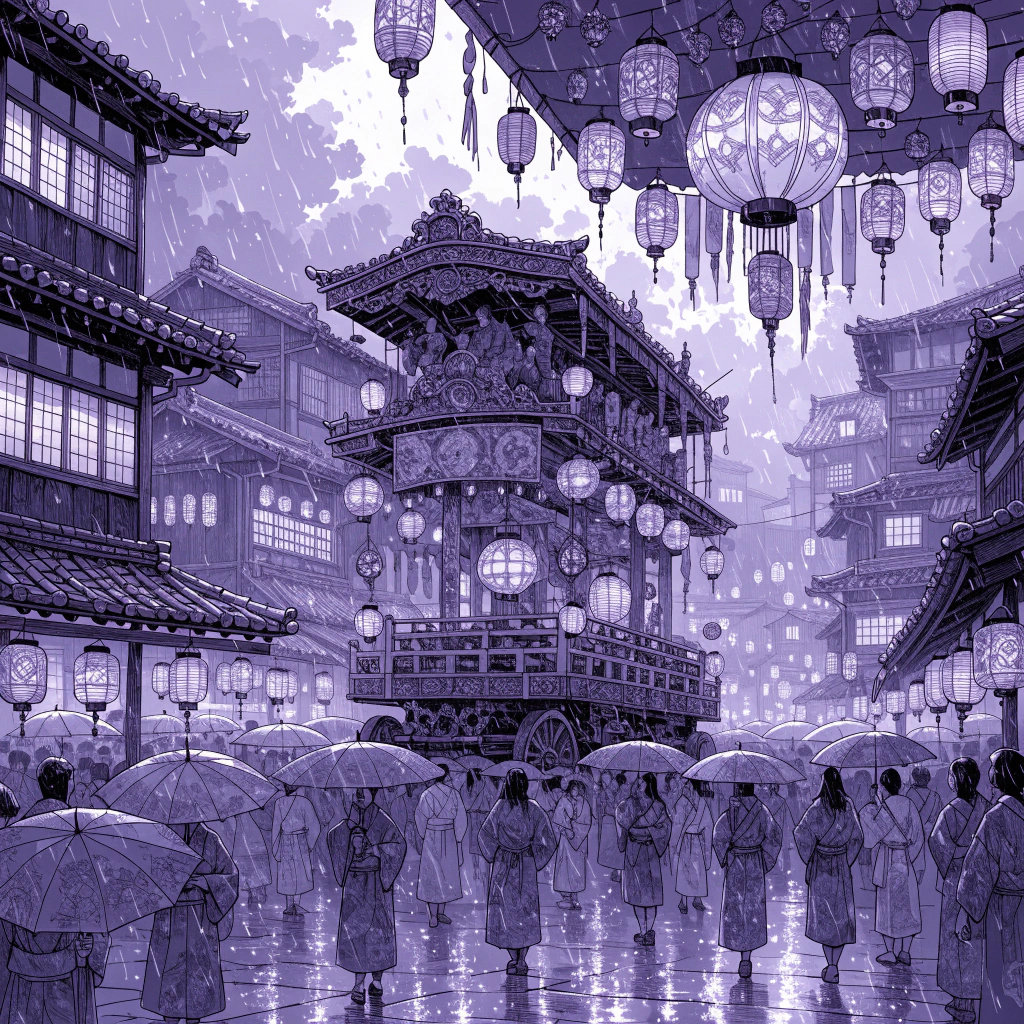
A Big Festival in Kyoto
Gion Matsuri is a famous festival in Japan. It is in Kyoto. This festival is very old. It starts in July. The festival is one month long.
People see big floats in the streets. The floats are beautiful. There is traditional music and food. Many people wear special clothes. They are called Yukata.
Families walk together and look at the lights. It is a happy time. Visitors from many countries come to Kyoto. They like the history and the art. The festival is very special for the city.
Point grammaire
Structure: Present Simple (to be)
"Gion Matsuri is a famous festival in Japan."
We use 'is' with singular nouns to describe facts. It shows what something is like.
Structure: Present Simple (Regular Verbs)
"Many people wear special clothes."
We use the base form of the verb (wear) with plural subjects (people) for general truths.
Teste ta compréhension
10 questions · A1 Débutant · 1 aperçu gratuit
Teste ce que tu as appris dans cet article. Réponds à toutes les questions pour gagner des XP !
Where is Gion Matsuri?
Tu veux terminer le quiz ?
9 questions supplémentaires t'attendent. Inscris-toi gratuitement pour débloquer le quiz complet et gagner des XP !
S'inscrire gratuitementTu as dj un compte ? Connexion
Bien joué !
Continue à pratiquer !
Déjà terminé — pas de XP supplémentaire
Inscris-toi pour gagner des XPDétail des questions
Where is Gion Matsuri?
Ta réponse:
Bonne réponse: Kyoto
The festival is in December.
Ta réponse:
Bonne réponse: Faux
What does 'famous' mean?
Ta réponse:
Bonne réponse: Many people know it
People see big _____ in the streets.
Ta réponse:
Bonne réponse: floats
Gion Matsuri: A Famous Festival in Kyoto
Gion Matsuri is a very famous festival in Kyoto, Japan. It is one of the biggest festivals in the country. It happens every July and lasts for the whole month. People from all over the world visit Kyoto to see the colorful parades and beautiful decorations.
The festival started a long time ago in the year 869. In those days, many people were sick because of a terrible disease. The people of Kyoto wanted to stop the sickness, so they had a special religious ceremony. They prayed to the gods for health and safety.
Today, the most exciting part is the giant parade. Large wooden carts, called floats, move through the streets. These floats are very heavy, and many men pull them with long ropes. Some floats are taller than houses! There is also traditional music and people wear beautiful clothes called yukata.
Gion Matsuri is important because it shows the history of Kyoto. It is more popular now than in the past, but it still keeps its old traditions. It is a wonderful time to visit Japan.
Point grammaire
Structure: Past Simple
"The festival started a long time ago in the year 869."
We use the past simple to talk about finished actions in the past. To form it for regular verbs, we usually add '-ed' to the base verb.
Structure: Comparatives
"Some floats are taller than houses!"
We use comparatives to compare two things. For short adjectives, we add '-er' and use the word 'than' after the adjective.
Teste ta compréhension
11 questions · A2 mentaire · 1 aperçu gratuit
Teste ce que tu as appris dans cet article. Réponds à toutes les questions pour gagner des XP !
Where does Gion Matsuri take place?
Tu veux terminer le quiz ?
10 questions supplémentaires t'attendent. Inscris-toi gratuitement pour débloquer le quiz complet et gagner des XP !
S'inscrire gratuitementTu as dj un compte ? Connexion
Bien joué !
Continue à pratiquer !
Déjà terminé — pas de XP supplémentaire
Inscris-toi pour gagner des XPDétail des questions
Where does Gion Matsuri take place?
Ta réponse:
Bonne réponse: Kyoto
The festival lasts for only one day.
Ta réponse:
Bonne réponse: Faux
What does 'floats' mean in the text?
Ta réponse:
Bonne réponse: Large decorated carts for parades
The festival started because many people were _____ in 869.
Ta réponse:
Bonne réponse: sick
Why did the people first have the ceremony?
Ta réponse:
Bonne réponse: To pray for health and stop a disease
Gion Matsuri: Kyoto's Magnificent Summer Festival
Gion Matsuri is one of the most famous festivals in Japan, which takes place in the city of Kyoto every July. This incredible event has been celebrated for over a thousand years, making it one of the oldest festivals in the country. It originally began in the year 869 as a religious ceremony to stop a terrible plague that was affecting the city at that time. Since then, it has evolved into a massive celebration of Kyoto’s rich culture and merchant history.
The festival is hosted by the Yasaka Shrine, and various events are held throughout the entire month. However, the most exciting highlight is the Yamaboko Junko, which is a grand parade of massive wooden floats. These floats, which are often called "moving museums," are decorated with beautiful tapestries and traditional ornaments from all over the world. Some of them are so large and heavy that they require dozens of people to pull them through the narrow streets.
During the evenings before the main parade, known as Yoiyama, the city center is closed to motorized traffic. The streets are filled with food stalls selling delicious local snacks, and many people can be seen wearing traditional summer kimonos called yukata. Hundreds of lanterns are lit, and traditional flute music is played, which creates a truly magical atmosphere for the visitors.
Because the festival has been preserved so well by the local community, it is recognized by UNESCO as an important part of world cultural heritage. Visitors from all over the world travel to Kyoto to experience this unique tradition. It is a special time when the ancient past and the modern present come together, showing that the spirit of Kyoto has stayed strong for centuries.
Point grammaire
Structure: Present Perfect
"This incredible event has been celebrated for over a thousand years."
We use the present perfect (have/has + past participle) to talk about an action that started in the past and continues into the present.
Structure: Passive Voice
"These floats... are decorated with beautiful tapestries."
The passive voice is used when the action is more important than the person doing it. It is formed with 'be' + past participle.
Teste ta compréhension
11 questions · B1 Intermédiaire · 1 aperçu gratuit
Teste ce que tu as appris dans cet article. Réponds à toutes les questions pour gagner des XP !
Why did the Gion Matsuri originally begin in 869?
Tu veux terminer le quiz ?
10 questions supplémentaires t'attendent. Inscris-toi gratuitement pour débloquer le quiz complet et gagner des XP !
S'inscrire gratuitementTu as dj un compte ? Connexion
Bien joué !
Continue à pratiquer !
Déjà terminé — pas de XP supplémentaire
Inscris-toi pour gagner des XPDétail des questions
Why did the Gion Matsuri originally begin in 869?
Ta réponse:
Bonne réponse: To stop a terrible plague
The Gion Matsuri events only take place on a single day in July.
Ta réponse:
Bonne réponse: Faux
What does the word 'tapestries' mean?
Ta réponse:
Bonne réponse: Thick fabrics with decorative designs
The festival is _____ by the Yasaka Shrine.
Ta réponse:
Bonne réponse: hosted
What are the massive floats in the parade often called?
Ta réponse:
Bonne réponse: Moving museums
The Gion Matsuri: A Millennium of Tradition and Resilience in Kyoto
The Gion Matsuri is not merely a local festival; it represents a profound intersection of historical resilience and artistic opulence. Spanning the entire month of July, this Kyoto-based celebration transforms the ancient capital into a living tapestry of Japanese heritage. While many contemporary festivals prioritize entertainment, the Gion Matsuri has maintained its spiritual core for over a millennium, tracing its origins back to a catastrophic plague in 869 AD. At that time, the ritual was established to appease the deities who were believed to be responsible for the devastating illness.
Historically, the event began as a religious ceremony known as Gion-go-ryo-e. Over the centuries, however, the festival underwent a significant transformation. As Kyoto’s merchant class grew in wealth and influence during the Edo period, they began to sponsor the construction of increasingly elaborate floats. Consequently, what started as a somber plea for health evolved into a magnificent showcase of community prestige and artisanal skill. This evolution reflects the shifting social dynamics of Japan, where the power of the merchant class became visible through public displays of grandeur.
The undisputed highlight of the festivities is the Yamaboko Junko, a grand procession of massive floats that navigate the narrow streets of downtown Kyoto. These structures, often referred to as 'moving museums', are adorned with exquisite tapestries from across the globe, some of which were imported via the Silk Road centuries ago. The sheer scale of these floats is breathtaking, with some weighing up to twelve tons. Remarkably, they are assembled without the use of a single nail, relying instead on traditional rope-binding techniques that have been passed down through generations. This architectural feat demonstrates the sophisticated engineering knowledge possessed by ancient craftsmen.
Furthermore, the festival serves as a vital link between the past and the present. Despite the challenges of urbanization and modernity, the local communities—known as 'yamaboko-cho'—continue to meticulously maintain these treasures. Participation in the festival is a matter of great pride, requiring months of preparation and coordination. In conclusion, the Gion Matsuri is more than just a tourist attraction; it is a testament to the enduring power of tradition and the collective spirit of a city that has survived numerous hardships throughout its long history.
Point grammaire
Structure: Present Perfect Simple
"the Gion Matsuri has maintained its spiritual core for over a millennium"
The present perfect is used here to describe an action that started in the past (869 AD) and continues up to the present moment.
Structure: Passive Voice
"These structures... are adorned with exquisite tapestries"
The passive voice is used to focus on the objects (the floats) rather than the people who decorated them, which is common in formal descriptions.
Structure: Relative Clauses
"the local communities—known as 'yamaboko-cho'—continue to meticulously maintain these treasures."
The phrase 'known as yamaboko-cho' acts as a non-defining relative clause, providing extra information about the subject without changing the basic meaning of the sentence.
Teste ta compréhension
11 questions · B2 Intermédiaire supérieur · 1 aperçu gratuit
Teste ce que tu as appris dans cet article. Réponds à toutes les questions pour gagner des XP !
What was the original purpose of the Gion Matsuri in 869 AD?
Tu veux terminer le quiz ?
10 questions supplémentaires t'attendent. Inscris-toi gratuitement pour débloquer le quiz complet et gagner des XP !
S'inscrire gratuitementTu as dj un compte ? Connexion
Bien joué !
Continue à pratiquer !
Déjà terminé — pas de XP supplémentaire
Inscris-toi pour gagner des XPDétail des questions
What was the original purpose of the Gion Matsuri in 869 AD?
Ta réponse:
Bonne réponse: To appease deities during a plague
The floats used in the procession are constructed using modern metal nails for stability.
Ta réponse:
Bonne réponse: Faux
What does the word 'opulence' mean in the context of the article?
Ta réponse:
Bonne réponse: Great wealth and luxuriousness
How did the festival change during the Edo period?
Ta réponse:
Bonne réponse: It became a display of merchant wealth and skill
The Gion Matsuri is described as a _____ to the enduring power of tradition.
Ta réponse:
Bonne réponse: testament
The Living Tapestry: Deciphering the Cultural Resilience of Gion Matsuri
Rarely does a festival encapsulate a millennium of urban identity as poignantly as Kyoto’s Gion Matsuri. While many contemporary celebrations have succumbed to the hollow artifice of commercial tourism, Gion Matsuri remains a profound testament to the historical resilience of the Japanese spirit. Its inception dates back to 869 AD, a period when the capital was besieged by a devastating plague. What began as a desperate religious ceremony, known as 'Gion-go-ryo-e', was intended to appease the deities and seek divine intercession. Through the ritualistic parade of portable shrines, the populace sought the mitigation of celestial wrath.
Over the centuries, the festival underwent a significant metamorphosis. It was the burgeoning merchant class of the Muromachi period that transformed a somber religious rite into a flamboyant display of economic prowess. The introduction of the 'Yamaboko' floats—towering structures often described as 'moving museums'—marked the transition toward secular grandeur. These floats are adorned with exquisite tapestries from as far afield as Persia and Belgium, reflecting Kyoto's historical role as a terminal for the Silk Road. The opulence of these decorations served not merely as aesthetic adornment but as a calculated manifestation of the guilds' wealth and social standing.
Crucial to the festival’s enduring appeal is the meticulous preservation of its ancestral traditions. The construction of the floats, which involves intricate joinery techniques without the use of a single nail, highlights a sophisticated level of craftsmanship. This veneration for traditional methods ensures that the festival remains an authentic link to the past, rather than a mere reenactment. However, the modern iteration of Gion Matsuri faces a nuanced dichotomy. On one hand, the festival provides a vital sense of continuity in an increasingly ephemeral digital age. On the other, the sheer scale of global tourism threatens to dilute the sanctity of the event, turning a sacred pilgrimage into a commodified spectacle.
Furthermore, the amalgamation of Shinto and Buddhist influences within the festival’s structure offers a fascinating insight into Japan’s syncretic religious history. The month-long series of events, culminating in the Yamaboko Junko, requires an extraordinary level of community coordination. This communal effort fosters a unique social cohesion, as neighborhoods compete to present the most auspicious display. Despite the inevitable pressures of modernization, the festival’s ability to adapt while maintaining its core spiritual essence is remarkable. Ultimately, Gion Matsuri is not just a relic of antiquity; it is a dynamic, evolving entity that continues to define the cultural landscape of Kyoto. To witness the procession is to observe the very heartbeat of a city that refuses to let its heritage fade into obscurity.
Point grammaire
Structure: Negative Inversion
"Rarely does a festival encapsulate a millennium of urban identity as poignantly as Kyoto’s Gion Matsuri."
Inversion is used here by placing 'Rarely' at the beginning of the sentence for emphasis. This requires the auxiliary verb 'does' to come before the subject 'a festival', creating a formal and dramatic tone.
Structure: Cleft Sentences
"It was the burgeoning merchant class of the Muromachi period that transformed a somber religious rite into a flamboyant display of economic prowess."
This 'It + be + subject + that' structure is used to focus on the specific group responsible for the change. It emphasizes 'the burgeoning merchant class' rather than the action itself.
Structure: Nominalisation
"The introduction of the 'Yamaboko' floats marked the transition toward secular grandeur."
Instead of saying 'When people introduced the floats', the author uses the noun 'introduction'. This creates a more academic and concise style, focusing on the concepts rather than the actors.
Teste ta compréhension
12 questions · C1 Avancé · 1 aperçu gratuit
Teste ce que tu as appris dans cet article. Réponds à toutes les questions pour gagner des XP !
What was the primary purpose of the original Gion-go-ryo-e ceremony in 869 AD?
Tu veux terminer le quiz ?
11 questions supplémentaires t'attendent. Inscris-toi gratuitement pour débloquer le quiz complet et gagner des XP !
S'inscrire gratuitementTu as dj un compte ? Connexion
Bien joué !
Continue à pratiquer !
Déjà terminé — pas de XP supplémentaire
Inscris-toi pour gagner des XPDétail des questions
What was the primary purpose of the original Gion-go-ryo-e ceremony in 869 AD?
Ta réponse:
Bonne réponse: To appease deities during a plague
The Yamaboko floats are built using modern steel nails to ensure structural integrity.
Ta réponse:
Bonne réponse: Faux
Which word is synonymous with 'luxuriousness and great wealth' as used in the text?
Ta réponse:
Bonne réponse: Opulence
The festival's origins are described as a desperate religious _____ to seek divine help.
Ta réponse:
Bonne réponse: ceremony
According to the article, why are the Yamaboko floats referred to as 'moving museums'?
Ta réponse:
Bonne réponse: They display exquisite international tapestries and crafts
The author suggests that global tourism may negatively impact the festival's sanctity.
Ta réponse:
Bonne réponse: Vrai
The Palimpsest of Gion: Navigating the Intersection of Sacred Liturgy and Merchant Opulence
The Gion Matsuri, an annual month-long observance in Kyoto, transcends the conventional parameters of a municipal festival, functioning instead as a sophisticated palimpsest of Japanese cultural history. While the casual observer might perceive merely a vibrant display of floats and festivities, a more scholarly inquiry reveals a complex strata of spiritual propitiation, sociopolitical assertion, and artistic syncretism. To understand the Gion Matsuri is to engage with over a millennium of urban evolution, beginning with its inception in 869 AD as a 'gion-go-ryo-e'—a ritualistic endeavor to appease the malevolent deities believed to be responsible for the devastating plagues then ravaging the Heian capital.
At the heart of this liturgical exercise lies the concept of apotropaic magic. The historical context of the festival’s origins suggests that the early residents of Kyoto viewed pestilence not through the lens of pathology, but as the manifestation of vengeful spirits. Consequently, it was deemed imperative that the sanctity of the city be restored through grand processions. Were the festival to cease, it was feared that the delicate equilibrium between the celestial and the terrestrial would be irrevocably shattered. This spiritual foundation remains sacrosanct, even as the festival has evolved to incorporate more secular elements. The Yasaka Shrine continues to serve as the ontological anchor for these proceedings, ensuring that the metaphysical gravity of the event is not lost amidst the encroachment of contemporary tourism.
However, the Gion Matsuri is equally a testament to the burgeoning power of Kyoto’s merchant class, the 'Machishu,' during the Muromachi and Edo periods. As the city’s economic landscape shifted, these affluent tradesmen sought to articulate their social standing through the ostentatious decoration of the 'Yamaboko' floats. These massive structures, some weighing upwards of twelve tons, became mobile repositories of global culture. The provenance of the textiles and tapestries adorning the floats—ranging from Persian carpets to Flemish weaves—illustrates a remarkable confluence of international trade routes meeting in the heart of Japan. It is through this aestheticization of wealth that the Machishu successfully asserted their autonomy against the traditional aristocracy and the shogunate.
One cannot overlook the ephemeral beauty of the 'Yoiyama' nights, where the atmospheric resonance of the festival reaches its zenith. The streets, illuminated by the soft glow of traditional lanterns, create a liminal space where the boundary between the past and the present becomes increasingly porous. It is here that the grandeur of the festival is most palpable, yet it is a grandeur tempered by a profound sense of transience. The meticulous assembly and subsequent dismantling of the floats serve as a poignant metaphor for the Buddhist concept of impermanence.
Furthermore, the festival provides a unique site for observing the syncretism of Japanese religious life. The seamless integration of Shinto rituals with Buddhist motifs suggests a theological flexibility that has long characterized the Japanese archipelago. This cultural synthesis is not merely a vestigial remnant of the past but a living practice that continues to adapt. Should the deities be properly appeased, the community believes it will be granted protection for another year, a sentiment that persists despite the secularization of modern society. In conclusion, the Gion Matsuri remains an indispensable subject for any serious analysis of Japanese identity. It is not merely a celebration of heritage but a dynamic performance of continuity, where the sacred and the profane are inextricably intertwined in a display of unparalleled artistic and spiritual depth.
Point grammaire
Structure: Inverted Conditional
"Were the festival to cease, it was feared that the delicate equilibrium between the celestial and the terrestrial would be irrevocably shattered."
This is a formal alternative to 'If the festival were to cease'. It uses inversion (verb before subject) to create a more scholarly or hypothetical tone, typical of C2 academic prose.
Structure: Subjunctive Mood
"Consequently, it was deemed imperative that the sanctity of the city be restored through grand processions."
The subjunctive 'be restored' is used after adjectives of necessity (imperative). It lacks the 's' or 'is/are' and remains in the base form to indicate a requirement or desired action.
Structure: Cleft Sentence for Emphasis
"It is through this aestheticization of wealth that the Machishu successfully asserted their autonomy..."
A cleft sentence (It is + [focus] + that/who) is used to emphasize a specific part of the sentence—in this case, the method by which the merchants gained power.
Teste ta compréhension
12 questions · C2 Maîtrise · 1 aperçu gratuit
Teste ce que tu as appris dans cet article. Réponds à toutes les questions pour gagner des XP !
According to the text, what was the primary impetus for the festival's inception in 869 AD?
Tu veux terminer le quiz ?
11 questions supplémentaires t'attendent. Inscris-toi gratuitement pour débloquer le quiz complet et gagner des XP !
S'inscrire gratuitementTu as dj un compte ? Connexion
Bien joué !
Continue à pratiquer !
Déjà terminé — pas de XP supplémentaire
Inscris-toi pour gagner des XPDétail des questions
According to the text, what was the primary impetus for the festival's inception in 869 AD?
Ta réponse:
Bonne réponse: To appease malevolent deities responsible for a plague
The author suggests that the festival's religious significance has been completely overshadowed by modern tourism.
Ta réponse:
Bonne réponse: Faux
Which word best describes the 'mobile repositories of global culture' mentioned in the text?
Ta réponse:
Bonne réponse: Yamaboko
The author describes the festival as a living _____ of Japanese cultural history.
Ta réponse:
Bonne réponse: palimpsest
What does the dismantling of the floats symbolize in the context of the article?
Ta réponse:
Bonne réponse: The Buddhist concept of impermanence
What is the meaning of 'syncretism' as used in the text?
Ta réponse:
Bonne réponse: The blending of different religious or cultural beliefs

