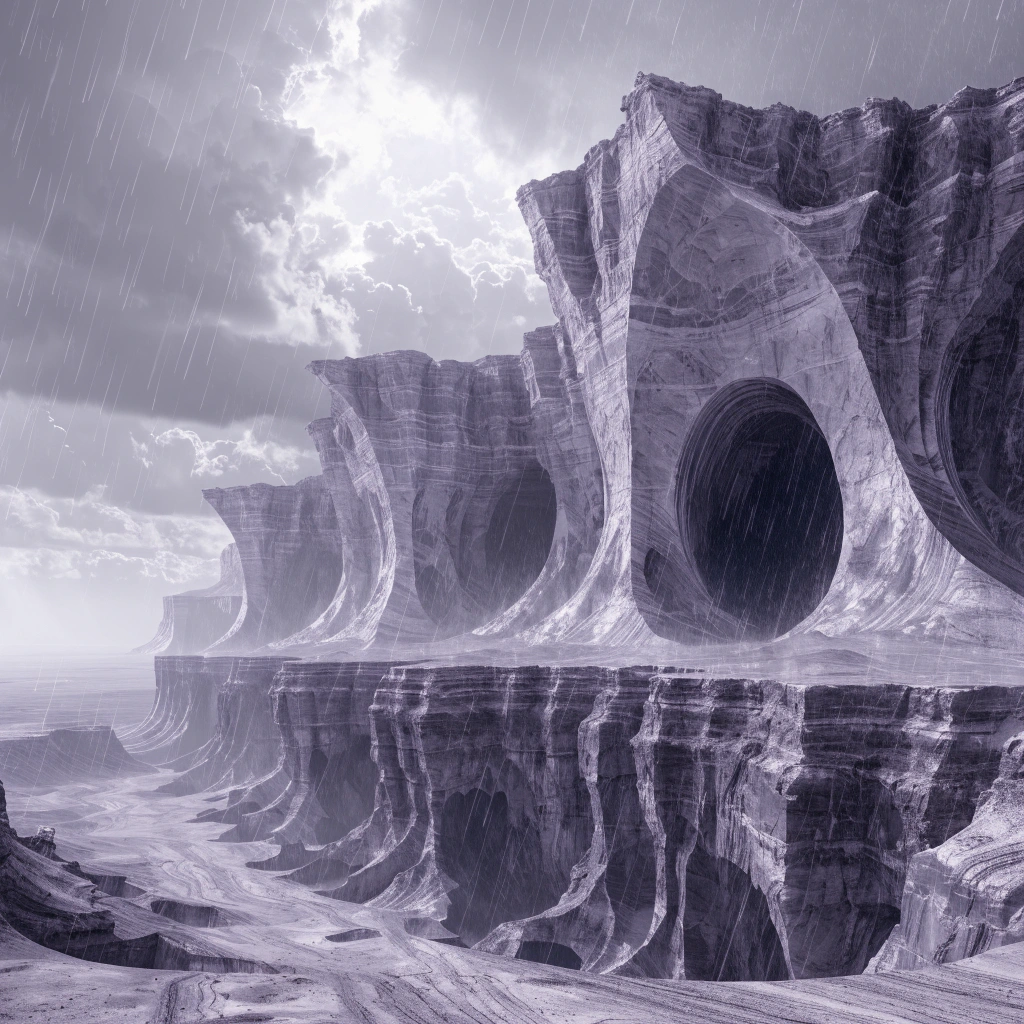
The Edge of the World
Jebel Tuwaiq is a big mountain in Saudi Arabia. It is near the city of Riyadh. People call it the Edge of the World. The cliffs are very high and big.
You can see the desert from the top. The view is very beautiful. Many years ago, this place was a sea. Today, you can find small shells in the rocks.
Visitors like to walk here. They take many photos of the cliffs. It is a very special place in nature.
Point grammaire
Structure: Present Simple 'Be'
"Jebel Tuwaiq is a big mountain in Saudi Arabia."
We use 'is' with singular subjects to describe facts. It tells us what something is or where it is.
Structure: Can for Possibility
"You can see the desert from the top."
We use 'can' to talk about things that are possible to do. It is followed by a basic verb like 'see' or 'find'.
Teste ta compréhension
10 questions · A1 Débutant · 1 aperçu gratuit
Teste ce que tu as appris dans cet article. Réponds à toutes les questions pour gagner des XP !
Where is Jebel Tuwaiq?
Tu veux terminer le quiz ?
9 questions supplémentaires t'attendent. Inscris-toi gratuitement pour débloquer le quiz complet et gagner des XP !
S'inscrire gratuitementTu as dj un compte ? Connexion
Bien joué !
Continue à pratiquer !
Déjà terminé — pas de XP supplémentaire
Inscris-toi pour gagner des XPDétail des questions
Where is Jebel Tuwaiq?
Ta réponse:
Bonne réponse: Riyadh
This place was a sea many years ago.
Ta réponse:
Bonne réponse: Vrai
What is a mountain?
Ta réponse:
Bonne réponse: A high hill
Visitors like to _____ here.
Ta réponse:
Bonne réponse: walk
The Edge of the World: A Desert Adventure
Jebel Tuwaiq is a very long mountain range in Saudi Arabia. It stretches for 800 kilometers across the desert. Many people call one special part 'The Edge of the World.' It is near the city of Riyadh, and it takes about ninety minutes to drive there.
Millions of years ago, this land was under a shallow sea. Today, the area is dry, but visitors can still find small fossils and sea shells in the rocks. The cliffs are very high and steep. They rise 300 meters above the ground. From the top, you can see the flat desert for many kilometers.
This place is very popular because the air is fresh and the view is amazing. Many people visit in the evening because the sunset is more beautiful than in the city. It is a quiet and peaceful place. However, visitors must be careful when they walk near the edge. It is a great adventure for everyone.
Point grammaire
Structure: Comparatives
"the sunset is more beautiful than in the city."
We use 'more' + adjective + 'than' to compare two things. Use this for adjectives with two or more syllables like 'beautiful'.
Structure: Past Simple (to be)
"this land was under a shallow sea."
We use 'was' for the past of 'is' when talking about history or finished states. It describes how things were a long time ago.
Teste ta compréhension
11 questions · A2 mentaire · 1 aperçu gratuit
Teste ce que tu as appris dans cet article. Réponds à toutes les questions pour gagner des XP !
Where is 'The Edge of the World' located?
Tu veux terminer le quiz ?
10 questions supplémentaires t'attendent. Inscris-toi gratuitement pour débloquer le quiz complet et gagner des XP !
S'inscrire gratuitementTu as dj un compte ? Connexion
Bien joué !
Continue à pratiquer !
Déjà terminé — pas de XP supplémentaire
Inscris-toi pour gagner des XPDétail des questions
Where is 'The Edge of the World' located?
Ta réponse:
Bonne réponse: Near the city of Riyadh
The land was covered by a sea millions of years ago.
Ta réponse:
Bonne réponse: Vrai
What does 'steep' mean?
Ta réponse:
Bonne réponse: Rising or falling very quickly
It takes about ninety _____ to drive there from Riyadh.
Ta réponse:
Bonne réponse: minutes
Why do people like to visit in the evening?
Ta réponse:
Bonne réponse: Because the sunset is more beautiful
Exploring the Edge of the World
Jebel Tuwaiq is a massive limestone cliff that stretches for hundreds of kilometers across the heart of Saudi Arabia. It is most famous for a specific point which is known as the 'Edge of the World.' This incredible site, which is located about 90 minutes from the city of Riyadh, has become a popular destination for travelers who want to experience the beauty of the desert.
The cliffs rise sharply from the ground, reaching a height of 300 meters. From the top, the view is spectacular because the land below looks like an endless ocean of sand. In the past, this area was actually the bottom of a shallow sea. Today, many fossils have been discovered by visitors who explore the rocks. You can still see ancient coral and shells that are embedded in the stone.
The Edge of the World has been visited by thousands of people since it became a top tourist attraction. Many hiking trails have been created for those who enjoy exercise. However, visitors are advised to bring plenty of water because the weather can be very hot. Most people stay until the evening to watch the sunset, which is considered one of the most beautiful sights in the kingdom. It is a place where you can truly feel the power of nature.
Point grammaire
Structure: Relative Clauses
"This incredible site, which is located about 90 minutes from the city of Riyadh, has become a popular destination."
We use 'which' to give more information about a thing or place. It helps combine two sentences into one complex sentence.
Structure: Passive Voice
"Today, many fossils have been discovered by visitors who explore the rocks."
The passive voice is used when the action is more important than the person doing it. It is formed with the verb 'to be' and the past participle.
Teste ta compréhension
11 questions · B1 Intermédiaire · 1 aperçu gratuit
Teste ce que tu as appris dans cet article. Réponds à toutes les questions pour gagner des XP !
How far is the Edge of the World from Riyadh?
Tu veux terminer le quiz ?
10 questions supplémentaires t'attendent. Inscris-toi gratuitement pour débloquer le quiz complet et gagner des XP !
S'inscrire gratuitementTu as dj un compte ? Connexion
Bien joué !
Continue à pratiquer !
Déjà terminé — pas de XP supplémentaire
Inscris-toi pour gagner des XPDétail des questions
How far is the Edge of the World from Riyadh?
Ta réponse:
Bonne réponse: 90 minutes
The area where Jebel Tuwaiq stands was once underwater.
Ta réponse:
Bonne réponse: Vrai
What does 'spectacular' mean?
Ta réponse:
Bonne réponse: Very exciting and beautiful to look at
Many hiking _____ have been created for those who enjoy exercise.
Ta réponse:
Bonne réponse: trails
What are visitors advised to bring with them?
Ta réponse:
Bonne réponse: Plenty of water
Standing at the Brink: The Majesty of Jebel Tuwaiq
Standing on the precipice of Jebel Tuwaiq, one cannot help but feel humbled by the sheer scale of the Saudi Arabian landscape. Known colloquially as the 'Edge of the World,' this geological wonder is part of a massive limestone escarpment that spans over 800 kilometers across the Najd plateau. While it is located only a short distance from the bustling capital of Riyadh, the site offers a profound sense of isolation and timelessness that is difficult to find elsewhere.
Geologically speaking, the history of the area is truly fascinating. Millions of years ago, the region that we now recognize as a dry, arid desert was actually the floor of a shallow sea. Consequently, the rocks are filled with fossilized coral and shells, remnants of an ancient marine ecosystem that thrived during the Jurassic period. Visitors who take the time to inspect the ground beneath their feet often find these small treasures embedded in the stone, serving as a silent reminder of the Earth's transformative nature. Had the tectonic plates not shifted over millennia, this dramatic vertical drop would never have been formed.
The most striking feature of the Edge of the World is the 300-meter vertical drop that provides an uninterrupted, panoramic view of the valley below. This valley, which used to be an ancient caravan route, now appears as a vast, empty expanse. For many years, the site remained relatively obscure, accessible only to those with four-wheel-drive vehicles and a spirit for adventure. However, in recent years, accessibility has improved significantly, allowing more tourists to witness the breathtaking sunsets for which the location is famous.
Despite its undeniable beauty, the terrain can be treacherous. The steep cliffs and loose gravel require visitors to exercise extreme caution, as the environment is as unforgiving as it is beautiful. Preservation efforts are also underway to ensure that the influx of tourists does not damage the delicate fossils or the natural integrity of the limestone formations. It is essential that the site is treated with respect so that future generations can experience the same awe-inspiring vista. In conclusion, Jebel Tuwaiq represents more than just a photo opportunity; it is a testament to the Earth's long and complex history, offering a rare glimpse into a world that existed long before humans arrived.
Point grammaire
Structure: Inverted Third Conditional
"Had the tectonic plates not shifted over millennia, this dramatic vertical drop would never have been formed."
This is a formal way to express a hypothetical situation in the past. By starting with 'Had' instead of 'If', the sentence becomes more academic and emphasizes the condition.
Structure: Passive Voice for Preservation
"Preservation efforts are also underway to ensure that the site is treated with respect."
The passive voice 'is treated' is used here to focus on the action being done to the site rather than the people doing it. It maintains a formal and objective tone.
Structure: Non-defining Relative Clauses
"This valley, which used to be an ancient caravan route, now appears as a vast, empty expanse."
This structure adds extra information about the 'valley' without being essential to the sentence's meaning. It is separated by commas and is common in descriptive B2 writing.
Teste ta compréhension
11 questions · B2 Intermédiaire supérieur · 1 aperçu gratuit
Teste ce que tu as appris dans cet article. Réponds à toutes les questions pour gagner des XP !
What was the environment of Jebel Tuwaiq millions of years ago?
Tu veux terminer le quiz ?
10 questions supplémentaires t'attendent. Inscris-toi gratuitement pour débloquer le quiz complet et gagner des XP !
S'inscrire gratuitementTu as dj un compte ? Connexion
Bien joué !
Continue à pratiquer !
Déjà terminé — pas de XP supplémentaire
Inscris-toi pour gagner des XPDétail des questions
What was the environment of Jebel Tuwaiq millions of years ago?
Ta réponse:
Bonne réponse: A shallow marine sea
The Edge of the World is located in the middle of Riyadh's city center.
Ta réponse:
Bonne réponse: Faux
What is the meaning of the word 'remnants' as used in the text?
Ta réponse:
Bonne réponse: Small remaining parts
The site is famous for its breathtaking _____, which attracts many tourists.
Ta réponse:
Bonne réponse: sunsets
Why is it necessary for visitors to exercise caution at the site?
Ta réponse:
Bonne réponse: Because of steep cliffs and loose gravel
Beyond the Horizon: The Geological Grandeur of Jebel Tuwaiq
The sheer magnitude of the Jebel Tuwaiq escarpment, a monolithic limestone ridge stretching across the Najd plateau, defies simple description. Known colloquially as the 'Edge of the World,' this geological marvel represents more than just a dramatic drop into the abyss; it is a silent witness to the eons that have shaped the Arabian Peninsula. Stretching over 800 kilometers, the escarpment’s prominence is not merely a matter of height but of historical and ecological significance. It stands as a testament to the transformative power of nature, where the terrestrial meets the celestial in a display of raw, unbridled beauty.
Rarely does one encounter such a visceral reminder of the planet’s aquatic past in the heart of a desert. Millions of years ago, the vast expanse currently occupied by sun-scorched plains was the floor of the Tethys Sea. The sedimentary layers of the cliffside are a literal timeline, where fossilized coral and ancient shells remain embedded in the rock, frozen in time. What visitors perceive today as an arid wasteland was once a thriving marine ecosystem. The erosion that carved these cliffs has revealed a primordial world, offering a vantage point that is as much chronological as it is physical.
It is the juxtaposition of the arid present with the marine past that captivates the modern traveler. Standing atop the 300-meter vertical drop, one is struck by the ephemeral nature of human existence compared to the enduring weight of the limestone. Such a landscape demands a critical analysis of our relationship with the environment. While the site has become a focal point for regional tourism, the preservation of its delicate fossil records remains a paramount concern. The influx of visitors necessitates a balance between accessibility and conservation, ensuring that the grandeur of the site is not compromised by its popularity.
Furthermore, the topographical features of Jebel Tuwaiq are a masterclass in geomorphology. The winding paths and jagged edges are the result of tectonic shifts and the relentless force of wind and water over millions of years. This geological narrative is not just a backdrop for photography; it is a complex story of transformation. To view the Edge of the World is to confront the sublime—a feeling of awe mixed with a profound sense of one's own insignificance in the face of nature’s vastness. Ultimately, Jebel Tuwaiq serves as a bridge between the deep past and the unfolding future of the region's natural heritage.
Point grammaire
Structure: Negative Inversion
"Rarely does one encounter such a visceral reminder of the planet’s aquatic past in the heart of a desert."
When a sentence starts with a negative or restrictive adverb (like 'Rarely'), the auxiliary verb comes before the subject. This structure is used for emphasis and is typical of formal C1-level writing.
Structure: Cleft Sentences
"It is the juxtaposition of the arid present with the marine past that captivates the modern traveler."
A cleft sentence is used to focus on a specific part of the sentence. Here, 'It is... that' highlights the specific cause of the traveler's captivation.
Structure: Nominalization
"The preservation of its delicate fossil records remains a paramount concern."
Nominalization involves turning verbs or adjectives into nouns (e.g., 'preservation' instead of 'preserving'). This makes the writing sound more objective, formal, and academic.
Teste ta compréhension
12 questions · C1 Avancé · 1 aperçu gratuit
Teste ce que tu as appris dans cet article. Réponds à toutes les questions pour gagner des XP !
What does the author suggest by calling the site a 'chronological' vantage point?
Tu veux terminer le quiz ?
11 questions supplémentaires t'attendent. Inscris-toi gratuitement pour débloquer le quiz complet et gagner des XP !
S'inscrire gratuitementTu as dj un compte ? Connexion
Bien joué !
Continue à pratiquer !
Déjà terminé — pas de XP supplémentaire
Inscris-toi pour gagner des XPDétail des questions
What does the author suggest by calling the site a 'chronological' vantage point?
Ta réponse:
Bonne réponse: It allows visitors to see different geological eras through its rock layers.
The Jebel Tuwaiq escarpment was originally formed by volcanic activity.
Ta réponse:
Bonne réponse: Faux
What does 'ephemeral' mean in the context of the article?
Ta réponse:
Bonne réponse: Lasting for a very short time
The cliffside is made of _____ layers that contain ancient sea fossils.
Ta réponse:
Bonne réponse: sedimentary
What is the main concern mentioned regarding the increase in tourism?
Ta réponse:
Bonne réponse: The potential damage to fossil records and the site's integrity.
The article states that Jebel Tuwaiq stretches for approximately 800 kilometers.
Ta réponse:
Bonne réponse: Vrai
The Sublime Verticality of Jebel Tuwaiq: A Palaeontological and Existential Inquiry
To traverse the central plateau of the Najd is to engage with a landscape that defies the conventional metrics of time and space. Looming over the horizon like a calcified titan, Jebel Tuwaiq stretches for a staggering eight hundred kilometers, a limestone escarpment that serves as the geological spine of Saudi Arabia. While its physical dimensions are formidable, it is the site colloquially dubbed the 'Edge of the World' that captures the collective imagination. Here, the plateau terminates with such abruptness that one is left suspended between the terrestrial and the celestial. Were one to stand atop this precipice, the sheer three-hundred-meter drop would serve as a visceral reminder of the primordial forces that sculpted our planet.
Lest the casual observer dismiss this vista as a mere exercise in aesthetics, a more profound investigation reveals a lithic record of antiquity. Millions of years ago, during the Jurassic period, this arid expanse was the floor of the Tethys Ocean, a shallow sea teeming with life. The stratification of the cliffs reveals layers of history, where fossilized coral and intricate shells are petrified within the rock—a silent vestige of an aquatic past. It is imperative that the modern visitor acknowledge the temporal dissonance inherent in this site; one stands on desert sand while touching the remnants of a marine ecosystem. Such a juxtaposition challenges our perception of environmental permanence, suggesting that the current aridity is but an ephemeral phase in a much larger cycle of orogeny and erosion.
Seldom does a landscape evoke such a sense of profound insignificance. The undulating plains below, once the site of ancient caravan routes, now appear as a blurred tapestry of ochre and gold. It might be argued that the allure of the Edge of the World lies not in its height, but in its ability to facilitate a moment of existential clarity. The scholarly consensus suggests that the Najd’s unique topography has influenced human settlement patterns for millennia, yet the escarpment itself remains largely indifferent to the passage of empires. The sheer scale of the Tuwaiq range, with its labyrinthine wadis and hidden caves, provides a sanctuary for biodiversity that has adapted to the harsh conditions of the desert.
From a palaeontological perspective, the site is a veritable laboratory. The sedimentary layers offer insights into the climatic shifts that have occurred since the Mesozoic era. Academic hedging is necessary when discussing the exact rate of erosion, yet it is evident that the limestone is slowly yielding to the elements. This slow decay, however, only enhances the dramatic silhouette of the cliffs. For the enthusiast of natural history, the Edge of the World is not merely a destination but a dialogue with the deep past. It is a place where the geological and the spiritual intersect, inviting a contemplation of the sublime that few other locations on Earth can facilitate. As the sun sets over the horizon, casting long shadows across the plains, the escarpment stands as a testament to the enduring majesty of the Arabian Peninsula.
Point grammaire
Structure: Inverted Conditional (C2 Level)
"Were one to stand atop this precipice, the sheer three-hundred-meter drop would serve as a visceral reminder."
This structure replaces the 'if' clause with 'were' + subject + 'to' + infinitive. It is used in formal or literary English to express hypothetical situations in the present or future.
Structure: Negative Inversion
"Seldom does a landscape evoke such a sense of profound insignificance."
When a sentence starts with a negative or restrictive adverb like 'seldom', 'rarely', or 'never', the auxiliary verb comes before the subject. This adds rhetorical emphasis and is common in academic prose.
Structure: Subjunctive with 'Lest'
"Lest the casual observer dismiss this vista as a mere exercise in aesthetics..."
The word 'lest' is followed by the base form of the verb (subjunctive mood) to express a fear or intention to prevent something from happening. It is a highly formal rhetorical device.
Teste ta compréhension
12 questions · C2 Maîtrise · 1 aperçu gratuit
Teste ce que tu as appris dans cet article. Réponds à toutes les questions pour gagner des XP !
What is the primary geological significance of the fossils found at Jebel Tuwaiq?
Tu veux terminer le quiz ?
11 questions supplémentaires t'attendent. Inscris-toi gratuitement pour débloquer le quiz complet et gagner des XP !
S'inscrire gratuitementTu as dj un compte ? Connexion
Bien joué !
Continue à pratiquer !
Déjà terminé — pas de XP supplémentaire
Inscris-toi pour gagner des XPDétail des questions
What is the primary geological significance of the fossils found at Jebel Tuwaiq?
Ta réponse:
Bonne réponse: They indicate the region was previously the floor of the Tethys Ocean.
The author suggests that the current desert state of the Najd is a permanent geological feature.
Ta réponse:
Bonne réponse: Faux
What does the term 'ephemeral' imply about the current state of the landscape?
Ta réponse:
Bonne réponse: It is temporary in the context of geological time.
The cliffs provide a _____ record of antiquity, showing layers of the Jurassic period.
Ta réponse:
Bonne réponse: lithic
According to the text, what captures the 'collective imagination' more than the physical dimensions of the range?
Ta réponse:
Bonne réponse: The site known as the Edge of the World.
The author uses academic hedging when discussing the exact rate of erosion of the limestone.
Ta réponse:
Bonne réponse: Vrai

