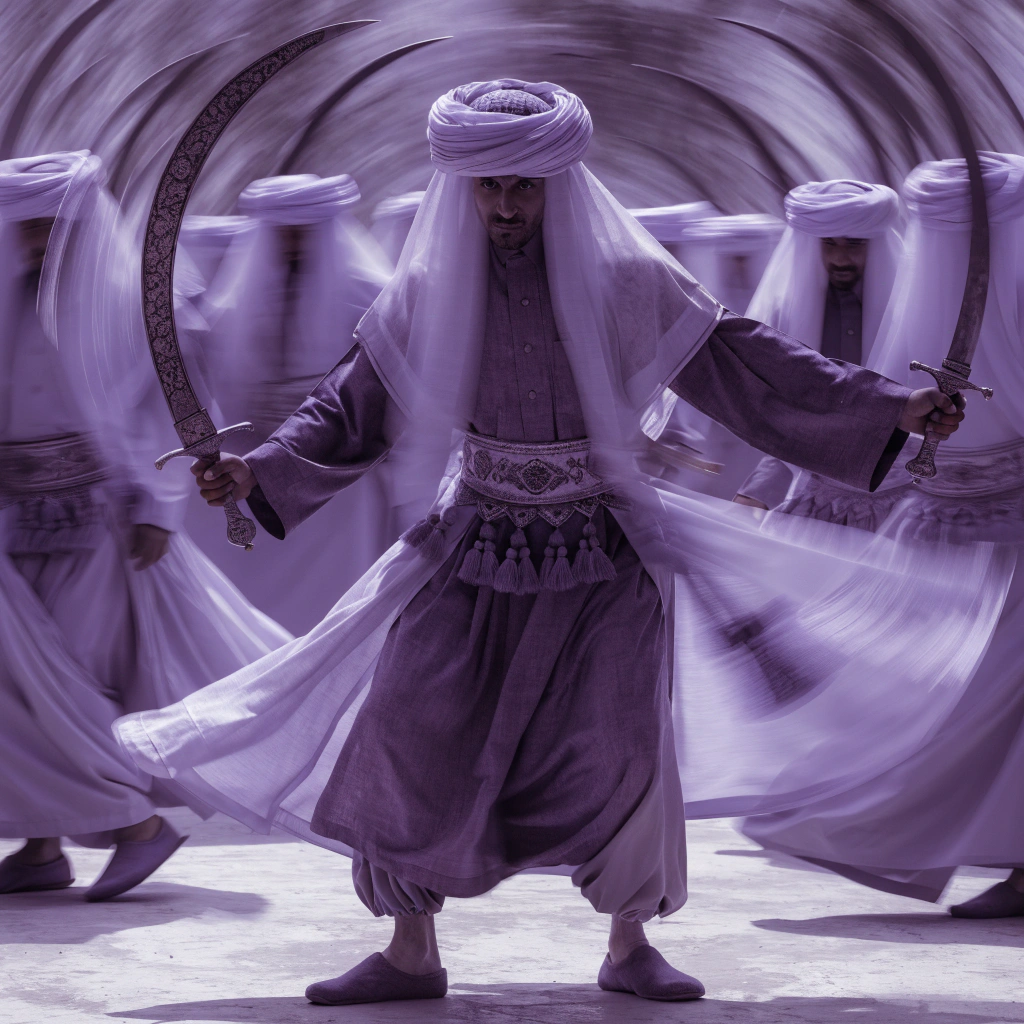
The Saudi Sword Dance
Al-Ardha is a famous dance in Saudi Arabia. It is a traditional dance from the Najd region. People call it the sword dance.
Long ago, men danced before a battle. They wanted to be brave. Today, men dance at weddings and festivals. They wear beautiful white clothes and carry swords.
There are drums and poetry. Men move together in a line. It is a very happy and proud dance. Many people watch the Ardha today. It is part of Saudi culture.
Point grammaire
Structure: Present Simple of 'to be'
"It is a famous dance in Saudi Arabia."
We use 'is' with singular subjects like 'it' or 'he' to describe facts. This helps us say what something is like.
Structure: Present Simple (Plural Verbs)
"Men move together in a line."
With plural subjects like 'men', we use the base form of the verb without an 's'. We use this to talk about habits or general truths.
Teste ta compréhension
10 questions · A1 Débutant · 1 aperçu gratuit
Teste ce que tu as appris dans cet article. Réponds à toutes les questions pour gagner des XP !
Where is the Ardha dance from?
Tu veux terminer le quiz ?
9 questions supplémentaires t'attendent. Inscris-toi gratuitement pour débloquer le quiz complet et gagner des XP !
S'inscrire gratuitementTu as dj un compte ? Connexion
Bien joué !
Continue à pratiquer !
Déjà terminé — pas de XP supplémentaire
Inscris-toi pour gagner des XPDétail des questions
Where is the Ardha dance from?
Ta réponse:
Bonne réponse: The Najd region
Men dance the Ardha at weddings today.
Ta réponse:
Bonne réponse: Vrai
What does 'brave' mean?
Ta réponse:
Bonne réponse: Not afraid
Men carry _____ during the dance.
Ta réponse:
Bonne réponse: swords
Al-Ardha Al-Najdiya: The Saudi Sword Dance
Al-Ardha Al-Najdiya is a very famous dance in Saudi Arabia. People often call it the national sword dance. Long ago, tribes in the Najd region started this dance. They performed it before a battle because they wanted to be brave. The dance showed their strength and power to their enemies. It was a way to feel stronger before a fight.
Today, the Ardha is different. It is a happy dance for celebrations. People perform it at national festivals, Eid, and big weddings. Men wear traditional clothes and carry swords. They move together in rows and sing beautiful poems. There are also many drums that make a loud and exciting sound.
This dance is more popular than many other traditional dances. It is a special part of Saudi culture. When you see the Ardha, you feel the history of the country. Many people enjoy watching the performers because the music is strong and the dance is beautiful. It is an amazing experience for everyone.
Point grammaire
Structure: Past Simple
"They performed it before a battle because they wanted to be brave."
We use the past simple to talk about finished actions in the past. To form regular verbs, we usually add '-ed' to the end of the word.
Structure: Comparatives
"This dance is more popular than many other traditional dances."
We use 'more' + adjective + 'than' to compare two things when the adjective is long. It shows that one thing has more of a quality than the other.
Teste ta compréhension
11 questions · A2 mentaire · 1 aperçu gratuit
Teste ce que tu as appris dans cet article. Réponds à toutes les questions pour gagner des XP !
Where did the Ardha dance originally come from?
Tu veux terminer le quiz ?
10 questions supplémentaires t'attendent. Inscris-toi gratuitement pour débloquer le quiz complet et gagner des XP !
S'inscrire gratuitementTu as dj un compte ? Connexion
Bien joué !
Continue à pratiquer !
Déjà terminé — pas de XP supplémentaire
Inscris-toi pour gagner des XPDétail des questions
Where did the Ardha dance originally come from?
Ta réponse:
Bonne réponse: The Najd region
In the past, tribes performed the dance to show they were weak.
Ta réponse:
Bonne réponse: Faux
What does 'brave' mean?
Ta réponse:
Bonne réponse: Not afraid of danger
Al-Ardha Al-Najdiya is the national _____ dance.
Ta réponse:
Bonne réponse: sword
Why do people perform the Ardha today?
Ta réponse:
Bonne réponse: For happy celebrations and festivals
L'Ardha Al-Najdiya : Une Danse Épée, Du Champ de Bataille à la Fête Nationale
L'Ardha Al-Najdiya est une expression culturelle très importante en Arabie Saoudite. Cette danse traditionnelle, souvent appelée la « danse de l'épée » nationale, a une histoire fascinante. Elle est née parmi les tribus de la région du Najd, au centre de l'Arabie, il y a très longtemps. À l'origine, l'Ardha était une danse de guerre. Avant de partir au combat, les hommes l'exécutaient pour montrer leur force, donner du courage aux guerriers et intimider leurs ennemis.
Historiquement, les participants portaient des épées et des tambours rythmiques accompagnaient leurs mouvements. C'était un spectacle puissant qui renforçait l'unité et la détermination de la tribu. L'Ardha n'était pas seulement une performance physique ; elle était aussi accompagnée de poésie et de chants qui racontaient des histoires de bravoure et d'honneur.
Avec le temps, le rôle de l'Ardha a beaucoup changé. Aujourd'hui, elle a été transformée en une célébration joyeuse et pacifique. Elle est devenue l’attraction principale des grands événements nationaux, comme les festivals, les célébrations de l'Aïd et les mariages. Quand vous assistez à l'Ardha, vous voyez des hommes vêtus de costumes traditionnels, tenant toujours des épées, danser en ligne au son des tambours et des chants. C'est un moment de fierté nationale et de partage.
Cette danse représente le riche patrimoine de l'Arabie Saoudite. Elle montre comment une tradition ancienne peut évoluer et s'adapter tout en gardant son esprit originel. L'Ardha Al-Najdiya est plus qu'une simple danse ; c'est un symbole vivant de l'identité et de l'histoire saoudiennes, appréciée par toutes les générations.
Point grammaire
Structure: La voix passive
"Elle a été transformée en une célébration joyeuse et pacifique."
La voix passive est utilisée pour mettre l'accent sur l'action ou sur ce qui subit l'action, plutôt que sur celui qui fait l'action. On la forme avec l'auxiliaire « être » conjugué et le participe passé du verbe principal.
Structure: Les pronoms relatifs 'qui' et 'que'
"C'était un spectacle puissant qui renforçait l'unité et la détermination de la tribu."
« Qui » est utilisé comme sujet d'un verbe et « que » est utilisé comme objet direct d'un verbe. Ils relient deux propositions pour éviter la répétition et ajouter des informations sur un nom.
Teste ta compréhension
11 questions · B1 Intermédiaire · 1 aperçu gratuit
Teste ce que tu as appris dans cet article. Réponds à toutes les questions pour gagner des XP !
Quel était le but original de l'Ardha Al-Najdiya ?
Tu veux terminer le quiz ?
10 questions supplémentaires t'attendent. Inscris-toi gratuitement pour débloquer le quiz complet et gagner des XP !
S'inscrire gratuitementTu as dj un compte ? Connexion
Bien joué !
Continue à pratiquer !
Déjà terminé — pas de XP supplémentaire
Inscris-toi pour gagner des XPDétail des questions
Quel était le but original de l'Ardha Al-Najdiya ?
Ta réponse:
Bonne réponse: Donner du courage et intimider l'ennemi
L'Ardha Al-Najdiya n'est plus pratiquée aujourd'hui.
Ta réponse:
Bonne réponse: Faux
Que signifie le mot 'patrimoine' dans le contexte de l'article ?
Ta réponse:
Bonne réponse: L'ensemble des traditions et de l'histoire d'une culture
À l'origine, l'Ardha était une danse de ______.
Ta réponse:
Bonne réponse: guerre
Les participants portaient des ______ et des tambours.
Ta réponse:
Bonne réponse: épées
Al-Ardha Al-Najdiya: A Synchronized Legacy of Saudi Strength
Having originated in the central Najd region, Al-Ardha Al-Najdiya represents far more than a mere performance; it is a profound manifestation of Saudi identity. Historically, this rhythmic display served as a tactical war dance, performed by tribal warriors before engaging in battle. The primary objective was to intimidate any potential adversary while simultaneously boosting the collective morale of the fighters. By drumming up courage through synchronization and poetic chanting, the tribes demonstrated their unwavering resilience and readiness to protect their land.
Today, the Ardha has been transformed into a celebratory performance that serves as the centerpiece of national festivals, Eid celebrations, and prestigious royal receptions. Despite its shift from the battlefield to the stage, the dance retains its stirring intensity. The performance typically involves two rows of men, dressed in traditional 'Daglah' coats or 'Sayf' robes, who sway in unison to the beat of large frame drums known as 'Takhmir' and 'Tathlith'. They carry swords, which are raised and lowered in a rhythmic fashion, symbolizing the defensive strength of the nation rather than a desire for aggression.
Central to the performance is the recitation of 'Nabati' poetry. These verses, often chanted by a lead poet and echoed by the ranks of dancers, tell epic stories of bravery, loyalty, and the complex history of the Arabian Peninsula. It is widely believed that the rhythmic drumming serves to ground the performance, creating a heartbeat that resonates with both the participants and the audience. This auditory experience, combined with the visual spectacle of gleaming swords and traditional attire, creates an atmosphere of deep-seated national pride.
In 2015, the cultural significance of the dance was recognized globally when it was inscribed on the UNESCO Representative List of the Intangible Cultural Heritage of Humanity. This prestigious recognition highlights how the tradition continues to unify the Saudi people, bridging the gap between a nomadic past and a modern, rapidly developing future. To witness the Ardha is to see the history of a nation in motion. It allows the Saudi people to commemorate their heritage while looking forward to new global horizons. Ultimately, the dance serves as a living archive of Saudi values, proving that even as a society evolves, its core cultural expressions remain as vital as ever.
Point grammaire
Structure: Perfect Participle Clause
"Having originated in the central Najd region, Al-Ardha Al-Najdiya represents far more than a mere performance..."
This structure is used to indicate that the action in the participle clause happened before the action in the main clause. It is common in formal writing to provide background information efficiently.
Structure: Present Perfect Passive
"Today, the Ardha has been transformed into a celebratory performance..."
Formed with 'has/have been' + past participle, this pattern focuses on the result of a past action on the present. It emphasizes the transformation itself rather than who performed it.
Structure: Passive with Reporting Verbs
"It is widely believed that the rhythmic drumming serves to ground the performance..."
This structure (It + is + past participle + that) is used to report general opinions or widely held beliefs. It maintains an objective, academic tone by avoiding personal pronouns.
Teste ta compréhension
11 questions · B2 Intermédiaire supérieur · 1 aperçu gratuit
Teste ce que tu as appris dans cet article. Réponds à toutes les questions pour gagner des XP !
What was the primary historical purpose of the Al-Ardha dance?
Tu veux terminer le quiz ?
10 questions supplémentaires t'attendent. Inscris-toi gratuitement pour débloquer le quiz complet et gagner des XP !
S'inscrire gratuitementTu as dj un compte ? Connexion
Bien joué !
Continue à pratiquer !
Déjà terminé — pas de XP supplémentaire
Inscris-toi pour gagner des XPDétail des questions
What was the primary historical purpose of the Al-Ardha dance?
Ta réponse:
Bonne réponse: To intimidate enemies and boost warrior morale
The Al-Ardha dance is currently only performed in the Najd region.
Ta réponse:
Bonne réponse: Faux
Which word describes a sign that shows an idea or feeling clearly?
Ta réponse:
Bonne réponse: Manifestation
The traditional coats worn by the dancers are known as ____.
Ta réponse:
Bonne réponse: Daglah
What does the movement of swords symbolize in the modern version of the dance?
Ta réponse:
Bonne réponse: Defensive strength of the nation
The Rhythmic Pulse of Sovereignty: Decoding the Al-Ardha Al-Najdiya
Rarely does a cultural performance encapsulate the collective soul of a nation as poignantly as the Al-Ardha Al-Najdiya. Originating in the rugged heartland of the Najd region, this 'sword dance' transcends mere choreography, serving as a living testament to the historical trajectory of Saudi Arabia. Historically, the Ardha was a bellicose precursor to tribal conflict, a strategic display of martial prowess designed to galvanize warriors and intimidate adversaries. However, what was once a prelude to war has undergone a profound transformation, evolving into a sophisticated emblem of national unity and festive jubilation.
What distinguishes the Ardha is its intricate fusion of poetry, rhythm, and movement. It is the rhythmic cadence of the drums—specifically the large takhmir and the smaller tathlith—that provides the heartbeat of the performance. Participants, clad in traditional daghla or sayah garments, brandish swords in a synchronized sway that mirrors the ebb and flow of a desert breeze. Yet, the visual spectacle is only half the narrative. Central to the performance is the recitation of Nabati poetry. These verses, chanted in a call-and-response format, often extol virtues of courage, loyalty, and the indomitable spirit of the leadership. The interplay between the spoken word and the percussive backdrop creates a sensory experience that is both ancient and immediate.
Critical to understanding the Ardha's contemporary relevance is the recognition of its role in fostering a shared identity. In an era of rapid globalization, the meticulous preservation of such traditions acts as a cultural anchor. The performance is fundamentally egalitarian; while it is often led by members of the royal family, it remains a communal expression where the boundaries between the elite and the citizenry blur in a collective celebration of heritage. This inclusivity reinforces the social contract, reminding participants of their shared history and mutual responsibilities.
Furthermore, the Ardha serves as a powerful medium for historical continuity. Not only does it commemorate the unification of the Kingdom under King Abdulaziz, but it also reinforces the social fabric of modern Saudi society. By analyzing the performance through a sociological lens, one can discern the transition from tribal autonomy to a unified national consciousness. The dance acts as a bridge, connecting the austere realities of the past with the prosperous aspirations of the future. Rarely has a tradition managed to remain so visceral and relevant while adapting to the shifting political and social landscapes of the 21st century.
In conclusion, the Al-Ardha Al-Najdiya is far more than a folkloric display. It is a nuanced dialogue between the past and the present, a rhythmic assertion of sovereignty, and a quintessential symbol of Saudi resilience. As the swords catch the light during a national festival, they do not herald conflict, but rather the enduring strength of a culture that refuses to be eclipsed by the passage of time. The preservation of such intricate traditions is not merely an act of nostalgia; it is a vital component of the nation's ongoing narrative.
Point grammaire
Structure: Inversion with Negative Adverbials
"Rarely does a cultural performance encapsulate the collective soul of a nation as poignantly as the Al-Ardha Al-Najdiya."
This structure places a negative or restrictive adverbial at the beginning for emphasis. It requires the auxiliary verb to come before the subject, creating a formal and dramatic tone.
Structure: Cleft Sentences
"It is the rhythmic cadence of the drums—specifically the large takhmir and the smaller tathlith—that provides the heartbeat of the performance."
Cleft sentences use the 'It is... that...' construction to focus on a specific piece of information. This highlights the drums as the primary source of the performance's rhythm.
Structure: Nominalization
"The meticulous preservation of such traditions acts as a cultural anchor."
Nominalization involves turning verbs into nouns (e.g., 'preserve' to 'preservation') to create a more academic and abstract style. It allows the focus to remain on the concept rather than the actor.
Teste ta compréhension
12 questions · C1 Avancé · 1 aperçu gratuit
Teste ce que tu as appris dans cet article. Réponds à toutes les questions pour gagner des XP !
What was the primary historical purpose of the Al-Ardha Al-Najdiya?
Tu veux terminer le quiz ?
11 questions supplémentaires t'attendent. Inscris-toi gratuitement pour débloquer le quiz complet et gagner des XP !
S'inscrire gratuitementTu as dj un compte ? Connexion
Bien joué !
Continue à pratiquer !
Déjà terminé — pas de XP supplémentaire
Inscris-toi pour gagner des XPDétail des questions
What was the primary historical purpose of the Al-Ardha Al-Najdiya?
Ta réponse:
Bonne réponse: A bellicose display to prepare warriors for battle
The Ardha is described as fundamentally egalitarian because it is a communal expression where elite and citizenry participate together.
Ta réponse:
Bonne réponse: Vrai
Which word means 'impossible to subdue or defeat'?
Ta réponse:
Bonne réponse: Indomitable
The Ardha serves as a powerful _____ for historical continuity in Saudi society.
Ta réponse:
Bonne réponse: medium
What role does Nabati poetry play in the performance?
Ta réponse:
Bonne réponse: It extols virtues like courage and loyalty through call-and-response
In the modern context, the brandished swords in the Ardha signify an upcoming military conflict.
Ta réponse:
Bonne réponse: Faux
Al-Ardha Al-Najdiya : Quintessence d'une Nation en Mouvement
L'Arabie Saoudite, terre de traditions ancestrales et de modernité fulgurante, recèle en son cœur une expression culturelle d'une puissance symbolique inégalée : l'Al-Ardha Al-Najdiya. Plus qu'une simple danse, elle constitue, à bien des égards, le substrat chorégraphique de l'identité nationale, un spectacle à la fois majestueux et viscéral qui ne manque jamais de captiver l'observateur. Il est impératif d'en saisir la profondeur historique et la résonance contemporaine pour en appréhender pleinement la portée.
Historiquement, l'Al-Ardha, dont le nom dérive du verbe arabe signifiant « montrer » ou « défiler », trouve ses origines dans les vastes étendues du Nejd, la région centrale de la péninsule. Il s'agissait initialement d'une danse guerrière, exécutée par les tribus avant de s'engager dans la bataille. Son objectif était double : d'une part, galvaniser le courage des combattants, insuffler une ardeur martiale et cimenter la cohésion du groupe face à l'adversité ; d'autre part, projeter une image de force et d'unité susceptible d'intimider l'ennemi. Les hommes, brandissant leurs épées, se mouvaient en rangs serrés, scandant des poèmes épiques et des chants tribaux, dont le rythme percutant était souvent accompagné de tambours. C'était une manifestation de la prouesse physique et de l'allégeance inébranlable à la tribu, une répétition rituelle de la victoire à venir.
La transition de cette chorégraphie martiale à une célébration nationale s'est opérée au fil des siècles, parallèlement à l'unification et à la consolidation du Royaume. L'Ardha a su transcender son rôle originel pour devenir le pivot des festivités nationales, des célébrations de l'Aïd et des mariages princiers ou populaires. On pourrait arguer que cette transformation n'a en rien dilué son intensité, mais l'a plutôt sublimée, la dotant d'une nouvelle dimension symbolique. Elle n'est plus l'expression d'une confrontation imminente, mais celle d'une unité retrouvée, d'une fierté collective et d'une continuité historique.
Les éléments constitutifs de l'Ardha contemporaine demeurent fidèles à son essence. Les participants, vêtus de la thobe traditionnelle et de la bisht, avancent en ligne droite ou en demi-cercle, leurs épées scintillantes reflétant la lumière. Au centre de la formation, les poètes déclament des vers qui exaltent la bravoure, la sagesse des dirigeants et la grandeur de la nation. Ces chants, dits « Al-Qasayed », sont repris en chœur par les danseurs, dont les mouvements synchronisés, lents et majestueux, créent une impression de puissance contenue. Le rythme, initialement lent et solennel, s'accélère progressivement, atteignant un crescendo d'exaltation collective où le claquement des épées et le tambourinage frénétique se fondent en une symphonie vibrante.
Cette danse n'est pas un simple divertissement ; elle est une affirmation. Elle incarne la mémoire vivante d'un peuple, la pérennité de ses valeurs et son aspiration à l'avenir. L'Al-Ardha Al-Najdiya, en dépit des mutations sociales et des défis du XXIe siècle, conserve un ancrage profond dans le tissu socioculturel saoudien. Elle offre un spectacle où l'esthétique du mouvement se conjugue à la poésie et à la musique pour exprimer une identité complexe et résiliente. Il serait superficiel de la réduire à une simple démonstration folklorique ; elle est, en vérité, la quintessence d'une nation qui danse son histoire, sa force et son unité, un héritage immatériel d'une valeur inestimable qui continue de résonner puissamment au-delà de ses frontières.
Point grammaire
Structure: L'utilisation du subjonctif après une expression impersonnelle
"Il est impératif d'en saisir la profondeur historique et la résonance contemporaine pour en appréhender pleinement la portée."
Le subjonctif est souvent requis après des expressions impersonnelles qui expriment la nécessité, l'obligation, le jugement, l'émotion ou le doute. Bien que l'exemple utilise l'infinitif ici (`d'en saisir`), il est crucial de noter que si le sujet de la subordonnée était différent de celui de la principale, le subjonctif serait employé : « Il est impératif *que l'on saisisse* la profondeur... ».
Structure: Le participe présent employé comme complément de verbe ou adjectif verbal
"Les hommes, brandissant leurs épées, se mouvaient en rangs serrés, scandant des poèmes épiques et des chants tribaux..."
Ici, « brandissant » et « scandant » sont des participes présents qui agissent comme des compléments du verbe principal « se mouvaient ». Ils décrivent des actions simultanées effectuées par le sujet. Le participe présent est invariable quand il est utilisé comme verbe, mais s'accorde en genre et en nombre quand il est employé comme adjectif verbal.
Structure: La concordance des temps dans une proposition subordonnée de but
"Son objectif était double : d'une part, galvaniser le courage des combattants, insuffler une ardeur martiale et cimenter la cohésion du groupe face à l'adversité ; d'autre part, projeter une image de force et d'unité susceptible d'intimider l'ennemi."
Bien que l'exemple utilise ici des infinitifs pour exprimer le but, il illustre la notion de finalité. Lorsque le but est exprimé par une subordonnée introduite par « pour que » ou « afin que », le verbe de la subordonnée est toujours au subjonctif. Si le verbe principal est au passé, le subjonctif passé ou imparfait peut être utilisé pour maintenir la concordance des temps.
Teste ta compréhension
12 questions · C2 Maîtrise · 1 aperçu gratuit
Teste ce que tu as appris dans cet article. Réponds à toutes les questions pour gagner des XP !
Quel était l'objectif principal de l'Al-Ardha lorsqu'elle était une danse guerrière ?
Tu veux terminer le quiz ?
11 questions supplémentaires t'attendent. Inscris-toi gratuitement pour débloquer le quiz complet et gagner des XP !
S'inscrire gratuitementTu as dj un compte ? Connexion
Bien joué !
Continue à pratiquer !
Déjà terminé — pas de XP supplémentaire
Inscris-toi pour gagner des XPDétail des questions
Quel était l'objectif principal de l'Al-Ardha lorsqu'elle était une danse guerrière ?
Ta réponse:
Bonne réponse: Renforcer le courage des combattants et intimider l'ennemi.
L'Al-Ardha Al-Najdiya est une danse exclusivement pratiquée dans la région côtière de l'Arabie Saoudite.
Ta réponse:
Bonne réponse: Faux
Que signifie le mot "ancrage" dans le contexte de l'article ?
Ta réponse:
Bonne réponse: Le fait d'être profondément enraciné ou attaché.
La danse de l'Al-Ardha a su _______ son rôle originel pour devenir le pivot des festivités nationales.
Ta réponse:
Bonne réponse: transcender
Comment le rythme de l'Al-Ardha évolue-t-il généralement au cours de la performance ?
Ta réponse:
Bonne réponse: Il est initialement lent et solennel, puis s'accélère.
Les poèmes déclamés pendant l'Ardha contemporaine exaltent la bravoure et la grandeur de la nation.
Ta réponse:
Bonne réponse: Vrai

