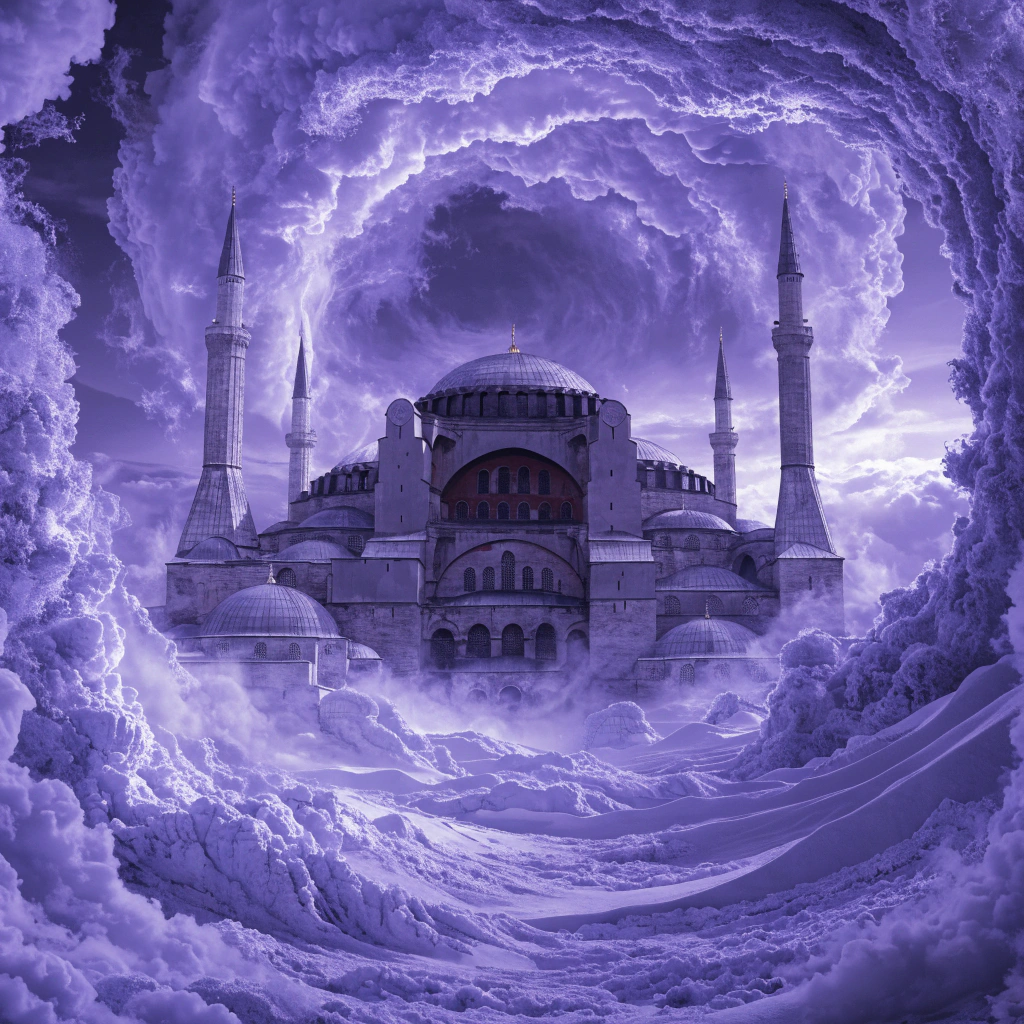
The Beautiful Hagia Sophia
Hagia Sophia is a very old building in Istanbul, Turkey. It is famous and beautiful. Many people visit it every year. In the past, it was a church. Later, it was a mosque. Today, it is a mosque again. It has a very big dome. The dome is high and round. There are four tall towers around the building. They are called minarets. Inside, there are beautiful colors and gold. It is a very special place. You can see history there. It is a great place for photos.
Point grammaire
Structure: Present Simple (to be)
"Hagia Sophia is a very old building in Istanbul, Turkey."
We use 'is' with singular subjects to state facts. It describes what something is or where it is.
Structure: There are (Plural)
"There are four tall towers around the building."
We use 'there are' to say that more than one thing exists. We add an 's' to the noun (towers).
Teste ta compréhension
10 questions · A1 Débutant · 1 aperçu gratuit
Teste ce que tu as appris dans cet article. Réponds à toutes les questions pour gagner des XP !
Where is Hagia Sophia?
Tu veux terminer le quiz ?
9 questions supplémentaires t'attendent. Inscris-toi gratuitement pour débloquer le quiz complet et gagner des XP !
S'inscrire gratuitementTu as dj un compte ? Connexion
Bien joué !
Continue à pratiquer !
Déjà terminé — pas de XP supplémentaire
Inscris-toi pour gagner des XPDétail des questions
Where is Hagia Sophia?
Ta réponse:
Bonne réponse: Istanbul
Hagia Sophia is a new building.
Ta réponse:
Bonne réponse: Faux
What does 'big' mean?
Ta réponse:
Bonne réponse: Large in size
It has a very big _____.
Ta réponse:
Bonne réponse: dome
The Beautiful Hagia Sophia
Hagia Sophia is a very famous building in Istanbul, Turkey. It is very old and has a long history. Emperor Justinian I built it a long time ago. Workers finished the construction in the year 537 AD. For almost a thousand years, it was the largest church in the whole world.
People love the Hagia Sophia because it is beautiful. It has a very big dome on top. At first, people thought a dome this big was impossible to build. However, the architects were very clever. They used special shapes to hold the heavy roof. Inside, there are many gold decorations and old pictures.
Today, Hagia Sophia is a very popular place for tourists. It is more famous than many other buildings in the city. Visitors come from many countries to see the history. It is a symbol of Istanbul and a bridge between the past and the present.
Point grammaire
Structure: Past Simple
"Emperor Justinian I built it a long time ago."
We use the Past Simple to talk about finished actions in the past. For irregular verbs like 'build', the past form is 'built'.
Structure: Comparatives
"It is more famous than many other buildings in the city."
We use 'more' + adjective + 'than' to compare two things when the adjective is long (two or more syllables).
Teste ta compréhension
11 questions · A2 mentaire · 1 aperçu gratuit
Teste ce que tu as appris dans cet article. Réponds à toutes les questions pour gagner des XP !
When did workers finish building the Hagia Sophia?
Tu veux terminer le quiz ?
10 questions supplémentaires t'attendent. Inscris-toi gratuitement pour débloquer le quiz complet et gagner des XP !
S'inscrire gratuitementTu as dj un compte ? Connexion
Bien joué !
Continue à pratiquer !
Déjà terminé — pas de XP supplémentaire
Inscris-toi pour gagner des XPDétail des questions
When did workers finish building the Hagia Sophia?
Ta réponse:
Bonne réponse: 537 AD
Hagia Sophia was once the largest church in the world.
Ta réponse:
Bonne réponse: Vrai
What does 'clever' mean?
Ta réponse:
Bonne réponse: Very smart
Hagia Sophia is a famous building in ____.
Ta réponse:
Bonne réponse: Istanbul
What is the most famous feature on top of the building?
Ta réponse:
Bonne réponse: A dome
Sainte-Sophie : Un chef-d'œuvre entre deux mondes
Sainte-Sophie, ou Aya Sofya en turc, est sans doute l'héritage le plus impressionnant de l'Empire byzantin. Située à Istanbul, cette structure magnifique a été construite sur l'ordre de l'empereur Justinien Ier et achevée en l'an 537. Pendant près de mille ans, elle a servi de plus grande cathédrale au monde, un titre qu'elle a conservé jusqu'à la construction de la cathédrale de Séville en Espagne.
Ce qui rend ce monument si spécial, c'est sa coupole massive. À l'époque de sa construction, une telle structure était considérée comme une impossibilité architecturale. Pour soutenir un poids aussi important, les architectes Isidore de Milet et Anthémius de Tralles ont utilisé des pendentifs. Ce sont des segments triangulaires qui permettent de poser une coupole ronde sur une base carrée. Cette innovation a permis de créer un espace intérieur immense et lumineux.
L'histoire de Sainte-Sophie est marquée par de nombreux changements culturels. Après avoir été le cœur de la chrétienté byzantine, elle a été transformée en mosquée en 1453 lors de la prise de Constantinople par les Ottomans. Plus tard, au XXe siècle, elle est devenue un musée sous l'influence de Mustafa Kemal Atatürk, avant de redevenir une mosquée plus récemment.
Aujourd'hui, les visiteurs qui entrent dans le monument sont souvent frappés par le mélange unique de mosaïques chrétiennes et de calligraphies islamiques. C'est un symbole puissant de l'histoire complexe de la Turquie, où l'Orient et l'Occident se rencontrent. Chaque pierre de cet édifice raconte une partie de l'histoire de l'humanité.
Point grammaire
Structure: La Voix Passive
"cette structure magnifique a été construite sur l'ordre de l'empereur"
On utilise la voix passive pour mettre l'accent sur l'objet de l'action. Elle se forme avec l'auxiliaire 'être' conjugué suivi du participe passé du verbe principal.
Structure: Les Pronoms Relatifs (qui / que)
"un titre qu'elle a conservé"
Le pronom 'que' remplace un complément d'objet direct (ici 'le titre'), tandis que 'qui' remplace le sujet d'une proposition subordonnée.
Teste ta compréhension
11 questions · B1 Intermédiaire · 1 aperçu gratuit
Teste ce que tu as appris dans cet article. Réponds à toutes les questions pour gagner des XP !
Qui a ordonné la construction de Sainte-Sophie ?
Tu veux terminer le quiz ?
10 questions supplémentaires t'attendent. Inscris-toi gratuitement pour débloquer le quiz complet et gagner des XP !
S'inscrire gratuitementTu as dj un compte ? Connexion
Bien joué !
Continue à pratiquer !
Déjà terminé — pas de XP supplémentaire
Inscris-toi pour gagner des XPDétail des questions
Qui a ordonné la construction de Sainte-Sophie ?
Ta réponse:
Bonne réponse: L'empereur Justinien Ier
Sainte-Sophie a été la plus grande cathédrale du monde pendant environ mille ans.
Ta réponse:
Bonne réponse: Vrai
Que signifie le mot 'coupole' ?
Ta réponse:
Bonne réponse: Un toit en forme de demi-sphère
Sainte-Sophie est considérée comme un _____ de l'architecture byzantine.
Ta réponse:
Bonne réponse: chef-d'œuvre
Quel changement a eu lieu en 1453 ?
Ta réponse:
Bonne réponse: Elle a été transformée en mosquée.
Hagia Sophia: A Living Chronicle of Architectural and Cultural Evolution
Standing as a testament to Byzantine ingenuity, the Hagia Sophia remains one of the most iconic structures in human history. Commissioned by Emperor Justinian I in the sixth century, it was intended to surpass all previous architectural feats. For nearly a millennium, it held the title of the world’s largest cathedral, serving as the spiritual heart of Eastern Christendom. Its most revolutionary feature, the massive central dome, appeared to float miraculously above the nave, a feat achieved through the innovative use of pendentives. These triangular segments allowed the weight of the circular dome to be distributed onto a square base, a technique that was considered an engineering marvel at the time.
However, the building’s significance extends far beyond its physical dimensions. Throughout the centuries, it has undergone numerous transformations, reflecting the shifting political and religious landscape of the region. Following the Ottoman conquest of Constantinople in 1453, Sultan Mehmed II ordered its conversion into a mosque, which led to the addition of minarets and the covering of Christian mosaics. This synthesis of styles created a unique aesthetic that influenced subsequent Ottoman architecture across the empire. The blending of Islamic calligraphy with Christian iconography remains one of its most striking characteristics.
In the 20th century, under the leadership of Mustafa Kemal Atatürk, the Hagia Sophia was designated as a museum, symbolizing a move towards secularism. This era allowed for the restoration of many original mosaics, providing scholars with invaluable insights into Byzantine art. Nevertheless, the recent decision to revert the site into a functioning mosque has sparked global debate regarding the preservation of its diverse heritage. Despite these controversies, the structure continues to draw millions of visitors, all of whom are captivated by its enduring grandeur.
Ultimately, the Hagia Sophia is not merely a monument; it is a living chronicle of civilizational change. Its ability to adapt while maintaining its structural integrity serves as a powerful metaphor for the resilience of cultural identity. As it continues to evolve, the challenge remains to balance its religious function with its status as a UNESCO World Heritage site, ensuring that its legacy is preserved for future generations.
Point grammaire
Structure: Present Perfect for Life Experiences/Ongoing Change
"Throughout the centuries, it has undergone numerous transformations."
The present perfect (has + past participle) is used here to describe changes that started in the past and continue to have relevance or effect in the present.
Structure: Passive Voice (Past Simple)
"the Hagia Sophia was designated as a museum"
The passive voice is used to focus on the object (the building) rather than the subject who performed the action, which is common in formal and historical writing.
Structure: Relative Clauses with 'Whom'
"all of whom are captivated by its enduring grandeur."
The relative pronoun 'whom' is used after a preposition or quantifier (like 'all of') to refer to people in a formal register.
Teste ta compréhension
11 questions · B2 Intermédiaire supérieur · 1 aperçu gratuit
Teste ce que tu as appris dans cet article. Réponds à toutes les questions pour gagner des XP !
What was the primary architectural innovation that allowed for the massive dome?
Tu veux terminer le quiz ?
10 questions supplémentaires t'attendent. Inscris-toi gratuitement pour débloquer le quiz complet et gagner des XP !
S'inscrire gratuitementTu as dj un compte ? Connexion
Bien joué !
Continue à pratiquer !
Déjà terminé — pas de XP supplémentaire
Inscris-toi pour gagner des XPDétail des questions
What was the primary architectural innovation that allowed for the massive dome?
Ta réponse:
Bonne réponse: The implementation of pendentives
Hagia Sophia served as a museum before it was ever used as a mosque.
Ta réponse:
Bonne réponse: Faux
What does 'synthesis' mean in the context of the article?
Ta réponse:
Bonne réponse: A combination of different artistic or cultural elements
The building was _____ by Emperor Justinian I in the sixth century.
Ta réponse:
Bonne réponse: commissioned
What does the author suggest the building serves as a metaphor for?
Ta réponse:
Bonne réponse: The resilience of cultural identity
Sainte-Sophie : L'Éternelle Énigme de la Sublime Porte
S'il est un monument qui incarne à lui seul les tumultes et la grandeur de l'histoire méditerranéenne, c'est bien Sainte-Sophie. Trônant majestueusement sur la ligne d'horizon d'Istanbul, cette structure millénaire ne se contente pas d'être un chef-d'œuvre architectural ; elle est le témoin privilégié des mutations géopolitiques et religieuses qui ont façonné le monde moderne. Érigée au VIe siècle sous l'impulsion de l'empereur Justinien Ier, elle fut conçue pour affirmer la suprématie de l'Empire byzantin et de la chrétienté. Nonobstant les contraintes techniques de l'époque, Justinien ambitionnait de surpasser la gloire du temple de Salomon, une prouesse qu'il pensait avoir accomplie lors de l'inauguration en 537.
Rarement aura-t-on vu une telle audace technique pour l'époque. Sous la direction d'Isidore de Milet et d'Anthémius de Tralles, l'édifice fut achevé en un temps record de moins de six ans. Le défi majeur résidait dans la conception de son dôme colossal, dont le diamètre avoisine les trente-deux mètres. Pour soutenir une telle masse sans que les murs ne s'effondrent sous la pression latérale, les architectes eurent recours à une innovation révolutionnaire : les pendentifs. Ces sections triangulaires permettent de faire reposer une coupole circulaire sur une base carrée, créant ainsi l'illusion que la voûte est suspendue au ciel par une chaîne d'or. La lumière, filtrée par quarante fenêtres à la base du dôme, inonde l'espace intérieur, sublimant les mosaïques dorées et les marbres précieux acheminés des confins de l'Empire.
Néanmoins, la pérennité de Sainte-Sophie ne repose pas uniquement sur ses pierres, mais sur sa capacité à se métamorphoser. Après avoir servi de cathédrale patriarcale pendant près d'un millénaire, elle fut transformée en mosquée lors de la chute de Constantinople en 1453 par le sultan Mehmed II. L'ajout des minarets et le recouvrement partiel des mosaïques byzantines marquèrent le début d'une nouvelle ère sous l'égide de l'Empire ottoman. Ce syncrétisme visuel, où les calligraphies arabes monumentales côtoient les vestiges de l'iconographie chrétienne, confère au lieu une atmosphère unique, presque mystique. La structure fut renforcée par l'architecte Sinan, dont les contreforts massifs ont permis à l'édifice de résister aux séismes récurrents de la région.
Au XXe siècle, sous l'impulsion de Mustafa Kemal Atatürk, la sécularisation de la Turquie entraîna la transformation du monument en musée en 1935. Cette décision visait à offrir Sainte-Sophie à l'humanité entière, par-delà les clivages confessionnels, en mettant en lumière son double héritage. Toutefois, l'histoire ne s'arrête jamais, et la récente reconversion du site en lieu de culte musulman en 2020 a ravivé les débats internationaux sur l'usage politique et culturel du patrimoine mondial. Quoi qu'il en soit, Sainte-Sophie demeure un symbole immuable de la résilience humaine. Sa survie face aux assauts du temps et de la politique témoigne d'une architecture qui, bien qu'ancrée dans le sol anatolien, semble aspirer à l'éternité. C'est dans ce dialogue incessant entre le passé et le présent que réside la véritable essence de cet édifice hors du commun.
Point grammaire
Structure: L'inversion du sujet après certains adverbes
"Rarement aura-t-on vu une telle audace technique pour l'époque."
Lorsqu'une phrase commence par un adverbe à sens restrictif ou négatif (Rarement, À peine, En vain), le sujet et le verbe sont inversés pour créer un effet stylistique soutenu.
Structure: La mise en relief (Phrase clivée)
"C'est dans ce dialogue incessant entre le passé et le présent que réside la véritable essence de cet édifice."
On utilise la structure 'C'est... que/qui' pour mettre l'accent sur un élément précis de la phrase, ici le lieu et la circonstance.
Structure: La nominalisation
"La récente reconversion du site en lieu de culte musulman en 2020 a ravivé les débats."
L'utilisation de noms (reconversion) au lieu de verbes permet de densifier l'information et d'adopter un ton plus formel et analytique typique du niveau C1.
Teste ta compréhension
12 questions · C1 Avancé · 1 aperçu gratuit
Teste ce que tu as appris dans cet article. Réponds à toutes les questions pour gagner des XP !
Quel était l'objectif principal de l'empereur Justinien Ier lors de la construction ?
Tu veux terminer le quiz ?
11 questions supplémentaires t'attendent. Inscris-toi gratuitement pour débloquer le quiz complet et gagner des XP !
S'inscrire gratuitementTu as dj un compte ? Connexion
Bien joué !
Continue à pratiquer !
Déjà terminé — pas de XP supplémentaire
Inscris-toi pour gagner des XPDétail des questions
Quel était l'objectif principal de l'empereur Justinien Ier lors de la construction ?
Ta réponse:
Bonne réponse: Affirmer la suprématie de l'Empire byzantin
Sainte-Sophie est restée une cathédrale pendant plus de mille ans.
Ta réponse:
Bonne réponse: Faux
Que signifie le mot 'Syncrétisme' dans le texte ?
Ta réponse:
Bonne réponse: Un mélange de styles et de croyances
Les architectes ont utilisé des _____ pour soutenir le dôme circulaire sur une base carrée.
Ta réponse:
Bonne réponse: pendentifs
Qui a décidé de transformer Sainte-Sophie en musée en 1935 ?
Ta réponse:
Bonne réponse: Mustafa Kemal Atatürk
L'architecte Sinan a ajouté des contreforts pour protéger l'édifice des tremblements de terre.
Ta réponse:
Bonne réponse: Vrai
The Hagia Sophia: A Palimpsest of Imperial Ambition and Architectural Audacity
Rarely has a single edifice encapsulated the turbulent evolution of Western and Eastern civilizations as poignantly as the Hagia Sophia. Standing as the crowning achievement of the Byzantine Empire, it remains an enduring testament to the intersection of divine aspiration and human ingenuity. It is a historical palimpsest, where layers of Christian orthodoxy and Islamic devotion are inextricably woven into the very mortar of its walls, defying any simplistic categorization of its identity. Commissioned by Emperor Justinian I in the sixth century, the structure was intended to be a physical manifestation of imperial hubris and spiritual favor, a monument that would transcend the limitations of contemporary engineering.
Had the architects, Isidore of Miletus and Anthemius of Tralles, not possessed an almost preternatural understanding of geometry, the massive dome—long considered an architectural impossibility—would have surely collapsed under its own weight. To solve the riddle of placing a circular dome atop a rectangular base, they utilized the pendentive, a triangular segment of a sphere that allows for the weight to be distributed to four massive piers. This innovation was not merely a structural necessity; it served an aesthetic and theological purpose. It is essential that the viewer perceive the dome not as a static roof, but as an ethereal canopy that seems suspended from heaven by a golden chain. The luminescence filtered through the forty windows at the dome's base creates a sense of weightlessness, suggesting that the divine presence might indeed reside within these hallowed precincts.
Throughout the centuries, the Hagia Sophia has weathered the vicissitudes of iconoclasm, seismic upheaval, and radical political shifts. When Constantinople fell to the Ottomans in 1453, Mehmed the Conqueror did not seek to dismantle this marvel but rather to repurpose it, adding minarets and covering mosaics to align it with Islamic practice. This transition marked a period of religious syncretism, where the building’s Christian past was preserved beneath layers of plaster and calligraphy, waiting to be rediscovered. One might argue that the building is less a site of conflict and more a canvas for the shared heritage of humanity.
In the modern era, the status of the Hagia Sophia has remained a subject of intense geopolitical debate. Its conversion into a museum in 1934 by Mustafa Kemal Atatürk symbolized a shift toward secularism and universalism, positioning the site as a shared cultural treasure. However, its recent reversion to a mosque has reignited discussions regarding the preservation of its pluralistic history. Lest we forget the ephemeral nature of empires, the Hagia Sophia stands as a reminder that while political regimes are transient, the pursuit of the sublime is eternal. It is imperative that the structure be viewed not merely as a relic of a bygone era, but as a living organism that continues to breathe the history of two worlds. The sacrosanct nature of the space, whether viewed through the lens of theology or art history, demands a nuanced appreciation for its complexity. To study the Hagia Sophia is to study the very paradigm of cultural evolution, where every stone tells a story of triumph, tragedy, and the relentless quest for the infinite.
Point grammaire
Structure: Negative Inversion
"Rarely has a single edifice encapsulated the turbulent evolution of Western and Eastern civilizations as poignantly as the Hagia Sophia."
When a sentence starts with a restrictive adverb like 'rarely', the auxiliary verb is placed before the subject. This is used in formal writing to emphasize the rarity or intensity of the statement.
Structure: Third Conditional (Inverted)
"Had the architects, Isidore of Miletus and Anthemius of Tralles, not possessed an almost preternatural understanding of geometry, the massive dome... would have surely collapsed."
This structure replaces 'If the architects had not possessed...' by omitting 'if' and placing 'had' at the beginning. It expresses a hypothetical situation in the past and its imaginary result.
Structure: Subjunctive Mood
"It is essential that the viewer perceive the dome not as a static roof, but as an ethereal canopy."
The subjunctive 'perceive' (rather than 'perceives') is used after adjectives expressing necessity or importance, such as 'essential', 'imperative', or 'crucial'.
Teste ta compréhension
12 questions · C2 Maîtrise · 1 aperçu gratuit
Teste ce que tu as appris dans cet article. Réponds à toutes les questions pour gagner des XP !
According to the article, what was the primary architectural challenge in building the Hagia Sophia?
Tu veux terminer le quiz ?
11 questions supplémentaires t'attendent. Inscris-toi gratuitement pour débloquer le quiz complet et gagner des XP !
S'inscrire gratuitementTu as dj un compte ? Connexion
Bien joué !
Continue à pratiquer !
Déjà terminé — pas de XP supplémentaire
Inscris-toi pour gagner des XPDétail des questions
According to the article, what was the primary architectural challenge in building the Hagia Sophia?
Ta réponse:
Bonne réponse: Supporting a circular dome on a rectangular base
The architects Isidore of Miletus and Anthemius of Tralles were primarily known as poets.
Ta réponse:
Bonne réponse: Faux
What does the term 'palimpsest' imply about the Hagia Sophia?
Ta réponse:
Bonne réponse: It contains multiple historical layers visible within one entity.
The transition of the building from a church to a mosque is described as a period of religious _____.
Ta réponse:
Bonne réponse: syncretism
What effect does the luminescence from the forty windows at the base of the dome create?
Ta réponse:
Bonne réponse: A feeling of weightlessness and divine presence
The conversion of the building into a museum in 1934 was intended to symbolize a move toward secularism.
Ta réponse:
Bonne réponse: Vrai

