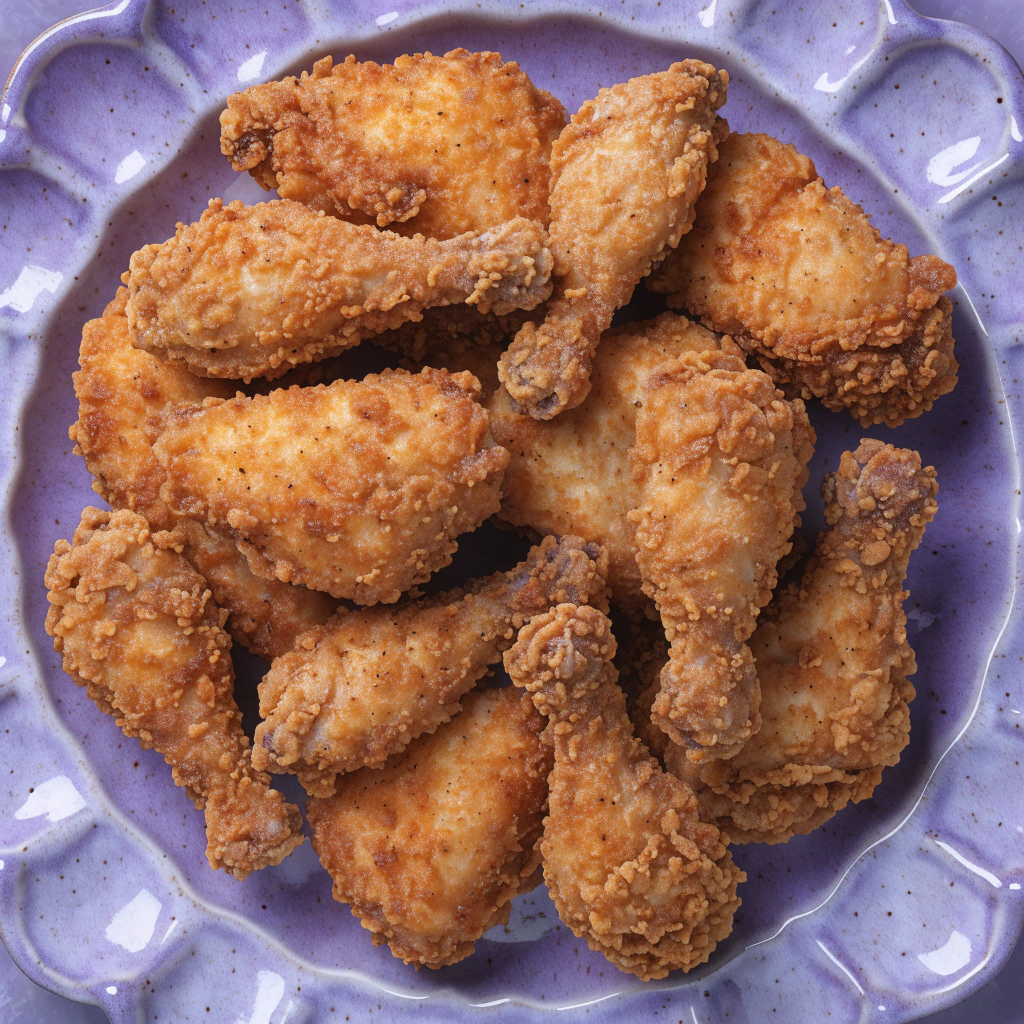
Southern Fried Chicken
Southern fried chicken is a very famous food in the USA. It comes from the South. People love this dish. It is crunchy and delicious. It is golden and hot.
Long ago, people from Scotland and West Africa mixed their ideas. They used oil and many spices. Today, families eat it for special days. It is important to many people.
You can find it in many restaurants. It is a part of American history. It is very popular and tasty. Many people cook it at home too. It is a traditional meal.
Point grammaire
Structure: Present Simple 'To Be'
"It is crunchy and delicious."
We use 'is' with singular objects like 'it' to describe facts. This helps us give information about things.
Structure: Present Simple Action Verbs
"Families eat it for special days."
We use the base form of the verb for plural subjects like 'families'. This describes a regular habit or general truth.
Teste ta compréhension
10 questions · A1 Débutant · 1 aperçu gratuit
Teste ce que tu as appris dans cet article. Réponds à toutes les questions pour gagner des XP !
Where does this food come from?
Tu veux terminer le quiz ?
9 questions supplémentaires t'attendent. Inscris-toi gratuitement pour débloquer le quiz complet et gagner des XP !
S'inscrire gratuitementTu as dj un compte ? Connexion
Bien joué !
Continue à pratiquer !
Déjà terminé — pas de XP supplémentaire
Inscris-toi pour gagner des XPDétail des questions
Where does this food come from?
Ta réponse:
Bonne réponse: The South
The chicken is crunchy.
Ta réponse:
Bonne réponse: Vrai
What does 'popular' mean?
Ta réponse:
Bonne réponse: Liked by many people
It is a traditional _____.
Ta réponse:
Bonne réponse: meal
The History of Southern Fried Chicken
Southern Fried Chicken is a very popular dish in the United States. It has a long and interesting history. Many years ago, different cultures met in the American South. Scottish people brought their way of frying chicken in fat. At the same time, people from West Africa added many delicious spices to the food. They mixed these two ideas together to create something new.
In the 18th and 19th centuries, life was very difficult for enslaved people. They could not keep large animals like cows or pigs, but they could keep chickens. Because of this, fried chicken became a special meal for important days and celebrations. It was better than other food because it was crispy and easy to carry.
Today, Southern Fried Chicken is famous all over the world. You can find it in many restaurants, but it started as a simple meal with a deep history. It is more famous than many other American dishes because it is part of the country's culture.
Point grammaire
Structure: Past Simple
"Scottish people brought their way of frying chicken in fat."
We use the past simple to talk about completed actions in the past. For regular verbs, we add -ed, but 'brought' is the irregular past of 'bring'.
Structure: Comparatives
"It was better than other food because it was crispy."
We use comparatives to compare two things. 'Better than' is the irregular comparative form of 'good'.
Teste ta compréhension
11 questions · A2 mentaire · 1 aperçu gratuit
Teste ce que tu as appris dans cet article. Réponds à toutes les questions pour gagner des XP !
Which group of people brought the technique of frying chicken in fat?
Tu veux terminer le quiz ?
10 questions supplémentaires t'attendent. Inscris-toi gratuitement pour débloquer le quiz complet et gagner des XP !
S'inscrire gratuitementTu as dj un compte ? Connexion
Bien joué !
Continue à pratiquer !
Déjà terminé — pas de XP supplémentaire
Inscris-toi pour gagner des XPDétail des questions
Which group of people brought the technique of frying chicken in fat?
Ta réponse:
Bonne réponse: Scottish people
Enslaved people were allowed to keep cows and pigs.
Ta réponse:
Bonne réponse: Faux
What does 'crispy' mean?
Ta réponse:
Bonne réponse: Pleasantly hard and dry on the outside
Fried chicken became a _____ meal for important days.
Ta réponse:
Bonne réponse: special
Why is fried chicken famous today?
Ta réponse:
Bonne réponse: Because it is part of American culture
The Surprising History of Southern Fried Chicken
Southern Fried Chicken is a famous dish that is loved by many people around the world. However, the history of this meal is more complex than you might think. It is a unique fusion of different culinary traditions that came together in the American South many years ago. The origins of the dish can be traced back to two main groups. In the 18th and 19th centuries, Scottish immigrants brought their tradition of deep-frying chicken in fat to the United States. At the same time, enslaved West Africans added their own vibrant seasonings and spices to the meat. This combination created the flavor that we recognize today. Because enslaved people were often allowed to keep chickens when they were forbidden from having other livestock, this dish became a prized meal for special occasions and community gatherings. Today, the recipe has been improved by many generations of talented cooks. The chicken is usually soaked in buttermilk, which makes the meat very tender, and then it is coated in seasoned flour. When it is fried correctly, the crust becomes incredibly crispy and golden. This specific cooking method has become a global symbol of Southern hospitality and comfort. In recent years, Southern Fried Chicken has gained international fame. You can find restaurants serving this dish in almost every country, from fast-food chains to expensive dining rooms. Although it started as a simple meal made by people with very few resources, it has transformed into a global favorite that represents a rich and difficult cultural history. Whether it is served with spicy sauce, honey, or biscuits, it remains a delicious part of American heritage that continues to bring people together.
Point grammaire
Structure: Passive Voice
"The chicken is usually soaked in buttermilk, which makes the meat very tender."
The passive voice is formed with 'be' + past participle. It is used here because the action (soaking the chicken) is more important than who is doing it.
Structure: Present Perfect
"In recent years, Southern Fried Chicken has gained international fame."
The present perfect is formed with 'has/have' + past participle. It is used for an action that happened at an unspecified time in the past and has a result in the present.
Teste ta compréhension
11 questions · B1 Intermédiaire · 1 aperçu gratuit
Teste ce que tu as appris dans cet article. Réponds à toutes les questions pour gagner des XP !
Which two cultures influenced the origins of Southern Fried Chicken?
Tu veux terminer le quiz ?
10 questions supplémentaires t'attendent. Inscris-toi gratuitement pour débloquer le quiz complet et gagner des XP !
S'inscrire gratuitementTu as dj un compte ? Connexion
Bien joué !
Continue à pratiquer !
Déjà terminé — pas de XP supplémentaire
Inscris-toi pour gagner des XPDétail des questions
Which two cultures influenced the origins of Southern Fried Chicken?
Ta réponse:
Bonne réponse: Scottish and West African
Enslaved people were allowed to keep any type of livestock they wanted.
Ta réponse:
Bonne réponse: Faux
What does the word 'tender' mean in the context of meat?
Ta réponse:
Bonne réponse: Soft and easy to eat
The chicken is usually _____ in buttermilk to make it soft.
Ta réponse:
Bonne réponse: soaked
Why did fried chicken become a prized meal for enslaved people?
Ta réponse:
Bonne réponse: Because they were often allowed to keep chickens but not other animals
The Culinary Legacy of Southern Fried Chicken: More Than a Fast Food Staple
Southern Fried Chicken is often viewed as a simple global commodity, yet its origins are deeply rooted in a complex history of cultural fusion and social resilience. Although many associate the dish with modern fast-food chains, its development represents a sophisticated intersection of diverse culinary traditions that emerged in the American South during the eighteenth century. This iconic dish was initially shaped by the combination of Scottish deep-frying techniques and the vibrant seasoning palettes brought to North America by enslaved West Africans.
Historically, the preparation of fried chicken was not an everyday occurrence but rather a prestigious activity reserved for special occasions. During the era of slavery, enslaved populations were frequently prohibited from owning large livestock, such as cattle or horses. However, they were often permitted to keep chickens, as these birds were considered small and of little value by plantation owners. Consequently, chickens became a primary source of independent enterprise and nutritional supplements for the enslaved. Through their ingenuity, enslaved cooks transformed what was a basic protein into a culinary masterpiece by incorporating indigenous spices and refined frying methods.
Furthermore, the dish played a significant role in the economic empowerment of African American women after the Civil War. Known as 'waiter carriers,' these women sold fried chicken and biscuits to passengers on trains at various stops, providing a rare opportunity for financial independence in a segregated society. By the time the recipe became a widespread household staple, these early entrepreneurs had already established its reputation for quality and flavor.
In contemporary society, while the dish has been commercialized globally, it remains a symbol of heritage. Evaluating its history allows us to appreciate the resilience of those who, despite facing extreme hardship, managed to create a lasting cultural legacy. To fully understand Southern Fried Chicken, one must look beyond the crispy exterior and recognize the layers of innovation and history that define it. It is not merely a meal; it is a testament to the enduring influence of African American culture on the global stage.
Point grammaire
Structure: Passive Voice
"This iconic dish was initially shaped by the combination of Scottish deep-frying techniques and West African seasoning."
The passive voice is used here to focus on the dish (the object) rather than the specific people who created it. It is formed using 'to be' + the past participle.
Structure: Past Perfect Tense
"By the time the recipe became a widespread household staple, these early entrepreneurs had already established its reputation."
The past perfect (had established) is used to show that one action in the past happened before another action (became a staple).
Structure: Concessive Clauses with 'Despite'
"Evaluating its history allows us to appreciate the resilience of those who, despite facing extreme hardship, managed to create a lasting cultural legacy."
'Despite' is used to introduce a contrast. It is followed by a noun phrase or a gerund (-ing form), showing that something happened even though there was an obstacle.
Teste ta compréhension
11 questions · B2 Intermédiaire supérieur · 1 aperçu gratuit
Teste ce que tu as appris dans cet article. Réponds à toutes les questions pour gagner des XP !
Which two cultures primarily influenced the creation of Southern Fried Chicken?
Tu veux terminer le quiz ?
10 questions supplémentaires t'attendent. Inscris-toi gratuitement pour débloquer le quiz complet et gagner des XP !
S'inscrire gratuitementTu as dj un compte ? Connexion
Bien joué !
Continue à pratiquer !
Déjà terminé — pas de XP supplémentaire
Inscris-toi pour gagner des XPDétail des questions
Which two cultures primarily influenced the creation of Southern Fried Chicken?
Ta réponse:
Bonne réponse: Scottish and West African
Enslaved people were allowed to keep large livestock like cattle.
Ta réponse:
Bonne réponse: Faux
What is the meaning of 'ingenuity' as used in the text?
Ta réponse:
Bonne réponse: Cleverness and original thinking
In the past, fried chicken was not an everyday meal; it was a _____ activity for special events.
Ta réponse:
Bonne réponse: prestigious
Who were the 'waiter carriers' mentioned in the article?
Ta réponse:
Bonne réponse: African American women who sold food at train stops
The Crusted Legacy: A Socio-Historical Analysis of Southern Fried Chicken
Few dishes in the American culinary canon evoke as much visceral emotion or carry such a profound historical burden as Southern Fried Chicken. While contemporary fast-food chains have rendered the dish a global commodity, its provenance is rooted in a complex amalgamation of disparate cultures and the grim realities of the antebellum South. It was the intersection of Scottish deep-frying techniques and the vibrant seasoning palettes of West Africa that birthed this iconic staple. This synthesis was not merely a culinary accident but a byproduct of the forced migration and cultural exchange inherent in the transatlantic slave trade.
Historically, the proliferation of fried chicken across the Southern United States was inextricably linked to the institution of slavery. Seldom were enslaved individuals permitted to own large livestock such as cattle or pigs, yet they were frequently allowed to keep poultry. This autonomy over a singular resource facilitated a form of culinary entrepreneurship; fried chicken became a prized dish for special occasions and a means of economic agency within enslaved communities. The meticulous seasoning and preparation—a testament to West African culinary resilience—transformed a humble protein into a sophisticated delicacy that eventually transcended racial and class boundaries.
However, the narrative of Southern Fried Chicken is not without its harrowing chapters. The 19th and 20th centuries saw the emergence of pervasive racial stereotypes that weaponized the dish against the very people who had refined it. This caricature of the African American community served to dehumanize and marginalize, even as the dish itself gained widespread popularity among white populations. What we witness today is the tension between the commodification of a cultural identity and the preservation of its authentic heritage. The commercial success of the dish often masks the systemic oppression that once governed its production.
In the modern era, Southern Fried Chicken has achieved a state of ubiquity, yet the nuanced history behind its crispy exterior often remains obscured. It is through the lens of history that we must view its evolution—from a symbol of survival in the face of bondage to a global gastronomic phenomenon. Ultimately, the dish stands as a monument to the endurance of cultural identity. Only by acknowledging the socio-political undercurrents can one truly appreciate the depth of this culinary legacy. The commensality shared over a plate of fried chicken today should, therefore, be accompanied by a recognition of the labor and ingenuity of those who first seasoned the oil.
Point grammaire
Structure: Inversion with Negative Adverbials
"Seldom were enslaved individuals permitted to own large livestock such as cattle or pigs..."
When a negative or restrictive adverbial like 'seldom' or 'never' starts a sentence, the auxiliary verb and subject are inverted. This adds emphasis and a formal, literary tone common in C1 writing.
Structure: Cleft Sentences
"It was the intersection of Scottish deep-frying techniques and the vibrant seasoning palettes of West Africa that birthed this iconic staple."
Cleft sentences use 'It is/was... that...' to focus on a specific part of the information. They are used to highlight the most important cause or subject in a complex narrative.
Structure: Nominalisation
"The commercial success of the dish often masks the systemic oppression that once governed its production."
Nominalisation involves turning verbs or adjectives into nouns (e.g., 'success' instead of 'succeed'). This makes the writing more abstract, objective, and dense, which is a hallmark of advanced English.
Teste ta compréhension
12 questions · C1 Avancé · 1 aperçu gratuit
Teste ce que tu as appris dans cet article. Réponds à toutes les questions pour gagner des XP !
According to the text, what was the primary reason chickens became popular among enslaved communities?
Tu veux terminer le quiz ?
11 questions supplémentaires t'attendent. Inscris-toi gratuitement pour débloquer le quiz complet et gagner des XP !
S'inscrire gratuitementTu as dj un compte ? Connexion
Bien joué !
Continue à pratiquer !
Déjà terminé — pas de XP supplémentaire
Inscris-toi pour gagner des XPDétail des questions
According to the text, what was the primary reason chickens became popular among enslaved communities?
Ta réponse:
Bonne réponse: Enslaved people were often forbidden from owning larger livestock.
The article suggests that the history of fried chicken is widely understood and celebrated in its full context today.
Ta réponse:
Bonne réponse: Faux
What does 'provenance' refer to in the context of the article?
Ta réponse:
Bonne réponse: The place of origin or history.
The author describes the seasoning and preparation as a testament to West African culinary _____.
Ta réponse:
Bonne réponse: resilience
What does the author identify as the 'tension' in the modern era regarding this dish?
Ta réponse:
Bonne réponse: Commodification of cultural identity versus preservation of heritage.
Scottish deep-frying techniques were the sole origin of Southern Fried Chicken.
Ta réponse:
Bonne réponse: Faux
The Gastronomic Crucible: Deconstructing the Socio-Historical Provenance of Southern Fried Chicken
The cultural lineage of Southern Fried Chicken is often obscured by its contemporary status as a ubiquitous fast-food staple. To perceive it merely as a culinary commodity is to ignore the profound socio-historical synthesis that occurred within the brutal interstices of the American South. The dish represents a confluence of disparate traditions: the deep-frying techniques of the Scots and the sophisticated seasoning palettes of West African origin. This amalgamation was not merely incidental; it was forged within the crucible of the plantation system, where the enslaved population utilized the limited resources at their disposal to create a dish of enduring complexity.
Historically, the provenance of immersion frying in the South is frequently attributed to Scottish immigrants. However, were one to examine the culinary landscape of 18th-century West Africa, one would find a pre-existing mastery of seasoning and frying techniques that predates the American experience. Enslaved individuals, often prohibited from owning larger livestock such as cattle or horses, were frequently permitted to keep chickens. Consequently, the bird became a vital source of independent sustenance and a rare medium for entrepreneurial agency. It is within this context of subjugation that fried chicken evolved from a utilitarian meal into a symbol of resilience and celebratory significance.
The transition of fried chicken from a domestic ritual to a global paradigm of American cuisine was fraught with complexity. Following the abolition of slavery, 'waiter carriers'—African American women who sold fried chicken and biscuits to passengers on trains—became quintessential figures in the Southern economy. This early form of entrepreneurship allowed these women to navigate a landscape of systemic exclusion. Yet, as the dish moved into the commercial sphere during the 20th century, the narrative of its origin was often sanitized or appropriated, stripped of its connection to the laborers who perfected its form.
From an analytical perspective, the hegemony of the modern fast-food industry has arguably diluted the dish's historical weight. The commodification of fried chicken has replaced the artisanal nuance of traditional preparation with a standardized, mass-produced aesthetic. Nevertheless, vestiges of the original synthesis remain for those who seek them. The interplay of spices—cayenne, black pepper, and paprika—serves as a sensory bridge to the West African influence, while the crisp, golden exterior remains a testament to the technical proficiency demanded by the frying process.
In contemporary discourse, it is imperative that the narrative surrounding Southern Fried Chicken be reclaimed as an epistemological study of cultural fusion. It is not merely a testament to the palate but a reflection of the human spirit’s capacity to innovate under duress. To consume the dish without acknowledging the historical vestiges of the plantation era is to engage in a form of historical amnesia. Only through a rigorous examination of its origins can we appreciate the dish as a profound synthesis of survival, skill, and cross-cultural exchange.
Ultimately, fried chicken stands as a quintessential American paradox: a dish born of the most oppressive circumstances that has ascended to the pinnacle of global popularity. Whether viewed through the lens of sociology, history, or gastronomy, its story remains a compelling illustration of how the interstices of culture can yield something both palatable and politically charged. Rare is the dish that carries such a heavy burden of history while maintaining its place as a cornerstone of comfort and community.
Point grammaire
Structure: Inverted Conditional (Subjunctive)
"However, were one to examine the culinary landscape of 18th-century West Africa, one would find a pre-existing mastery..."
This structure replaces 'if one were to examine' with an inverted word order to sound more formal and academic. It is used to discuss hypothetical or unlikely situations in the present or future.
Structure: Inversion with Negative/Restrictive Adjectives
"Rare is the dish that carries such a heavy burden of history while maintaining its place as a cornerstone of comfort and community."
Placing the adjective 'Rare' at the beginning of the sentence followed by the verb 'is' emphasizes the uniqueness of the subject. This is a common rhetorical device in high-level analytical prose.
Structure: Passive Voice with Academic Hedging
"Historically, the provenance of immersion frying in the South is frequently attributed to Scottish immigrants."
The use of 'is frequently attributed to' allows the author to report a common belief without stating it as an absolute, undeniable fact. This 'hedging' is a hallmark of C2-level scholarly writing.
Teste ta compréhension
12 questions · C2 Maîtrise · 1 aperçu gratuit
Teste ce que tu as appris dans cet article. Réponds à toutes les questions pour gagner des XP !
What does the author suggest is a common mistake when viewing Southern Fried Chicken today?
Tu veux terminer le quiz ?
11 questions supplémentaires t'attendent. Inscris-toi gratuitement pour débloquer le quiz complet et gagner des XP !
S'inscrire gratuitementTu as dj un compte ? Connexion
Bien joué !
Continue à pratiquer !
Déjà terminé — pas de XP supplémentaire
Inscris-toi pour gagner des XPDétail des questions
What does the author suggest is a common mistake when viewing Southern Fried Chicken today?
Ta réponse:
Bonne réponse: Viewing it merely as a commercial fast-food product without historical context.
Enslaved people were often allowed to keep chickens because they were considered 'ancillary livestock' that posed little threat to the plantation hierarchy.
Ta réponse:
Bonne réponse: Vrai
Which word describes the leadership or dominance of the modern fast-food industry over the dish's narrative?
Ta réponse:
Bonne réponse: Hegemony
The author argues that consuming the dish without acknowledging its past is a form of historical _____.
Ta réponse:
Bonne réponse: amnesia
Who were the 'waiter carriers' mentioned in the text?
Ta réponse:
Bonne réponse: African American women who sold food to train passengers post-abolition.
The text claims that the Scottish were the only group with a pre-existing mastery of frying techniques.
Ta réponse:
Bonne réponse: Faux

