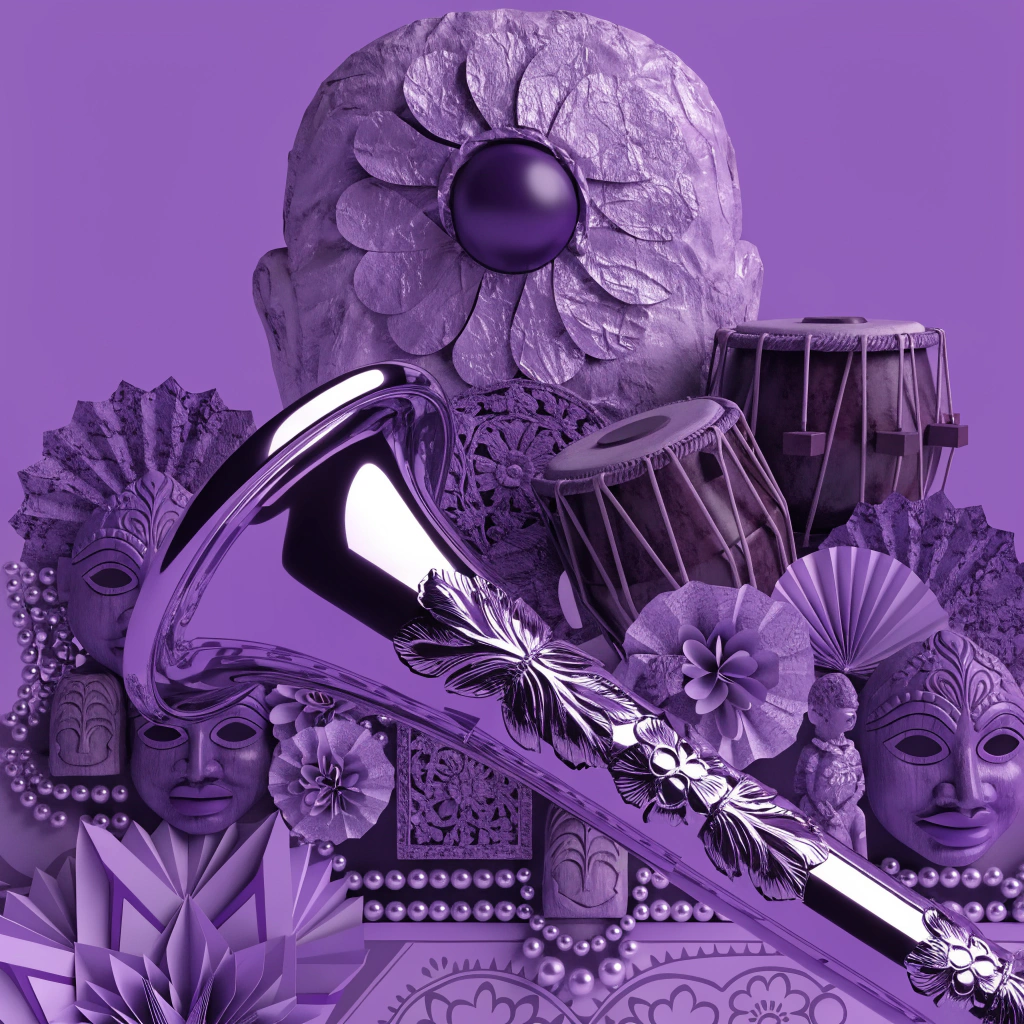
インドの古い音楽
インドはとても大きい国です。インドには古い音楽があります。この音楽は「インド古典音楽」と言います。とてもきれいです。
インド古典音楽には二つの種類があります。北インドの音楽と南インドの音楽です。多くの人がこの音楽を好きです。楽器を使います。歌も歌います。世界中の人々がこの音楽を聞きます。楽しいです。
文法スポットライト
パターン: Noun があります
"インドには古い音楽があります。"
「〜があります」は、物があることを言うときに使います。場所のあとに「に」を使います。このパターンは、人や動物ではないものの存在を示します。
パターン: Noun と Noun
"北インドの音楽と南インドの音楽です。"
「〜と〜」は、二つ以上のものを並べて言うときに使います。「〜と〜と〜」のように、たくさん使うこともできます。英語の「and」と同じような意味です。
理解度をチェック
10 問 · A1 初級 · 無料プレビュー 1回
この記事で学んだことをテストしよう。全問正解してXPを獲得!
インド古典音楽はどんな音楽ですか?
問題の内訳
インド古典音楽はどんな音楽ですか?
あなたの回答:
正解: 古い音楽
インド古典音楽には一つの種類があります。
あなたの回答:
正解: 間違い
「楽器」の意味は何ですか?
あなたの回答:
正解: 音を出す道具
多くの人がこの音楽を___です。
あなたの回答:
正解: 好き
The Beautiful Sounds of Indian Classical Music
Indian classical music is very old and beautiful. It started thousands of years ago in India. People first sang these songs because they were part of ancient books called the Vedas. Today, this music is still very popular in India and around the world.
There are two main types of Indian music. Hindustani music comes from the north, and Carnatic music comes from the south. Both types use a single melody. In a concert, you usually hear a singer or an instrument, like a sitar. There is also a soft sound in the background that never stops.
Learning this music is more difficult than learning pop music. Students must study for many years with a teacher. They learn special patterns called ragas. Each raga is different because it shows a special feeling, like happiness or sadness. People believe that Indian music is more complex than other traditions, but it is also very peaceful to hear.
文法スポットライト
パターン: Comparatives (more + adjective + than)
"Learning this music is more difficult than learning pop music."
We use 'more' with adjectives that have two or more syllables to compare two things. We always put 'than' after the adjective and before the second thing we are comparing.
パターン: Past Simple
"It started thousands of years ago in India."
We use the past simple to talk about things that happened at a specific time in the past. Regular verbs end in -ed, like 'started', while irregular verbs like 'sang' change their spelling.
理解度をチェック
11 問 · A2 初級 · 無料プレビュー 1回
この記事で学んだことをテストしよう。全問正解してXPを獲得!
Where does Carnatic music come from?
問題の内訳
Where does Carnatic music come from?
あなたの回答:
正解: Southern India
Indian classical music is a new style of music.
あなたの回答:
正解: 間違い
What does 'complex' mean?
あなたの回答:
正解: Having many parts and difficult
Each raga is different because it shows a special _____.
あなたの回答:
正解: feeling
What is a sitar?
あなたの回答:
正解: A musical instrument
The Soul of India: Exploring Classical Music
Indian classical music is an ancient and beautiful art form that has been performed for thousands of years. Its roots are found in the Samaveda, which is one of the oldest texts in Indian history. Today, this music is respected worldwide for its complexity and deep spiritual meaning. It is not just about entertainment; it is a way to connect with the divine.
The tradition is divided into two main branches: Hindustani music, which is popular in Northern India, and Carnatic music, which comes from the South. Although they have different styles, both systems use a single melody line. This melody is usually supported by a 'drone,' a continuous sound that is provided by a special instrument called a Tanpura. The drone creates a background that never stops during the performance.
Two essential elements of this music are the Raga and the Tala. A Raga is a melodic structure that creates a specific mood or atmosphere. On the other hand, the Tala is the rhythmic cycle that keeps the time. Unlike Western music, which often uses complex chords, Indian classical music focuses on the purity of the notes and the emotion they carry.
For centuries, this knowledge has been passed down from teachers to students through the 'Guru-Shishya' tradition. This means that students often live with their masters for years to learn the secrets of the music. In recent years, Indian classical music has been influenced by modern culture, yet it remains true to its original rules. Many famous musicians have performed in large concert halls across Europe and America, sharing this rich heritage with the world.
文法スポットライト
パターン: Present Perfect Passive
"Indian classical music is an ancient and beautiful art form that has been performed for thousands of years."
This pattern (has/have + been + past participle) is used to describe an action that started in the past and continues to the present, where the focus is on the action itself rather than who did it.
パターン: Relative Clauses
"Its roots are found in the Samaveda, which is one of the oldest texts in Indian history."
We use relative clauses starting with 'which' to give more information about a thing or situation. It helps to combine two sentences into one complex sentence.
理解度をチェック
11 問 · B1 中級 · 無料プレビュー 1回
この記事で学んだことをテストしよう。全問正解してXPを獲得!
What are the two main branches of Indian classical music?
問題の内訳
What are the two main branches of Indian classical music?
あなたの回答:
正解: Hindustani and Carnatic
Indian classical music uses complex chords just like Western music.
あなたの回答:
正解: 間違い
What does 'heritage' mean?
あなたの回答:
正解: Traditions passed down through generations
The _____ is the rhythmic cycle that keeps the time during a performance.
あなたの回答:
正解: Tala
Where are the roots of this musical tradition found?
あなたの回答:
正解: In the Samaveda texts
The Timeless Resonance: Understanding Indian Classical Music
Indian classical music is widely regarded as one of the most sophisticated and intricate musical systems in existence today. Having originated thousands of years ago in the sacred Vedas, particularly the Samaveda, it has evolved into a complex art form that balances rigid structure with creative freedom. This tradition is not merely a form of entertainment; rather, it is a spiritual journey that requires years of dedicated practice and discipline.
The tradition is predominantly divided into two major branches: Hindustani classical music from Northern India and Carnatic classical music from the South. Although both systems share a common ancestry, they have diverged over centuries due to various historical influences. Hindustani music has been influenced by various Persian and Islamic cultures, leading to a more improvisational and fluid style. Conversely, Carnatic music has remained more structurally consistent, focusing on composed pieces and intricate rhythmic patterns.
Despite these differences, both branches are monophonic, meaning they focus on a single melody line rather than Western harmony. This melody is typically played over a continuous 'drone,' usually provided by an instrument called the Tanpura, which creates a rich harmonic resonance. The two fundamental pillars of this music are Raga and Tala. A Raga is a melodic framework that goes beyond a simple scale; it is a collection of notes used to create a specific mood. Interestingly, certain Ragas are only performed at specific times of the day or during particular seasons to maximize their emotional impact. Meanwhile, Tala refers to the rhythmic cycle, which can be incredibly complex, involving irregular beats that the performer must master through years of rigorous training.
One of the most unique aspects of this heritage is the 'Guru-Shishya parampara,' an oral tradition where knowledge is passed down directly from a teacher to a student. This relationship is built on mutual respect and requires the student to live a life of total immersion in music. Furthermore, contemporary musicians continue to preserve this ancient system while also experimenting with modern fusion, ensuring that the music remains relevant in a globalized world. It is a tradition whose legacy continues to inspire musicians worldwide, proving that ancient wisdom can still resonate in the modern age.
文法スポットライト
パターン: Present Perfect Passive
"Hindustani music has been influenced by various Persian and Islamic cultures."
This pattern is used to describe an action that happened in the past and has an effect on the present, where the focus is on the recipient of the action. It is formed using 'has/have + been + past participle'.
パターン: Participle Phrases
"Having originated thousands of years ago in the sacred Vedas, it has evolved into a complex art form."
Perfect participle phrases (Having + past participle) are used to show that one action was completed before another action in the main clause. They help in making writing more concise and formal.
パターン: Relative Clauses with 'Whose'
"It is a tradition whose legacy continues to inspire musicians worldwide."
'Whose' is a relative pronoun used to indicate possession or a relationship between a person/thing and the noun that follows. It is used here to link 'tradition' with its 'legacy'.
理解度をチェック
11 問 · B2 中上級 · 無料プレビュー 1回
この記事で学んだことをテストしよう。全問正解してXPを獲得!
What are the two primary branches of Indian classical music mentioned in the text?
問題の内訳
What are the two primary branches of Indian classical music mentioned in the text?
あなたの回答:
正解: Hindustani and Carnatic
Hindustani and Carnatic music systems share no common ancestry and are completely different.
あなたの回答:
正解: 間違い
What is the definition of a 'framework' in the context of music?
あなたの回答:
正解: A basic structure used to build a melody
The rhythmic cycle in Indian classical music is known as ____.
あなたの回答:
正解: Tala
Why is a Raga considered more than just a musical scale?
あなたの回答:
正解: Because it is designed to evoke specific emotions or moods
The Transcendental Architecture of Indian Classical Music: A Dual Heritage
Seldom has a musical system achieved such a profound synthesis of mathematical precision and spiritual transcendence as Indian classical music. Rooted in the ancient Samaveda, this tradition represents not merely an aesthetic pursuit but a philosophical inquiry into the nature of sound itself. The preservation of these intricate melodic structures over millennia is a testament to the resilience of India’s cultural fabric. What distinguishes this tradition from its Western counterparts is the fundamental absence of polyphony; instead, the music is monophonic, centered on a single melodic line supported by a constant drone. This structural simplicity, however, is deceptive. Within this framework lies a complexity of microtonal shifts and rhythmic cycles that demand years of rigorous discipline to master.
The tradition is bifurcated into two primary branches: Hindustani music of the North and Carnatic music of the South. While both systems share the foundational concepts of raga (melodic framework) and tala (rhythmic cycle), they diverged significantly following the 12th century. The Carnatic system, largely insulated from external influences, maintained a more rigid adherence to historical structures, whereas Hindustani music absorbed Persian and Islamic elements, resulting in a more fluid, expressive style. Furthermore, the role of the Tanpura, providing a constant drone, is indispensable. This drone is not merely background noise; it provides the harmonic reference point against which every microtonal nuance of the raga is measured. Without the drone, the subtle tension and resolution inherent in the melody would lose their contextual meaning.
It is within the improvisational nature of the raga that the performer’s true mastery is revealed. A raga is not merely a scale but a living entity—a nuanced set of rules that dictate how notes should be approached, emphasized, or avoided. Not only does a raga encompass specific notes, but it also evokes a particular 'rasa' or emotional essence, often tied to specific times of day or seasons. This ephemeral quality ensures that no two performances are ever identical, as the artist navigates the delicate balance between tradition and spontaneous creation. The pedagogical foundation of this art form remains the 'guru-shishya parampara', an ancient oral tradition where knowledge is transmitted directly from teacher to disciple. This lineage-based system ensures the continuity of stylistic idiosyncrasies that define different 'gharanas' or schools of thought.
In contemporary times, the global reach of Indian classical music has expanded, influencing genres from jazz to minimalism. Yet, despite this modernization, the core ethos remains unchanged. The goal of the musician is not personal acclaim, but rather a dissolution of the self into the sound, leading both performer and listener toward a state of spiritual elevation. Through this lens, Indian classical music serves as a bridge between the finite human experience and the infinite realm of the divine. The perpetuation of this lineage relies heavily on the dedication of practitioners who view music as a form of yoga—a path toward self-realization.
文法スポットライト
パターン: Negative Inversion
"Seldom has a musical system achieved such a profound synthesis of mathematical precision and spiritual transcendence as Indian classical music."
Used for emphasis by placing a negative or restrictive adverb at the beginning of the sentence, followed by the auxiliary verb and then the subject.
パターン: Cleft Sentences
"What distinguishes this tradition from its Western counterparts is the fundamental absence of polyphony."
Used to focus on specific information by splitting a sentence into two clauses, starting with a 'Wh-' word to highlight the subject or object.
パターン: Nominalisation
"The preservation of these intricate melodic structures over millennia is a testament to the resilience of India’s cultural fabric."
The process of turning verbs or adjectives into nouns ('preservation' from 'preserve') to create a more formal, academic tone and pack more information into a sentence.
理解度をチェック
12 問 · C1 上級 · 無料プレビュー 1回
この記事で学んだことをテストしよう。全問正解してXPを獲得!
What is the primary reason given for the divergence of Hindustani and Carnatic music?
問題の内訳
What is the primary reason given for the divergence of Hindustani and Carnatic music?
あなたの回答:
正解: Varying degrees of external cultural influence
Indian classical music is characterized by its complex polyphonic structures.
あなたの回答:
正解: 間違い
What does 'ephemeral' mean in the context of a raga performance?
あなたの回答:
正解: Lasting for a short time
The 'guru-shishya parampara' is a/an _____ tradition where knowledge is passed down directly.
あなたの回答:
正解: oral
What is the function of the Tanpura in a performance?
あなたの回答:
正解: To act as a harmonic reference point
The Hindustani system is described as being more rigid than the Carnatic system.
あなたの回答:
正解: 間違い
The Ontological Resonance of Raga: A Scholarly Inquiry into the Vedic Lineage of Indian Classical Music
Indian classical music, an intricate tapestry woven from the threads of ancient Vedic chants, represents perhaps the most sophisticated ontological exploration of sound in human history. To suggest that it is merely a genre would be to commit a reductionist fallacy of the highest order. Rather, it is a lived philosophy, a spiritual praxis that seeks to bridge the chasm between the temporal and the transcendental. Rooted in the Samaveda, which dates back several millennia, this tradition has bifurcated into two distinct yet intrinsically linked branches: the Hindustani system of the North and the Carnatic system of the South. While the former underwent a process of cultural osmosis following various Persian influences, the latter remained relatively insular, preserving a more archaic, structured quintessence. Seldom has a musical tradition maintained such rigorous continuity while allowing for such profound individual expression.
Central to both systems is the concept of the Raga—a melodic framework that defies Western notions of a static scale. A Raga is not merely a sequence of notes but a living entity, operating through microtonal inflections known as 'shrutis' that evoke specific emotive states or 'rasas'. The performer does not merely play a piece; they inhabit it, navigating the ephemeral nature of the present moment through rigorous improvisation. Were one to scrutinize the rhythmic complexity of the Tala, one would find a cyclical perception of time that mirrors the cosmic rhythms of the universe, contrasting sharply with the linear progression favored in Western classical traditions. This monophonic tradition is underpinned by the constant, unyielding drone of the Tanpura, which provides a metaphysical anchor for the soloist. It is through this monophonic drone that the soloist establishes a sense of primordial resonance, ensuring that every melodic deviation remains tethered to a fundamental truth.
In the Hindustani tradition, the concept of the 'Gharana'—a stylistic school or house—further complicates the musical landscape, with each lineage offering a unique interpretation of the Ragas. Whether it be the dhrupad style's austere majesty or the khayal's more ornate fluidity, the diversity within the tradition is staggering. Instruments like the Sitar and Sarod, with their sympathetic strings, create a halo of sound that enhances the microtonal nuances of the performance. In contrast, the Carnatic tradition often emphasizes vocal compositions, where the human voice is considered the ultimate instrument, capable of the most intricate oscillations. This dichotomy between the instrumental focus of the North and the vocal-centric South provides a rich field for musicological analysis. The pedagogical transmission of this knowledge occurs through the 'Guru-Shishya Parampara', an oral tradition that emphasizes not just technical proficiency but a holistic immersion into the master’s artistic lineage.
Furthermore, the ontological significance of 'Nada Brahma'—the belief that sound is the creative manifestation of the divine—permeates every aspect of the performance. The musician is viewed not as a creator, but as a vessel through which the primordial sound flows. This perspective necessitates a level of humility and discipline that transcends the ego, aiming instead for a state of meditative absorption. Despite the encroaching pressures of globalization and the commodification of art, Indian classical music continues to thrive, ostensibly because its core principles are rooted in universal truths that remain impervious to the vagaries of fashion. It remains a testament to the enduring power of human creativity when guided by a profound spiritual purpose, offering a visceral experience that is as intellectually demanding as it is emotionally evocative. In conclusion, the study of Indian classical music provides a window into a world where mathematics, philosophy, and art converge, creating a symphony of existence that continues to resonate across the centuries.
文法スポットライト
パターン: Negative Inversion
"Seldom has a musical tradition maintained such rigorous continuity while allowing for such profound individual expression."
When negative or restrictive adverbs (like 'seldom', 'never', 'rarely') start a sentence for emphasis, the auxiliary verb is placed before the subject.
パターン: Subjunctive Conditional (Inverted)
"Were one to scrutinize the rhythmic complexity of the Tala, one would find a cyclical perception of time."
This is a formal alternative to 'If one were to...'. It uses the subjunctive 'were' at the start of the clause to express a hypothetical or scholarly condition.
パターン: Cleft Sentence
"It is through this monophonic drone that the soloist establishes a sense of primordial resonance."
A cleft sentence is used to focus on a specific part of the sentence (the 'monophonic drone'). It follows the structure: It + is/was + [emphasized part] + relative clause.
理解度をチェック
12 問 · C2 マスター · 無料プレビュー 1回
この記事で学んだことをテストしよう。全問正解してXPを獲得!
What is the primary distinction mentioned between Hindustani and Carnatic music?
問題の内訳
What is the primary distinction mentioned between Hindustani and Carnatic music?
あなたの回答:
正解: Hindustani was influenced by Persian culture, while Carnatic remained more insular.
The concept of 'Nada Brahma' suggests that the musician is the ultimate creator of sound.
あなたの回答:
正解: 間違い
What does 'quintessence' mean in the context of the article?
あなたの回答:
正解: The most perfect or typical example of a quality.
The constant background sound provided by the Tanpura is referred to as a _____.
あなたの回答:
正解: drone
Which term describes the melodic framework that uses microtonal inflections?
あなたの回答:
正解: Raga
The 'Guru-Shishya Parampara' is an oral tradition of teaching.
あなたの回答:
正解: 正しい

