이탈리아의 특별한 불꽃 축제
이탈리아에 아주 재미있는 축제가 있습니다. 이름은 "스콥피오 델 카로"입니다. 이것은 "수레 폭발"이라는 뜻입니다. 이 축제는 350년 동안 계속되었습니다. 정말 오래된 축제입니다.
매년 부활절 일요일에 이 축제를 합니다. 이탈리아 피렌체에서 이 축제를 볼 수 있습니다. 옛날에 파치노라는 기사가 예루살렘에서 돌을 가져왔습니다. 이 돌로 '성스러운 불'을 만들었습니다. 사람들은 이 불을 집으로 가져갔습니다.
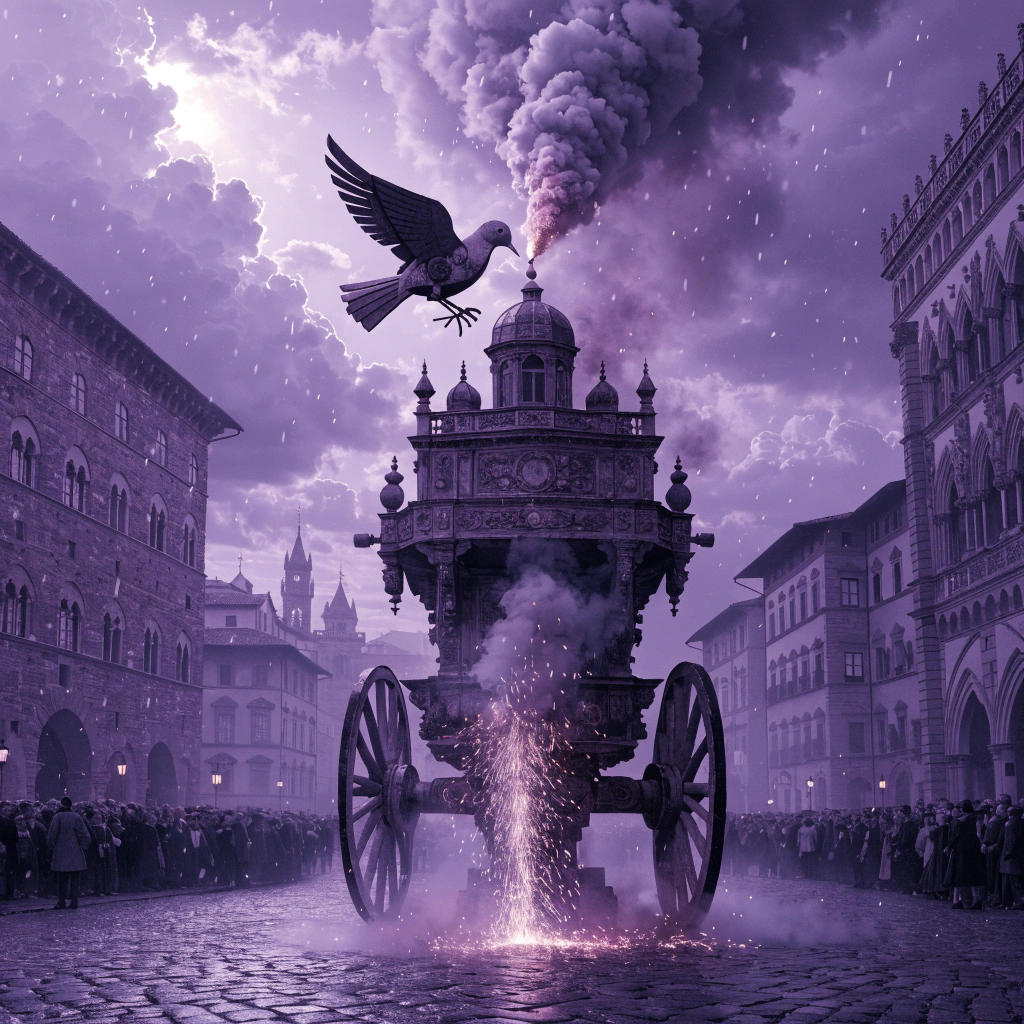
지금은 큰 나무 수레가 있습니다. 수레는 3층 건물처럼 아주 큽니다. 이 수레에서 불꽃놀이를 합니다. 불꽃이 밤하늘로 높이 올라갑니다. 사람들이 이것을 보고 모두 행복합니다. 아주 특별한 행사입니다.
문법 스포트라이트
패턴: ~입니다 (입니다)
"이것은 "수레 폭발"이라는 뜻입니다."
명사 뒤에 붙어서 "무엇이다"라고 말할 때 사용합니다. 정중하고 공식적인 표현입니다.
패턴: ~에 있습니다 (~에 있다)
"이탈리아에 아주 재미있는 축제가 있습니다."
장소를 나타내는 명사 뒤에 붙어서 "어디에 무엇이 있다"고 말할 때 사용합니다. 존재나 위치를 나타냅니다.
이해도를 테스트하세요
10 질문 · A1 초급 · 무료 미리보기 1회
이 기사에서 배운 내용을 테스트하세요. 모든 질문에 답하여 XP를 획득하세요!
이탈리아 축제의 이름은 무엇입니까?
문제별 결과
이탈리아 축제의 이름은 무엇입니까?
내 답변:
정답: 스콥피오 델 카로
이 축제는 매년 부활절 일요일에 열립니다.
내 답변:
정답: 참
'축제'는 무슨 뜻입니까?
내 답변:
정답: 행사
옛날에 파치노라는 _____가 예루살렘에서 돌을 가져왔습니다.
내 답변:
정답: 기사
A Famous Explosion in Florence
Every Easter Sunday, people in Florence, Italy, watch a very special event. It is called the 'Scoppio del Carro,' or the 'Explosion of the Cart.' This tradition is very old because it started hundreds of years ago.
A long time ago, a brave knight named Pazzino came back from a war. He brought three special stones from Jerusalem. People used these stones to make a 'holy fire' for the city. Later, this tradition changed into a big celebration with a huge wooden cart.
Today, the cart is 30 feet tall. It is bigger and more beautiful than other carts. White oxen pull the cart through the streets to the cathedral. Inside the church, a mechanical bird flies down a wire and hits the cart. This starts a big firework display. It is louder and more exciting than a normal party! People believe that if the bird hits the cart correctly, the city will have a good year.
문법 스포트라이트
패턴: Past Simple (Irregular Verbs)
"He brought three special stones from Jerusalem."
We use the past simple for finished actions in the past. Irregular verbs like 'bring' change their form to 'brought' instead of adding '-ed'.
패턴: Comparatives
"It is bigger and more beautiful than other carts."
We use comparatives to compare two things. For short adjectives, we add '-er' (bigger), and for long adjectives, we use 'more' (more beautiful).
이해도를 테스트하세요
11 질문 · A2 초등급 · 무료 미리보기 1회
이 기사에서 배운 내용을 테스트하세요. 모든 질문에 답하여 XP를 획득하세요!
Where does this event take place?
문제별 결과
Where does this event take place?
내 답변:
정답: Florence
The 'Scoppio del Carro' is a new tradition.
내 답변:
정답: 거짓
What does 'huge' mean?
내 답변:
정답: Very big
The cart is _____ than other carts.
내 답변:
정답: bigger
What animal pulls the cart?
내 답변:
정답: Oxen
The Spectacular Explosion of the Cart in Florence
Every year on Easter Sunday, the city of Florence hosts a spectacular event called the 'Scoppio del Carro,' which means the 'Explosion of the Cart.' This tradition, which has been celebrated for over 350 years, is a mix of history, religion, and excitement.
The story began during the First Crusade when a young knight named Pazzino de' Pazzi returned from Jerusalem. He brought back three flints that were used to light a holy fire. In the past, this fire was carried through the streets to the people's homes. Today, the event has evolved into a massive display of fireworks.
A huge, 30-foot-tall antique cart is pulled through the streets by white oxen. The cart is decorated with flowers and ribbons. When it reaches the cathedral, a mechanical dove, called the 'colombina,' is sent from the altar. The dove travels along a wire to hit the cart, which is filled with fireworks. If the dove returns successfully to the altar, it is believed that the city will have a good harvest and good luck for the year.
Thousands of people gather in the square to watch the explosion. The sky is filled with smoke and bright colors. This tradition is loved by locals and tourists alike because it connects the modern city to its ancient roots. It has become one of the most important festivals in Italy, showing how history is still alive in the streets of Florence.
문법 스포트라이트
패턴: Relative Clauses
"This tradition, which has been celebrated for over 350 years, is a mix of history, religion, and excitement."
We use 'which' to give extra information about a thing. In this case, it adds a historical detail about the tradition without starting a new sentence.
패턴: Passive Voice (Present Simple)
"A huge, 30-foot-tall antique cart is pulled through the streets by white oxen."
The passive voice is formed with 'to be' + past participle. It is used here because the action of pulling the cart is more important than who is pulling it.
이해도를 테스트하세요
11 질문 · B1 중급 · 무료 미리보기 1회
이 기사에서 배운 내용을 테스트하세요. 모든 질문에 답하여 XP를 획득하세요!
Where did Pazzino de' Pazzi get the stones to light the holy fire?
문제별 결과
Where did Pazzino de' Pazzi get the stones to light the holy fire?
내 답변:
정답: Jerusalem
The 'colombina' is a real bird that flies into the cart.
내 답변:
정답: 거짓
What does 'massive' mean?
내 답변:
정답: Very large and heavy
The cart is _____ with flowers and ribbons.
내 답변:
정답: decorated
What does a successful dove flight symbolize for the city?
내 답변:
정답: A good harvest
The Explosion of the Cart: Florence's Spectacular Easter Tradition
Every Easter Sunday, the historic city of Florence transforms into a magnificent stage for one of Italy’s most captivating and ancient traditions: the Scoppio del Carro, or 'Explosion of the Cart.' This centuries-old ceremony, which dates back over 350 years, is not merely a display of pyrotechnics but a profound celebration of Florentine identity, historical pride, and religious devotion. For the locals, the event represents a bridge between their medieval heritage and the contemporary world, drawing thousands of curious spectators to the heart of the city.
The origins of the Scoppio del Carro are rooted in the First Crusade of the 11th century. According to legend, a young Florentine knight named Pazzino de' Pazzi was the first to scale the walls of Jerusalem. As a reward for his bravery, he was gifted three flints from the Holy Sepulchre. Upon his return to Florence, these sacred stones were used to ignite a 'holy fire' every Easter, which was then distributed among the citizens to symbolize renewal and light. Over time, this simple act evolved into the elaborate spectacle we witness today.
The centerpiece of the event is a massive, 30-foot-tall antique cart known as the 'Brindellone.' This elaborate structure, built in 1711, is meticulously decorated and pulled through the narrow, cobblestone streets by two white oxen adorned with floral garlands. The procession is a vibrant affair, accompanied by drummers, flag-throwers, and hundreds of participants dressed in traditional Renaissance attire. As the cart reaches the Piazza del Duomo, it is positioned between the Cathedral and the Baptistery, awaiting its dramatic transformation.
During the Easter Mass, the Archbishop of Florence performs a ritual that high-tech enthusiasts might find surprisingly sophisticated for its age. He lights a mechanical, dove-shaped rocket called the 'Colombina,' which carries an olive branch in its beak. The dove slides along a wire from the high altar, shoots out of the church, and strikes the cart outside, triggering a spectacular display of fireworks and colorful smoke.
The success of the entire ritual hinges on the flight of the Colombina. If the Colombina failed to complete its journey, the citizens would traditionally anticipate a poor harvest; however, a successful flight is seen as a harbinger of good fortune. Consequently, the crowd watches the bird’s journey with bated breath. Despite the modern era’s reliance on scientific forecasting, this symbolic gesture remains a crucial part of the city's cultural fabric, proving that ancient traditions can still hold significant meaning in the 21st century.
문법 스포트라이트
패턴: Relative Clauses with 'which'
"This centuries-old ceremony, which dates back over 350 years, is not merely a display of pyrotechnics..."
Non-defining relative clauses provide extra information about a noun. They are separated by commas and use 'which' for objects or events.
패턴: Passive Voice
"This elaborate structure, built in 1711, is meticulously decorated and pulled through the narrow streets..."
The passive voice (is + past participle) is used here to focus on the cart (the object) rather than the people performing the action, which is common in formal descriptions.
패턴: Second Conditional
"If the Colombina failed to complete its journey, the citizens would traditionally anticipate a poor harvest."
The second conditional (If + past simple, would + infinitive) is used to talk about hypothetical or imaginary situations and their consequences.
이해도를 테스트하세요
11 질문 · B2 중상급 · 무료 미리보기 1회
이 기사에서 배운 내용을 테스트하세요. 모든 질문에 답하여 XP를 획득하세요!
What is the historical origin of the 'holy fire' used in the ceremony?
문제별 결과
What is the historical origin of the 'holy fire' used in the ceremony?
내 답변:
정답: It was created using flints brought back from Jerusalem.
The 'Brindellone' is a modern cart built specifically for tourists in the 21st century.
내 답변:
정답: 거짓
What does the word 'meticulously' mean in the context of the article?
내 답변:
정답: With extreme care and attention to detail.
The mechanical dove used to ignite the fireworks is known as the _____.
내 답변:
정답: Colombina
What is believed to happen if the dove successfully returns to the altar?
내 답변:
정답: The city will experience prosperity and a good harvest.
피렌체의 부활절, 역사의 불꽃으로 피어나는 '수레의 폭발(Scoppio del Carro)'
매년 부활절 아침, 이탈리아 피렌체의 두오모 광장은 고요를 깨뜨리는 웅장한 행렬과 함께 수 세기를 거슬러 올라가는 역사적 재현의 장이 된다. '수레의 폭발(Scoppio del Carro)'이라 불리는 이 의식은 단순한 종교 행사를 넘어, 피렌체 시민들의 정체성과 중세의 기사도 정신이 응축된 문화적 정수라 할 수 있다. 이 전통의 뿌리는 11세기 제1차 십자군 전쟁으로 거슬러 올라가는데, 당시 피렌체의 젊은 기사 파치노 데 파치(Pazzino de' Pazzi)가 예루살렘 성묘 교회에서 가져온 세 개의 부싯돌로부터 시작되었다.
전설에 따르면 파치노는 예루살렘 성벽을 가장 먼저 넘은 공로로 이 부싯돌들을 하사받았으며, 이를 피렌체로 가져와 '거룩한 불'을 지피는 데 사용했다. 초기에는 이 불을 도시 전역에 배달하는 소박한 형태였으나, 시간이 흐르며 가문의 위상을 과시하고 공동체의 안녕을 기원하는 화려한 축제로 변모했다. 오늘날 이 의식의 주인공은 '브린델로네(Brindellone)'라 불리는 약 9미터 높이의 거대한 골동품 수레이다. 17세기에 제작된 이 수레는 정교한 조각과 화려한 장식으로 꾸며져 있으며, 수백 년의 세월을 견뎌온 피렌체의 산증인이기도 하다.
행사의 정점은 미사 도중 대성당 제단에서 발사되는 기계식 비둘기 '콜롬비나(Colombina)'가 수레에 연결된 도선을 타고 날아가 수레 안의 폭죽을 점화하는 순간이다. 굉음과 함께 화려한 불꽃이 하늘을 수놓는 광경은 보는 이로 하여금 경외심을 느끼게 하거니와, 그해의 풍요로운 수확을 점치는 예언적 의미까지 내포하고 있다. 만약 비둘기가 수레를 정확히 타격하고 다시 제단으로 무사히 돌아오면, 피렌체 사람들은 이를 신의 축복이자 풍년의 징조로 여긴다.
현대 사회에서 이러한 전통이 지닌 의미는 결코 가볍지 않다. 급변하는 시대적 흐름 속에서도 피렌체는 과거의 유산을 단순히 보존하는 데 그치지 않고, 이를 현대적 감각으로 재해석하여 도시의 생명력을 유지하고 있다. '수레의 폭발'은 과거와 현재가 교차하는 지점에서 피렌체인들의 자긍심을 고취하는 기제이자, 인류가 공유해야 할 소중한 문화적 자산이라 하겠다. 이 장엄한 의식을 통해 우리는 전통이 어떻게 공동체를 하나로 묶어주는지, 그리고 역사가 어떻게 현재의 삶 속에서 살아 숨 쉬는지 목격하게 된다.
문법 스포트라이트
패턴: -(으)로 하여금
"광경은 보는 이로 하여금 경외심을 느끼게 하거니와..."
어떤 대상에게 특정한 행동이나 상태를 유도할 때 사용하는 사동 표현입니다. 주로 격식적인 문장에서 'A로 하여금 B하게 하다'의 형태로 쓰입니다.
패턴: -거니와
"경외심을 느끼게 하거니와, 그해의 풍요로운 수확을 점치는 예언적 의미까지 내포하고 있다."
앞의 사실을 인정하면서 그에 더해 다른 사실이 있음을 나타낼 때 사용합니다. '뿐만 아니라'와 유사한 의미를 지닙니다.
패턴: -라기보다(는)
"단순한 종교적 의례라기보다 피렌체의 정체성이 담긴 행사이다."
앞의 내용보다 뒤의 내용이 더 적절한 설명임을 나타낼 때 사용합니다. (본문 내용을 바탕으로 한 활용 예시)
이해도를 테스트하세요
12 질문 · C1 고급 · 무료 미리보기 1회
이 기사에서 배운 내용을 테스트하세요. 모든 질문에 답하여 XP를 획득하세요!
'수레의 폭발' 전통의 역사적 배경이 되는 사건은 무엇입니까?
문제별 결과
'수레의 폭발' 전통의 역사적 배경이 되는 사건은 무엇입니까?
내 답변:
정답: 제1차 십자군 전쟁
파치노 데 파치는 예루살렘에서 가져온 금화를 사용하여 거룩한 불을 피웠다.
내 답변:
정답: 거짓
'정교하다'의 의미로 가장 적절한 것은?
내 답변:
정답: 매우 세밀하고 훌륭하다
폭죽을 점화하기 위해 대성당에서 날아가는 기계식 비둘기의 이름은 _____이다.
내 답변:
정답: 콜롬비나
비둘기가 무사히 제단으로 돌아오는 것은 무엇을 상징합니까?
내 답변:
정답: 풍년과 축복
의식에 사용되는 수레인 '브린델로네'는 17세기에 제작되었다.
내 답변:
정답: 참
The Liturgical Pyrotechnics of Florence: An Analytical Inquiry into the Scoppio del Carro
In the heart of Florence, where the Renaissance spirit remains inextricably woven into the city’s contemporary fabric, the annual 'Scoppio del Carro' stands as a testament to the enduring power of atavistic ritual. Occurring every Easter Sunday, this 'Explosion of the Cart' is not merely a display of pyrotechnic virtuosity but a complex semiotic performance that bridges the chasm between the medieval past and the secular present. To the uninitiated observer, the spectacle of a thirty-foot antique wagon, the Brindellone, erupting into a cacophony of sparks might seem anachronistic. However, should one delve into the historical stratification of the event, a profound narrative of identity, faith, and agricultural propitiation emerges. The genesis of this tradition is rooted in the First Crusade, specifically attributed to the exploits of Pazzino de' Pazzi. Legend dictates that he was the first to scale the walls of Jerusalem, subsequently receiving three flints from the Holy Sepulchre as a reward for his valor. Upon his return to Florence, these relics became the cornerstone of a new liturgy. It is essential that the observer recognize the flint’s transition from a physical tool to a spiritual catalyst; the 'holy fire' struck from these stones was once distributed to Florentine households as a symbol of purification. Over centuries, this modest distribution evolved into the grandiose ceremony witnessed today. Central to the modern iteration is the 'Colombina,' a mechanical dove propelled by a rocket. During the Easter Mass, the Archbishop of Florence ignites the fuse of this avian contraption at the high altar of the Duomo. The dove then hurtles along a wire, traversing the length of the cathedral to strike the Brindellone parked outside, thereby initiating a choreographed explosion of crackers and Catherine wheels. The efficacy of the ritual, at least in the collective psyche of the agrarian past, was contingent upon the Colombina’s successful return to the altar. Had the mechanical dove faltered in its flight, it would have been interpreted as an ominous portent for the year’s harvest. While modern Florence is no longer bound by the whims of the seasons in a literal sense, the psychological weight of this omen persists. This syncretism of Christian liturgy and pagan-inflected folk belief exemplifies the Florentine capacity for cultural preservation. Furthermore, the event serves as a socio-political anchor. The Pazzi family, despite their later infamy following the failed conspiracy against the Medici, remains inextricably linked to the city’s ritualistic calendar through this event. It is a rare instance where the vestige of a disgraced lineage is not only tolerated but celebrated as a fundamental component of civic pride. The Scoppio del Carro, therefore, is not merely a festive diversion; it is an ontological bridge. It allows the modern citizen to participate in a shared continuity of time, where the boundaries between the sacred and the profane become porous. In an era of rapid globalization, such localized manifestations of pomp and tradition provide a necessary sense of rootedness, ensuring that the Florentine identity remains as resilient as the ancient flints from which its holy fire first sprang.
문법 스포트라이트
패턴: Conditional Inversion
"Should one delve into the historical stratification of the event, a profound narrative of identity, faith, and agricultural propitiation emerges."
The inversion of 'should' and the subject 'one' replaces 'if' to create a more formal, academic tone typical of C2 writing.
패턴: The Present Subjunctive
"It is essential that the observer recognize the flint’s transition from a physical tool to a spiritual catalyst."
The subjunctive 'recognize' (without an 's') is used after adjectives of importance or necessity like 'essential' to express a requirement.
패턴: Third Conditional Inversion
"Had the mechanical dove faltered in its flight, it would have been interpreted as an ominous portent for the year’s harvest."
This formal structure replaces 'If the mechanical dove had faltered' to discuss hypothetical past situations and their consequences.
이해도를 테스트하세요
12 질문 · C2 마스터 · 무료 미리보기 1회
이 기사에서 배운 내용을 테스트하세요. 모든 질문에 답하여 XP를 획득하세요!
What is the primary historical origin of the flints used in the ceremony?
문제별 결과
What is the primary historical origin of the flints used in the ceremony?
내 답변:
정답: They were brought from Jerusalem by a Florentine knight.
The Pazzi family is currently celebrated for their political success in Florentine history.
내 답변:
정답: 거짓
Which word describes a sign or warning of a future event?
내 답변:
정답: Portent
The mechanical dove, known as the _____, is central to the pyrotechnic display.
내 답변:
정답: Colombina
According to the text, what did a failed flight of the mechanical dove signify in the past?
내 답변:
정답: A poor agricultural harvest.
The article suggests that the Scoppio del Carro helps maintain a sense of local identity in a globalized world.
내 답변:
정답: 참
이탈리아의 큰 축제: 스코피오 델 카로
이탈리아. 플로렌스에 있습니다. 이것은 '스코피오 델 카로' 축제입니다. 이 축제는 부활절에 합니다. 아주 오래된 전통입니다. 350년 되었습니다. 큰 마차가 있습니다. 이 마차에서 불이 납니다. 사람들이 이것을 봅니다. 아주 멋있습니다. 이것은 특별한 날입니다.
문법 스포트라이트
패턴: -입니다
"이것은 축제입니다."
명사 뒤에 붙어서 '무엇이다'를 말할 때 씁니다. 아주 기본적인 표현입니다. 문장을 끝낼 때 사용합니다.
이해도를 테스트하세요
9 질문 · A0 프리비기너 · 무료 미리보기 1회
이 기사에서 배운 내용을 테스트하세요. 모든 질문에 답하여 XP를 획득하세요!
'스코피오 델 카로'는 무엇입니까?
문제별 결과
'스코피오 델 카로'는 무엇입니까?
내 답변:
정답: 축제
'스코피오 델 카로'는 이탈리아에 있습니다.
내 답변:
정답: 참
'마차'는 무엇입니까?
내 답변:
정답: 큰 차

