A Special Day in Florence
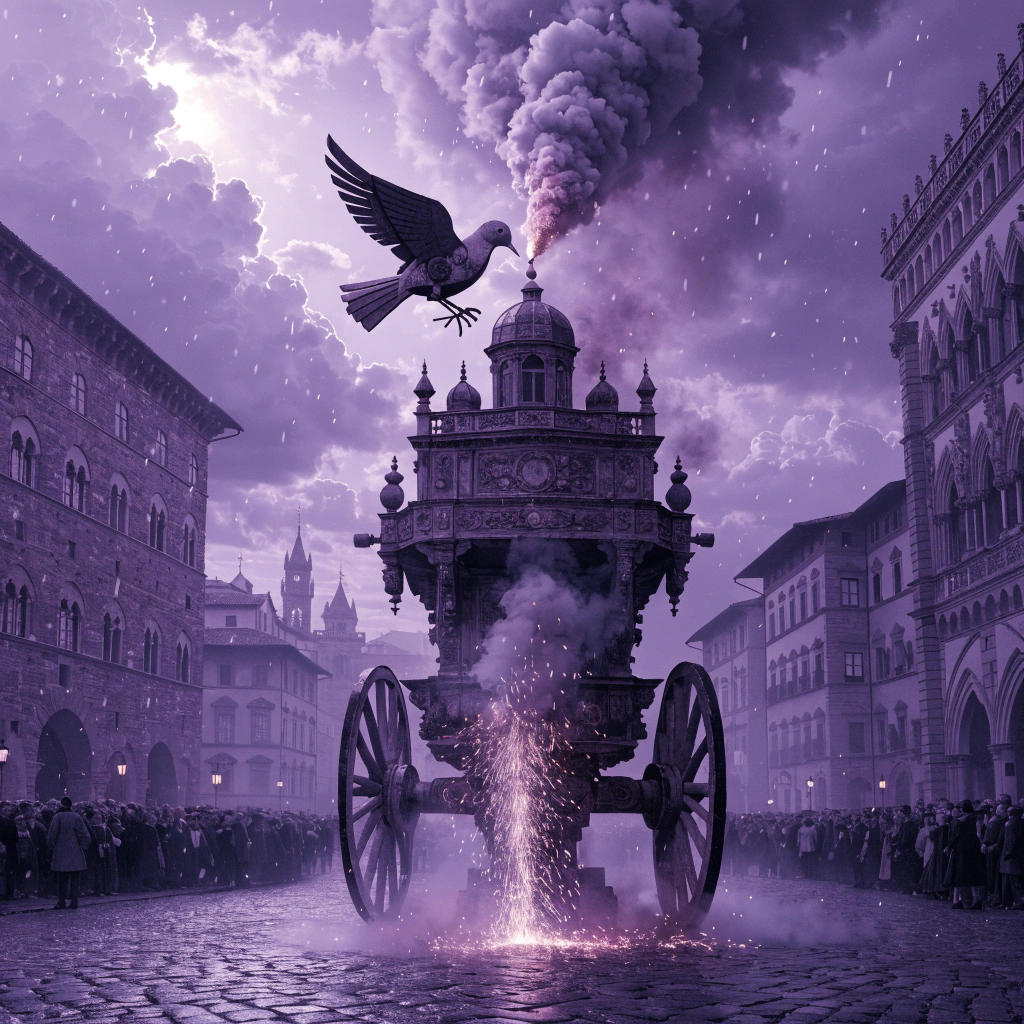
Every Easter Sunday, there is a big party in Florence, Italy. People call it the 'Scoppio del Carro.' This means the 'Explosion of the Cart.' It is a very old tradition. A large, beautiful cart moves through the streets. White oxen pull the cart to a big church. Many people watch the cart. They wear colorful clothes and play music. Inside the church, a mechanical dove flies on a wire. It hits the cart outside. Then, many fireworks explode. It is very loud and bright. People are happy because it is a lucky day.
نکته دستوری
الگو: Present Simple (Third Person Singular)
"A mechanical dove flies on a wire."
We use the present simple for facts and traditions. For 'he', 'she', or 'it', we usually add -s or -ies to the verb.
الگو: Adjectives before Nouns
"A large, beautiful cart moves through the streets."
In English, describing words like 'large' and 'beautiful' come before the noun they describe. This helps the reader imagine the object first.
درک خود را بسنجید
10 سوال · A1 مبتدی · 1 پیشنمایش رایگان
آنچه از این مقاله آموختید را بسنجید. به همه سؤالات پاسخ دهید و XP کسب کنید!
Where is the Scoppio del Carro?
آیا میخواهید آزمون را تمام کنید؟
9 سؤال دیگر منتظر شماست. ثبتنام رایگان کنید تا آزمون کامل را باز کنید و XP کسب کنید!
ثبتنام رایگانقبلاً ثبتنام کردی؟ ورود
جزئیات سؤالات
Where is the Scoppio del Carro?
پاسخ شما:
پاسخ درست: In Florence
The Scoppio del Carro is a new tradition.
پاسخ شما:
پاسخ درست: نادرست
What is a 'cart'?
پاسخ شما:
پاسخ درست: A vehicle with wheels
White _____ pull the cart to the church.
پاسخ شما:
پاسخ درست: oxen
A Famous Explosion in Florence
Every Easter Sunday, people in Florence, Italy, watch a very special event. It is called the 'Scoppio del Carro,' or the 'Explosion of the Cart.' This tradition is very old because it started hundreds of years ago.
A long time ago, a brave knight named Pazzino came back from a war. He brought three special stones from Jerusalem. People used these stones to make a 'holy fire' for the city. Later, this tradition changed into a big celebration with a huge wooden cart.
Today, the cart is 30 feet tall. It is bigger and more beautiful than other carts. White oxen pull the cart through the streets to the cathedral. Inside the church, a mechanical bird flies down a wire and hits the cart. This starts a big firework display. It is louder and more exciting than a normal party! People believe that if the bird hits the cart correctly, the city will have a good year.
نکته دستوری
الگو: Past Simple (Irregular Verbs)
"He brought three special stones from Jerusalem."
We use the past simple for finished actions in the past. Irregular verbs like 'bring' change their form to 'brought' instead of adding '-ed'.
الگو: Comparatives
"It is bigger and more beautiful than other carts."
We use comparatives to compare two things. For short adjectives, we add '-er' (bigger), and for long adjectives, we use 'more' (more beautiful).
درک خود را بسنجید
11 سوال · A2 مقدماتی · 1 پیشنمایش رایگان
آنچه از این مقاله آموختید را بسنجید. به همه سؤالات پاسخ دهید و XP کسب کنید!
Where does this event take place?
آیا میخواهید آزمون را تمام کنید؟
10 سؤال دیگر منتظر شماست. ثبتنام رایگان کنید تا آزمون کامل را باز کنید و XP کسب کنید!
ثبتنام رایگانقبلاً ثبتنام کردی؟ ورود
جزئیات سؤالات
Where does this event take place?
پاسخ شما:
پاسخ درست: Florence
The 'Scoppio del Carro' is a new tradition.
پاسخ شما:
پاسخ درست: نادرست
What does 'huge' mean?
پاسخ شما:
پاسخ درست: Very big
The cart is _____ than other carts.
پاسخ شما:
پاسخ درست: bigger
What animal pulls the cart?
پاسخ شما:
پاسخ درست: Oxen
The Spectacular Explosion of the Cart in Florence
Every year on Easter Sunday, the city of Florence hosts a spectacular event called the 'Scoppio del Carro,' which means the 'Explosion of the Cart.' This tradition, which has been celebrated for over 350 years, is a mix of history, religion, and excitement.
The story began during the First Crusade when a young knight named Pazzino de' Pazzi returned from Jerusalem. He brought back three flints that were used to light a holy fire. In the past, this fire was carried through the streets to the people's homes. Today, the event has evolved into a massive display of fireworks.
A huge, 30-foot-tall antique cart is pulled through the streets by white oxen. The cart is decorated with flowers and ribbons. When it reaches the cathedral, a mechanical dove, called the 'colombina,' is sent from the altar. The dove travels along a wire to hit the cart, which is filled with fireworks. If the dove returns successfully to the altar, it is believed that the city will have a good harvest and good luck for the year.
Thousands of people gather in the square to watch the explosion. The sky is filled with smoke and bright colors. This tradition is loved by locals and tourists alike because it connects the modern city to its ancient roots. It has become one of the most important festivals in Italy, showing how history is still alive in the streets of Florence.
نکته دستوری
الگو: Relative Clauses
"This tradition, which has been celebrated for over 350 years, is a mix of history, religion, and excitement."
We use 'which' to give extra information about a thing. In this case, it adds a historical detail about the tradition without starting a new sentence.
الگو: Passive Voice (Present Simple)
"A huge, 30-foot-tall antique cart is pulled through the streets by white oxen."
The passive voice is formed with 'to be' + past participle. It is used here because the action of pulling the cart is more important than who is pulling it.
درک خود را بسنجید
11 سوال · B1 متوسط · 1 پیشنمایش رایگان
آنچه از این مقاله آموختید را بسنجید. به همه سؤالات پاسخ دهید و XP کسب کنید!
Where did Pazzino de' Pazzi get the stones to light the holy fire?
آیا میخواهید آزمون را تمام کنید؟
10 سؤال دیگر منتظر شماست. ثبتنام رایگان کنید تا آزمون کامل را باز کنید و XP کسب کنید!
ثبتنام رایگانقبلاً ثبتنام کردی؟ ورود
جزئیات سؤالات
Where did Pazzino de' Pazzi get the stones to light the holy fire?
پاسخ شما:
پاسخ درست: Jerusalem
The 'colombina' is a real bird that flies into the cart.
پاسخ شما:
پاسخ درست: نادرست
What does 'massive' mean?
پاسخ شما:
پاسخ درست: Very large and heavy
The cart is _____ with flowers and ribbons.
پاسخ شما:
پاسخ درست: decorated
What does a successful dove flight symbolize for the city?
پاسخ شما:
پاسخ درست: A good harvest
The Explosion of the Cart: Florence's Spectacular Easter Tradition
Every Easter Sunday, the historic city of Florence transforms into a magnificent stage for one of Italy’s most captivating and ancient traditions: the Scoppio del Carro, or 'Explosion of the Cart.' This centuries-old ceremony, which dates back over 350 years, is not merely a display of pyrotechnics but a profound celebration of Florentine identity, historical pride, and religious devotion. For the locals, the event represents a bridge between their medieval heritage and the contemporary world, drawing thousands of curious spectators to the heart of the city.
The origins of the Scoppio del Carro are rooted in the First Crusade of the 11th century. According to legend, a young Florentine knight named Pazzino de' Pazzi was the first to scale the walls of Jerusalem. As a reward for his bravery, he was gifted three flints from the Holy Sepulchre. Upon his return to Florence, these sacred stones were used to ignite a 'holy fire' every Easter, which was then distributed among the citizens to symbolize renewal and light. Over time, this simple act evolved into the elaborate spectacle we witness today.
The centerpiece of the event is a massive, 30-foot-tall antique cart known as the 'Brindellone.' This elaborate structure, built in 1711, is meticulously decorated and pulled through the narrow, cobblestone streets by two white oxen adorned with floral garlands. The procession is a vibrant affair, accompanied by drummers, flag-throwers, and hundreds of participants dressed in traditional Renaissance attire. As the cart reaches the Piazza del Duomo, it is positioned between the Cathedral and the Baptistery, awaiting its dramatic transformation.
During the Easter Mass, the Archbishop of Florence performs a ritual that high-tech enthusiasts might find surprisingly sophisticated for its age. He lights a mechanical, dove-shaped rocket called the 'Colombina,' which carries an olive branch in its beak. The dove slides along a wire from the high altar, shoots out of the church, and strikes the cart outside, triggering a spectacular display of fireworks and colorful smoke.
The success of the entire ritual hinges on the flight of the Colombina. If the Colombina failed to complete its journey, the citizens would traditionally anticipate a poor harvest; however, a successful flight is seen as a harbinger of good fortune. Consequently, the crowd watches the bird’s journey with bated breath. Despite the modern era’s reliance on scientific forecasting, this symbolic gesture remains a crucial part of the city's cultural fabric, proving that ancient traditions can still hold significant meaning in the 21st century.
نکته دستوری
الگو: Relative Clauses with 'which'
"This centuries-old ceremony, which dates back over 350 years, is not merely a display of pyrotechnics..."
Non-defining relative clauses provide extra information about a noun. They are separated by commas and use 'which' for objects or events.
الگو: Passive Voice
"This elaborate structure, built in 1711, is meticulously decorated and pulled through the narrow streets..."
The passive voice (is + past participle) is used here to focus on the cart (the object) rather than the people performing the action, which is common in formal descriptions.
الگو: Second Conditional
"If the Colombina failed to complete its journey, the citizens would traditionally anticipate a poor harvest."
The second conditional (If + past simple, would + infinitive) is used to talk about hypothetical or imaginary situations and their consequences.
درک خود را بسنجید
11 سوال · B2 بالاتر از متوسط · 1 پیشنمایش رایگان
آنچه از این مقاله آموختید را بسنجید. به همه سؤالات پاسخ دهید و XP کسب کنید!
What is the historical origin of the 'holy fire' used in the ceremony?
آیا میخواهید آزمون را تمام کنید؟
10 سؤال دیگر منتظر شماست. ثبتنام رایگان کنید تا آزمون کامل را باز کنید و XP کسب کنید!
ثبتنام رایگانقبلاً ثبتنام کردی؟ ورود
جزئیات سؤالات
What is the historical origin of the 'holy fire' used in the ceremony?
پاسخ شما:
پاسخ درست: It was created using flints brought back from Jerusalem.
The 'Brindellone' is a modern cart built specifically for tourists in the 21st century.
پاسخ شما:
پاسخ درست: نادرست
What does the word 'meticulously' mean in the context of the article?
پاسخ شما:
پاسخ درست: With extreme care and attention to detail.
The mechanical dove used to ignite the fireworks is known as the _____.
پاسخ شما:
پاسخ درست: Colombina
What is believed to happen if the dove successfully returns to the altar?
پاسخ شما:
پاسخ درست: The city will experience prosperity and a good harvest.
The Pyrotechnic Legacy: Decoding the Scoppio del Carro
Rarely does a contemporary urban landscape offer a spectacle as historically saturated as the 'Scoppio del Carro' in Florence. This 'Explosion of the Cart,' a tradition spanning over three centuries, is not merely a display of pyrotechnic prowess but a profound manifestation of Florentine identity. Its origins are inextricably linked to the First Crusade, specifically to the legendary exploits of Pazzino de' Pazzi. Upon his return from the Holy Sepulchre in Jerusalem, Pazzino purportedly carried three flints, gifts consecrated by his bravery, which served to ignite a sacred flame for the city. The distribution of this fire to the citizenry, once a humble act of community bonding, has undergone a metamorphosis into the resplendent ritual witnessed today.
At the heart of the ceremony stands the 'Brindellone,' a three-story-tall antique cart that serves as a moving vestige of medieval engineering. Adorned with intricate carvings and symbols of the four quarters of the city, the cart is hauled through the streets by white oxen, their horns gilded for the occasion. Such is the gravity of the event that the entire city seems to hold its breath as the procession moves toward the Duomo. The juxtaposition of these ancient symbols against the backdrop of modern tourism creates a fascinating, albeit somewhat anachronistic, atmosphere.
It is the ignition of the 'Colombina'—a mechanical dove-shaped rocket—that constitutes the climax of the liturgy. During the 'Gloria in Excelsis Deo,' the Archbishop of Florence lights the fuse of the dove from the high altar. The rocket then hurtles down a wire, striking the cart positioned outside and initiating a tumultuous explosion of fireworks. To the casual observer, this may appear as mere entertainment; however, for the Florentines, the successful flight of the dove is a harbinger of a prosperous harvest and civic well-being. Should the dove fail to return to the altar, it is historically viewed as an omen of impending misfortune.
The perpetuation of the Scoppio del Carro allows for a nuanced exploration of how tradition survives in a globalized world. Critics might argue that the event has been commodified for the tourist gaze, yet the visceral reaction of the local population suggests a deeper, more enduring connection. The synthesis of religious devotion, historical myth-making, and agricultural superstition provides a complex tapestry of meaning. It is not just about the fireworks; it is about the communal affirmation of a shared past.
Ultimately, the Scoppio del Carro remains a vital component of the Tuscan cultural landscape. The meticulous preservation of the cart and the rigid adherence to the liturgical sequence ensure that the event remains authentic. In an era characterized by rapid technological advancement, the sight of a 17th-century cart exploding in the shadow of a Renaissance cathedral offers a rare moment of historical continuity. It is this very continuity that reinforces the social fabric of Florence, reminding its inhabitants that their present is forever anchored in the embers of their storied past.
نکته دستوری
الگو: Inversion with Negative Adverbials
"Rarely does a contemporary urban landscape offer a spectacle as historically saturated as the 'Scoppio del Carro' in Florence."
When a sentence starts with a negative or restrictive adverbial like 'rarely', the subject and auxiliary verb are inverted. This is used in formal writing to emphasize the rarity or importance of the statement.
الگو: Cleft Sentences
"It is the ignition of the 'Colombina'—a mechanical dove-shaped rocket—that constitutes the climax of the liturgy."
Cleft sentences use the structure 'It is/was + [subject] + that/who' to focus on specific information. Here, it highlights that the ignition, rather than any other part of the event, is the most important moment.
الگو: Nominalisation
"The distribution of this fire to the citizenry... has undergone a metamorphosis into the resplendent ritual witnessed today."
Nominalisation involves turning verbs or adjectives into nouns (e.g., 'distribute' to 'distribution'). This creates a more objective, academic tone and allows for more complex sentence structures in C1-level writing.
درک خود را بسنجید
12 سوال · C1 پیشرفته · 1 پیشنمایش رایگان
آنچه از این مقاله آموختید را بسنجید. به همه سؤالات پاسخ دهید و XP کسب کنید!
What is the historical origin of the flints used in the ceremony?
آیا میخواهید آزمون را تمام کنید؟
11 سؤال دیگر منتظر شماست. ثبتنام رایگان کنید تا آزمون کامل را باز کنید و XP کسب کنید!
ثبتنام رایگانقبلاً ثبتنام کردی؟ ورود
جزئیات سؤالات
What is the historical origin of the flints used in the ceremony?
پاسخ شما:
پاسخ درست: They were brought from Jerusalem by a knight.
The 'Brindellone' is transported through the streets by a team of horses.
پاسخ شما:
پاسخ درست: نادرست
What does 'vestige' mean in the context of the article?
پاسخ شما:
پاسخ درست: A remaining trace of the past
The cart is a _____ of medieval engineering.
پاسخ شما:
پاسخ درست: vestige
What does the successful flight of the 'Colombina' represent to the locals?
پاسخ شما:
پاسخ درست: A sign of a good harvest
The Scoppio del Carro is described as having both religious and agricultural significance.
پاسخ شما:
پاسخ درست: درست
The Liturgical Pyrotechnics of Florence: An Analytical Inquiry into the Scoppio del Carro
In the heart of Florence, where the Renaissance spirit remains inextricably woven into the city’s contemporary fabric, the annual 'Scoppio del Carro' stands as a testament to the enduring power of atavistic ritual. Occurring every Easter Sunday, this 'Explosion of the Cart' is not merely a display of pyrotechnic virtuosity but a complex semiotic performance that bridges the chasm between the medieval past and the secular present. To the uninitiated observer, the spectacle of a thirty-foot antique wagon, the Brindellone, erupting into a cacophony of sparks might seem anachronistic. However, should one delve into the historical stratification of the event, a profound narrative of identity, faith, and agricultural propitiation emerges. The genesis of this tradition is rooted in the First Crusade, specifically attributed to the exploits of Pazzino de' Pazzi. Legend dictates that he was the first to scale the walls of Jerusalem, subsequently receiving three flints from the Holy Sepulchre as a reward for his valor. Upon his return to Florence, these relics became the cornerstone of a new liturgy. It is essential that the observer recognize the flint’s transition from a physical tool to a spiritual catalyst; the 'holy fire' struck from these stones was once distributed to Florentine households as a symbol of purification. Over centuries, this modest distribution evolved into the grandiose ceremony witnessed today. Central to the modern iteration is the 'Colombina,' a mechanical dove propelled by a rocket. During the Easter Mass, the Archbishop of Florence ignites the fuse of this avian contraption at the high altar of the Duomo. The dove then hurtles along a wire, traversing the length of the cathedral to strike the Brindellone parked outside, thereby initiating a choreographed explosion of crackers and Catherine wheels. The efficacy of the ritual, at least in the collective psyche of the agrarian past, was contingent upon the Colombina’s successful return to the altar. Had the mechanical dove faltered in its flight, it would have been interpreted as an ominous portent for the year’s harvest. While modern Florence is no longer bound by the whims of the seasons in a literal sense, the psychological weight of this omen persists. This syncretism of Christian liturgy and pagan-inflected folk belief exemplifies the Florentine capacity for cultural preservation. Furthermore, the event serves as a socio-political anchor. The Pazzi family, despite their later infamy following the failed conspiracy against the Medici, remains inextricably linked to the city’s ritualistic calendar through this event. It is a rare instance where the vestige of a disgraced lineage is not only tolerated but celebrated as a fundamental component of civic pride. The Scoppio del Carro, therefore, is not merely a festive diversion; it is an ontological bridge. It allows the modern citizen to participate in a shared continuity of time, where the boundaries between the sacred and the profane become porous. In an era of rapid globalization, such localized manifestations of pomp and tradition provide a necessary sense of rootedness, ensuring that the Florentine identity remains as resilient as the ancient flints from which its holy fire first sprang.
نکته دستوری
الگو: Conditional Inversion
"Should one delve into the historical stratification of the event, a profound narrative of identity, faith, and agricultural propitiation emerges."
The inversion of 'should' and the subject 'one' replaces 'if' to create a more formal, academic tone typical of C2 writing.
الگو: The Present Subjunctive
"It is essential that the observer recognize the flint’s transition from a physical tool to a spiritual catalyst."
The subjunctive 'recognize' (without an 's') is used after adjectives of importance or necessity like 'essential' to express a requirement.
الگو: Third Conditional Inversion
"Had the mechanical dove faltered in its flight, it would have been interpreted as an ominous portent for the year’s harvest."
This formal structure replaces 'If the mechanical dove had faltered' to discuss hypothetical past situations and their consequences.
درک خود را بسنجید
12 سوال · C2 تسلط · 1 پیشنمایش رایگان
آنچه از این مقاله آموختید را بسنجید. به همه سؤالات پاسخ دهید و XP کسب کنید!
What is the primary historical origin of the flints used in the ceremony?
آیا میخواهید آزمون را تمام کنید؟
11 سؤال دیگر منتظر شماست. ثبتنام رایگان کنید تا آزمون کامل را باز کنید و XP کسب کنید!
ثبتنام رایگانقبلاً ثبتنام کردی؟ ورود
جزئیات سؤالات
What is the primary historical origin of the flints used in the ceremony?
پاسخ شما:
پاسخ درست: They were brought from Jerusalem by a Florentine knight.
The Pazzi family is currently celebrated for their political success in Florentine history.
پاسخ شما:
پاسخ درست: نادرست
Which word describes a sign or warning of a future event?
پاسخ شما:
پاسخ درست: Portent
The mechanical dove, known as the _____, is central to the pyrotechnic display.
پاسخ شما:
پاسخ درست: Colombina
According to the text, what did a failed flight of the mechanical dove signify in the past?
پاسخ شما:
پاسخ درست: A poor agricultural harvest.
The article suggests that the Scoppio del Carro helps maintain a sense of local identity in a globalized world.
پاسخ شما:
پاسخ درست: درست

