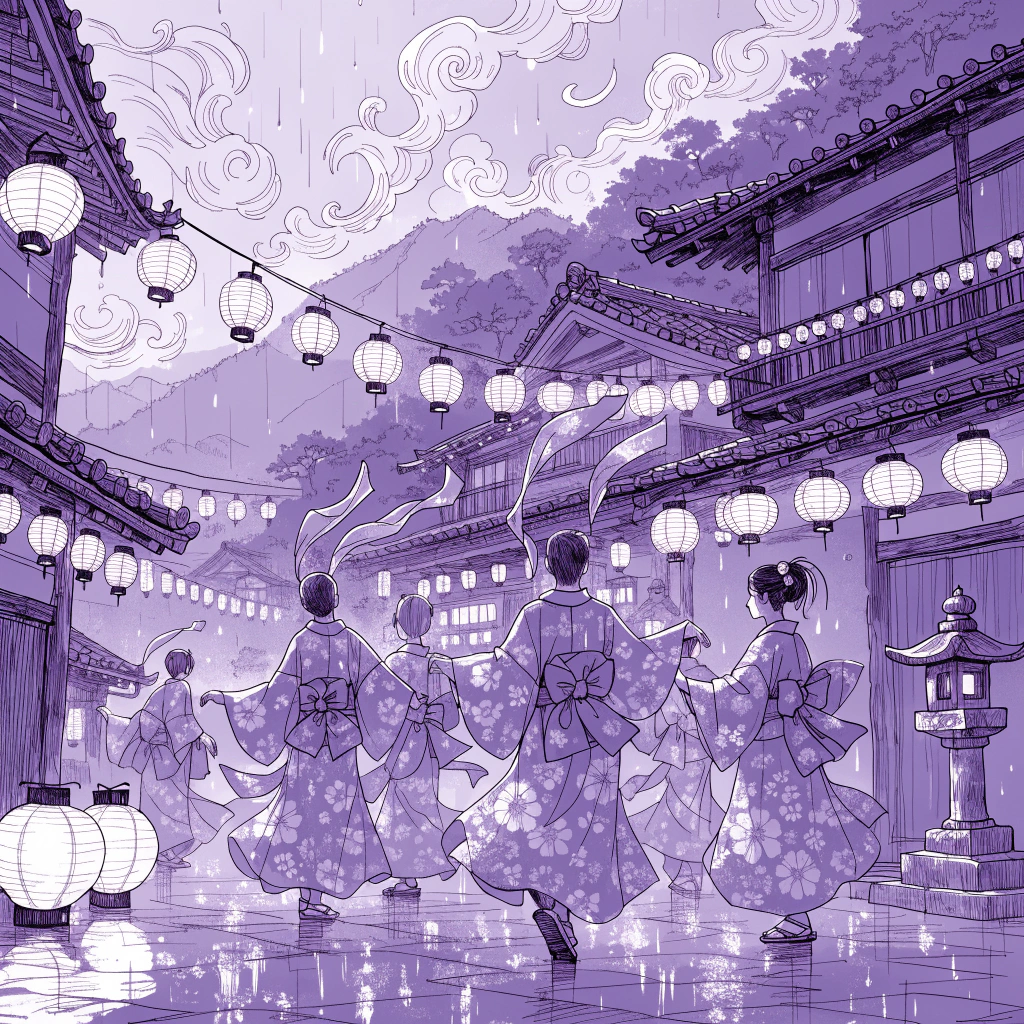
Obon: A Special Festival in Japan
Obon is a very special festival in Japan. It usually happens in August. During this time, many people travel back to their hometowns. They want to visit their families and friends.
Families believe that the spirits of their ancestors come home. People clean their houses carefully. They put fresh flowers and delicious food on small tables.
At night, people dance together in the streets. They wear beautiful traditional clothes. There are many paper lanterns everywhere. These lanterns show the way for the spirits. Obon is a happy and important time for Japanese families.
문법 스포트라이트
패턴: Present Simple (Regular Actions)
"People clean their houses carefully."
We use the present simple to talk about things that are true or happen regularly. For plural subjects like 'people', we use the base verb without 's'.
패턴: There is / There are
"There are many paper lanterns everywhere."
We use 'There are' to say that more than one thing exists in a place. It is followed by a plural noun like 'lanterns'.
이해도를 테스트하세요
10 질문 · A1 초급 · 무료 미리보기 1회
이 기사에서 배운 내용을 테스트하세요. 모든 질문에 답하여 XP를 획득하세요!
When does Obon usually happen?
문제별 결과
When does Obon usually happen?
내 답변:
정답: In August
Many people travel to their hometowns during Obon.
내 답변:
정답: 참
What is a 'festival'?
내 답변:
정답: A special day for celebration
People clean their _____ carefully.
내 답변:
정답: houses
Obon: A Special Festival in Japan
Obon is a very important festival in Japan. It usually happens in mid-August. During this time, Japanese people believe that the spirits of their ancestors return home to visit. It is a special time for families to be together.
Many people travel to their hometowns because they want to see their relatives. Because of this, the trains and airports are busier than other times of the year. Families visit the graves of their ancestors. They clean the graves and put flowers there. They also offer food and water because they want to welcome the spirits.
In the evenings, people wear traditional clothes called yukata. They dance the Bon Odori in parks and streets. At the end of the festival, families put lanterns on rivers or the sea. These lanterns guide the spirits back to their world. Obon is a beautiful and peaceful festival. It helps people remember their history and their family members.
문법 스포트라이트
패턴: Comparatives
"Because of this, the trains and airports are busier than other times of the year."
We use the ending '-ier' or '-er' with 'than' to compare two things. 'Busy' becomes 'busier' to show that travel is more active during Obon.
패턴: Conjunction 'because'
"Many people travel to their hometowns because they want to see their relatives."
We use 'because' to give a reason for an action. In this sentence, it explains why people are traveling.
이해도를 테스트하세요
11 질문 · A2 초등급 · 무료 미리보기 1회
이 기사에서 배운 내용을 테스트하세요. 모든 질문에 답하여 XP를 획득하세요!
When does Obon usually happen in Japan?
문제별 결과
When does Obon usually happen in Japan?
내 답변:
정답: In mid-August
Families clean the graves of their ancestors during Obon.
내 답변:
정답: 참
What does the word 'lanterns' mean?
내 답변:
정답: Lights inside a container
The lanterns help _____ the spirits back to their world.
내 답변:
정답: guide
Why are trains and airports busier during Obon?
내 답변:
정답: Because people travel to see relatives
Obon: A Special Time to Remember Ancestors
Obon is a significant cultural event in Japan that has been celebrated for over 500 years. It is based on Buddhist beliefs and is often called the 'Festival of Lanterns.' During this time, the spirits of deceased ancestors are believed to return to the world of the living to visit their families. Because of this, Obon is a very emotional and important period for Japanese people.
While the specific dates vary by region, the festival is observed by the majority of Japan in mid-August. This time coincides with a peak travel season because many people who live in big cities return to their ancestral hometowns. Families gather together to welcome the spirits, share traditional meals, and tell stories about their relatives.
Before the festival begins, houses are cleaned and special food is prepared. Families also visit the graves of their loved ones to pray and offer flowers. One of the most beautiful traditions involves lanterns, which are hung outside houses to guide the spirits back home. In some areas, floating lanterns are placed in rivers to help the spirits return to the other world at the end of the festival.
Another famous part of Obon is the 'Bon Odori' dance. People wear light summer kimonos called yukata and dance in circles to traditional music. Many families have kept these traditions for generations because they believe it is essential to respect their history. Even though the world is changing, Obon remains a time when the past and the present come together in a beautiful way.
문법 스포트라이트
패턴: Passive Voice
"Obon is a significant cultural event in Japan that has been celebrated for over 500 years."
The passive voice is used when the action is more important than who is doing it. It is formed using 'be' + past participle.
패턴: Relative Clauses
"One of the most beautiful traditions involves lanterns, which are hung outside houses to guide the spirits back home."
Relative clauses give more information about a noun. 'Which' is used here to add extra details about the lanterns.
이해도를 테스트하세요
11 질문 · B1 중급 · 무료 미리보기 1회
이 기사에서 배운 내용을 테스트하세요. 모든 질문에 답하여 XP를 획득하세요!
How long has Obon been a part of Japanese culture?
문제별 결과
How long has Obon been a part of Japanese culture?
내 답변:
정답: More than 500 years
Most people in Japan observe Obon in mid-August.
내 답변:
정답: 참
What is the meaning of 'ancestor'?
내 답변:
정답: A relative from a past generation
Families visit the _____ of their loved ones to pray and offer flowers.
내 답변:
정답: graves
What is the purpose of the lanterns during Obon?
내 답변:
정답: To guide the spirits of ancestors back home
Ancestral Reverence: The Sociocultural Significance of Obon in Modern Japan
Obon, frequently referred to as the Festival of Lanterns, represents a profound intersection of spiritual belief and cultural identity within Japanese society. For over five centuries, this period has been dedicated to honoring the spirits of deceased ancestors, who are believed to temporarily return to the earthly realm to visit their living relatives. While the specific timing of the festival varies regionally—some urban centers observe it in July according to the solar calendar—the vast majority of the nation commemorates Obon in mid-August. This synchronization with the summer holidays facilitates a massive annual migration, as millions of urban dwellers return to their ancestral hometowns, resulting in significant logistical challenges for the country's transportation networks.
The rituals associated with Obon are characterized by a unique blend of solemnity and celebration. Families meticulously clean ancestral gravesites and present offerings of food and incense at household altars, known as butsudan. One of the most visually striking and poignant elements of the festival is the tōrō nagashi, a ceremony where paper lanterns are floated down rivers or into the sea. This practice is symbolically intended to guide the spirits back to the afterlife once the festival concludes. Furthermore, the Bon Odori folk dance serves as a communal expression of joy and gratitude. Participants, often dressed in traditional yukata, gather in public squares to perform rhythmic movements that have been passed down through generations. These activities collectively illustrate a deliberate effort to maintain a spiritual connection with the past while simultaneously reinforcing contemporary community bonds.
From a sociological perspective, Obon serves as much more than a mere religious observance; it acts as a crucial mechanism for social cohesion in an increasingly fragmented world. Despite the gradual secularization of Japanese society, the festival remains a cornerstone of the annual calendar, bridging the gap between ancient tradition and modern life. However, the tradition is not without its challenges. The pressures of rapid urbanization and the decline of the traditional multi-generational household have inevitably led to subtle shifts in how Obon is practiced. In some cases, the spiritual aspects are overshadowed by the commercialization of the holiday period.
Nevertheless, the enduring resilience of Obon suggests that the fundamental human need for ancestral connection remains deeply ingrained in the Japanese psyche. By acknowledging the presence of those who came before, the living find a sense of continuity and belonging amidst the flux of modern existence. As Japan continues to navigate the complexities of the 21st century, the Festival of Lanterns stands as a powerful testament to the enduring influence of heritage and the profound importance of familial legacy.
문법 스포트라이트
패턴: Passive Reporting Structures
"deceased ancestors, who are believed to temporarily return to the earthly realm"
This structure is used to report general beliefs or opinions without attributing them to a specific person. It is formed using 'Subject + be + past participle + to-infinitive'.
패턴: Concessive Clauses with 'While'
"While the specific timing of the festival varies regionally... the vast majority of the nation commemorates Obon in mid-August."
In formal writing, 'while' can be used at the start of a sentence to introduce a contrast or concession. It acknowledges one fact while emphasizing the main point in the second clause.
패턴: Participle Clauses of Method
"By acknowledging the presence of those who came before, the living find a sense of continuity"
Using 'By + -ing' explains the method or means by which a result is achieved. It is a sophisticated way to link actions and consequences in B2 level English.
이해도를 테스트하세요
11 질문 · B2 중상급 · 무료 미리보기 1회
이 기사에서 배운 내용을 테스트하세요. 모든 질문에 답하여 XP를 획득하세요!
What is the primary spiritual purpose of Obon according to the text?
문제별 결과
What is the primary spiritual purpose of Obon according to the text?
내 답변:
정답: To honor and welcome back the spirits of ancestors
The entire country of Japan celebrates Obon exclusively in July.
내 답변:
정답: 거짓
Which word best describes a ceremony that is 'deeply moving or touching'?
내 답변:
정답: Poignant
The 'tōrō nagashi' ceremony involves floating paper _____ down rivers to guide spirits.
내 답변:
정답: lanterns
What does the author suggest about the impact of urbanization on Obon?
내 답변:
정답: It has caused subtle shifts in how the festival is practiced.
Ancestral Echoes: The Metaphysical and Sociological Tapestry of Japan’s Obon
Rarely has a tradition so seamlessly blended the metaphysical with the mundane as Japan’s Obon festival. Emerging from a complex historical confluence of Buddhist and Confucian thought, Obon transcends mere religious observation, serving instead as a vital pillar of Japanese communal cohesion. For over five centuries, this 'Festival of Lanterns' has functioned as a temporal bridge, where the veil between the living and the deceased is perceived to thin, allowing the spirits of ancestors to return to their earthly origins for a brief, sacred visitation.
The manifestation of Obon in modern Japan is characterized by a massive migratory phenomenon that reshapes the nation’s geography for a week. It is the profound sense of ancestral obligation that dictates the travel patterns of millions during the sweltering mid-August heat. As urban dwellers retreat from the steel-and-glass metropolises to their ancestral hometowns, the nation undergoes a collective introspection. This mass exodus, while logistically daunting, underscores the enduring power of filial piety in a society often characterized by rapid technological advancement and social atomization.
Central to the festival are the rituals of welcome and farewell, which are executed with meticulous care. Families clean gravesites and offer food to the spirits, a practice rooted in the ancient concept of 'segaki'—the feeding of hungry ghosts to alleviate their suffering. The ethereal glow of 'chochin' lanterns serves a dual purpose: guiding the ancestors home and illuminating the path back to the spirit world at the festival’s conclusion. The Bon Odori dance, performed in communal spaces, represents a celebration of the interconnectedness of past and present generations. The rhythmic chanting and synchronized movements evoke a sense of shared identity that momentarily defies the isolation of modern life.
However, the preservation of Obon’s spiritual sanctity is not without its challenges. The relentless march of urbanization and the subsequent depopulation of rural areas have placed traditional practices under significant strain. Furthermore, the commercialization of the holiday period has led some critics to argue that the festival's intrinsic meaning is being overshadowed by consumerist impulses. Is the modern observation of Obon a genuine spiritual homecoming, or has it devolved into a secular vacation period? This nuanced debate reflects broader anxieties regarding the loss of cultural heritage in a globalized world.
Despite these concerns, the ephemeral beauty of the 'toro nagashi'—the floating of lanterns down rivers—remains a poignant reminder of the cycle of life and death. The syncretism of ancient beliefs with contemporary life ensures that Obon remains a dynamic, albeit evolving, cultural force. It provides a necessary pause for reflection on the impermanence of existence and the enduring bonds of kinship. Ultimately, Obon is less a mourning of the past and more a celebration of the continuity of the human spirit across generations.
문법 스포트라이트
패턴: Inversion
"Rarely has a tradition so seamlessly blended the metaphysical with the mundane as Japan’s Obon festival."
Inversion is used here for rhetorical emphasis. By placing 'Rarely' at the beginning, the auxiliary verb 'has' must precede the subject 'a tradition' to create a formal, dramatic tone.
패턴: Cleft Sentence
"It is the profound sense of ancestral obligation that dictates the travel patterns of millions during the sweltering mid-August heat."
This 'It is... that' structure focuses the reader's attention on the specific cause (ancestral obligation) rather than the resulting action (travel patterns), adding weight to the sociological argument.
패턴: Nominalisation
"The commercialization of the holiday period has led some critics to argue that the festival's intrinsic meaning is being overshadowed."
Nominalisation turns the verb 'commercialize' into the noun 'commercialization'. This allows for a more abstract, concise, and academic discussion of complex social phenomena.
이해도를 테스트하세요
12 질문 · C1 고급 · 무료 미리보기 1회
이 기사에서 배운 내용을 테스트하세요. 모든 질문에 답하여 XP를 획득하세요!
What is the primary sociological impact of Obon mentioned in the text?
문제별 결과
What is the primary sociological impact of Obon mentioned in the text?
내 답변:
정답: A massive migratory phenomenon from cities to rural areas
The article suggests that Obon is exclusively a Buddhist tradition with no other influences.
내 답변:
정답: 거짓
What does 'ephemeral' mean in the context of the article?
내 답변:
정답: Short-lived and transitory
The preservation of Obon's spiritual _____ is challenged by urbanization.
내 답변:
정답: sanctity
What does the 'Bon Odori' dance symbolize according to the author?
내 답변:
정답: The interconnectedness of past and present generations
The 'toro nagashi' involves floating lanterns down rivers to guide spirits.
내 답변:
정답: 참
The Ancestral Conduit: An Analytical Disquisition on Obon and the Japanese Cultural Psyche
The ontological framework of Japanese societal cohesion finds perhaps its most poignant manifestation in the annual observance of Obon, a period wherein the demarcations between the corporeal realm and the ancestral ether become ostensibly porous. For over half a millennium, this syncretic tradition, woven from the disparate threads of Buddhist liturgy and Confucian filial piety, has served as a pivotal locus for communal and familial reintegration. While the Gregorian calendar might relegate such observances to the periphery of modern life, Obon remains an indomitable fixture of the Japanese summer, necessitating a nationwide exodus as urban denizens return to their ancestral hometowns. This mass migration, colloquially termed the 'U-turn' phenomenon, is not merely a logistical exigency but a profound ritualistic enactment of return—a physical mirroring of the spirits’ own journey back to the world of the living.
Central to the Obon ethos is the belief that the spirits of the deceased revisit the earthly plane to commune with their descendants. This is not a period of macabre trepidation, but rather one of celebratory veneration. Should one traverse the rural landscapes during mid-August, one would encounter an array of symbolic gestures designed to facilitate this ethereal homecoming. From the meticulous cleaning of grave sites to the construction of 'spirit horses' fashioned from cucumbers and eggplants, the Japanese populace engages in a sophisticated semiotics of hospitality. It is imperative that the spirits find their path unencumbered; thus, the lighting of 'mukaebi' or welcoming fires serves as a beacon, guiding the ephemeral visitors through the liminal space between worlds. This propitiation of the ancestors is thought to ensure the continued prosperity and harmony of the lineage, reinforcing a sense of historical continuity that transcends the individual lifespan.
Furthermore, the aesthetic dimensions of Obon—most notably the 'Bon Odori' and 'Tōrō nagashi'—provide a fertile ground for scholarly inquiry into the nature of collective memory. The Bon Odori, a folk dance of varying regional iterations, functions as a kinetic expression of gratitude. Participants circle a central scaffold, their synchronized movements suggesting a dissolution of the ego into the broader communal identity. It is as if the living and the dead were momentarily entwined in a singular, rhythmic pulse. Similarly, the 'Tōrō nagashi' or the floating of lanterns down rivers, marks the poignant conclusion of the festival. As thousands of paper lanterns drift toward the sea, they symbolize the 'okuribi' or send-off fire, guiding the spirits back to the realm of the departed. This ritualistic navigation of water serves as a metaphor for the evanescence of life, a theme deeply rooted in the Japanese aesthetic of 'mono no aware'—the pathos of things.
Yet, to view Obon solely through the lens of antiquity would be to overlook its adaptive resilience within a hyper-modernized society. Critics might argue that the commercialization of the holiday has diluted its spiritual potency; however, the persistent vitality of these customs suggests otherwise. Even within the neon-lit confines of Tokyo, the impulse to acknowledge one’s heritage remains palpable. The festival necessitates a pause in the relentless machinery of late-stage capitalism, mandating a temporary sojourn into the domestic sphere. Lest the modern individual lose their sense of self in the cacophony of globalization, Obon provides a vital tether to the past. It is an annual recalibration of the Japanese identity, asserting that the present is inextricably bound to the legacies of those who preceded us. In this sense, Obon is not merely a historical relic, but a living, breathing component of the national consciousness, perpetually evolving yet fundamentally anchored in the veneration of the ancestral line.
문법 스포트라이트
패턴: Should + Subject + Inversion (Conditional)
"Should one traverse the rural landscapes during mid-August, one would encounter an array of symbolic gestures..."
This is a formal alternative to 'If one should traverse'. It uses inversion to create a more scholarly and hypothetical tone, typical of C2-level academic prose.
패턴: Lest + Subjunctive
"Lest the modern individual lose their sense of self in the cacophony of globalization, Obon provides a vital tether to the past."
The word 'lest' is followed by the base form of the verb (subjunctive) to express a negative purpose or fear of a certain outcome. It is highly formal and used to indicate precaution.
패턴: Relative Pronoun + Preposition (Wherein)
"...a period wherein the demarcations between the corporeal realm and the ancestral ether become ostensibly porous."
'Wherein' is a formal relative adverb meaning 'in which'. It is used here to define the specific conditions or characteristics of the Obon period in a literary style.
이해도를 테스트하세요
12 질문 · C2 마스터 · 무료 미리보기 1회
이 기사에서 배운 내용을 테스트하세요. 모든 질문에 답하여 XP를 획득하세요!
What does the author suggest is the primary function of the 'U-turn' phenomenon?
문제별 결과
What does the author suggest is the primary function of the 'U-turn' phenomenon?
내 답변:
정답: A ritualistic enactment of the spirits' journey.
The author characterizes Obon as a period of fear and dread regarding the returning spirits.
내 답변:
정답: 거짓
Which word best describes the quality of life being fleeting, as symbolized by the lanterns?
내 답변:
정답: Evanescence
The author argues that Obon provides a vital _____ to the past for individuals in a globalized world.
내 답변:
정답: tether
According to the text, what is the significance of the 'spirit horses'?
내 답변:
정답: They are symbolic gestures to aid the spirits' homecoming.
The author believes that modernization has completely destroyed the spiritual essence of Obon.
내 답변:
정답: 거짓

