cavalry 30초 만에
- Cavalry refers to soldiers on horseback, valued for speed and mobility in historical warfare.
- Modernly, it includes armored or air units (tanks/helicopters) that perform fast-moving military tasks.
- Metaphorically, 'the cavalry' describes a person or group arriving just in time to provide rescue or help.
- It is a collective noun, often used with 'the,' and is frequently confused with the religious term 'Calvary.'
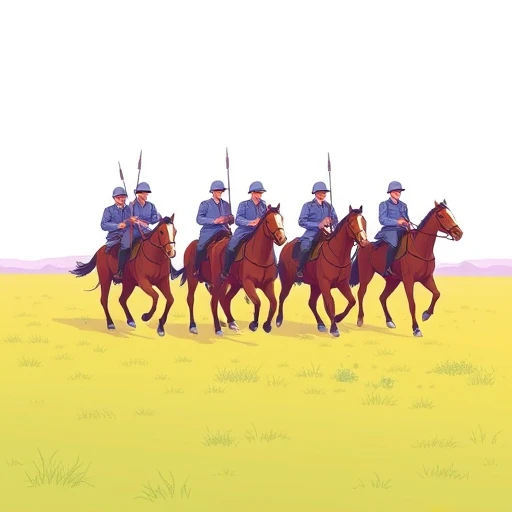
The word cavalry historically refers to the segment of a military force that serves and fights on horseback. In the annals of warfare, the cavalry was the prestigious arm of the service, prized for its mobility, speed, and the sheer psychological impact of a mounted charge. When you encounter this word in a historical context, it almost always conjures images of soldiers in uniform, wielding sabers or lances, galloping across a battlefield. However, the term has evolved significantly over the centuries. In modern military terminology, 'cavalry' often refers to units equipped with armored vehicles, such as tanks, or even helicopters, which are sometimes called 'air cavalry.' The core essence of the word—mobility and the ability to strike quickly—remains the same, even if the 'steeds' have changed from flesh and blood to steel and engines.
- Historical Context
- In the 19th century, the cavalry was essential for reconnaissance, scouting ahead of the main army to find the enemy's position.
Beyond the battlefield, 'cavalry' has found a firm place in our daily metaphorical language. You will often hear people say, 'The cavalry is coming!' or 'Waiting for the cavalry.' In these instances, the word is used to describe a person or group of people who arrive just in time to provide much-needed assistance or to rescue someone from a difficult situation. If a business project is failing and a team of experts is brought in at the last minute to fix it, those experts are the metaphorical cavalry. This usage stems from the classic trope in Western movies where the U.S. Cavalry would arrive at the climax of a battle to save the protagonists from certain defeat. It carries a connotation of relief, rescue, and decisive intervention.
The general knew that without the cavalry, the infantry would be overwhelmed by the enemy's superior numbers.
The word also implies a certain level of status. Historically, maintaining a horse and the necessary equipment was expensive, so cavalrymen were often drawn from the upper classes or the aristocracy. This has left a linguistic trail in related words like 'cavalier,' which can mean a gentleman or, more negatively, someone who is dismissive or haughty. When using 'cavalry,' consider whether you are speaking about literal history, modern military technology, or using it as a figure of speech for a timely rescue. In all these cases, the word emphasizes movement and the turning of the tide in a conflict or problem.
- Modern Usage
- The news report mentioned that the armored cavalry was moving toward the border to deter further aggression.
Just as the store was getting too busy for one person to handle, the rest of the staff arrived like the cavalry.
Ancient cavalry units often wore heavy armor to protect both the rider and the horse.
The sound of the cavalry bugle signaled the start of the final charge.
He felt like the cavalry had arrived when his friends showed up with tools to help him move.
- Military Branch
- The cavalry is often considered the most mobile branch of the land forces.
Using the word cavalry correctly involves understanding its role as a collective noun. While it refers to many soldiers, it is usually treated as a singular entity when referring to the unit as a whole, but can be plural depending on the dialect (British English often uses plural verbs with collective nouns). For example, you can say 'The cavalry is advancing' or 'The cavalry are advancing.' In American English, the singular 'is' is much more common. When you are writing about history, you might specify the type of cavalry, such as 'light cavalry' (used for speed and scouting) or 'heavy cavalry' (used for direct shock attacks). This adds precision to your descriptions and shows a deeper understanding of the term's military origins.
- Collective Noun
- The cavalry was stationed at the fort during the winter months.
In a metaphorical sense, the word is almost always used with the definite article 'the.' We rarely say 'a cavalry arrived'; instead, we say 'the cavalry arrived.' This is because the metaphor refers to a specific, expected, or hoped-for rescue force. It’s also common to use verbs like 'send in,' 'call for,' or 'wait for' in conjunction with cavalry. For instance, 'We were losing the debate until our lead researcher arrived; it felt like someone had finally sent in the cavalry.' This structure emphasizes the transition from a state of struggle to a state of being supported. It is a powerful way to describe a turning point in any narrative, whether it's a story about a war or a story about an office meeting.
The commander decided to hold the cavalry in reserve until the enemy was tired.
Another important aspect of using 'cavalry' is understanding its collocations. It is frequently paired with adjectives that describe its function or appearance. 'Mounted cavalry' is technically redundant but often used for emphasis. 'Air cavalry' and 'armored cavalry' are essential terms in modern military history. In literature, you might see 'the thundering cavalry,' which uses an onomatopoeic adjective to describe the sound of many horses. By using these descriptive pairings, you can make your writing more vivid and evocative. Whether you are describing a scene from the Napoleonic Wars or a high-stakes corporate takeover, the word 'cavalry' brings a sense of dynamic energy and decisive force to your sentences.
- Metaphorical Rescue
- When the IT department finally fixed the server, the employees cheered as if the cavalry had arrived.
The Polish cavalry was famous for its winged hussars who wore feathers on their backs.
The sudden appearance of the cavalry on the ridge changed the outcome of the battle.
They are waiting for the cavalry to bail them out of their financial troubles.
The cavalry charge was a desperate attempt to break the siege.
- Modern Armor
- The 1st Cavalry Division is one of the most decorated units in the United States Army.
You are most likely to encounter the word cavalry in three primary settings: historical discussions, military news, and popular culture. In history classes or documentaries, it is an indispensable term. Whether discussing the Mongol hordes, the knights of the Middle Ages, or the American Civil War, the cavalry’s role is always a central theme. Historians use the word to describe the strategic advantages of speed and the evolution of military technology. If you are a fan of historical fiction or non-fiction, you will see this word frequently used to describe the movements of armies and the drama of battle. It carries a weight of tradition and tactical significance that few other military terms possess.
- Historical Media
- Documentaries about the Napoleonic Wars often feature detailed animations of cavalry maneuvers.
In the realm of modern military news and defense analysis, 'cavalry' remains relevant. While horses are rarely used in combat today, many units retain the name 'cavalry' to honor their heritage. You might hear a news anchor talk about 'armored cavalry regiments' being deployed to a conflict zone. In this context, the word signifies a specific type of unit that is fast-moving and heavily armed, often serving as the vanguard of a larger force. Understanding this helps you grasp the nuances of military reporting, where traditional names are often kept for modern technology to maintain a sense of continuity and esprit de corps within the armed forces.
The movie depicted the cavalry arriving at the last second to save the settlers.
Finally, popular culture—especially movies and television—is a major source of this word. The 'cavalry charge' is a classic cinematic trope. From the 'Charge of the Light Brigade' to the 'Ride of the Rohirrim' in *The Lord of the Rings*, the arrival of the cavalry is a moment of high drama and emotional release. In everyday speech, people use the word idiomatically. If you're at a party and more food arrives just as you're running out, someone might joke, 'Here comes the cavalry!' This figurative use is so common that even people with no interest in military history understand exactly what it means: help has arrived, and the situation is under control. It’s a word that bridges the gap between ancient warfare and modern social interactions.
- Pop Culture
- In many Western films, the sound of a bugle heralds the arrival of the cavalry.
The sports commentator said the substitute players were like the cavalry coming to save the game.
The history book detailed the role of the cavalry in the Battle of Waterloo.
The protesters cheered when the legal team arrived, calling them the cavalry.
The cavalry barracks were located just outside the city walls.
- News Reports
- The military parade featured a display of both modern tanks and traditional cavalry.
The most frequent mistake people make with the word cavalry is a spelling and pronunciation error: confusing it with 'Calvary.' This is an incredibly common slip-up, even for native speakers. 'Cavalry' (CAV-al-ry) refers to soldiers on horses, while 'Calvary' (CAL-va-ry) is the biblical name of the hill where Jesus was crucified. The difference is just the placement of the 'l' and the 'v,' but the meanings are entirely unrelated. To avoid this, remember that 'cavalry' comes from the same root as 'caballo' (Spanish for horse) or 'cheval' (French for horse). If you think of the 'v' coming after the 'ca,' like in 'cave,' it might help you keep the soldiers and the hill separate.
- Spelling Error
- Incorrect: The calvary charged down the hill. Correct: The cavalry charged down the hill.
Another mistake is using 'cavalry' to refer to a single person. 'Cavalry' is a collective noun for a group or a branch of the military. If you want to talk about one individual, you should use 'cavalryman,' 'trooper,' or 'mounted soldier.' Saying 'He is a cavalry' is grammatically incorrect. It would be like saying 'He is an army.' Similarly, people sometimes forget that 'cavalry' is a noun and try to use it as an adjective without a following noun. While you can say 'cavalry tactics,' you shouldn't say 'The move was very cavalry.' Instead, you might say 'The move was typical of the cavalry' or use an adjective like 'gallant' or 'swift' to describe the action.
Many students mistakenly write 'Calvary' when they mean the military cavalry.
A third common error involves the misuse of the idiom 'the cavalry is coming.' Sometimes people use it when help is arriving, but the help is actually expected or routine. The idiom is best reserved for situations where the help is a 'rescue'—something that saves the day when things look bleak. Using it for a regular scheduled delivery might sound a bit overly dramatic, though it can be used for humorous effect. Additionally, be careful with the word 'cavalier.' While it shares a root with 'cavalry,' it is usually used today to describe a lack of proper concern or a dismissive attitude. Don't assume that someone who is 'cavalier' has anything to do with horses or the military; they are just being nonchalant or irresponsible.
- Grammar Tip
- Always use 'the' before 'cavalry' when using it in its metaphorical sense of a rescue force.
The teacher corrected the student's essay, pointing out that cavalry refers to the unit, not the soldier.
Don't use cavalry if you are talking about soldiers on foot; that is the infantry.
The speaker's cavalier attitude was inappropriate, but it had nothing to do with the cavalry.
The cavalry is often pluralized as 'cavalries' when referring to multiple different units from different nations.
- Pronunciation
- Make sure to emphasize the 'v' sound in the middle: CAV-al-ry.
When exploring words similar to cavalry, it's helpful to categorize them by their specific military function or their metaphorical meaning. In a military context, the most direct contrast is 'infantry,' which refers to soldiers who fight on foot. While the cavalry provides speed, the infantry provides the bulk of the fighting force and the ability to hold ground. Another related term is 'artillery,' which refers to large-caliber guns or cannons. Together, the infantry, cavalry, and artillery formed the three main branches of traditional armies. If you are looking for a more specific type of cavalry, you might use 'dragoons' (soldiers who ride horses but fight on foot) or 'hussars' (light cavalry known for their ornate uniforms and speed).
- Infantry vs. Cavalry
- Infantry are the foot soldiers; cavalry are the mounted ones. Infantry are slow but steady; cavalry are fast and impactful.
In modern contexts, you might replace 'cavalry' with 'armor' or 'armored division' when talking about tanks. If you are talking about helicopters, 'airmobile' or 'aviation' units are the contemporary equivalents. Metaphorically, if you want to avoid the word 'cavalry,' you could use terms like 'reinforcements,' 'backup,' 'relief,' or 'rescue party.' For example, instead of saying 'the cavalry arrived,' you could say 'the reinforcements showed up just in time.' However, 'cavalry' carries a more heroic and dramatic tone than 'backup.' It suggests a grand entrance that completely changes the situation, whereas 'backup' might just mean a little extra help.
The dragoons were a versatile type of cavalry that could adapt to different battle conditions.
Comparing 'cavalry' with 'knighthood' is also interesting. While all knights were cavalrymen, not all cavalrymen were knights. Knighthood implies a social rank and a code of conduct (chivalry), whereas 'cavalry' is simply a functional military term. Interestingly, the word 'chivalry' itself comes from the same root as 'cavalry' (the French 'chevalier'). This connection highlights the historical link between being a horse-soldier and being a member of the upper class. When choosing between these words, consider the level of formality and the specific nuance you want to convey. If you want to sound more academic, 'mounted forces' is a good alternative. If you want to be more descriptive, 'the galloping host' might work in a creative writing piece.
- Synonym Comparison
- 'Reinforcements' is neutral and general; 'Cavalry' is specific, historical, and often metaphorical.
The artillery provided cover fire while the cavalry moved into position.
In modern warfare, the armored units have taken over the role of the traditional cavalry.
The term mounted police is used for officers who patrol on horses in cities today.
The vanguard of the army was composed of elite cavalry units.
- Metaphorical Alternatives
- Instead of 'waiting for the cavalry,' you could say 'waiting for a miracle' or 'waiting for backup.'
How Formal Is It?
재미있는 사실
The words 'cavalry', 'chivalry', and 'cavalier' all share the same root, showing the historical link between horse-riding and social status.
발음 가이드
- Saying 'Calvary' (CAL-vuh-ree) instead of 'Cavalry'.
- Dropping the middle 'al' sound, making it 'Kav-ree'.
- Confusing the 'v' and 'l' positions.
- Over-emphasizing the last syllable.
- Pronouncing the 'c' like an 's'.
난이도
Common in history and news, but the spelling is tricky.
Easy to confuse with 'Calvary'.
Pronunciation is straightforward if you remember the 'v'.
Easily recognized in context.
다음에 무엇을 배울까
선수 학습
다음에 배울 것
고급
알아야 할 문법
Collective Nouns
The cavalry (is/are) coming.
Noun Adjuncts
A cavalry charge.
Definite Article with Idioms
Wait for THE cavalry.
Possessive of Collective Nouns
The cavalry's horses.
Pluralizing Collective Nouns
The cavalries of Europe.
수준별 예문
The cavalry has many horses.
The group of horse-soldiers has many horses.
Cavalry is a group word.
I see the cavalry in the movie.
I see the horse-soldiers in the movie.
Use 'the' before cavalry.
The cavalry is very fast.
The horse-soldiers are very fast.
Singular verb 'is' is common.
The soldiers in the cavalry wear hats.
The soldiers in the horse-group wear hats.
Preposition 'in' is used.
The cavalry helps the king.
The horse-soldiers help the king.
Third person singular verb.
Look at the big cavalry!
Look at the big group of horse-soldiers!
Exclamatory sentence.
The cavalry is coming now.
The horse-soldiers are coming now.
Present continuous tense.
My favorite part is the cavalry.
My favorite part is the horse-soldiers.
Cavalry as a subject complement.
The cavalry arrived at the fort yesterday.
The horse-soldiers reached the fort yesterday.
Past tense 'arrived'.
They are waiting for the cavalry to help.
They are waiting for the horse-soldiers to help.
Infinitive 'to help'.
The cavalry moved across the open field.
The horse-soldiers moved across the field.
Preposition 'across'.
Is the cavalry coming to the party?
Is the 'help' coming to the party? (metaphorical)
Question form.
The cavalry was famous for its speed.
The horse-soldiers were famous for being fast.
Possessive 'its' refers to cavalry.
He wants to join the cavalry one day.
He wants to be in the horse-soldier group.
Verb 'join' with a group.
The cavalry had many brave men.
The horse-soldier group had many brave men.
Past tense 'had'.
We saw the cavalry in the parade.
We saw the horse-soldiers in the parade.
Direct object.
Historically, the cavalry played a vital role in scouting.
In the past, horse-soldiers were very important for looking for the enemy.
Adverb 'Historically' modifies the sentence.
When the project was failing, the management sent in the cavalry.
When the project was in trouble, the bosses sent help.
Metaphorical usage.
The sound of the cavalry bugle echoed through the valley.
The sound of the horse-soldiers' horn was heard in the valley.
Noun adjunct 'cavalry bugle'.
Modern cavalry units often use armored vehicles instead of horses.
Today's horse-soldier units use tanks.
Plural 'units' with cavalry.
The cavalry charge was the most dramatic moment of the battle.
The horse-soldiers' attack was the most exciting part.
Compound noun 'cavalry charge'.
She felt relieved when the cavalry finally showed up.
She felt better when help finally arrived.
Adjective 'relieved' with a 'when' clause.
The cavalry was stationed near the border to prevent an invasion.
The horse-soldiers were placed near the border.
Passive voice 'was stationed'.
The museum has a large exhibit on the history of the cavalry.
The museum shows the history of horse-soldiers.
Prepositional phrase 'on the history of...'.
The commander decided to hold the cavalry in reserve for a decisive blow.
The leader kept the horse-soldiers back for a final attack.
Idiom 'in reserve'.
The transition from horse-mounted cavalry to mechanized units took decades.
The change from horses to machines took a long time.
Compound adjective 'horse-mounted'.
The cavalry's mobility allowed them to outflank the enemy infantry.
The horse-soldiers' speed let them get around the side of the foot soldiers.
Possessive 'cavalry's'.
In many Westerns, the arrival of the cavalry is a classic 'deus ex machina.'
In movies, the horse-soldiers arriving is a lucky, sudden rescue.
Literary term 'deus ex machina'.
The Polish cavalry was renowned for its bravery during the early days of World War II.
The Polish horse-soldiers were famous for being brave.
Adjective 'renowned'.
The term 'air cavalry' was coined during the Vietnam War to describe helicopter units.
The name 'air cavalry' started in the Vietnam War.
Passive voice 'was coined'.
The sudden appearance of the cavalry caused panic among the enemy ranks.
The horse-soldiers showing up suddenly made the enemy scared.
Noun 'panic' as an object.
He dismissed the idea with a cavalier attitude, typical of the old cavalry officers.
He didn't care about the idea, like an old horse-soldier leader.
Adjective 'cavalier' related to 'cavalry'.
The strategic deployment of the cavalry was instrumental in securing the victory.
Putting the horse-soldiers in the right place was key to winning.
Adjective 'instrumental'.
The romanticized image of the cavalry charge often masks the brutal reality of warfare.
The pretty picture of horse-soldiers charging hides how bad war is.
Verb 'masks'.
The abolition of the horse-mounted cavalry marked the end of an era in military history.
Getting rid of horse-soldiers was the end of a long time in history.
Noun 'abolition'.
The cavalry served as the eyes and ears of the army, providing critical reconnaissance.
The horse-soldiers were the scouts who found information.
Metaphor 'eyes and ears'.
The hussars were a specialized form of light cavalry known for their speed and ornate uniforms.
Hussars were fast horse-soldiers with fancy clothes.
Appositive phrase.
The metaphorical cavalry—in this case, a government bailout—arrived just as the bank was about to collapse.
The government help came just as the bank was failing.
Parenthetical dash.
The sheer shock of a heavy cavalry charge could break even the most disciplined infantry lines.
The power of a big horse attack could break strong foot-soldier lines.
Noun phrase 'sheer shock'.
The cavalry's heritage is still celebrated in many modern regiments through traditional ceremonies.
The history of horse-soldiers is still honored today.
Present perfect passive 'is still celebrated'.
The obsolescence of the cavalry was precipitated by the advent of the machine gun and barbed wire.
The end of horse-soldiers was caused by new guns and wire.
Noun 'obsolescence'.
One must distinguish between the tactical utility of the cavalry and its symbolic status within the military hierarchy.
You have to see the difference between how useful horse-soldiers were and how important they seemed.
Formal 'One must'.
The 'Charge of the Light Brigade' remains a poignant reminder of the cavalry's vulnerability in the face of modern artillery.
The famous charge shows how easily horse-soldiers could be killed by big guns.
Adjective 'poignant'.
The term 'cavalry' evokes a bygone age of chivalry and individual gallantry on the battlefield.
The word makes you think of an old time of being a gentleman and brave.
Verb 'evokes'.
The seamless integration of air cavalry into modern doctrine has redefined the concept of rapid response.
Using helicopters well has changed how we think about fast help.
Noun phrase 'seamless integration'.
The decline of the cavalry mirrored the broader societal shift from agrarian to industrial economies.
The end of horse-soldiers was like the change from farms to factories.
Verb 'mirrored'.
The commander's reliance on the cavalry was seen as an anachronism in an age of mechanized warfare.
Using horse-soldiers was seen as old-fashioned in a time of machines.
Noun 'anachronism'.
The psychological impact of a massed cavalry charge was often as significant as its physical toll.
How much the horse attack scared people was as important as how many it killed.
Comparative 'as significant as'.
자주 쓰는 조합
자주 쓰는 구문
— Help has arrived just in time.
When my dad showed up with a spare tire, I shouted, 'The cavalry is here!'
— Waiting for someone else to solve a problem.
We can't just wait for the cavalry; we have to fix this ourselves.
— To bring in expert help or reinforcements.
The manager decided to send in the cavalry to finish the project.
— Describing someone who rescues a situation.
She arrived like the cavalry and sorted out the mess.
— A common exclamation when help arrives.
Cavalry to the rescue! I've brought the pizza!
— To ask for serious help.
If this doesn't work, we'll have to call for the cavalry.
— Asking where the expected help is.
The deadline is in an hour; where's the cavalry?
— Realizing you have to solve a problem alone.
There's no cavalry coming; it's up to us.
— Clarifying that you are using the word as a figure of speech.
The metaphorical cavalry arrived in the form of a tax refund.
— Fast and aggressive strategies.
They used cavalry tactics to take over the market.
자주 혼동되는 단어
A religious site; often confused due to similar spelling.
Can mean a horseman, but usually means dismissive today.
The code of conduct for knights, not the unit itself.
관용어 및 표현
— Help is on the way to save a desperate situation.
Don't worry, the cavalry is coming to help us with the move.
informal— Hoping for a rescue rather than taking action.
He's just sitting there waiting for the cavalry instead of looking for a job.
informal— To deploy the best or most powerful resources to solve a problem.
The company sent in the cavalry of lawyers to handle the lawsuit.
neutral— To ride or move very fast and with purpose.
He rode his bike like the cavalry to get home before the rain.
informal— A sudden, powerful, and often risky attempt to achieve something.
The final marketing push was a real cavalry charge.
metaphorical— To request help from a higher authority or more skilled group.
We had to call in the cavalry when the pipes burst.
informal— A way to announce your arrival when you've come to help.
The cavalry's here! I've got the extra chairs!
informal— A rhetorical question asked when help is absent.
I'm doing all the work; where is the cavalry when you need them?
humorous— A single person who does the work of many or saves the day alone.
He was a one-man cavalry during the crisis.
informal— A variation, meaning waiting for the signal for help to arrive.
We're just waiting for the bugle and the cavalry.
literary혼동하기 쉬운
Similar spelling and pronunciation.
Cavalry is soldiers on horses; Calvary is a hill in the Bible.
The cavalry (soldiers) rode to Calvary (the hill).
Both are military branches.
Infantry are on foot; cavalry are mounted.
The infantry marched while the cavalry rode.
Both are military branches.
Artillery uses big guns; cavalry uses horses/tanks.
The artillery fired before the cavalry charged.
Same root word.
Cavalry is a group; cavalier is an adjective for an attitude.
The cavalry officer had a cavalier attitude.
Same root word.
Cavalry is the group; chivalry is the behavior code.
The cavalry followed the rules of chivalry.
문장 패턴
The cavalry is [adjective].
The cavalry is fast.
The cavalry arrived at [place].
The cavalry arrived at the camp.
They sent in the cavalry to [verb].
They sent in the cavalry to fix the problem.
The [adjective] cavalry [verb] the [noun].
The light cavalry scouted the area.
The [noun] of the cavalry was [adjective].
The mobility of the cavalry was crucial.
Despite the [noun], the cavalry [verb].
Despite the terrain, the cavalry advanced.
Wait for the cavalry.
We are waiting for the cavalry.
The cavalry charge.
The cavalry charge was brave.
어휘 가족
명사
형용사
관련
사용법
Common in specific genres (history, Westerns) and as a common idiom.
-
Writing 'Calvary' for soldiers.
→
Cavalry
Calvary is a religious place; cavalry is a military unit.
-
Saying 'He is a cavalry.'
→
He is a cavalryman.
Cavalry is a group, not an individual.
-
Using 'cavalry' for foot soldiers.
→
Infantry
Cavalry must be mounted (on horses or in vehicles).
-
Misplacing the stress.
→
KAV-al-ry
The stress is on the first syllable, not the second.
-
Using it as an adjective for 'brave'.
→
Gallant or Chivalrous
Cavalry is a noun, though 'cavalier' is an adjective with a different meaning.
팁
The V-L Rule
In 'cavalry,' the 'V' comes first. Think of a 'VALiant' soldier.
Metaphorical Rescue
Use 'the cavalry' when help is a surprise or a big relief.
Branch Knowledge
Remember: Infantry = Feet, Cavalry = Horses, Artillery = Cannons.
Collective Noun
Treat it like 'team' or 'family' in your sentences.
Related Words
Learning 'cavalry' helps you understand 'chivalry' and 'cavalier'.
Three Syllables
Don't rush it; say KAV-al-ry clearly.
Vivid Verbs
Pair 'cavalry' with verbs like 'charge,' 'gallop,' or 'deploy'.
Modern Context
Don't be surprised to see 'cavalry' used for tanks in the news.
Horse in a Cave
Visualize a horse in a CAVE to remember the first four letters.
Latin Roots
Knowing 'caballus' (horse) helps you connect it to Spanish 'caballo'.
암기하기
기억법
Think of a CAVE full of horses. CAV-alry. The 'V' comes before the 'L', unlike in the religious word 'Calvary'.
시각적 연상
Imagine a soldier on a horse wearing a 'V' for Victory. The 'V' is in the middle of caValry.
Word Web
챌린지
Try to use 'cavalry' in a sentence about a time a friend helped you with a difficult task.
어원
The word 'cavalry' entered English in the mid-16th century from the Middle French 'cavalerie'. This, in turn, came from the Italian 'cavalleria', derived from 'cavallo', meaning 'horse'.
원래 의미: Originally, it referred simply to a group of horsemen or the state of being a knight.
It belongs to the Romance language family (Latin 'caballus' for pack-horse).문화적 맥락
Be aware that in some historical contexts, the cavalry was used in colonial suppression, which can be a sensitive topic.
Commonly used in idioms about being rescued at the last minute.
실생활에서 연습하기
실제 사용 상황
Military History
- Cavalry charge
- Light cavalry
- Scouting mission
- Mounted unit
Office/Work
- Send in the cavalry
- Waiting for backup
- The experts are here
- Saved the project
Movies/TV
- The cavalry is coming
- Sound the bugle
- Rescue mission
- Climactic battle
Sports
- Fresh legs
- Substitutes
- Turning the tide
- Late-game rescue
Daily Life
- Thanks for coming
- You're a lifesaver
- Just in time
- Need some help
대화 시작하기
"Have you ever seen a movie where the cavalry saves the day at the last minute?"
"Do you think horses still have a place in modern military ceremonies?"
"Who would you call your 'cavalry' when you are in a difficult situation?"
"What is the difference between the cavalry and the infantry in your opinion?"
"Have you ever accidentally written 'Calvary' instead of 'cavalry'?"
일기 주제
Describe a time in your life when it felt like 'the cavalry' arrived to help you.
Write a short story about a historical battle from the perspective of a cavalryman.
Discuss the pros and cons of using horses in warfare versus modern tanks.
Why do you think the image of a cavalry charge is so popular in movies?
If you were in the army, would you rather be in the cavalry or the infantry? Why?
자주 묻는 질문
10 질문It is a collective noun. In American English, it usually takes a singular verb ('The cavalry is coming'). In British English, it can take a plural verb ('The cavalry are coming').
Historically, cavalry used horses. In modern times, 'armor' (tanks) has taken over the role of the cavalry, and many units are called 'armored cavalry'.
It's an idiom meaning help is arriving just in time, based on old movies where horse-soldiers rescued people at the last minute.
No, 'cavalry' refers to the whole group. One person is a 'cavalryman' or a 'trooper'.
Yes, it refers to military units that use helicopters to move quickly, a term popularized during the Vietnam War.
Light cavalry consisted of smaller horses and lighter equipment, used for speed, scouting, and chasing retreating enemies.
Heavy cavalry used large horses and heavy armor, designed to charge directly into enemy lines with great force.
It is pronounced KAV-al-ry. Be careful not to put the 'L' before the 'V'.
It comes from the Italian word 'cavallo,' which means 'horse'.
Yes, but most are now 'armored' (tanks) or 'air' (helicopters). Some countries keep horse units for ceremonies.
셀프 테스트 180 질문
Write a sentence using 'cavalry' in a historical context.
Well written! Good try! Check the sample answer below.
Write a sentence using 'cavalry' as a metaphor for help.
Well written! Good try! Check the sample answer below.
Explain the difference between cavalry and infantry.
Well written! Good try! Check the sample answer below.
Describe a 'cavalry charge' using three adjectives.
Well written! Good try! Check the sample answer below.
Why is 'cavalry' often confused with 'Calvary'?
Well written! Good try! Check the sample answer below.
Write a short dialogue where someone says 'The cavalry is here!'
Well written! Good try! Check the sample answer below.
What does 'air cavalry' mean in modern warfare?
Well written! Good try! Check the sample answer below.
Write a sentence about a 'cavalry bugle'.
Well written! Good try! Check the sample answer below.
Use the word 'cavalry' in a sentence about a museum.
Well written! Good try! Check the sample answer below.
Explain why the cavalry was important for scouting.
Well written! Good try! Check the sample answer below.
Write a sentence using 'cavalry' and 'infantry' together.
Well written! Good try! Check the sample answer below.
What is a 'cavalier' attitude? (related word)
Well written! Good try! Check the sample answer below.
Write a sentence about the Polish cavalry.
Well written! Good try! Check the sample answer below.
Use 'cavalry' in a sentence about a business situation.
Well written! Good try! Check the sample answer below.
Describe the sound of a cavalry charge.
Well written! Good try! Check the sample answer below.
Write a sentence about 'heavy cavalry'.
Well written! Good try! Check the sample answer below.
Write a sentence about 'light cavalry'.
Well written! Good try! Check the sample answer below.
What does 'send in the cavalry' mean?
Well written! Good try! Check the sample answer below.
Write a sentence about a 'cavalryman'.
Well written! Good try! Check the sample answer below.
Use 'cavalry' in a sentence about a parade.
Well written! Good try! Check the sample answer below.
Describe a time you needed 'the cavalry' to help you.
Read this aloud:
당신의 답변:
Speech recognition is not supported in your browser. Try Chrome or Edge.
Do you think the cavalry is still important today? Why or why not?
Read this aloud:
당신의 답변:
Speech recognition is not supported in your browser. Try Chrome or Edge.
How would you explain the word 'cavalry' to a child?
Read this aloud:
당신의 답변:
Speech recognition is not supported in your browser. Try Chrome or Edge.
What are the differences between historical and modern cavalry?
Read this aloud:
당신의 답변:
Speech recognition is not supported in your browser. Try Chrome or Edge.
Why do you think the 'cavalry charge' is so common in movies?
Read this aloud:
당신의 답변:
Speech recognition is not supported in your browser. Try Chrome or Edge.
If you were a general, how would you use your cavalry?
Read this aloud:
당신의 답변:
Speech recognition is not supported in your browser. Try Chrome or Edge.
What other military branches do you know besides the cavalry?
Read this aloud:
당신의 답변:
Speech recognition is not supported in your browser. Try Chrome or Edge.
Have you ever seen a cavalry parade? Describe it.
Read this aloud:
당신의 답변:
Speech recognition is not supported in your browser. Try Chrome or Edge.
What does the word 'chivalry' mean to you? (related word)
Read this aloud:
당신의 답변:
Speech recognition is not supported in your browser. Try Chrome or Edge.
Is it better to be fast (cavalry) or steady (infantry)?
Read this aloud:
당신의 답변:
Speech recognition is not supported in your browser. Try Chrome or Edge.
What is the most famous cavalry unit you've heard of?
Read this aloud:
당신의 답변:
Speech recognition is not supported in your browser. Try Chrome or Edge.
How do you feel when someone arrives to help you just in time?
Read this aloud:
당신의 답변:
Speech recognition is not supported in your browser. Try Chrome or Edge.
Why is it important to distinguish between 'cavalry' and 'Calvary'?
Read this aloud:
당신의 답변:
Speech recognition is not supported in your browser. Try Chrome or Edge.
What kind of animals besides horses could be used as cavalry?
Read this aloud:
당신의 답변:
Speech recognition is not supported in your browser. Try Chrome or Edge.
Describe the equipment a 19th-century cavalryman might have.
Read this aloud:
당신의 답변:
Speech recognition is not supported in your browser. Try Chrome or Edge.
What are the risks of a cavalry charge?
Read this aloud:
당신의 답변:
Speech recognition is not supported in your browser. Try Chrome or Edge.
How has technology changed the role of the cavalry?
Read this aloud:
당신의 답변:
Speech recognition is not supported in your browser. Try Chrome or Edge.
Do you like historical movies about the cavalry?
Read this aloud:
당신의 답변:
Speech recognition is not supported in your browser. Try Chrome or Edge.
What is the sound of a cavalry charge in your imagination?
Read this aloud:
당신의 답변:
Speech recognition is not supported in your browser. Try Chrome or Edge.
Who is the 'cavalry' in your family or friend group?
Read this aloud:
당신의 답변:
Speech recognition is not supported in your browser. Try Chrome or Edge.
Listen to the description of a battle. Where was the cavalry located?
Listen to the news report. What kind of cavalry is being deployed?
Listen to the idiom. What situation is the speaker describing?
Listen to the poem. What happened to the cavalry?
Listen to the pronunciation. Which word is being said: cavalry or Calvary?
Listen to the historical lecture. Why did the cavalry decline?
Listen to the dialogue. Who is being called 'the cavalry'?
Listen to the bugle call. What command is being given to the cavalry?
Listen to the description of a uniform. Which branch does it belong to?
Listen to the movie clip. How do the characters react to the cavalry?
Listen to the interview with a veteran. What was his role in the cavalry?
Listen to the podcast. What is the origin of the word 'cavalry'?
Listen to the story. What did the cavalry do at the end?
Listen to the military briefing. What is the cavalry's objective?
Listen to the joke. Why is the word 'cavalry' used?
/ 180 correct
Perfect score!
Summary
The word 'cavalry' signifies rapid intervention and support, whether in a literal military sense (horse-soldiers or tanks) or as a figurative rescue in daily life. Example: 'When the server crashed, the IT team arrived like the cavalry to save our data.'
- Cavalry refers to soldiers on horseback, valued for speed and mobility in historical warfare.
- Modernly, it includes armored or air units (tanks/helicopters) that perform fast-moving military tasks.
- Metaphorically, 'the cavalry' describes a person or group arriving just in time to provide rescue or help.
- It is a collective noun, often used with 'the,' and is frequently confused with the religious term 'Calvary.'
The V-L Rule
In 'cavalry,' the 'V' comes first. Think of a 'VALiant' soldier.
Metaphorical Rescue
Use 'the cavalry' when help is a surprise or a big relief.
Branch Knowledge
Remember: Infantry = Feet, Cavalry = Horses, Artillery = Cannons.
Collective Noun
Treat it like 'team' or 'family' in your sentences.
![Peaky Blinders S5E01 - The Art of Negotiation (Thomas Shelby) [Netflix Trend Serials]](https://sublearn.com/storage/thumbnails/I398uOWcnZs.jpg)