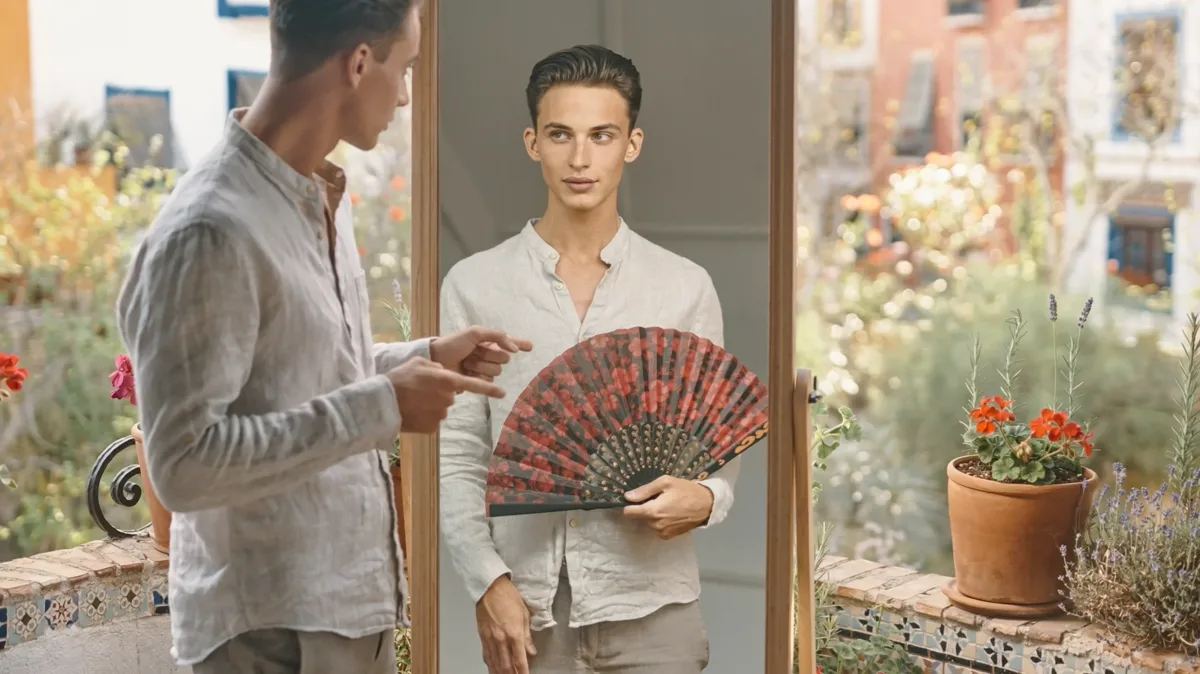
Chapter in 30 Seconds
Learn to talk about yourself and handle objects like a native speaker.
- Introduce yourself and others using reflexive verbs.
- Describe your daily routine using actions you do to yourself.
- Position object pronouns correctly within a sentence.
배울 내용
Hey friend! Ready to take a big leap in Spanish? This chapter is going to unlock some of the most important secrets of the language for you! We're diving into verbs and pronouns, but not just any verbs and pronouns. First, you'll learn how to express actions you do to yourself. For instance, how to introduce yourself (like me llamo which means my name is) or say you wake up in the morning (like me levanto). Here, you'll get familiar with reflexive verbs such as llamarse and levantarse, and you'll see how adding myself or yourself suddenly brings a sentence to life! After that, we'll tackle where to place those clever little words (pronouns) like lo, la, me, and te so your sentences sound natural and correct. You'll learn they usually go before conjugated verbs, but sometimes they attach to the end of certain verb forms. Imagine meeting a new Spanish-speaking friend and confidently introducing yourself, or talking about your daily routine and saying when you wake up. Even when you want to ask for something in a shop and say, I want it. These skills will be incredibly useful in your everyday conversations. By the end of this chapter, you'll be a master of these small tricks and can easily form many fun and practical sentences. Don't worry, it's much easier than you think and incredibly exciting! Let's go!
-
스페인어 재귀 동사: 자신을 ~하다 (llamarse, levantarse)동사 앞에
me,te,se같은 특별한 단어를 붙여서, 내가 나 자신에게 하는 행동을 말할 때 써요. 이름 말하기나 씻는 행동처럼요. -
스페인어 재귀 동사: 자신에게 하는 행동 (-se)내가 나한테 하는 행동을 말할 때, 재귀동사와 딱 맞는 대명사를 함께 써야 해요. 마법의 단어들:
me,te,se. -
대명사 위치 (lo, la, me, te)대명사는 보통 동사 앞에 오지만, 동사 원형이나 명령문 뒤에는 찰떡처럼 붙어요.
lo,la,me,te위치만 기억하면 끝!
Learning Objectives
By the end of this chapter, you will be able to:
-
1
By the end you will be able to introduce yourself and others using 'llamarse' in both informal (tú) and formal (usted) contexts.
-
2
By the end you will be able to conjugate common daily routine verbs using the correct reflexive pronouns.
-
3
By the end you will be able to place direct object pronouns (lo, la) correctly before conjugated verbs or attached to infinitives.
챕터 가이드

Overview
I call myself (me llamo) or I wake myself up(me levanto). You’ll discover how the little word -se attached to a verb's infinitive signals this
doing it to yourselfaction. Beyond that, we'll tackle the clever placement of Spanish object pronouns like lo, la, me, and te, which allow you to refer to people or things without repeating nouns.
I want it instead of I want the book.
How This Grammar Works
myself, yourself, or ourselves. In Spanish, these verbs are identified by the -se ending in their infinitive form, such as llamarse (to call oneself) or levantarse (to get oneself up). When you conjugate a reflexive verb, you also need a reflexive pronoun that matches the subject:I call myself, you'd use me llamo. To say You wake up, it's te levantas. The pronoun me or te always goes *before* the conjugated verb.me or you.
Common Mistakes
- 1✗ Wrong:
Yo llamo Juan.
Yo me llamo Juan.
to call oneself). Omitting me changes the meaning to I call Juan (as in, I make a phone call to Juan) or I call *a* Juan(I name someone Juan). The reflexive pronoun me is essential here to indicate
I call *myself*.- 1✗ Wrong:
Quiero comprar el.
Quiero comprarlo.
it as an object. You need the direct object pronoun lo to replace it (referring to a masculine noun) or him. Also, when the main verb is an infinitive (comprar), the object pronoun lo attaches to its end.- 1✗ Wrong:
Me gusta mucho.(Meaning: I like it a lot, referring to a specific thing)
Lo me gusta mucho.(Less common structure, often Me gusta mucho covers 'it' if the 'it' is understood) OR Me gusta mucho. (If 'it' is implicitly understood as 'that thing' or 'this activity') OR if referring to a specific object, Me gusta mucho este libro. (I like this book a lot.)
it pleases me, if you explicitly want to refer to a specific *object* that you like, and you've already mentioned it, you'd usually say Me gusta mucho and let the context imply the 'it'. If you *must* use a pronoun for the object being liked, it's usually integrated differently, but for A1, Me gusta mucho is perfectly fine and common. The error here is trying to force lo in a way that doesn't fit the gustar structure, which works differently from typical verbs. For verbs like quiero, tengo, veo, using lo/la is straightforward.
Real Conversations
A
B
A
B
A
B
Quick FAQ
What's the difference between me llamo and yo llamo?
Me llamo means My name is or I call myself, using the reflexive verb llamarse. Yo llamo means I call (someone or something else), like
I call my friend.
How do I know if a verb is reflexive in Spanish?
Reflexive verbs in their infinitive form always end with -se, like levantarse (to get up) or ducharse (to shower).
When do I attach pronouns like lo or me to the end of a verb?
You attach pronouns to the end of the verb when the verb is an infinitive (e.g., quiero verlo - I want to see it) or a positive command (e.g., ¡Cómpralo! - Buy it!). Otherwise, they generally go before the conjugated verb.
Can lo and la refer to people as well as things?
Yes, lo can mean him or it (masculine), and la can mean her or it (feminine).

Cultural Context
주요 예문 (4)
팁과 요령 (3)
부메랑 규칙
Me lavo las manos.(내 손을 씻음) vs.
Lavo el coche. (차를 씻음)신체 부위 함정
Me lavo las manos.(나는 손을 씻는다.)
RID 규칙을 기억하세요!
Me lo das ahora처럼요.
핵심 어휘 (7)
Real-World Preview
Making a New Friend
Shopping for a Shirt
Review Summary
- [Me/Te/Se] + llamo/llamas/llama
- Pronoun (me, te, se, nos, os, se) + Verb
- Pronoun + Verb OR Verb-Pronoun
자주 하는 실수
In Spanish, you don't 'call' Juan, you 'call yourself' Juan. Without the 'me', you are saying you are calling someone named Juan on the phone.
While 'Me quiero lavar' is correct, students often try to put the pronoun between the two verbs ('Quiero me lavar'), which is never allowed.
The verb must still be conjugated to match the subject (ellos), even when a reflexive pronoun (se) is present.
이 챕터의 규칙 (3)
Next Steps
You've just mastered one of the most 'Spanish' parts of the language! Reflexives and pronouns make your speech fluid and natural. Keep practicing your routine and you'll be a pro in no time!
Write down 5 things you do every morning using reflexive verbs.
Practice introducing your family members using 'se llama'.
빠른 연습 (9)
올바른 문장을 선택하세요:
frontend.learn_grammar.from_rule: 스페인어 재귀 동사: 자신을 ~하다 (llamarse, levantarse)
Yo ___ lavo las manos.
frontend.learn_grammar.from_rule: 스페인어 재귀 동사: 자신에게 하는 행동 (-se)
Find and fix the mistake:
No cómpralo!
frontend.learn_grammar.from_rule: 대명사 위치 (lo, la, me, te)
Quiero ____ (see you).
frontend.learn_grammar.from_rule: 대명사 위치 (lo, la, me, te)
Find and fix the mistake:
¿Cómo te llama?
frontend.learn_grammar.from_rule: 스페인어 재귀 동사: 자신을 ~하다 (llamarse, levantarse)
문법적으로 올바른 문장을 고르세요:
frontend.learn_grammar.from_rule: 스페인어 재귀 동사: 자신에게 하는 행동 (-se)
올바른 위치를 고르세요:
frontend.learn_grammar.from_rule: 대명사 위치 (lo, la, me, te)
Yo ___ llamo María.
frontend.learn_grammar.from_rule: 스페인어 재귀 동사: 자신을 ~하다 (llamarse, levantarse)
Find and fix the mistake:
Nosotros lavamos las manos.
frontend.learn_grammar.from_rule: 스페인어 재귀 동사: 자신에게 하는 행동 (-se)
Score: /9
자주 묻는 질문 (6)
Quiero verlo esta noche라고 해야 맞아요.
Dime는 괜찮지만 Dámelo por favor처럼 길어지면 찍어줘야 해요.

