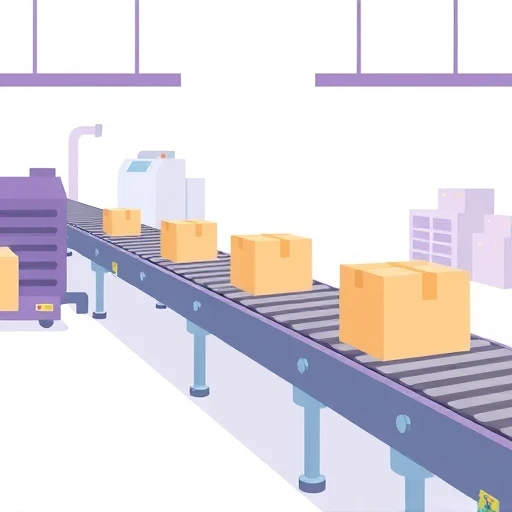
conveyor in 30 Seconds
- A conveyor is a mechanical system, like a moving belt, used to transport items automatically and continuously in industrial or commercial settings.
- Commonly found in airports, factories, and supermarkets, conveyors replace manual labor by moving goods efficiently along a fixed path.
- The term can also be used metaphorically to describe any process that produces a steady, mechanical stream of items or people.
- Types of conveyors include belt, roller, and chain systems, all designed to optimize the flow of materials in a supply chain.
The term conveyor refers to a sophisticated yet fundamentally simple mechanical apparatus designed for the automated transportation of materials, objects, or packages from one specific point to another. In its most ubiquitous form, it is seen as a 'conveyor belt,' a continuous loop of material that rotates around pulleys. However, the technical scope of a conveyor extends far beyond just belts; it encompasses roller systems, chain-driven paths, and even pneumatic tubes. People use this word primarily in industrial, commercial, and logistical contexts to describe the backbone of modern mass production and distribution. Without the conveyor, the efficiency of the modern world would effectively collapse, as it replaces the need for manual labor in moving heavy or repetitive items.
- Industrial Utility
- In factories, conveyors are the literal lifelines of the assembly line, moving car parts, electronics, or food items through various stages of manufacturing without human intervention.
The factory installed a new overhead conveyor to move engine blocks across the floor.
Beyond the factory floor, you encounter conveyors in your daily life more often than you might realize. When you stand at an airport baggage claim, the rotating platform that delivers your suitcase is a specialized type of conveyor. When you place your groceries on the black moving strip at the supermarket checkout, you are interacting with a small-scale conveyor system. The word implies a sense of 'continuous flow' and 'automated delivery.' It is rarely used for a single, one-time movement by a person, but rather for a system that is designed to run consistently over time.
- Logistical Context
- In massive distribution centers like those run by Amazon, conveyors sort thousands of packages per hour using sensors and mechanical arms.
A high-speed conveyor sorted the parcels by zip code in seconds.
Historically, the concept of the conveyor dates back to the late 18th century, but it was the Industrial Revolution that saw its true evolution. Early versions were made of wood and leather, used primarily to move grain. Today, they are made of high-grade polymers, steel, and are often controlled by complex AI algorithms. When using this word, you are evoking an image of efficiency, mechanization, and the relentless pace of industry. It can also be used metaphorically to describe a process that produces a steady stream of something, such as a 'conveyor of talent' in a sports academy.
The mining company used a long-distance conveyor to transport coal from the pit to the processing plant.
- Public Spaces
- Escalators and moving walkways are essentially passenger conveyors designed to transport people through malls and airports.
The sushi arrived at our table on a miniature conveyor system.
The grain conveyor was blocked by a buildup of dust and debris.
Using the word conveyor correctly requires an understanding of its role as a noun that describes a system. It is almost always the subject or object of actions related to movement, maintenance, or installation. Because it is a countable noun, it usually requires an article ('a', 'the') or a possessive pronoun. In technical writing, it is often paired with specific descriptors to clarify the type of system being discussed, such as 'belt conveyor,' 'screw conveyor,' or 'gravity conveyor.'
- Subject Position
- When the conveyor is the one doing the work, it acts as the subject of the sentence.
The conveyor carries the raw materials directly into the furnace.
In more complex sentence structures, you might describe the state of the conveyor. For instance, if a conveyor stops working, you would use verbs like 'jammed,' 'stalled,' or 'malfunctioned.' If you are describing the speed, you might say the conveyor 'accelerated' or 'slowed down.' It is also common to use 'conveyor' in the possessive form when referring to its components, such as 'the conveyor's motor' or 'the conveyor's belt tension.'
- Object Position
- When a person or another machine interacts with the system, 'conveyor' becomes the object.
The technician spent the afternoon repairing the broken conveyor.
Metaphorical usage is another important aspect of how this word is used in sentences. When describing a process that seems mechanical or repetitive, 'conveyor' is often part of a 'conveyor belt' metaphor. For example, 'The school system has become a conveyor belt for standardized testing.' In this case, the word emphasizes a lack of individuality and a focus on throughput and efficiency over quality or care.
The new software provides a conveyor of data that feeds directly into our analytics engine.
- Prepositional Phrases
- We often use 'on' or 'along' to describe the position of items relative to the conveyor.
Please place your trays on the conveyor after you finish your meal.
The luggage conveyor at Terminal 3 is currently out of service.
The word conveyor is most frequently heard in environments where logistics, manufacturing, or large-scale public transit are the focus. If you work in a warehouse, a factory, or a shipping hub, 'conveyor' is a daily part of your vocabulary. Managers might discuss 'conveyor uptime,' while maintenance crews talk about 'conveyor lubrication.' It is a word that signifies the pulse of the workplace—if the conveyor is moving, the business is making money.
- Travel and Tourism
- Airports are perhaps the most common place for the general public to hear this word, specifically regarding baggage handling.
'Attention passengers, please collect your luggage from conveyor number five.'
In the culinary world, specifically in 'kaiten-zushi' (conveyor belt sushi) restaurants, the word is central to the dining experience. Here, the conveyor is not just a tool but the primary method of service. You will hear diners and staff referring to the 'sushi conveyor' as they wait for their favorite dishes to pass by. Similarly, in large-scale commercial kitchens or food processing plants, conveyors are used to move bread through ovens or bottles through filling stations, and the term is used constantly by food safety inspectors and plant operators.
- Construction and Mining
- On construction sites or in quarries, conveyors are used to move massive amounts of dirt, gravel, or ore.
The foreman ordered the portable conveyor to be moved closer to the excavation site.
You will also encounter the word in documentaries about the Industrial Revolution or modern technology. Narrators often use 'conveyor' to explain how Henry Ford revolutionized car manufacturing. In these contexts, the word is synonymous with 'progress' and 'automation.' In a more modern setting, tech news might discuss 'conveyor systems' in highly automated grocery warehouses where robots and conveyors work in tandem to fulfill online orders.
The documentary highlighted how the conveyor belt changed the nature of manual labor forever.
- Retail and Shopping
- Supermarket checkout lines are the most frequent point of contact for the average person with a conveyor.
The cashier waited for the customer to put all their items on the conveyor.
The recycling center uses a magnetic conveyor to separate metal from plastic.
While conveyor is a relatively straightforward noun, learners often make mistakes regarding its spelling, its distinction from related verbs, and its use in idiomatic expressions. The most common error is spelling the word as 'conveyer.' While 'conveyer' is technically an acceptable variant in some dictionaries (referring to a person who conveys information), 'conveyor' is the industry standard for the mechanical device. Using the 'er' ending in a technical or business report might be seen as a lack of professional knowledge.
- Spelling Confusion
- Avoid 'conveyer' when talking about machinery; stick to 'conveyor' for all industrial and commercial contexts.
Incorrect: The factory needs a new conveyer belt.
Correct: The factory needs a new conveyor belt.
Another mistake involves confusing the noun 'conveyor' with the verb 'convey.' A conveyor is the *thing* that does the conveying. You wouldn't say 'The conveyor is conveying the box' unless you wanted to be very repetitive. Instead, use more descriptive verbs like 'transports,' 'moves,' 'carries,' or 'delivers.' Additionally, learners sometimes use 'conveyor' when they actually mean 'escalator' or 'elevator.' While an escalator is a type of conveyor, it has its own specific name that should be used in public settings.
- Misusing the Metaphor
- When using the 'conveyor belt' metaphor, ensure you are implying a lack of care or a mechanical, unthinking process.
Mistake: 'The hospital is a conveyor of health.' (This sounds like the hospital is a factory that doesn't care about patients.)
A subtle mistake is using 'conveyor' for things that don't move in a continuous loop. For example, a forklift is not a conveyor because it is a vehicle that moves items individually and non-continuously. A conveyor must imply a fixed path and a continuous or semi-continuous flow. Finally, ensure you use the correct prepositions. Items are 'on' the conveyor, not 'in' it (unless it's a tube-based pneumatic conveyor).
Correct: The boxes are moving along the conveyor.
- Countability Errors
- Remember that 'conveyor' is countable. You cannot say 'There is much conveyor in the factory.'
Correct: There are many conveyors in the distribution center.
The engineer checked the conveyor alignment to prevent the belt from slipping.
Understanding the synonyms and alternatives for conveyor helps in choosing the right word for the right context. While 'conveyor' is the most general term, other words might be more specific to the industry or the type of movement being described. For example, in the context of shipping, you might use 'transporter' or 'carrier.' In a more abstract sense, you might use 'pipeline' or 'channel.'
- Conveyor vs. Transporter
- A 'transporter' is a broader term that can include vehicles like trucks or ships, whereas a 'conveyor' is almost always a fixed mechanical system.
The conveyor moves the parts within the building, but the transporter moves them between cities.
Another common alternative is 'feeder.' A feeder is a specific type of conveyor used to 'feed' materials into another machine at a controlled rate. For example, a 'screw feeder' moves grain into a mixer. If you are talking about the movement of people, 'moving walkway' or 'travelator' are the preferred terms in airports and malls. In a metaphorical sense, 'pipeline' is often used when talking about a sequence of events or a supply of candidates for a job, implying a more fluid or digital process than the mechanical 'conveyor.'
- Conveyor vs. Assembly Line
- An 'assembly line' is the entire process of making a product, while the 'conveyor' is the physical machine that moves the product through that line.
The workers stood along the conveyor as part of the massive assembly line.
In the world of computer science, the term 'pipeline' is a direct metaphorical descendant of the conveyor. Just as a conveyor moves physical parts through a factory, a data pipeline moves information through various processing stages. If you are writing about technology, choosing between 'conveyor' and 'pipeline' depends on whether the context is physical or digital. For physical logistics, 'conveyor' remains the king of terminology.
The conveyor system was upgraded to handle heavier loads.
- Carousel
- A 'carousel' is a conveyor that moves in a circular or oval path, commonly used for luggage or in dry cleaners.
The dry cleaner retrieved the suit using a motorized conveyor carousel.
The roller conveyor allowed the boxes to slide easily with minimal friction.
How Formal Is It?
Fun Fact
The first 'conveyor belts' in the 18th century were made of leather and wood and were used to move grain over very short distances in mills.
Pronunciation Guide
- Pronouncing the 'o' like 'or' in 'door'. It should be a soft 'uh' sound.
- Stressing the first syllable (CON-veyor).
- Confusing the ending with 'er' (conveyer).
- Mumbling the middle 'vey' sound.
- Over-emphasizing the 'c' at the beginning.
Difficulty Rating
Easy to recognize in context due to its frequent use in public spaces.
Spelling (or vs er) can be tricky for some learners.
Pronunciation is mostly regular once the stress is learned.
Clearly audible in airport announcements and technical discussions.
What to Learn Next
Prerequisites
Learn Next
Advanced
Grammar to Know
Nouns ending in -or vs -er
Conveyor (machine) vs. Teacher (person).
Passive Voice for Mechanical Processes
The items are transported by the conveyor.
Compound Nouns
Conveyor belt, conveyor system, conveyor motor.
Prepositions of Place (on/along)
The box is on the conveyor; it moves along the conveyor.
Articles with Countable Nouns
A conveyor, the conveyors, some conveyors.
Examples by Level
The food is on the conveyor.
La nourriture est sur le tapis roulant.
Simple subject-verb-prepositional phrase.
The conveyor moves the bags.
Le convoyeur déplace les sacs.
Present simple tense for a regular action.
Is the conveyor fast?
Le convoyeur est-il rapide ?
Question form using 'to be'.
Put your tray on the conveyor.
Posez votre plateau sur le convoyeur.
Imperative sentence for giving instructions.
The conveyor is black.
Le convoyeur est noir.
Describing a noun with an adjective.
I see a conveyor at the airport.
Je vois un convoyeur à l'aéroport.
Direct object 'a conveyor'.
The conveyor stops now.
Le convoyeur s'arrête maintenant.
Present simple with an adverb of time.
Wait for the conveyor.
Attendez le convoyeur.
Imperative verb with a prepositional object.
The factory uses a long conveyor to move boxes.
L'usine utilise un long convoyeur pour déplacer les boîtes.
Use of 'to + verb' for purpose.
You can find your luggage on conveyor three.
Vous pouvez trouver vos bagages sur le convoyeur trois.
Using 'can' for possibility.
The conveyor belt is broken today.
Le tapis roulant est cassé aujourd'hui.
Compound noun 'conveyor belt'.
The sushi moves on a small conveyor.
Les sushis se déplacent sur un petit convoyeur.
Present simple for a general truth.
The workers stand next to the conveyor.
Les ouvriers se tiennent à côté du convoyeur.
Preposition of place 'next to'.
Does the conveyor move quickly?
Le convoyeur se déplace-t-il rapidement ?
Question form with 'does'.
The conveyor helps the staff work faster.
Le convoyeur aide le personnel à travailler plus vite.
Verb 'help' followed by object and infinitive.
We need to fix the conveyor soon.
Nous devons réparer le convoyeur bientôt.
Modal phrase 'need to'.
The automated conveyor system reduced the need for manual labor.
Le système de convoyeur automatisé a réduit le besoin de travail manuel.
Past simple tense with a complex subject.
Items are sorted as they travel along the conveyor.
Les articles sont triés au fur et à mesure qu'ils circulent sur le convoyeur.
Passive voice 'are sorted'.
The conveyor's motor needs regular maintenance to prevent breakdowns.
Le moteur du convoyeur nécessite un entretien régulier pour éviter les pannes.
Possessive form 'conveyor's'.
If the conveyor stops, the whole production line will fail.
Si le convoyeur s'arrête, toute la ligne de production échouera.
First conditional (if + present, will + verb).
The luggage conveyor at the airport was extremely crowded.
Le convoyeur à bagages de l'aéroport était extrêmement encombré.
Past simple with an adverb 'extremely'.
They installed a magnetic conveyor to separate metal scraps.
Ils ont installé un convoyeur magnétique pour séparer les débris métalliques.
Past simple with an infinitive of purpose.
The conveyor carries coal from the mine to the ship.
Le convoyeur transporte le charbon de la mine au navire.
Present simple for a continuous process.
Please ensure no loose clothing gets caught in the conveyor.
Veuillez vous assurer qu'aucun vêtement ample ne se coince dans le convoyeur.
Subjunctive-like 'ensure' clause.
The conveyor belt metaphor is often used to describe repetitive educational systems.
La métaphore du tapis roulant est souvent utilisée pour décrire les systèmes éducatifs répétitifs.
Metaphorical use of the noun.
Modern logistics rely heavily on high-speed conveyors and sorting algorithms.
La logistique moderne repose largement sur des convoyeurs à grande vitesse et des algorithmes de tri.
Verb 'rely on' with plural nouns.
The conveyor was designed to handle fragile items without causing damage.
Le convoyeur a été conçu pour manipuler des articles fragiles sans causer de dommages.
Passive voice with 'designed to'.
By implementing a spiral conveyor, the factory saved a significant amount of floor space.
En mettant en œuvre un convoyeur en spirale, l'usine a économisé une quantité importante d'espace au sol.
Gerund phrase 'By implementing'.
The conveyor's speed can be adjusted depending on the volume of orders.
La vitesse du convoyeur peut être ajustée en fonction du volume des commandes.
Modal passive 'can be adjusted'.
The mining operation utilizes a five-mile-long conveyor system.
L'opération minière utilise un système de convoyeur de cinq milles de long.
Compound adjective 'five-mile-long'.
A jam in the conveyor caused a major delay in the shipping schedule.
Un blocage dans le convoyeur a causé un retard important dans le calendrier d'expédition.
Noun 'jam' acting as the subject.
The conveyor provides a continuous flow of parts to the assembly station.
Le convoyeur assure un flux continu de pièces vers le poste d'assemblage.
Present simple for functional description.
The relentless pace of the conveyor dictated the rhythm of the workers' lives.
Le rythme implacable du convoyeur dictait le rythme de vie des ouvriers.
Personification of 'conveyor' as a dictating force.
The integration of IoT sensors into the conveyor allows for predictive maintenance.
L'intégration de capteurs IoT dans le convoyeur permet une maintenance prédictive.
Complex noun phrase as subject.
Critics argue that the university has become a conveyor for corporate-ready graduates.
Les critiques soutiennent que l'université est devenue un convoyeur de diplômés prêts pour l'entreprise.
Abstract metaphorical usage.
The conveyor's modular design enables quick reconfiguration for different product lines.
La conception modulaire du convoyeur permet une reconfiguration rapide pour différentes lignes de produits.
Possessive noun with complex object.
Pneumatic conveyors use air pressure to transport bulk materials through sealed pipes.
Les convoyeurs pneumatiques utilisent la pression de l'air pour transporter des matériaux en vrac dans des tuyaux scellés.
Technical plural usage.
The efficiency of the conveyor system is paramount to the facility's overall throughput.
L'efficacité du système de convoyeur est primordiale pour le débit global de l'installation.
Use of the formal adjective 'paramount'.
The conveyor's incline was too steep for the heavy pallets to ascend safely.
L'inclinaison du convoyeur était trop forte pour que les palettes lourdes puissent monter en toute sécurité.
Adjective 'steep' with 'too... for... to' structure.
They utilized a vertical conveyor to bridge the gap between the two floors.
Ils ont utilisé un convoyeur vertical pour combler l'écart entre les deux étages.
Formal verb 'utilize'.
The conveyor serves as a quintessential emblem of the Fordist era of mass production.
Le convoyeur sert d'emblème quintessentiel de l'ère fordiste de la production de masse.
High-level vocabulary like 'quintessential' and 'emblem'.
The sheer scale of the conveyor network within the distribution hub is staggering.
L'ampleur du réseau de convoyeurs au sein de la plateforme de distribution est stupéfiante.
Use of 'sheer' for emphasis.
Any disruption to the conveyor's operation sends ripples through the entire supply chain.
Toute perturbation du fonctionnement du convoyeur se répercute sur l'ensemble de la chaîne d'approvisionnement.
Metaphorical 'ripples' used with technical subject.
The conveyor's throughput was optimized using sophisticated load-balancing algorithms.
Le débit du convoyeur a été optimisé à l'aide d'algorithmes sophistiqués d'équilibrage de charge.
Technical jargon 'throughput' and 'load-balancing'.
The historical transition from manual portage to conveyor systems marked a paradigm shift in logistics.
La transition historique du portage manuel aux systèmes de convoyeurs a marqué un changement de paradigme dans la logistique.
Abstract concept 'paradigm shift'.
The conveyor's rollers were coated in a specialized polymer to minimize acoustic pollution.
Les rouleaux du convoyeur ont été recouverts d'un polymère spécialisé pour minimiser la pollution sonore.
Passive voice with technical detail.
The conveyor system's redundancy ensures that production continues even during partial failure.
La redondance du système de convoyeur garantit que la production se poursuit même en cas de défaillance partielle.
Use of the noun 'redundancy'.
The conveyor's trajectory was precisely mapped to avoid structural obstacles in the old building.
La trajectoire du convoyeur a été cartographiée avec précision pour éviter les obstacles structurels dans le vieux bâtiment.
Adverbial precision 'precisely mapped'.
Common Collocations
Common Phrases
— A continuous supply of something, often used metaphorically.
The school is a conveyor belt of talented musicians.
— A conveyor that has stopped because something is stuck.
The jammed conveyor caused a backup in the warehouse.
— How fast the belt is moving.
We need to increase the conveyor speed to meet the deadline.
— The belt at the airport for suitcases.
The baggage conveyor started moving five minutes after we landed.
— A conveyor that can be moved to different locations.
They used a portable conveyor to load the truck.
— A device that detects items on the belt.
The conveyor sensor triggers the sorting arm.
— The metal structure that holds the belt.
The conveyor frame is made of stainless steel.
Often Confused With
Conveyance is the act of transporting or a legal document; conveyor is the machine.
An escalator is a conveyor for people that looks like stairs.
An elevator moves things vertically in a closed car; a conveyor is usually an open path.
Idioms & Expressions
— A system that treats students like products on a line.
Many critics dislike the conveyor belt education system.
informal/critical— Moving in a very fast, mechanical, and repetitive way.
The orders were coming in like a conveyor belt.
neutral— Being in a system that guarantees a good outcome.
He's been on the conveyor belt to success since he joined the firm.
informal— Someone or something that tells many lies continuously.
The tabloid has become a conveyor of lies.
literary— To halt a process that has become too fast or out of control.
We need to stop the conveyor and rethink our strategy.
metaphorical— A place that consistently produces high-quality people.
That football club is a conveyor belt of talent.
journalistic— To provide the necessary input for a continuous process.
Marketing's job is to feed the conveyor with new leads.
business— Something that is standard or mass-produced.
This isn't a custom design; it's right off the conveyor.
informal— Thinking only about throughput and not quality.
The manager's conveyor belt mentality is hurting morale.
critical— To ensure that a process or business continues without stopping.
Our main goal is to keep the conveyor moving.
businessEasily Confused
It is a spelling variant.
Conveyor is the standard spelling for machinery. Conveyer often refers to a person who communicates information.
He is a conveyer of bad news, but the factory needs a new conveyor.
They are often used as synonyms.
The belt is just the flexible strip; the conveyor is the whole machine including motors and rollers.
The conveyor belt is part of the larger conveyor system.
Both move things.
A transporter can be a vehicle (truck, ship); a conveyor is a fixed mechanical path.
The transporter truck arrived at the conveyor dock.
They look similar.
A feeder is a specific conveyor used to supply a machine at a set rate.
The screw feeder is a type of small conveyor.
Both are moving paths.
A travelator is specifically for people to walk on; a conveyor is usually for goods.
Don't put your luggage on the travelator; use the conveyor.
Sentence Patterns
The [noun] is on the conveyor.
The bag is on the conveyor.
The conveyor moves the [noun].
The conveyor moves the boxes.
The [noun] is used to [verb] [noun].
The conveyor is used to transport goods.
If the conveyor [verb], then [result].
If the conveyor jams, production will stop.
The [adjective] nature of the conveyor [verb] [noun].
The relentless nature of the conveyor dictated the workflow.
The conveyor serves as a [noun] for [abstract concept].
The conveyor serves as a metaphor for industrial efficiency.
They installed a [adjective] conveyor.
They installed a modern conveyor.
The conveyor's [noun] needs [noun].
The conveyor's belt needs replacement.
Word Family
Nouns
Verbs
Adjectives
Related
How to Use It
Common in industrial, travel, and retail domains.
-
Spelling it as 'conveyer'.
→
conveyor
While 'conveyer' is sometimes seen, 'conveyor' is the standard spelling for the mechanical device in all professional contexts.
-
Using 'conveyor' as a verb.
→
The conveyor carries the items.
Learners often say 'The machine conveyors the boxes.' 'Conveyor' is a noun; use 'conveys' or 'carries' as the verb.
-
Confusing 'conveyor' with 'elevator'.
→
The conveyor moves the boxes; the elevator moves the people.
An elevator is a vertical lift in a shaft; a conveyor is a continuous path for materials.
-
Saying 'in the conveyor'.
→
on the conveyor
Items are placed 'on' the surface of the belt or rollers, not inside the machine itself.
-
Using 'conveyor' for a single truck.
→
The transporter/truck.
A conveyor must be a fixed, continuous mechanical system, not a vehicle that moves independently.
Tips
Be Specific
When writing for a technical audience, specify the type of conveyor (belt, roller, screw) to show your expertise.
The 'O' Rule
Remember 'conveyor' ends in 'OR' like 'motor' and 'rotor'—all are mechanical parts.
Safety First
In a workplace, always use the word 'conveyor' when referring to safety protocols to ensure everyone knows you mean the machinery.
Metaphorical Use
Use 'conveyor belt' to describe a process that feels impersonal or overly mechanical.
Countability
Treat 'conveyor' as a countable noun. Use 'many conveyors' or 'a conveyor,' never 'much conveyor'.
Related Verbs
Pair 'conveyor' with verbs like 'transport,' 'carry,' 'sort,' and 'deliver' for natural-sounding English.
Stress the 'VEY'
Make sure the middle syllable 'VEY' is the loudest and longest part of the word.
Airport English
At the airport, look for the word 'Carousel' on signs, but listen for 'Conveyor' in announcements.
Avoid Repetition
If you use 'conveyor' in one sentence, try 'system' or 'line' in the next to keep your writing interesting.
Maintenance
Words like 'lubrication,' 'tension,' and 'alignment' are frequently used alongside 'conveyor' in technical manuals.
Memorize It
Mnemonic
Think of a 'CON-VEY-OR' as a 'Continuous-Vehicle-for-Objects'. The 'CON' stands for continuous, and 'VEY' sounds like 'way'. It's a continuous way to move things.
Visual Association
Imagine a long black snake made of rubber that never ends, carrying boxes on its back through a dark factory.
Word Web
Challenge
Try to spot three different types of conveyors in your city this week (hint: check the supermarket, the airport, and a construction site).
Word Origin
Derived from the verb 'convey,' which comes from the Old French 'conveier,' meaning 'to escort' or 'to go with.' This, in turn, comes from the Vulgar Latin 'conviare,' which is a combination of 'com-' (together) and 'via' (way).
Original meaning: Originally, it meant to accompany someone on a journey or to escort them for protection.
Indo-European (Latin branch).Cultural Context
Be careful using the metaphor 'conveyor belt' when talking about sensitive human processes like healthcare or adoption, as it can sound cold or uncaring.
Commonly associated with airport stress or the boredom of factory work.
Practice in Real Life
Real-World Contexts
Airport Baggage Claim
- Which conveyor is our flight on?
- The conveyor is stuck.
- Pick up your bags from the conveyor.
- The conveyor has started moving.
Factory Floor
- The conveyor speed is too high.
- We need to grease the conveyor rollers.
- The parts are falling off the conveyor.
- Shut down the conveyor for maintenance.
Supermarket Checkout
- Put the heavy items on the conveyor first.
- The conveyor stops automatically.
- Clean the conveyor belt.
- The conveyor is full.
Sushi Restaurant
- Grab the plate from the conveyor.
- The conveyor has a lot of variety today.
- Don't put empty plates back on the conveyor.
- The conveyor is moving fast.
Warehouse/Logistics
- The conveyor sorts by zip code.
- Load the boxes onto the conveyor.
- The conveyor connects to the loading dock.
- Monitor the conveyor for jams.
Conversation Starters
"Have you ever seen how a luggage conveyor works behind the scenes at an airport?"
"Do you think conveyor belt sushi is better than ordering from a menu?"
"How much do you think a factory relies on its conveyor system to stay profitable?"
"What's the longest conveyor belt you've ever seen in person?"
"Do you think the 'conveyor belt' metaphor for education is a fair criticism?"
Journal Prompts
Describe a time you were waiting at a luggage conveyor. What were you feeling and what did you see?
If you had to design a conveyor for your home, what would it move and where would it go?
Reflect on the idea of an 'assembly line life.' In what ways do you feel like you are on a conveyor?
Write about the importance of automation in the modern world, using the conveyor as your main example.
Imagine you are a small package traveling on a massive warehouse conveyor. Describe your journey.
Frequently Asked Questions
10 questionsA conveyor belt is specifically the moving strip of material that carries items. A 'conveyor' is the entire machine, which includes the belt, the motor, the rollers, and the frame. People often use them interchangeably in casual speech.
In the context of industrial machinery, 'conveyor' (with an 'o') is the standard and most widely accepted spelling. 'Conveyer' is sometimes used to describe a person who conveys information or messages.
They are most common in manufacturing plants, distribution centers (like Amazon), airports (for luggage), supermarkets (at checkout), and mining operations.
Yes, there are 'vertical conveyors' and 'spiral conveyors' designed specifically to move items between different floors or levels of a building.
It is a system in a restaurant where plates of sushi move past the customers on a small belt, allowing them to pick what they want directly from the conveyor.
Usually, a safety sensor will trigger and stop the motor to prevent damage. A technician must then remove the obstruction and restart the system.
Technically, yes. An escalator is a specialized conveyor designed to transport people vertically using a series of interlocking steps.
They can be made of rubber, PVC, urethane, nylon, polyester, or even stainless steel, depending on what they are carrying and the environment they are in.
Speeds vary greatly. A supermarket conveyor moves very slowly, while high-speed sorting conveyors in mail facilities can move at several meters per second.
There isn't one single inventor, but Richard Sutcliffe invented the first conveyor belt for use in coal mines in 1905, and Henry Ford made them famous in car manufacturing.
Test Yourself 200 questions
Describe how a conveyor is used at an airport.
Well written! Good try! Check the sample answer below.
Write a sentence using the word 'conveyor' and the word 'factory'.
Well written! Good try! Check the sample answer below.
Explain the metaphorical meaning of 'conveyor belt education'.
Well written! Good try! Check the sample answer below.
Compare a conveyor to a forklift. Which is better for a warehouse?
Well written! Good try! Check the sample answer below.
Write a safety warning for workers using a conveyor.
Well written! Good try! Check the sample answer below.
Describe your experience at a conveyor belt sushi restaurant.
Well written! Good try! Check the sample answer below.
How did the conveyor belt change the Industrial Revolution?
Well written! Good try! Check the sample answer below.
Write a dialogue between two factory workers about a broken conveyor.
Well written! Good try! Check the sample answer below.
Explain the difference between a belt conveyor and a roller conveyor.
Well written! Good try! Check the sample answer below.
What are the benefits of using an automated conveyor system?
Well written! Good try! Check the sample answer below.
Write a formal email requesting a repair for a luggage conveyor.
Well written! Good try! Check the sample answer below.
How would you use a conveyor in your dream house?
Well written! Good try! Check the sample answer below.
Discuss the environmental impact of long-distance conveyors in mining.
Well written! Good try! Check the sample answer below.
Describe the movement of a conveyor using three different adverbs.
Well written! Good try! Check the sample answer below.
Write a short story about a package's journey on a conveyor.
Well written! Good try! Check the sample answer below.
Why is 'conveyor' spelled with an 'o' and not an 'e' in technical contexts?
Well written! Good try! Check the sample answer below.
What is the role of sensors in a modern conveyor system?
Well written! Good try! Check the sample answer below.
Describe the sound of a large industrial conveyor.
Well written! Good try! Check the sample answer below.
Write a sentence using 'conveyor' as the subject and 'carries' as the verb.
Well written! Good try! Check the sample answer below.
Explain how a gravity conveyor works without a motor.
Well written! Good try! Check the sample answer below.
Pronounce the word 'conveyor' three times, focusing on the stress.
Read this aloud:
You said:
Speech recognition is not supported in your browser. Try Chrome or Edge.
Explain to a friend how a supermarket conveyor works.
Read this aloud:
You said:
Speech recognition is not supported in your browser. Try Chrome or Edge.
Describe the last time you saw a conveyor at an airport.
Read this aloud:
You said:
Speech recognition is not supported in your browser. Try Chrome or Edge.
Discuss the pros and cons of automation in factories.
Read this aloud:
You said:
Speech recognition is not supported in your browser. Try Chrome or Edge.
Give a short presentation on the history of the conveyor belt.
Read this aloud:
You said:
Speech recognition is not supported in your browser. Try Chrome or Edge.
Debate the 'conveyor belt' metaphor for modern society.
Read this aloud:
You said:
Speech recognition is not supported in your browser. Try Chrome or Edge.
Explain why safety is important around moving conveyors.
Read this aloud:
You said:
Speech recognition is not supported in your browser. Try Chrome or Edge.
Describe the different types of conveyors you know.
Read this aloud:
You said:
Speech recognition is not supported in your browser. Try Chrome or Edge.
Tell a story about a conveyor that broke down at the worst time.
Read this aloud:
You said:
Speech recognition is not supported in your browser. Try Chrome or Edge.
How would you improve the luggage conveyor system at airports?
Read this aloud:
You said:
Speech recognition is not supported in your browser. Try Chrome or Edge.
Describe the sound and smell of a large industrial factory.
Read this aloud:
You said:
Speech recognition is not supported in your browser. Try Chrome or Edge.
Explain the concept of 'throughput' to a new employee.
Read this aloud:
You said:
Speech recognition is not supported in your browser. Try Chrome or Edge.
Roleplay: You are a technician explaining a conveyor repair to a manager.
Read this aloud:
You said:
Speech recognition is not supported in your browser. Try Chrome or Edge.
What is your favorite thing about conveyor belt sushi?
Read this aloud:
You said:
Speech recognition is not supported in your browser. Try Chrome or Edge.
Describe a conveyor using at least three adjectives.
Read this aloud:
You said:
Speech recognition is not supported in your browser. Try Chrome or Edge.
How does a conveyor save time in a warehouse?
Read this aloud:
You said:
Speech recognition is not supported in your browser. Try Chrome or Edge.
Talk about the materials used to make conveyor belts.
Read this aloud:
You said:
Speech recognition is not supported in your browser. Try Chrome or Edge.
Explain the difference between 'conveyor' and 'conveyance'.
Read this aloud:
You said:
Speech recognition is not supported in your browser. Try Chrome or Edge.
Discuss the future of conveyors (e.g., using AI and robots).
Read this aloud:
You said:
Speech recognition is not supported in your browser. Try Chrome or Edge.
Describe a conveyor belt you saw in a movie.
Read this aloud:
You said:
Speech recognition is not supported in your browser. Try Chrome or Edge.
Listen for the word 'conveyor' in an airport announcement.
Listen to a description of a factory and identify the conveyor's role.
Listen for technical terms like 'belt tension' and 'roller' in a maintenance video.
Listen to a news report about supply chain issues and note the mention of conveyors.
Listen to a documentary about Henry Ford and summarize the conveyor's impact.
Listen for the number of the conveyor in an airport baggage claim announcement.
Listen to a safety briefing and identify three rules for conveyors.
Listen to a podcast about industrial design and the evolution of conveyors.
Listen to a customer complaining about a slow conveyor at a supermarket.
Listen to an engineer explaining the benefits of a spiral conveyor.
Listen for the stress in the word 'conveyor' in a natural conversation.
Listen to a description of a 'sushi conveyor' and identify the food mentioned.
Listen to a lecture on logistics and the role of high-speed conveyors.
Listen for the difference between 'conveyor' and 'conveyer' in speech.
Listen to a worker reporting a jam on the conveyor line.
/ 200 correct
Perfect score!
Summary
A conveyor is the backbone of automation, providing a continuous and efficient method for moving goods. For example, 'The airport conveyor delivered the luggage to the passengers.'
- A conveyor is a mechanical system, like a moving belt, used to transport items automatically and continuously in industrial or commercial settings.
- Commonly found in airports, factories, and supermarkets, conveyors replace manual labor by moving goods efficiently along a fixed path.
- The term can also be used metaphorically to describe any process that produces a steady, mechanical stream of items or people.
- Types of conveyors include belt, roller, and chain systems, all designed to optimize the flow of materials in a supply chain.
Be Specific
When writing for a technical audience, specify the type of conveyor (belt, roller, screw) to show your expertise.
The 'O' Rule
Remember 'conveyor' ends in 'OR' like 'motor' and 'rotor'—all are mechanical parts.
Safety First
In a workplace, always use the word 'conveyor' when referring to safety protocols to ensure everyone knows you mean the machinery.
Metaphorical Use
Use 'conveyor belt' to describe a process that feels impersonal or overly mechanical.