The video owner has disabled playback on external websites.
This video is no longer available on YouTube.
This video cannot be played right now.
Watch on YouTube
ابزارهای یادگیری هوش مصنوعی را باز کنید
ثبتنام کنید تا به ابزارهای قدرتمندی دسترسی پیدا کنید که به شما کمک میکنند سریعتر از هر ویدیو یاد بگیرید.
آمار یادگیری
سطح CEFR
سختی
زیرنویسها (492 بخشها)
Mind reading?
Of course not.
I love reading.
Look, mind reading might sound like pseudoscientific--
pardon my language--
bullshoot.
But its scientific counterpart, thought identification,
is very much a real thing.
It's based in neuroimaging and machine learning,
and what's really cool is that experiments in mind reading
aren't just about spying on what someone is thinking.
They're about figuring out what thoughts are even made of.
I mean, when I think of something,
what does that mental picture actually look like?
What resolution is it in?
How high fidelity is a memory,
and how do they change over time?
Well, in this episode,
I'm going to look at how reading people's minds
can help us answer these questions.
My journey begins right here at the University of Oregon.
I'm meeting with Dr. Brice Kuhl from the Kuhl lab.
He's a neuroscientist who uses neuroimaging
and machine learning to figure out what people are thinking
without them telling him.
So tell me what you're doing here.
Well, I'm in the cognitive neuroscience program here,
and I study human memory.
My lab primarily uses neuroimaging methods,
so we do a lot of work using
functional magnetic resonance imaging,
or fMRI.
And how do you use fMRI to investigate memories?
We're looking at the pattern of neural activity.
When you form a memory, there's a certain pattern.
And we can record that pattern
and then test whether that pattern is reinstated
or reactivated at a later point, like when you're remembering it.
Does that mean we can look at the patterns of brain activity
and deduce what it is that is being remembered, or recalled,
or even just thought?
Yes, and so we call that decoding.
So it basically takes your input pattern
as some pattern of activity that we record
while you're remembering something.
And we make a prediction about what you're remembering.
You can see how this sounds like mind reading.
[laughs] Yes. It sounds like that.
So, Brice, what are you going to do to me today?
So, what we're going to be doing today
is uncharted territory for us.
So we're going to be trying out a kind of new variant
of the experiment on you.
So I can't guarantee any particular results.
But it represents where the field is
and where we're trying to go.
Today, you're going to participate in an experiment
where you'll be studying faces.
So we're going to have you study
12 pictures of celebrities.
People I already am familiar with.
-People that you know, yeah. -Okay.
And you're going to try to remember those pictures.
Then we're going to have you go into the MRI scanner.
Try to bring that picture to mind as vividly as possible.
And we're going to be recording your brain activity
as you try to imagine these pictures.
We're going to try to build the face.
Essentially draw a picture of what you're remembering.
-A picture? -A picture.
An actual picture that we can print out
and I could, like, hang on my wall.
[laughs] If you wanted.
[Michael] The first step is for me to memorize
the 12 specific celebrity photographs
Brice will later try to detect me thinking about.
I sat down to do this graduate student, Max.
The success of his predictions depend, in part,
on my ability to recall these faces
as vividly as possible while inside the fMRI.
All right, so...
[sighs]
I think I have a pretty good memory of all of those.
-Great. -I feel the stakes are high.
With the celebrity faces hopefully memorized,
it's time for the next step:
going through the metal detector
and into the fMRI,
where Brice will record and monitor my brain activity,
and then later feed it into his algorithm to rebuild the faces.
This will be the first time he's attempted
to reconstruct faces from long-term memory,
which is very difficult, because we're relying
on how clearly I can remember the celebrity photos
I saw an hour ago.
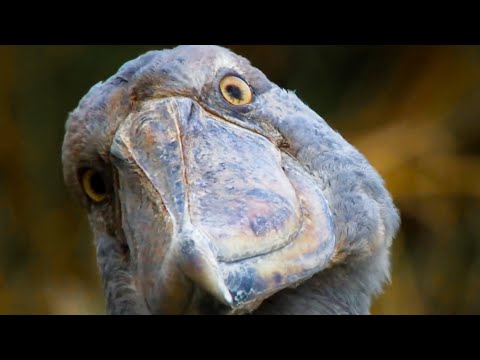
I love its eyes. Look at that.
[woman]
Wouldn't the kid be like, "It's going to eat me"?
An fMRI monitors the activity within the brain
زیرنویس کامل در پخشکننده ویدیو موجود است
با تمرینها یاد بگیرید
تمرینهای واژگان، گرامر و درک مطلب از این ویدیو بسازید
نظرات (0)
برای نظر دادن وارد شویدثبتنام کن و همه امکانات رو باز کن
پیشرفتت رو دنبال کن، واژگان رو ذخیره کن و تمرین کن
حالت تعاملی
آزمون
پاسخ صحیح:



آزمون
پاسخ صحیح:
آزمونها هنگام تماشای ویدیو ظاهر میشوند
راهنمای حفظ
از این ویدیو
شروع رایگان یادگیری زبان

