A Big Party in Brazil
In Brazil, June is a special month. People celebrate Festa Junina. It is a big festival in winter. The festival is for families and friends.
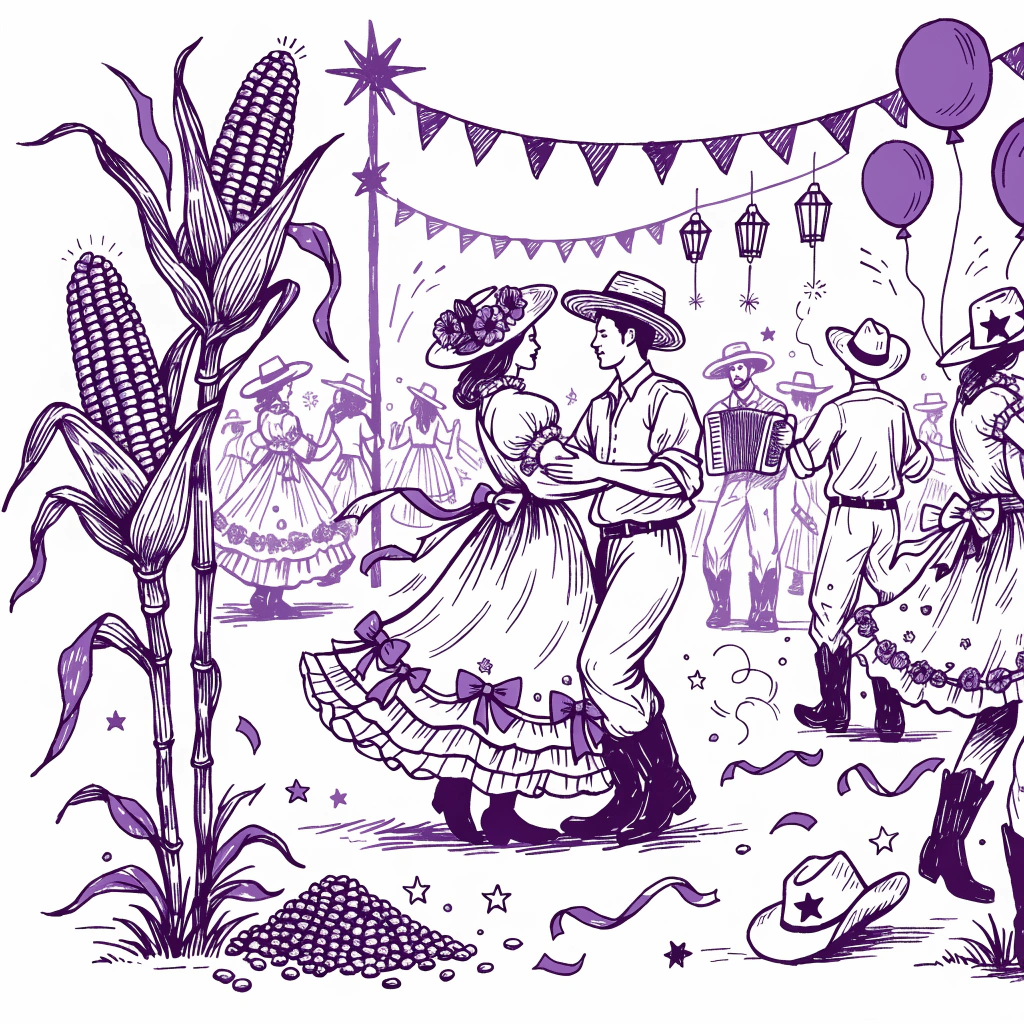
People wear colorful clothes. Men wear straw hats. Women wear pretty dresses. They look like people from the country.
There is a lot of food. People eat corn and sweet cake. It is very delicious.
People dance together in a circle. They listen to happy music. There is often a big fire. Festa Junina is a very happy celebration.
Grammar Spotlight
Pattern: Present Simple (to be)
"It is a big festival in winter."
We use 'is' with 'it' to describe a fact or a state. It is the most common way to give information about a thing.
Pattern: Present Simple (Action Verbs)
"People wear colorful clothes."
We use the base form of the verb (wear) for plural subjects (people). This shows a regular habit or general truth.
Test Your Understanding
10 questions · A1 Beginner · 1 free preview
Test what you learned from this article. Answer all questions to earn XP!
What is Festa Junina?
Want to finish the quiz?
9 more questions are waiting for you. Sign up free to unlock the full quiz and earn XP!
Sign Up FreeAlready have an account? Sign In
Question Breakdown
What is Festa Junina?
Your answer:
Correct answer: A festival
The festival is in the winter.
Your answer:
Correct answer: True
What does 'delicious' mean?
Your answer:
Correct answer: Tastes very good
Men wear straw _____.
Your answer:
Correct answer: hats
Festa Junina: A Traditional Brazilian Party
Festa Junina is a very famous festival in Brazil. Many people think it is the second most popular celebration after Carnival. It happens every year in June. This festival is older than many other traditions because the Portuguese brought it to Brazil many years ago.
The festival celebrates three important saints. It also celebrates the end of the corn harvest. Because it is winter in Brazil during June, the weather is cooler than in the summer. People build big fires to stay warm and dance around them.
The theme of Festa Junina is country life. People wear colorful clothes and straw hats. They look like "caipiras," which means people from the countryside. They eat many delicious foods made of corn, like corn cake and popcorn. Children play games and win prizes. It is a very happy time for families and friends.
Grammar Spotlight
Pattern: Comparative Adjectives
"the weather is cooler than in the summer."
We use comparative adjectives to compare two things. For short adjectives, we add '-er' and then use the word 'than'.
Pattern: Past Simple (Irregular)
"the Portuguese brought it to Brazil many years ago."
We use the past simple for actions that finished in the past. 'Brought' is the irregular past form of the verb 'bring'.
Test Your Understanding
11 questions · A2 Elementary · 1 free preview
Test what you learned from this article. Answer all questions to earn XP!
When does Festa Junina happen every year?
Want to finish the quiz?
10 more questions are waiting for you. Sign up free to unlock the full quiz and earn XP!
Sign Up FreeAlready have an account? Sign In
Question Breakdown
When does Festa Junina happen every year?
Your answer:
Correct answer: In June
Festa Junina is the most popular festival in Brazil.
Your answer:
Correct answer: False
What does 'countryside' mean?
Your answer:
Correct answer: Land outside of towns
People wear _____ hats during the festival.
Your answer:
Correct answer: straw
Why do people build big fires?
Your answer:
Correct answer: To stay warm
Brazil’s Traditional June Festivals: A Celebration of Country Life
While Carnival is famous worldwide, Brazil has another important celebration that is loved by many people. This is called 'Festa Junina', or the June Festival. These festivals have been celebrated in Brazil for centuries, since they were first introduced by the Portuguese during the colonial period.
The festivals are held to honor three Catholic saints: Saint Anthony, Saint John the Baptist, and Saint Peter. However, the celebrations are also connected to the seasons. Because June is the time of the winter solstice in the Southern Hemisphere, the festivals celebrate the end of the rainy season and the beginning of the corn harvest. For this reason, most of the traditional food is made from corn, such as corn cakes and popcorn.
During the 'festas caipiras', people dress in rural clothing to celebrate country life. Men often wear straw hats and checkered shirts, while women wear colorful dresses with ribbons. One of the most important parts of the festival is the 'Quadrilha', which is a traditional folk dance that is performed by large groups of people.
Special bonfires are lit during the cold June nights, which create a warm and cozy atmosphere for families to gather. These festivals are not just about religion; they are a way for Brazilians to celebrate their rural history and spend time with their community. If you visit Brazil in June, you will definitely see these colorful decorations and taste the delicious traditional snacks that have become a symbol of Brazilian culture.
Grammar Spotlight
Pattern: Present Perfect Passive
"These festivals have been celebrated in Brazil for centuries..."
This pattern is used to talk about an action that started in the past and continues to the present, where the focus is on the event rather than who did it. It is formed using 'have/has + been + past participle'.
Pattern: Passive Voice (Present Simple)
"most of the traditional food is made from corn..."
The passive voice is used when the action is more important than the person performing it. It is formed using 'is/are + past participle'.
Test Your Understanding
11 questions · B1 Intermediate · 1 free preview
Test what you learned from this article. Answer all questions to earn XP!
Which festival is considered the most popular in Brazil according to the context?
Want to finish the quiz?
10 more questions are waiting for you. Sign up free to unlock the full quiz and earn XP!
Sign Up FreeAlready have an account? Sign In
Question Breakdown
Which festival is considered the most popular in Brazil according to the context?
Your answer:
Correct answer: Carnival
Festa Junina takes place during the summer season in Brazil.
Your answer:
Correct answer: False
What does 'rural' mean?
Your answer:
Correct answer: Related to the countryside
Special _____ are lit during the cold June nights to create a warm atmosphere.
Your answer:
Correct answer: bonfires
What is the 'Quadrilha'?
Your answer:
Correct answer: A traditional folk dance
Beyond the Carnival: The Cultural Significance of Brazil's Festa Junina
While Carnival is frequently cited as the quintessential Brazilian celebration, Festa Junina—or the June Festival—holds a similarly prominent position in the nation’s cultural calendar. These festivities, which take place throughout the month of June, offer a fascinating insight into the country’s colonial history and its agrarian roots. Originally introduced by the Portuguese during the colonial period, the tradition has evolved from a strictly religious observance into a massive cultural phenomenon that celebrates rural life and the corn harvest.
The festivals primarily commemorate three Catholic saints: Saint Anthony, Saint John the Baptist, and Saint Peter. However, the timing of these celebrations is not purely coincidental. They synchronize perfectly with the winter solstice in the Southern Hemisphere, a period traditionally associated with agricultural cycles. Because the corn harvest occurs during this time, many of the traditional dishes served—such as pamonha and canjica—are corn-based, highlighting the deep connection between the festivities and the land.
One of the most distinctive features of Festa Junina is the rustic aesthetic adopted by participants. Men and women dress in traditional 'caipira' attire, which typically includes checkered shirts, straw hats, and painted-on freckles. This costume serves as a tribute to the rural inhabitants of the Brazilian interior. Central to the celebration is the 'quadrilha', a complex square dance that was originally inspired by 19th-century French court dances. This blend of European influence and local rural culture illustrates how Brazil has historically integrated diverse traditions to create a unique national heritage.
From a socio-economic perspective, Festa Junina is vital. In many regions, particularly the Northeast, these festivals are more significant than Carnival, attracting millions of tourists and providing a substantial boost to local economies. If the Portuguese had not introduced these traditions during the colonial era, the cultural identity of the Brazilian interior might have developed quite differently. Today, the festivals serve as a bridge between the past and the present, ensuring that regional customs are not lost in an increasingly globalized world.
In conclusion, Festa Junina is far more than just a series of parties. It is a sophisticated manifestation of Brazilian identity that honors religious history, agricultural necessity, and the rustic charm of country life. By analyzing its components, one can appreciate how this heritage continues to thrive, adapting to modern times while remaining firmly rooted in its agrarian origins.
Grammar Spotlight
Pattern: Relative Clauses
"These festivities, which take place throughout the month of June, offer a fascinating insight into the country’s colonial history."
Non-defining relative clauses provide extra information about a noun. They are separated by commas and use 'which' for things or 'who' for people.
Pattern: Passive Voice
"Originally introduced by the Portuguese during the colonial period, the tradition has evolved."
The passive voice is used to focus on the action or the object being acted upon rather than the subject. It is formed using the verb 'to be' and the past participle.
Pattern: Third Conditional
"If the Portuguese had not introduced these traditions during the colonial era, the cultural identity of the Brazilian interior might have developed quite differently."
The third conditional describes a hypothetical situation in the past. It uses 'if + past perfect' and 'would/might have + past participle'.
Test Your Understanding
11 questions · B2 Upper Intermediate · 1 free preview
Test what you learned from this article. Answer all questions to earn XP!
What is the status of Festa Junina compared to Carnival in Brazil?
Want to finish the quiz?
10 more questions are waiting for you. Sign up free to unlock the full quiz and earn XP!
Sign Up FreeAlready have an account? Sign In
Question Breakdown
What is the status of Festa Junina compared to Carnival in Brazil?
Your answer:
Correct answer: It is considered the second most prominent celebration.
The timing of Festa Junina is linked to the winter solstice in the Southern Hemisphere.
Your answer:
Correct answer: True
What does 'rustic' mean in the context of the article?
Your answer:
Correct answer: Relating to a simple, countryside style.
The festivals primarily _____ the lives of three Catholic saints.
Your answer:
Correct answer: commemorate
Why are many traditional Festa Junina dishes corn-based?
Your answer:
Correct answer: The festival coincides with the corn harvest.
The Rural Reimagined: Deciphering the Socio-Cultural Tapestry of Brazil’s Festa Junina
While Rio’s Carnival may dominate the international imagination, it is Festa Junina that arguably captures the authentic pulse of the Brazilian hinterland. Originating from the midsummer celebrations brought by Portuguese colonizers, these festivals have undergone a profound metamorphosis, evolving into a complex socio-cultural phenomenon known as 'festas caipiras.' Celebrated throughout June, the festivities pay homage to three Catholic saints: Anthony, John the Baptist, and Peter. However, to view these events through a purely liturgical lens would be to overlook the intricate syncretism that defines them. Rarely do contemporary urbanites consider the profound theological underpinnings of their revelry, yet the vestiges of European folk traditions remain palpable.
Central to the allure of Festa Junina is the romanticization of the rural archetype. Participants don 'caipira' attire—checkered shirts, straw hats, and painted-on freckles—engaging in a performative nod to the agrarian lifestyle. This pastoral aesthetic is not merely a costume choice; it represents a collective nostalgia for a pre-industrial Brazil. The preservation of these customs serves as a bulwark against the homogenizing forces of globalization. It is through this performative identity that Brazilians reconcile their modern urban lives with a collective agrarian memory. The dichotomy between the sophisticated city-dweller and the humble country person is temporarily dissolved in the heat of the 'quadrilha'—a traditional folk dance derived from the French quadrille.
Furthermore, the culinary landscape of the festival is intrinsically linked to the winter solstice and the corn harvest. Corn, a staple crop of the Americas, is transformed into an array of ubiquitous delicacies such as 'pamonha' and 'canjica.' The propensity for corn-based dishes highlights the historical reliance on seasonal cycles. It is the abundance of corn that dictates the rhythm of the feast, serving as a reminder of the land’s fertility. Even in the concrete jungles of São Paulo or the coastal sprawl of Recife, the scent of parched corn and woodsmoke evokes a sense of shared heritage that transcends geographic boundaries.
However, a critical analysis reveals a tension between authenticity and commercialization. As these festivals become increasingly subsumed by corporate sponsorships and mass tourism, some argue that the rustic charm is being eroded. The question arises: can a tradition rooted in rural hardship maintain its integrity when staged in a high-tech arena? Despite these concerns, the resilience of Festa Junina is undeniable. It remains a testament to Brazil's ability to synthesize disparate cultural elements into a cohesive national narrative. Ultimately, the festival is less about historical accuracy and more about the enduring power of community, warmth, and the celebration of life amidst the Southern Hemisphere’s winter chill.
Grammar Spotlight
Pattern: Inversion with Negative/Restrictive Adverbs
"Rarely do contemporary urbanites consider the profound theological underpinnings of their revelry."
Inversion is used here to emphasize the rarity of the action. When 'rarely' starts a sentence, the auxiliary verb 'do' comes before the subject 'urbanites'.
Pattern: Cleft Sentences
"It is through this performative identity that Brazilians reconcile their modern urban lives with a collective agrarian memory."
A cleft sentence (It is... that...) is used to focus on a specific part of the sentence—in this case, the 'performative identity' as the means of reconciliation.
Pattern: Nominalisation
"The preservation of these customs serves as a bulwark against the homogenizing forces of globalization."
Using 'The preservation' (noun) instead of 'Preserving' (verb) makes the tone more formal and academic, focusing on the concept rather than the action.
Test Your Understanding
12 questions · C1 Advanced · 1 free preview
Test what you learned from this article. Answer all questions to earn XP!
According to the article, what is the 'caipira' aesthetic primarily a reflection of?
Want to finish the quiz?
11 more questions are waiting for you. Sign up free to unlock the full quiz and earn XP!
Sign Up FreeAlready have an account? Sign In
Question Breakdown
According to the article, what is the 'caipira' aesthetic primarily a reflection of?
Your answer:
Correct answer: A collective nostalgia for pre-industrial Brazil
The 'quadrilha' dance originated from a Portuguese court dance.
Your answer:
Correct answer: False
What does the word 'ubiquitous' mean in the context of the text?
Your answer:
Correct answer: Found everywhere throughout the festival
The article suggests that the festival serves as a _____ against globalization.
Your answer:
Correct answer: bulwark
Which crop is described as the primary influencer of the festival's culinary landscape?
Your answer:
Correct answer: Corn
The author argues that Festa Junina is purely about historical accuracy.
Your answer:
Correct answer: False
The Pastoral Palimpsest: Deciphering the Socio-Historical Strata of Brazil’s Festa Junina
While Carnival may dominate the global imagination as the definitive Brazilian spectacle, it is arguably the Festa Junina that offers a more nuanced window into the nation's complex cultural DNA. Observed throughout the month of June, these festivities, ostensibly religious in provenance, represent a profound syncretism of European Catholic traditions and the agrarian realities of the Southern Hemisphere. To the uninitiated, the festivals might appear to be a mere parochial frolic; however, should one scrutinize the underlying motifs, a sophisticated tapestry of historical negotiation becomes evident. Scarcely had the Portuguese established their colonial outposts than the European midsummer traditions—honoring Saints Anthony, John, and Peter—began to coalesce with the indigenous and later African influences that define the Brazilian hinterland.
The central archetype of the celebration is the 'caipira,' a stylized representation of the rural laborer. Participants don checkered shirts and straw hats, painting faux freckles and gaps in their teeth to evoke a rustic simplicity. Yet, this performance is not merely an exercise in caricature; it is an ephemeral reclamation of the country’s agrarian roots within an increasingly urbanized society. The juxtaposition of the winter solstice’s chill with the warmth of the 'fogueira' (bonfire) serves as a poignant reminder of the festival's vestigial link to ancient solar rites. It is paramount that the observer acknowledge the corn harvest as the festival's gastronomic quintessence. From 'pamonha' to 'canjica,' the ubiquity of maize-based delicacies underscores the festival’s functional origin as a harvest celebration, where the bounty of the earth was celebrated with both piety and revelry.
Perhaps the most idiosyncratic element of the Festa Junina is the 'Quadrilha,' a folk dance whose provenance is surprisingly aristocratic. Derived from the French 'quadrille' of the 18th and 19th centuries, the dance was initially embraced by the Brazilian elite before being appropriated and repurposed by the rural masses. In its current iteration, the Quadrilha functions as a theatrical piece, often centered around a mock wedding. This narrative device serves as a subtle social commentary, lampooning the rigid structures of marriage and law through the lens of rural farce. The caller’s commands, often featuring phonetic vestiges of French—such as 'anarriê' (en arrière)—provide a linguistic echo of the festival's transcontinental journey.
In the contemporary era, the Festa Junina has undergone a process of commodification, particularly in the massive 'Arraiás' of Northeastern cities like Campina Grande and Caruaru. Here, the scale of the celebration rivals that of Carnival, yet the core sentiment remains one of community and nostalgia. Despite the influx of modern musical genres like 'Sertanejo Universitário,' the traditional 'Forró' remains the festival’s rhythmic heartbeat. It is imperative that the cultural historian recognize the Festa Junina not as a static relic, but as a dynamic negotiation of identity. It remains a space where the dichotomy between the urban and the rural is momentarily dissolved, allowing Brazilians to inhabit a shared, idealized version of their collective past. Thus, the festivals endure, not merely as a tribute to saints, but as a vital, evolving expression of the Brazilian spirit, proving that tradition is most resilient when it is most adaptable.
Grammar Spotlight
Pattern: Inverted Conditional
"should one scrutinize the underlying motifs, a sophisticated tapestry of historical negotiation becomes evident."
This formal structure replaces 'if' with the auxiliary verb (should) at the start of the clause. It is used in C2 English to provide a more scholarly or hypothetical tone to the sentence.
Pattern: Negative Inversion
"Scarcely had the Portuguese established their colonial outposts than the European midsummer traditions began to coalesce..."
When using negative or restrictive adverbs like 'scarcely' or 'hardly' at the beginning of a sentence for emphasis, the subject and auxiliary verb are inverted. It emphasizes the immediate sequence of events.
Pattern: Subjunctive Mood
"It is paramount that the observer acknowledge the corn harvest as the festival's gastronomic quintessence."
The subjunctive 'acknowledge' (base form) is used after adjectives of importance or necessity (paramount, imperative). It indicates a requirement or a strongly recommended action.
Test Your Understanding
12 questions · C2 Mastery · 1 free preview
Test what you learned from this article. Answer all questions to earn XP!
What does the author suggest about the relationship between Festa Junina and Carnival?
Want to finish the quiz?
11 more questions are waiting for you. Sign up free to unlock the full quiz and earn XP!
Sign Up FreeAlready have an account? Sign In
Question Breakdown
What does the author suggest about the relationship between Festa Junina and Carnival?
Your answer:
Correct answer: Festa Junina provides a more detailed understanding of Brazil's cultural history.
The 'Quadrilha' dance was originally created by rural Brazilian peasants.
Your answer:
Correct answer: False
Which word describes the blending of different cultural or religious beliefs?
Your answer:
Correct answer: Syncretism
The 'caipira' costume is described as an _____ reclamation of agrarian roots.
Your answer:
Correct answer: ephemeral
Why is corn (maize) central to the festival's food?
Your answer:
Correct answer: The festival coincides with the corn harvest season.
The author believes the festival is a 'static relic' of the past.
Your answer:
Correct answer: False
