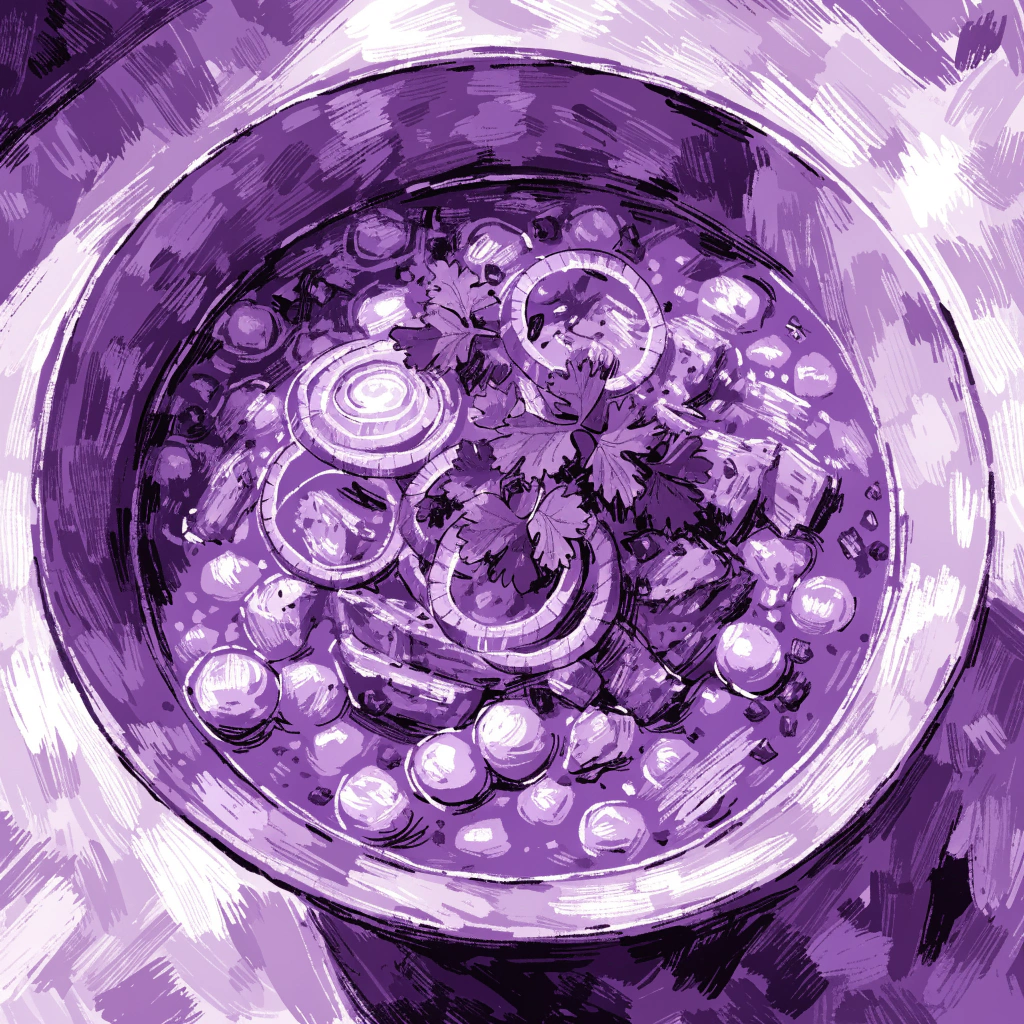
A Tasty Soup from Mexico
Pozole is a very famous soup from Mexico. It is an old dish. People in Mexico love it.
The most important part is the corn. The corn is big and white. It looks like a small flower. People cook the corn with water and salt.
Usually, the soup has meat. Some people use pork and some use chicken. You can add many things on top. You can put lettuce, onion, and lime in your bowl.
Mexican families eat pozole for parties. It is delicious and warm. Everyone is happy when they eat this special soup.
Grammar Spotlight
Pattern: Present Simple (to be)
"Pozole is a very famous soup from Mexico."
We use 'is' for one person or thing. It describes a fact or a state in the present.
Pattern: Can + Verb
"You can add many things on top."
We use 'can' to talk about possibilities. After 'can', we use the base form of the verb without 'to'.
Test Your Understanding
10 questions · A1 Beginner · 1 free preview
Test what you learned from this article. Answer all questions to earn XP!
Where is pozole from?
Want to finish the quiz?
9 more questions are waiting for you. Sign up free to unlock the full quiz and earn XP!
Sign Up FreeAlready have an account? Sign In
Question Breakdown
Where is pozole from?
Your answer:
Correct answer: Mexico
Pozole is a very new dish.
Your answer:
Correct answer: False
What does 'delicious' mean?
Your answer:
Correct answer: Tastes very good
Mexican families eat pozole for _____.
Your answer:
Correct answer: parties
Pozole: Mexico's Special Soup
Mexico has many delicious foods, but pozole is very special. It is a traditional soup from the ancient Aztec times. People in Mexico often eat it for celebrations like birthdays or Independence Day.
The most important ingredient is a special type of corn called cacahuazintle. Chefs cook the corn in a special way until it looks like small white flowers. This makes the soup soft and delicious. There are different types of pozole. For example, pozole rojo is red and spicy, but pozole blanco is white and simple.
In the past, the Aztecs used pozole for religious rituals. Today, it is a meal for families and friends. Many people think pozole is better than other soups because you can add many toppings. You can put lettuce, radish, onion, and lime on top. It is healthy because it has vegetables and meat. You should try it when you visit Mexico!
Grammar Spotlight
Pattern: Comparative Adjectives
"Many people think pozole is better than other soups because you can add many toppings."
We use comparative adjectives to compare two things. For the word 'good', we use the irregular form 'better than'.
Pattern: Past Simple
"In the past, the Aztecs used pozole for religious rituals."
We use the past simple for actions that finished in the past. For regular verbs like 'use', we add '-d' or '-ed' to the end.
Test Your Understanding
11 questions · A2 Elementary · 1 free preview
Test what you learned from this article. Answer all questions to earn XP!
What is the most important ingredient in pozole?
Want to finish the quiz?
10 more questions are waiting for you. Sign up free to unlock the full quiz and earn XP!
Sign Up FreeAlready have an account? Sign In
Question Breakdown
What is the most important ingredient in pozole?
Your answer:
Correct answer: Corn
People in Mexico only eat pozole for breakfast.
Your answer:
Correct answer: False
What is an ingredient?
Your answer:
Correct answer: One of the foods used to make a dish
Pozole is a _____ soup from Mexico.
Your answer:
Correct answer: traditional
Which type of pozole is red and spicy?
Your answer:
Correct answer: Pozole rojo
Pozole: The Heart of Mexican Tradition
Pozole is a traditional Mexican soup that has been enjoyed for centuries. It is much more than just a meal; it is a symbol of history and culture. This ancient dish, which was created by the Aztecs, held a very important role in religious rituals. Today, it is still served at every major celebration, such as weddings and Independence Day.
The most important ingredient in the soup is a special variety of corn called cacahuazintle. Before it is cooked, the corn is prepared using a process called nixtamalization. In this process, the corn is soaked in a special alkaline solution so that the outer skin can be removed. When the corn is boiled, the kernels open up like small white flowers. This gives the soup its distinctive texture and earthy flavor.
Pozole is usually served in a large bowl and can be red, white, or green depending on the ingredients used. The red version uses dried chilies, while the green version is made with tomatillos and pumpkin seeds. After the soup is served, people often add fresh toppings like lettuce, radishes, oregano, and lime juice. It is frequently eaten with crispy tortillas called tostadas.
Over time, this dish has become famous all over the world because it offers a unique taste of Mexico’s rich heritage. If you ever visit Mexico, you must try a bowl of pozole to truly understand the local culture. It is a warm, filling dish that has connected generations of families together through its wonderful flavors.
Grammar Spotlight
Pattern: Present Perfect
"Pozole is a traditional Mexican soup that has been enjoyed for centuries."
The present perfect is used here to describe an action that started in the past and continues to the present. It is formed using 'has/have' plus the past participle of the verb.
Pattern: Passive Voice
"Before it is cooked, the corn is prepared using a process called nixtamalization."
The passive voice is used when the action is more important than the person doing it. It is formed using the verb 'to be' and the past participle of the main verb.
Test Your Understanding
11 questions · B1 Intermediate · 1 free preview
Test what you learned from this article. Answer all questions to earn XP!
Which ancient civilization originally created pozole?
Want to finish the quiz?
10 more questions are waiting for you. Sign up free to unlock the full quiz and earn XP!
Sign Up FreeAlready have an account? Sign In
Question Breakdown
Which ancient civilization originally created pozole?
Your answer:
Correct answer: The Aztecs
Pozole is only served in one color: white.
Your answer:
Correct answer: False
What does the word 'heritage' mean?
Your answer:
Correct answer: The traditions and history of a nation
When the corn is boiled, the kernels open up like small white _____.
Your answer:
Correct answer: flowers
People often eat pozole with crispy tortillas called _____.
Your answer:
Correct answer: tostadas
Pozole: A Culinary Journey Through Mexico’s Ancestral Heritage
Pozole is not merely a culinary delight; it represents a profound connection to Mexico’s pre-Hispanic heritage. This ancient dish, which held significant ritualistic importance for the Aztec Empire, remains a staple in contemporary Mexican festivities. Central to the preparation of pozole is a variety of large-kernel corn known as cacahuazintle. This specific grain undergoes a complex chemical process called nixtamalization. During this procedure, the corn is cooked in an alkaline solution, typically lime and water, to remove the outer hull and soften the grain. Consequently, the kernels blossom like small white flowers, providing the soup with its distinctive texture and earthy flavor profile.
Historically, the consumption of pozole was restricted to special religious ceremonies. It was believed that the gods provided corn as a sacred gift to humanity, and thus, consuming it in this form was a way to commune with the divine. Following the Spanish conquest, the recipe evolved as new ingredients were introduced. Nevertheless, the fundamental essence of the dish—the nixtamalized corn—remained unchanged, preserving a link to the past that has endured for centuries. Today, pozole is celebrated across the nation, with regional variations that reflect the diverse geography of Mexico.
There are three primary versions of pozole: white, green, and red. The white version is the most basic, allowing the natural flavor of the corn to shine. In contrast, the green version incorporates ingredients such as tomatillos, pumpkin seeds, and green chiles, while the red version gains its vibrant color and heat from dried chiles like ancho and guajillo. Furthermore, the dish is typically served with an array of garnishes, including shredded lettuce, radishes, onion, lime, and oregano. These additions allow individuals to customize their bowls, creating a balance of flavors and textures that is both refreshing and hearty.
In contemporary society, pozole is often served during major national holidays, such as Independence Day, or at large family gatherings. It serves as a symbol of hospitality and national identity. The process of making pozole from scratch is labor-intensive, often requiring several hours of simmering to achieve the perfect consistency. Despite the time required for its preparation, the significance of the meal lies in the communal experience of sharing it. Ultimately, pozole is more than just a soup; it is a testament to the resilience of Mexican culture and its ability to preserve ancient traditions in a modern world.
Grammar Spotlight
Pattern: Relative Clauses
"This ancient dish, which held significant ritualistic importance for the Aztec Empire, remains a staple in contemporary Mexican festivities."
Non-defining relative clauses provide extra information about a noun. They are separated by commas and use relative pronouns like 'which' or 'who'.
Pattern: Passive Voice
"During this procedure, the corn is cooked in an alkaline solution, typically lime and water."
The passive voice is used to focus on the action or the object being acted upon rather than the subject. It is formed with 'to be' + past participle.
Pattern: Discourse Markers for Contrast
"Nevertheless, the fundamental essence of the dish—the nixtamalized corn—remained unchanged."
Markers like 'nevertheless' or 'in contrast' are used to link ideas that show opposition or unexpected results, enhancing the flow of academic writing.
Test Your Understanding
11 questions · B2 Upper Intermediate · 1 free preview
Test what you learned from this article. Answer all questions to earn XP!
What is the primary purpose of nixtamalization in the preparation of pozole?
Want to finish the quiz?
10 more questions are waiting for you. Sign up free to unlock the full quiz and earn XP!
Sign Up FreeAlready have an account? Sign In
Question Breakdown
What is the primary purpose of nixtamalization in the preparation of pozole?
Your answer:
Correct answer: To remove the hull and soften the corn kernels
Historically, pozole was a common everyday meal for all Aztec citizens.
Your answer:
Correct answer: False
What does 'contemporary' mean in the context of the article?
Your answer:
Correct answer: Belonging to the present time
The specific variety of corn used in pozole is known as _____.
Your answer:
Correct answer: cacahuazintle
Which version of pozole uses tomatillos and pumpkin seeds?
Your answer:
Correct answer: Green pozole
The Alchemical Heritage of Pozole: A Gastronomic Tapestry of Mexico
Seldom does a culinary tradition encapsulate the spiritual and historical evolution of a nation as poignantly as Pozole. To the uninitiated, it might appear to be a mere hearty soup; however, for the Mexican people, it represents a profound cultural nexus that stretches back to the Pre-Columbian era. The dish’s lineage is inextricably linked to the Aztec Empire, where it held a sacrosanct position in ritualistic ceremonies. It was believed that maize was a divine substance, and thus, the consumption of Pozole was a way to commune with the gods. While the ingredients have evolved since the Spanish conquest, the soul of the dish remains anchored in its ancient origins.
It is the meticulous process of nixtamalization that serves as the bedrock of this iconic dish. This chemical metamorphosis involves cooking the 'cacahuazintle' corn—a large-kernel variety—in an alkaline solution, typically lime and water. This process is not merely for culinary flourish; it serves to remove the hull, soften the grain, and unlock essential nutrients that would otherwise remain bio-unavailable. The transformation of the grain into blossoming, flower-like florets provides Pozole with its signature chewy texture and an earthy, nuanced flavor profile that is entirely unique to the region.
Diversity within the dish is as vast as the Mexican landscape itself. While the central theme remains consistent, regional interpretations offer a fascinating study in gastronomic adaptation. In the lush state of Guerrero, one might encounter 'Pozole Verde,' enriched with a pungent blend of pumpkin seeds and green tomatoes. Conversely, the 'Pozole Rojo' of Jalisco is characterized by a deep, smoky complexity derived from dried chilies like ancho and guajillo. In its 'Blanco' form, the soup is a minimalist masterpiece, relying entirely on the quality of the hominy and the meat to carry the narrative. This regionalism reflects the nuanced ways in which local ecosystems dictate culinary identity.
Beyond the broth, the communal ritual of garnishing is perhaps the most vital facet of the experience. A bowl of Pozole is never served in isolation; it is accompanied by an array of textures and flavors—shredded cabbage, radishes, oregano, lime, and toasted tortillas known as tostadas. The act of customizing one's bowl is a deeply personal yet shared experience, reinforcing the ubiquitous nature of the dish at weddings, national holidays, and family gatherings. This participatory element ensures that Pozole remains a living tradition rather than a stagnant relic of the past.
In contemporary Mexico, the secularization of Pozole has not diminished its prestige. Instead, it has become a symbol of national resilience and syncretism. The integration of pork, introduced by the Spanish, with the indigenous maize illustrates the complex weaving of disparate cultures into a single, cohesive identity. To analyze Pozole is to analyze the history of Mexico itself—a blend of ancient wisdom, colonial influence, and a relentless commitment to communal celebration. It stands as a testament to the idea that food is not just sustenance, but a vessel for historical memory.
Grammar Spotlight
Pattern: Inversion with negative adverbials
"Seldom does a culinary tradition encapsulate the spiritual and historical evolution of a nation as poignantly as Pozole."
When using negative or restrictive adverbials like 'seldom' at the start of a sentence for emphasis, the auxiliary verb is placed before the subject.
Pattern: It-Cleft Sentences
"It is the meticulous process of nixtamalization that serves as the bedrock of this iconic dish."
This structure is used to focus on a specific piece of information (the process of nixtamalization) by placing it after 'It is' and before the relative clause.
Pattern: Nominalisation
"The transformation of the grain into blossoming, flower-like florets provides Pozole with its signature chewy texture."
Using a noun phrase ('The transformation of the grain') instead of a verb ('When the grain transforms') creates a more formal, academic tone suitable for C1 level writing.
Test Your Understanding
12 questions · C1 Advanced · 1 free preview
Test what you learned from this article. Answer all questions to earn XP!
What was the primary significance of Pozole in the Aztec Empire according to the text?
Want to finish the quiz?
11 more questions are waiting for you. Sign up free to unlock the full quiz and earn XP!
Sign Up FreeAlready have an account? Sign In
Question Breakdown
What was the primary significance of Pozole in the Aztec Empire according to the text?
Your answer:
Correct answer: It was a ritualistic dish used to communicate with the divine.
The process of nixtamalization is purely for aesthetic purposes to make the corn look like flowers.
Your answer:
Correct answer: False
What does 'sacrosanct' mean in the context of the article?
Your answer:
Correct answer: Something regarded as too important or holy to be changed.
The integration of pork and indigenous maize illustrates the complex weaving of disparate cultures into a single _____ identity.
Your answer:
Correct answer: cohesive
Which regional variation is associated with the use of pumpkin seeds?
Your answer:
Correct answer: Pozole Verde from Guerrero
The author argues that modern Pozole has lost its cultural prestige due to secularization.
Your answer:
Correct answer: False
The Alchemical Resonance of Pozole: A Gastronomic Palimpsest of Mexican Identity
Were one to deconstruct the culinary tapestry of Mesoamerica, the resulting narrative would inevitably converge upon Pozole, a dish that transcends the rudimentary classification of 'soup' to inhabit a space of profound ontological significance. To the uninitiated, Pozole might appear as a mere confluence of broth and corn; however, for the Mexican psyche, it represents a vestige of a pre-Columbian worldview, a ritualistic vessel that has weathered the tempests of colonial erasure and modern homogenization. The foundational element of this dish is the cacahuazintle, a variety of heirloom maize characterized by its oversized, starchy kernels. The preparation of this grain involves the ancient process of nixtamalization, an alchemical metamorphosis in which the corn is steeped in an alkaline solution—traditionally lime—to slough off the fibrous hull. This process does not merely tenderize the grain; it facilitates a structural unfolding, causing the endosperm to blossom into a form reminiscent of a white flower. It is this floral efflorescence that provides Pozole with its distinctive, chewy texture and its deeply resonant, earthy olfactory profile.
Historically, the consumption of Pozole was far from a quotidian affair. Within the socio-religious framework of the Aztec Empire, it was a sacred concoction, allegedly linked to sacrificial rites that underscored the cyclical nature of life and death. While the contemporary iteration of the dish has been sanitized of its more macabre ancestral associations, the communal gravity of the meal remains intact. Whether it be the Pozole Blanco of Guerrero, the vibrant Pozole Verde of Michoacán, or the robust Pozole Rojo of Jalisco, each regional variation serves as a localized dialect of a broader national idiom. The act of garnishing the dish—adding radishes for crunch, lime for acidity, and oregano for a herbaceous top note—is an exercise in individual agency within a collective tradition. It is a moment where the ephemeral nature of taste meets the enduring weight of history.
One might argue that the resilience of Pozole lies in its capacity to act as a gastronomic palimpsest. Each layer of ingredient and technique reflects a different era of Mexican history, from the indigenous cultivation of maize to the Spanish introduction of porcine proteins. To analyze Pozole is to analyze the very concept of 'Mestizaje'—the cultural and biological synthesis that defines modern Mexico. The dish exists as a living archive, a sensory bridge between the obsidian mirrors of the past and the neon-lit markets of the present. Lest we succumb to the reductionist view that food is merely fuel, Pozole stands as a testament to the fact that what we consume is inextricably linked to who we are. It is a quintessential example of how a singular dish can encapsulate the contradictions, triumphs, and enduring spirit of a civilization. In the steam rising from a bowl of Pozole, one finds not just the aroma of corn and chili, but the very breath of a culture that refuses to be forgotten, maintaining its relevance through a continuous process of reinterpretation and reverence.
Grammar Spotlight
Pattern: Inverted Conditional (Were one to...)
"Were one to deconstruct the culinary tapestry of Mesoamerica, the resulting narrative would inevitably converge upon Pozole."
This is a formal alternative to 'If someone were to...'. It uses the subjunctive 'were' in an inverted position to express a hypothetical or unlikely situation in the present or future.
Pattern: Negative Clause with 'Lest'
"Lest we succumb to the reductionist view that food is merely fuel, Pozole stands as a testament..."
'Lest' is a formal conjunction meaning 'to avoid the risk of' or 'for fear that'. It is followed by a verb in the subjunctive mood (succumb) and is used to explain the purpose of the preceding or following statement.
Pattern: Correlative Conjunctions with Subjunctive Nuance
"Whether it be the Pozole Blanco of Guerrero, the vibrant Pozole Verde of Michoacán, or the robust Pozole Rojo of Jalisco..."
The use of 'Whether it be' instead of 'Whether it is' employs the subjunctive to acknowledge multiple possibilities or varieties without committing to one, emphasizing universality.
Test Your Understanding
12 questions · C2 Mastery · 1 free preview
Test what you learned from this article. Answer all questions to earn XP!
What is the primary function of nixtamalization as described in the text?
Want to finish the quiz?
11 more questions are waiting for you. Sign up free to unlock the full quiz and earn XP!
Sign Up FreeAlready have an account? Sign In
Question Breakdown
What is the primary function of nixtamalization as described in the text?
Your answer:
Correct answer: To facilitate a structural metamorphosis and remove the hull
The author suggests that modern Pozole still retains its macabre sacrificial elements in practice.
Your answer:
Correct answer: False
What does the term 'palimpsest' imply about Pozole?
Your answer:
Correct answer: It is a dish that contains visible traces of its historical layers.
The process of nixtamalization involves soaking the corn in an _____ solution.
Your answer:
Correct answer: alkaline
The author uses the term 'Mestizaje' to refer to:
Your answer:
Correct answer: The cultural and biological synthesis defining modern Mexico.
The text argues that food should be viewed primarily as fuel for the body.
Your answer:
Correct answer: False
