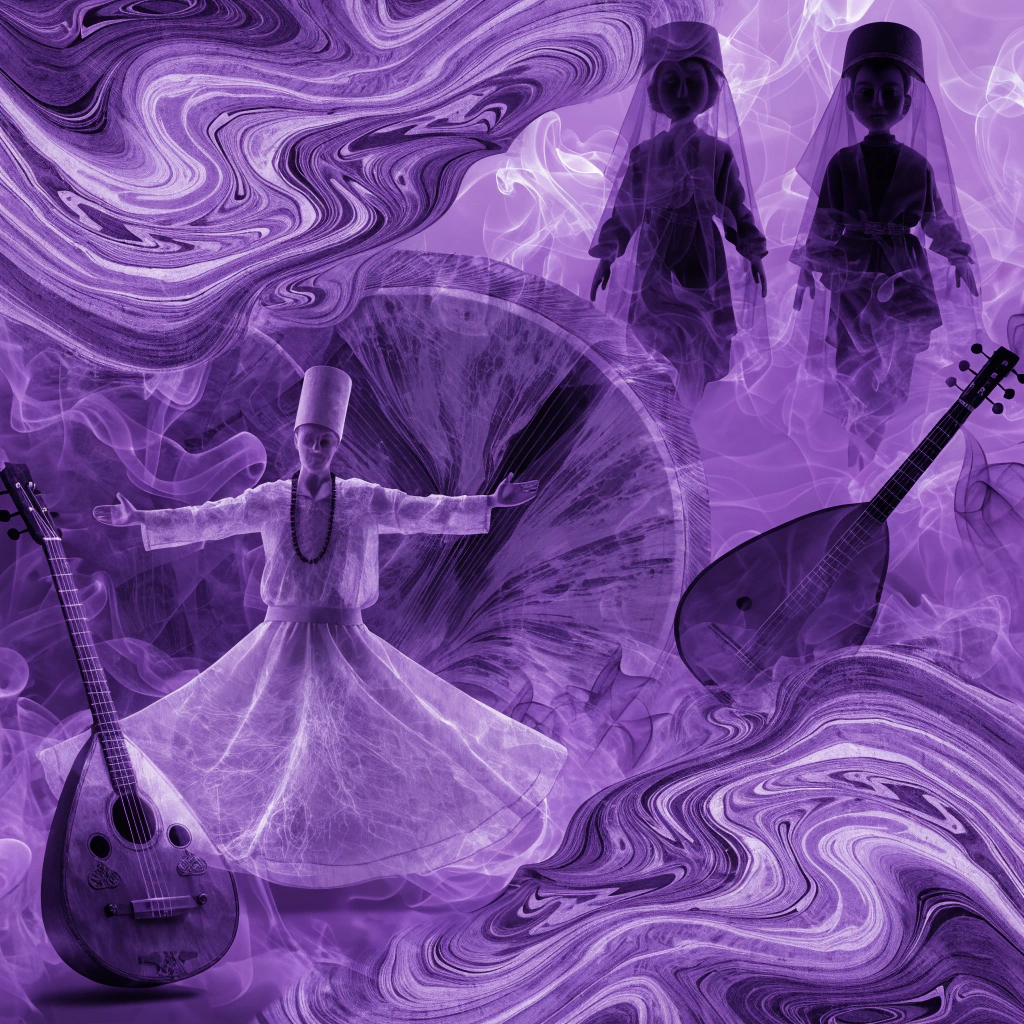
Music and Stories in Turkey
Turkey has a special music tradition. It is the Aşık tradition. An Aşık is a singer and a poet. They travel to many small villages. They play a musical instrument. It is called the bağlama. The bağlama has a long neck and strings.
The Aşık sings many songs. The songs are about love, nature, and people. They tell stories with their music. Many people listen to the songs. This tradition is very old. It is over one thousand years old. It is a big part of Turkish culture.
Grammar Spotlight
Pattern: Present Simple: 'Be' Verb
"An Aşık is a singer and a poet."
We use 'is' for one person or thing. It describes what someone or something is.
Pattern: Present Simple: Action Verbs
"They play a musical instrument."
We use the base form of the verb (play) for plural subjects like 'they'. This describes a regular habit.
Test Your Understanding
10 questions · A1 Beginner · 1 free preview
Test what you learned from this article. Answer all questions to earn XP!
Where do Aşıks travel?
Want to finish the quiz?
9 more questions are waiting for you. Sign up free to unlock the full quiz and earn XP!
Sign Up FreeAlready have an account? Sign In
Question Breakdown
Where do Aşıks travel?
Your answer:
Correct answer: To small villages
The bağlama is a musical instrument.
Your answer:
Correct answer: True
What is a 'singer'?
Your answer:
Correct answer: A person who makes music with their voice
The bağlama has a long _____ and strings.
Your answer:
Correct answer: neck
The Singing Poets of Turkey
In Turkey, there is a very old and beautiful music tradition called the Aşık tradition. An Aşık is a wandering poet and singer. For hundreds of years, these musicians traveled from village to village. They played a special instrument called the bağlama. The bağlama is a long-necked lute with seven strings. It is the most important instrument in Turkish folk music.
Aşıks were more important than modern singers because they were the news reporters of the past. They sang about love, nature, and social problems. Their songs helped people learn about history and culture. The lyrics were simple but very deep. Many famous Aşıks, like Aşık Veysel, became heroes in Turkey.
Today, people still love this tradition. Modern musicians play the bağlama, and it is more popular than other old instruments. It is a symbol of Turkish history. When an Aşık plays the bağlama, the music tells a story that everyone can understand.
Grammar Spotlight
Pattern: Comparatives (more + adjective + than)
"Aşıks were more important than modern singers because they were the news reporters of the past."
Use 'more' before long adjectives to compare two things. Always include 'than' after the adjective to show the comparison.
Pattern: Past Simple (Regular Verbs)
"For hundreds of years, these musicians traveled from village to village."
Add '-ed' to the end of regular verbs to talk about finished actions in the past. It shows the action happened a long time ago.
Test Your Understanding
11 questions · A2 Elementary · 1 free preview
Test what you learned from this article. Answer all questions to earn XP!
What is an Aşık?
Want to finish the quiz?
10 more questions are waiting for you. Sign up free to unlock the full quiz and earn XP!
Sign Up FreeAlready have an account? Sign In
Question Breakdown
What is an Aşık?
Your answer:
Correct answer: A wandering poet and singer
The bağlama has ten strings.
Your answer:
Correct answer: False
What does 'symbol' mean?
Your answer:
Correct answer: A sign that represents an idea
The bağlama is a long-necked _____ with seven strings.
Your answer:
Correct answer: lute
Why were Aşıks like news reporters?
Your answer:
Correct answer: They sang about social problems and news
The Wandering Poets of Turkey: The Aşık Tradition
For more than a thousand years, the Aşık tradition has been a central part of Turkish culture. An Aşık is a wandering poet-singer who travels between villages to share stories and music. These musicians are not just performers; they are also teachers and philosophers who have preserved the Turkish language through their songs. In many Turkish homes, you can find a bağlama hanging on the wall, showing how much people respect this instrument.
The most important tool for an Aşık is the bağlama. This is a traditional long-necked lute that is played with great skill. The bağlama is often called the 'voice' of the poet because it helps them express deep emotions. In the past, songs were not written down, so the music was passed from one generation to another by listening and practicing. It is not just a piece of wood and strings; it represents the soul of the people.
The songs usually focus on themes like love, social justice, and spiritual beliefs. Because the Aşıks travel a lot, they have seen many different ways of life. They use their music to talk about the problems of society and to give advice to their listeners. This tradition is very social, and people often gather in coffee houses to hear the latest poems. Aşıks often engage in competitions where they improvise poems against each other, testing their intelligence and speed.
Today, this ancient art has been recognized by UNESCO as an important part of human heritage. Although modern music is popular now, the bağlama is still taught in many schools. The tradition has changed over time, but the message of peace and love remains the same. Many young people have started to learn the bağlama because they want to keep their history alive.
Grammar Spotlight
Pattern: Present Perfect Tense
"the Aşık tradition has been a central part of Turkish culture."
The present perfect is formed with 'have/has' and the past participle. It is used here to describe a state that started in the past and continues to the present day.
Pattern: Passive Voice
"This is a traditional long-necked lute that is played with great skill."
The passive voice is formed with the verb 'to be' and the past participle. We use it when the action (playing the lute) is more important than who is doing it.
Test Your Understanding
11 questions · B1 Intermediate · 1 free preview
Test what you learned from this article. Answer all questions to earn XP!
What is an Aşık?
Want to finish the quiz?
10 more questions are waiting for you. Sign up free to unlock the full quiz and earn XP!
Sign Up FreeAlready have an account? Sign In
Question Breakdown
What is an Aşık?
Your answer:
Correct answer: A wandering poet-singer
The bağlama is a type of wind instrument.
Your answer:
Correct answer: False
What does 'ancient' mean?
Your answer:
Correct answer: Very old
The songs usually focus on themes like _____, social justice, and spiritual beliefs.
Your answer:
Correct answer: love
Why is the bağlama called the 'voice' of the poet?
Your answer:
Correct answer: Because it helps express deep emotions
The Echoes of Anatolia: Understanding the Aşık Tradition and the Bağlama
The Aşık tradition stands as a fundamental pillar of Turkish folk music and oral literature, representing a cultural heritage that has spanned over a millennium. An 'Aşık' is traditionally defined as a wandering poet-singer who travels from village to village, accompanied by the soulful melodies of the bağlama, a long-necked lute. This tradition is not merely regarded as a form of entertainment; rather, it serves as a vital social institution that has preserved the Turkish language and collective memory through centuries of change.
Central to this practice is the bağlama, an instrument that is often considered the voice of the Anatolian people. The music produced is frequently improvised, allowing the performer to respond to the immediate emotions of their audience or the specific atmosphere of a gathering. Historically, these minstrels were the primary source of news and moral education in rural areas. Their songs, which cover diverse themes such as unrequited love, social justice, and deep philosophical devotion, provided a voice for the common people against regional hardships.
Furthermore, the Aşık tradition is deeply rooted in spiritual and social philosophy. Many Aşıks were seen as wise figures who could critique societal flaws through satire and poetry. This oral transmission of values ensured that even in the absence of formal education, the ethical foundations of the community remained intact. Consequently, the tradition has been recognized by UNESCO as an Intangible Cultural Heritage of Humanity, highlighting its global significance.
In contemporary Turkey, while the lifestyle of the wandering minstrel has largely faded due to urbanization, the influence of the Aşık spirit remains remarkably enduring. Modern musicians continue to draw inspiration from the rhythmic patterns and lyrical depth of the old masters. By blending traditional techniques with modern genres, they ensure that the bağlama continues to resonate with younger generations. In essence, the Aşık tradition is a testament to the power of oral storytelling and the enduring nature of cultural identity in a rapidly evolving world.
Grammar Spotlight
Pattern: Passive Voice
"This tradition is not merely regarded as a form of entertainment."
The passive voice is used here to focus on the tradition itself rather than the people who regard it. It is formed using 'to be' (is) + the past participle (regarded).
Pattern: Relative Clauses
"An 'Aşık' is traditionally defined as a wandering poet-singer who travels from village to village."
The relative pronoun 'who' introduces a defining relative clause that gives essential information about the 'poet-singer'.
Pattern: Present Perfect Simple
"Consequently, the tradition has been recognized by UNESCO as an Intangible Cultural Heritage of Humanity."
The present perfect is used to describe an action that happened at an unspecified time in the past and has relevance to the present. It is formed with 'has/have' + past participle.
Test Your Understanding
11 questions · B2 Upper Intermediate · 1 free preview
Test what you learned from this article. Answer all questions to earn XP!
According to the article, what was the primary historical role of the Aşıks in rural areas?
Want to finish the quiz?
10 more questions are waiting for you. Sign up free to unlock the full quiz and earn XP!
Sign Up FreeAlready have an account? Sign In
Question Breakdown
According to the article, what was the primary historical role of the Aşıks in rural areas?
Your answer:
Correct answer: They served as a primary source of news and moral education.
The Aşık tradition has been officially recognized by UNESCO.
Your answer:
Correct answer: True
What does 'contemporary' mean in the context of the text?
Your answer:
Correct answer: Belonging to the present time
The music produced by an Aşık is frequently _____, allowing them to respond to the audience's emotions.
Your answer:
Correct answer: improvised
What instrument is central to the Aşık tradition?
Your answer:
Correct answer: The bağlama
Resonance of the Steppe: The Philosophical and Social Architecture of the Aşık Tradition
The Aşık tradition, a profound synthesis of oral literature and music, stands as a testament to the cultural resilience of the Anatolian plateau. Spanning over a millennium, this minstrelsy is far more than a mere display of artistic prowess; it represents a sophisticated repository of collective memory, ethical philosophy, and socio-political commentary. Central to this tradition is the Aşık—the wandering poet-singer—whose identity is inextricably linked to the bağlama, a long-necked lute that serves as both a musical companion and a spiritual conduit.
Rarely has a musical instrument achieved such a state of veneration within a secular context. The bağlama is not merely played; it is consulted. It is through the resonant strings of this instrument that the Aşık navigates the complexities of human emotion, ranging from the depths of melancholic lamentation to the heights of spiritual ecstasy. The systematic preservation of the Turkish language, particularly during periods of linguistic transition, owes a significant debt to these minstrels. By prioritizing the vernacular over the more formal Ottoman literary styles, the Aşıklar ensured that the linguistic heritage of the common people remained vibrant and accessible.
Furthermore, the Aşık tradition functions as a vital social institution. Not only did these minstrels provide entertainment, but they also acted as the moral conscience of their communities. Through the art of 'atışma'—a competitive form of improvised poetic dueling—Aşıks would engage in nuanced debates regarding social justice, governance, and the human condition. These performances were often characterized by a sharp, egalitarian wit, challenging the status quo and advocating for the marginalized. Such improvisation required not only linguistic dexterity but also a profound understanding of the prevailing social dynamics.
It is the intrinsic link between the performer and the instrument that facilitates this unique form of communication. The Aşık does not simply recite memorized verses; rather, the performance is a live, breathing entity where the poem is sculpted in real-time to reflect the immediate environment. This fluidity ensures that the tradition remains perpetually relevant, evolving to address contemporary anxieties while remaining anchored in historical truth. In contemporary Turkey, while the nomadic lifestyle of the Aşık has largely vanished, the essence of the tradition persists. The recognition of the Aşık tradition by UNESCO as an Intangible Cultural Heritage of Humanity underscores its global significance. It serves as a reminder that music and poetry, when intertwined, possess the power to transcend temporal boundaries and foster a sense of shared identity.
Grammar Spotlight
Pattern: Inversion
"Rarely has a musical instrument achieved such a state of veneration within a secular context."
Inversion is used after negative or restrictive adverbs like 'rarely' to add emphasis. The auxiliary verb 'has' moves before the subject 'a musical instrument'.
Pattern: Cleft Sentences
"It is through the resonant strings of this instrument that the Aşık navigates the complexities of human emotion."
Cleft sentences use 'It is... that' to focus on a specific part of the sentence (the instrument's strings) as the primary cause or means of an action.
Pattern: Nominalisation
"The systematic preservation of the Turkish language, particularly during periods of linguistic transition, owes a significant debt to these minstrels."
Nominalisation turns verbs or adjectives into nouns (e.g., 'preserve' to 'preservation'). This creates a more formal, academic tone typical of C1 writing.
Test Your Understanding
12 questions · C1 Advanced · 1 free preview
Test what you learned from this article. Answer all questions to earn XP!
According to the text, what is the primary significance of the Aşık tradition beyond entertainment?
Want to finish the quiz?
11 more questions are waiting for you. Sign up free to unlock the full quiz and earn XP!
Sign Up FreeAlready have an account? Sign In
Question Breakdown
According to the text, what is the primary significance of the Aşık tradition beyond entertainment?
Your answer:
Correct answer: It served as a sophisticated repository of collective memory and socio-political commentary.
The Aşık tradition has existed for over a thousand years.
Your answer:
Correct answer: True
What does 'atışma' refer to in the context of the article?
Your answer:
Correct answer: A competitive form of improvised poetic dueling.
The bağlama serves as both a musical companion and a spiritual _____.
Your answer:
Correct answer: conduit
How did the Aşıklar contribute to the Turkish language?
Your answer:
Correct answer: By prioritizing the vernacular over formal Ottoman styles.
Aşıks strictly follow memorized scripts during their performances.
Your answer:
Correct answer: False
The Anatolian Minstrelsy: An Epistemological Inquiry into the Aşık Tradition and the Resonance of the Bağlama
The Aşık tradition, a cornerstone of Turkish cultural identity, represents a sophisticated amalgamation of pre-Islamic Turkic shamanism and the profound depths of Sufi mysticism. To perceive the Aşık merely as a wandering minstrel is to commit a reductionist error; rather, they are the custodians of an oral repository that has survived for over a millennium. Tracing its lineage back to the nomadic bards of Central Asia, the tradition underwent a significant transformation upon the migration of the Oghuz Turks to Anatolia, where the ancient 'kopuz' evolved into the modern bağlama. Central to this phenomenon is the bağlama, a long-necked lute whose resonance is said to mimic the human voice, thereby facilitating a direct conduit between the performer’s soul and the audience. Seldom has an instrument been so inextricably linked to the collective consciousness of a nation as the bağlama. It is not simply a tool for melodic expression but a sacred object, often referred to as the 'stringed Quran' in certain heterodox traditions, highlighting its role in spiritual enlightenment and moral instruction.
Throughout history, the Aşık has functioned as a vital social mediator. In the absence of widespread literacy, these poets utilized the power of verse and melody to disseminate news, preserve historical narratives, and, perhaps most crucially, critique the socio-political hierarchies of their time. Through the use of clever subterfuge and allegorical language, an Aşık could challenge the injustices of a local governor or the follies of the ruling elite without falling victim to immediate retribution. This egalitarian spirit is quintessential to the tradition, as it empowers the marginalized and provides a voice to the voiceless. The 'atışma', or poetic duel, serves as the ultimate display of this intellectual prowess, where two Aşıks engage in a dialectic of wit, improvising verses that must adhere to strict rhythmic and rhyming schemes while simultaneously addressing complex philosophical inquiries. The pedagogical nature of the tradition is maintained through a rigorous master-apprentice (usta-çırak) relationship, ensuring that the nuances of both the music and the ethics are transmitted across generations.
However, the transition of this tradition into the modern era is not without its tensions. The ephemeral nature of oral performance, where each rendition is a unique, unrepeatable event, stands in stark contrast to the fixed, static quality of digital recordings and written nomenclature. It is imperative that the Aşık tradition be viewed not merely as a relic of a bygone pastoral age, but as a living, breathing social institution that continues to evolve. While the urbanization of Turkey has altered the traditional settings of these performances, the core themes of love, longing, and justice remain as relevant as ever. Should one overlook the spiritual dimensions of the music, the entire philosophical edifice of the Aşık tradition would crumble, leaving behind only a hollow aesthetic shell.
The recognition of the Aşık tradition by UNESCO as part of the Intangible Cultural Heritage of Humanity underscores its global significance. Yet, this institutionalization brings its own set of challenges. There is a risk that by codifying the tradition, we might inadvertently stifle the very improvisational freedom that defines it. The synthesis of tradition and modernity requires a delicate balance—one where the bağlama continues to echo the struggles and aspirations of the people while embracing new forms of expression. Ultimately, the Aşık remains a figure of profound cultural resonance, a bridge between the ancestral past and the uncertain future, reminding us that as long as there is a story to be told, the strings of the bağlama will never fall silent.
Grammar Spotlight
Pattern: Negative Inversion
"Seldom has an instrument been so inextricably linked to the collective consciousness of a nation as the bağlama."
When negative or restrictive adverbs like 'seldom' or 'never' start a sentence for emphasis, the auxiliary verb and subject are inverted. This creates a more formal and dramatic tone.
Pattern: The Subjunctive Mood
"It is imperative that the Aşık tradition be viewed not merely as a relic, but as a living, breathing social institution."
The base form of the verb (be) is used after certain adjectives of necessity or importance. This highlights the urgency or essential nature of the recommendation.
Pattern: Mixed/Advanced Conditionals
"Should one overlook the spiritual dimensions of the music, the entire philosophical edifice of the Aşık tradition would crumble..."
The use of 'Should' at the beginning of a conditional sentence replaces 'If' and makes the condition sound more formal and hypothetical. It is commonly used in academic writing.
Test Your Understanding
12 questions · C2 Mastery · 1 free preview
Test what you learned from this article. Answer all questions to earn XP!
According to the text, why is the bağlama referred to as the 'stringed Quran'?
Want to finish the quiz?
11 more questions are waiting for you. Sign up free to unlock the full quiz and earn XP!
Sign Up FreeAlready have an account? Sign In
Question Breakdown
According to the text, why is the bağlama referred to as the 'stringed Quran'?
Your answer:
Correct answer: To emphasize its role in spiritual enlightenment and moral instruction.
The Aşık tradition has its roots in pre-Islamic Turkic culture.
Your answer:
Correct answer: True
Which word describes the temporary, unrepeatable nature of an oral performance?
Your answer:
Correct answer: Ephemeral
The 'atışma' is a poetic _____ where two bards compete through improvised verse.
Your answer:
Correct answer: duel
What is the primary concern mentioned regarding the institutionalization of the Aşık tradition by UNESCO?
Your answer:
Correct answer: It could accidentally limit the improvisational freedom that defines the art.
The 'usta-çırak' relationship is a modern invention to replace traditional schooling.
Your answer:
Correct answer: False
