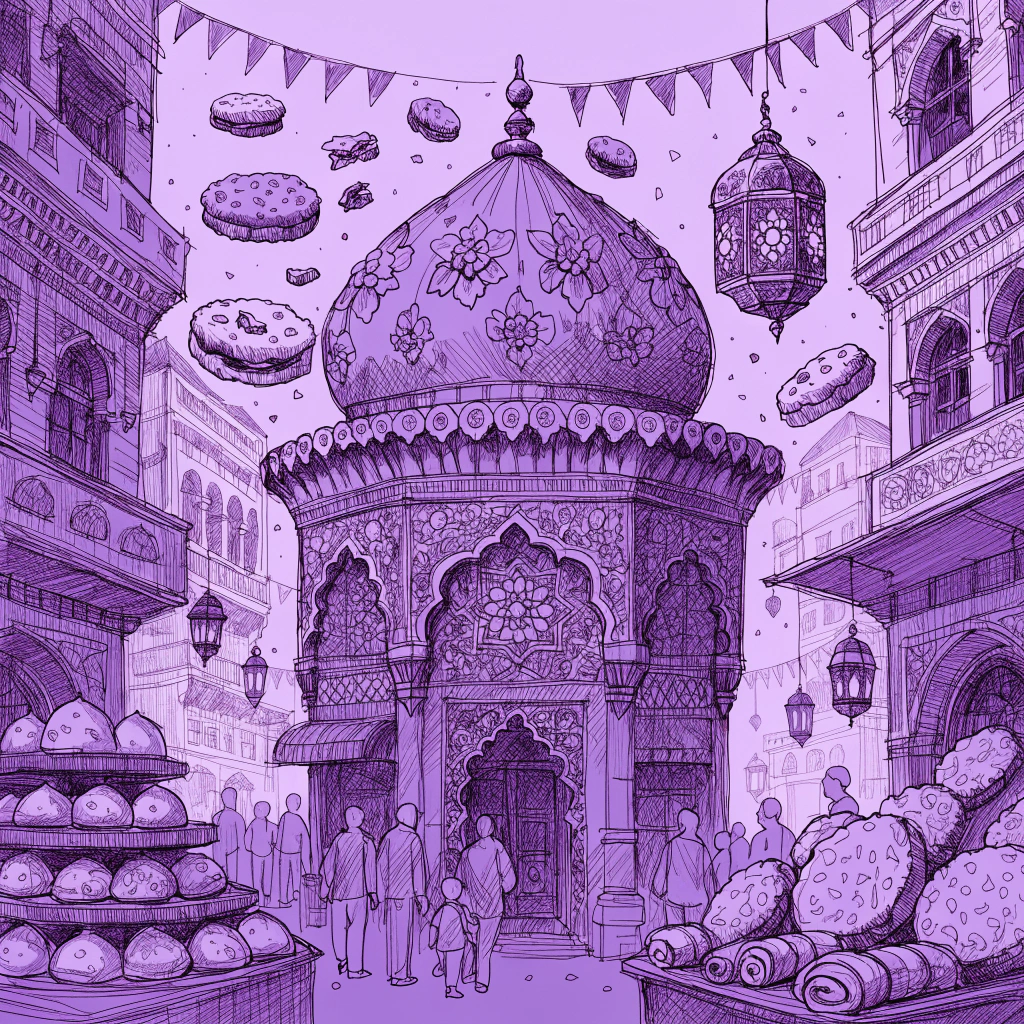
Eid al-Fitr in Egypt
Eid al-Fitr is a happy time in Egypt. It comes after Ramadan. People wake up early in the morning. They wear new clothes. Families go to the mosque to pray. After the prayer, children get money from their parents. This money is called Eidiya.
Families eat special cookies called Kahk. These cookies are very sweet. People visit their friends and relatives. They say Eid Mubarak to everyone. The streets are busy and beautiful. It is a great celebration for everyone.
Point grammaire
Structure: Present Simple (to be)
"Eid al-Fitr is a happy time in Egypt."
We use 'is' with singular subjects to describe facts. It shows a state or condition that is true now.
Structure: Plural Nouns
"Families eat special cookies called Kahk."
We add '-s' or '-ies' to nouns to show there is more than one. For example, 'family' becomes 'families' and 'cookie' becomes 'cookies'.
Teste ta compréhension
10 questions · A1 Débutant · 1 aperçu gratuit
Teste ce que tu as appris dans cet article. Réponds à toutes les questions pour gagner des XP !
When does Eid al-Fitr happen?
Tu veux terminer le quiz ?
9 questions supplémentaires t'attendent. Inscris-toi gratuitement pour débloquer le quiz complet et gagner des XP !
S'inscrire gratuitementTu as dj un compte ? Connexion
Bien joué !
Continue à pratiquer !
Déjà terminé — pas de XP supplémentaire
Inscris-toi pour gagner des XPDétail des questions
When does Eid al-Fitr happen?
Ta réponse:
Bonne réponse: After Ramadan
People wear old clothes on Eid.
Ta réponse:
Bonne réponse: Faux
What are cookies?
Ta réponse:
Bonne réponse: Small, sweet cakes
Children get _____ from their parents.
Ta réponse:
Bonne réponse: money
A Joyous Eid al-Fitr in Egypt
Eid al-Fitr is a very special time in Egypt. Last year, the celebration was wonderful. It started after the holy month of Ramadan. During Ramadan, people fasted from sunrise to sunset, but they were happy when Eid arrived.
Before the holiday, the streets were busier than usual. Many families went to the shops because they wanted to buy new clothes. They also made delicious cookies called Kahk. These cookies are very popular in Egypt.
On the first day of Eid, people woke up early for the morning prayer. Everyone wore their new clothes and went to the mosque. After the prayer, families visited their relatives. Children were very happy because they received money and gifts. They went to the park and played with their friends. The atmosphere was more colorful than a normal day. It was a time for love and joy for everyone.
Point grammaire
Structure: Past Simple
"Many families went to the shops because they wanted to buy new clothes."
The past simple is used for completed actions in the past. Regular verbs add '-ed', while irregular verbs like 'go' change to 'went'.
Structure: Comparatives
"The streets were busier than usual."
We use comparatives to compare two things. For short adjectives ending in 'y', we change 'y' to 'i' and add '-er' plus the word 'than'.
Teste ta compréhension
11 questions · A2 mentaire · 1 aperçu gratuit
Teste ce que tu as appris dans cet article. Réponds à toutes les questions pour gagner des XP !
What did families buy before the holiday?
Tu veux terminer le quiz ?
10 questions supplémentaires t'attendent. Inscris-toi gratuitement pour débloquer le quiz complet et gagner des XP !
S'inscrire gratuitementTu as dj un compte ? Connexion
Bien joué !
Continue à pratiquer !
Déjà terminé — pas de XP supplémentaire
Inscris-toi pour gagner des XPDétail des questions
What did families buy before the holiday?
Ta réponse:
Bonne réponse: New clothes
People fasted during the days of Eid al-Fitr.
Ta réponse:
Bonne réponse: Faux
What does 'delicious' mean?
Ta réponse:
Bonne réponse: Very tasty
People went to the _____ for the morning prayer.
Ta réponse:
Bonne réponse: mosque
Why were the children happy?
Ta réponse:
Bonne réponse: Because they received money and gifts
Celebrating Eid al-Fitr in the Heart of Egypt
Eid al-Fitr is one of the most exciting festivals in Egypt. It marks the end of Ramadan, which is the month of fasting. When the new moon has been sighted, the celebration officially begins. This period is known for its happiness, spiritual gratitude, and strong social connections.
Before the holiday starts, the streets of Cairo and other cities are filled with energy. Many shops have stayed open until the early morning because families need to buy new clothes for their children. These new outfits are an important part of the tradition. Additionally, special cookies called Kahk are prepared by families or bought from local bakeries. These delicious treats, which are filled with nuts or honey, are shared with neighbors and friends.
On the first morning of Eid, the sound of prayer can be heard from every mosque. Thousands of people gather in large open spaces to pray together. After the prayer, the atmosphere becomes very festive. Children are often given 'Eidiya,' which is a small amount of money from older relatives. This money is usually spent on toys, sweets, or trips to the cinema.
During the three-day holiday, many public parks and the banks of the Nile are visited by families who want to enjoy the fresh air. People have celebrated this way for generations, and the sense of community is very strong. It is a time when old arguments are forgotten and kindness is shown to everyone. Eid al-Fitr is truly a beautiful season that brings all Egyptians together.
Point grammaire
Structure: Passive Voice
"Special cookies called Kahk are prepared by families or bought from local bakeries."
The passive voice is used when the action is more important than the person doing it. It is formed using the verb 'to be' and the past participle of the main verb.
Structure: Relative Clauses
"These delicious treats, which are filled with nuts or honey, are shared with neighbors and friends."
Relative clauses give extra information about a noun. We use 'which' for things or animals and 'who' for people.
Teste ta compréhension
11 questions · B1 Intermédiaire · 1 aperçu gratuit
Teste ce que tu as appris dans cet article. Réponds à toutes les questions pour gagner des XP !
What signals the official start of Eid al-Fitr?
Tu veux terminer le quiz ?
10 questions supplémentaires t'attendent. Inscris-toi gratuitement pour débloquer le quiz complet et gagner des XP !
S'inscrire gratuitementTu as dj un compte ? Connexion
Bien joué !
Continue à pratiquer !
Déjà terminé — pas de XP supplémentaire
Inscris-toi pour gagner des XPDétail des questions
What signals the official start of Eid al-Fitr?
Ta réponse:
Bonne réponse: The sighting of the new moon
Shops in Egypt close very early in the days leading up to Eid.
Ta réponse:
Bonne réponse: Faux
What does the word 'traditional' mean in the context of the article?
Ta réponse:
Bonne réponse: Following customs from the past
Children are often given a small amount of money called _____
Ta réponse:
Bonne réponse: Eidiya
Where do many families go to enjoy the fresh air during the holiday?
Ta réponse:
Bonne réponse: To public parks and the Nile
Beyond the Fast: The Cultural and Social Fabric of Eid al-Fitr in Egypt
As the holy month of Ramadan draws to a conclusion, Egypt undergoes a remarkable transformation. The transition from the spiritual discipline of fasting to the vibrant celebrations of Eid al-Fitr is not merely a change in schedule, but a profound cultural shift that has been observed for centuries. This festival, known as the 'Small Eid,' signifies the successful completion of a rigorous month of reflection and self-restraint.
In the days preceding the festival, a sense of frantic anticipation permeates the air. The streets of Cairo and other major cities are bustling with activity as shops remain open until the early hours of the morning. Families are seen purchasing new clothes, a tradition that symbolizes a fresh start and prosperity. This economic surge is a testament to the importance of the holiday within the Egyptian socio-economic framework. Furthermore, the preparation of 'Kahk'—traditional powdered sugar cookies—is a communal activity that reinforces bonds between neighbors and relatives.
The first day of Eid commences with the early morning prayer, known as Salat al-Eid. Thousands of worshippers, dressed in their finest attire, gather in large open-air squares and historic mosques, creating a powerful image of social cohesion. This collective act of worship is often followed by heartfelt greetings where strangers embrace, wishing each other 'Eid Mubarak.' Following the prayer, the atmosphere shifts toward domestic celebration. Children are often gifted 'Eidiya,' a small sum of money given by elder relatives, which adds to the excitement of the day. This practice not only brings joy to the younger generation but also emphasizes the values of generosity and family hierarchy that are deeply embedded in Egyptian culture.
From an analytical perspective, Eid al-Fitr serves as a psychological release after a month of fasting. It provides a structured opportunity for individuals to reconnect with their communities and celebrate their spiritual achievements through shared meals and public outings. While the ways in which people celebrate may have evolved with modernization, the core values of gratitude and unity remain prevalent throughout the country. Public parks and the Nile corniche become focal points for families seeking to enjoy the outdoors, illustrating the public nature of Egyptian festivities. In conclusion, Eid al-Fitr in Egypt is much more than a religious holiday; it is a complex tapestry of tradition, social interaction, and economic activity. By maintaining these customs, Egyptian society ensures that its cultural identity remains robust in an ever-changing world.
Point grammaire
Structure: Present Perfect Passive
"The transition... is not merely a change in schedule, but a profound cultural shift that has been observed for centuries."
This is used to describe an action that started in the past and continues to be true, where the focus is on the action rather than who performed it. It is formed using 'has/have been' + past participle.
Structure: Non-defining Relative Clause
"Children are often gifted 'Eidiya,' a small sum of money given by elder relatives, which adds to the excitement of the day."
This structure provides extra information about a noun phrase. It is separated by a comma and uses 'which' to refer back to the entire previous idea or a specific noun.
Structure: Gerunds as Objects of Prepositions
"By maintaining these customs, Egyptian society ensures that its cultural identity remains robust."
When a verb follows a preposition like 'by', 'in', or 'after', it must take the -ing form (gerund). This often explains the method or time of an action.
Teste ta compréhension
11 questions · B2 Intermédiaire supérieur · 1 aperçu gratuit
Teste ce que tu as appris dans cet article. Réponds à toutes les questions pour gagner des XP !
What does the author suggest about the economic aspect of Eid in Egypt?
Tu veux terminer le quiz ?
10 questions supplémentaires t'attendent. Inscris-toi gratuitement pour débloquer le quiz complet et gagner des XP !
S'inscrire gratuitementTu as dj un compte ? Connexion
Bien joué !
Continue à pratiquer !
Déjà terminé — pas de XP supplémentaire
Inscris-toi pour gagner des XPDétail des questions
What does the author suggest about the economic aspect of Eid in Egypt?
Ta réponse:
Bonne réponse: It serves as a testament to the holiday's importance.
The preparation of 'Kahk' is described as an individual activity performed in secret.
Ta réponse:
Bonne réponse: Faux
What does the word 'cohesion' mean in the context of the article?
Ta réponse:
Bonne réponse: The act of being united as a whole.
The article states that the holiday signifies the completion of a _____ month of reflection.
Ta réponse:
Bonne réponse: rigorous
According to the text, what is the 'Eidiya'?
Ta réponse:
Bonne réponse: A monetary gift given to children.
L'Aïd al-Fitr en Égypte : Une Symphonie de Joie et de Dévotion
L'Aïd al-Fitr, communément appelé la "Petite Fête", marque avec faste la fin du jeûne du Ramadan, un mois de piété et de réflexion intense pour les musulmans du monde entier. En Égypte, cependant, cette célébration transcende sa dimension purement religieuse pour s'ériger en un véritable pilier culturel, une période où l'effervescence et l'allégresse collective atteignent leur paroxysme. Ce n'est pas simplement un jour férié ; c'est une symphonie de rituels ancestraux, de rassemblements familiaux chaleureux et d'une générosité contagieuse qui imprègne chaque foyer, chaque rue, du Caire grouillant à la plus humble des bourgades.
Les jours précédant l'Aïd sont caractérisés par une frénésie palpable. À peine le croissant de lune annonciateur du mois de Chawwal est-il aperçu que la nation entière se mue en un vaste atelier de préparatifs. Les marchés, d'ordinaire déjà animés, battent leur plein jusqu'aux petites heures du matin. C'est l'occasion ou jamais pour les familles d'acquérir de nouveaux vêtements, la fameuse "tenue de l'Aïd", symbole de renouveau et de pureté. Les confiseries traditionnelles, telles que les "Kahk al-Eid" – de délicieux biscuits sablés farcis de dattes, de noix ou de loukoum et généreusement saupoudrés de sucre glace – sont préparées en quantités astronomiques, souvent en famille, renforçant les liens intergénérationnels. Cette période est également propice à la "Zakat al-Fitr", une aumône obligatoire visant à s'assurer que même les plus démunis puissent célébrer dignement.
Le matin de l'Aïd, une atmosphère de solennité et de joie mêlées enveloppe le pays. Des milliers de fidèles, revêtus de leurs plus beaux atours, affluent vers les mosquées et les grands espaces ouverts pour la prière spéciale de l'Aïd. Ce rassemblement public, empreint d'une profonde dévotion, est un moment fort de communion. C'est après cette prière que les festivités profanes prennent toute leur ampleur. Les familles se réunissent, souvent autour d'un festin somptueux où les plats traditionnels égyptiens rivalisent de saveurs. Les aînés distribuent l'« Eidiya », de petites sommes d'argent, aux enfants, pour leur plus grand plaisir, perpétuant ainsi une tradition chère qui symbolise la bénédiction et la prospérité.
Ce qui frappe le plus lors de l'Aïd en Égypte, c'est l'ubiquité de la joie et la prééminence des liens sociaux. Loin de n'être qu'une simple commémoration religieuse, l'Aïd est une ode à la famille, à l'amitié et à la communauté. On rend visite aux parents, aux amis, aux voisins, et même aux connaissances lointaines. Les portes sont ouvertes, les maisons sont emplies de rires et de conversations animées. La générosité est de mise, qu'il s'agisse de partager un repas, d'offrir des douceurs ou simplement d'échanger des vœux. Il est essentiel que ces moments de partage ne soient pas perçus comme une obligation, mais comme une expression naturelle de gratitude et d'appartenance.
Bien que la modernité ait apporté son lot de changements, l'essence de l'Aïd al-Fitr en Égypte demeure inaltérée. C'est une période où le passé et le présent se rencontrent harmonieusement, où les traditions séculaires sont chéries et transmises avec ferveur. L'Aïd est, en définitive, bien plus qu'une fête ; c'est le reflet de l'âme égyptienne, de sa résilience, de sa convivialité et de sa capacité à trouver la joie même dans les circonstances les plus simples. C'est une célébration de la vie, de la foi et de l'unité qui, année après année, continue de tisser la riche tapisserie culturelle du pays.
Point grammaire
Structure: Inversion après adverbe de temps (À peine... est-il)
"À peine le croissant de lune annonciateur du mois de Chawwal est-il aperçu que la nation entière se mue en un vaste atelier de préparatifs."
Cette structure, souvent introduite par des adverbes comme "à peine", "non seulement", "peut-être", inverse le sujet et le verbe pour créer un effet stylistique ou pour marquer une concomitance ou une conséquence immédiate. Elle est typique du registre soutenu.
Structure: Phrase clivée (C'est... qui/que)
"C'est l'occasion ou jamais pour les familles d'acquérir de nouveaux vêtements..."
Les phrases clivées (ou "cleft sentences") sont utilisées pour mettre en emphase un élément particulier de la phrase. "C'est... qui" met en valeur le sujet, tandis que "C'est... que" met en valeur un complément. Elles permettent de focaliser l'attention du lecteur.
Structure: Nominalisation
"Ce rassemblement public, empreint d'une profonde dévotion, est un moment fort de communion."
La nominalisation consiste à transformer un verbe ou un adjectif en nom. Elle rend le style plus concis et plus formel, permettant d'exprimer des idées complexes de manière plus abstraite et synthétique, caractéristique du niveau C1.
Teste ta compréhension
12 questions · C1 Avancé · 1 aperçu gratuit
Teste ce que tu as appris dans cet article. Réponds à toutes les questions pour gagner des XP !
Quelle est l'une des caractéristiques principales des jours précédant l'Aïd al-Fitr en Égypte?
Tu veux terminer le quiz ?
11 questions supplémentaires t'attendent. Inscris-toi gratuitement pour débloquer le quiz complet et gagner des XP !
S'inscrire gratuitementTu as dj un compte ? Connexion
Bien joué !
Continue à pratiquer !
Déjà terminé — pas de XP supplémentaire
Inscris-toi pour gagner des XPDétail des questions
Quelle est l'une des caractéristiques principales des jours précédant l'Aïd al-Fitr en Égypte?
Ta réponse:
Bonne réponse: Une frénésie de préparatifs et d'achats
L'« Eidiya » est une tradition où les enfants offrent de l'argent aux aînés.
Ta réponse:
Bonne réponse: Faux
Que signifie le mot "paroxysme" dans le contexte de l'article ?
Ta réponse:
Bonne réponse: Le point culminant d'une émotion
L'Aïd al-Fitr marque avec ______ la fin du jeûne du Ramadan.
Ta réponse:
Bonne réponse: faste
Quelle est la fonction principale de la "Zakat al-Fitr" mentionnée dans l'article?
Ta réponse:
Bonne réponse: Assurer que les plus démunis puissent célébrer
L'Aïd en Égypte est considéré comme une célébration purement religieuse, sans dimension culturelle.
Ta réponse:
Bonne réponse: Faux
The Liminality of Celebration: An Analytical Perspective on Eid al-Fitr in the Egyptian Context
The transition from the ascetic rigors of Ramadan to the exuberant festivities of Eid al-Fitr in Egypt represents a profound psychological and spiritual interregnum. It is not merely a cessation of fasting, but a complex socio-cultural phenomenon that interrogates the boundaries between the sacred and the profane. As the month of Shawwal commences, the Egyptian landscape undergoes a metamorphosis, characterized by a sensory cacophony that belies the quietude of the preceding month. It is imperative that the crescent moon be sighted with precision, for this celestial verification serves as the catalyst for a nationwide catharsis. Should one venture into the bustling markets of Cairo in the penultimate days of the fast, one would encounter a sartorial frenzy, as families navigate the labyrinthine alleys to procure the traditional 'Eid outfit,' a symbolic shedding of the old self.
Central to this period is the egalitarian spirit manifest in the communal dawn prayer. Seldom do the streets of Cairo witness such a poignant manifestation of collective identity as when thousands congregate in open-air musallas, their voices rising in a resonant unison of takbirat. This ritual serves as a cultural bedrock, reinforcing social cohesion across disparate economic strata. It might be argued that the modern iteration of Eid is increasingly susceptible to the encroaching forces of globalization; however, the persistent adherence to ancestral customs suggests a resilience of heritage. Not until the final echoes of the prayer have faded do the more hedonistic aspects of the holiday truly begin, shifting the focus from spiritual introspection to communal indulgence.
Gastronomy plays a pivotal role in this transition, most notably through the consumption of Kahk. These ornate cookies, often stuffed with agwa or malban, are more than mere confectionery; they are vestiges of Pharaonic and Fatimid legacies, meticulously preserved through generations. The preparation of Kahk often involves a communal effort among neighbors, further cementing the bonds of the 'hara' or neighborhood. While some scholars posit that the commercialization of these treats threatens their traditional significance, the emotional resonance they hold for the Egyptian populace remains indefatigable.
Furthermore, the holiday facilitates a unique urban-rural flux. The 'Eid homecoming' sees a significant portion of the urban workforce return to their ancestral villages, a migration that underscores the enduring importance of the extended family unit. This movement highlights the liminality of the Egyptian identity—perpetually caught between the rapid pace of metropolitan modernization and the steadfast traditions of the rural heartland. In conclusion, Eid al-Fitr in Egypt is an ephemeral yet essential period that allows for a collective re-calibration of the spirit, balancing the weight of religious obligation with the lightness of social celebration.
Point grammaire
Structure: The Present Subjunctive
"It is imperative that the crescent moon be sighted with precision..."
Used after verbs or adjectives of necessity or requirement. It uses the base form of the verb (be) regardless of the subject.
Structure: Negative Inversion
"Seldom do the streets of Cairo witness such a poignant manifestation of collective identity..."
When a sentence starts with a negative or restrictive adverb like 'seldom', the auxiliary verb comes before the subject for dramatic emphasis.
Structure: Inverted First Conditional (Should)
"Should one venture into the bustling markets of Cairo in the penultimate days of the fast..."
This replaces 'If one should venture' to sound more formal and academic. It describes a possible but less certain situation.
Teste ta compréhension
12 questions · C2 Maîtrise · 1 aperçu gratuit
Teste ce que tu as appris dans cet article. Réponds à toutes les questions pour gagner des XP !
What does the author suggest about the relationship between modern Eid and globalization?
Tu veux terminer le quiz ?
11 questions supplémentaires t'attendent. Inscris-toi gratuitement pour débloquer le quiz complet et gagner des XP !
S'inscrire gratuitementTu as dj un compte ? Connexion
Bien joué !
Continue à pratiquer !
Déjà terminé — pas de XP supplémentaire
Inscris-toi pour gagner des XPDétail des questions
What does the author suggest about the relationship between modern Eid and globalization?
Ta réponse:
Bonne réponse: Cultural heritage has shown resilience despite globalizing influences.
The author characterizes the transition from Ramadan to Eid as a purely economic shift.
Ta réponse:
Bonne réponse: Faux
Which word describes the 'trace of something disappearing'?
Ta réponse:
Bonne réponse: Vestiges
The preparation of Kahk is described as a _____ effort among neighbors.
Ta réponse:
Bonne réponse: communal
According to the text, what is the significance of the 'Eid outfit'?
Ta réponse:
Bonne réponse: It represents a symbolic shedding of the old self.
The text states that the dawn prayer serves to reinforce social cohesion.
Ta réponse:
Bonne réponse: Vrai

