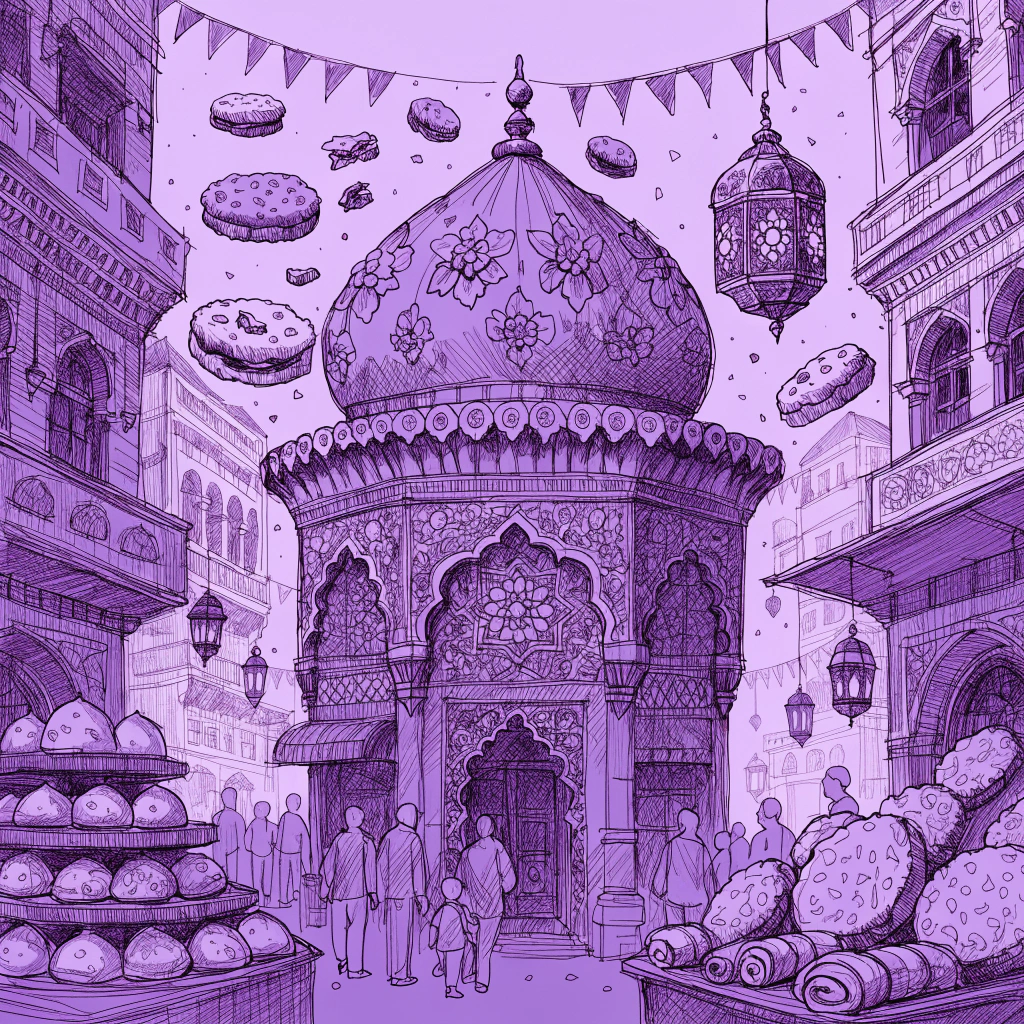
Eid al-Fitr in Egypt
Eid al-Fitr is a happy time in Egypt. It comes after Ramadan. People wake up early in the morning. They wear new clothes. Families go to the mosque to pray. After the prayer, children get money from their parents. This money is called Eidiya.
Families eat special cookies called Kahk. These cookies are very sweet. People visit their friends and relatives. They say Eid Mubarak to everyone. The streets are busy and beautiful. It is a great celebration for everyone.
Grammar Spotlight
Pattern: Present Simple (to be)
"Eid al-Fitr is a happy time in Egypt."
We use 'is' with singular subjects to describe facts. It shows a state or condition that is true now.
Pattern: Plural Nouns
"Families eat special cookies called Kahk."
We add '-s' or '-ies' to nouns to show there is more than one. For example, 'family' becomes 'families' and 'cookie' becomes 'cookies'.
Test Your Understanding
10 questions · A1 Beginner · 1 free preview
Test what you learned from this article. Answer all questions to earn XP!
When does Eid al-Fitr happen?
Want to finish the quiz?
9 more questions are waiting for you. Sign up free to unlock the full quiz and earn XP!
Sign Up FreeAlready have an account? Sign In
Question Breakdown
When does Eid al-Fitr happen?
Your answer:
Correct answer: After Ramadan
People wear old clothes on Eid.
Your answer:
Correct answer: False
What are cookies?
Your answer:
Correct answer: Small, sweet cakes
Children get _____ from their parents.
Your answer:
Correct answer: money
A Joyous Eid al-Fitr in Egypt
Eid al-Fitr is a very special time in Egypt. Last year, the celebration was wonderful. It started after the holy month of Ramadan. During Ramadan, people fasted from sunrise to sunset, but they were happy when Eid arrived.
Before the holiday, the streets were busier than usual. Many families went to the shops because they wanted to buy new clothes. They also made delicious cookies called Kahk. These cookies are very popular in Egypt.
On the first day of Eid, people woke up early for the morning prayer. Everyone wore their new clothes and went to the mosque. After the prayer, families visited their relatives. Children were very happy because they received money and gifts. They went to the park and played with their friends. The atmosphere was more colorful than a normal day. It was a time for love and joy for everyone.
Grammar Spotlight
Pattern: Past Simple
"Many families went to the shops because they wanted to buy new clothes."
The past simple is used for completed actions in the past. Regular verbs add '-ed', while irregular verbs like 'go' change to 'went'.
Pattern: Comparatives
"The streets were busier than usual."
We use comparatives to compare two things. For short adjectives ending in 'y', we change 'y' to 'i' and add '-er' plus the word 'than'.
Test Your Understanding
11 questions · A2 Elementary · 1 free preview
Test what you learned from this article. Answer all questions to earn XP!
What did families buy before the holiday?
Want to finish the quiz?
10 more questions are waiting for you. Sign up free to unlock the full quiz and earn XP!
Sign Up FreeAlready have an account? Sign In
Question Breakdown
What did families buy before the holiday?
Your answer:
Correct answer: New clothes
People fasted during the days of Eid al-Fitr.
Your answer:
Correct answer: False
What does 'delicious' mean?
Your answer:
Correct answer: Very tasty
People went to the _____ for the morning prayer.
Your answer:
Correct answer: mosque
Why were the children happy?
Your answer:
Correct answer: Because they received money and gifts
Celebrating Eid al-Fitr in the Heart of Egypt
Eid al-Fitr is one of the most exciting festivals in Egypt. It marks the end of Ramadan, which is the month of fasting. When the new moon has been sighted, the celebration officially begins. This period is known for its happiness, spiritual gratitude, and strong social connections.
Before the holiday starts, the streets of Cairo and other cities are filled with energy. Many shops have stayed open until the early morning because families need to buy new clothes for their children. These new outfits are an important part of the tradition. Additionally, special cookies called Kahk are prepared by families or bought from local bakeries. These delicious treats, which are filled with nuts or honey, are shared with neighbors and friends.
On the first morning of Eid, the sound of prayer can be heard from every mosque. Thousands of people gather in large open spaces to pray together. After the prayer, the atmosphere becomes very festive. Children are often given 'Eidiya,' which is a small amount of money from older relatives. This money is usually spent on toys, sweets, or trips to the cinema.
During the three-day holiday, many public parks and the banks of the Nile are visited by families who want to enjoy the fresh air. People have celebrated this way for generations, and the sense of community is very strong. It is a time when old arguments are forgotten and kindness is shown to everyone. Eid al-Fitr is truly a beautiful season that brings all Egyptians together.
Grammar Spotlight
Pattern: Passive Voice
"Special cookies called Kahk are prepared by families or bought from local bakeries."
The passive voice is used when the action is more important than the person doing it. It is formed using the verb 'to be' and the past participle of the main verb.
Pattern: Relative Clauses
"These delicious treats, which are filled with nuts or honey, are shared with neighbors and friends."
Relative clauses give extra information about a noun. We use 'which' for things or animals and 'who' for people.
Test Your Understanding
11 questions · B1 Intermediate · 1 free preview
Test what you learned from this article. Answer all questions to earn XP!
What signals the official start of Eid al-Fitr?
Want to finish the quiz?
10 more questions are waiting for you. Sign up free to unlock the full quiz and earn XP!
Sign Up FreeAlready have an account? Sign In
Question Breakdown
What signals the official start of Eid al-Fitr?
Your answer:
Correct answer: The sighting of the new moon
Shops in Egypt close very early in the days leading up to Eid.
Your answer:
Correct answer: False
What does the word 'traditional' mean in the context of the article?
Your answer:
Correct answer: Following customs from the past
Children are often given a small amount of money called _____
Your answer:
Correct answer: Eidiya
Where do many families go to enjoy the fresh air during the holiday?
Your answer:
Correct answer: To public parks and the Nile
Beyond the Fast: The Cultural and Social Fabric of Eid al-Fitr in Egypt
As the holy month of Ramadan draws to a conclusion, Egypt undergoes a remarkable transformation. The transition from the spiritual discipline of fasting to the vibrant celebrations of Eid al-Fitr is not merely a change in schedule, but a profound cultural shift that has been observed for centuries. This festival, known as the 'Small Eid,' signifies the successful completion of a rigorous month of reflection and self-restraint.
In the days preceding the festival, a sense of frantic anticipation permeates the air. The streets of Cairo and other major cities are bustling with activity as shops remain open until the early hours of the morning. Families are seen purchasing new clothes, a tradition that symbolizes a fresh start and prosperity. This economic surge is a testament to the importance of the holiday within the Egyptian socio-economic framework. Furthermore, the preparation of 'Kahk'—traditional powdered sugar cookies—is a communal activity that reinforces bonds between neighbors and relatives.
The first day of Eid commences with the early morning prayer, known as Salat al-Eid. Thousands of worshippers, dressed in their finest attire, gather in large open-air squares and historic mosques, creating a powerful image of social cohesion. This collective act of worship is often followed by heartfelt greetings where strangers embrace, wishing each other 'Eid Mubarak.' Following the prayer, the atmosphere shifts toward domestic celebration. Children are often gifted 'Eidiya,' a small sum of money given by elder relatives, which adds to the excitement of the day. This practice not only brings joy to the younger generation but also emphasizes the values of generosity and family hierarchy that are deeply embedded in Egyptian culture.
From an analytical perspective, Eid al-Fitr serves as a psychological release after a month of fasting. It provides a structured opportunity for individuals to reconnect with their communities and celebrate their spiritual achievements through shared meals and public outings. While the ways in which people celebrate may have evolved with modernization, the core values of gratitude and unity remain prevalent throughout the country. Public parks and the Nile corniche become focal points for families seeking to enjoy the outdoors, illustrating the public nature of Egyptian festivities. In conclusion, Eid al-Fitr in Egypt is much more than a religious holiday; it is a complex tapestry of tradition, social interaction, and economic activity. By maintaining these customs, Egyptian society ensures that its cultural identity remains robust in an ever-changing world.
Grammar Spotlight
Pattern: Present Perfect Passive
"The transition... is not merely a change in schedule, but a profound cultural shift that has been observed for centuries."
This is used to describe an action that started in the past and continues to be true, where the focus is on the action rather than who performed it. It is formed using 'has/have been' + past participle.
Pattern: Non-defining Relative Clause
"Children are often gifted 'Eidiya,' a small sum of money given by elder relatives, which adds to the excitement of the day."
This structure provides extra information about a noun phrase. It is separated by a comma and uses 'which' to refer back to the entire previous idea or a specific noun.
Pattern: Gerunds as Objects of Prepositions
"By maintaining these customs, Egyptian society ensures that its cultural identity remains robust."
When a verb follows a preposition like 'by', 'in', or 'after', it must take the -ing form (gerund). This often explains the method or time of an action.
Test Your Understanding
11 questions · B2 Upper Intermediate · 1 free preview
Test what you learned from this article. Answer all questions to earn XP!
What does the author suggest about the economic aspect of Eid in Egypt?
Want to finish the quiz?
10 more questions are waiting for you. Sign up free to unlock the full quiz and earn XP!
Sign Up FreeAlready have an account? Sign In
Question Breakdown
What does the author suggest about the economic aspect of Eid in Egypt?
Your answer:
Correct answer: It serves as a testament to the holiday's importance.
The preparation of 'Kahk' is described as an individual activity performed in secret.
Your answer:
Correct answer: False
What does the word 'cohesion' mean in the context of the article?
Your answer:
Correct answer: The act of being united as a whole.
The article states that the holiday signifies the completion of a _____ month of reflection.
Your answer:
Correct answer: rigorous
According to the text, what is the 'Eidiya'?
Your answer:
Correct answer: A monetary gift given to children.
Beyond the Fast: The Socio-Cultural Tapestry of Eid al-Fitr in Contemporary Egypt
Rarely does a transition in the lunar calendar evoke such a profound metamorphosis in the Egyptian collective consciousness as the arrival of Eid al-Fitr. Marking the culmination of Ramadan’s month-long period of introspection and dawn-to-sunset fasting, Eid is far more than a mere religious observance; it is a complex socio-economic phenomenon that permeates every stratum of society. The sighting of the Shawwal moon acts as a catalyst, shifting the national psyche from the solemnity of spiritual discipline to a jubilant embrace of communal life.
In the lead-up to the holiday, the urban landscape of Cairo and other major cities undergoes a striking transformation. It is the pursuit of 'Eid outfits' and festive delicacies that drives the nocturnal economy, with shops remaining vibrant until the early hours of the morning. This commercial frenzy, however, is ostensibly about more than consumerism. It represents a collective desire to start anew, a physical manifestation of the spiritual cleansing achieved during the preceding month. Not only do families invest significant resources into these preparations, but they also engage in the meticulous cleaning of homes, reinforcing the notion of a 'fresh start' that is central to the holiday’s ethos.
Central to the Egyptian experience of Eid is the consumption of Kahk—traditional powdered sugar-dusted cookies. The preparation of these treats often involves a communal effort, where neighbors and extended family members gather to knead dough and press intricate patterns into the pastry. This practice serves as a vital vestige of historical continuity, bridging the gap between the ancient past and the digital present. While the proliferation of mass-produced alternatives has threatened this tradition, the artisanal preparation of Kahk remains a bastion of cultural identity. The act of sharing these sweets is a gesture of reciprocity that helps to alleviate social tensions and reinforce the bonds of kinship.
On the morning of the first day, the atmosphere is charged with a unique spiritual energy. Mosques and public squares overflow with worshippers for the Eid prayer. Such is the scale of the gathering that the very architecture of the city seems to expand to accommodate the sea of believers. Following the prayer, the focus shifts to the 'Eidiyat'—the tradition of gifting money to children. While some critics argue that this practice encourages materialism, others maintain that it fosters a sense of financial autonomy and joy in the younger generation.
However, contemporary Eid is not without its challenges. The increasing urbanization and the rise of digital connectivity have led to a nuanced shift in how the holiday is celebrated. What was once a series of mandatory physical visits is increasingly being replaced by digital greetings, leading to debates regarding the erosion of traditional social fabric. Furthermore, the economic pressures facing many Egyptian households have necessitated a more pragmatic approach to the festivities. Despite these shifts, the essence of Eid—a celebration of resilience, altruism, and collective joy—remains ubiquitous, proving that while the form of the celebration may evolve, its heart remains steadfastly anchored in the Egyptian soul.
Grammar Spotlight
Pattern: Negative Inversion
"Rarely does a transition in the lunar calendar evoke such a profound metamorphosis in the Egyptian collective consciousness as the arrival of Eid al-Fitr."
When a sentence starts with a negative or restrictive adverbial (like 'rarely', 'never', or 'seldom'), the subject and the auxiliary verb are inverted to add emphasis and formal weight.
Pattern: Cleft Sentences
"It is the pursuit of 'Eid outfits' and festive delicacies that drives the nocturnal economy."
Cleft sentences use the structure 'It is/was + [noun phrase] + that/who...' to focus on a specific piece of information, highlighting the 'pursuit' as the primary cause of the economic activity.
Pattern: Nominalisation
"The proliferation of digital greetings has led to debates regarding the erosion of traditional social fabric."
Nominalisation involves turning verbs or adjectives into nouns (e.g., 'proliferate' to 'proliferation'). This makes the writing more abstract, formal, and concise, which is characteristic of C1 and C2 level academic English.
Test Your Understanding
12 questions · C1 Advanced · 1 free preview
Test what you learned from this article. Answer all questions to earn XP!
What does the author suggest about the commercial preparations for Eid?
Want to finish the quiz?
11 more questions are waiting for you. Sign up free to unlock the full quiz and earn XP!
Sign Up FreeAlready have an account? Sign In
Question Breakdown
What does the author suggest about the commercial preparations for Eid?
Your answer:
Correct answer: They represent a physical extension of spiritual renewal.
The author argues that the tradition of Kahk is entirely lost due to mass-produced alternatives.
Your answer:
Correct answer: False
What does 'reciprocity' mean in the context of the article?
Your answer:
Correct answer: A system of mutual exchange and benefit.
The author notes that despite modernization, the essence of Eid remains _____ in the Egyptian soul.
Your answer:
Correct answer: ubiquitous
Which grammatical feature is used to emphasize the scale of the Eid prayer gatherings?
Your answer:
Correct answer: Metaphorical language about city architecture.
The article suggests that digital greetings are viewed by some as a threat to traditional social bonds.
Your answer:
Correct answer: True
The Liminality of Celebration: An Analytical Perspective on Eid al-Fitr in the Egyptian Context
The transition from the ascetic rigors of Ramadan to the exuberant festivities of Eid al-Fitr in Egypt represents a profound psychological and spiritual interregnum. It is not merely a cessation of fasting, but a complex socio-cultural phenomenon that interrogates the boundaries between the sacred and the profane. As the month of Shawwal commences, the Egyptian landscape undergoes a metamorphosis, characterized by a sensory cacophony that belies the quietude of the preceding month. It is imperative that the crescent moon be sighted with precision, for this celestial verification serves as the catalyst for a nationwide catharsis. Should one venture into the bustling markets of Cairo in the penultimate days of the fast, one would encounter a sartorial frenzy, as families navigate the labyrinthine alleys to procure the traditional 'Eid outfit,' a symbolic shedding of the old self.
Central to this period is the egalitarian spirit manifest in the communal dawn prayer. Seldom do the streets of Cairo witness such a poignant manifestation of collective identity as when thousands congregate in open-air musallas, their voices rising in a resonant unison of takbirat. This ritual serves as a cultural bedrock, reinforcing social cohesion across disparate economic strata. It might be argued that the modern iteration of Eid is increasingly susceptible to the encroaching forces of globalization; however, the persistent adherence to ancestral customs suggests a resilience of heritage. Not until the final echoes of the prayer have faded do the more hedonistic aspects of the holiday truly begin, shifting the focus from spiritual introspection to communal indulgence.
Gastronomy plays a pivotal role in this transition, most notably through the consumption of Kahk. These ornate cookies, often stuffed with agwa or malban, are more than mere confectionery; they are vestiges of Pharaonic and Fatimid legacies, meticulously preserved through generations. The preparation of Kahk often involves a communal effort among neighbors, further cementing the bonds of the 'hara' or neighborhood. While some scholars posit that the commercialization of these treats threatens their traditional significance, the emotional resonance they hold for the Egyptian populace remains indefatigable.
Furthermore, the holiday facilitates a unique urban-rural flux. The 'Eid homecoming' sees a significant portion of the urban workforce return to their ancestral villages, a migration that underscores the enduring importance of the extended family unit. This movement highlights the liminality of the Egyptian identity—perpetually caught between the rapid pace of metropolitan modernization and the steadfast traditions of the rural heartland. In conclusion, Eid al-Fitr in Egypt is an ephemeral yet essential period that allows for a collective re-calibration of the spirit, balancing the weight of religious obligation with the lightness of social celebration.
Grammar Spotlight
Pattern: The Present Subjunctive
"It is imperative that the crescent moon be sighted with precision..."
Used after verbs or adjectives of necessity or requirement. It uses the base form of the verb (be) regardless of the subject.
Pattern: Negative Inversion
"Seldom do the streets of Cairo witness such a poignant manifestation of collective identity..."
When a sentence starts with a negative or restrictive adverb like 'seldom', the auxiliary verb comes before the subject for dramatic emphasis.
Pattern: Inverted First Conditional (Should)
"Should one venture into the bustling markets of Cairo in the penultimate days of the fast..."
This replaces 'If one should venture' to sound more formal and academic. It describes a possible but less certain situation.
Test Your Understanding
12 questions · C2 Mastery · 1 free preview
Test what you learned from this article. Answer all questions to earn XP!
What does the author suggest about the relationship between modern Eid and globalization?
Want to finish the quiz?
11 more questions are waiting for you. Sign up free to unlock the full quiz and earn XP!
Sign Up FreeAlready have an account? Sign In
Question Breakdown
What does the author suggest about the relationship between modern Eid and globalization?
Your answer:
Correct answer: Cultural heritage has shown resilience despite globalizing influences.
The author characterizes the transition from Ramadan to Eid as a purely economic shift.
Your answer:
Correct answer: False
Which word describes the 'trace of something disappearing'?
Your answer:
Correct answer: Vestiges
The preparation of Kahk is described as a _____ effort among neighbors.
Your answer:
Correct answer: communal
According to the text, what is the significance of the 'Eid outfit'?
Your answer:
Correct answer: It represents a symbolic shedding of the old self.
The text states that the dawn prayer serves to reinforce social cohesion.
Your answer:
Correct answer: True
