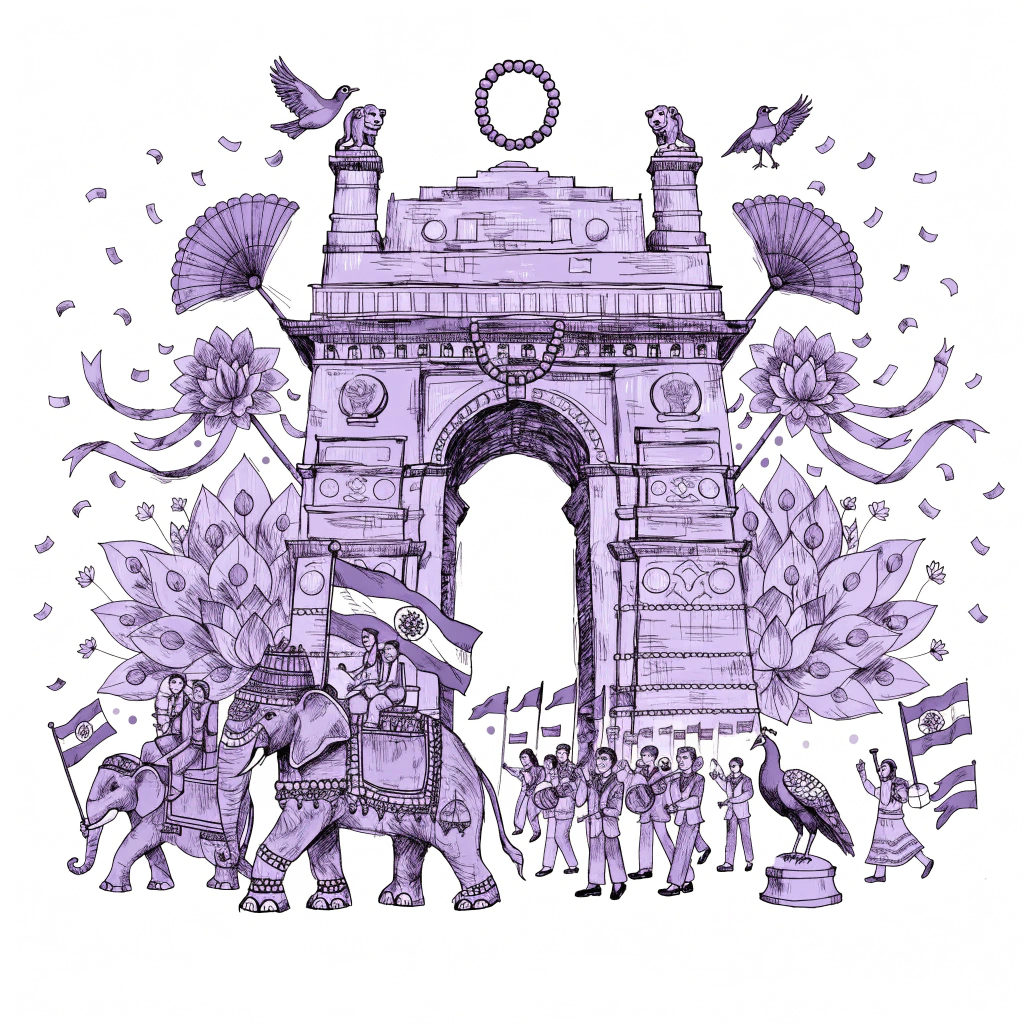
Republic Day in India
Republic Day is a very big holiday in India. It is on January 26th every year. This day is important for all Indian people.
In New Delhi, there is a big parade. The parade has many soldiers and loud music. The President of India watches the parade. There are many colorful groups from different parts of India.
Children wave the Indian flag. They wear beautiful clothes and dance. People sing songs and feel happy. It is a special day to celebrate the country.
Point grammaire
Structure: Present Simple with 'Be'
"Republic Day is a very big holiday in India."
We use 'is' for one thing and 'are' for many things. It helps us talk about facts or describe how things are.
Structure: Present Simple for Plural Subjects
"Children wave the Indian flag."
When the subject is plural (like 'children'), we use the base form of the verb. We use this to talk about actions that happen regularly.
Teste ta compréhension
10 questions · A1 Débutant · 1 aperçu gratuit
Teste ce que tu as appris dans cet article. Réponds à toutes les questions pour gagner des XP !
When is Republic Day in India?
Tu veux terminer le quiz ?
9 questions supplémentaires t'attendent. Inscris-toi gratuitement pour débloquer le quiz complet et gagner des XP !
S'inscrire gratuitementTu as dj un compte ? Connexion
Bien joué !
Continue à pratiquer !
Déjà terminé — pas de XP supplémentaire
Inscris-toi pour gagner des XPDétail des questions
When is Republic Day in India?
Ta réponse:
Bonne réponse: January 26th
There is a big parade in New Delhi.
Ta réponse:
Bonne réponse: Vrai
What is a 'flag'?
Ta réponse:
Bonne réponse: A piece of cloth for a country
Children _____ the Indian flag.
Ta réponse:
Bonne réponse: wave
Celebrating Republic Day in India
Republic Day is a very special day in India. People celebrate it every year on January 26th. India became independent from Britain in 1947, but it did not have its own laws yet. On January 26th, 1950, India started using its new Constitution. This made India a republic.
The biggest celebration is in the capital city, New Delhi. There is a very long parade on a street called Kartavya Path. Thousands of people go there to watch. There are soldiers, beautiful dancers, and school children. There are also many colorful floats from different parts of India. People feel very proud of their country.
Republic Day is a national holiday. Schools and offices are closed. Many people stay at home with their families. They watch the parade on television and eat delicious food. In the evening, many buildings have beautiful lights. It is a day of joy and unity for everyone in India.
Point grammaire
Structure: Les adjectifs superlatifs
"The biggest celebration is in the capital city, New Delhi."
On utilise 'the' + adjectif + '-est' pour comparer une chose à tout un groupe. Cela montre que cette célébration est la numéro un en taille.
Structure: Le Prétérit (Simple Past - Verbes réguliers et irréguliers)
"India started using its new Constitution."
On utilise le prétérit (past simple) pour parler d'actions terminées dans le passé. 'Started' est un verbe régulier (on ajoute -ed), tandis que 'made' et 'became' dans l'article sont irréguliers.
Teste ta compréhension
11 questions · A2 mentaire · 1 aperçu gratuit
Teste ce que tu as appris dans cet article. Réponds à toutes les questions pour gagner des XP !
À quelle date l'Inde célèbre-t-elle le jour de la République ?
Tu veux terminer le quiz ?
10 questions supplémentaires t'attendent. Inscris-toi gratuitement pour débloquer le quiz complet et gagner des XP !
S'inscrire gratuitementTu as dj un compte ? Connexion
Bien joué !
Continue à pratiquer !
Déjà terminé — pas de XP supplémentaire
Inscris-toi pour gagner des XPDétail des questions
À quelle date l'Inde célèbre-t-elle le jour de la République ?
Ta réponse:
Bonne réponse: 26 janvier
L'Inde a commencé à utiliser sa Constitution en 1947.
Ta réponse:
Bonne réponse: Faux
Que signifie 'independent' ?
Ta réponse:
Bonne réponse: Libre du contrôle d'un autre pays
Beaucoup de gens regardent le défilé à la ____.
Ta réponse:
Bonne réponse: television
Où a lieu le plus grand défilé du jour de la République ?
Ta réponse:
Bonne réponse: New Delhi
Republic Day: Celebrating India's Democratic Identity
Republic Day is celebrated every year on January 26th to honor the date when the Constitution of India came into effect. Although India had gained independence from British rule in 1947, it remained a dominion for a few years. Finally, in 1950, India became a sovereign, democratic republic. This transition was a historic moment that defined the nation’s identity.
The main celebration has been held in the capital, New Delhi, every year since the first Republic Day. A massive parade is organized on Rajpath, which starts from the Rashtrapati Bhavan and goes past the India Gate. The President of India, who is the head of state, unfurls the national flag while the national anthem is played. This is a moment of great pride for every citizen, as the flag symbolizes the sacrifices made by freedom fighters.
The parade is a magnificent display of India's military strength and cultural diversity. Different states prepare colorful floats that showcase their unique traditions and achievements. Many people have traveled from far away just to witness this spectacular event. Additionally, school children participate by performing dances and singing patriotic songs. Every year, a foreign leader is invited to be the Chief Guest at the parade, which strengthens international relations.
Republic Day is not just about parades; it is a day to remember the values of justice, liberty, equality, and fraternity. These principles are written in the Preamble of the Constitution. Over the years, India has made significant progress in various fields, and this day serves as a reminder of the journey the nation has taken. The celebrations officially conclude on the evening of January 29th with the Beating Retreat ceremony. It is a time when people reflect on their responsibilities as citizens of a free nation.
Point grammaire
Structure: La voix passive
"A massive parade is organized on Rajpath."
On utilise la voix passive ici parce que l'action (organiser le défilé) est plus importante que la personne qui l'exécute. Elle se forme avec le verbe 'to be' (être) et le participe passé du verbe principal.
Structure: Les propositions relatives explicatives
"The President of India, who is the head of state, unfurls the national flag."
Cette proposition donne des informations supplémentaires sur le Président. Elle est séparée par des virgules et utilise 'who' pour les personnes. Si tu la supprimes, la phrase garde tout son sens.
Teste ta compréhension
11 questions · B1 Intermédiaire · 1 aperçu gratuit
Teste ce que tu as appris dans cet article. Réponds à toutes les questions pour gagner des XP !
En quelle année la Constitution de l'Inde est-elle entrée en vigueur ?
Tu veux terminer le quiz ?
10 questions supplémentaires t'attendent. Inscris-toi gratuitement pour débloquer le quiz complet et gagner des XP !
S'inscrire gratuitementTu as dj un compte ? Connexion
Bien joué !
Continue à pratiquer !
Déjà terminé — pas de XP supplémentaire
Inscris-toi pour gagner des XPDétail des questions
En quelle année la Constitution de l'Inde est-elle entrée en vigueur ?
Ta réponse:
Bonne réponse: 1950
L'Inde est devenue indépendante et une république le même jour en 1947.
Ta réponse:
Bonne réponse: Faux
Que signifie le mot 'sovereign' dans le texte ?
Ta réponse:
Bonne réponse: Indépendant et autonome
Le Président de l'Inde _____ le drapeau national pendant la cérémonie.
Ta réponse:
Bonne réponse: unfurls
Où se déroule le défilé principal de la fête de la République ?
Ta réponse:
Bonne réponse: New Delhi
Beyond Independence: The Significance of India's Republic Day
India's journey toward becoming a fully independent nation was a complex and multi-faceted process that extended far beyond the initial, joyous celebration of independence in 1947. While August 15 marks the definitive end of British colonial rule, it was on January 26, 1950, that the nation truly defined its own internal identity by formally adopting its Constitution. Consequently, Republic Day is not merely a commemoration of a specific date on the calendar, but rather a profound celebration of the democratic values that underpin the world's largest democracy.
Historically, the transition from a colony to a republic was significant. Although India had gained its freedom three years earlier, it initially remained a dominion under the British Crown, maintaining a constitutional link to the monarchy. The drafting of a comprehensive and inclusive constitution, led by the visionary Dr. B.R. Ambedkar, was essential to establish India as a sovereign, socialist, secular, and democratic republic. Interestingly, January 26 was specifically chosen to honor the 1930 declaration of 'Purna Swaraj' (Complete Self-Rule), a bold proclamation that had been a major turning point in the long struggle for liberty.
Today, the festivities in New Delhi are characterized by a grand and prestigious parade along Kartavya Path. This spectacular event showcases India's military prowess through disciplined formations and advanced technology, alongside its rich and vibrant cultural tapestry. Various states and union territories present elaborate tableaus, each illustrating unique traditions, regional achievements, and folklore. Furthermore, the presence of a foreign head of state as the chief guest underscores India's growing diplomatic influence and its strategic partnerships on the global stage.
Nevertheless, the day serves a much deeper purpose than just a public spectacle or a display of strength. It is a solemn time for citizens to reflect on their fundamental constitutional rights and their corresponding duties to the nation. As the President unfurls the national flag and the anthem resonates across the country, the ceremony reminds the population of the sacrifices made by freedom fighters. Having overcome numerous socioeconomic challenges since 1950, India continues to strive toward the lofty ideals of justice, liberty, and equality for all its people. Therefore, Republic Day remains a cornerstone of Indian national identity, bridging the historical gap between a colonial past and a self-determined, modern future.
Point grammaire
Structure: Passive Voice (Past Simple)
"January 26 was specifically chosen to honor the 1930 declaration of 'Purna Swaraj'."
The passive voice is used when the focus is on the action or the object rather than the person doing it. It is formed using the verb 'to be' followed by the past participle.
Structure: Perfect Participle Clause
"Having overcome numerous socioeconomic challenges since 1950, India continues to strive toward the lofty ideals of justice."
This structure is used to show that one action was completed before another action started. It is a formal way to combine two sentences that have the same subject.
Structure: Reduced Relative Clause
"The drafting of a comprehensive and inclusive constitution, led by the visionary Dr. B.R. Ambedkar, was essential..."
This pattern shortens a relative clause (e.g., 'which was led by') by removing the relative pronoun and the verb 'to be'. It makes the writing more concise and sophisticated.
Teste ta compréhension
11 questions · B2 Intermédiaire supérieur · 1 aperçu gratuit
Teste ce que tu as appris dans cet article. Réponds à toutes les questions pour gagner des XP !
What specifically occurred on January 26, 1950, in India?
Tu veux terminer le quiz ?
10 questions supplémentaires t'attendent. Inscris-toi gratuitement pour débloquer le quiz complet et gagner des XP !
S'inscrire gratuitementTu as dj un compte ? Connexion
Bien joué !
Continue à pratiquer !
Déjà terminé — pas de XP supplémentaire
Inscris-toi pour gagner des XPDétail des questions
What specifically occurred on January 26, 1950, in India?
Ta réponse:
Bonne réponse: The formal adoption of the Constitution
India became a sovereign republic immediately upon gaining independence in 1947.
Ta réponse:
Bonne réponse: Faux
What does the word 'sovereign' mean in the context of the article?
Ta réponse:
Bonne réponse: Possessing supreme and independent power
During the Republic Day ceremony, the President _____ the national flag.
Ta réponse:
Bonne réponse: unfurls
Why was the date January 26 specifically selected for Republic Day?
Ta réponse:
Bonne réponse: To honor the 1930 declaration of Complete Self-Rule
Sovereignty Unveiled: The Constitutional Metamorphosis of Modern India
Whilst the strokes of midnight on August 15, 1947, heralded the end of nearly two centuries of British colonial rule, India’s journey toward complete political self-determination was far from over. For three years following independence, the nation remained a dominion, technically acknowledging the British Crown as the ceremonial head of state. It was the adoption of the Constitution on January 26, 1950, that officially severed these final legal vestiges, establishing India as a sovereign, socialist, secular, and democratic republic. This momentous transition is commemorated annually as Republic Day, a date chosen for its historical resonance with the 1930 Purna Swaraj declaration, where the Indian National Congress first articulated the demand for absolute independence.
The meticulous drafting of the Constitution was an intellectual feat of unparalleled proportions, led by Dr. B.R. Ambedkar. Seldom has a legal document attempted to balance such a plethora of linguistic, religious, and socio-economic diversities within a single unified framework. Ambedkar and the drafting committee spent nearly three years refining the text, drawing inspiration from various global models while ensuring local relevance. The Preamble, often described as the 'soul of the Constitution', underscores the collective aspiration for justice, liberty, equality, and fraternity. However, the implementation of these egalitarian ideals remains a complex paradox in a burgeoning democracy grappling with systemic inequities.
Central to the festivities is the grand parade at Kartavya Path in New Delhi. Not only does the parade showcase military prowess through advanced hardware and precision marching, but it also celebrates the diverse cultural tapestry of the subcontinent. The presence of a foreign head of state as the chief guest underscores India's evolving geopolitical stature. The display of 'jhankis', or tableaux, provides a visual narrative of regional achievements, ranging from pioneering technological breakthroughs to indigenous folklore. These displays serve as a reminder of the unity in diversity that the Constitution seeks to protect.
Beyond the pageantry, Republic Day invites critical analysis of India's progress. The severance of colonial ties was merely the inception of a continuous process of nation-building. The burgeoning middle class and the rapid digitalization of the economy stand in stark contrast to the persistent agrarian challenges and educational disparities. To view the Constitution as a static document would be a fallacy; it is a living organism, subject to amendments that reflect the changing ethos of the citizenry. This flexibility has allowed the nation to navigate the tumultuous decades following the transition from a colony to a republic.
In essence, Republic Day is the culmination of a revolutionary dream. It serves as a reminder that sovereignty is not a gift bestowed upon a people, but a responsibility continuously upheld through civic engagement. As the tricolor is unfurled across the nation, it symbolizes a collective commitment to the constitutional values that define the Indian identity in an increasingly fragmented global landscape. The celebration is not merely for the laws written on parchment, but for the democratic spirit that continues to animate the world's largest democracy.
Point grammaire
Structure: Cleft Sentences
"It was the adoption of the Constitution on January 26, 1950, that officially severed these final legal vestiges."
Cleft sentences use 'It + is/was + [emphasized part] + that/who' to focus on specific information. In this context, it emphasizes the exact event that triggered the legal change.
Structure: Inversion with Negative/Restrictive Adverbs
"Seldom has a legal document attempted to balance such a plethora of linguistic, religious, and socio-economic diversities."
When sentences start with restrictive words like 'Seldom' or 'Never', the auxiliary verb comes before the subject. This structure adds a formal, dramatic emphasis to the difficulty of the task.
Structure: Inversion with 'Not only... but also'
"Not only does the parade showcase military prowess through advanced hardware and precision marching, but it also celebrates the diverse cultural tapestry of the subcontinent."
When 'Not only' starts a sentence, the subject and auxiliary verb are inverted. This is a sophisticated way to link two related points while maintaining a formal tone.
Teste ta compréhension
12 questions · C1 Avancé · 1 aperçu gratuit
Teste ce que tu as appris dans cet article. Réponds à toutes les questions pour gagner des XP !
What was the legal status of India between 1947 and 1950?
Tu veux terminer le quiz ?
11 questions supplémentaires t'attendent. Inscris-toi gratuitement pour débloquer le quiz complet et gagner des XP !
S'inscrire gratuitementTu as dj un compte ? Connexion
Bien joué !
Continue à pratiquer !
Déjà terminé — pas de XP supplémentaire
Inscris-toi pour gagner des XPDétail des questions
What was the legal status of India between 1947 and 1950?
Ta réponse:
Bonne réponse: A British dominion
January 26th was chosen for Republic Day because it was the day India gained independence from Britain.
Ta réponse:
Bonne réponse: Faux
Which word describes something that is growing or increasing rapidly?
Ta réponse:
Bonne réponse: Burgeoning
The implementation of these egalitarian ideals remains a complex _____ in a burgeoning democracy.
Ta réponse:
Bonne réponse: paradox
What is the primary function of the 'jhankis' during the parade?
Ta réponse:
Bonne réponse: To showcase regional achievements and folklore
The Indian Constitution is described as a static document that cannot be changed.
Ta réponse:
Bonne réponse: Faux
The Constitutional Odyssey: Evaluating the Metamorphosis of the Indian Republic
While the euphoria of August 15, 1947, marked the culmination of a protracted struggle against British colonial hegemony, it did not, in a strictly legal sense, represent the absolute zenith of Indian self-determination. For nearly three years following the withdrawal of the British Raj, India retained the somewhat paradoxical status of a dominion—a vestigial link to the Crown that necessitated a final, decisive metamorphosis. This transition reached its apotheosis on January 26, 1950, when the Constitution of India came into effect, officially establishing the nation as a sovereign, socialist, secular, and democratic republic. Seldom has a post-colonial transition been so meticulously codified as that of India, reflecting a unique blend of indigenous aspirations and global legal traditions.
The choice of January 26 was far from arbitrary; it was steeped in historical resonance. Two decades prior, in 1930, the Indian National Congress had issued the Purna Swaraj (Complete Self-Rule) declaration, a seminal moment that challenged the very foundations of imperial authority. By aligning the birth of the Republic with this anniversary, the architects of the Constitution sought to bridge the gap between revolutionary aspiration and institutional reality. It was a symbolic reclamation of a date that had hitherto served as a beacon for the independence movement.
At the heart of this legal architecture stood Dr. B.R. Ambedkar, whose erudition and unwavering commitment to social justice shaped a document that was as much a social contract as a legal framework. The Preamble, often described as the 'soul' of the Constitution, delineates an egalitarian vision that seeks to reconcile the disparate threads of a deeply stratified society. In a land defined by its staggering plurality of language, religion, and ethnicity, the commitment to secularism was not merely a political choice but an existential necessity. The Constitution thus became the bedrock upon which a modern, diverse polity could be constructed, ensuring that the rights of the individual were not subsumed by the whims of the majority.
Should one analyze the contemporary celebrations in the capital, New Delhi, one would find a meticulously choreographed spectacle that reflects the dual nature of the Republic. The vibrant parade along the Kartavya Path serves as a testament to India’s burgeoning military prowess and its rich cultural tapestry. Yet, beneath the veneer of pomp and circumstance lies a deeper philosophical inquiry: how does a nation maintain its democratic integrity in an era of global volatility? The Republic Day honors are not merely a nod to the past; they are a reaffirmation of the collective resolve to uphold the tenets of justice, liberty, and equality.
Nevertheless, the journey of the Indian Republic is far from static. It is a living experiment, one that requires constant vigilance to ensure that the spirit of the Constitution remains untarnished. Critics might argue that the implementation of constitutional ideals remains an ongoing endeavor, particularly concerning economic disparities and social prejudices. Be that as it may, the enduring strength of the Indian democratic paradigm lies in its capacity for self-correction and its resilience in the face of internal and external pressures. As the nation commemorates this milestone annually, it is imperative that the citizenry reflect on the fragility and the fortitude of their republican identity.
Ultimately, Republic Day serves as a poignant reminder that independence is not an endpoint but a threshold. The severing of colonial ties was but the first act; the subsequent task of building a republic based on the rule of law and the dignity of the individual remains the defining challenge of the modern era. As long as the Preamble continues to inspire and the institutions remain robust, the Indian Republic will continue to evolve, navigating the complexities of the twenty-first century with the same audacity that characterized its inception.
Point grammaire
Structure: L'inversion conditionnelle
"Should one analyze the contemporary celebrations in the capital, New Delhi, one would find a meticulously choreographed spectacle..."
Cette structure formelle remplace 'If one should analyze' en inversant l'auxiliaire et le sujet. C'est courant dans l'anglais académique et littéraire pour exprimer des situations hypothétiques avec un ton sophistiqué.
Structure: Le subjonctif
"it is imperative that the citizenry reflect on the fragility and the fortitude of their republican identity."
La forme de base du verbe 'reflect' est utilisée après des adjectifs de nécessité (imperative, vital, essential). Même si le sujet est à la troisième personne du singulier, le verbe reste 'reflect' sans 's', indiquant le mode subjonctif utilisé pour les exigences ou l'urgence.
Structure: L'inversion négative pour l'emphase
"Seldom has a post-colonial transition been so meticulously codified as that of India..."
Quand une phrase commence par un adverbe négatif ou restrictif comme 'seldom', 'rarely' ou 'never', le verbe auxiliaire ('has') doit précéder le sujet ('a post-colonial transition'). Cela souligne la rareté ou l'importance de l'affirmation.
Teste ta compréhension
12 questions · C2 Maîtrise · 1 aperçu gratuit
Teste ce que tu as appris dans cet article. Réponds à toutes les questions pour gagner des XP !
Quel était le statut juridique spécifique de l'Inde entre 1947 et 1950 ?
Tu veux terminer le quiz ?
11 questions supplémentaires t'attendent. Inscris-toi gratuitement pour débloquer le quiz complet et gagner des XP !
S'inscrire gratuitementTu as dj un compte ? Connexion
Bien joué !
Continue à pratiquer !
Déjà terminé — pas de XP supplémentaire
Inscris-toi pour gagner des XPDétail des questions
Quel était le statut juridique spécifique de l'Inde entre 1947 et 1950 ?
Ta réponse:
Bonne réponse: Un dominion de la Couronne britannique
La date du 26 janvier a été choisie principalement parce que c'était le jour où les Britanniques ont officiellement quitté l'Inde.
Ta réponse:
Bonne réponse: Faux
Quel mot décrit le mieux la déclaration d''Autonomie Complète' de 1930 ?
Ta réponse:
Bonne réponse: Seminal
Le Préambule est souvent décrit métaphoriquement comme _____ de la Constitution.
Ta réponse:
Bonne réponse: soul
Selon l'article, pourquoi la laïcité était-elle considérée comme une 'nécessité existentielle' pour l'Inde ?
Ta réponse:
Bonne réponse: Pour gérer l'époustouflante pluralité de religions et d'ethnies
L'auteur suggère que la République indienne est un produit fini qui ne nécessite plus de changements.
Ta réponse:
Bonne réponse: Faux

