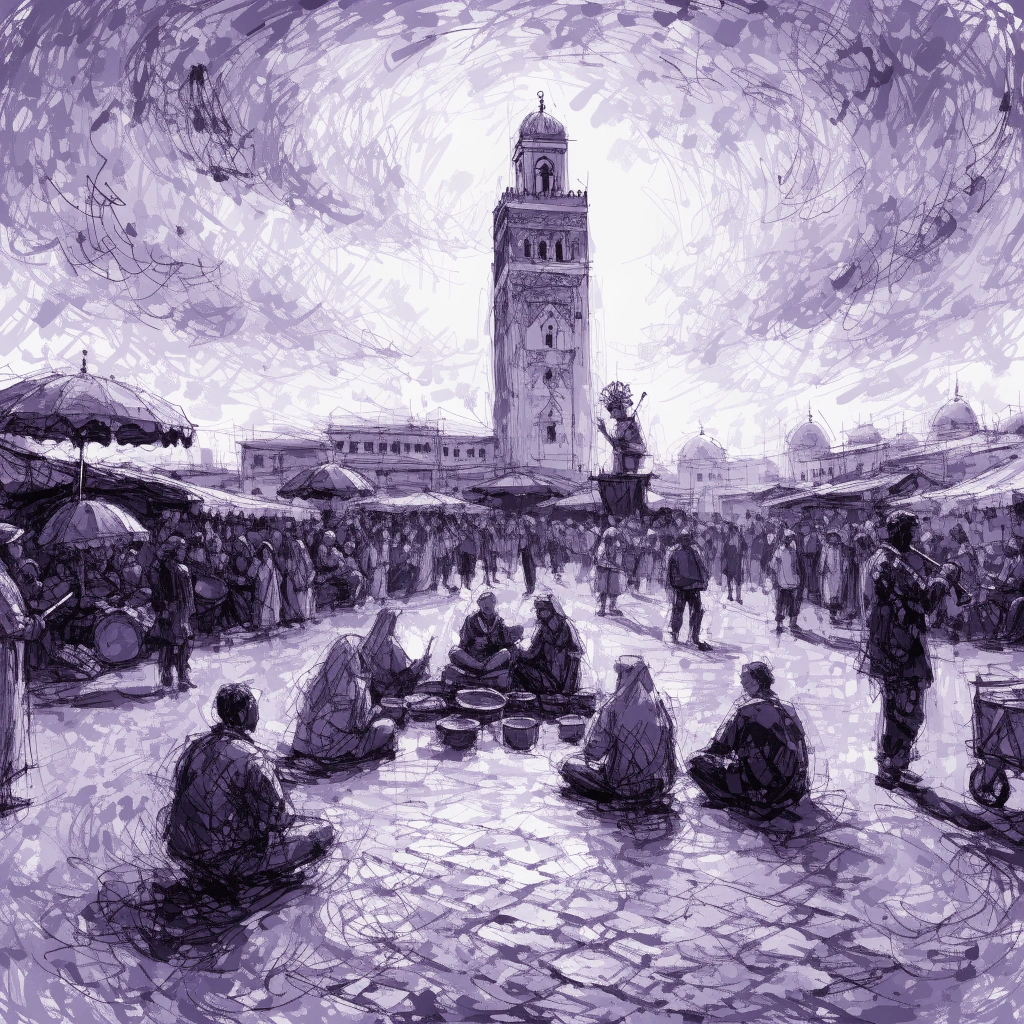
A Famous Square in Morocco
Djemaa el-Fnaa is a big square in Marrakech. It is in the center of the city in Morocco. Many people visit this place every day. It is very busy and loud.
In the morning, you can see monkeys and snakes. There are many small shops. You can buy fresh orange juice. It is very cold and delicious.
In the evening, the square changes. There are many food stalls. You can eat traditional food. People tell stories and play music. It is a very special place for everyone.
Point grammaire
Structure: Present Simple 'To Be'
"Djemaa el-Fnaa is a big square in Marrakech."
We use 'is' for one person or thing. It describes a fact or a state in the present.
Structure: Modal Verb 'Can'
"You can see monkeys and snakes."
We use 'can' to talk about things that are possible to do. The verb after 'can' does not change.
Teste ta compréhension
10 questions · A1 Débutant · 1 aperçu gratuit
Teste ce que tu as appris dans cet article. Réponds à toutes les questions pour gagner des XP !
Where is Djemaa el-Fnaa?
Tu veux terminer le quiz ?
9 questions supplémentaires t'attendent. Inscris-toi gratuitement pour débloquer le quiz complet et gagner des XP !
S'inscrire gratuitementTu as dj un compte ? Connexion
Bien joué !
Continue à pratiquer !
Déjà terminé — pas de XP supplémentaire
Inscris-toi pour gagner des XPDétail des questions
Where is Djemaa el-Fnaa?
Ta réponse:
Bonne réponse: In Marrakech
The square is very quiet.
Ta réponse:
Bonne réponse: Faux
What does 'fresh' mean?
Ta réponse:
Bonne réponse: Recently made or new
You can buy fresh orange _____.
Ta réponse:
Bonne réponse: juice
The Magic of Djemaa el-Fnaa
Djemaa el-Fnaa is a very famous square in Marrakech, Morocco. It is the heart of the city and it is always busy. Many years ago, the city’s founders built the square for trade and public meetings. In 2001, UNESCO said it was a special place for history and culture because of its old traditions.
During the day, the square is full of life. You can see orange juice stalls, henna artists, and many people. It is louder and more exciting than other places in the city. In the evening, the square changes completely. Many cooks arrive and prepare delicious food. You can smell the meat and spices in the air. There are also storytellers, musicians, and traditional dancers.
Djemaa el-Fnaa is bigger than most squares in Africa. It is a great place because it is very old but also very modern. Visitors love it because they can see the traditions of Morocco. It is a magical experience for everyone who visits this beautiful city.
Point grammaire
Structure: Comparatives
"It is louder and more exciting than other places in the city."
We use comparatives to compare two things. For short words, we add '-er' (louder), and for long words, we use 'more' (more exciting).
Structure: Past Simple
"Many years ago, the city’s founders built the square for trade and public meetings."
The past simple is used for finished actions in the past. 'Built' is the irregular past form of the verb 'build'.
Teste ta compréhension
11 questions · A2 mentaire · 1 aperçu gratuit
Teste ce que tu as appris dans cet article. Réponds à toutes les questions pour gagner des XP !
Where is the famous square Djemaa el-Fnaa located?
Tu veux terminer le quiz ?
10 questions supplémentaires t'attendent. Inscris-toi gratuitement pour débloquer le quiz complet et gagner des XP !
S'inscrire gratuitementTu as dj un compte ? Connexion
Bien joué !
Continue à pratiquer !
Déjà terminé — pas de XP supplémentaire
Inscris-toi pour gagner des XPDétail des questions
Where is the famous square Djemaa el-Fnaa located?
Ta réponse:
Bonne réponse: Marrakech, Morocco
The square is quiet and empty during the day.
Ta réponse:
Bonne réponse: Faux
What does 'delicious' mean?
Ta réponse:
Bonne réponse: Tasting very good
Djemaa el-Fnaa is _____ than most squares in Africa.
Ta réponse:
Bonne réponse: bigger
Why did UNESCO recognize the square in 2001?
Ta réponse:
Bonne réponse: Because of its history and culture
The Magic of Djemaa el-Fnaa: The Heart of Marrakech
Djemaa el-Fnaa is a famous square in Marrakech, Morocco, which has been the center of city life for centuries. Since the city was founded in the 11th century, this place has welcomed travelers from all over the world. In 2001, the square was declared a 'Masterpiece of the Oral and Intangible Heritage of Humanity' by UNESCO because it protects traditional culture.
During the day, the square is a busy marketplace where you can find orange juice stalls and snake charmers. However, the real magic starts when the sun goes down. As evening approaches, the space is transformed into a huge open-air restaurant. Hundreds of food stalls are set up, and the air is filled with the smell of grilled meat and spices. Local people and tourists sit together at long wooden tables to enjoy traditional Moroccan dishes like couscous and tagine.
Djemaa el-Fnaa is also famous for its performers. You can see storytellers who tell ancient tales to large crowds. These traditions have been passed down through many generations. Musicians play traditional instruments, and dancers entertain people who have traveled long distances to see the show. It is a place where the past and the present meet in a beautiful way.
Visitors have often described the square as a chaotic but exciting experience. The square serves as a bridge between different cultures, allowing everyone to share a unique moment in the heart of the city. If you visit Marrakech, you should spend an evening here. It is not just a tourist attraction; it is a living piece of history that continues to thrive today. Many people who visit Morocco say that they have never seen anything like it.
Point grammaire
Structure: The Passive Voice
"In 2001, the square was declared a 'Masterpiece of the Oral and Intangible Heritage of Humanity' by UNESCO."
The passive voice is used when the focus is on the action or the object receiving the action. It is formed using 'to be' + past participle.
Structure: The Present Perfect
"Many people who visit Morocco say that they have never seen anything like it."
The present perfect is used to talk about experiences in our lives up to now. It is formed using 'have/has' + past participle.
Teste ta compréhension
11 questions · B1 Intermédiaire · 1 aperçu gratuit
Teste ce que tu as appris dans cet article. Réponds à toutes les questions pour gagner des XP !
Why did UNESCO declare the square a masterpiece?
Tu veux terminer le quiz ?
10 questions supplémentaires t'attendent. Inscris-toi gratuitement pour débloquer le quiz complet et gagner des XP !
S'inscrire gratuitementTu as dj un compte ? Connexion
Bien joué !
Continue à pratiquer !
Déjà terminé — pas de XP supplémentaire
Inscris-toi pour gagner des XPDétail des questions
Why did UNESCO declare the square a masterpiece?
Ta réponse:
Bonne réponse: Because it protects traditional culture
The square is transformed into a restaurant during the morning.
Ta réponse:
Bonne réponse: Faux
What does 'thrive' mean?
Ta réponse:
Bonne réponse: To grow and be successful
What kind of food can you find at the square?
Ta réponse:
Bonne réponse: Couscous and tagine
The storytellers tell _____ tales to large crowds.
Ta réponse:
Bonne réponse: ancient
Djemaa el-Fnaa: The Living Heart of Marrakech
Situated at the entrance of the historic Medina, Djemaa el-Fnaa represents far more than just a bustling marketplace; it is a complex cultural phenomenon that has survived for nearly a millennium. Since its foundation in the 11th century by the Almoravid dynasty, the square has evolved from a simple site of public assembly into a global symbol of intangible heritage. Recognizing its unique status as a center for oral traditions, UNESCO declared it a Masterpiece of the Oral and Intangible Heritage of Humanity in 2001, highlighting the urgent importance of preserving the ancient customs that continue to thrive within its boundaries.
During the daylight hours, the square possesses a relatively calm atmosphere, occupied by water sellers in traditional costumes and snake charmers who captivate passing tourists with their rhythmic melodies. However, as the sun begins to set, the space undergoes a dramatic transformation. The arrival of numerous food stalls creates a dense canopy of smoke, while the air fills with the rich aroma of grilled meats and exotic spices. This transition marks the beginning of a sensory spectacle that attracts thousands of visitors and locals alike every single night, turning the area into a massive open-air dining hall.
What truly distinguishes Djemaa el-Fnaa from other urban spaces is its role as a vital platform for oral expression. Storytellers, known locally as Hlaikia, gather large circles of listeners to recount epic tales and legends that have been passed down through generations. Despite the rise of digital entertainment and modern media, these performers manage to maintain the audience's attention through sophisticated linguistic techniques and dramatic flair. This oral tradition serves as a vital link to Morocco’s history, ensuring that the collective memory of the community remains intact even in a rapidly changing world.
Furthermore, the square acts as a crossroad where various social groups interact daily. It is a place where rural traditions meet urban lifestyles, creating a vibrant cultural mosaic that is unique to Marrakech. While some critics argue that tourism has commercialized certain aspects of the square, the fundamental essence of Djemaa el-Fnaa remains unchanged. It continues to be a space where the past and present collide, offering a profound insight into the Moroccan identity. Ultimately, the preservation of such a site is essential for maintaining global cultural diversity in an increasingly standardized world.
Point grammaire
Structure: Present Perfect Simple
"it is a complex cultural phenomenon that has survived for nearly a millennium."
The present perfect is used here to describe an action or state that started in the past (11th century) and continues to the present day.
Structure: Passive Voice with Present Perfect
"recount epic tales and legends that have been passed down through generations."
This structure (have + been + past participle) focuses on the stories themselves rather than the specific people who told them over time.
Structure: Concession Clauses with 'While'
"While some critics argue that tourism has commercialized certain aspects of the square, the fundamental essence of Djemaa el-Fnaa remains unchanged."
The word 'while' is used to introduce a contrast or concession, acknowledging one viewpoint before presenting the main point of the sentence.
Teste ta compréhension
11 questions · B2 Intermédiaire supérieur · 1 aperçu gratuit
Teste ce que tu as appris dans cet article. Réponds à toutes les questions pour gagner des XP !
What was the primary reason UNESCO recognized Djemaa el-Fnaa in 2001?
Tu veux terminer le quiz ?
10 questions supplémentaires t'attendent. Inscris-toi gratuitement pour débloquer le quiz complet et gagner des XP !
S'inscrire gratuitementTu as dj un compte ? Connexion
Bien joué !
Continue à pratiquer !
Déjà terminé — pas de XP supplémentaire
Inscris-toi pour gagner des XPDétail des questions
What was the primary reason UNESCO recognized Djemaa el-Fnaa in 2001?
Ta réponse:
Bonne réponse: Its role as a center for oral traditions
The atmosphere of the square remains exactly the same from morning until night.
Ta réponse:
Bonne réponse: Faux
Which word describes something that is not physical but is culturally important?
Ta réponse:
Bonne réponse: Intangible
The square has survived for nearly a _____, dating back to the 11th century.
Ta réponse:
Bonne réponse: millennium
Who are the 'Hlaikia' mentioned in the text?
Ta réponse:
Bonne réponse: Local storytellers
The Ephemeral Permanence of Djemaa el-Fnaa: A Sensory Tapestry of Marrakech
Rarely has a public space managed to encapsulate the paradoxical nature of a nation as effectively as Djemaa el-Fnaa. Situated at the crossroads of the Medina in Marrakech, this vast esplanade serves as a living museum, a theater of the absurd, and a marketplace of dreams. Since its inception under the Almoravid dynasty in the 11th century, the square has undergone numerous transformations, yet its core identity as a site for public assembly remains unyielding. The designation of the square as a 'Masterpiece of the Oral and Intangible Heritage of Humanity' by UNESCO in 2001 was not merely a symbolic gesture; it was a recognition of the evanescent nature of the performances that occur here daily.
Seldom does one encounter such a visceral assault on the senses as that experienced upon entering the square at dusk. As the sun dips below the horizon, the space undergoes a metamorphosis. What was a sparse expanse in the heat of the afternoon becomes a dense cacophony of sound and movement. It is within this architectural void that the soul of Marrakech resides, manifested through the rhythmic drumming of Gnaoua musicians and the enticing aromas of grilled meats. The orchestration of these elements creates a palpable energy that transcends the physical boundaries of the square.
Central to the square’s allure are the 'halqa'—circles of spectators gathered around storytellers, acrobats, and musicians. It is the storytellers who carry the weight of history, weaving narratives that have been passed down through generations. These tales, often laden with moral allegories and local folklore, provide a window into the Moroccan psyche. However, the preservation of these oral traditions remains a paramount concern. In an era dominated by digital distractions and the homogenization of global culture, the traditional storyteller faces an uphill battle for relevance.
Critics argue that the increasing commercialization of Djemaa el-Fnaa threatens to dilute its authenticity. The influx of tourism has led to a convergence of traditional practices and modern consumerism, where some performances feel more orchestrated for the camera than for the community. Yet, despite these pressures, the square retains a vestige of its ancient spirit. The ephemeral nature of the nightly festivities ensures that no two visits are identical. Each evening is a unique convergence of individuals, an alchemist's blend of the ancient and the contemporary.
Ultimately, the significance of Djemaa el-Fnaa lies in its ability to bridge the gap between the past and the present. It stands as a testament to the resilience of intangible culture. While the physical structures of Marrakech may crumble or be renovated, the spirit of the square persists through the collective memory of those who participate in its daily rituals. It is this very evanescence that makes it permanent—a paradox that continues to captivate the imagination of all who wander into its embrace.
Point grammaire
Structure: Negative Inversion
"Seldom does one encounter such a visceral assault on the senses as that experienced upon entering the square at dusk."
Inversion is used for emphasis by placing a negative or restrictive adverb at the beginning of the sentence followed by an auxiliary verb and the subject. This creates a more formal and dramatic tone typical of C1 level writing.
Structure: Cleft Sentences
"It is within this architectural void that the soul of Marrakech resides."
Cleft sentences focus on specific information by splitting a single clause into two. Here, 'It is... that' emphasizes the location (the architectural void) as the essential site for the city's soul.
Structure: Nominalization
"The designation of the square as a 'Masterpiece of the Oral and Intangible Heritage of Humanity' by UNESCO in 2001 was not merely a symbolic gesture."
Nominalization turns verbs (designate) into nouns (designation) to package complex ideas into the subject of a sentence. This allows for more abstract and nuanced academic or professional analysis.
Teste ta compréhension
12 questions · C1 Avancé · 1 aperçu gratuit
Teste ce que tu as appris dans cet article. Réponds à toutes les questions pour gagner des XP !
What was the primary reason UNESCO designated Djemaa el-Fnaa a 'Masterpiece'?
Tu veux terminer le quiz ?
11 questions supplémentaires t'attendent. Inscris-toi gratuitement pour débloquer le quiz complet et gagner des XP !
S'inscrire gratuitementTu as dj un compte ? Connexion
Bien joué !
Continue à pratiquer !
Déjà terminé — pas de XP supplémentaire
Inscris-toi pour gagner des XPDétail des questions
What was the primary reason UNESCO designated Djemaa el-Fnaa a 'Masterpiece'?
Ta réponse:
Bonne réponse: Its role as a platform for oral and intangible traditions
The article suggests that the square's atmosphere remains identical from morning to night.
Ta réponse:
Bonne réponse: Faux
What does 'ephemeral' mean in the context of the article?
Ta réponse:
Bonne réponse: Lasting for a very short time
The article mentions that the square has undergone numerous changes since its _____ in the 11th century.
Ta réponse:
Bonne réponse: inception
According to the text, what is the main threat to the traditional storytellers?
Ta réponse:
Bonne réponse: Digital distractions and global cultural homogenization
The author believes that the square's commercialization has completely destroyed its ancient spirit.
Ta réponse:
Bonne réponse: Faux
The Ephemeral Palimpsest: A Socio-Cultural Anatomy of Djemaa el-Fnaa
To traverse the threshold of Djemaa el-Fnaa is to surrender oneself to a sensory cacophony that defies the sterile categorization of modern urban planning. Situated at the cardinal heart of Marrakech, this square serves not merely as a geographic locus but as a living palimpsest, where layers of Almoravid history, oral tradition, and contemporary globalization intersect in a volatile, yet harmonious, flux. Declared a 'Masterpiece of the Oral and Intangible Heritage of Humanity' by UNESCO in 2001, the square represents a rare survival of the medieval public sphere, albeit one that is perpetually renegotiating its identity amidst the pressures of late-stage capitalism. Seldom does a public space encapsulate such a profound tension between the preservation of atavistic traditions and the inevitable commodification that accompanies international acclaim.
Should one deconstruct the auditory landscape of the square, the 'halqa' emerges as the quintessential element of its cultural fabric. These circles of spectators, gathered around storytellers, musicians, and performers, constitute a liminal space where the boundaries between performer and audience are porous. The storytelling tradition, or 'hikayat', is particularly noteworthy; it is a repository of collective memory that predates the written word. However, the survival of these oral narratives is not guaranteed. As the younger generation gravitates toward digital consumption, there is a palpable concern that the nuanced dialectics of the traditional storyteller might undergo a process of ossification, becoming a mere caricature for the tourist gaze rather than a vibrant medium of social critique.
Furthermore, the physical environment of Djemaa el-Fnaa undergoes a diurnal metamorphosis that is almost liturgical in its precision. By day, the square is a labyrinthine marketplace, punctuated by the presence of water sellers and henna artists. Yet, as twilight descends, the space is reclaimed by a temporary architecture of food stalls, their rising steam creating a chiaroscuro effect against the backdrop of the Koutoubia Mosque. This transition is not merely logistical but ontological; the square shifts from a site of pragmatic commerce to one of ritualistic communal consumption. It is imperative that the observer remain cognizant of the socio-economic undercurrents at play here; the vibrancy of the night market is sustained by a complex network of labor that remains largely invisible to the casual visitor.
One might argue that the UNESCO designation has acted as a double-edged sword. While it has undoubtedly provided a protective framework against aggressive urban redevelopment, it has also catalyzed a shift toward the museumification of the square. When a living tradition is institutionalized, it risks losing the very spontaneity that defined its inception. The challenge, therefore, lies in fostering an environment where the 'halqa' can evolve without being stifled by the expectations of authenticity imposed by external observers. The square remains a site of resistance against the homogenization of global culture, a place where the local vernacular continues to assert its sovereignty through music, jest, and narrative.
In conclusion, Djemaa el-Fnaa is less a destination and more an experiential phenomenon. It is a testament to the resilience of human connection in an increasingly atomized world. To truly comprehend the square, one must look beyond the spectacle and engage with the underlying rhythms of a community that has, for nearly a millennium, turned a void into a vibrant theater of existence. Whether it will withstand the encroaching tides of modernity remains to be seen, but for now, it stands as a defiant bastion of the intangible.
Point grammaire
Structure: Inversion after Negative/Restrictive Adverbs
"Seldom does a public space encapsulate such a profound tension between the preservation of atavistic traditions and the inevitable commodification that accompanies international acclaim."
When using restrictive words like 'seldom', 'rarely', or 'never' at the start of a sentence for emphasis, the auxiliary verb is placed before the subject.
Structure: Conditional Inversion (Subjunctive)
"Should one deconstruct the auditory landscape of the square, the 'halqa' emerges as the quintessential element of its cultural fabric."
The word 'should' replaces 'if' in formal contexts to express a hypothetical condition. This structure is common in academic and scholarly writing.
Structure: The Subjunctive Mood with 'Imperative'
"It is imperative that the observer remain cognizant of the socio-economic undercurrents at play here."
After adjectives expressing urgency or requirement (imperative, essential, crucial), the base form of the verb ('remain' instead of 'remains') is used in a 'that' clause.
Teste ta compréhension
12 questions · C2 Maîtrise · 1 aperçu gratuit
Teste ce que tu as appris dans cet article. Réponds à toutes les questions pour gagner des XP !
According to the article, why is the UNESCO designation described as a 'double-edged sword'?
Tu veux terminer le quiz ?
11 questions supplémentaires t'attendent. Inscris-toi gratuitement pour débloquer le quiz complet et gagner des XP !
S'inscrire gratuitementTu as dj un compte ? Connexion
Bien joué !
Continue à pratiquer !
Déjà terminé — pas de XP supplémentaire
Inscris-toi pour gagner des XPDétail des questions
According to the article, why is the UNESCO designation described as a 'double-edged sword'?
Ta réponse:
Bonne réponse: It provided protection but also risked turning a living tradition into a static museum piece.
The author suggests that the 'halqa' is a rigid performance where the audience has no role.
Ta réponse:
Bonne réponse: Faux
What does 'atavistic' mean in the context of the article?
Ta réponse:
Bonne réponse: Characterized by a return to ancestral or ancient ways.
The square undergoes a diurnal _____ that changes it from a marketplace to a food court.
Ta réponse:
Bonne réponse: metamorphosis
What does the author identify as a threat to the traditional storytelling ('hikayat')?
Ta réponse:
Bonne réponse: The shift of younger generations toward digital media.
The transition of the square from day to night is described as being almost liturgical in its precision.
Ta réponse:
Bonne réponse: Vrai

