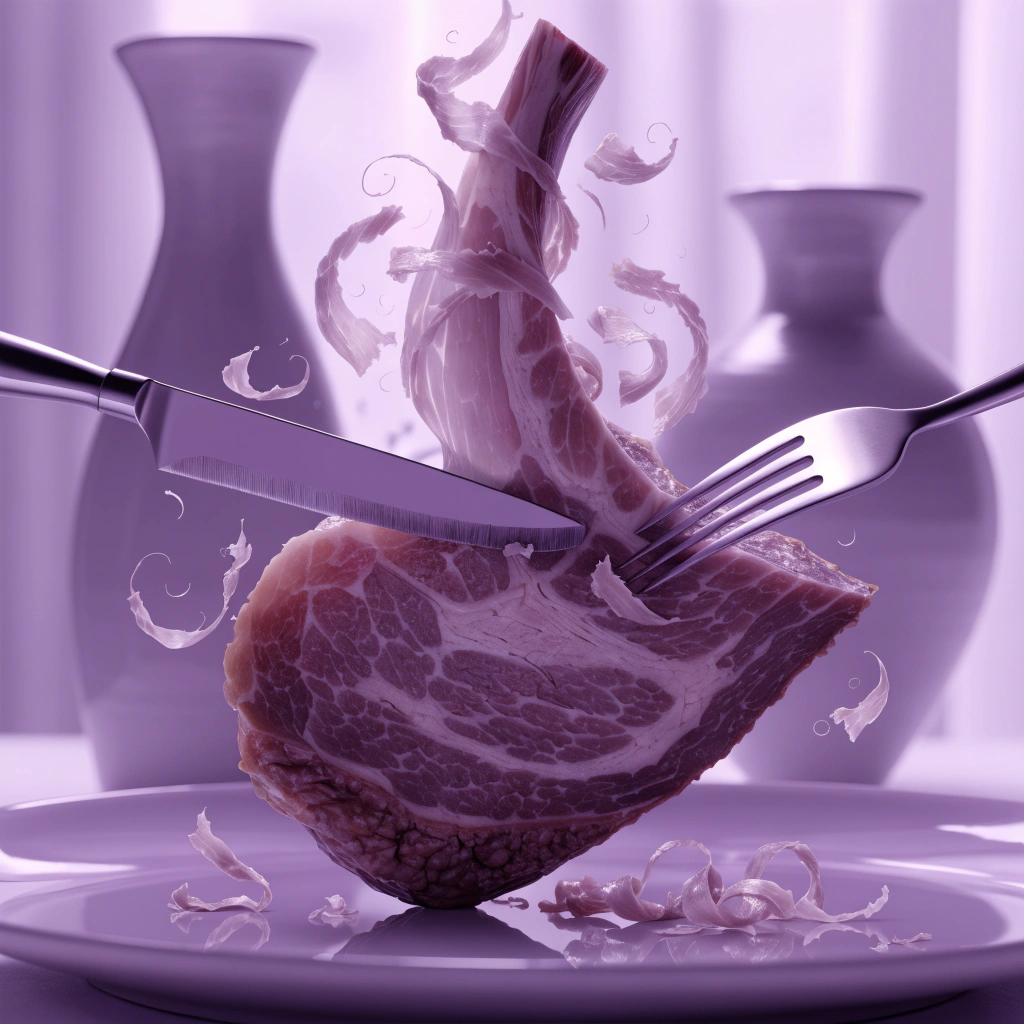
A Special Ham from Spain
Jamón Ibérico is a special ham from Spain. It is very famous and delicious. This ham is not like other ham. It is an important part of Spanish culture.
The pigs live in a big forest called the dehesa. They are free and happy. In the autumn, the pigs eat many acorns. Acorns are small nuts from oak trees. This food makes the meat very tasty and soft.
People in Spain eat this ham at parties and festivals. It is expensive but very good. Many tourists visit Spain to try this special food.
Point grammaire
Structure: Present Simple with 'be'
"It is very famous and delicious."
We use 'is' for singular things like 'it' or 'the ham'. This describes a fact or a state that is always true.
Structure: Present Simple Plural
"The pigs live in a big forest."
When the subject is plural (the pigs), the verb does not have an 's'. Use the base form of the verb for facts about groups.
Teste ta compréhension
10 questions · A1 Débutant · 1 aperçu gratuit
Teste ce que tu as appris dans cet article. Réponds à toutes les questions pour gagner des XP !
Where is Jamón Ibérico from?
Tu veux terminer le quiz ?
9 questions supplémentaires t'attendent. Inscris-toi gratuitement pour débloquer le quiz complet et gagner des XP !
S'inscrire gratuitementTu as dj un compte ? Connexion
Bien joué !
Continue à pratiquer !
Déjà terminé — pas de XP supplémentaire
Inscris-toi pour gagner des XPDétail des questions
Where is Jamón Ibérico from?
Ta réponse:
Bonne réponse: Spain
The pigs live in small cages.
Ta réponse:
Bonne réponse: Faux
What does 'delicious' mean?
Ta réponse:
Bonne réponse: Very good taste
In the autumn, the pigs eat many _____.
Ta réponse:
Bonne réponse: acorns
Le Trésor de l'Espagne : Le Jambon Ibérique
En Espagne, il existe un produit exceptionnel : le jambon ibérique de Bellota. Ce n'est pas un jambon ordinaire, c'est un trésor de la gastronomie. Ce produit vient d'une race spéciale de cochons noirs qui vivent en liberté.
Ces animaux habitent dans la 'dehesa', une grande forêt de chênes. Pendant l'hiver, les cochons courent dans la nature et mangent beaucoup de glands. Les glands donnent un goût unique et riche à la viande. C'est pour cette raison que le jambon est très célèbre dans le monde entier.
La préparation est longue et difficile. Le jambon sèche pendant deux ou trois ans dans des caves spéciales. Parce que le processus est naturel, le goût est meilleur que le jambon industriel. En Espagne, les familles mangent ce jambon pendant les fêtes. C'est une tradition ancienne qui montre l'importance de la nature et de la patience. Le jambon ibérique est plus qu'un aliment, c'est un symbole de culture.
Point grammaire
Structure: Le comparatif de supériorité
"le goût est meilleur que le jambon industriel."
On utilise 'meilleur que' à la place de 'plus bon que' pour comparer la qualité de deux choses. C'est une forme irrégulière très commune en français.
Structure: La conjonction de cause 'parce que'
"Parce que le processus est naturel, le goût est meilleur."
On utilise 'parce que' pour expliquer la raison d'une situation. Il lie une cause à une conséquence dans la phrase.
Teste ta compréhension
11 questions · A2 mentaire · 1 aperçu gratuit
Teste ce que tu as appris dans cet article. Réponds à toutes les questions pour gagner des XP !
Quelle est la couleur des cochons ibériques ?
Tu veux terminer le quiz ?
10 questions supplémentaires t'attendent. Inscris-toi gratuitement pour débloquer le quiz complet et gagner des XP !
S'inscrire gratuitementTu as dj un compte ? Connexion
Bien joué !
Continue à pratiquer !
Déjà terminé — pas de XP supplémentaire
Inscris-toi pour gagner des XPDétail des questions
Quelle est la couleur des cochons ibériques ?
Ta réponse:
Bonne réponse: Noirs
Les cochons mangent des glands pendant l'hiver.
Ta réponse:
Bonne réponse: Vrai
Que signifie le mot 'gland' ?
Ta réponse:
Bonne réponse: Le fruit du chêne
Le jambon _____ pendant deux ou trois ans avant d'être prêt.
Ta réponse:
Bonne réponse: sèche
Où vivent les cochons en liberté ?
Ta réponse:
Bonne réponse: Dans la dehesa
The Secrets of Spain's Most Famous Ham
Have you ever heard of Jamón Ibérico de Bellota? In Spain, this special ham is considered a national treasure. It has been produced for centuries using traditional methods that have not changed much over time. It is not just a snack; it is a symbol of Spanish culture.
The story begins with the Iberian pig, which is a unique breed found in the Iberian Peninsula. These pigs are famous because they have the genetic ability to store fat inside their muscle tissue. This creates a marbled texture that is very similar to expensive Wagyu beef. The best quality ham comes from pigs that live in the 'dehesa', which is a protected Mediterranean forest. During the autumn, the pigs roam freely and eat acorns, known as 'bellotas'. These acorns give the meat a nutty flavor and healthy fats.
The production process is long and requires a lot of patience. After the meat is prepared, it is covered in salt and left to dry in special cellars. This process is called curing. Some hams are cured for more than three years before they are ready to be eaten. During this time, the flavor becomes deeper and more complex.
Today, Jamón Ibérico de Bellota is enjoyed by people all over the world. It is usually served in very thin slices that melt in your mouth. Although it can be expensive, many people believe that it is worth the price because of the incredible history and hard work behind every piece. It represents a perfect balance between nature and tradition.
Point grammaire
Structure: Present Perfect
"It has been produced for centuries using traditional methods that have not changed much over time."
The present perfect (have/has + past participle) is used here to describe an action that started in the past and continues to the present day.
Structure: Relative Clauses
"The story begins with the Iberian pig, which is a unique breed found in the Iberian Peninsula."
Relative clauses starting with 'which' or 'that' provide extra information about a noun. In this case, 'which' explains more about the Iberian pig.
Teste ta compréhension
11 questions · B1 Intermédiaire · 1 aperçu gratuit
Teste ce que tu as appris dans cet article. Réponds à toutes les questions pour gagner des XP !
What gives the meat its unique nutty flavor?
Tu veux terminer le quiz ?
10 questions supplémentaires t'attendent. Inscris-toi gratuitement pour débloquer le quiz complet et gagner des XP !
S'inscrire gratuitementTu as dj un compte ? Connexion
Bien joué !
Continue à pratiquer !
Déjà terminé — pas de XP supplémentaire
Inscris-toi pour gagner des XPDétail des questions
What gives the meat its unique nutty flavor?
Ta réponse:
Bonne réponse: The acorns the pigs eat
The production methods for this ham have changed completely in the last year.
Ta réponse:
Bonne réponse: Faux
What does 'curing' mean in the context of the article?
Ta réponse:
Bonne réponse: Preserving meat by salting and drying it
The best quality ham comes from pigs that live in the _____, a type of forest.
Ta réponse:
Bonne réponse: dehesa
How long can the curing process last for some hams?
Ta réponse:
Bonne réponse: More than three years
L'excellence du Jamón Ibérico de Bellota : Un trésor gastronomique espagnol
Le Jamón Ibérico de Bellota ne se résume pas à un simple produit de charcuterie ; il incarne une véritable prouesse artisanale où s'entremêlent la biologie, l'écologie et des traditions ancestrales. Issu du porc ibérique, une race unique originaire de la péninsule Ibérique, ce jambon se distingue par sa capacité génétique à stocker des graisses au sein même de son tissu musculaire. Ce phénomène, appelé persillage, confère à la viande une texture fondante et des arômes d'une complexité rare, rappelant le célèbre bœuf Wagyu. Contrairement aux races de porcs blancs industriels, l'animal ibérique transforme son environnement en une ressource lipidique d'une qualité exceptionnelle.
La qualité suprême, désignée sous l'appellation « de Bellota », provient d'animaux ayant passé leurs derniers mois en liberté totale dans la « dehesa ». Ce vaste écosystème méditerranéen, composé principalement de chênes verts et de chênes-lièges, offre aux porcs une alimentation riche en glands (bellotas). Bien que l'on puisse penser que l'élevage intensif soit plus rentable, les producteurs traditionnels maintiennent ce mode de vie sylvopastoral car il est essentiel au développement des acides oléiques. Ces acides gras, semblables à ceux de l'huile d'olive, sont responsables du goût de noisette et des bienfaits cardiovasculaires du produit fini.
Le processus de transformation est tout aussi rigoureux et nécessite l'expertise d'un « maestro jamonero ». Après la « montanera » — la période de pâturage hivernale — les jambons subissent un affinage dont la durée peut atteindre quatre ans. Durant cette phase, le sel pénètre lentement la chair tandis que les variations saisonnières de température permettent aux graisses de se stabiliser et de s'oxyder. Il est impératif que les conditions de séchage soient naturelles pour que l'oxydation lente des lipides produise les notes olfactives si recherchées par les gourmets.
Toutefois, ce patrimoine gastronomique est actuellement menacé par le changement climatique qui fragilise l'équilibre de la dehesa. Si les précipitations diminuent de manière drastique, la production de glands chute inévitablement, mettant en péril la survie de ce système séculaire. Il est donc crucial que des mesures de protection environnementale soient renforcées afin que les générations futures puissent continuer à savourer ce joyau. En somme, déguster une fine tranche de Jamón Ibérico, c'est apprécier une harmonie parfaite entre l'animal, l'homme et la nature.
Point grammaire
Structure: Le Subjonctif Présent
"Bien que l'on puisse penser que l'élevage intensif soit plus rentable..."
Utilisé après la conjonction 'bien que' pour exprimer une concession. Il souligne ici une idée que l'auteur va contredire.
Structure: Le Pronom Relatif 'Dont'
"...les jambons subissent un affinage dont la durée peut atteindre quatre ans."
Ce pronom remplace un complément introduit par 'de' (la durée DE l'affinage). Il permet de fluidifier la phrase.
Structure: La Voix Passive
"...ce patrimoine gastronomique est actuellement menacé par le changement climatique..."
Formée avec l'auxiliaire 'être' et le participe passé, elle met l'accent sur l'objet qui subit l'action (le patrimoine).
Teste ta compréhension
11 questions · B2 Intermédiaire supérieur · 1 aperçu gratuit
Teste ce que tu as appris dans cet article. Réponds à toutes les questions pour gagner des XP !
Quelle caractéristique génétique rend le porc ibérique unique ?
Tu veux terminer le quiz ?
10 questions supplémentaires t'attendent. Inscris-toi gratuitement pour débloquer le quiz complet et gagner des XP !
S'inscrire gratuitementTu as dj un compte ? Connexion
Bien joué !
Continue à pratiquer !
Déjà terminé — pas de XP supplémentaire
Inscris-toi pour gagner des XPDétail des questions
Quelle caractéristique génétique rend le porc ibérique unique ?
Ta réponse:
Bonne réponse: Sa capacité à stocker des graisses dans ses muscles
L'affinage du jambon ibérique peut durer jusqu'à quatre ans.
Ta réponse:
Bonne réponse: Vrai
Que signifie le mot 'Bellota' en français dans ce contexte ?
Ta réponse:
Bonne réponse: Gland
Le porc ibérique se nourrit principalement de _____ durant la montanera.
Ta réponse:
Bonne réponse: glands
Qu'est-ce que la 'dehesa' ?
Ta réponse:
Bonne réponse: Un écosystème méditerranéen de pâturage
The Gastronomic Alchemy of the Dehesa: Beyond the Cured Ham
Rarely does a culinary product achieve such a profound synthesis of biology, ecology, and heritage as Jamón Ibérico de Bellota. Often referred to as the 'Pata Negra' due to the distinctive black hooves of the Iberian pig, this delicacy is far more than a mere cured meat; it is a testament to a centuries-old symbiotic relationship between man and nature. At the heart of this artisanal masterpiece lies the 'dehesa', a protected Mediterranean ecosystem characterized by rolling hills and vast oak forests. It is within this unique landscape that the Iberian pig roams freely during the 'montanera', the final fattening phase where the animals subsist almost exclusively on fallen acorns, or bellotas.
What distinguishes the Iberian breed from its porcine counterparts is its remarkable physiological predisposition to store fat within its muscle tissue. This genetic trait results in the exquisite marbling often compared to Japanese Wagyu beef. However, the true magic occurs through the infiltration of oleic acid from the acorns into the meat. The consumption of these nuts not only alters the chemical composition of the fat, making it chemically similar to olive oil, but also imbues the ham with its signature nutty aroma and buttery texture. Such is the complexity of this process that any attempt to industrialize it invariably leads to a loss of the nuanced flavors that connoisseurs so highly prize.
Furthermore, the maturation process of Jamón Ibérico de Bellota is an exercise in extreme patience. The legs are salted and then hung in 'secaderos' (natural drying rooms) where they undergo a slow transformation over three to five years. During this time, the interplay of temperature and humidity allows for the steady development of umami-rich compounds. The preservation of this tradition, however, faces contemporary challenges. The encroachment of intensive farming and the potential impact of climate change on acorn production threaten the stability of the dehesa.
It is the meticulous adherence to traditional methods that ensures the authenticity of the product in an increasingly globalized market. While some might argue that the high price point of 'Bellota' grade ham is prohibitive, others maintain that it reflects the true cost of environmental stewardship and artisanal labor. Ultimately, the consumption of Jamón Ibérico de Bellota is not merely an act of eating; it is an engagement with a living history. The continued reverence for this product serves as a bulwark against the homogenization of global food culture, reminding us that some things simply cannot be rushed or replicated by modern machinery.
Point grammaire
Structure: Inversion
"Rarely does a culinary product achieve such a profound synthesis of biology, ecology, and heritage as Jamón Ibérico de Bellota."
Inversion is used here by placing 'Rarely' at the beginning for emphasis. The auxiliary verb 'does' comes before the subject 'a culinary product' to create a more formal and dramatic tone.
Structure: Cleft Sentence
"It is within this unique landscape that the Iberian pig roams freely during the 'montanera'."
This 'It is... that' structure is a cleft sentence used to focus on the specific location. It emphasizes 'this unique landscape' as the crucial element of the sentence.
Structure: Nominalisation
"The preservation of this tradition, however, faces contemporary challenges."
The verb 'preserve' is turned into the noun 'preservation'. This is a hallmark of C1 writing as it allows for more abstract and concise expression of complex ideas.
Teste ta compréhension
12 questions · C1 Avancé · 1 aperçu gratuit
Teste ce que tu as appris dans cet article. Réponds à toutes les questions pour gagner des XP !
What is the primary factor that makes the fat in Jamón Ibérico de Bellota similar to olive oil?
Tu veux terminer le quiz ?
11 questions supplémentaires t'attendent. Inscris-toi gratuitement pour débloquer le quiz complet et gagner des XP !
S'inscrire gratuitementTu as dj un compte ? Connexion
Bien joué !
Continue à pratiquer !
Déjà terminé — pas de XP supplémentaire
Inscris-toi pour gagner des XPDétail des questions
What is the primary factor that makes the fat in Jamón Ibérico de Bellota similar to olive oil?
Ta réponse:
Bonne réponse: The consumption of acorns rich in oleic acid
The article suggests that industrializing the production of this ham enhances its flavor profile.
Ta réponse:
Bonne réponse: Faux
What does 'stewardship' mean in the context of the article?
Ta réponse:
Bonne réponse: Responsible management and care of the environment
The pigs spend their final fattening phase, known as the _____, eating acorns in the forest.
Ta réponse:
Bonne réponse: montanera
According to the text, what is a major threat to the 'dehesa' ecosystem?
Ta réponse:
Bonne réponse: Intensive farming and climate change
The maturation process can last as long as five years.
Ta réponse:
Bonne réponse: Vrai
The Gastronomic Alchemy of the Dehesa: An Ontological Analysis of Jamón Ibérico de Bellota
To contemplate the Jamón Ibérico de Bellota is to engage with a profound intersection of evolutionary biology, anthropogenic landscape management, and ancestral tradition. Central to this discourse is the dehesa, a meticulously managed Mediterranean ecosystem where the holm oak reigns supreme, providing the essential sustenance for the Iberian pig. Were one to traverse these undulating plains during the montanera—the final fattening phase—the significance of this ecological symbiosis would become immediately apparent. The Iberian pig, an inimitable breed native to the peninsula, possesses a singular genetic predisposition for interstitial fat infiltration. This physiological anomaly, characterized by the storage of lipids within the muscle tissue rather than merely beneath the dermis, renders its musculature a canvas of marbled excellence, reminiscent of the finest Wagyu beef.
This genetic blueprint is further augmented by the porcine diet, which is predominantly comprised of acorns (bellotas) rich in oleic acid. As the pigs forage across the dehesa, they ingest vast quantities of these nuts, the chemical constituents of which are integrated into their cellular structure. It is imperative that the specimen be allowed to roam freely; the physical exertion of foraging ensures that the fat is distributed evenly throughout the muscle, preventing the accumulation of undesirable adipose deposits. This interaction between breed and environment creates a product that is, quite literally, the physical manifestation of the landscape itself.
However, the creation of Jamón Ibérico de Bellota is not solely a biological feat; it is a temporal one. The curing process must be viewed not merely as a method of preservation, but as an alchemical transformation. Once the haunches are harvested, they are buried in sea salt before being moved to 'secaderos' (natural drying houses). Over a period of three to five years, the hams are subjected to the fluctuating temperatures and humidity of the Spanish mountain ranges. During this time, the fats undergo a complex process of proteolysis and lipolysis. Not only does this process elicit a myriad of complex volatile compounds, but it also creates a texture so evanescent that it dissolves upon the palate, releasing a spectrum of flavors ranging from nutty sweetness to earthy umami.
The provenance of the ham is sacrosanct, protected by stringent 'Denominación de Origen' regulations that ensure its status as a paragon of Spanish heritage. These legal frameworks dictate everything from the purity of the porcine lineage to the exact number of trees required per animal. Should any element of this delicate balance be disturbed—be it through intensive farming practices or environmental degradation—the resultant product would fail to achieve the sensory depth required of a true Bellota. One might even posit that the ham serves as a biological archive, preserving the environmental conditions of a specific time and place within its fibers.
Furthermore, the cultural sovereignty of this delicacy cannot be overstated. It represents a vestige of a pre-industrial era, where the rhythm of production was dictated by the seasons rather than the exigencies of the global market. In an age of mass production and hyper-processed foods, the Jamón Ibérico de Bellota stands as a testament to the enduring value of patience, craftsmanship, and ecological stewardship. It is a sensory experience that demands a corresponding level of intellectual engagement, inviting the epicurean to reflect upon the intricate web of relationships that sustain such a masterpiece. To consume it is to participate in a form of temporal communion, a way for the modern individual to reconnect with the slow, deliberate pulse of the natural world, mediated by the hand of the artisan.
Point grammaire
Structure: Inverted Conditional
"Were one to traverse these undulating plains during the montanera—the final fattening phase—the significance of this ecological symbiosis would become immediately apparent."
This structure replaces 'If one were to...' with 'Were one to...'. It is a formal, high-level way to express a hypothetical situation in the present or future, typical of academic and literary C2 prose.
Structure: Subjunctive Mood
"It is imperative that the specimen be allowed to roam freely."
The subjunctive 'be allowed' follows the adjective 'imperative'. This mood is used to express necessity, urgency, or requirements, and is a hallmark of formal English proficiency.
Structure: Negative Inversion
"Not only does this process elicit a myriad of complex volatile compounds, but it also creates a texture so evanescent that it dissolves upon the palate."
Starting a sentence with a negative or restrictive phrase ('Not only') requires inverting the subject and the auxiliary verb ('does this process elicit'). It adds rhetorical emphasis and sophistication.
Teste ta compréhension
12 questions · C2 Maîtrise · 1 aperçu gratuit
Teste ce que tu as appris dans cet article. Réponds à toutes les questions pour gagner des XP !
What is the primary biological advantage mentioned regarding the Iberian pig?
Tu veux terminer le quiz ?
11 questions supplémentaires t'attendent. Inscris-toi gratuitement pour débloquer le quiz complet et gagner des XP !
S'inscrire gratuitementTu as dj un compte ? Connexion
Bien joué !
Continue à pratiquer !
Déjà terminé — pas de XP supplémentaire
Inscris-toi pour gagner des XPDétail des questions
What is the primary biological advantage mentioned regarding the Iberian pig?
Ta réponse:
Bonne réponse: The ability to store fat within the muscle tissue
The curing process is described as a simple method of preventing decay.
Ta réponse:
Bonne réponse: Faux
Which word describes something that is impossible to copy or unique?
Ta réponse:
Bonne réponse: Inimitable
The dehesa is a meticulously managed _____ ecosystem.
Ta réponse:
Bonne réponse: Mediterranean
According to the text, why is the physical movement of the pigs essential?
Ta réponse:
Bonne réponse: To ensure the fat is distributed evenly through the muscle
The text suggests that modern industrial practices could potentially improve the quality of the ham.
Ta réponse:
Bonne réponse: Faux

