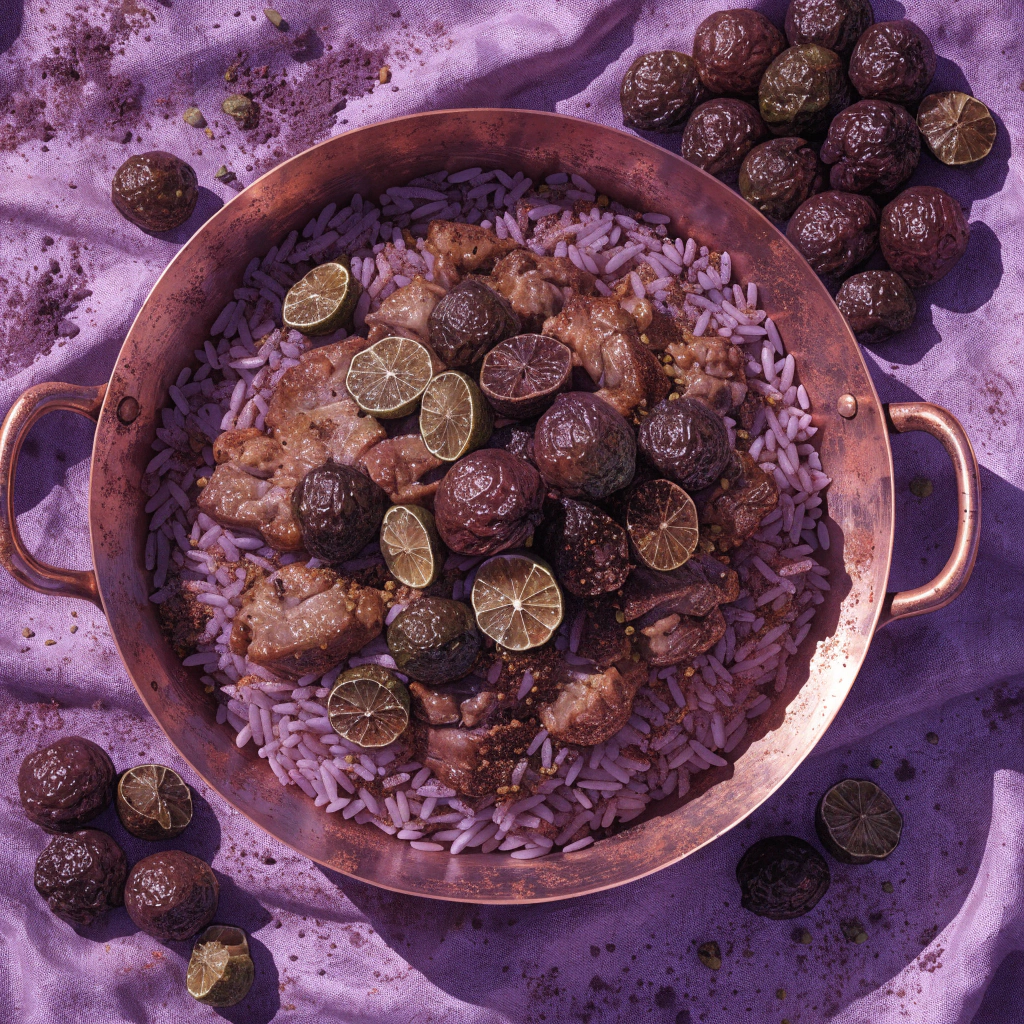
Le Machboos, un Plat des Émirats Arabes Unis
Le Machboos est un plat très populaire aux Émirats Arabes Unis. C'est le plat national. Il est fait avec du riz et de la viande ou du poisson. On peut aussi utiliser du poulet.
Pour préparer le Machboos, on cuisine la viande avec des oignons et de l'ail. On ajoute des épices spéciales. Ces épices donnent un très bon goût. Il y a aussi un ingrédient spécial : le loomi. C'est un citron noir séché.
Le Machboos est un grand plat familial. On le mange souvent pour le déjeuner. C'est un plat délicieux et important pour la culture émiratie.
Point grammaire
Structure: Le présent de l'indicatif (Verbes en -ER)
"On le mange souvent pour le déjeuner."
Le présent de l'indicatif est utilisé pour parler d'actions qui se passent maintenant, d'habitudes ou de vérités générales. Pour les verbes réguliers qui finissent par -er, on enlève -er et on ajoute des terminaisons comme -e, -es, -e, -ons, -ez, -ent. Par exemple, 'manger' devient 'je mange', 'tu manges', 'il/elle/on mange'.
Structure: Les articles définis et indéfinis
"Le Machboos est un plat très populaire."
Les articles définis (le, la, les) désignent quelque chose de spécifique ou déjà connu. Par exemple, 'le Machboos' parle de ce plat précis. Les articles indéfinis (un, une, des) désignent quelque chose de général ou une chose parmi d'autres. Par exemple, 'un plat' signifie 'n'importe quel plat'.
Teste ta compréhension
10 questions · A1 Débutant · 1 aperçu gratuit
Teste ce que tu as appris dans cet article. Réponds à toutes les questions pour gagner des XP !
Quel ingrédient spécial est utilisé dans le Machboos?
Tu veux terminer le quiz ?
9 questions supplémentaires t'attendent. Inscris-toi gratuitement pour débloquer le quiz complet et gagner des XP !
S'inscrire gratuitementTu as dj un compte ? Connexion
Bien joué !
Continue à pratiquer !
Déjà terminé — pas de XP supplémentaire
Inscris-toi pour gagner des XPDétail des questions
Quel ingrédient spécial est utilisé dans le Machboos?
Ta réponse:
Bonne réponse: le loomi
Le Machboos est le plat national des Émirats Arabes Unis.
Ta réponse:
Bonne réponse: Vrai
Que signifie 'déjeuner'?
Ta réponse:
Bonne réponse: le repas du midi
Le Machboos est un plat _____ populaire aux Émirats Arabes Unis.
Ta réponse:
Bonne réponse: très
Machboos: The Most Famous Dish in the UAE
Machboos is the most famous food in the United Arab Emirates. It is the national dish and people usually eat it for lunch. Families enjoy this meal together, especially on Fridays because it is a special day.
The dish has rice, meat, and many spices. You can use chicken, lamb, or fish. The most important ingredient is the 'loomi.' These are dried black limes. They give the rice a sour and special taste that people love.
To make Machboos, the cook first fries onions and garlic in a big pot. Then, they add a special spice mix called 'Bezar.' This mix has many different flavors. After that, they cook the meat with water. Finally, they put the rice in the pot and wait for it to be ready.
Many people think Machboos is tastier than other rice dishes because the rice absorbs all the flavors from the meat and spices. It is a very healthy and traditional meal for everyone in the UAE. It is a great way to learn about Emirati culture.
Point grammaire
Structure: Superlatives
"Machboos is the most famous food in the United Arab Emirates."
We use superlatives to compare one thing to a whole group. For long adjectives like 'famous', we use 'the most' before the adjective.
Structure: Comparatives
"Many people think Machboos is tastier than other rice dishes..."
We use comparatives to compare two things. For short adjectives ending in 'y', we change the 'y' to 'i' and add 'er' plus 'than'.
Teste ta compréhension
11 questions · A2 mentaire · 1 aperçu gratuit
Teste ce que tu as appris dans cet article. Réponds à toutes les questions pour gagner des XP !
What is the most important ingredient in Machboos?
Tu veux terminer le quiz ?
10 questions supplémentaires t'attendent. Inscris-toi gratuitement pour débloquer le quiz complet et gagner des XP !
S'inscrire gratuitementTu as dj un compte ? Connexion
Bien joué !
Continue à pratiquer !
Déjà terminé — pas de XP supplémentaire
Inscris-toi pour gagner des XPDétail des questions
What is the most important ingredient in Machboos?
Ta réponse:
Bonne réponse: Loomi
People usually eat Machboos for breakfast.
Ta réponse:
Bonne réponse: Faux
What does 'traditional' mean?
Ta réponse:
Bonne réponse: Something done for a long time
Families enjoy this meal _____.
Ta réponse:
Bonne réponse: together
What is 'Bezar'?
Ta réponse:
Bonne réponse: A spice mix
The Heart of Emirati Cuisine: Discovering Machboos
Machboos is the most famous dish in the United Arab Emirates, and it has been enjoyed by families for generations. This traditional meal, which is often called the national dish, consists of spiced rice and meat. Although many countries in the Middle East have similar rice dishes, the Emirati version has a unique taste because of its special ingredients.
The preparation of Machboos is a careful process. First, onions and garlic are sautéed with a blend of spices known as Bezar. This local spice mix, which includes cinnamon, cardamom, and turmeric, gives the dish its deep flavor. The meat, which can be chicken, lamb, or fish, is cooked slowly until it is tender. One of the most important ingredients is 'loomi,' or dried black limes. These limes provide a sour taste that balances the rich spices.
In Emirati culture, Machboos is not just food; it represents hospitality. It is usually served on a large platter so that everyone can share the meal together. Recently, Machboos has become popular with tourists who visit Dubai and Abu Dhabi. Many local restaurants have added it to their menus to show the authentic flavors of the region.
If you have never tried Machboos, you should definitely taste it during your next trip to the UAE. It is a dish that has been perfected over many years, and it continues to be a favorite part of daily life. Whether it is cooked at home or in a restaurant, it remains a symbol of Emirati tradition.
Point grammaire
Structure: Present Perfect
"Recently, Machboos has become popular with tourists who visit Dubai and Abu Dhabi."
The present perfect (has/have + past participle) is used for actions that happened in the past but are connected to the present. Here, it describes a recent change in popularity.
Structure: Passive Voice
"This traditional meal, which is often called the national dish, consists of spiced rice and meat."
The passive voice (is/are + past participle) is used when the focus is on the object of the action. It is common in formal writing or when the person doing the action is obvious or unknown.
Teste ta compréhension
11 questions · B1 Intermédiaire · 1 aperçu gratuit
Teste ce que tu as appris dans cet article. Réponds à toutes les questions pour gagner des XP !
What ingredient gives Machboos its unique sour taste?
Tu veux terminer le quiz ?
10 questions supplémentaires t'attendent. Inscris-toi gratuitement pour débloquer le quiz complet et gagner des XP !
S'inscrire gratuitementTu as dj un compte ? Connexion
Bien joué !
Continue à pratiquer !
Déjà terminé — pas de XP supplémentaire
Inscris-toi pour gagner des XPDétail des questions
What ingredient gives Machboos its unique sour taste?
Ta réponse:
Bonne réponse: Loomi
Machboos is only served in private homes and cannot be found in restaurants.
Ta réponse:
Bonne réponse: Faux
What does 'authentic' mean in the context of the article?
Ta réponse:
Bonne réponse: Real and traditional
The meat used in Machboos is cooked until it is _____.
Ta réponse:
Bonne réponse: tender
How is Machboos usually served to represent hospitality?
Ta réponse:
Bonne réponse: On a large platter for sharing
Machboos: The Culinary Soul of the United Arab Emirates
In the heart of Emirati culture lies a dish that transcends mere sustenance, serving as a powerful symbol of national identity and hospitality. Machboos, often referred to as the undisputed king of the UAE's lunch table, is a sophisticated rice-based meal that reflects the rich history of trade and tradition in the Arabian Peninsula. While various spiced rice dishes like Biryani or Kabsa are prevalent throughout the Middle East, the Emirati Machboos is distinguished by its unique aromatic profile and the specific use of local ingredients. This dish is not merely a meal; it is a synthesis of history, meticulously crafted through generations of culinary practice.
The defining characteristic of Machboos is the 'Bezar' spice blend. This homegrown mixture typically includes cumin, coriander, cinnamon, and turmeric, creating a flavor profile that is both complex and deeply comforting. However, what truly sets the Emirati version apart is the inclusion of 'loomi'—dried black limes. These limes provide a subtle, citrusy acidity that balances the richness of the meat and the warmth of the spices. Whether the protein chosen is lamb, chicken, or a local fish such as Kingfish, the preparation remains an art form that requires patience and precision.
The cooking process begins with the meat being sautéed alongside onions and garlic until a golden-brown crust is achieved. Subsequently, the Bezar and loomi are added, allowing the aromas to permeate the kitchen. Water is then introduced, and the mixture is left to simmer, which ensures the meat becomes exceptionally tender while creating a flavorful broth. Once the meat has reached the desired consistency, it is removed, and the long-grain basmati rice is cooked directly in the remaining liquid. This technique allows every grain of rice to absorb the essence of the spices and the meat, resulting in a cohesive and flavorful dish.
Furthermore, Machboos serves a significant social function. In Emirati households, it is traditionally served on a large communal platter, encouraging a sense of unity and shared experience among diners. Consequently, the dish has remained a staple at weddings, religious festivals, and family gatherings, despite the rapid modernization of the UAE. Although international cuisines have become widely available in cities like Dubai and Abu Dhabi, Machboos continues to hold a quintessential place in the hearts of the local population. It represents a link to the past, reminding citizens of their nomadic ancestors while remaining a vibrant part of contemporary life.
Point grammaire
Structure: Passive Voice
"The cooking process begins with the meat being sautéed alongside onions and garlic until a golden-brown crust is achieved."
The passive voice is used here to focus on the action (sautéing and achieving a crust) rather than the person doing it. It is formed using a form of 'to be' plus the past participle.
Structure: Relative Clauses
"In the heart of Emirati culture lies a dish that transcends mere sustenance..."
The relative pronoun 'that' introduces a clause that provides essential information about 'a dish'. This structure allows for more complex descriptions in a single sentence.
Structure: Discourse Markers for Consequence
"Consequently, the dish has remained a staple at weddings, religious festivals, and family gatherings..."
'Consequently' is a formal transition word used to show the result of a previous statement. It helps create a logical flow in academic or formal writing.
Teste ta compréhension
11 questions · B2 Intermédiaire supérieur · 1 aperçu gratuit
Teste ce que tu as appris dans cet article. Réponds à toutes les questions pour gagner des XP !
What is the primary factor that distinguishes Emirati Machboos from other regional rice dishes?
Tu veux terminer le quiz ?
10 questions supplémentaires t'attendent. Inscris-toi gratuitement pour débloquer le quiz complet et gagner des XP !
S'inscrire gratuitementTu as dj un compte ? Connexion
Bien joué !
Continue à pratiquer !
Déjà terminé — pas de XP supplémentaire
Inscris-toi pour gagner des XPDétail des questions
What is the primary factor that distinguishes Emirati Machboos from other regional rice dishes?
Ta réponse:
Bonne réponse: The specific spice profile and the use of 'loomi'
The meat is typically boiled in water before being sautéed with onions.
Ta réponse:
Bonne réponse: Faux
What does 'quintessential' mean in the context of the article?
Ta réponse:
Bonne réponse: Representing the most typical or perfect example
The 'loomi' provides a citrusy _____ that balances the richness of the meat.
Ta réponse:
Bonne réponse: acidity
According to the text, why is the rice cooked in the remaining broth?
Ta réponse:
Bonne réponse: To allow the rice to absorb the essence of the spices and meat
Culinary Heritage and National Identity: The Socio-Cultural Significance of Emirati Machboos
Seldom does a single dish encapsulate the multifaceted history of a nation as poignantly as Machboos does for the United Arab Emirates. Often heralded as the undisputed sovereign of the Emirati lunch table, Machboos is far more than a mere culinary staple; it is a gastronomic testament to the UAE’s historical position as a nexus of maritime trade. While regional variations of spiced rice dishes, such as the Saudi Kabsa or the Indian-influenced Biryani, are ubiquitous across the Middle East, the Emirati iteration possesses a distinct identity forged through a specific aromatic profile and traditional preparation methods.
The meticulous assembly of 'Bezar', a bespoke homegrown spice blend, represents a confluence of global influences and local ingenuity. This amalgamation typically includes peppercorns, cumin, coriander, and cinnamon, yet it is the inclusion of 'loomi'—sun-dried black limes—that provides the dish with its characteristic citrusy depth. The preparation begins with the searing of protein—be it succulent lamb, chicken, or local fish like Kingfish—followed by a slow-tempering of onions and garlic. This foundational layer ensures that the subsequent addition of long-grain rice absorbs the nuanced essence of the broth, resulting in a dish that is both robust and sophisticated.
What distinguishes the Emirati approach to Machboos from its neighbors is not merely the ingredients, but the cultural philosophy underpinning its consumption. In an era of rapid globalization and the influx of international fast-food chains, the persistence of Machboos as a weekend ritual serves as an immutable anchor for national identity. It is an enactment of 'Karam' (generosity), a quintessential Khaleeji value where the communal plate serves as a space for social cohesion. The act of sharing Machboos transcends the simple intake of sustenance; it is a deliberate preservation of heritage against the tide of modernity.
Furthermore, the dish offers a fascinating lens through which to observe the evolution of Emirati society. Historically, the choice of protein was dictated by geography—coastal communities favored fish, while desert-dwelling Bedouins relied on camel or goat. Today, the ubiquity of chicken and lamb reflects the shifts in economic prosperity and logistics. However, despite these adaptations, the core technique remains sacred. The slow-cooking process, which allows the tartness of the loomi to permeate the rice, creates a sensory experience that is deeply evocative for any Emirati.
Ultimately, Machboos remains a resilient symbol of the UAE’s cultural landscape. Its ability to incorporate foreign spices while maintaining a distinct local character mirrors the nation’s broader historical trajectory. For the language learner, understanding the nuances of Machboos is not just a lesson in vocabulary, but an invitation to appreciate the complex interplay between tradition, trade, and the enduring power of the communal table.
Point grammaire
Structure: Inversion
"Seldom does a single dish encapsulate the multifaceted history of a nation as poignantly as Machboos does for the United Arab Emirates."
Inversion is used after negative or restrictive adverbs (like 'seldom' or 'never') to add emphasis. The auxiliary verb 'does' is placed before the subject 'a single dish'.
Structure: Cleft Sentence
"It is the inclusion of 'loomi'—sun-dried black limes—that provides the dish with its characteristic citrusy depth."
A cleft sentence focuses on a specific part of the information by using 'It is/was... that...'. This structure highlights 'the inclusion of loomi' as the primary cause of the flavor.
Structure: Nominalisation
"The meticulous assembly of 'Bezar', a bespoke homegrown spice blend, represents a confluence of global influences and local ingenuity."
Nominalisation involves turning verbs (assemble) or adjectives into nouns (assembly). This creates a more formal, academic tone suitable for C1 level writing.
Teste ta compréhension
12 questions · C1 Avancé · 1 aperçu gratuit
Teste ce que tu as appris dans cet article. Réponds à toutes les questions pour gagner des XP !
What is identified as the primary factor distinguishing Emirati Machboos from other regional rice dishes?
Tu veux terminer le quiz ?
11 questions supplémentaires t'attendent. Inscris-toi gratuitement pour débloquer le quiz complet et gagner des XP !
S'inscrire gratuitementTu as dj un compte ? Connexion
Bien joué !
Continue à pratiquer !
Déjà terminé — pas de XP supplémentaire
Inscris-toi pour gagner des XPDétail des questions
What is identified as the primary factor distinguishing Emirati Machboos from other regional rice dishes?
Ta réponse:
Bonne réponse: The specific use of loomi and the Bezar spice blend
The article suggests that Machboos has been largely replaced by international fast food in Emirati households.
Ta réponse:
Bonne réponse: Faux
What does the word 'immutable' mean in the context of the article?
Ta réponse:
Bonne réponse: Unchanging and fixed over time
The act of sharing Machboos transcends the simple intake of _____; it is a deliberate preservation of heritage.
Ta réponse:
Bonne réponse: sustenance
How did geography historically influence the preparation of Machboos?
Ta réponse:
Bonne réponse: It dictated the specific protein used based on the community's environment
The preparation of Machboos begins by boiling the rice before adding any spices or meat.
Ta réponse:
Bonne réponse: Faux
Le Machboos Émirati : Quintessence Culinaire et Hégémonie Gastronomique au Cœur du Désert
Dans le vaste et chatoyant panorama culinaire du Moyen-Orient, où les arômes épicés et les traditions ancestrales s'entrelacent pour former une mosaïque de saveurs exquises, le Machboos émirati se dresse comme une icône indubitable, un véritable emblème national. Loin d'être une simple préparation culinaire, il incarne l'âme d'une nation, la générosité de son hospitalité et la richesse de son histoire. Si d'aucuns pourraient arguer que les riz épicés sont légion dans la région, du Kabsa saoudien au Biryani indien, le Machboos des Émirats arabes unis revendique une singularité intrinsèque qui le distingue avec une netteté remarquable.
Ce qui confère au Machboos son caractère inimitable réside avant tout dans son profil organoleptique distinctif, façonné par un assemblage d'épices d'une subtilité et d'une complexité rares. Au cœur de cette alchimie gustative se trouve le « bezar », un mélange d'épices maison dont la composition exacte, souvent jalousement gardée, varie légèrement d'une famille à l'autre, mais qui inclut généralement de la coriandre, du cumin, de la cardamome, du poivre noir, du curcuma et du piment. C'est cette synergie d'aromates, méticuleusement torréfiés et moulus, qui confère au plat sa profondeur et sa chaleur caractéristiques. Cependant, l'ingrédient qui parachève véritablement l'identité du Machboos est le « loomi », ou citron noir séché. Son amertume acidulée et fumée, à la fois discrète et persistante, infuse le riz et la viande d'une dimension gustative absolument essentielle, élevant le plat au-delà de la simple somme de ses composants.
La préparation du Machboos est un rituel qui témoigne d'un savoir-faire ancestral. Elle débute invariablement par la cuisson de la viande – qu'il s'agisse d'agneau tendre, de poulet juteux ou de poissons locaux comme le thazard-barracuda (Kingfish) – qui est d'abord saisie puis mijotée avec des oignons caramélisés et de l'ail, avant d'être imprégnée du bezar. C'est à ce stade que le loomi, souvent perforé pour libérer ses arômes, est introduit. Le riz basmati, préalablement rincé et trempé, est ensuite ajouté au bouillon parfumé, absorbant ainsi toutes les nuances des épices et des jus de cuisson. La cuisson à l'étouffée qui s'ensuit est cruciale : elle permet au riz de cuire parfaitement, grain par grain, tout en développant une texture moelleuse et un parfum envoûtant. Il est impératif que le riz soit cuit à point, afin qu'il ne soit ni trop ferme ni trop pâteux, condition sine qua non à l'appréciation optimale de ce mets.
Au-delà de ses qualités intrinsèques, le Machboos occupe une place prépondérante dans le tissu social et culturel émirati. Il n'est pas seulement un plat ; il est le point focal des rassemblements familiaux, des célébrations et des marques d'hospitalité. Servir le Machboos, souvent sur de grands plateaux partagés, est une invitation à la convivialité, un geste qui renforce les liens communautaires et perpétue des traditions séculaires. Dans un monde en constante mutation, où les influences extérieures sont omniprésentes, le Machboos demeure un ancrage, un rappel tangible des racines et de l'identité émiraties. Il est la quintessence du repas de midi, l'apogée de la gastronomie locale, et il semblerait que son hégémonie sur la table émiratie soit éternellement assurée, défiant le temps et les modes éphémères.
En définitive, le Machboos émirati transcende son statut de simple recette pour devenir un véritable patrimoine vivant. Sa complexité aromatique, la méticulosité de sa préparation et sa profonde signification culturelle en font un sujet d'étude fascinant pour quiconque s'intéresse à la sociologie de l'alimentation et à la manière dont les plats peuvent façonner et refléter l'identité d'un peuple. Il est donc juste d'affirmer que le Machboos est bien plus qu'un plat : c'est une narration culinaire, une ode aux saveurs du désert et un témoignage éloquent de la richesse culturelle des Émirats arabes unis.
Point grammaire
Structure: Le subjonctif après 'il est impératif que'
"Il est impératif que le riz soit cuit à point, afin qu'il ne soit ni trop ferme ni trop pâteux, condition sine qua non à l'appréciation optimale de ce mets."
L'expression 'il est impératif que' exprime une nécessité absolue et est toujours suivie du subjonctif. Cela souligne l'importance cruciale de l'action pour le résultat souhaité.
Structure: L'inversion du sujet pour un effet rhétorique ou stylistique
"Si d'aucuns pourraient arguer que les riz épicés sont légion dans la région, du Kabsa saoudien au Biryani indien, le Machboos des Émirats arabes unis revendique une singularité intrinsèque qui le distingue avec une netteté remarquable."
L'inversion du sujet ('d'aucuns pourraient arguer') après une subordonnée conjonctive comme 'si' est une tournure plus formelle et littéraire, typique du niveau C2. Elle permet de varier la structure de la phrase et d'apporter une touche d'élégance au discours.
Structure: Le participe présent pour exprimer une action simultanée ou une cause
"Servir le Machboos, souvent sur de grands plateaux partagés, est une invitation à la convivialité, un geste qui renforce les liens communautaires et perpétue des traditions séculaires."
Le participe présent ('renforçant', 'perpétuant') est utilisé ici pour décrire des actions qui se produisent simultanément ou qui sont la conséquence directe de l'action principale. Il permet de condenser l'information et d'enrichir la phrase sans recourir à des propositions subordonnées complexes.
Teste ta compréhension
12 questions · C2 Maîtrise · 1 aperçu gratuit
Teste ce que tu as appris dans cet article. Réponds à toutes les questions pour gagner des XP !
Quelle est la principale caractéristique qui distingue le Machboos émirati des autres riz épicés de la région, selon l'article ?
Tu veux terminer le quiz ?
11 questions supplémentaires t'attendent. Inscris-toi gratuitement pour débloquer le quiz complet et gagner des XP !
S'inscrire gratuitementTu as dj un compte ? Connexion
Bien joué !
Continue à pratiquer !
Déjà terminé — pas de XP supplémentaire
Inscris-toi pour gagner des XPDétail des questions
Quelle est la principale caractéristique qui distingue le Machboos émirati des autres riz épicés de la région, selon l'article ?
Ta réponse:
Bonne réponse: Son profil organoleptique unique, notamment grâce au 'bezar' et au 'loomi'.
Le 'bezar' est un mélange d'épices dont la composition est universellement standardisée dans toutes les familles émiraties.
Ta réponse:
Bonne réponse: Faux
Que signifie le mot 'hégémonie' dans le contexte de l'article ?
Ta réponse:
Bonne réponse: La suprématie ou la domination d'une entité.
L'ingrédient qui parachève l'identité du Machboos est le 'loomi', ou citron noir ______.
Ta réponse:
Bonne réponse: séché
Pourquoi la cuisson à l'étouffée est-elle cruciale pour le Machboos ?
Ta réponse:
Bonne réponse: Pour que le riz absorbe toutes les saveurs et développe une texture moelleuse.
Le Machboos est considéré comme un plat qui renforce les liens communautaires et perpétue les traditions aux Émirats arabes unis.
Ta réponse:
Bonne réponse: Vrai

