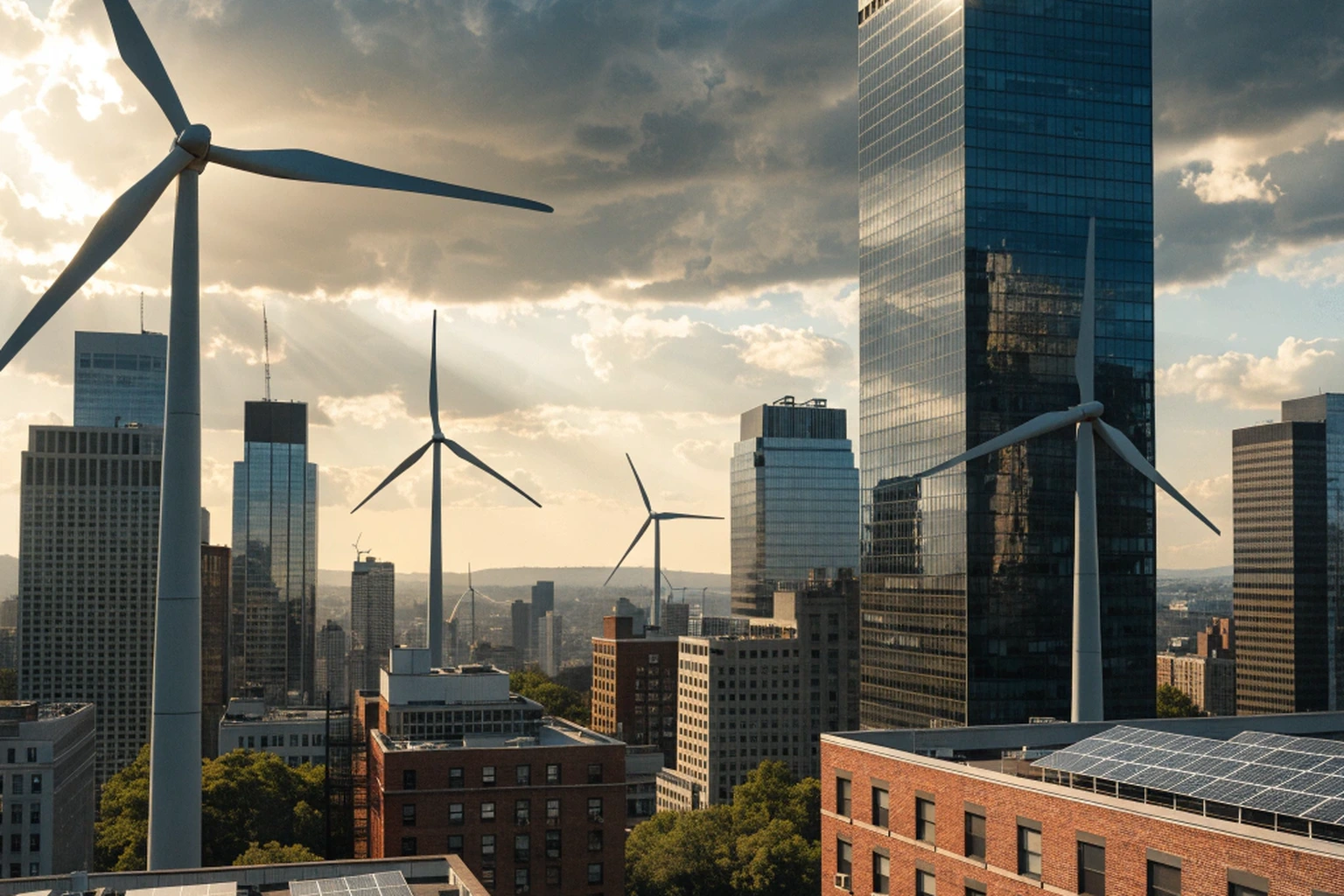
New Energy in the USA
The United States is changing. People use new energy now. This energy comes from the sun and the wind. It is clean energy. Solar power is very popular. Large panels catch the sun. Wind power is also important. Large fans make electricity. These new jobs help the economy. Many workers have new jobs in green energy. They build big machines. This is good for the earth. The air is clean and the future is bright. Many people are happy with this change.
Point grammaire
Structure: Present Simple (to be)
"Solar power is very popular."
We use 'is' for singular subjects to describe a state or a fact. It is the most common verb in English to give information.
Structure: Present Simple (Action Verbs)
"They build big machines."
For plural subjects like 'they', we use the base form of the verb. This pattern describes regular activities or general truths.
Teste ta compréhension
10 questions · A1 Débutant · 1 aperçu gratuit
Teste ce que tu as appris dans cet article. Réponds à toutes les questions pour gagner des XP !
Where does the new energy come from?
Tu veux terminer le quiz ?
9 questions supplémentaires t'attendent. Inscris-toi gratuitement pour débloquer le quiz complet et gagner des XP !
S'inscrire gratuitementTu as dj un compte ? Connexion
Bien joué !
Continue à pratiquer !
Déjà terminé — pas de XP supplémentaire
Inscris-toi pour gagner des XPDétail des questions
Where does the new energy come from?
Ta réponse:
Bonne réponse: The sun and the wind
The article says that new energy is dirty.
Ta réponse:
Bonne réponse: Faux
What does 'earth' mean?
Ta réponse:
Bonne réponse: Our world and planet
Large fans make _____.
Ta réponse:
Bonne réponse: electricity
A Green Future for the United States
The United States is changing. For a long time, people used oil and coal for energy. But now, the country is moving to renewable energy like the sun and the wind. This is a very big change for the economy.
Today, solar power is cheaper than it was ten years ago. It is also cleaner than coal. Because of this, many cities are building large wind farms and solar parks. These big projects help the environment and protect nature.
This transition is also creating many new jobs. Thousands of people now work in factories that make batteries and solar panels. The green economy is becoming very important for every state. It is bigger and stronger every year. Many workers are happy because they have new opportunities in this sector. They learn new skills to help the planet. The future of energy in America is green and bright.
Point grammaire
Structure: Past Simple
"For a long time, people used oil and coal for energy."
We use the past simple to talk about finished actions or habits in the past. It is formed by adding -ed to regular verbs like 'use'.
Structure: Comparatives
"Today, solar power is cheaper than it was ten years ago."
We use comparatives to show the difference between two things. For short adjectives, we add -er + than.
Teste ta compréhension
11 questions · A2 mentaire · 1 aperçu gratuit
Teste ce que tu as appris dans cet article. Réponds à toutes les questions pour gagner des XP !
What kind of energy is the United States moving toward?
Tu veux terminer le quiz ?
10 questions supplémentaires t'attendent. Inscris-toi gratuitement pour débloquer le quiz complet et gagner des XP !
S'inscrire gratuitementTu as dj un compte ? Connexion
Bien joué !
Continue à pratiquer !
Déjà terminé — pas de XP supplémentaire
Inscris-toi pour gagner des XPDétail des questions
What kind of energy is the United States moving toward?
Ta réponse:
Bonne réponse: Renewable energy
Solar power is more expensive today than it was ten years ago.
Ta réponse:
Bonne réponse: Faux
What does 'environment' mean?
Ta réponse:
Bonne réponse: The natural world
The green economy is _____ many new jobs.
Ta réponse:
Bonne réponse: creating
Where do many people work in the green economy?
Ta réponse:
Bonne réponse: In factories making batteries
The Big Shift: America’s Move to Green Energy
The United States is currently going through a major change. For many years, the country has relied on fossil fuels like coal and oil. However, things are changing quickly. The nation is moving toward a 'Green Economy,' which is powered by renewable energy sources like the sun and the wind. This shift is one of the most significant transformations that has happened in recent years.
This transition has been driven by new technology and lower costs. In the past, solar panels were very expensive, but prices have dropped significantly. Because of this, many large companies have decided to invest in clean energy projects. Furthermore, aggressive federal policies have been introduced by the government to support these changes and reduce carbon pollution.
The shift to renewable energy is also creating many opportunities for workers. Hundreds of thousands of new jobs have been created in the manufacturing sector. For example, some factories that used to make car parts are now producing components for wind turbines. This means that people who live in industrial areas have found new ways to earn a living in a changing world.
Many experts believe that this is the most significant economic transformation in modern history. Although there are still challenges to face, the progress that has been made is very impressive. The Green Economy is no longer a small part of the market; it is now a major driver of the American economy. As more people use clean energy, the environment will become cleaner, and the economy will continue to grow for future generations.
Point grammaire
Structure: Present Perfect
"For many years, the country has relied on fossil fuels like coal and oil."
We use the present perfect (has/have + past participle) to describe an action that started in the past and continues to the present. Here, it shows that the reliance on oil began long ago and is still relevant to the current situation.
Structure: Passive Voice
"Hundreds of thousands of new jobs have been created in the manufacturing sector."
The passive voice is used when the action is more important than the person doing it. It is formed using 'be' + past participle. In this sentence, the focus is on the jobs, not the specific companies creating them.
Teste ta compréhension
11 questions · B1 Intermédiaire · 1 aperçu gratuit
Teste ce que tu as appris dans cet article. Réponds à toutes les questions pour gagner des XP !
What is the main reason companies are investing in clean energy projects?
Tu veux terminer le quiz ?
10 questions supplémentaires t'attendent. Inscris-toi gratuitement pour débloquer le quiz complet et gagner des XP !
S'inscrire gratuitementTu as dj un compte ? Connexion
Bien joué !
Continue à pratiquer !
Déjà terminé — pas de XP supplémentaire
Inscris-toi pour gagner des XPDétail des questions
What is the main reason companies are investing in clean energy projects?
Ta réponse:
Bonne réponse: New technology and lower costs
The 'Green Economy' is still a very small and unimportant part of the market.
Ta réponse:
Bonne réponse: Faux
What does 'transition' mean in the context of the article?
Ta réponse:
Bonne réponse: A process of changing from one state to another
The nation is moving toward a 'Green _____', which is powered by renewable energy.
Ta réponse:
Bonne réponse: Economy
What are some factories producing instead of car parts?
Ta réponse:
Bonne réponse: Components for wind turbines
The Great Shift: America's Renewable Energy Revolution
The United States is currently undergoing a monumental shift in its energy landscape, marking one of the most significant economic transformations in its history. This transition from a fossil-fuel-based economy to one powered by renewable sources is no longer a distant goal but a present reality. Driven by remarkable technological breakthroughs and a global urgency to address climate change, the 'Green Economy' has emerged as a major industrial force. Consequently, hundreds of thousands of jobs are being created in the manufacturing and installation sectors, revitalizing regions that once relied heavily on traditional industries.
One of the primary catalysts for this change has been the dramatic reduction in the costs associated with wind and solar power. Over the last decade, these technologies have become increasingly competitive with traditional coal and gas. In many parts of the country, building new renewable capacity is now more cost-effective than continuing to operate existing fossil fuel plants. Furthermore, aggressive federal policies have been implemented to accelerate the pace of decarbonization. These policies provide the necessary financial framework for companies to invest in long-term projects. Had the government not intervened with financial incentives, the transition would likely have been much slower and less coordinated.
However, such a large-scale transformation is not without its significant obstacles. The existing power grid, which was designed decades ago for centralized fossil fuel plants, requires extensive modernization to handle the variable nature of renewable energy. Integrating solar and wind power requires a more flexible and resilient infrastructure. Moreover, the transition necessitates a skilled workforce capable of operating in this new high-tech industrial environment. While some critics argue that the costs of upgrading the national infrastructure are prohibitive, proponents suggest that the long-term economic benefits and energy security far outweigh the initial investment.
In conclusion, the renewable energy transition represents a pivotal moment in American history. It involves a complex interplay between government policy, technological innovation, and market economics. Although the path ahead remains challenging and requires substantial capital, the shift towards a sustainable future appears to be irreversible. The United States is not just changing its power sources; it is redefining its entire economic identity for the twenty-first century. Analysis of current trends suggests that those who adapt most quickly to this green revolution will lead the global economy in the coming decades.
Point grammaire
Structure: Inverted Third Conditional
"Had the government not intervened with financial incentives, the transition would likely have been much slower and less coordinated."
This structure is used to talk about hypothetical situations in the past. 'Had' is placed at the beginning of the sentence to replace 'If', making the tone more formal and academic.
Structure: Present Perfect Passive
"Furthermore, aggressive federal policies have been implemented to accelerate the pace of decarbonization."
This pattern is used to describe actions that happened at an unspecified time in the past and have an effect on the present. The passive voice focuses on the action (the policies) rather than who performed it.
Structure: Concessive Clauses with 'While'
"While some critics argue that the costs of upgrading the national infrastructure are prohibitive, proponents suggest that the long-term economic benefits far outweigh the initial investment."
The word 'while' is used here to introduce a contrast between two different ideas or opinions. It functions similarly to 'although' to provide a balanced analysis of a situation.
Teste ta compréhension
11 questions · B2 Intermédiaire supérieur · 1 aperçu gratuit
Teste ce que tu as appris dans cet article. Réponds à toutes les questions pour gagner des XP !
What is the primary reason the 'Green Economy' is no longer considered a niche sector?
Tu veux terminer le quiz ?
10 questions supplémentaires t'attendent. Inscris-toi gratuitement pour débloquer le quiz complet et gagner des XP !
S'inscrire gratuitementTu as dj un compte ? Connexion
Bien joué !
Continue à pratiquer !
Déjà terminé — pas de XP supplémentaire
Inscris-toi pour gagner des XPDétail des questions
What is the primary reason the 'Green Economy' is no longer considered a niche sector?
Ta réponse:
Bonne réponse: It has become a major industrial force creating many jobs.
Renewable energy is now more expensive to produce than coal and gas in many parts of the U.S.
Ta réponse:
Bonne réponse: Faux
What does 'catalyst' mean in the context of the article?
Ta réponse:
Bonne réponse: A factor that causes or accelerates a change
The existing power _____ requires modernization to handle the variable nature of renewable energy.
Ta réponse:
Bonne réponse: grid
According to the article, what was the role of federal policies?
Ta réponse:
Bonne réponse: To provide a financial framework for long-term projects.
The Great Decarbonization: Navigating the United States' Energy Metamorphosis
Rarely has the American industrial landscape witnessed such a profound upheaval as that currently precipitated by the transition toward renewable energy. Long tethered to the volatility of fossil fuel markets, the United States is now navigating a paradigm shift that transcends mere environmental stewardship. This metamorphosis, driven by a convergence of technological breakthroughs and aggressive fiscal policy, is fundamentally reconfiguring the nation’s economic DNA.
What has catalyzed this accelerated shift is not merely environmental altruism, but a cold, hard economic reality. The plummeting costs of photovoltaic technology and wind turbine manufacturing have rendered renewable energy the most cost-effective option in many regions. Consequently, the Green Economy has ceased to be a niche sector, evolving instead into a primary engine of industrial growth. The subsidization provided by landmark legislation, such as the Inflation Reduction Act, has further bolstered investor confidence, leading to the creation of hundreds of thousands of manufacturing jobs.
However, the path to total decarbonization is fraught with logistical complexities. Central to this challenge is the fragility of the existing electrical grid, which was designed for centralized, predictable power generation. The integration of intermittent energy sources, such as solar and wind, necessitates a radical overhaul of energy storage and transmission infrastructure. Without the widespread implementation of advanced battery systems and long-distance high-voltage lines, the ubiquity of green energy will remain a tantalizing but unreachable goal.
Moreover, the transition is not occurring in a socio-political vacuum. While some regions embrace the influx of green investment, others face the prohibitive social costs of decommissioning legacy coal and gas plants. The displacement of workers in traditional energy sectors poses a significant hurdle, requiring nuanced policy interventions to ensure a 'just transition.' It is the delicate balance between economic pragmatism and social equity that will ultimately determine the success of this endeavor.
Furthermore, the geopolitical implications of this shift are profound. By reducing its reliance on foreign oil, the United States aims to enhance its energy resilience and national security. Yet, this creates a new dependency on the rare earth minerals essential for renewable technologies—minerals often sourced from geopolitical rivals. This irony underscores the complexity of modern energy sovereignty. In conclusion, the renewable energy transition in the United States represents more than a technological upgrade; it is a holistic reimagining of how a global superpower fuels its future.
Point grammaire
Structure: Negative Inversion
"Rarely has the American industrial landscape witnessed such a profound upheaval..."
Inversion is used after negative or restrictive adverbs like 'rarely' or 'seldom' to add emphasis. The auxiliary verb comes before the subject.
Structure: Pseudo-cleft Sentence
"What has catalyzed this accelerated shift is not merely environmental altruism..."
Cleft sentences focus on specific information. Here, the 'What' clause acts as the subject to emphasize the cause of the shift.
Structure: Nominalization
"Without the widespread implementation of advanced battery systems..."
Using nouns like 'implementation' instead of verbs like 'implementing' creates a more formal, academic tone suitable for C1 analysis.
Teste ta compréhension
12 questions · C1 Avancé · 1 aperçu gratuit
Teste ce que tu as appris dans cet article. Réponds à toutes les questions pour gagner des XP !
What is the primary factor driving the renewable energy transition according to the text?
Tu veux terminer le quiz ?
11 questions supplémentaires t'attendent. Inscris-toi gratuitement pour débloquer le quiz complet et gagner des XP !
S'inscrire gratuitementTu as dj un compte ? Connexion
Bien joué !
Continue à pratiquer !
Déjà terminé — pas de XP supplémentaire
Inscris-toi pour gagner des XPDétail des questions
What is the primary factor driving the renewable energy transition according to the text?
Ta réponse:
Bonne réponse: Economic cost-effectiveness and policy
The current electrical grid was originally designed to handle intermittent energy sources.
Ta réponse:
Bonne réponse: Faux
Which word describes the irregular nature of wind and solar energy?
Ta réponse:
Bonne réponse: Intermittent
The transition is not occurring in a socio-political ____.
Ta réponse:
Bonne réponse: vacuum
What is the 'irony' mentioned regarding energy sovereignty?
Ta réponse:
Bonne réponse: Reducing oil reliance creates a new dependency on rare minerals.
The 'Green Economy' is still considered a niche sector in the United States.
Ta réponse:
Bonne réponse: Faux
The Great Decarbonization: Navigating the Socio-Economic Metamorphosis of the American Energy Landscape
The United States currently finds itself at a pivotal juncture, navigating an epochal transition from a carbon-intensive industrial model to a burgeoning 'Green Economy'. This metamorphosis, while ostensibly driven by ecological imperatives, is equally a product of pragmatic economic recalibration. The shift from a fossil-fuel-based hegemony to one powered by renewables represents one of the most significant structural transformations in the nation's history. Central to this evolution is the confluence of rapid technological breakthroughs and aggressive federal policy, most notably the Inflation Reduction Act, which has acted as a catalyst for unprecedented investment in sustainable infrastructure.
Were the nation to ignore the burgeoning demand for sustainable infrastructure, it would risk losing its competitive edge in the global market. The transition is not merely a substitution of energy sources but a wholesale reimagining of industrial production. One could posit that the decline of the coal industry is less a result of regulatory overreach and more a consequence of the inexorable march of market forces; as the levelized cost of solar and wind energy continues to plummet, the economic viability of traditional hydrocarbons faces an existential threat. It is imperative that the federal government continue to provide the impetus for this shift, lest the momentum be squandered in the face of political vacillation.
Furthermore, the labor market is undergoing a profound recalibration. While the specter of industrial obsolescence looms over traditional fossil-fuel hubs, the renewable sector is creating hundreds of thousands of jobs in manufacturing, installation, and research. However, this transition is not without its dialectical tensions. There is a palpable anxiety in regions long dependent on the extraction industry, where the promise of a 'just transition' remains more theoretical than realized. For the nascent green sector to achieve true hegemony, it must address the socio-economic disparities that threaten to undermine public consensus.
Not only does this transition offer a pathway to carbon neutrality, but it also provides a framework for a renewed American industrialism. The reshoring of supply chains for critical minerals and the domestic manufacturing of photovoltaic cells suggest a move toward strategic autonomy. Nevertheless, scholarly analysis suggests that the path ahead is fraught with logistical complexities, from the modernization of an aging electrical grid to the streamlining of permitting processes. It is essential that the workforce be adequately retrained to inhabit these new roles, as the complexity of modern energy systems requires a level of technical proficiency that far exceeds that of previous generations.
Ultimately, the success of the renewable energy transition in the United States will be judged by its ability to synthesize economic growth with environmental stewardship. The transition is an inexorable reality, yet its final form remains a subject of intense debate. Whether the U.S. can maintain its status as a global leader depends on its capacity to navigate these turbulent waters with both foresight and fortitude. The 'Green Economy' is no longer a niche sector; it is the cornerstone of a future that demands both innovation and equity. As the nation pivots, the discourse must shift from whether the transition should occur to how it can be most effectively and equitably managed.
Point grammaire
Structure: Inverted Conditionals
"Were the nation to ignore the burgeoning demand for sustainable infrastructure, it would risk losing its competitive edge."
In formal C2 English, 'were' can be used to replace 'if' in hypothetical conditions. This inversion of the subject and verb adds a layer of formality and theoretical weight to the statement.
Structure: The Subjunctive Mood
"It is essential that the workforce be adequately retrained to inhabit these new roles."
The subjunctive 'be' is used after adjectives of necessity (essential, imperative, crucial). This is a hallmark of formal academic and analytical prose, indicating a requirement or strong recommendation.
Structure: Negative Inversion
"Not only does this transition offer a pathway to carbon neutrality, but it also provides a framework for a renewed American industrialism."
Beginning a sentence with 'Not only' requires an inversion of the subject and auxiliary verb (does this transition offer). This rhetorical device is used to emphasize the dual importance of the points being made.
Teste ta compréhension
12 questions · C2 Maîtrise · 1 aperçu gratuit
Teste ce que tu as appris dans cet article. Réponds à toutes les questions pour gagner des XP !
What does the author suggest is the primary driver behind the energy transition besides ecology?
Tu veux terminer le quiz ?
11 questions supplémentaires t'attendent. Inscris-toi gratuitement pour débloquer le quiz complet et gagner des XP !
S'inscrire gratuitementTu as dj un compte ? Connexion
Bien joué !
Continue à pratiquer !
Déjà terminé — pas de XP supplémentaire
Inscris-toi pour gagner des XPDétail des questions
What does the author suggest is the primary driver behind the energy transition besides ecology?
Ta réponse:
Bonne réponse: Pragmatic economic recalibration
The author argues that the decline of the coal industry is primarily due to excessive government regulation.
Ta réponse:
Bonne réponse: Faux
Which word describes something that is impossible to stop?
Ta réponse:
Bonne réponse: Inexorable
The author notes that there is a _____ anxiety in regions dependent on extraction industries.
Ta réponse:
Bonne réponse: palpable
What logistical complexity is specifically mentioned as a hurdle for the energy transition?
Ta réponse:
Bonne réponse: Modernization of the aging electrical grid
The text suggests that the 'Green Economy' has moved beyond being a niche sector.
Ta réponse:
Bonne réponse: Vrai

