









ted en 30 secondes
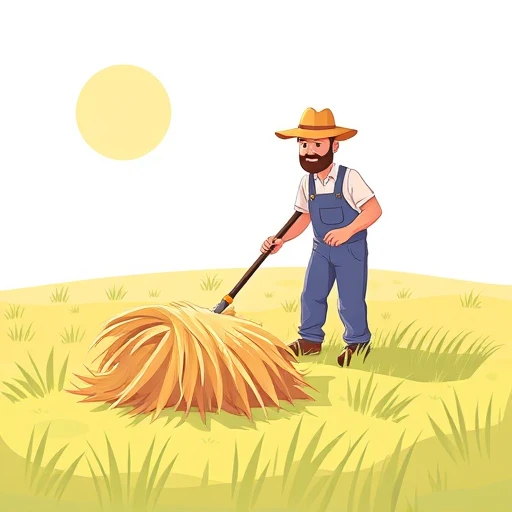
- Tedding is the agricultural act of spreading out cut grass to dry it in the sun.
- It is a vital step in making hay, preventing rot and ensuring high-quality livestock feed.
- The word is primarily used in rural and farming contexts, often involving machinery called tedders.
- Correct usage requires doubling the 'd' in the past tense (tedded) and present participle (tedding).
The verb ted is a highly specialized agricultural term that refers to the specific action of spreading out or turning over mown grass or hay. In the lifecycle of fodder production, tedding is the crucial middle step between cutting (mowing) and gathering (raking/baling). The primary objective of tedding is to facilitate the drying process by exposing the damp underside of the grass to the sun and wind. Without this intervention, hay can rot or ferment improperly, losing its nutritional value for livestock. Historically, this was a labor-intensive manual task performed with wooden forks, but in modern industrial farming, it is accomplished using a machine called a 'tedder' attached to a tractor.
- Agricultural Context
- Tedding is most frequently discussed during the 'hay season'—the window of dry weather in late spring or summer when farmers race against the rain to cure their crops.
After the morning dew had evaporated, the farmhands began to ted the heavy swathes of grass across the meadow.
The word carries a sense of traditional rural life and is often found in pastoral literature or technical farming manuals. It is rarely used in urban settings, making it a marker of specialized knowledge or a connection to the land. When a farmer says they are 'tedding,' they are describing a process of aeration. The grass, once cut, lies in thick rows called 'swaths.' If left undisturbed, the moisture trapped at the bottom would lead to mold. By tedding, the farmer 'fluffs' the grass, allowing air to circulate through the stalks. This is essential for the 'curing' process, which transforms green grass into stable, dry hay that can be stored for winter feed.
- Seasonal Timing
- The timing of tedding is critical; it must be done when the sun is high and the humidity is low to maximize the rate of evaporation.
The rhythmic sound of the tractor tedding the field echoed through the valley all afternoon.
In a broader, more metaphorical sense (though rare), 'tedding' can imply the act of spreading something out to examine it or to let it 'breathe.' However, this usage is almost exclusively literary. In most cases, if you hear the word, you are in the company of someone who understands the intricacies of land management. The word's survival in the English language is a testament to the enduring nature of agriculture, as the fundamental physics of drying grass have not changed in thousands of years, even if the tools have evolved from hand-carved wood to hydraulic steel.
- Mechanical Evolution
- Modern rotary tedders use spinning tines to lift and throw the hay, ensuring a more uniform distribution than manual labor ever could.
We need to ted the hay at least twice today if we hope to bale it before the storm arrives.
Ultimately, to 'ted' is to participate in the ancient dance of the harvest. It is a word of action, of movement, and of preparation. It signifies the transition from the vitality of the growing plant to the utility of the preserved fodder. When you use this word, you are invoking a specific piece of human history and a vital component of the food chain that supports global livestock production.
Using the verb ted correctly requires an understanding of its transitive nature; it almost always takes a direct object, usually 'hay,' 'grass,' or 'crop.' It follows standard conjugation patterns: ted (base), teds (third-person singular), tedded (past tense), and tedding (present participle). Because it is a technical term, it is most at home in descriptive writing, agricultural reports, or historical fiction. It is rarely used in the passive voice, as the action is typically a deliberate task performed by an agent (a farmer or a machine).
- Direct Object Usage
- The verb usually acts upon the material being dried. Example: 'The farmer tedded the alfalfa.'
If the weather holds, we will ted the upper pasture by noon.
In complex sentences, 'ted' often appears in conjunction with other agricultural verbs to describe a sequence of events. For instance, 'mow, ted, and rake' is the standard progression. You might also see it used in the gerund form to describe the activity itself: 'Tedding is essential for high-quality silage.' When writing about the past, 'tedded' evokes a sense of manual labor and the rhythm of the seasons. In a C2 context, one might use it to add precise local color to a narrative set in a rural environment.
- Infinitive Purpose
- It is often used with 'to' to express purpose. Example: 'He went out to ted the grass.'
The laborers were hired specifically to ted the clover before the evening dampness set in.
Furthermore, the word can be used in a more abstract, literary way to describe the dispersal of items. For example, 'The wind tedded the fallen leaves across the lawn.' While this is not the primary definition, it utilizes the core concept of spreading and thinning out a pile of organic material. In academic writing regarding agronomy, the word is used with clinical precision to discuss moisture percentages and drying rates. For example, 'Frequent tedding reduced the moisture content from 70% to 15% within forty-eight hours.'
- Participle as Adjective
- The present participle 'tedding' can describe the machine itself: 'A tedding machine.'
The tedded hay lay like a golden carpet over the field, drying rapidly in the intense July heat.
In summary, 'ted' is a verb of utility and precision. Whether used in a literal farming context or a creative literary one, it conveys a specific physical action of spreading and aerating. Mastery of this word allows for more evocative and accurate descriptions of rural life and agricultural processes, elevating your vocabulary to a professional or C2 level.
The word ted is most commonly heard in geographical areas where livestock farming and hay production are central to the local economy. In the United Kingdom, particularly in regions like the Cotswolds, Yorkshire, or the Scottish Borders, the term is a staple of everyday rural conversation during the summer months. Similarly, in the Midwestern United States or the dairy regions of New Zealand and Australia, farmers use the term casually when discussing their daily chores or the progress of their harvest. You will hear it in livestock markets, agricultural supply stores, and at county fairs where machinery is on display.
- Rural Dialogue
- In a village pub, you might hear a farmer say, 'I've got ten acres left to ted before the rain comes tonight.'
'Have you tedded the bottom meadow yet?' the neighbor shouted over the fence.
Beyond casual conversation, the word is frequently used in specialized media. Agricultural radio programs, such as the BBC's 'The Archers' or rural news podcasts, often mention tedding in the context of weather reports and crop yields. Technical manuals for farm equipment manufacturers like John Deere or Kuhn use the term extensively to describe the function and maintenance of their machinery. If you are watching a documentary about historical farming techniques or the industrialization of agriculture, 'tedding' will likely be used to describe the transition from hand-forking to mechanized drying.
- Literature and Poetry
- Classic English poets and novelists, such as Thomas Hardy or Robert Frost, use 'ted' to ground their work in the physical reality of the countryside.
The poem described the maidens as they went out to ted the hay in the early morning light.
In academic settings, such as agricultural colleges or botanical research centers, 'tedding' is used in the study of forage conservation. Researchers might analyze the impact of different tedding frequencies on the protein content of hay. Therefore, while the word is niche, it is deeply embedded in the professional and cultural vocabulary of anyone involved in the science or practice of farming. It is a word that smells of cut grass and diesel, a word that signals the hard work of the summer harvest.
- Modern Media
- YouTube channels dedicated to farming and 'homesteading' frequently feature videos of 'tedding' as part of their seasonal content.
'Watch as we ted this field to get the moisture down before baling,' the vlogger explained.
In conclusion, you are most likely to encounter 'ted' in the fields, in the pages of rural literature, or in the technical discourse of agronomy. It is a word that bridges the gap between ancient tradition and modern technology, remaining as relevant today as it was centuries ago.
The most common mistake people make with the verb ted is confusing it with other similar-sounding words or misapplying it to non-agricultural contexts. Because 'Ted' is also a common diminutive for the name Edward or Theodore, there is a frequent risk of humorous or confusing ambiguity in spoken English. However, in writing, the lack of capitalization usually distinguishes the verb from the name. Another common error is confusing 'ted' with 'tread' (to walk on) or 'tether' (to tie up). These words are phonetically similar but have entirely different meanings and origins.
- Confusing Ted with Rake
- Many people use 'rake' when they actually mean 'ted.' Raking pulls hay together into a line; tedding spreads it out to dry.
Incorrect: We need to ted the hay into rows for the baler. (Correct: rake)
Another mistake is using 'ted' for general drying tasks. For example, one does not 'ted' laundry on a clothesline, nor does one 'ted' wet hair. The word is strictly reserved for organic material, specifically grass, hay, or straw, in an outdoor agricultural setting. Using it for household chores sounds archaic or intentionally eccentric. Furthermore, learners often forget the spelling rule for the past tense. Since 'ted' is a short vowel word ending in a single consonant, the final 'd' must be doubled: 'tedded,' not 'teded.'
- Misunderstanding the Process
- Some assume tedding is the same as harvesting. It is only one step in the curing process, not the final collection of the crop.
Incorrect: The farmer tedded the wheat to make bread. (Tedding is for hay, not grain harvesting.)
In metaphorical usage, the mistake is often over-extension. While you might poetically say the wind 'tedded' the clouds, using it to mean 'spreading news' or 'distributing wealth' is generally considered incorrect or confusing. The word's physical association with lifting and turning is its defining characteristic. If there is no sense of 'turning over' or 'aerating,' 'ted' is likely the wrong word. Finally, ensure you don't confuse the verb with the noun 'tedder.' You ted the hay with a tedder; you do not 'tedder' the hay.
- Verb vs. Noun Confusion
- Avoid saying 'I am going to tedder the field.' The correct form is 'I am going to ted the field.'
Correct: He spent the morning tedding the grass with his new mechanical tedder.
By avoiding these common pitfalls, you can use 'ted' with the confidence of a native speaker or a seasoned agriculturalist. Precision in vocabulary is the hallmark of advanced language proficiency, and understanding the specific boundaries of 'ted' is a perfect example of this.
While ted is a very specific term, there are several related words that describe similar actions in agriculture and beyond. Understanding the nuances between these words will help you choose the most appropriate term for your context. The most common synonym is 'turn,' but 'turn' is much broader and lacks the specific implication of spreading for the purpose of drying. Other related terms include 'rake,' 'spread,' 'aerate,' and 'strew.' Each of these has a slightly different focus, whether it be the tool used, the intended outcome, or the manner of movement.
- Ted vs. Turn
- 'Turn' is the general action. 'Ted' is the specific agricultural process of turning and spreading hay to dry. You can turn a pancake, but you cannot ted one.
While he tedded the hay, his brother turned the soil in the garden.
'Rake' is often confused with 'ted,' but they are actually opposite actions in the haymaking process. To rake is to gather together into a concentrated line (a windrow), whereas to ted is to scatter and thin out. 'Spread' is a more general synonym that can be used for butter, news, or hay, but it lacks the technical 'turning' component of tedding. 'Aerate' is a scientific term that describes the goal of tedding—introducing air—but it is more commonly used for soil (poking holes) or water (adding oxygen) than for hay.
- Ted vs. Strew
- 'Strew' implies a messy or random scattering (e.g., 'strewing flowers'). 'Ted' is a systematic, purposeful scattering for a functional goal.
The wind tedded the grass more effectively than the old hand-forks ever could.
In literary contexts, you might see 'winnow' used similarly, though winnowing specifically refers to blowing air through grain to remove the chaff. 'Scatter' is another alternative, but like 'strew,' it lacks the industrial or agricultural precision of 'ted.' If you are looking for a more modern, technical term, 'mechanical conditioning' is sometimes used in industrial farming, though it refers to a slightly different process of crushing the stalks to speed up drying. For most purposes, 'ted' remains the most accurate and evocative word for the task at hand.
- Comparison Table
- Ted: Spreading for drying. Rake: Gathering for collection. Mow: Cutting the grass. Bale: Compressing for storage.
The farmer had to ted the crop before he could even think about raking it into windrows.
How Formal Is It?
Le savais-tu ?
Despite its ancient roots, the word is still the standard technical term in modern high-tech agriculture.
Guide de prononciation
- Pronouncing it like 'teed' (long e).
- Confusing it with 'tread' (adding an 'r').
- Mumbling the final 'd'.
Niveau de difficulté
Easy to read but requires context to understand the specific meaning.
Requires knowledge of the double 'd' spelling rule and specific context.
Simple pronunciation but rare in everyday urban speech.
Can be confused with the name 'Ted' or the word 'tread'.
Quoi apprendre ensuite
Prérequis
Apprends ensuite
Avancé
Grammaire à connaître
CVC Doubling
ted -> tedded, tedding (double the final consonant).
Transitive Verbs
The farmer tedded the hay (requires an object).
Gerund as Subject
Tedding is essential for drying.
Infinitive of Purpose
He went out to ted the grass.
Past Participle as Adjective
The tedded hay smelled sweet.
Exemples par niveau
The farmer will ted the grass.
Le fermier va faner l'herbe.
Simple future tense.
It is time to ted the hay.
Il est temps de faner le foin.
Infinitive phrase.
Do you ted the grass?
Est-ce que tu fanes l'herbe ?
Simple present question.
He teds the hay every summer.
Il fane le foin chaque été.
Third-person singular -s.
We need to ted the field.
Nous devons faner le champ.
Modal verb 'need to'.
The sun helps to ted the hay.
Le soleil aide à faner le foin.
Subject-verb-object.
They ted the grass today.
Ils fanent l'herbe aujourd'hui.
Present tense.
Can you help me ted?
Peux-tu m'aider à faner ?
Modal verb 'can'.
The tractor is tedding the hay now.
Le tracteur est en train de faner le foin.
Present continuous.
Yesterday, they tedded all the grass.
Hier, ils ont fané toute l'herbe.
Past tense with double 'd'.
You must ted the hay when it is dry.
Tu dois faner le foin quand il fait sec.
Modal 'must'.
Is he tedding the field by himself?
Est-ce qu'il fane le champ tout seul ?
Continuous question.
The machine teds the grass very fast.
La machine fane l'herbe très vite.
Adverb 'fast'.
We like tedding in the morning.
Nous aimons faner le matin.
Gerund after 'like'.
She learned how to ted last year.
Elle a appris à faner l'année dernière.
Past tense 'learned'.
Don't forget to ted the clover.
N'oublie pas de faner le trèfle.
Imperative negative.
If we don't ted the hay, it will rot.
Si nous ne fanons pas le foin, il va pourrir.
First conditional.
The workers have been tedding since dawn.
Les ouvriers fanent depuis l'aube.
Present perfect continuous.
Tedding is a vital part of the harvest.
Le fanage est une partie vitale de la récolte.
Gerund as subject.
He bought a new machine to ted the crop.
Il a acheté une nouvelle machine pour faner la récolte.
Infinitive of purpose.
The hay was tedded twice before baling.
Le foin a été fané deux fois avant la mise en balles.
Passive voice.
While tedding, the farmer saw a fox.
En fanant, le fermier a vu un renard.
Participle clause.
It’s important to ted the grass evenly.
Il est important de faner l'herbe uniformément.
Adverb 'evenly'.
They decided to ted the upper meadow first.
Ils ont décidé de faner le pré du haut en premier.
Infinitive after 'decided'.
The rotary tedder is designed to ted efficiently.
La faneuse rotative est conçue pour faner efficacement.
Passive construction.
By tedding the grass, you reduce moisture.
En fanant l'herbe, vous réduisez l'humidité.
Preposition + gerund.
The crop needs tedding at regular intervals.
La récolte a besoin d'être fanée à intervalles réguliers.
Need + gerund (passive sense).
He spent the whole afternoon tedding the alfalfa.
Il a passé tout l'après-midi à faner la luzerne.
Spend time + gerund.
The wind tedded the dry leaves across the yard.
Le vent a éparpillé les feuilles sèches dans la cour.
Metaphorical use.
Tedding ensures that the hay cures properly.
Le fanage garantit que le foin sèche correctement.
Noun clause.
Having tedded the field, he went inside.
Ayant fané le champ, il est rentré.
Perfect participle.
The smell of tedded grass filled the air.
L'odeur de l'herbe fanée remplissait l'air.
Past participle as adjective.
The efficacy of tedding depends on the humidity.
L'efficacité du fanage dépend de l'humidité.
Abstract noun subject.
They tedded the swathes to accelerate drying.
Ils ont fané les andains pour accélérer le séchage.
Technical term 'swathes'.
Tedding must be performed with great care.
Le fanage doit être effectué avec grand soin.
Modal passive.
The mechanical action of tedding fluffs the hay.
L'action mécanique du fanage aère le foin.
Specific verb 'fluffs'.
Frequent tedding is necessary in damp climates.
Un fanage fréquent est nécessaire dans les climats humides.
Adjective + gerund.
The sun-drenched field was ready to be tedded.
Le champ inondé de soleil était prêt à être fané.
Compound adjective.
He watched the machine ted the long rows.
Il regardait la machine faner les longues rangées.
Watch + object + bare infinitive.
Tedding prevents the formation of harmful molds.
Le fanage empêche la formation de moisissures nocives.
Gerund subject.
The labor of tedding was once a communal effort.
Le travail de fanage était autrefois un effort communal.
Historical context.
The wind tedded the clouds across the azure sky.
Le vent éparpillait les nuages dans le ciel azur.
Poetic metaphor.
Agronomists study the optimal time to ted.
Les agronomes étudient le moment optimal pour faner.
Academic context.
Tedding requires a delicate touch to avoid leaf loss.
Le fanage nécessite un toucher délicat pour éviter la perte de feuilles.
Technical nuance.
The rhythmic tedding of the hay defined his summer.
Le fanage rythmique du foin a défini son été.
Gerund as noun.
She tedded the documents across the desk to sort them.
Elle a étalé les documents sur le bureau pour les trier.
Extended metaphorical use.
To ted is to engage with the elements of nature.
Faner, c'est s'engager avec les éléments de la nature.
Infinitive as subject.
The field, newly tedded, shimmered in the heat.
Le champ, nouvellement fané, miroitait dans la chaleur.
Appositive participle phrase.
Synonymes
Antonymes
Collocations courantes
Phrases Courantes
— The two main steps of drying and gathering hay.
We have to ted and rake before sunset.
— A general way to refer to the material being processed.
The farmer tedded the crop after mowing.
Souvent confondu avec
The common name for Edward or Theodore.
To walk or step on something.
To tie an animal to a post.
Expressions idiomatiques
— Engaging in a futile or useless activity (rare/regional).
Trying to convince him is like tedding the wind.
informal— Scattered or spread out in a messy way.
The papers were tedded like hay across the floor.
literary— To spread out or organize one's ideas (very rare).
I need a moment to ted my thoughts before the meeting.
poetic— A modern play on words among farmers, meaning it's time to work.
Sun's out, ted's out—let's get to the field!
slang— To spread something very widely or thinly.
He tedded his resources thin across too many projects.
metaphorical— To spread or air out the facts (obscure).
It's time we ted the truth about what happened.
archaic— Preparing the way for something else.
The early work tedded the path for the final success.
metaphorical— Completely finished with the spreading task.
The field is all tedded up and ready for the sun.
informal— Extremely dry (referring to hay).
This hay is tedded to the bone; it's perfect.
farming slang— To keep working or moving forward.
Just keep on tedding; we'll finish eventually.
informalFacile à confondre
Both are haymaking tasks.
Raking gathers; tedding spreads.
First we ted, then we rake.
Both involve grass.
Mowing cuts; tedding dries.
He mowed the field and then tedded it.
Both are harvest steps.
Baling packs; tedding spreads.
You can't bale until you ted.
Both mean to spread.
Strewing is random; tedding is for drying.
Don't just strew the hay; ted it properly.
Both involve air.
Aerating is often for soil; tedding is for hay.
The machine teds the hay to aerate it.
Structures de phrases
I ted the hay.
I ted the hay.
He is tedding the grass.
He is tedding the grass.
We have tedded the field.
We have tedded the field.
The hay needs tedding.
The hay needs tedding.
After tedding the crop, we waited.
After tedding the crop, we waited.
The act of tedding defines the season.
The act of tedding defines the season.
Rarely had he tedded so much hay.
Rarely had he tedded so much hay.
The wind tedded the clouds.
The wind tedded the clouds.
Famille de mots
Noms
Verbes
Adjectifs
Apparenté
Comment l'utiliser
Low (general English), High (agricultural English)
-
teded
→
tedded
You must double the final consonant in short-vowel verbs.
-
teding
→
tedding
The present participle also requires a double 'd'.
-
I tedded the laundry.
→
I aired the laundry.
'Ted' is only for agricultural use.
-
He is teddering the field.
→
He is tedding the field.
'Tedder' is the noun; 'ted' is the verb.
-
Ted the hay into a pile.
→
Rake the hay into a pile.
Tedding spreads; it does not pile.
Astuces
Double the D
Always remember 'tedded' and 'tedding' have two 'd's.
Short E
Keep the 'e' short, like in 'bed'.
Know the Sequence
Remember: Mow -> Ted -> Rake -> Bale.
Ted vs Rake
Ted = Spread. Rake = Collect.
The Tedder
The machine is a 'tedder,' but the action is 'to ted'.
Sunny Days
Tedding is a 'fair weather' word.
Pastoral Tone
Use 'ted' to give your writing a rural, traditional feel.
Transitive
Always give 'ted' an object (e.g., ted the hay).
T-E-D
Turns Every Day (to dry).
Mémorise-le
Moyen mnémotechnique
Think of 'Ted' the farmer who 'teds' the hay to keep it 'dry.' (T-E-D: Turns Every Day).
Association visuelle
Imagine a giant fork lifting a pile of grass and shaking it out like a rug.
Word Web
Défi
Try to use 'ted' in a sentence describing something other than hay, like leaves or papers, to test its metaphorical limits.
Origine du mot
Derived from Middle English 'tedden,' which likely comes from an Old Norse source.
Sens originel : The Old Norse 'teðja' meant to spread manure or dung, but the English meaning shifted exclusively to hay.
Germanic (Scandinavian branch).Contexte culturel
No specific sensitivities; it is a neutral technical term.
Commonly used in the UK, Ireland, USA, Canada, Australia, and NZ farming communities.
Pratique dans la vie réelle
Contextes réels
On a farm
- ted the hay
- get the tedder out
- ted the field
- check the tedding
In a weather report
- good for tedding
- dry enough to ted
- window for tedding
- rain will stop tedding
In a history book
- tedded by hand
- manual tedding
- traditional haymaking
- tedding forks
In a machinery catalog
- high-speed tedding
- efficient tedding
- tedding width
- rotary tedding
In rural literature
- the scent of tedded hay
- tedding in the sun
- rhythmic tedding
- labor of tedding
Amorces de conversation
"Have you ever seen a tractor tedding hay in a field during the summer?"
"Do you think manual tedding was more difficult than modern mechanical methods?"
"Why is tedding such a critical step in the process of making hay?"
"In your country, is there a specific word for turning grass to dry it?"
"How does the weather affect a farmer's decision to ted their crop?"
Sujets d'écriture
Describe the sights and smells of a field where hay is being tedded on a hot July afternoon.
Imagine you are a farmer in the 1800s. Write about a day spent tedding hay by hand.
Discuss the importance of specialized vocabulary like 'ted' in preserving cultural and professional identities.
Write a poem where the wind acts as a 'tedder' of leaves or clouds.
Argue for the importance of modern agricultural machinery in making tasks like tedding more efficient.
Questions fréquentes
10 questionsTedding is the process of spreading out cut grass to help it dry. Raking is the process of gathering that dry grass into rows so it can be picked up or baled. They are opposite actions.
Technically, no. 'Ted' is specifically an agricultural term for grass or hay. For laundry, you would use 'air' or 'hang out'.
It is spelled with two 'd's: 'tedded'. This follows the English rule of doubling the final consonant for short-vowel, single-syllable words.
It is very common in farming communities but quite rare in cities. It is a specialized 'niche' word.
A tedder is the machine used to ted hay. It usually has spinning arms with metal teeth (tines) that lift and scatter the grass.
They ted hay to make sure it dries evenly. If hay is stored while wet, it can grow mold or even catch fire due to chemical reactions.
No, 'ted' is only a verb. The noun form for the person or machine is 'tedder', and the activity is 'tedding'.
The best time is on a sunny, windy day, usually a few hours after the grass has been cut and the morning dew has dried.
Yes, it is used in both British and American English, as well as in other English-speaking agricultural regions.
Yes, in literature, it can mean to spread or scatter things like leaves or clouds, but this is less common than its farming meaning.
Teste-toi 200 questions
Write a sentence using 'ted' in the present continuous tense.
Well written! Good try! Check the sample answer below.
Explain why a farmer might need to ted their crop twice in one day.
Well written! Good try! Check the sample answer below.
Use 'tedded' in a sentence about a historical farm.
Well written! Good try! Check the sample answer below.
Write a short paragraph describing the process of haymaking, including the word 'ted'.
Well written! Good try! Check the sample answer below.
Create a metaphorical sentence using the verb 'ted'.
Well written! Good try! Check the sample answer below.
Describe a 'tedder' machine and its function.
Well written! Good try! Check the sample answer below.
Write a dialogue between two farmers about tedding.
Well written! Good try! Check the sample answer below.
Explain the difference between tedding and raking in three sentences.
Well written! Good try! Check the sample answer below.
Use the word 'tedding' as the subject of a sentence.
Well written! Good try! Check the sample answer below.
Write a formal sentence about tedding for an agricultural report.
Well written! Good try! Check the sample answer below.
Describe the smell of 'tedded hay'.
Well written! Good try! Check the sample answer below.
Write a sentence using 'ted' and 'sunshine'.
Well written! Good try! Check the sample answer below.
Use 'ted' in a question.
Well written! Good try! Check the sample answer below.
Write a sentence about a 'rotary tedder'.
Well written! Good try! Check the sample answer below.
Explain the etymology of 'ted' in your own words.
Well written! Good try! Check the sample answer below.
Write a sentence about 'tedding the swathes'.
Well written! Good try! Check the sample answer below.
Use 'ted' in a conditional sentence (If...).
Well written! Good try! Check the sample answer below.
Write a sentence about 'manual tedding'.
Well written! Good try! Check the sample answer below.
Describe a field that has just been tedded.
Well written! Good try! Check the sample answer below.
Write a sentence using 'ted' to describe clouds.
Well written! Good try! Check the sample answer below.
Pronounce the word 'ted'.
Read this aloud:
Tu as dit :
Speech recognition is not supported in your browser. Try Chrome or Edge.
Pronounce the word 'tedded'.
Read this aloud:
Tu as dit :
Speech recognition is not supported in your browser. Try Chrome or Edge.
Pronounce the word 'tedding'.
Read this aloud:
Tu as dit :
Speech recognition is not supported in your browser. Try Chrome or Edge.
Use 'ted' in a sentence about a farm.
Read this aloud:
Tu as dit :
Speech recognition is not supported in your browser. Try Chrome or Edge.
Explain the difference between tedding and raking aloud.
Read this aloud:
Tu as dit :
Speech recognition is not supported in your browser. Try Chrome or Edge.
Describe a tedder machine to a friend.
Read this aloud:
Tu as dit :
Speech recognition is not supported in your browser. Try Chrome or Edge.
Say: 'The farmer tedded the hay in the sunshine.'
Read this aloud:
Tu as dit :
Speech recognition is not supported in your browser. Try Chrome or Edge.
Say: 'Tedding is essential for high-quality silage.'
Read this aloud:
Tu as dit :
Speech recognition is not supported in your browser. Try Chrome or Edge.
Say: 'We need to ted the alfalfa twice today.'
Read this aloud:
Tu as dit :
Speech recognition is not supported in your browser. Try Chrome or Edge.
Say: 'The wind tedded the clouds across the sky.'
Read this aloud:
Tu as dit :
Speech recognition is not supported in your browser. Try Chrome or Edge.
Describe your favorite summer activity using the word 'tedding'.
Read this aloud:
Tu as dit :
Speech recognition is not supported in your browser. Try Chrome or Edge.
Explain why tedding is important for cows.
Read this aloud:
Tu as dit :
Speech recognition is not supported in your browser. Try Chrome or Edge.
Say: 'The rotary tedder is very efficient.'
Read this aloud:
Tu as dit :
Speech recognition is not supported in your browser. Try Chrome or Edge.
Say: 'Have you tedded the lower meadow yet?'
Read this aloud:
Tu as dit :
Speech recognition is not supported in your browser. Try Chrome or Edge.
Say: 'The scent of tedded grass is wonderful.'
Read this aloud:
Tu as dit :
Speech recognition is not supported in your browser. Try Chrome or Edge.
Say: 'Agronomists study the best time to ted.'
Read this aloud:
Tu as dit :
Speech recognition is not supported in your browser. Try Chrome or Edge.
Say: 'Manual tedding was a communal effort.'
Read this aloud:
Tu as dit :
Speech recognition is not supported in your browser. Try Chrome or Edge.
Say: 'Don't forget to ted the swathes.'
Read this aloud:
Tu as dit :
Speech recognition is not supported in your browser. Try Chrome or Edge.
Say: 'The sun helps to ted the hay.'
Read this aloud:
Tu as dit :
Speech recognition is not supported in your browser. Try Chrome or Edge.
Say: 'Tedding prevents rot.'
Read this aloud:
Tu as dit :
Speech recognition is not supported in your browser. Try Chrome or Edge.
Listen and identify the verb: 'The farmer is tedding the field.'
Listen and identify the object: 'We must ted the hay now.'
Listen and identify the tense: 'He tedded the grass yesterday.'
Listen for the machine name: 'The tedder is broken.'
Listen and determine if the action is finished: 'I have tedded the meadow.'
Listen for the crop name: 'Ted the alfalfa before the rain.'
Listen for the reason: 'We ted to prevent mold.'
Listen and identify the speaker's location: 'I'm out here tedding the back forty.'
Listen for the frequency: 'You should ted the hay twice.'
Listen for the tool: 'He used a fork to ted the grass.'
Listen and identify the tone: 'The rhythmic tedding of the hay...' (Poetic/Descriptive)
Listen for the time: 'We will ted at noon.'
Listen for the weather: 'It's too wet to ted.'
Listen for the subject: 'The machine teds the grass.'
Listen for the synonym: 'He went to turn the hay.'
/ 200 correct
Perfect score!
Summary
The verb 'ted' is a specific agricultural term for aerating and spreading mown grass to facilitate drying. Example: 'We must ted the hay twice today to ensure it cures before the storm arrives.'
- Tedding is the agricultural act of spreading out cut grass to dry it in the sun.
- It is a vital step in making hay, preventing rot and ensuring high-quality livestock feed.
- The word is primarily used in rural and farming contexts, often involving machinery called tedders.
- Correct usage requires doubling the 'd' in the past tense (tedded) and present participle (tedding).
Context is Key
Only use 'ted' when discussing hay or in a very specific poetic sense.
Double the D
Always remember 'tedded' and 'tedding' have two 'd's.
Short E
Keep the 'e' short, like in 'bed'.
Know the Sequence
Remember: Mow -> Ted -> Rake -> Bale.
Exemple
We must ted the hay while the sun is still high in the sky.
Contenu associé
Voir dans les vidéos



Expressions liées
Plus de mots sur Actions
bites
B1Il prend plusieurs bouchées de son gâteau.
trying
B2La situation était particulièrement éprouvante pour les nouveaux parents qui ne dormaient plus.
appear
A1Le soleil apparaît le matin.
decided
B1Il a décidé de partir tôt pour éviter les embouteillages.
combined
B1Leurs efforts combinés ont permis de terminer le projet à temps.
finish
A1Je finis mes devoirs.
compose
A1Elle a passé toute la nuit à composer une lettre d'amour passionnée. L'eau est composée de deux atomes d'hydrogène et d'un atome d'oxygène.
met
B1J'ai rencontré mon ami hier au café.
extend
B1Étendre signifie rendre quelque chose plus long ou plus grand, comme une date limite ou un bras.
traveling
A2Le voyage est l'activité consistant à se déplacer d'un endroit à un autre.
Commentaires (0)
Connectez-vous pour CommenterDécouvre notre contenu d'apprentissage
Langues
Vocabulaire
Expressions
Règles de grammaire
Nous utilisons des cookies essentiels pour la connexion, la sécurité et les préférences. Les analyses optionnelles ne démarrent que si vous les acceptez.

Installer SubLearn
Ajoute à ton écran d'accueil pour une expérience plus rapide, comme une application
Se connecter Créer un compte
Fastest option

Historique des conversations
Aucune conversation passée.
Assistant SubLearn
Support IA
Tu veux créer un ticket de support ? Un agent humain pourra t'aider.
Tu as utilisé tes messages gratuits
Inscris-toi pour un chat IA illimitéPropulsé par IA — les réponses peuvent parfois être inexactes