baldy 30秒で
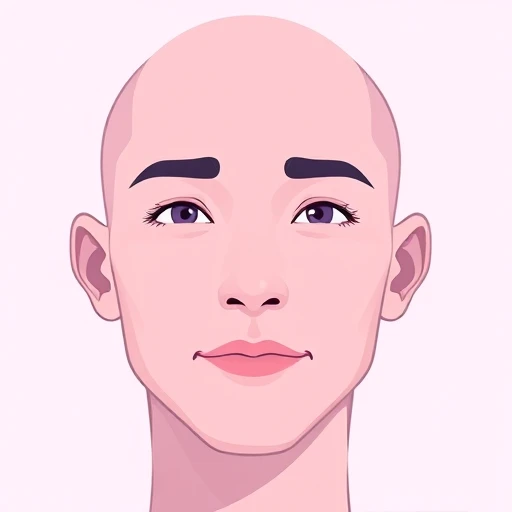
- A baldy is an informal noun for a person who is bald, often used as a nickname or a teasing label among friends and family members.
- The word is derived from the adjective 'bald' with the suffix '-y', making it a countable noun that specifically refers to the person rather than the trait.
- While it can be used affectionately in close relationships, it is potentially offensive when used by strangers or in formal settings, as it reduces identity to appearance.
- Commonly heard in British and American English, it is a staple of informal banter, comedic writing, and casual descriptions of people in everyday life.
The word baldy is a noun that refers specifically to a person who has little or no hair on their head. While the adjective 'bald' describes the state of hairlessness, 'baldy' turns that characteristic into a label for the person themselves. It is important to understand that this term is highly informal and carries a specific social weight. In many English-speaking cultures, particularly in the United Kingdom, Australia, and parts of North America, 'baldy' is used as a nickname or a descriptive label. However, its reception depends entirely on the relationship between the speaker and the listener. Among close friends, it might be used as a form of 'banter'—a playful, teasing way to acknowledge a friend's receding hairline or shaved head. In this context, it is often seen as affectionate, though still slightly irreverent. Conversely, if used by a stranger or in a heated argument, 'baldy' can be perceived as a mild insult or a derogatory remark aimed at someone's physical appearance. The suffix '-y' in English often acts as a diminutive, which can either make a word sound 'cuter' and more familiar or, paradoxically, more belittling. For a learner of English at the B1 level, it is crucial to recognize that while you might hear this word in movies, television shows, or casual conversations, you should be very cautious about using it yourself. It is rarely appropriate in professional, formal, or respectful settings. If you are describing someone's appearance to the police or in a medical context, you would say 'the man was bald' rather than calling him 'a baldy.' The word essentially reduces a person's entire identity to their lack of hair, which is why it can be sensitive. In modern discourse, there is an increasing awareness of 'body shaming,' and even though hair loss is a natural process for many, calling someone a 'baldy' can sometimes be seen as insensitive. Historically, the term has been around for centuries, evolving alongside other physical descriptors. It captures a specific type of casual, often masculine, social interaction where physical traits are fair game for commentary. When you encounter this word, look for the tone of the speaker. Is there a smile? Is the tone aggressive? This will tell you whether 'baldy' is being used as a friendly jab or a genuine attempt to offend.
- Grammatical Category
- Noun (Countable). Plural: baldies.
- Register
- Informal, Colloquial, potentially Pejorative.
- Typical Subject
- Usually refers to adult men, though it can technically apply to anyone without hair.
'Hey, baldy! Did you forget to put on your hat in this cold weather?' laughed his brother.
The comedian made a joke about being a baldy to win over the audience.
In the old cartoon, the villain was often depicted as a grumpy baldy.
He took no offense when his friends called him a baldy during the football match.
The little boy pointed at the man and whispered, 'Look at that baldy,' much to his mother's embarrassment.
Using the word baldy correctly requires an understanding of its grammatical function as a countable noun. Unlike 'bald,' which is an adjective used to describe a person (e.g., 'He is bald'), 'baldy' is the person themselves. You will often see it preceded by an article like 'a' or 'the,' or used directly as a vocative—a word used to address someone directly. For example, 'Hey, baldy!' is a direct address. In terms of sentence structure, it often occupies the subject or object position. For instance, 'The baldy in the front row couldn't see the screen' or 'I saw a couple of baldies at the gym today.' Because it is informal, it is frequently found in spoken English rather than formal writing. You might encounter it in dialogue within a novel to establish a character's rough or casual personality. It is also common in comedic writing. When using the plural form, 'baldies,' the same rules apply. It is important to note that 'baldy' can sometimes be modified by adjectives to change the tone. A 'grumpy baldy' or a 'cute baldy' (though the latter is rare) shows how the noun can be expanded. Another common usage is as a nickname. In some social circles, a man who loses his hair early might be nicknamed 'Baldy' by his peers. In this case, it functions like a proper noun and is often capitalized. However, as a learner, you should be aware of the 'social' grammar of the word. Using it in a sentence like 'My boss is a baldy' could get you into trouble, whereas 'My brother is a bit of a baldy' might be acceptable depending on your family dynamic. The word is also sometimes used in compound-like structures or alongside other informal descriptors. You might hear someone say, 'He’s a right old baldy,' where 'right old' acts as an intensifier common in British dialects. In American English, you might hear 'baldy' less frequently than terms like 'bald-headed guy,' but it remains universally understood across the Anglosphere. When practicing your writing, try to use 'baldy' in contexts where characters are being informal or slightly rude. This helps you internalize the 'flavor' of the word. Remember, the goal of using such a word is often to evoke a specific atmosphere—one of casualness, disrespect, or intimate familiarity. If your goal is simply to describe someone's appearance neutrally, stick to 'the man with the bald head' or 'he is bald.' The noun 'baldy' is never neutral; it always carries an emotional or social charge.
- As a Subject
- 'The baldy shouted at the kids to get off his lawn.'
- As an Object
- 'I wouldn't want to be a baldy in this freezing weather.'
- As a Nickname
- 'Everyone in the village knows Baldy Miller.'
'Don't be such a baldy,' he joked, pointing at his friend's thinning hair.
The group of baldies at the convention were all wearing matching t-shirts.
He was tired of being called a baldy by his younger cousins.
You are most likely to hear the word baldy in environments where informal, candid, or even slightly aggressive language is common. One of the primary settings is among groups of men, particularly in sports culture. In the locker room of a football or rugby club, players often use physical traits as the basis for nicknames or 'ribbing' (gentle teasing). A player who has lost his hair might be referred to as 'the baldy' by his teammates. This is a classic example of 'in-group' language where a term that might be offensive to an outsider is used as a sign of camaraderie. You will also hear it in British sitcoms and comedy sketches. British humor often relies on self-deprecation or making fun of physical imperfections, and 'baldy' is a staple of this tradition. Think of characters in shows like 'Only Fools and Horses' or 'The Royle Family,' where such terms are used to ground the characters in a working-class, everyday reality. In movies, a 'baldy' might be a character archetype—often a tough guy, a villain, or a comic relief character. For example, a group of street toughs might yell 'Hey, baldy!' at a protagonist to provoke a fight. In the world of children's literature or cartoons, 'baldy' is sometimes used because it is a simple, descriptive word that children can easily understand, though it is often used by 'bully' characters to show their mean nature. Another place you might encounter the word is in online forums or social media comments, particularly in discussions about celebrities or public figures. If a famous actor is seen with a receding hairline, 'trolls' or commenters might use the term 'baldy' to mock them. However, it is also used in 'bald pride' communities where people embrace their hairlessness. In these spaces, 'baldy' might be reclaimed as a positive or neutral term, similar to how other descriptive labels have been reclaimed by the communities they describe. Finally, you might hear it in very old-fashioned contexts. In the mid-20th century, 'baldy' was a more common, almost standard informal term, whereas today it is often replaced by more modern slang or simply avoided in favor of more sensitive language. Understanding where you hear 'baldy' helps you understand the social boundaries of English. It’s a word of the streets, the pubs, and the playgrounds, not the boardroom or the classroom. When you hear it, pay attention to the power dynamic: who is saying it to whom? This will give you a deep insight into the relationship between the speakers.
- Movies & TV
- Often used by bullies or in 'tough guy' dialogue to demean a character.
- Sports Culture
- A common nickname for players or coaches with no hair.
- Everyday Banter
- Used between close friends (usually male) as a playful insult.
In the movie, the protagonist's rival sneers, 'Listen here, baldy, stay out of my way.'
The crowd at the stadium started a lighthearted chant for the 'famous baldy' on the wing.
One of the most frequent mistakes learners make with the word baldy is confusing its part of speech. Many students try to use 'baldy' as an adjective, saying things like 'He is a baldy man' or 'His head is baldy.' This is grammatically incorrect. 'Baldy' is a noun that represents the person. The correct adjective is 'bald.' So, you should say 'He is a bald man' or 'He is a baldy.' Using both together is redundant and sounds unnatural to native speakers. Another common error is failing to recognize the level of formality. Because 'baldy' is a simple word, learners might assume it is safe to use in any casual situation. However, as mentioned before, it can be quite offensive. A mistake would be using it to describe a stranger or someone in a position of authority, even if you think you are being 'casual.' For example, calling a bald waiter 'baldy' would be considered extremely rude and would likely result in a complaint. A third mistake involves pronunciation and spelling. Learners sometimes confuse 'baldy' with 'boldly' (the adverb form of 'bold,' meaning brave). While they sound somewhat similar, their meanings are entirely different. 'He walked boldly' means he walked with confidence, while 'He walked baldy' is nonsense. In terms of spelling, remember the 'y' at the end; some might mistakenly write 'baldie,' which is actually an accepted alternative spelling, but 'baldy' is more common in most regions. Another nuance is the pluralization. The plural of 'baldy' is 'baldies.' Some learners might try to say 'baldys,' which is incorrect. Finally, there is the mistake of 'over-application.' Not every person without hair is a 'baldy.' The term usually implies a certain look—often a completely smooth head or a very obvious pattern of male-pattern baldness. Using it for someone who has a very short buzz cut (where hair is still visible) might not be technically accurate in the slang sense. To avoid these mistakes, always ask yourself: 'Is this a formal situation?' and 'Do I know this person well enough to tease them?' If the answer to either is no, avoid the word 'baldy' entirely and use 'bald' or 'hairless' instead. Understanding these boundaries is what separates a B1 learner from a more advanced, culturally fluent speaker.
- Confusing Noun and Adjective
- Incorrect: 'The baldy head.' Correct: 'The bald head' or 'The baldy's head.'
- Inappropriate Formality
- Incorrect: Using 'baldy' in a job interview or a formal report.
- Spelling/Homophone Confusion
- Confusing 'baldy' with 'boldly' or 'body'.
Mistake: 'Look at that baldy mountain.' (Incorrect usage as an adjective for an object).
Correction: 'Look at that bald mountain.' (Correct adjective usage).
If you want to describe someone without hair but feel that baldy is too informal or potentially rude, there are several alternatives you can use, depending on the context. The most direct and neutral alternative is simply the adjective bald. For example, 'He is bald' or 'a bald man.' This is safe in almost any situation. If you want to be more descriptive or slightly more polite, you might use phrases like thinning on top or receding hairline. These suggest that the person is in the process of losing their hair, which can feel less 'final' and blunt than calling them a 'baldy.' In more formal or medical contexts, you might encounter the term alopecia, which is the medical condition of hair loss. You wouldn't use this in casual conversation, but it's the 'correct' term in a doctor's office. On the slang side, there are many colorful alternatives to 'baldy.' In British English, slaphead is a very common synonym. Like 'baldy,' it is informal and can be used teasingly among friends. Another common slang term is cue ball, referring to the smooth, white ball in billiards. Calling someone a 'cue ball' emphasizes the shine and smoothness of their head. In American English, you might hear chrome dome, which again plays on the idea of a shiny, metallic-looking head. For a more old-fashioned or literary feel, the word bald-pate might be used, though it is quite rare today. If someone has intentionally shaved their head, rather than losing hair naturally, they are often called a skinhead. However, be extremely careful with this term, as it has strong associations with certain political and subcultural movements, some of which are extremist. A safer way to describe someone who chooses to have no hair is to say they have a shaved head. When comparing these words, 'baldy' sits right in the middle of the 'informality' scale. It's not as medical as 'alopecia,' not as descriptive as 'thinning,' and not as aggressive as some other slang terms, but it's still a word that requires caution. By learning these alternatives, you can choose the word that best fits the 'vibe' of your conversation. If you are with friends and want to be funny, 'slaphead' or 'baldy' might work. If you are at work, 'bald' is your best bet. If you are being sensitive, 'losing his hair' is the kindest way to put it.
- Bald (Adjective)
- The most neutral and common way to describe hairlessness. 'He is bald.'
- Slaphead (Slang)
- Mainly British. Very informal and teasing. 'Alright, slaphead, how's it going?'
- Chrome Dome (Slang)
- Mainly American. Refers to a very shiny bald head. 'He's a real chrome dome.'
- Cue Ball (Metaphor)
- Compares the head to a billiard ball. 'His head is like a cue ball.'
Comparison: While 'baldy' is a noun for the person, 'bald' is the adjective for the state.
How Formal Is It?
豆知識
In the past, 'baldy' was also used to describe animals with white patches on their heads, such as certain types of horses or birds.
発音ガイド
- Pronouncing it like 'boldly' (with an 'o' sound).
- Making the 'y' sound too long.
- Forgetting the 'l' sound entirely.
- Confusing it with 'body'.
- Stress on the second syllable.
難易度
The word is simple to read and usually appears in clear contexts.
Learners must be careful not to use it as an adjective.
High social risk; requires understanding of tone and relationship.
Easy to hear, though sometimes confused with 'boldly'.
次に学ぶべきこと
前提知識
次に学ぶ
上級
知っておくべき文法
Noun vs Adjective
He is bald (adj). He is a baldy (noun).
Pluralization of -y nouns
One baldy, two baldies.
Diminutive Suffix -y
Adding -y to words like 'dad' (daddy) or 'bald' (baldy).
Vocative Case
Using 'baldy' to address someone: 'Hey, baldy!'
Articles with Countable Nouns
Always use 'a', 'the', or a number with 'baldy'.
レベル別の例文
The man is a baldy.
L'homme est un chauve.
Uses 'a' because 'baldy' is a countable noun.
Is he a baldy?
Est-il chauve ?
Question form with the verb 'to be'.
My dad is not a baldy.
Mon père n'est pas un chauve.
Negative sentence using 'not'.
Look at the baldy!
Regarde le chauve !
Imperative sentence.
The baldy has a hat.
Le chauve a un chapeau.
Subject-verb-object structure.
Two baldies are walking.
Deux chauves marchent.
Plural form 'baldies'.
He is a happy baldy.
C'est un chauve heureux.
Adjective 'happy' modifying the noun 'baldy'.
The baldy is my uncle.
Le chauve est mon oncle.
Using 'the' to specify a person.
He became a baldy when he was thirty.
Il est devenu chauve quand il avait trente ans.
Using 'become' to show a change in state.
Don't call him a baldy; it's mean.
Ne l'appelle pas 'le chauve' ; c'est méchant.
Negative imperative.
The little baldy was very funny.
Le petit chauve était très drôle.
Adjective 'little' before the noun.
I saw a baldy at the store today.
J'ai vu un chauve au magasin aujourd'hui.
Past simple tense.
He is the only baldy in our class.
Il est le seul chauve de notre classe.
Using 'the only' for uniqueness.
The baldy's head was very shiny.
La tête du chauve était très brillante.
Possessive form 'baldy's'.
Why are you such a baldy?
Pourquoi es-tu si chauve ?
Using 'such a' for emphasis.
He likes being a baldy in the summer.
Il aime être chauve en été.
Gerund 'being' after the verb 'likes'.
He's a bit of a baldy now, isn't he?
Il est un peu chauve maintenant, n'est-ce pas ?
Question tag 'isn't he?' and 'a bit of a' to soften the noun.
The comedian referred to himself as a 'proud baldy'.
L'humoriste s'est qualifié de 'chauve fier'.
Reflexive verb 'referred to himself'.
I wouldn't call him a baldy to his face.
Je ne l'appellerais pas 'le chauve' en face.
Conditional 'wouldn't' for hypothetical situations.
The baldy in the movie was actually the hero.
Le chauve dans le film était en fait le héros.
Defining the subject with a prepositional phrase 'in the movie'.
Stop being such a baldy and put a hat on!
Arrête de faire le chauve et mets un chapeau !
Informal imperative with 'stop being'.
He was nicknamed 'Baldy' by his teammates.
Il a été surnommé 'Baldy' par ses coéquipiers.
Passive voice 'was nicknamed'.
There were several baldies in the front row.
Il y avait plusieurs chauves au premier rang.
Using 'there were' for existence in the past.
Being a baldy saves him a lot of money on shampoo.
Être chauve lui fait économiser beaucoup d'argent en shampooing.
Gerund phrase as the subject.
The term 'baldy' can be quite offensive if used in the wrong context.
Le terme 'baldy' peut être assez offensant s'il est utilisé dans le mauvais contexte.
Using 'if' for conditional results.
He took the 'baldy' comments with a grain of salt.
Il a pris les commentaires sur sa calvitie avec légèreté.
Idiomatic expression 'with a grain of salt'.
Despite being a baldy, he was considered very attractive.
Bien qu'étant chauve, il était considéré comme très attirant.
Contrastive linker 'despite'.
The character was described as a 'grumpy old baldy'.
Le personnage était décrit comme un 'vieux chauve grincheux'.
Multiple adjectives modifying the noun.
He's been a baldy since his early twenties, which is quite young.
Il est chauve depuis le début de la vingtaine, ce qui est assez jeune.
Present perfect 'has been' for a state starting in the past.
Calling someone a baldy is a classic example of schoolyard bullying.
Appeler quelqu'un 'le chauve' est un exemple classique de harcèlement scolaire.
Gerund as subject.
The actor had to play a baldy for his latest role.
L'acteur a dû jouer un chauve pour son dernier rôle.
Modal 'had to' for necessity.
He doesn't mind being a baldy as long as he stays fit.
Ça ne le dérange pas d'être chauve tant qu'il reste en forme.
Conjunction 'as long as' for conditions.
The author uses the epithet 'baldy' to highlight the character's vulnerability.
L'auteur utilise l'épithète 'baldy' pour souligner la vulnérabilité du personnage.
Advanced vocabulary like 'epithet' and 'vulnerability'.
It’s a bit of a cliché to portray the villain as a menacing baldy.
C'est un peu un cliché de représenter le méchant comme un chauve menaçant.
Infinitive phrase as the real subject.
The sociolinguistic nuances of the word 'baldy' are fascinating.
Les nuances sociolinguistiques du mot 'baldy' sont fascinantes.
Complex noun phrase as subject.
He reclaimed the term 'baldy' and turned it into a personal brand.
Il s'est réapproprié le terme 'baldy' et en a fait une marque personnelle.
Using 'reclaimed' in a cultural context.
The banter was full of 'baldy' jokes, but no one took offense.
Les plaisanteries étaient pleines de blagues sur les chauves, mais personne ne s'est vexé.
Coordinating conjunction 'but' showing contrast.
To label him merely as a 'baldy' is to ignore his many other qualities.
Le qualifier simplement de 'chauve', c'est ignorer ses nombreuses autres qualités.
Parallel infinitive structure 'To... is to...'.
The word 'baldy' carries a certain working-class grit in British literature.
Le mot 'baldy' porte un certain cran de la classe ouvrière dans la littérature britannique.
Abstract noun 'grit' used metaphorically.
Whether he likes it or not, he's the most famous baldy in the tech world.
Qu'il le veuille ou non, c'est le chauve le plus célèbre du monde de la tech.
Concessive clause 'Whether... or not'.
The pejorative use of 'baldy' has declined in professional discourse.
L'usage péjoratif de 'baldy' a décliné dans le discours professionnel.
Formal academic tone.
One might argue that 'baldy' serves as a linguistic marker of informal intimacy.
On pourrait soutenir que 'baldy' sert de marqueur linguistique d'intimité informelle.
Subjunctive/modal 'might argue' for academic caution.
The suffixation in 'baldy' exemplifies the English tendency toward diminutive personification.
La suffixation dans 'baldy' illustre la tendance anglaise à la personnification diminutive.
Highly technical linguistic terminology.
He navigated the 'baldy' teasing with a level of stoicism that was admirable.
Il a géré les taquineries sur sa calvitie avec un stoïcisme admirable.
Complex sentence with a relative clause.
The term 'baldy' is often weaponized in political satire to dehumanize opponents.
Le terme 'baldy' est souvent utilisé comme une arme dans la satire politique pour déshumaniser les adversaires.
Passive voice with 'weaponized'.
Its transition from a neutral descriptor to a potentially loaded noun is a classic etymological shift.
Sa transition d'un descripteur neutre à un nom potentiellement chargé est un changement étymologique classique.
Possessive 'Its' referring to the word.
The 'baldy' trope in cinema often correlates with characters of low moral fiber.
Le trope du 'chauve' au cinéma est souvent corrélé à des personnages de faible moralité.
Using 'trope' and 'correlates with'.
Such colloquialisms as 'baldy' provide a window into the cultural psyche of the era.
Des expressions familières comme 'baldy' offrent une fenêtre sur le psychisme culturel de l'époque.
Formal 'Such... as' structure.
よく使う組み合わせ
よく使うフレーズ
— A very informal, often rude or playful way to get a bald person's attention.
Hey, baldy! You dropped your wallet!
— Used to describe someone who is starting to lose a significant amount of hair.
He's becoming a bit of a baldy these days.
— A way to identify a specific person in a crowd by their lack of hair.
Do you see the baldy over there in the red shirt?
— The act of using the term as a label or insult.
I can't believe you called your teacher a baldy!
— To have the appearance of someone who is bald.
If you shave your head, you'll look like a baldy.
— Describing a group where many people have no hair.
It was like a room full of baldies at the convention.
— When 'Baldy' is used as a person's primary informal name.
He's been nicknamed Baldy since high school.
— A stereotypical description of an older, irritable bald man.
My neighbor is just a grumpy old baldy.
— The process of losing all one's hair.
He's worried he's going to turn into a baldy like his father.
よく混同される語
An adverb meaning 'bravely'. It sounds similar but has no relation to hair.
A common noun. Sometimes mispronounced by learners as 'baldy'.
An adverb meaning 'in a plain or blunt way'. It is not the adverb form of 'baldy'.
慣用句と表現
— A playful, ironic play on 'Goldilocks,' used to tease a bald person.
How's it going, Baldy-locks? Found any hair yet?
very informal/joking— A common idiom meaning completely bald (a coot is a type of bird).
He's as bald as a coot under that wig.
informal— An idiom meaning 'calm down,' often used jokingly with bald people.
Keep your hair on, baldy! I was only joking.
informal/slang— A humorous 'excuse' bald people use, implying they are bald because they are so smart/busy.
Why am I a baldy? Well, grass doesn't grow on a busy street!
humorous— Describing someone whose head is perfectly smooth and round.
He's got a real cue ball head, that baldy.
informal— Used as a noun to describe a bald person, implying their head is 'slappable'.
Don't be a slap-head, use some sunscreen.
slang (British)— A polite way to say someone is becoming a baldy.
He's getting a bit thin on top these days.
neutral/polite— Describing the early stages of becoming a baldy.
He's receding at the temples, so he'll be a baldy soon.
descriptive— Occasionally used to describe a very shiny bald head.
Look at that chrome-plated baldy!
slang— A humorous, 'politically correct' way to refer to a baldy.
He prefers the term 'hair-challenged' to 'baldy'.
ironic/humorous間違えやすい
Both relate to hair loss.
'Bald' is an adjective (describes a person), while 'baldy' is a noun (is the person).
He is bald. He is a baldy.
Both relate to the state of hair.
'Balding' is an adjective for someone currently losing hair; 'baldy' is for someone who is already bald.
The balding man will soon be a baldy.
Similar spelling and sound.
'Bold' means brave or daring; 'bald' means no hair.
The bold man was also a baldy.
Both describe people with no hair.
'Skinhead' usually implies a choice or a subculture; 'baldy' is more general and often refers to natural hair loss.
He's a skinhead, not a natural baldy.
Both are informal nouns for bald people.
'Slaphead' is more common in British English and is slightly more 'slangy' than 'baldy'.
Alright, slaphead, how's the baldy life?
文型パターン
He is a [baldy].
He is a baldy.
The [baldy] is [adjective].
The baldy is tall.
He is a bit of a [baldy].
He is a bit of a baldy.
Don't call him a [baldy].
Don't call him a baldy.
Despite being a [baldy], he...
Despite being a baldy, he is very confident.
He was nicknamed [Baldy].
He was nicknamed Baldy.
To label him as a [baldy] is...
To label him as a baldy is unfair.
The [baldy] trope in [media]...
The baldy trope in action films is common.
語族
名詞
動詞
形容詞
関連
使い方
Common in spoken informal English; rare in formal writing.
-
He is a baldy man.
→
He is a bald man. / He is a baldy.
You cannot use 'baldy' as an adjective. It is a noun that means 'bald man'.
-
The mountain is a baldy.
→
The mountain is bald.
'Baldy' is almost exclusively used for people. For objects or nature, use the adjective 'bald'.
-
He walked baldy into the room.
→
He walked boldly into the room.
Learners often confuse 'baldy' with 'boldly' (bravely).
-
Look at those baldys.
→
Look at those baldies.
The plural of 'baldy' follows the standard 'y to ies' rule.
-
Calling a stranger 'baldy' to be friendly.
→
Using 'bald man' or no descriptor at all.
'Baldy' is too informal for strangers and can be taken as an insult.
ヒント
Know Your Audience
Never use 'baldy' in a professional setting or with someone you don't know well. It is strictly for informal situations.
Noun vs Adjective
Remember that 'baldy' is a person. You can say 'He is a baldy' but not 'He has a baldy head'.
Listen for Banter
If you hear friends calling each other 'baldy', it's usually a sign of a close relationship. Don't join in unless you are also close to them!
Polite Alternatives
If you need to be respectful, use 'bald' or 'hairless' instead of 'baldy'.
Clear Vowels
Make sure to pronounce the 'l' and the 'ee' sound at the end clearly to avoid confusion with other words.
Plural Form
The plural is 'baldies'. Remember to change the 'y' to 'ie' before adding 's'.
Movie Tropes
Notice how bald characters are portrayed in movies. This will help you understand the 'vibe' of the word 'baldy'.
Regional Differences
In the UK, 'baldy' is very common in pubs and sports. In the US, it's still used but might feel slightly more old-fashioned.
Creative Writing
Use 'baldy' to give a character a rough or very casual way of speaking.
When in Doubt
If you are worried about offending someone, simply don't use the word. 'Bald' is always safer.
暗記しよう
記憶術
Think of a 'Ball'—it is round and smooth. A 'Baldy' has a head like a 'Ball'. The '-y' makes it a person.
視覚的連想
Imagine a shiny cue ball from a pool table with a smiley face on it. That is a 'baldy'.
Word Web
チャレンジ
Try to use 'baldy' in a sentence about a fictional character in a movie. Then, rewrite the sentence using the more polite word 'bald'.
語源
The word 'baldy' comes from the adjective 'bald,' which has its roots in Middle English 'ballede.' The suffix '-y' was added later to create a noun form.
元の意味: The original root likely meant 'white' or 'having a white patch,' referring to the appearance of a hairless scalp.
Germanic (English).文化的な背景
Avoid using this word for women, people with medical conditions (like cancer), or in any professional setting.
In the UK, 'baldy' is often used in 'lad culture' as a form of endearment or mild teasing.
実生活で練習する
実際の使用場面
At a pub with friends
- It's your turn to buy a drink, baldy!
- When did you become such a baldy?
- Nice haircut, baldy!
- You're a handsome baldy.
Describing a movie character
- The villain was a scary baldy.
- He played a funny baldy in that show.
- The baldy was the strongest character.
- I liked the baldy's performance.
Talking about family
- My uncle is a total baldy.
- All the men in my family are baldies.
- He's been a baldy since he was young.
- He looks good as a baldy.
Joking about aging
- Don't worry, being a baldy is better than having grey hair.
- You're turning into a baldy!
- Welcome to the baldy club.
- The baldy life is the best life.
Sports commentary (informal)
- The baldy on the wing is fast!
- Look at that baldy go!
- The manager is a famous baldy.
- He's the best baldy in the league.
会話のきっかけ
"Do you think it's rude to call someone a baldy, or is it just a joke?"
"Who is the most famous baldy in your country?"
"Would you ever shave your head and become a baldy by choice?"
"Have you ever heard someone use the word 'baldy' in a movie?"
"Why do you think some people get offended by the word 'baldy'?"
日記のテーマ
Describe a character who is a 'baldy'. What is their personality like?
Write about a time you heard someone use a nickname like 'baldy'. Was it friendly or mean?
How does the word 'baldy' change when you use it with a friend versus a stranger?
List three pros and three cons of being a 'baldy'.
Compare the words 'bald' and 'baldy'. When should you use each one?
よくある質問
10 問It can be. If you use it with someone you don't know, it is usually considered rude or offensive. However, among close friends, it is often used as a playful nickname or 'banter'. Always consider your relationship with the person before using it.
Technically, yes, but it is almost never done. Calling a woman a 'baldy' is considered much more offensive than calling a man one. It is best to avoid using this term for women entirely.
'Bald' is an adjective (e.g., 'He is bald'). 'Baldy' is a noun (e.g., 'He is a baldy'). You use 'bald' to describe the trait and 'baldy' to label the person.
Yes, 'baldie' is an alternative spelling of 'baldy'. Both are used, though 'baldy' is generally more common in most English-speaking regions.
There isn't really a polite way to use the noun 'baldy'. To be polite, you should use the adjective 'bald' or phrases like 'he has a shaved head' or 'he is losing his hair'.
Yes, it is understood and used in American English, although Americans might more frequently use terms like 'bald guy' or 'chrome dome'.
Yes, in some contexts, it can refer to an animal with a white head or a white patch on its head, like a 'Baldy' cow or horse, but this is less common than the human usage.
It is considered colloquial or informal rather than 'hard' slang. It has been part of the English language for a long time.
It is a common way to say someone is starting to look bald or is noticeably losing their hair, without being as blunt as just calling them 'a baldy'.
In English, the '-y' suffix often creates a noun from an adjective and adds a sense of familiarity, smallness, or informality. It turns a description into a nickname.
自分をテスト 200 問
Write a short dialogue between two friends where one calls the other a 'baldy'.
Well written! Good try! Check the sample answer below.
Describe a famous bald person using the word 'baldy' in an informal way.
Well written! Good try! Check the sample answer below.
Explain why you should not call a stranger a 'baldy'.
Well written! Good try! Check the sample answer below.
Write three sentences using the plural form 'baldies'.
Well written! Good try! Check the sample answer below.
Create a nickname for a character using the word 'baldy'.
Well written! Good try! Check the sample answer below.
Compare 'bald' and 'baldy' in two sentences.
Well written! Good try! Check the sample answer below.
Write a sentence using 'baldy' as a subject.
Well written! Good try! Check the sample answer below.
Write a sentence using 'baldy' as an object.
Well written! Good try! Check the sample answer below.
Use 'baldy' in a sentence about a sports team.
Well written! Good try! Check the sample answer below.
Write a sentence about someone becoming a 'baldy'.
Well written! Good try! Check the sample answer below.
Describe a 'shiny baldy' in a creative sentence.
Well written! Good try! Check the sample answer below.
Write a sentence using 'baldy' and 'hat'.
Well written! Good try! Check the sample answer below.
Use 'baldy' in a sentence that sounds like a joke.
Well written! Good try! Check the sample answer below.
Write a sentence about a 'proud baldy'.
Well written! Good try! Check the sample answer below.
Write a sentence about a 'little baldy'.
Well written! Good try! Check the sample answer below.
Use 'baldy' in a sentence about a movie villain.
Well written! Good try! Check the sample answer below.
Write a sentence using 'baldy' and 'shampoo'.
Well written! Good try! Check the sample answer below.
Write a sentence using 'baldy' and 'mirror'.
Well written! Good try! Check the sample answer below.
Use 'baldy' in a sentence about a family gathering.
Well written! Good try! Check the sample answer below.
Write a sentence using 'baldy' and 'sunburn'.
Well written! Good try! Check the sample answer below.
Pronounce the word 'baldy' clearly.
Read this aloud:
あなたの回答:
Speech recognition is not supported in your browser. Try Chrome or Edge.
Use 'baldy' in a sentence to address a close friend jokingly.
Read this aloud:
あなたの回答:
Speech recognition is not supported in your browser. Try Chrome or Edge.
Explain the difference between 'bald' and 'baldy' out loud.
Read this aloud:
あなたの回答:
Speech recognition is not supported in your browser. Try Chrome or Edge.
Say 'Two baldies are walking' in English.
Read this aloud:
あなたの回答:
Speech recognition is not supported in your browser. Try Chrome or Edge.
Describe a bald man using the word 'baldy' in a sentence.
Read this aloud:
あなたの回答:
Speech recognition is not supported in your browser. Try Chrome or Edge.
Ask a question using the word 'baldy'.
Read this aloud:
あなたの回答:
Speech recognition is not supported in your browser. Try Chrome or Edge.
Say 'He is a bit of a baldy' with a friendly tone.
Read this aloud:
あなたの回答:
Speech recognition is not supported in your browser. Try Chrome or Edge.
Pronounce the plural 'baldies'.
Read this aloud:
あなたの回答:
Speech recognition is not supported in your browser. Try Chrome or Edge.
Tell a short joke about a 'baldy'.
Read this aloud:
あなたの回答:
Speech recognition is not supported in your browser. Try Chrome or Edge.
Use 'baldy' and 'shiny' in one sentence.
Read this aloud:
あなたの回答:
Speech recognition is not supported in your browser. Try Chrome or Edge.
Say 'Don't call him a baldy' firmly.
Read this aloud:
あなたの回答:
Speech recognition is not supported in your browser. Try Chrome or Edge.
Describe your favorite bald actor as a 'famous baldy'.
Read this aloud:
あなたの回答:
Speech recognition is not supported in your browser. Try Chrome or Edge.
Say 'The baldy's head is cold'.
Read this aloud:
あなたの回答:
Speech recognition is not supported in your browser. Try Chrome or Edge.
Use 'baldy' in a sentence about a nickname.
Read this aloud:
あなたの回答:
Speech recognition is not supported in your browser. Try Chrome or Edge.
Say 'A room full of baldies' clearly.
Read this aloud:
あなたの回答:
Speech recognition is not supported in your browser. Try Chrome or Edge.
Explain why 'baldy' can be rude.
Read this aloud:
あなたの回答:
Speech recognition is not supported in your browser. Try Chrome or Edge.
Say 'He's a right old baldy' with a British accent.
Read this aloud:
あなたの回答:
Speech recognition is not supported in your browser. Try Chrome or Edge.
Use 'baldy' in a sentence about a football coach.
Read this aloud:
あなたの回答:
Speech recognition is not supported in your browser. Try Chrome or Edge.
Say 'I saw a baldy at the store'.
Read this aloud:
あなたの回答:
Speech recognition is not supported in your browser. Try Chrome or Edge.
Pronounce 'baldy' and 'boldly' to show the difference.
Read this aloud:
あなたの回答:
Speech recognition is not supported in your browser. Try Chrome or Edge.
Listen to the sentence: 'The baldy is my friend.' Who is the friend?
Listen for the word 'baldy' in this sentence: 'He walked boldly into the room.' Did you hear 'baldy'?
Listen: 'Hey, baldy! Come here!' Is the speaker being formal?
Listen: 'There were three baldies at the party.' How many bald people were there?
Listen: 'The baldy's head was shiny.' What was shiny?
Listen: 'He's a bit of a baldy.' Is he completely bald?
Listen: 'Don't call him a baldy.' Is this a command or a question?
Listen: 'The famous baldy smiled.' What did the person do?
Listen: 'Baldy Miller is here.' Is Miller a first name or a nickname here?
Listen: 'The room was full of baldies.' Was the room empty?
Listen: 'He's a proud baldy.' Does he feel bad about his hair?
Listen: 'The little baldy ran fast.' Was the person slow?
Listen: 'The baldy's scalp was red.' Why might it be red?
Listen: 'Stop being a baldy!' Is this likely a joke?
Listen: 'Is that baldy your brother?' Who is the speaker asking about?
/ 200 correct
Perfect score!
Summary
The word 'baldy' is a casual, countable noun for a bald person. It is primarily used in informal social contexts and can be either a friendly nickname or a mild insult. Example: 'My brother has been a baldy since he was twenty-five.'
- A baldy is an informal noun for a person who is bald, often used as a nickname or a teasing label among friends and family members.
- The word is derived from the adjective 'bald' with the suffix '-y', making it a countable noun that specifically refers to the person rather than the trait.
- While it can be used affectionately in close relationships, it is potentially offensive when used by strangers or in formal settings, as it reduces identity to appearance.
- Commonly heard in British and American English, it is a staple of informal banter, comedic writing, and casual descriptions of people in everyday life.
Know Your Audience
Never use 'baldy' in a professional setting or with someone you don't know well. It is strictly for informal situations.
Noun vs Adjective
Remember that 'baldy' is a person. You can say 'He is a baldy' but not 'He has a baldy head'.
Listen for Banter
If you hear friends calling each other 'baldy', it's usually a sign of a close relationship. Don't join in unless you are also close to them!
Polite Alternatives
If you need to be respectful, use 'bald' or 'hairless' instead of 'baldy'.