The Verb 'To Be' (am, is, are)
Grammar Rule in 30 Seconds
The verb 'to be' is the 'glue' of English, connecting a person or thing to a description, name, or location.
- Use `am` only with `I` (e.g., I am happy).
- Use `is` for one person/thing (he, she, it) (e.g., She is a doctor).
- Use `are` for you and groups (you, we, they) (e.g., We are students).
Overview
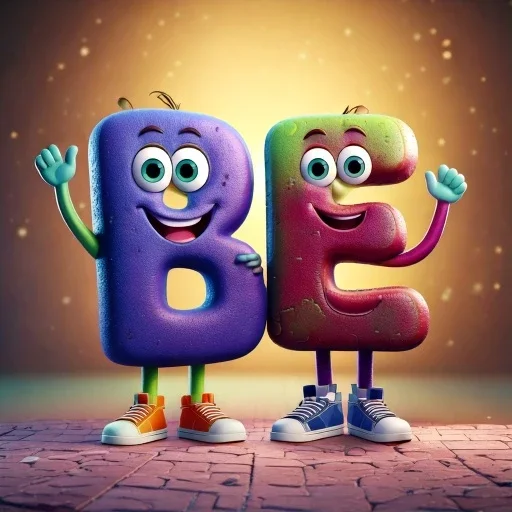
Learn 'am', 'is', and 'are' first. These words are very important.
Use these words for names, feelings, and places. They are everywhere!
These words change for different people. Say 'I am' and 'she is'.
Don't worry — once you practice a little, it will feel very natural. Let's learn it step by step!
Conjugation Table
| Subject | Verb | Example | Contraction |
|---|---|---|---|
| I | am |
I'm a student. |
I'm |
| You | are |
You're very kind. |
You're |
| He | is |
He's my brother. |
He's |
| She | is |
She's busy today. |
She's |
| It | is |
It's sunny outside. |
It's |
| We | are |
We're good friends. |
We're |
| They | are |
They're at home. |
They're |
How This Grammar Works
Choose the right word for the person. It must match the person.
Here's the easy version:
I → always use am
he / she / it → always use is
you / we / they → always use are
That is it! Just remember three rules.
Think of it like clothes that need to fit: You wouldn't wear shoes that are too big or too small. In the same way, am only fits with I, is fits with one person or thing, and are fits with you or more than one.
Quick examples:
I am happy.✅ (I+am)She is a teacher.✅ (she+is)We are friends.✅ (we+are)
Short forms (contractions): In everyday English, people almost always use short forms. They sound more natural and friendly:
I am → I'm
he is → he's / she is → she's / it is → it's
you are → you're / we are → we're / they are → they're
Say 'I am tired' or 'I’m tired'. Both ways are good.
Formation Pattern
✅ Positive Sentences
How to write: Person + am/is/are + other words.
I am a student.→I'm a student.She is from Japan.→She's from Japan.They are my friends.→They're my friends.
❌ Negative Sentences
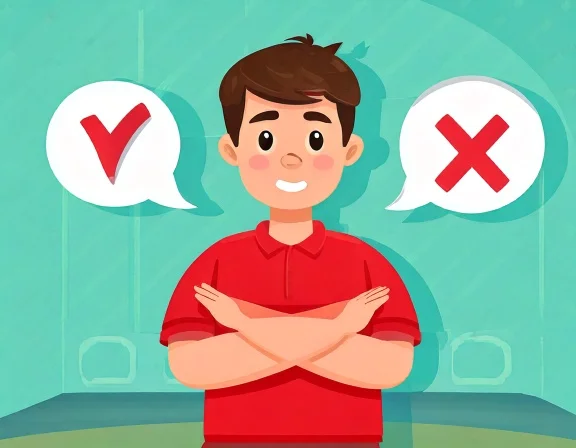
How to say no: Person + am/is/are + not + other words.
Just add not after the verb!
I am not tired.→I'm not tired.He is not here.→He isn't here.orHe's not here.We are not ready.→We aren't ready.orWe're not ready.
❓ Questions
How to ask: Am/Is/Are + person + other words?
Change the order. Put 'am', 'is', or 'are' first.
Am I late?Is she your sister?Are you hungry?
💬 Short Answers
Give a short answer for 'yes' or 'no' questions.
Are you a student?→Yes, I am./No, I'm not.Is it cold outside?→Yes, it is./No, it isn't.Are they home?→Yes, they are./No, they aren't.
When To Use It
Use these words every day. Here are some examples.
👩💼 Professions & Jobs
I'm a teacher.
She's a nurse at the hospital.
🎂 Age
I'm 20 years old.
My grandma is 75.
🏠 Where You Live
We're from Mexico.
I'm in London right now.
🌍 Nationality
He's Brazilian.
They're Japanese.
😊 Personality
She's very friendly.
My brother is shy.
👤 Appearance
He's tall and thin.
Her eyes are green.
💭 Feelings & Emotions
I'm so happy!
They're nervous about the test.
👨👩👧 Family
She's my older sister.
They're my parents.
👋 Identity & Introductions
I'm Alex.
This is my friend Sara.
📍 Location
The bank is on Main Street.
We're at the airport.
🌤️ Weather
It's cold today.
It's sunny and warm.
🕐 Time
It's 3 o'clock.
It's almost midnight.
🏥 Health
I'm sick today.
She's feeling better now.
💰 Prices & Numbers
The ticket is $10.
These shoes are expensive.
Examples by Category
💭 Feelings & Emotions
I'm happy today!
Texting a friend
She is tired after work.
Talking about someone
We are excited about the trip!
Group chat
Hey, how are you? I'm good!
Greeting a friend
👩💼 Professions & Jobs
My sister is a software engineer.
Introducing family
They are teachers at my school.
Describing people
I am a student.
Self-introduction
He is a doctor at the hospital.
Talking about a friend
📍 Places & Locations
We are at the coffee shop right now.
Texting your location
The books are on the table.
Describing a room
She is in the library.
Answering where someone is
The park is near my house.
Giving directions
🎨 Descriptions & Appearance
She is very tall for her age.
Describing someone
The flowers are beautiful.
Admiring nature
This pizza is delicious!
At a restaurant
My new phone is really fast.
Showing a gadget
👋 Identity & Introduction
I am a new student at SubLearn.
First day at school
My name is Alex.
Meeting someone new

We are from Brazil.
Introducing your group
This is my best friend, Leo.
Introducing someone
🐾 Animals & Nature
The dogs are very playful today.
At the park
My cat is sleeping on the sofa.
Describing your pet
The sky is cloudy this morning.
Talking about weather
Those birds are so colorful!
Nature walk
When Not To Use It
Do not use these for actions. Use action words instead.
- ❌
I am go to school.→ ✅I go to school. - ❌
She is like pizza.→ ✅She likes pizza. - ❌
They are play football.→ ✅They play football.
Use these to describe things. Do not use them for actions.
Is there an action? If yes, you do not need these words.
Common Mistakes
Mistakes are okay! Here is how to fix them.
1. Mixing up "is" and "are"
❌ The dogs is hungry.
✅ The dogs are hungry.
'Dogs' means many things. Use 'are' for many things.
Tip: One thing = is. Two or more things = are.
2. Forgetting the verb completely
❌ She happy.
✅ She is happy.
In English, you always need 'am', 'is', or 'are' here.
3. Using "am" with the wrong subject
❌ He am a doctor.
✅ He is a doctor.
Why? Am is only for I. Nobody else! He, she, and it always use is.
4. Confusing "it's" and "its"
it's = it is → It's cold today. (it is cold)
its = belonging to it → The cat loves its toy. (the toy belongs to the cat)
Tip: If you can replace it with "it is," use it's with the apostrophe.
5. Double verb: using "be" after am/is/are
❌ I am be happy.
✅ I am happy.
'Am' is enough. Do not use two words for one thing.
Memory Trick
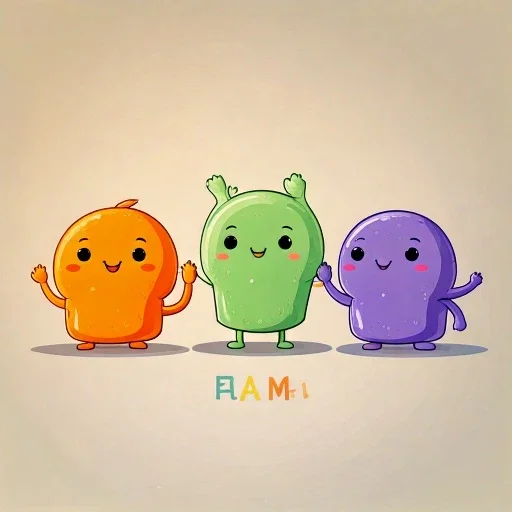
Think of it like a family with 3 members:
AM= The loner. Only "I" uses it. Just one person: me!I'm happy.IS= The single one. For one person or thing (not you, not me).She's a doctor./It's cold.ARE= The group. For "you" (always!) and for two or more people/things.You're nice./They're here.
Quick song to remember:
'I am, you are, he is'. Now you know it well!
Say it a few times and you'll never forget it!
Memory Trick
Here are 3 easy tricks to remember am, is, and are:
- I → am — Only I uses am. They are best friends! No other word uses am. Example: I am happy.
- He / She / It → is — Use is for one person or thing (but not I or you). Think: one = is. Examples: She is tall. / The cat is small.
- You / We / They → are — Use are for two or more people or things. Also, you always uses are (even for one person!). Examples: You are nice. / They are here.
Easy summary: I → am, one thing → is, you / many → are. That's it!
Real Conversations
In real life, people almost always use the short forms. Here are some conversations you might hear every day:
Meeting someone new
👤 "Hi! I'm Alex. What's your name?"
👤 "Hey! I'm Sara. Nice to meet you!"
👤 "This is my friend Leo. He's from Italy."
Asking how someone feels
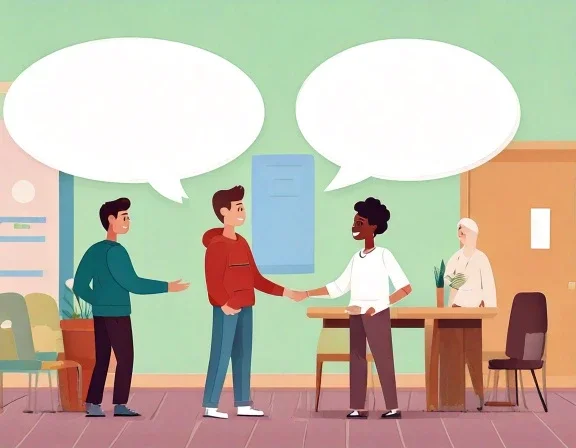
👤 "How are you today?"
👤 "I'm great, thanks! How about you?"
👤 "I'm a bit tired, but I'm okay!"
Talking about where things are
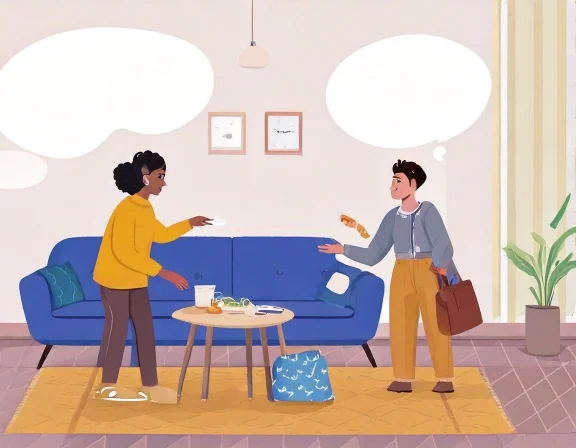
👤 "Where are my keys?"
👤 "They're on the kitchen table."
👤 "And where is my phone?"
👤 "It's in your bag!"
Notice: In speaking, we almost never say "I am" or "she is" — we say I'm and she's. It sounds much more natural!
Contrast With Similar Patterns
These pairs confuse many learners. Here's the difference:
"to be" vs. "to have"
I am hungry. = how I feel right now
I have a sandwich. = something I own/possess
Use 'be' for feelings. Use 'have' for things you own.
"to be" vs. "to do"
She is a singer. = who she is (identity)
She sings every day. = what she does (action)
Use these for what something is, not what it does.
"there is" vs. "there are"
There is a cat in the garden. = one cat
There are three cats in the garden. = more than one
Tip: One thing = there is. More than one = there are.
Progressive Practice
The best way to learn to be is to practice a little every day. Here are some fun ways:
Look at your room. Say: 'The table is brown'.
Talk about your family: "My mom is a nurse." "My brothers are funny." "I am the youngest."
Write about yourself: "I am [your name]. I am [age] years old. I am from [country]. I am a [job/student]." Try it now!
Ask yourself questions. 'Am I happy? Yes, I am!'
Quick FAQ
Why can't I just use one form for everything?
Match the word to the person. Practice makes it easy!
When should I use the short form (I'm) vs. the full form (I am)?
Both are good. Use "I'm" when you talk to friends. Use "I am" for school or work. Use "I AM" to be strong.
Why do we use "are" with "you" even for one person?
Always use "are" with the word "you". Use it for one person. Use it for many people. Always say "you are".
What about "was" and "were"?
"Was" and "were" are for the past. Do not worry about them now. Learn "am", "is", and "are" first. We will learn the others later.
Present Simple Conjugation of 'To Be'
| Subject | Affirmative | Negative | Question |
|---|---|---|---|
|
I
|
am
|
am not
|
Am I?
|
|
You
|
are
|
are not / aren't
|
Are you?
|
|
He
|
is
|
is not / isn't
|
Is he?
|
|
She
|
is
|
is not / isn't
|
Is she?
|
|
It
|
is
|
is not / isn't
|
Is it?
|
|
We
|
are
|
are not / aren't
|
Are we?
|
|
They
|
are
|
are not / aren't
|
Are they?
|
Common Contractions
| Full Form | Contraction | Negative Contraction |
|---|---|---|
|
I am
|
I'm
|
I'm not
|
|
You are
|
You're
|
You aren't / You're not
|
|
He is
|
He's
|
He isn't / He's not
|
|
She is
|
She's
|
She isn't / She's not
|
|
It is
|
It's
|
It isn't / It's not
|
|
We are
|
We're
|
We aren't / We're not
|
|
They are
|
They're
|
They aren't / They're not
|
Meanings
The verb 'to be' describes the state, identity, or quality of a subject rather than an action.
Identity and Names
Used to state who or what someone or something is.
“I am Sarah.”
“This is a book.”
Location
Used to describe where someone or something is situated.
“He is at home.”
“The keys are on the table.”
Feelings and States
Used to describe emotions, physical conditions, or temporary states.
“I am hungry.”
“You are tired.”
Professions
Used to state a person's job or role.
“She is a teacher.”
“They are engineers.”
Age
Used to state how old someone or something is.
“I am twenty years old.”
“He is five.”
Reference Table
| Form | Structure | Example |
|---|---|---|
|
Affirmative
|
Subject + am/is/are
|
I am a student.
|
|
Negative
|
Subject + am/is/are + not
|
She is not here.
|
|
Question
|
Am/Is/Are + Subject
|
Are they ready?
|
|
Short Answer (+)
|
Yes, + subject + am/is/are
|
Yes, I am. (No contraction!)
|
|
Short Answer (-)
|
No, + subject + am/is/are + not
|
No, they aren't.
|
|
Wh- Question
|
Wh- word + am/is/are + Subject
|
Where is the cat?
|
|
Contraction
|
Subject'm/s/re
|
We're happy.
|
Formality Spectrum
I am prepared to depart. (Leaving a location)
I am ready to go. (Leaving a location)
I'm ready! (Leaving a location)
I'm set. (Leaving a location)
The Many Faces of 'To Be'
Identity
- Name I am John
- Job She is a nurse
Location
- Place We are at home
Feelings
- Emotion They are sad
Singular vs. Plural
Which form should I use?
Is the subject 'I'?
Is it one person/thing (He/She/It)?
Common Adjectives with 'To Be'
Feelings
- • Happy
- • Sad
- • Angry
Physical
- • Tall
- • Tired
- • Hungry
Weather
- • Cold
- • Hot
- • Sunny
Examples by Level
I am happy.
She is a doctor.
They are at school.
Are you cold?
It is a big dog.
We are not hungry.
He's not from Italy.
The keys aren't in my bag.
Is your mother a teacher?
We're very tired after the trip.
The weather is usually quite mild here.
You are being very helpful today.
Is it true that she is moving?
They are both interested in art.
The results are to be announced tomorrow.
It is essential that he be informed.
The building is currently being renovated.
Whether that is the case remains to be seen.
It was her who was responsible for the error.
The truth is, I am quite exhausted.
Were it not for your help, I would fail.
Such is the nature of the business.
To be, or not to be, that is the question.
The problem is not so much that he is poor, but that he is lazy.
There is no denying the impact of his work.
The city is but a shadow of its former self.
Easily Confused
Many languages use 'have' for age, hunger, and thirst.
Learners use 'It is' to mean 'exists'.
Learners try to contract 'Yes, I am' to 'Yes, I'm'.
Common Mistakes
I is happy.
I am happy.
She teacher.
She is a teacher.
I have 20 years old.
I am 20 years old.
They no are here.
They are not here.
Do you be tired?
Are you tired?
Yes, I'm.
Yes, I am.
Is the cats hungry?
Are the cats hungry?
I am being a student.
I am a student.
It's mean that...
It means that...
If I was you...
If I were you...
Sentence Patterns
I am ___.
She is not ___.
Are they ___?
It is ___ today.
Real World Usage
I'm a photographer based in NYC.
Are you here yet?
I am very interested in this role.
Where is gate 5?
I am sick.
Is this dish spicy?
Use Contractions
No 'Do' Support
Age is a State
How are you?
Smart Tips
Always use 'I'm' followed by your name. It sounds much more natural than 'My name is...'.
Use the full form in positive short answers to avoid sounding unfinished.
Always start with 'It's'. English always needs a subject, even for weather.
Always use 'are', even if you are talking to just one person.
Pronunciation
Contraction Reduction
In fast speech, 'I am' becomes 'I'm' /aɪm/. 'You are' becomes 'You're' /jʊər/.
The 's' sound in 'is'
The 's' in 'is' and 'He's' sounds like a /z/.
Linking 'are'
When 'are' is followed by a vowel, the 'r' is often pronounced clearly (e.g., 'They are at...').
Yes/No Question Rising
Are you happy? ↗
Asking for confirmation.
Statement Falling
I am happy. ↘
Giving information.
Memorize It
Mnemonic
Remember 'A-I-R': Am for I, Is for Singular, Are for Rest.
Visual Association
Imagine a bridge with three lanes. The first lane is only for a single person named 'I' (Am). The second lane is for single cars (Is). The third lane is for buses with many people (Are).
Rhyme
I am, you are, he is too. We are, they are, how are you?
Story
Once there was a king named 'I' who only liked the word 'Am'. His three children, He, She, and It, shared a small toy called 'Is'. All the other people in the kingdom (You, We, They) had to share a big boat called 'Are'.
Word Web
Challenge
Look around the room and say 5 sentences using 'is' or 'are' to describe what you see (e.g., 'The lamp is on').
Cultural Notes
Americans use 'I'm good' to mean 'I am fine' or 'No thank you'.
In some dialects, 'I'm' is used even in places where Americans might use the full 'I am'.
The 'invariant be' is used for habitual actions, while the copula is sometimes omitted for present states.
The English verb 'to be' is a 'suppletive' verb, meaning it comes from three different Proto-Indo-European roots.
Conversation Starters
Where are you from?
What is your job?
How are you feeling today?
Who is your favorite celebrity?
Journal Prompts
Common Mistakes
Test Yourself
She ___ a very kind person.
Which one is correct?
Find and fix the mistake:
I'm not have hungry.
Arrange the words in the correct order:
All words placed
Click words above to build the sentence
Match each item on the left with its pair on the right:
___ (It is) very hot today.
We ___ ready.
Are you a student? Yes, I ___.
Score: /8
Practice Exercises
8 exercisesShe ___ a very kind person.
Which one is correct?
Find and fix the mistake:
I'm not have hungry.
you / from / Are / London / ?
I -> ?, He -> ?, We -> ?
___ (It is) very hot today.
We ___ ready.
Are you a student? Yes, I ___.
Score: /8
Practice Bank
12 exercisesThe weather today ___ sunny.
I ___ from Canada.
Choose the correct sentence:
She not is ready.
Translate into English: 'El libro está en la mesa.'
Arrange these words into a question:
Match the subjects with the correct form:
My friends is very busy this week.
Translate into English: 'Ella no está aquí ahora.'
How old ___ your brother?
Choose the correct sentence:
Arrange these words into a sentence:
Score: /12
FAQ (8)
English is an old language, and the verb 'to be' comes from different roots. It's irregular, so you just have to memorize these specific pairs.
No, in formal writing, you should use the full forms like `I am` or `It is`. Contractions are for speaking and casual writing.
There is no difference in meaning. `Isn't` is just the shorter, more common way to say it in conversation.
In English, age is considered a state of being (who you are), not a possession (something you have).
Both! In English, `you` is used for one person and for a group of people. The verb is always `are` for both.
Only with the subject `I`. It is the most exclusive form of the verb.
Yes, but that's for more advanced tenses like the Present Continuous (e.g., 'I am running'). For now, focus on using it with nouns and adjectives.
Usually, yes. But it can also mean 'It has' in the present perfect (e.g., 'It's been a long day'). Context will tell you which one it is!
Scaffolded Practice
1
2
3
4
Mastery Progress
Needs Practice
Improving
Strong
Mastered
In Other Languages
Ser / Estar
English doesn't distinguish between permanent and temporary 'being'.
Être
French uses 'to have' for physical states like hunger.
Sein
German word order changes more than English in questions.
Desu / Arimasu / Imasu
Japanese verbs don't change based on 'I', 'You', or 'They'.
Zero Copula
Arabic omits the verb entirely in the present affirmative.
Shì (是)
Chinese doesn't use 'to be' with adjectives.
Learning Path
Prerequisites
Continue With
English Negatives: Saying 'Not' (am not, isn't, aren't)
Overview Learning to say "no" in English is very important. You use "am", "is", and "are" to talk about facts. Sometimes...
Verb 'have': Present Simple forms (I have / He has)
Overview The verb have is a very important word in English. We use it to talk about things...
Are you ready? English Questions with 'be'
Overview Questions help you get information. You can ask about names, places, or feelings. In English, we use "am", "is"...
English Negation: Using 'not' correctly
Overview English negation means saying "no" or "not." You use it to say something is not true. This word helps you talk...
Past Simple: Verb 'to be' (was/were)
Overview The verb `to be` is fundamental in English, describing existence, states, or conditions. Unlike most verbs, `to...
Related Videos
 05:57
05:57 The infamous JoJo thought experiment - Michael Vazquez and Sarah Stroud
 05:17
05:17 Upstairs, downstairs: The life of a British maid - Stephanie Honchell Smith
 07:36
07:36 Why Doesn’t the Yucatán Have Rivers?
Master All 4 Present Tenses in 10 Min | English Grammar Lesson | Best Way To Learn English Tenses
Learn English | Let's Talk - Free English Lessons
Related Grammar Rules
Present Perfect: US vs UK (I've done vs I did)
Overview The Present Perfect tense describes actions completed in the past that maintain a connection to the present. Th...
Phrasal Verbs: An Introduction (Turn On, Give Up, Look After)
## Phrasal Verbs: An Introduction A **phrasal verb** = verb + particle (up, on, off, out, in, away...) The combination...
Life Experiences: Present Perfect with Ever and Never
Overview The Present Perfect with `ever` and `never` is a cornerstone for discussing personal experiences, enabling you...
Future Continuous (will be -ing)
Overview The **Future Continuous** (also called the Future Progressive) is a verb tense used to project yourself into th...
English Present Perfect: Connecting Past to Now (Basic Formation)
Overview The English **Present Perfect** tense serves a crucial function in connecting past events or states with the pr...

