









drumsticks in 30 Seconds
- Drumsticks are essential tools for drummers, typically made of wood like hickory or maple, used to strike percussion instruments to create various rhythmic sounds and tones.
- In a culinary context, a drumstick is the lower part of a bird's leg, especially chicken or turkey, known for being flavorful and easy to eat by hand.
- The word is a countable noun, almost always used in the plural because musical sticks come in pairs and chicken legs are often served in multiples.
- The term is widely used in music, cooking, and everyday conversation, and its meaning is usually determined by the setting—a concert hall versus a kitchen.
The term drumsticks is a versatile noun that functions in two primary domains: music and culinary arts. In the musical context, drumsticks are the primary tools used by drummers and percussionists to strike drums, cymbals, and other instruments to create sound. These sticks are typically made of wood, such as hickory, maple, or oak, but can also be found in synthetic materials like carbon fiber. They are designed with a specific balance, weight, and tip shape to produce different tones. For example, a round tip might produce a bright, clear sound on a cymbal, while a barrel tip offers a broader, punchier tone on a snare drum. Musicians use them in every genre imaginable, from the delicate jazz rhythms of a small club to the thunderous beats of a stadium rock concert. When people talk about drumsticks in this sense, they are often discussing the technical aspects of playing, the brand of sticks they prefer, or the physical act of keeping time.
- Musical Context
- Refers to the pair of wooden or synthetic sticks used to play percussion instruments. Usage: 'The drummer broke one of his drumsticks during the high-energy finale.'
On the other hand, in the culinary world, a drumstick refers to the lower part of a bird's leg, most commonly a chicken or turkey. This piece of meat is a favorite for many because it is flavorful, juicy, and comes with its own 'handle'—the bone. It is the section of the leg below the thigh, known anatomically as the drumstick because its shape vaguely resembles the musical tool. You will hear this word used frequently at dinner tables, in restaurants, and during holiday celebrations like Thanksgiving or Christmas. Whether fried, roasted, or grilled, the drumstick is a staple of comfort food across many cultures. It is often the piece of chicken children reach for first because it is easy to hold and eat without utensils.
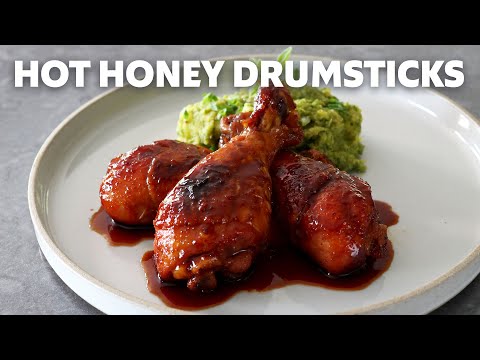
The chef seasoned the chicken drumsticks with a blend of smoked paprika, garlic powder, and dried oregano before placing them in the oven.
The word is used in everyday conversation to describe these two very different objects, yet the context usually makes the meaning immediately clear. You wouldn't expect to see a drummer eating his equipment, nor would you expect a chef to play a snare drum with a piece of poultry. However, the shared name is a classic example of how English uses physical resemblance to name objects. The tapering shape of the bird's leg bone and the surrounding muscle mimics the tapering handle and head of the musical stick. This visual metaphor has been part of the English language for centuries, making the word deeply embedded in both artistic and domestic life.
In more specialized settings, such as a recording studio, you might hear professionals discuss the 'weight' or 'gauge' of drumsticks, such as 5A or 7N, which refers to their thickness and intended use. In a professional kitchen, a butcher might discuss the 'yield' of drumsticks from a batch of poultry. Despite these technical nuances, for the average person, the word remains a simple, everyday term that evokes either the sound of a beat or the smell of a home-cooked meal. It is a word that spans the gap between the creative arts and the basic human need for sustenance, showing how language evolves to connect different parts of our experience through simple visual similarities.
Using the word drumsticks correctly requires an understanding of its plural nature and its dual meanings. Most commonly, the word is used in the plural because drumsticks almost always come in pairs—whether you are playing the drums or buying a pack of chicken. You would rarely say 'I need a drumstick' unless you were specifically referring to a single piece of meat or a single broken stick. When constructing sentences, it is important to provide enough context so the listener knows which version you are talking about. For example, 'He gripped the drumsticks tightly' suggests a musical context, while 'He grabbed the drumsticks from the platter' suggests a meal.
- Grammar Tip
- 'Drumsticks' is a countable noun. Use 'many' or 'a few' with it, rather than 'much'. Example: 'How many drumsticks are left in the bucket?'
In a musical sentence, you might focus on the action or the material. 'The jazz drummer preferred thin maple drumsticks for their light touch and subtle resonance.' Here, the adjectives 'thin', 'maple', and 'light' help define the specific type of drumstick. In a culinary sentence, the focus is often on preparation or consumption. 'We marinated the turkey drumsticks overnight in a mixture of buttermilk and hot sauce to ensure they stayed moist during the long roasting process.' In this case, 'turkey' and 'marinated' clarify that we are talking about food. The word can also be used as a compound noun or in phrases like 'drumstick primrose' (a type of flower) or 'drumstick tree' (the Moringa tree), though these are much less common.
After the concert, the lead drummer tossed his sweat-stained drumsticks into the cheering crowd as a souvenir.
When writing about drumsticks, consider the verbs that naturally pair with them. For music: 'twirl', 'grip', 'strike', 'tap', 'break', or 'brandish'. For food: 'roast', 'fry', 'gnaw', 'season', or 'serve'. These verbs act as signposts for your reader. Additionally, the word can be used metaphorically, though this is rare. Someone might describe a person with very thin legs as having 'drumstick legs,' which is usually a slightly humorous or informal observation. However, in most professional or formal writing, the word will stick to its literal definitions. Whether you are writing a review of a percussion performance or a recipe for a summer barbecue, 'drumsticks' is a precise and necessary term.
Finally, pay attention to the prepositions. You play *with* drumsticks, and you eat *a* drumstick. You might buy a pair *of* drumsticks at a music shop, or a pack *of* drumsticks at the butcher. These small words help glue the sentence together. By varying your sentence structure—starting with the subject, or perhaps an adverbial phrase—you can make your descriptions of drumsticks more engaging. 'With a flourish of his drumsticks, the musician began the solo' is more evocative than 'He used his drumsticks to play.' Similarly, 'Crispy and golden, the drumsticks were the star of the picnic' sounds more appetizing than 'The drumsticks were good.'
The word drumsticks is ubiquitous in several specific environments. If you walk into a music conservatory or a high school band room, the air is filled with the sound of drumsticks clicking together or hitting practice pads. You will hear teachers instructing students on how to hold their drumsticks using a 'matched grip' or a 'traditional grip.' In this setting, the word is technical and functional. Music store employees will ask, 'Are you looking for wooden or nylon-tipped drumsticks?' or 'What size drumsticks does your teacher recommend?' It is a word of the trade, essential for anyone involved in the rhythmic arts.
- In the Kitchen
- 'I'll take two drumsticks and a side of coleslaw, please.' This is a common phrase heard at fast-food counters and family dinners alike.
In the domestic sphere, 'drumsticks' is a word of the kitchen and the dining table. During the holidays, there is often a playful competition over who gets the turkey drumsticks. Parents might say to their children, 'Finish your drumstick before you have dessert.' In grocery stores, you will see labels on plastic-wrapped trays: 'Chicken Drumsticks - Family Pack.' It is a word associated with nourishment, family gatherings, and the simple pleasure of eating with one's hands. It carries a sense of informality and comfort, as drumsticks are rarely served at the most formal black-tie galas where knives and forks are strictly required for every bite.
'Does anyone want the last of the drumsticks?' asked Sarah, holding the serving platter over the table at the backyard BBQ.
You will also encounter the word in popular culture. In movies about bands, such as 'Whiplash,' the drumsticks are central characters themselves, often shown splintering or covered in blood to represent the drummer's dedication. In advertisements for fast food, the visual of a golden-brown drumstick being dipped into sauce is a powerful marketing tool. Even in nature documentaries, you might hear a narrator describe the 'drumstick-like' legs of certain wading birds. The word's reach is surprisingly wide, touching on art, biology, commerce, and daily survival. It is a word that most English speakers learn early in childhood and continue to use throughout their lives in various contexts.
Lastly, you might hear the word in specialized botanical or medical contexts. The 'drumstick tree' (Moringa oleifera) is famous in global health circles for its nutrient-rich leaves and seed pods that look like long sticks. In medicine, 'drumstick fingers' or 'clubbing' is a clinical sign where the tips of the fingers enlarge, resembling the head of a drumstick. While these uses are more niche, they demonstrate how the simple shape of a drumstick—a long shaft with a bulbous end—is a universal visual reference point. Whether you are a musician, a foodie, a gardener, or a doctor, the word 'drumsticks' provides a clear, descriptive image that everyone understands.
One of the most common mistakes learners make with drumsticks is failing to distinguish it from other percussion tools or other parts of the bird. In music, a drumstick is specifically a stick, usually wooden. It is not a 'mallet,' which has a large, soft head (like those used for marimbas or timpani), nor is it a 'brush,' which consists of many thin wires. Using 'drumstick' to describe a mallet can lead to confusion in a professional musical setting. Similarly, in the kitchen, a drumstick is not a 'wing' or a 'thigh.' The thigh is the upper part of the leg, and the wing is the appendage used for flight. Calling a chicken wing a drumstick might lead to a disappointed diner who was expecting more meat!
- Vocabulary Confusion
- Mistake: 'I played the xylophone with drumsticks.' Correction: 'I played the xylophone with mallets.' (Drumsticks are too hard for most melodic percussion).
Another frequent error involves the pluralization and collective nouns. Since drumsticks are almost always used in pairs, learners sometimes forget to use the plural 's' when referring to the set. Saying 'I bought a drumstick for my drum kit' sounds odd because you need two to play effectively. Conversely, when buying chicken, you might buy 'a pack of drumsticks,' but if you are only eating one, you must remember to drop the 's'. 'I ate three drumstick' is grammatically incorrect; it must be 'three drumsticks.' This is a basic rule of countable nouns that is easy to overlook in the heat of conversation.
Incorrect: 'The drummer lost his drumstick.' (Unless he only lost one of the two). Correct: 'The drummer lost his drumsticks.'
Pronunciation can also be a minor hurdle. The 'u' in drumsticks is a short /ʌ/ sound, like in 'cup' or 'bus.' Some learners might accidentally use a long 'u' sound like in 'doom,' which would make the word unrecognizable. Additionally, the 'ck' and 's' at the end require a crisp transition. 'Drum-stix' is the correct phonetic flow. In terms of spelling, remember that it is a compound-like word: 'drum' + 'stick'. Some people mistakenly write it as two words ('drum sticks'), which is technically acceptable in some contexts but the single-word form is the standard for both the musical and culinary meanings.
Finally, be careful with the register. While 'drumsticks' is a perfectly fine word for most situations, in a very high-end culinary environment, a chef might use the French term 'pilon' or simply refer to the 'leg.' However, using 'drumsticks' is never 'wrong'—it's just more common in casual or standard English. In music, referring to 'sticks' is the common shorthand among professionals. If you say, 'Pass me my sticks,' other musicians will know exactly what you mean. Over-explaining by saying 'Pass me my musical drumsticks' would sound unnatural and redundant. Mastery of the word involves knowing when to use the full term and when the shorthand 'sticks' or 'legs' is more appropriate for the flow of the conversation.
Exploring synonyms and alternatives for drumsticks helps to refine your vocabulary and provide variety in your writing. In the musical realm, the most common alternative is simply 'sticks.' Drummers almost always refer to their tools this way. However, there are more specific terms depending on the tool's construction. 'Mallets' are used for instruments like the glockenspiel or timpani and have a distinct, often padded head. 'Brushes' are used in jazz for a softer, sweeping sound. 'Rods' (or 'hot rods') are bundles of thin wooden sticks used to play at a lower volume than standard drumsticks. Each of these has a specific purpose and cannot be used interchangeably with 'drumsticks' if you want to be precise.
- Musical Alternatives
- Sticks (General), Mallets (Padded), Brushes (Wire/Plastic), Rods (Bundled), Beaters (for Bass Drums).
In the culinary world, the alternatives are usually more descriptive of the anatomy. You might hear 'chicken legs,' though this often implies the drumstick and the thigh together. If you are looking for a more formal or technical term, 'tibia' is the anatomical name for the bone, but you would never use this at a dinner table unless you were a biologist making a joke. In some regions, especially in the UK and Australia, 'drumstick' can also refer to a specific type of sweet or ice cream, so alternatives like 'poultry leg' or 'lower leg' might be used in technical cooking manuals to avoid any confusion with confectionery.
While the rock drummer used heavy oak drumsticks, the orchestral percussionist reached for soft-headed mallets to play the gong.
There are also metaphorical alternatives. If you are describing someone's thin legs, you might use 'spindly legs' or 'matchstick legs' instead of 'drumstick legs.' These carry slightly different connotations—'matchstick' implies extreme fragility, while 'drumstick' implies a specific shape (thin at the bottom, wider at the top). In the context of the 'drumstick tree' (Moringa), you might simply call it 'Moringa' or 'the miracle tree,' which focuses on its health benefits rather than the shape of its pods. Understanding these alternatives allows you to choose the word that best fits the tone and precision of your message.
Finally, when discussing the act of playing, you might use verbs as alternatives to the noun. Instead of saying 'He used his drumsticks on the snare,' you could say 'He drummed a tattoo on the snare' or 'He beat the rhythm.' This shifts the focus from the object to the action. In cooking, instead of 'We ate drumsticks,' you might say 'We enjoyed the dark meat,' which categorizes the drumstick and thigh together based on their muscle type and flavor profile. By expanding your vocabulary around 'drumsticks,' you gain the ability to describe music and food with much greater color and accuracy.
How Formal Is It?
Fun Fact
The use of 'drumstick' for chicken was originally a polite Victorian euphemism to avoid saying the word 'leg' in public!
Pronunciation Guide
- Pronouncing the 'u' like 'oo' (droom-stick).
- Forgetting the 's' at the end when talking about a pair.
- Merging the 'm' and 's' too quickly.
Difficulty Rating
Easy to recognize in context.
Simple spelling but requires correct pluralization.
Clear pronunciation but requires short 'u' sound.
Easily distinguishable in conversation.
What to Learn Next
Prerequisites
Learn Next
Advanced
Grammar to Know
Countable Nouns
I have three drumsticks (not 'three drumstick').
Compound Nouns
Drumstick is one word, not 'drum stick'.
Prepositions of Tool
You play *with* drumsticks.
Adjective Placement
The *wooden* drumsticks (adjective before noun).
Articles
*A* drumstick (general) vs *The* drumstick (specific).
Examples by Level
I have two drumsticks.
I have two sticks for the drum.
Plural noun with 's'.
The chicken drumstick is good.
The chicken leg is tasty.
Singular noun with 'the'.
He plays with drumsticks.
He uses sticks to play the drum.
Preposition 'with' used for tools.
Do you like drumsticks?
Do you like chicken legs?
Question form.
The drumsticks are on the table.
The sticks are on the table.
Plural 'are'.
I eat a drumstick.
I am eating one chicken leg.
Indefinite article 'a'.
She has new drumsticks.
She bought new sticks for her drums.
Adjective 'new' before the noun.
Look at the drumsticks!
Look at those sticks/legs!
Imperative sentence.
The drummer needs new drumsticks.
The musician needs new sticks.
Subject-verb agreement.
We cooked ten chicken drumsticks.
We made ten chicken legs.
Number + noun.
He hit the drum with his drumsticks.
He used the sticks to hit the drum.
Past tense 'hit'.
Can I have another drumstick?
Can I have one more chicken leg?
'Another' with singular noun.
The drumsticks are made of wood.
The sticks are wooden.
Passive construction 'are made of'.
She put the drumsticks in the bag.
She put the sticks/legs in the bag.
Preposition 'in'.
My brother plays the drums with drumsticks.
My brother uses sticks for his drums.
Present simple tense.
These drumsticks are very spicy.
These chicken legs have a lot of spice.
Demonstrative 'these'.
The jazz drummer uses thin drumsticks for a softer sound.
He uses light sticks for quiet music.
Adjective 'thin' modifying the noun.
I prefer chicken drumsticks over the wings.
I like the legs more than the wings.
Comparison using 'over'.
He accidentally broke one of his drumsticks during the show.
One stick snapped while he was playing.
'One of his' followed by plural.
The recipe calls for six turkey drumsticks.
The instructions say you need six turkey legs.
Phrasal verb 'calls for'.
You should hold the drumsticks loosely to play better.
Don't grip the sticks too hard.
Adverb 'loosely' modifying the action.
We bought a family pack of drumsticks for the barbecue.
We bought many chicken legs for the party.
Collective phrase 'family pack of'.
The drumsticks clicked together as he counted down the beat.
The sticks made a sound before the song started.
Intransitive use of 'clicked'.
She seasoned the drumsticks with salt and pepper.
She put salt and pepper on the chicken legs.
Verb 'seasoned'.
The drummer's precision was enhanced by his custom-made drumsticks.
His special sticks helped him play accurately.
Passive voice 'was enhanced'.
Marinating the drumsticks in yogurt makes them incredibly tender.
Using yogurt makes the chicken legs soft.
Gerund 'marinating' as subject.
He brandished his drumsticks like a conductor's baton.
He held the sticks like a leader.
Simile using 'like'.
The price of hickory drumsticks has risen significantly this year.
Wooden sticks are more expensive now.
Present perfect tense.
She expertly removed the skin from the chicken drumsticks.
She took the skin off the legs carefully.
Adverb 'expertly'.
The audience cheered when he threw his drumsticks into the pit.
People were happy when he gave away his sticks.
Complex sentence with 'when'.
Nylon-tipped drumsticks are known for their durability and bright tone.
Sticks with plastic ends last long and sound sharp.
Compound adjective 'nylon-tipped'.
We served the drumsticks with a side of roasted vegetables.
The chicken legs came with vegetables.
Prepositional phrase 'with a side of'.
The percussionist experimented with various drumsticks to achieve the perfect resonance.
He tried different sticks for the best sound.
Verb 'experimented' with 'with'.
The succulent meat of the drumstick fell easily off the bone.
The chicken was so well-cooked it was soft.
Descriptive adjective 'succulent'.
His drumsticks were a blur of motion during the complex solo.
He moved the sticks so fast you couldn't see them clearly.
Metaphorical 'blur of motion'.
The 'drumstick' sign in the patient's X-ray indicated a specific bone deformity.
The bone looked like a drumstick in the medical image.
Noun used as an attributive adjective.
The chef's signature dish featured braised drumsticks in a red wine reduction.
His special meal was chicken legs in wine sauce.
Sophisticated culinary vocabulary.
The rhythmic tapping of drumsticks against the practice pad echoed through the hall.
The sound of sticks on a pad was loud.
Participial phrase 'tapping of drumsticks'.
He opted for maple drumsticks, citing their superior flex and lighter weight.
He chose maple because they bend better and are light.
Catenative verb 'opted for'.
The cultural significance of the turkey drumstick during Thanksgiving cannot be overstated.
The turkey leg is very important for the holiday.
Abstract noun 'significance'.
The virtuoso's manipulation of the drumsticks was nothing short of miraculous.
The way he used the sticks was amazing.
Idiomatic 'nothing short of'.
The culinary anthropologist discussed the evolution of the drumstick as a portable snack.
A scientist talked about why we eat chicken legs.
Complex noun phrase.
The drummer's calloused hands bore witness to years of gripping heavy drumsticks.
His hands showed he had played a lot.
Personification 'bore witness'.
The artisan hand-turned each pair of drumsticks from reclaimed exotic hardwoods.
The maker made the sticks by hand from old wood.
Compound verb 'hand-turned'.
The juxtaposition of the delicate violin and the thunderous drumsticks created a jarring effect.
The soft violin and loud drums sounded strange together.
Sophisticated noun 'juxtaposition'.
In the realm of avian anatomy, the drumstick corresponds to the tibiotarsus.
In birds, the leg part has a scientific name.
Technical register.
The drummer's idiosyncratic style involved using drumsticks of mismatched weights.
He had a unique way of using different sticks.
Adjective 'idiosyncratic'.
The braised drumsticks were glazed in a balsamic infusion, offering a complex flavor profile.
The chicken legs had a fancy vinegar sauce.
Advanced culinary description.
Common Collocations
Common Phrases
— Hitting the sticks together to start a song.
The drummer clicked the drumsticks to set the tempo.
— A humorous way to describe very thin legs.
He was a tall man with skinny drumstick legs.
— A standard way to buy chicken legs at a store.
Pick up a pack of drumsticks on your way home.
— Sticks made specifically for a certain musician.
He has his name engraved on his custom drumsticks.
— To accidentally let a stick fall while playing.
He was embarrassed when he dropped a drumstick during the solo.
— Another name for the Moringa tree.
The drumstick tree is known for its health benefits.
— A type of flower with a round head.
The drumstick primrose is blooming in the garden.
Often Confused With
Mallets have large, soft heads; drumsticks are usually plain wood.
The thigh is the upper leg; the drumstick is the lower leg.
Brushes are made of wires for soft jazz sounds, not solid sticks.
Idioms & Expressions
— To act independently and not follow others (a variation of the standard idiom).
She always marched to the beat of her own drumsticks.
informal— To give someone the best or most fun part of something.
Since it's his birthday, let's give him the drumstick of the project.
slang— Extremely thin or skinny.
After the illness, his arms were as thin as a drumstick.
informal— To work very hard or make a lot of noise about something.
He's really beating the drumsticks for this new policy.
metaphorical— A related idiom about physical objects vs words.
Sticks and stones may break my bones, but drumsticks are for music.
playful— To eat every bit of meat off a drumstick.
He was so hungry he picked the drumstick bone clean.
informal— An idiom about being less important, often contrasted with the drummer.
He didn't want to play second fiddle; he wanted the drumsticks.
metaphorical— Having a natural talent for music, often associated with drumsticks.
You can tell he has the rhythm in his bones by how he holds his drumsticks.
poetic— A playful way to tell someone to move or dance.
Come on, shake your drumsticks and get to work!
informal— Getting the worse part of a bargain (related to 'short end of the stick').
He felt he got the drumstick end of the deal.
informalEasily Confused
Both are pairs of sticks used with hands.
Chopsticks are for eating; drumsticks are for playing drums or are the food itself.
Don't use your drumsticks to eat your rice!
Both are small sticks.
Matchsticks are for starting fires and are much smaller.
His legs were as thin as matchsticks, not drumsticks.
Both are sticks.
Walking sticks are for support while walking and are much larger.
The old man used a walking stick, not a drumstick.
Both are long, edible 'sticks'.
Breadsticks are made of bread; drumsticks are meat.
We had breadsticks with our pasta and drumsticks for the main course.
Both are sticks.
A yardstick is for measuring length.
Use the yardstick to measure the room, not your drumsticks.
Sentence Patterns
I like [noun].
I like drumsticks.
He is playing with [noun].
He is playing with drumsticks.
The [noun] are made of [material].
The drumsticks are made of hickory.
I would like [number] [noun], please.
I would like four drumsticks, please.
While [verb-ing], he [verb] the [noun].
While drumming, he broke the drumsticks.
The [noun] were [past participle] with [ingredient].
The drumsticks were seasoned with paprika.
The [noun]'s [property] was [adjective].
The drumstick's resonance was impressive.
Such was the [noun]'s [property] that [result].
Such was the drumstick's durability that it lasted the whole tour.
Word Family
Nouns
Verbs
Adjectives
Related
How to Use It
Very high in both musical and culinary domains.
-
I play the drums with drumstick.
→
I play the drums with drumsticks.
You need two sticks to play, so it must be plural.
-
I ate a chicken stick.
→
I ate a chicken drumstick.
'Chicken stick' is not a standard term; 'drumstick' is the correct name.
-
He used drumsticks for the xylophone.
→
He used mallets for the xylophone.
Drumsticks are for drums; mallets are for melodic percussion.
-
The drum sticks are on the floor.
→
The drumsticks are on the floor.
It should be written as one word, not two.
-
I prefer the white meat of the drumstick.
→
I prefer the dark meat of the drumstick.
Drumsticks are dark meat; breasts are white meat.
Tips
Context is King
Always look at the surrounding words. If you see 'music,' it's a stick. If you see 'dinner,' it's chicken.
The Short U
Practice the 'uh' sound in 'drum.' It's the same as in 'up' or 'fun.'
Plural Pairs
Remember that musical drumsticks always come in pairs. Use 'a pair of drumsticks' for better fluency.
Know Your Parts
Distinguish between drumsticks, thighs, and wings when talking about chicken to avoid confusion.
Stick Sizes
If you're learning drums, know that 7A is thin, 5A is medium, and 2B is thick.
Crispy Skin
For the best drumsticks, pat them dry before seasoning to get the skin extra crispy.
Compound Word
Don't put a space between 'drum' and 'stick.' It's one solid word.
Holiday Traditions
In the US, the 'wishbone' is in the breast, but the 'drumstick' is the favorite piece for many to eat.
Body Description
Be careful using 'drumstick legs' as it can be offensive, though often meant humorously.
Check the Tips
When buying musical sticks, check if they are wood-tipped or nylon-tipped, as they sound different.
Memorize It
Mnemonic
Think of a DRUMmer holding a STICK. Now imagine that stick is a chicken leg. DRUM + STICK = Drumstick!
Visual Association
Visualize a drum set where the sticks are actually giant fried chicken legs. It's a silly image that's hard to forget.
Word Web
Challenge
Try to use the word 'drumsticks' in a sentence that includes both the musical and culinary meanings.
Word Origin
The word 'drumstick' appeared in the mid-18th century. It is a compound of 'drum' (the instrument) and 'stick' (the tool).
Original meaning: Originally used only for the musical tool. The culinary use for a bird's leg began in the late 1700s due to the visual resemblance.
Germanic (English compound).Cultural Context
Generally a neutral word, but be aware that 'drumstick legs' can be seen as a body-shaming comment if used unkindly.
Very common in the US and UK for both meanings. In the UK, 'Drumstick' is also a famous brand of chewy lollipops.
Practice in Real Life
Real-World Contexts
Music Store
- Where are the drumsticks?
- Do you have 5A drumsticks?
- I need wooden tips.
- How much is a pair?
Dinner Table
- Pass the drumsticks.
- I want a drumstick.
- Is the drumstick spicy?
- This drumstick is juicy.
Rock Concert
- He threw his drumsticks!
- The drumsticks broke.
- Look at those sticks fly.
- He's fast with the drumsticks.
Grocery Store
- A pack of drumsticks.
- Are these fresh drumsticks?
- Chicken or turkey drumsticks?
- Price per pound for drumsticks.
Music Lesson
- Hold your drumsticks like this.
- Don't drop your drumsticks.
- Practice with your drumsticks.
- Bring your drumsticks next week.
Conversation Starters
"Do you prefer playing drums with drumsticks or your hands?"
"What's your favorite way to cook chicken drumsticks?"
"Have you ever seen a drummer throw their drumsticks into the crowd?"
"Who gets the drumsticks in your family during a big holiday meal?"
"Do you think wooden or synthetic drumsticks sound better?"
Journal Prompts
Describe the first time you ever held a pair of drumsticks and tried to play.
Write a recipe for the perfect spicy chicken drumsticks.
Imagine a world where drumsticks (the musical kind) were made of food. What would happen?
Why do you think the drumstick is such a popular piece of chicken for children?
If you were a drummer, what kind of drumsticks would you use and why?
Frequently Asked Questions
10 questionsNo, while most are made of hickory, maple, or oak, some are made of carbon fiber, plastic, or aluminum for different sounds and durability.
It is called a drumstick because its shape—thin at one end and thick at the other—resembles the sticks used to play drums.
The 5A is the most common size, used for a wide variety of musical styles because of its medium weight and length.
Yes, turkey drumsticks are very popular, especially at fairs and during holiday meals like Thanksgiving.
It is almost always written as one word: 'drumstick.'
It is the lower part of the leg, below the knee joint (the thigh is above the knee).
Most do, but some play with their hands (like conga players) or use brushes or mallets for different effects.
It is a plastic cap on the end of the stick that produces a brighter, sharper sound on cymbals and lasts longer than wood.
Yes, they are a good source of protein, though they are 'dark meat' and have slightly more fat than chicken breasts.
It is the Moringa tree, named for its long, thin seed pods that look like drumsticks.
Test Yourself 92 questions
Write a sentence about a drummer.
Well written! Good try! Check the sample answer below.
Write a sentence about your favorite food.
Well written! Good try! Check the sample answer below.
/ 92 correct
Perfect score!
Summary
The word 'drumsticks' uniquely identifies both a musical tool and a piece of poultry, linked by their similar elongated, bulbous shape. Example: 'The drummer put down his drumsticks to enjoy a plate of fried chicken drumsticks.'
- Drumsticks are essential tools for drummers, typically made of wood like hickory or maple, used to strike percussion instruments to create various rhythmic sounds and tones.
- In a culinary context, a drumstick is the lower part of a bird's leg, especially chicken or turkey, known for being flavorful and easy to eat by hand.
- The word is a countable noun, almost always used in the plural because musical sticks come in pairs and chicken legs are often served in multiples.
- The term is widely used in music, cooking, and everyday conversation, and its meaning is usually determined by the setting—a concert hall versus a kitchen.
Context is King
Always look at the surrounding words. If you see 'music,' it's a stick. If you see 'dinner,' it's chicken.
The Short U
Practice the 'uh' sound in 'drum.' It's the same as in 'up' or 'fun.'
Plural Pairs
Remember that musical drumsticks always come in pairs. Use 'a pair of drumsticks' for better fluency.
Know Your Parts
Distinguish between drumsticks, thighs, and wings when talking about chicken to avoid confusion.
Related Content
See it in Videos
More Food words
additive
B2A substance added to something in small quantities to improve, strengthen, or preserve it. It is most commonly used in the context of food processing, fuel production, and industrial manufacturing to enhance specific qualities like flavor, shelf life, or performance.
additives
B2A substance added to something in small quantities to improve or preserve it. Additives are often used in food production to enhance flavor, appearance, or shelf life, but they can also be used in fuels, plastics, and other industrial products.
almond
B2Describes a light, creamy-tan color or an oval shape that tapers at the ends, resembling the seed of the almond tree. It is frequently used in the context of fashion, beauty, and interior design to categorize shades and physical features.
annatto
B1Annatto is a natural food coloring derived from the seeds of the achiote tree. It is primarily used to impart a yellow to reddish-orange hue to foods like cheese, butter, rice, and baked goods.
appetite
C1Appetite refers to a natural desire to satisfy a bodily need, most commonly for food. In a broader sense, it describes a strong desire or liking for a specific activity, experience, or object, such as power or knowledge.
appetizer
C1An appetizer is a small portion of food or a drink served before a meal to stimulate the appetite. It is usually savory and intended to prepare the palate for the main courses to follow.
appetizing
B2Describing food or smells that look or smell attractive and make you feel hungry. It is often used to describe the visual presentation or aroma of a meal rather than its actual flavor.
apple
C1Describes an action performed with a wholesome simplicity, clarity, and a refreshing, crisp quality. It is a highly figurative and literary adverbial usage signifying a naturally perfect or aesthetically pleasing execution.
apples
A1Apples are round, edible fruits produced by an apple tree (Malus domestica). They are known for their crisp texture and come in various colors such as red, green, and yellow.
apricot
C1Describes a soft, yellowish-orange color characteristic of the fruit's skin, often used in aesthetic contexts such as fashion and interior design. At an advanced level, it implies a specific warmth and subtlety in color theory and descriptive writing.

