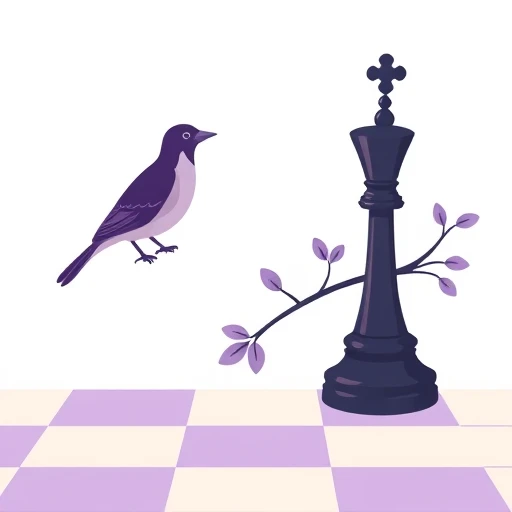
rook in 30 Seconds
- A rook is a major chess piece that moves horizontally or vertically across any number of unoccupied squares, essential for late-game strategy and castling.
- The term also describes a large, social black bird of the crow family, specifically the Corvus frugilegus, known for nesting in large colonies called rookeries.
- Etymologically, the chess term comes from the Persian word for chariot, while the bird's name is an onomatopoeic Old English word mimicking its harsh call.
- In informal contexts, 'to rook' can function as a verb meaning to cheat or swindle someone, though this usage is becoming increasingly rare in modern English.
The word rook is a fascinating noun that occupies two very distinct worlds: the intellectual battlefield of the chessboard and the natural landscape of the avian world. In the context of chess, a rook is a major piece, often resembling a castle tower, which possesses the unique ability to move any number of squares horizontally or vertically. This piece is fundamental to the game's strategy, particularly in the endgame where its power to control entire ranks and files becomes decisive. Historically, the name derives from the Persian word 'rukh,' which referred to a chariot, illustrating its role as a fast-moving, powerful force on the board. Beyond the game, a rook is also a species of bird belonging to the Corvidae family, specifically Corvus frugilegus. These birds are known for their iridescent black plumage, a distinctive patch of bare, greyish-white skin at the base of their bill, and their highly social nature, often nesting in large, noisy colonies known as rookeries. Understanding the word 'rook' requires navigating these two definitions, both of which carry connotations of structure, intelligence, and community.
- Chess Context
- In chess, the rook is considered a 'heavy piece' or 'major piece,' valued at five points. It is the only piece besides the king involved in the special move known as castling, which is essential for king safety and connecting the rooks for a coordinated attack.
- Ornithological Context
- The rook is a gregarious bird found across Europe and Asia. Unlike the solitary raven or the pair-bonding carrion crow, rooks are almost always seen in groups, symbolizing a collective existence that has influenced English literature and folklore for centuries.
The grandmaster sacrificed his rook to force a checkmate in three moves.
When people use the word 'rook' in modern conversation, they are most likely discussing a game of chess or describing a scene in the countryside. In a chess match, players might talk about 'doubling their rooks' on an open file to maximize pressure. In a nature-oriented context, one might observe a 'rookery' in the tall elms behind an old manor house. Interestingly, the word also has a verb form, meaning to swindle or cheat, though this is less common today and stems from the bird's perceived 'thieving' nature. However, as a noun, it remains a neutral and descriptive term. The rook's dual identity makes it a staple in both technical gaming manuals and poetic descriptions of the British landscape. Whether you are analyzing a complex endgame or listening to the raucous cawing of birds at dusk, the 'rook' represents a blend of calculated precision and wild, social complexity.
A solitary rook perched atop the weathered chimney, silhouetted against the autumn sunset.
- Symbolism
- In heraldry, the 'chess-rook' is a common charge, representing strategic thinking and defense. In literature, the presence of rooks often signals a sense of ancient, established tradition or a slightly eerie, gothic atmosphere.
The linguistic journey of 'rook' is equally compelling. The chess term arrived in Europe via the Arabic 'rukh' and the Persian 'rukh,' which originally meant a chariot. As the game evolved and moved through different cultures, the chariot was reimagined as a fortified tower or castle, leading to the common but technically incorrect name 'castle' for the piece. Meanwhile, the bird's name has Old English roots ('hrōc'), which is onomatopoeic, mimicking the harsh, croaking sound the bird makes. This convergence of a Persian military term and an Anglo-Saxon sound-imitation into a single English word is a perfect example of the language's layered history. Today, whether you are a grandmaster or a birdwatcher, the rook is a term that evokes specific, vivid imagery of either the quiet intensity of a tournament hall or the bustling activity of a treetop colony.
By moving the rook to the seventh rank, the player effectively paralyzed the opponent's king.
The sky was filled with hundreds of rooks returning to their nests at twilight.
- Strategic Importance
- Mastering the use of the rook is often the bridge between a beginner and an intermediate chess player. Learning how to 'lift' a rook or create a 'battery' with the queen is essential for advanced play.
In conclusion, the word 'rook' is a versatile and evocative noun. It bridges the gap between the structured, logical world of abstract games and the messy, vibrant world of nature. Whether it is the 'castle' on a board or the 'crow' in the sky, the rook is a symbol of power, community, and enduring presence. Its usage remains steady in English, anchored by the popularity of chess and the ubiquity of these birds in many parts of the world. By understanding its dual nature, learners can appreciate the richness of English vocabulary and the way history and nature intertwine in a single four-letter word.
Using the word rook correctly depends entirely on whether you are referring to the game of chess or the biological bird. In chess, 'rook' is a technical term and usually functions as the subject or object of a sentence involving movement, strategy, or value. For example, you might say, 'The rook is trapped,' or 'I will exchange my rook for your knight.' It is important to treat it as a countable noun. When referring to the bird, 'rook' is also a countable noun, but it is frequently used in the plural because these birds are rarely seen alone. Phrases like 'a colony of rooks' or 'the cawing of rooks' are very common. Below, we explore various ways to integrate this word into your writing and speech, ensuring you capture the right tone for each context.
- Chess Strategy
- 'He moved his rook to a8, putting the king in check.' Here, the word is used to describe a specific action within the rules of the game. It functions as a direct object.
- Natural Description
- 'The rooks were busy building their nests in the high branches of the oak trees.' This sentence uses the plural form to describe the collective behavior of the birds.
In the endgame, a single rook can often prevent the opponent's king from advancing.
When writing about chess, 'rook' is often paired with verbs like 'develop,' 'sacrifice,' 'double,' or 'castle.' A common mistake for beginners is calling it a 'castle.' While the piece looks like a castle, in formal play and notation, it is always called a 'rook.' For instance, 'The player castled kingside, bringing the rook into the center.' In ornithological contexts, 'rook' is often associated with sounds and locations. You might write about the 'raucous rook' or the 'rook-filled sky.' The word 'rookery' is a specific derivative that refers to their nesting site, and using it can add a layer of sophistication to your descriptions of nature. For example, 'The noise from the nearby rookery was almost deafening during the spring mornings.'
The farmer watched the rooks foraging in the freshly plowed field.
- Metaphorical Use
- 'He was a mere rook in their political game, moved around without any say in his own fate.' This uses the chess definition metaphorically to describe someone with limited but specific power who is controlled by others.
Furthermore, 'rook' can appear in compound words and phrases. In chess notation, the letter 'R' stands for Rook. You might see 'Rxe5,' which means 'Rook takes the piece on e5.' In birdwatching, you might hear about 'rook-shooting' (a historical and controversial practice) or 'rook-calling.' The versatility of the word allows it to fit into highly technical manuals as well as evocative poetry. When using it, consider the audience: a chess player will expect precise terminology, while a general reader will appreciate the descriptive qualities of the bird. Always ensure that the context clarifies which 'rook' you are talking about, although the two are rarely confused in practice due to the vast difference between a wooden game piece and a living creature.
She decided to trade her bishop for his rook, believing the exchange would favor her in the long run.
The ancient elms were home to a thriving rook colony that had been there for generations.
- Comparative Usage
- 'Unlike the agile knight, the rook requires clear paths to be effective.' This sentence highlights the specific movement rules of the chess piece by comparing it to another.
In summary, whether you are describing a strategic maneuver on a 64-square board or the social dynamics of a bird colony, 'rook' is a precise and useful word. By paying attention to the verbs and adjectives you pair it with, you can communicate clearly and effectively. Remember that in chess, it is a symbol of straight-line power, and in nature, it is a symbol of communal life. Both uses are standard and widely understood, making 'rook' an essential part of a B1-level vocabulary and beyond.
You will encounter the word rook in several specific environments, ranging from the quiet tension of a chess club to the sprawling fields of the countryside. If you are a fan of strategy games, you'll hear it constantly in tutorials, live-streamed matches, and casual games. Commentators might shout, 'What a brilliant rook sacrifice!' or 'He's lost his rook, it's all over now.' In these settings, the word is synonymous with power and tactical value. Outside of the gaming world, the word is a staple of British and European nature documentaries and literature. If you are watching a BBC program about the changing seasons, the narrator might describe the 'winter parliament of rooks' gathering in the bare trees. This usage is deeply embedded in the cultural consciousness of regions where these birds are common.
- Chess Tournaments
- 'The rook on d1 is putting immense pressure on the center.' You'll hear this in any analysis of a professional game, where the rook's position is a key talking point.
- Rural Conversations
- 'The rooks are nesting early this year; it's going to be a mild spring.' In farming communities, the behavior of rooks is often a topic of casual conversation and folk wisdom.
'Check with the rook!' the coach whispered during the practice match.
In literature, 'rook' often appears to set a specific scene. Think of classic English novels where the protagonist walks through a park or an estate; the 'cawing of rooks' is a standard auditory detail used to evoke a sense of place and time. It suggests a landscape that is old, perhaps a bit neglected, and full of life. You might also hear the word in idioms or older slang, though this is rarer. For instance, the phrase 'to rook someone' means to cheat them, often at cards or in a business deal. While you might not hear this in a modern office, you might encounter it in a 19th-century novel or a period drama. The word's presence in 'The Queen's Gambit' and other popular media centered on chess has also given it a modern resurgence in everyday conversation among new fans of the game.
The documentary highlighted the complex social hierarchy within a rook colony.
- Education and Science
- In biology classes, rooks are often studied for their problem-solving abilities. You might hear a professor say, 'The rook demonstrated remarkable tool-use in this experiment.'
Furthermore, the word 'rook' is common in puzzles and brain teasers. Crossword enthusiasts frequently encounter it as a four-letter word for 'Chess piece' or 'Black bird.' This makes it a high-frequency word in the world of word games. In the UK, 'Rook' is also a surname, and you might see it on storefronts or in history books. Despite its multiple meanings, the context usually makes the intended sense immediately clear. Whether you're in a park, a library, or a gaming hall, 'rook' is a word that carries with it a sense of history and specific function. Its distinct sounds—the sharp 'r' and the hard 'k'—make it easily recognizable even in a noisy environment.
'I've got two rooks and a pawn against his queen,' the player explained.
The old castle ruins were perpetually circled by a swarm of rooks.
- In Modern Gaming
- Even in video games that aren't chess, 'Rook' is a popular codename for characters who are sturdy, defensive, or tower-like, reinforcing the chess-based imagery.
In summary, 'rook' is a word you will hear in specialized hobbies (chess, birdwatching), in educational settings (biology, history), and in cultural depictions of the countryside. It is a word that bridges the gap between the intellectual and the natural, making it a versatile addition to any English learner's lexicon. Its clear, concise sound and specific meanings ensure that it remains a stable and frequently used term in various spheres of life.
While rook is a relatively straightforward word, learners often encounter a few common pitfalls, particularly regarding its chess definition and its distinction from similar-looking birds. The most frequent mistake in a chess context is calling the piece a 'castle.' While the piece is shaped like a tower and the move involving it is called 'castling,' the piece itself is always a 'rook' in formal terminology. Using 'castle' instead of 'rook' is a tell-tale sign of a beginner. Another common error involves the bird; many people confuse rooks with crows or ravens. While they are all part of the same family, a rook has distinct physical features and social behaviors that set it apart. Misidentifying a rook as a crow in a nature-writing context can diminish the precision of your description.
- The 'Castle' Confusion
- Mistake: 'I moved my castle to the end of the board.' Correction: 'I moved my rook to the end of the board.' Always use 'rook' for the piece and 'castle' for the move.
- Bird Identification
- Mistake: Calling a solitary black bird a rook. Correction: Rooks are highly social. If you see one alone, it's more likely a crow or a raven. Rooks are almost always in groups.
Incorrect: 'The rook can move diagonally if it's not blocked.' Correct: 'The rook can only move horizontally or vertically.'
Another area of confusion is the verb form 'to rook.' Because this is an older, more idiomatic use, learners might try to use it in formal business contexts. Saying 'I was rooked by that supplier' is very informal and carries a slightly dated, British tone. In a professional setting, it is better to use 'defrauded,' 'cheated,' or 'overcharged.' Additionally, spelling can sometimes be an issue, though 'rook' is short. Some might confuse it with 'rock' or 'brook' due to the similar vowel sounds, but the context usually prevents this. In chess notation, beginners might forget that the rook is represented by 'R' and the king by 'K,' sometimes confusing the two if they aren't paying close attention to the symbols.
Incorrect: 'There was a rook of crows in the tree.' Correct: 'There was a rookery in the tree' or 'There were rooks in the tree.'
- Pronunciation Pitfalls
- The 'oo' in rook is short, like in 'foot' or 'book,' not long like in 'boot' or 'food.' Pronouncing it with a long 'u' sound is a common error for non-native speakers.
Furthermore, people sometimes misuse the term 'rookery.' While it originally referred to a colony of rooks, it is now also used for colonies of seals or penguins. However, using it for a group of random birds (like sparrows or pigeons) is incorrect. Precision in collective nouns is a hallmark of advanced English. Finally, in the context of the game 'Rook' (a popular card game), the word refers to the specific bird pictured on the cards. Confusing the rules of the card game with the rules of chess because they share a name is a rare but possible mistake for those new to both. By keeping these distinctions in mind—rook vs. castle, rook vs. crow, and the short 'oo' sound—you can avoid the most common errors associated with this word.
Incorrect: 'He rooked his king to safety.' Correct: 'He castled to bring his king to safety and develop his rook.'
The rook is often the last piece to be developed in the opening phase of chess.
- Collective Noun Errors
- A group of rooks is a 'building' or a 'parliament,' though 'colony' is more common in scientific contexts. Avoid saying 'a flock of rooks' if you want to sound more native.
In conclusion, avoiding mistakes with 'rook' involves mastering its specific terminology in chess and its biological characteristics in nature. By steering clear of the word 'castle' for the piece, ensuring the correct short vowel pronunciation, and accurately identifying the bird, you will use 'rook' with the confidence of a native speaker. These small details make a significant difference in the clarity and professionalism of your English communication.
Exploring synonyms and alternatives for rook requires looking at its two primary meanings separately. In the world of chess, there are very few direct synonyms for the piece itself, as 'rook' is the official technical term. However, in casual conversation, people often use 'castle,' though as noted previously, this is technically incorrect in a formal context. In terms of its role, a rook is a 'major piece' or a 'heavy piece,' terms that also apply to the queen. When discussing the bird, the alternatives are usually more general terms for members of the crow family (corvids) or specific related species. Understanding these nuances helps in choosing the most precise word for your specific context.
- Castle vs. Rook
- 'Castle' is the most common informal alternative. While understood by everyone, 'rook' is preferred in all chess literature, notation, and competitive play. Use 'castle' only when speaking to children or absolute beginners.
- Crow vs. Rook
- A 'crow' is a close relative. The main difference is that crows are often solitary or in pairs, while rooks are colonial. Crows also lack the bare white patch at the base of the beak that adult rooks possess.
The player utilized his rook (or 'major piece') to dominate the open file.
In the context of the bird, you might use 'corvid' as a more scientific or formal alternative. This category includes rooks, crows, ravens, magpies, and jays. If you are describing a large group of black birds but aren't sure of the species, 'corvids' is a safe and accurate term. Another related word is 'raven,' though ravens are much larger and have a distinct wedge-shaped tail. In literature, rooks are sometimes referred to as 'the black-winged host' or similar poetic descriptions. If you are using 'rook' as a verb (to cheat), synonyms include 'swindle,' 'fleece,' 'dupe,' or 'con.' These words vary in intensity and formality, with 'swindle' being quite common and 'fleece' implying taking a large amount of money from someone.
The rook is often compared to the bishop; while the bishop is agile on diagonals, the rook is powerful on straight lines.
- Raven vs. Rook
- Ravens are the largest corvids and are known for their deep, croaking 'pruk' sound. Rooks are smaller and have a higher-pitched 'kaah' sound. Ravens are also more likely to be found in mountainous or coastal areas.
When looking for alternatives in chess strategy, you might talk about 'heavy artillery' when referring to the queen and rooks together. This metaphorical language is common in chess coaching. In the realm of collective nouns, while 'rookery' is the standard for the place, a group of rooks can be called a 'building' or a 'parliament.' Using 'parliament' is particularly evocative and refers to the birds' habit of gathering and making a lot of noise, as if in a heated debate. In summary, while 'rook' is a very specific term, knowing its relatives and informal alternatives allows you to tailor your language to your audience, whether you're writing a scientific report, a chess blog, or a piece of fiction.
The con artist managed to rook the unsuspecting tourists out of their savings.
The rookery was a chaotic scene of birds competing for the best nesting spots.
- Jackdaw vs. Rook
- Jackdaws are smaller than rooks and have a distinctive grey nape (back of the neck) and pale eyes. They often live alongside rooks in the same colonies.
In conclusion, while 'rook' is the most accurate term for its specific chess and biological meanings, understanding the broader family of words—from 'castle' and 'major piece' to 'corvid' and 'parliament'—enriches your vocabulary. It allows for more descriptive writing and clearer communication. Whether you choose the technical precision of 'rook' or the descriptive flair of its alternatives, you now have the tools to navigate these linguistic choices effectively.
How Formal Is It?
Fun Fact
In medieval chess, the rook was often the most powerful piece because the queen and bishop had much more limited movements than they do today. Also, the word 'rookery' was once used to describe the poorest parts of London because the crowded houses looked like bird nests.
Pronunciation Guide
- Pronouncing it with a long 'oo' sound like 'root' or 'boot'.
- Confusing the vowel with the 'u' in 'luck'.
- Failing to aspirate the final 'k' sound clearly.
- Pronouncing the 'r' too harshly (like a rolled 'r').
- Mixing it up with 'rock' (/rɒk/).
Difficulty Rating
Easy to recognize in context, though 'rookery' might be new.
Requires knowledge of specific chess or nature terminology.
Simple pronunciation, but avoid the long 'oo' sound.
Distinct sound, usually clear in both meanings.
What to Learn Next
Prerequisites
Learn Next
Advanced
Grammar to Know
Countable Nouns
One rook, two rooks.
Irregular Plurals (Contrast)
Unlike 'goose/geese', 'rook' is a regular plural: 'rooks'.
Onomatopoeia
The word 'rook' mimics the sound the bird makes.
Compound Nouns
Rookery, rook-pawn, rook-lift.
Verb-Noun Homonyms
A rook (noun) can rook (verb) you.
Examples by Level
The rook is a black bird.
Le tour est un oiseau noir.
Simple subject-verb-complement structure.
I have two rooks in my chess set.
J'ai deux tours dans mon jeu d'échecs.
Plural noun 'rooks'.
The rook moves in a straight line.
La tour se déplace en ligne droite.
Present simple for a general fact.
Look at the rook in the tree!
Regarde la tour dans l'arbre !
Imperative sentence.
The rook is in the corner of the board.
La tour est dans le coin de l'échiquier.
Prepositional phrase 'in the corner'.
Is that a rook or a crow?
Est-ce une tour ou une corneille ?
Interrogative sentence.
The rook is a strong piece.
La tour est une pièce forte.
Adjective 'strong' modifying 'piece'.
Many rooks live together.
Beaucoup de tours vivent ensemble.
Quantifier 'many' with plural noun.
The rooks are making a lot of noise today.
Les tours font beaucoup de bruit aujourd'hui.
Present continuous for current action.
You can castle with your king and your rook.
Vous pouvez roquer avec votre roi et votre tour.
Modal verb 'can' for possibility.
A rookery is a place where rooks nest.
Une colonie de tours est un endroit où les tours nichent.
Defining a noun using a relative clause.
He lost his rook during the game.
Il a perdu sa tour pendant la partie.
Past simple tense.
The rook has a white patch on its face.
La tour a une tache blanche sur sa face.
Possessive 'its'.
I prefer using the rook to the bishop.
Je préfère utiliser la tour plutôt que le fou.
Comparison using 'prefer... to'.
Rooks are very clever birds.
Les tours sont des oiseaux très intelligents.
Adverb 'very' modifying adjective 'clever'.
The rook is often called a castle by beginners.
La tour est souvent appelée château par les débutants.
Passive voice.
The grandmaster decided to sacrifice his rook for a better position.
Le grand maître a décidé de sacrifier sa tour pour une meilleure position.
Infinitive of purpose 'for a better position'.
We could hear the rooks cawing from the nearby woods.
Nous pouvions entendre les tours croasser depuis le bois voisin.
Verb of perception 'hear' followed by participle 'cawing'.
In the endgame, the rook is essential for supporting pawns.
En fin de partie, la tour est essentielle pour soutenir les pions.
Gerund 'supporting' after a preposition.
The farmer was annoyed by the rooks eating his seeds.
Le fermier était agacé par les tours qui mangeaient ses graines.
Passive voice with a participle phrase.
She moved her rook to the seventh rank to attack the pawns.
Elle a déplacé sa tour au septième rang pour attaquer les pions.
Infinitive of purpose.
A rookery can contain hundreds of individual nests.
Une colonie de tours peut contenir des centaines de nids individuels.
Modal 'can' for potential.
The rook is more valuable than a knight or a bishop.
La tour a plus de valeur qu'un cavalier ou un fou.
Comparative adjective 'more valuable than'.
They were rooked by a dishonest salesman at the market.
Ils ont été escroqués par un vendeur malhonnête au marché.
Passive voice using the verb 'to rook'.
The rook's ability to control open files makes it a formidable weapon.
La capacité de la tour à contrôler les colonnes ouvertes en fait une arme redoutable.
Possessive 'rook's' and gerund 'to control'.
Rooks are known for their complex social interactions within the colony.
Les tours sont connues pour leurs interactions sociales complexes au sein de la colonie.
Prepositional phrase 'within the colony'.
By doubling his rooks on the e-file, he forced a resignation.
En doublant ses tours sur la colonne e, il a forcé l'abandon.
Gerund phrase 'By doubling...'.
The ancient rookery had been a feature of the estate for centuries.
L'ancienne colonie de tours était une caractéristique du domaine depuis des siècles.
Past perfect continuous 'had been'.
A rook lift is a maneuver where the rook moves in front of its own pawns.
Un 'rook lift' est une manœuvre où la tour se déplace devant ses propres pions.
Relative clause 'where the rook moves...'.
The birds were identified as rooks due to their distinctive grey beaks.
Les oiseaux ont été identifiés comme des tours en raison de leurs becs gris distinctifs.
Passive voice and 'due to' for reason.
He felt he had been rooked when he realized the car was a lemon.
Il a eu l'impression d'avoir été escroqué quand il a réalisé que la voiture était une épave.
Past perfect passive 'had been rooked'.
Rooks often forage in large groups, following the plow across the fields.
Les tours fourragent souvent en grands groupes, suivant la charrue à travers les champs.
Participle phrase 'following the plow'.
The strategic depth of rook endgames often baffles even experienced players.
La profondeur stratégique des finales de tours déroute souvent même les joueurs expérimentés.
Subject-verb agreement with 'depth' and 'baffles'.
The cawing of the rooks provided a somber soundtrack to the funeral procession.
Le croassement des tours fournissait une bande-son sombre au cortège funèbre.
Metaphorical use of 'soundtrack'.
The rook's verticality on the board mirrors the architectural towers it resembles.
La verticalité de la tour sur l'échiquier reflète les tours architecturales auxquelles elle ressemble.
Abstract noun 'verticality'.
Centuries-old rookeries are often protected as vital parts of the local ecosystem.
Les colonies de tours séculaires sont souvent protégées en tant que parties vitales de l'écosystème local.
Compound adjective 'Centuries-old'.
He managed to rook his business partners out of their shares through a series of shell companies.
Il a réussi à escroquer ses partenaires commerciaux de leurs parts grâce à une série de sociétés écrans.
Phrasal verb-like structure 'rook out of'.
The rook is a quintessentially British bird, synonymous with the rural landscape.
La tour est un oiseau britannique par excellence, synonyme du paysage rural.
Adverb 'quintessentially'.
Mastering the 'rook and pawn' ending is a prerequisite for attaining a master title.
Maîtriser la finale 'tour et pion' est une condition préalable à l'obtention d'un titre de maître.
Gerund 'Mastering' as the subject.
The rook's iridescent feathers shimmered with hints of blue and purple in the sunlight.
Les plumes iridescentes de la tour miroitaient avec des reflets de bleu et de violet au soleil.
Descriptive adjectives and prepositional phrases.
The rook, or 'rukh' in its original Persian, embodies the historical journey of chess from East to West.
La tour, ou 'rukh' dans son persan d'origine, incarne le voyage historique des échecs d'Est en Ouest.
Appositive phrase 'or 'rukh' in its original Persian'.
The raucous cacophony emanating from the rookery was a testament to the birds' gregarious nature.
La cacophonie rauque émanant de la colonie de tours témoignait de la nature grégaire des oiseaux.
Sophisticated vocabulary like 'cacophony' and 'emanating'.
In the hands of a virtuoso, the rook becomes a scalpel, precisely dissecting the opponent's defenses.
Entre les mains d'un virtuose, la tour devient un scalpel, disséquant avec précision les défenses de l'adversaire.
Extended metaphor.
The term 'rookery' was evocatively co-opted to describe the squalid, labyrinthine slums of Victorian London.
Le terme 'rookery' a été récupéré de manière évocatrice pour décrire les bidonvilles sordides et labyrinthiques du Londres victorien.
Passive voice with complex adverbs.
The rook's cognitive plasticity allows it to solve multi-step problems that stymie other avian species.
La plasticité cognitive de la tour lui permet de résoudre des problèmes en plusieurs étapes qui bloquent d'autres espèces aviaires.
Scientific terminology 'cognitive plasticity'.
The poem juxtaposes the solitary figure of the wanderer with the communal clamor of the rooks.
Le poème juxtapose la figure solitaire du vagabond à la clameur communale des tours.
Verb 'juxtaposes' for literary analysis.
The rook's movement, restricted yet powerful, serves as a metaphor for the rigid hierarchies of the court.
Le mouvement de la tour, restreint mais puissant, sert de métaphore aux hiérarchies rigides de la cour.
Adjective-heavy parenthetical phrase.
He was so thoroughly rooked that he didn't realize his inheritance was gone until the bailiffs arrived.
Il a été si complètement escroqué qu'il n'a pas réalisé que son héritage avait disparu avant l'arrivée des huissiers.
Result clause 'so... that'.
Synonyms
Antonyms
Common Collocations
Common Phrases
— A standard way to describe a chess move. It specifies the piece and the destination square.
The computer suggested moving the rook to e4.
— Refers to the pawns on the 'a' or 'h' files, which are in front of the rooks' starting positions.
He advanced the rook's pawn to create a distraction.
— The standard collective noun for a group of these birds. It emphasizes their social nature.
A colony of rooks has lived in those trees for decades.
— A powerful position for a rook in chess, where it can attack many of the opponent's pawns.
Once he got his rook on the seventh, the game was essentially over.
— A simile used to describe a very loud and chaotic place. It compares the noise to a bird colony.
The school cafeteria was as noisy as a rookery during lunch.
— A common comparison of piece value and utility in different chess positions.
In this open position, the rook vs bishop advantage is clear.
— Refers to the distinctive, harsh sound made by the bird. Often used in descriptive writing.
The rook's call echoed across the empty moor.
— A situation in chess where a rook has no legal moves and is likely to be captured.
He realized too late that he had a trapped rook on the kingside.
— Refers to the social and nesting habits of rooks. Used in biology.
The researchers spent months observing rookery behavior.
— Describing something that resembles a rook, either in shape (tower-like) or movement (straight).
The building had a strange, rook-like silhouette against the sky.
Often Confused With
Beginners often call the chess rook a 'castle', but 'rook' is the correct name.
Rooks and crows look similar, but rooks are social and have a bare beak base.
The words sound similar, but a rock is a stone and a rook is a piece or bird.
Idioms & Expressions
— To cheat or swindle someone, especially out of money. It is informal and slightly dated.
I think that mechanic rooked me; the repairs shouldn't have cost that much.
informal— A historical term for a place where criminals and outcasts gather. It uses the bird's social habit as a metaphor.
The old docks had become a rookery of thieves and smugglers.
literary/historical— While not using the word 'rook,' this idiom is often confused with it because rooks look like castles. It means an unrealistic plan.
His dreams of becoming a billionaire overnight were just castles in the air.
neutral— A rare idiom meaning to move directly and without deviation. It refers to the bird's purposeful flying.
He headed for the finish line, straight as a rook's flight.
literary— An obscure phrase meaning to act as a powerful but predictable force. It comes from chess.
In the negotiations, he played the rook, refusing to budge from his straight-line demands.
rare— A very rare, informal insult implying someone is noisy and unintelligent, like a bird.
Don't be so rook-brained; think about the consequences!
slang— A poetic way to describe a group of rooks, suggesting they are debating or making laws.
The parliament of rooks in the churchyard seemed to be deciding the fate of the village.
poetic— Sometimes used to describe a messy, tangled hairstyle or a cluttered room.
Her hair was a total rook's nest after the long hike in the wind.
informal— A specific chess idiom that involves the rook. It means to move the king to safety.
He decided to castle kingside to avoid the center attack.
technical— Used metaphorically to describe a direct, uncompromising action or decision.
Firing the manager was a bold rook's move by the CEO.
literaryEasily Confused
Both are large, black birds in the same family.
Crows are usually solitary or in pairs; rooks live in large colonies. Rooks also have a greyish-white patch at the base of their beak.
I saw a solitary crow in the field, but the rooks were all together in the trees.
Both are large black birds.
Ravens are much larger than rooks and have a wedge-shaped tail and a thicker beak. They are also less social than rooks.
The raven's deep croak was different from the rook's higher caw.
They are black birds that often live in the same areas as rooks.
Jackdaws are smaller and have a grey neck and distinctive pale eyes.
The jackdaws and rooks were both nesting in the same group of trees.
The chess piece is shaped like a castle tower.
In chess terminology, the piece is a 'rook'. 'Castle' is only used as a verb for the special move.
You use the rook to castle, but the piece itself is not called a castle.
The words rhyme and have similar vowel sounds.
A brook is a small stream of water; a rook is a bird or a chess piece.
The rook flew over the small brook in the meadow.
Sentence Patterns
The rook is [adjective].
The rook is black.
I have a [noun] and a rook.
I have a king and a rook.
The rook moves [adverbial phrase].
The rook moves in straight lines.
By [gerund] the rook, the player [verb].
By moving the rook, the player won the game.
The [noun] of the rook [verb] the [noun].
The cawing of the rook disturbed the peace.
The rook, [appositive], [verb] [object].
The rook, a symbol of defense, stood firm on the board.
It is [adjective] to [verb] the rook.
It is important to develop the rook.
The rookery was [adjective] with [noun].
The rookery was loud with hundreds of birds.
Word Family
Nouns
Verbs
Adjectives
Related
How to Use It
Common in chess and nature contexts; rare as a verb.
-
Calling the chess piece a 'castle'.
→
Calling it a 'rook'.
While it looks like a castle, 'rook' is the official name. 'Castle' is the name of the move.
-
Pronouncing 'rook' like 'root'.
→
Pronouncing it like 'book'.
The vowel sound is short /ʊ/, not long /uː/.
-
Thinking rooks and crows are the same bird.
→
Recognizing they are different species.
They are related but have different physical features and social habits.
-
Using 'rook' as a verb in a formal business email.
→
Using 'defraud' or 'overcharge'.
'To rook' is informal and can sound unprofessional in a serious context.
-
Thinking a rook can move diagonally.
→
Knowing it only moves horizontally and vertically.
Diagonal moves are for bishops and queens, not rooks.
Tips
Connect Your Rooks
In chess, rooks are strongest when they 'protect' each other on the same rank or file. This is called connecting your rooks.
Check the Beak
If you're birdwatching, look for the pale, featherless area around the beak to confirm it's a rook and not a crow.
Use 'Rookery'
When describing a busy, noisy place, you can use 'rookery' as a metaphor to make your writing more vivid.
Rooks on the Seventh
Getting a rook onto your opponent's second-to-last row (the 7th rank for white) is one of the most powerful tactical goals.
Short 'oo'
Remember that 'rook' sounds like 'look'. Don't make the 'oo' sound too long.
Persian Roots
Knowing that 'rook' means 'chariot' can help you remember its fast, straight-line movement on the board.
Social Birds
If you see a black bird all by itself, it's probably not a rook. Rooks almost always travel and nest in groups.
Avoid 'Castle'
In any formal writing about chess, always use the word 'rook'. It shows you know the game well.
Victorian Slums
If you read about 'rookeries' in a 19th-century novel, remember it refers to crowded, poor housing, not birds.
The Card Game
If someone invites you to play 'Rook', they might mean the card game, not chess. Always clarify!
Memorize It
Mnemonic
Think of a 'Rook' as a 'Rock' that moves in straight lines like a 'Road'. For the bird, remember that 'Rooks' live in 'Groups' and 'Croak'.
Visual Association
Imagine a tall, square stone tower (the chess piece) with a large black bird perched on top of it. This combines both meanings into one image.
Word Web
Challenge
Try to use the word 'rook' in three different sentences today: one about a game, one about nature, and one using the word 'rookery'.
Word Origin
The chess term 'rook' comes from the Middle English 'rok,' which was borrowed from the Old French 'roc.' This, in turn, came from the Arabic 'rukh,' and originally from the Persian 'rukh,' meaning a chariot. The bird's name 'rook' comes from the Old English 'hrōc,' which is of Germanic origin and is onomatopoeic, intended to imitate the bird's croaking sound.
Original meaning: Chariot (chess piece) / Croaking bird (animal).
Indo-European (Persian/Germanic).Cultural Context
The verb 'to rook' (to cheat) is informal and could be seen as mildly offensive or slangy in some contexts, but it is generally safe.
Rooks are very common in the UK and Ireland, making them a frequent subject of nature poetry and local lore.
Practice in Real Life
Real-World Contexts
Playing Chess
- Check with the rook.
- Develop your rooks.
- Control the open file.
- Castle with the rook.
Birdwatching
- Look at that rookery.
- Hear the rooks cawing.
- A flock of rooks.
- Identify the rook's beak.
Literature/Poetry
- The parliament of rooks.
- A rook-filled sky.
- Shadows of rooks.
- The ancient rookery.
Informal Business
- Don't get rooked.
- He rooked me.
- A total rook-off.
- Avoid being rooked.
History
- The London rookeries.
- Victorian rookery life.
- The Persian rukh.
- Medieval chess rooks.
Conversation Starters
“Do you prefer playing with the rook or the bishop in chess?”
“Have you ever seen a rookery in the tall trees near your home?”
“Did you know that the word 'rook' for a chess piece comes from a Persian word for chariot?”
“What's the most common bird you see in your neighborhood? Is it a rook?”
“How do you usually use your rooks in the endgame of a chess match?”
Journal Prompts
Describe a game of chess you played where the rook was the most important piece.
Write about a time you visited the countryside and heard the sound of rooks.
Reflect on the word 'rookery'—how does it describe both a bird colony and a crowded human space?
If you were a chess piece, would you be a rook? Why or why not?
Research the intelligence of rooks and write a short summary of what you found.
Frequently Asked Questions
10 questionsTechnically, no. While the piece is shaped like a castle tower, its official name in chess is 'rook'. 'Castle' is the name of the move where the king and rook move together. Using 'rook' is more professional and correct in all formal games.
The easiest way is to look at the beak. Adult rooks have a patch of bare, greyish-white skin at the base of their beak, while crows have feathers all the way down. Also, if you see a large group of them nesting together, they are almost certainly rooks.
It is an informal way of saying to cheat or swindle someone, especially out of money. For example, 'I got rooked by that shady car dealer.' It's not very common in modern speech but you might see it in books.
A rookery is a colony of breeding rooks, usually a group of nests in the tops of tall trees. The term is also used for breeding colonies of other animals, like seals or penguins, but it started with the rook bird.
The name comes from the Persian word 'rukh', which meant a chariot. When chess came to Europe, the chariot was eventually changed into a tower, but the name 'rook' stayed.
Each player starts with two rooks. They are placed in the four corners of the board (squares a1, h1 for white, and a8, h8 for black).
No, a rook can only move horizontally (along ranks) or vertically (along files). It can move any number of squares as long as no other pieces are in the way.
Yes, rooks are extremely intelligent birds. Like other members of the crow family, they have been shown to use tools, solve complex puzzles, and even understand basic principles of physics in laboratory tests.
Rooks make a harsh, raucous 'kaah' or 'caw' sound. It is similar to a crow's call but often described as more resonant or flat. In a rookery, the combined noise of many birds can be very loud.
It is not a common first name, but it is a fairly well-known surname in English-speaking countries. It is also the name of a popular card game and several fictional characters.
Test Yourself 200 questions
Describe the movement of a rook in chess.
Well written! Good try! Check the sample answer below.
Explain the difference between a rook and a crow.
Well written! Good try! Check the sample answer below.
Write a short story about a bird living in a rookery.
Well written! Good try! Check the sample answer below.
Why is the rook an important piece in the endgame of chess?
Well written! Good try! Check the sample answer below.
Discuss the etymology of the word 'rook'.
Well written! Good try! Check the sample answer below.
Write a sentence using 'rook' as a verb.
Well written! Good try! Check the sample answer below.
Describe the appearance of a rook (the bird).
Well written! Good try! Check the sample answer below.
What is castling and how does the rook participate?
Well written! Good try! Check the sample answer below.
Compare the value of a rook to a bishop.
Well written! Good try! Check the sample answer below.
Explain the historical meaning of 'rookery' in London.
Well written! Good try! Check the sample answer below.
Write a dialogue between two chess players discussing a rook sacrifice.
Well written! Good try! Check the sample answer below.
How do rooks show their intelligence in nature?
Well written! Good try! Check the sample answer below.
Describe the sound of a rookery in the morning.
Well written! Good try! Check the sample answer below.
What are 'connected rooks' and why are they useful?
Well written! Good try! Check the sample answer below.
Write a poem about a black rook in a winter tree.
Well written! Good try! Check the sample answer below.
Explain why a beginner might call a rook a 'castle'.
Well written! Good try! Check the sample answer below.
What is a 'rook lift' and when would you use it?
Well written! Good try! Check the sample answer below.
Describe a situation where someone might be 'rooked'.
Well written! Good try! Check the sample answer below.
What is the significance of the rook in heraldry?
Well written! Good try! Check the sample answer below.
How does the rook's social behavior benefit the species?
Well written! Good try! Check the sample answer below.
Explain the rules of how a rook moves in chess.
Read this aloud:
You said:
Speech recognition is not supported in your browser. Try Chrome or Edge.
Describe a rookery you have seen or heard about.
Read this aloud:
You said:
Speech recognition is not supported in your browser. Try Chrome or Edge.
Talk about why the rook is more valuable than a pawn.
Read this aloud:
You said:
Speech recognition is not supported in your browser. Try Chrome or Edge.
Discuss the social behavior of rooks compared to other birds.
Read this aloud:
You said:
Speech recognition is not supported in your browser. Try Chrome or Edge.
Tell a story about someone getting 'rooked' in a deal.
Read this aloud:
You said:
Speech recognition is not supported in your browser. Try Chrome or Edge.
Compare the role of the rook and the queen in a chess game.
Read this aloud:
You said:
Speech recognition is not supported in your browser. Try Chrome or Edge.
Explain the etymology of 'rook' to a friend.
Read this aloud:
You said:
Speech recognition is not supported in your browser. Try Chrome or Edge.
Describe the physical features of a rook bird.
Read this aloud:
You said:
Speech recognition is not supported in your browser. Try Chrome or Edge.
Talk about the importance of 'open files' for rooks.
Read this aloud:
You said:
Speech recognition is not supported in your browser. Try Chrome or Edge.
Discuss the use of the word 'rookery' in a historical context.
Read this aloud:
You said:
Speech recognition is not supported in your browser. Try Chrome or Edge.
How would you teach a child the difference between a rook and a crow?
Read this aloud:
You said:
Speech recognition is not supported in your browser. Try Chrome or Edge.
Explain the concept of 'doubling rooks'.
Read this aloud:
You said:
Speech recognition is not supported in your browser. Try Chrome or Edge.
Talk about the sound of a rook and what it reminds you of.
Read this aloud:
You said:
Speech recognition is not supported in your browser. Try Chrome or Edge.
Discuss the strategic value of a rook sacrifice.
Read this aloud:
You said:
Speech recognition is not supported in your browser. Try Chrome or Edge.
Describe the starting position of the rooks on a chessboard.
Read this aloud:
You said:
Speech recognition is not supported in your browser. Try Chrome or Edge.
Talk about the intelligence of corvids like the rook.
Read this aloud:
You said:
Speech recognition is not supported in your browser. Try Chrome or Edge.
Explain the move 'castling' in detail.
Read this aloud:
You said:
Speech recognition is not supported in your browser. Try Chrome or Edge.
Discuss the symbolic meaning of the rook in literature.
Read this aloud:
You said:
Speech recognition is not supported in your browser. Try Chrome or Edge.
Talk about a time you played a game involving a rook.
Read this aloud:
You said:
Speech recognition is not supported in your browser. Try Chrome or Edge.
Explain why the rook is called a 'major piece'.
Read this aloud:
You said:
Speech recognition is not supported in your browser. Try Chrome or Edge.
Listen to the description of a chess piece: 'It stands in the corner, looks like a tower, and moves straight.' Which piece is it?
Listen to the sound of a bird cawing in a large group. What bird is most likely making this sound in a colony?
Listen to a chess commentator: 'He's moving his rook to the seventh rank to pressure the pawns.' Where is the rook moving?
Listen to a nature guide: 'The rookery over there has been active for fifty years.' What is the guide talking about?
Listen to a story: 'I realized too late that the salesman had rooked me.' What happened to the speaker?
Listen to a historical fact: 'The word rook comes from the Persian rukh.' What was the original meaning?
Listen to a chess tip: 'Always try to connect your rooks on an open file.' What should you do with your rooks?
Listen to a description: 'This bird has a bare white patch at the base of its bill.' Which bird is being described?
Listen to a sentence: 'The rookery was as noisy as a busy market.' What is being compared?
Listen to a chess move: 'White castles kingside, moving the rook to f1.' Which square does the rook land on?
Listen to a biology lecture: 'Rooks are known for tool-use in laboratory settings.' What can rooks do?
Listen to a poem: 'The rooks returned to the elms at dusk.' When did the birds return?
Listen to a warning: 'Watch out, he'll rook you if you're not careful.' What is the warning about?
Listen to a chess analysis: 'The rook sacrifice was the only way to break the defense.' Why was the rook sacrificed?
Listen to a description: 'The piece is worth five points and moves orthogonally.' Which piece is it?
/ 200 correct
Perfect score!
Summary
The word 'rook' is a dual-purpose noun referring to a powerful, straight-moving chess piece and a social, black bird. For example: 'The player used his rook to pin the knight, while a flock of rooks circled the ancient tower.'
- A rook is a major chess piece that moves horizontally or vertically across any number of unoccupied squares, essential for late-game strategy and castling.
- The term also describes a large, social black bird of the crow family, specifically the Corvus frugilegus, known for nesting in large colonies called rookeries.
- Etymologically, the chess term comes from the Persian word for chariot, while the bird's name is an onomatopoeic Old English word mimicking its harsh call.
- In informal contexts, 'to rook' can function as a verb meaning to cheat or swindle someone, though this usage is becoming increasingly rare in modern English.
Connect Your Rooks
In chess, rooks are strongest when they 'protect' each other on the same rank or file. This is called connecting your rooks.
Check the Beak
If you're birdwatching, look for the pale, featherless area around the beak to confirm it's a rook and not a crow.
Use 'Rookery'
When describing a busy, noisy place, you can use 'rookery' as a metaphor to make your writing more vivid.
Rooks on the Seventh
Getting a rook onto your opponent's second-to-last row (the 7th rank for white) is one of the most powerful tactical goals.