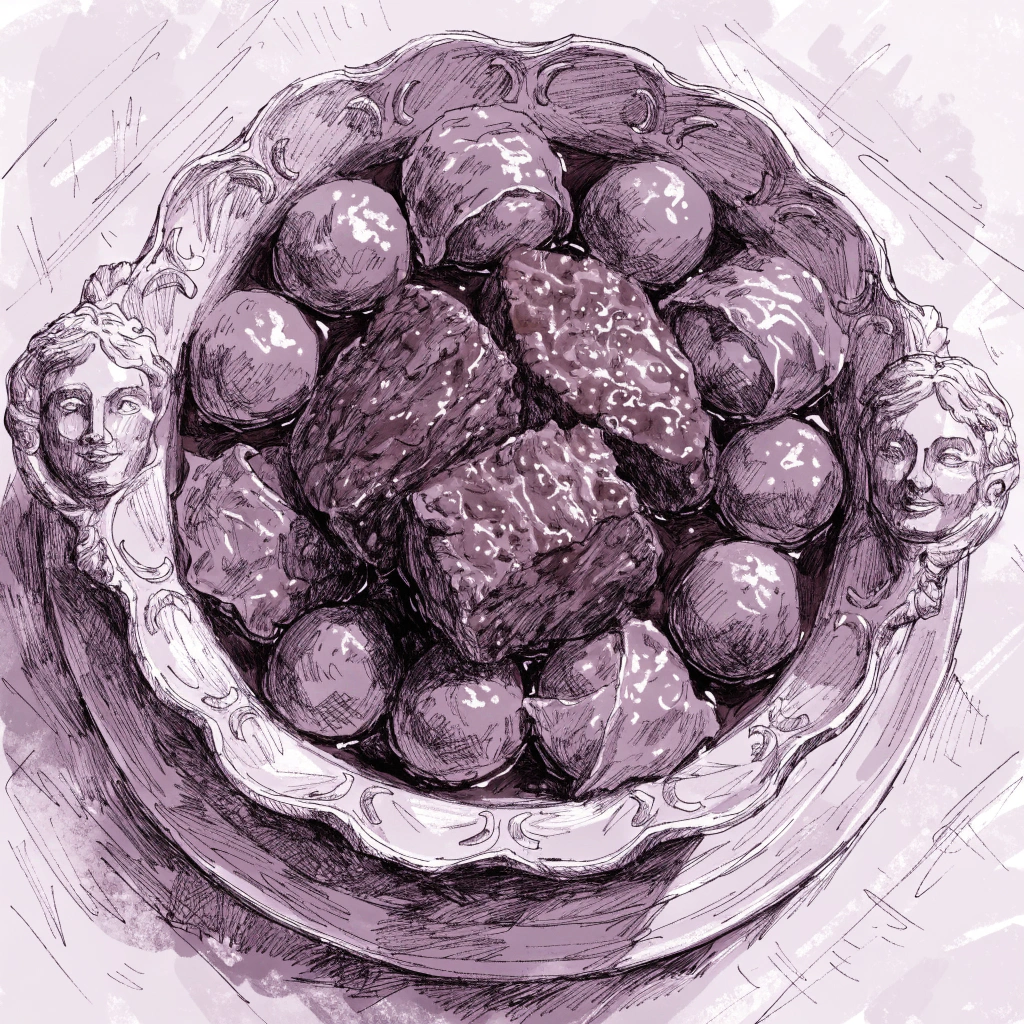
Sauerbraten: Uma Comida Famosa da Alemanha
Sauerbraten é um prato famoso da Alemanha. Muitas pessoas dizem que é o prato nacional. É um tipo de carne assada. A carne fica em um molho especial por muitos dias, às vezes três ou dez dias! Este molho tem vinagre, vinho e temperos. Ele deixa a carne muito macia e com um sabor delicioso. É uma receita antiga e tradicional.
As famílias alemãs comem Sauerbraten em casa. Este prato mostra a história e a cultura da Alemanha. É uma comida muito importante. Muitas pessoas gostam de Sauerbraten em todo o país.
Gramática em destaque
Padrão: O Verbo 'Ser' (Presente)
"Sauerbraten **é** um prato famoso da Alemanha."
O verbo 'ser' significa 'to be'. Usamos 'é' para falar sobre o que algo ou alguém é. Por exemplo, 'ele é', 'ela é', 'você é'.
Padrão: Adjetivos com 'Muito'
"Ele deixa a carne **muito** macia e com um sabor delicioso."
A palavra 'muito' significa 'very' ou 'a lot'. Usamos 'muito' antes de um adjetivo (como 'macia' ou 'famoso') para mostrar que algo tem aquela qualidade em grande quantidade.
Teste sua compreensão
10 perguntas · A1 Iniciante · 1 pré-visualização grátis
Teste o que aprendeu neste artigo. Responda todas as perguntas para ganhar XP!
Sobre qual país o artigo fala?
Quer finalizar o quiz?
9 perguntas a mais estão esperando por você. Cadastre-se grátis para desbloquear o quiz completo e ganhar XP!
Cadastrar grátisJá tem conta? Entrar
Detalhamento das perguntas
Sobre qual país o artigo fala?
Sua resposta:
Resposta correta: Alemanha
Sauerbraten é um tipo de salada.
Sua resposta:
Resposta correta: Falso
O que significa a palavra 'sabor'?
Sua resposta:
Resposta correta: O gosto da comida
A carne fica em um _____ especial por muitos dias.
Sua resposta:
Resposta correta: molho
A Traditional German Dinner: Sauerbraten
Sauerbraten is a very famous dish from Germany. Many people say it is the national dish because it is popular in every region. It is a special type of pot roast.
In the past, people wanted to make cheap meat soft and tasty. They put the meat in a liquid with vinegar, wine, and many spices. The meat stayed in this liquid for three to ten days. This long time made the meat very tender. It also gave the meat a strong flavor.
Today, most people use beef for Sauerbraten. The sauce is special because it is sweet and sour. It is more delicious than a normal roast because of the spices. People usually eat it with red cabbage and potato dumplings. It is a great meal for a cold winter day because it is warm and heavy.
Gramática em destaque
Padrão: Past Simple
"In the past, people wanted to make cheap meat soft and tasty."
We use the past simple to talk about things that happened in the past. To form it, we usually add '-ed' to the end of regular verbs like 'want' or 'stay'.
Padrão: Comparatives
"It is more delicious than a normal roast because of the spices."
We use comparatives to compare two things. For long adjectives like 'delicious', we use 'more' before the adjective and 'than' after it.
Teste sua compreensão
11 perguntas · A2 Elementar · 1 pré-visualização grátis
Teste o que aprendeu neste artigo. Responda todas as perguntas para ganhar XP!
How long do people usually keep the meat in the liquid?
Quer finalizar o quiz?
10 perguntas a mais estão esperando por você. Cadastre-se grátis para desbloquear o quiz completo e ganhar XP!
Cadastrar grátisJá tem conta? Entrar
Detalhamento das perguntas
How long do people usually keep the meat in the liquid?
Sua resposta:
Resposta correta: 3 to 10 days
Sauerbraten is only popular in one small city in Germany.
Sua resposta:
Resposta correta: Falso
What does 'tender' mean?
Sua resposta:
Resposta correta: Soft and easy to eat
The sauce is special because it is sweet and _____.
Sua resposta:
Resposta correta: sour
What do people usually serve with Sauerbraten?
Sua resposta:
Resposta correta: Red cabbage and potato dumplings
Sauerbraten: A Traditional Taste of Germany
Sauerbraten is a famous pot roast that is often called the national dish of Germany. It has been a favorite for many generations because of its unique, sour flavor. While it is popular across the whole country, different regions have developed their own special ways of preparing it.
The most important part of making Sauerbraten is the marination process. The meat, which is usually beef nowadays, is soaked in a mixture of vinegar, wine, and water for several days. In the past, horse meat was often used because it was cheaper, but this has changed over time. This long process is necessary because it helps to tenderize the meat, making it very soft and juicy.
Many different spices are added to the liquid, such as bay leaves, cloves, and peppercorns. These ingredients have been used for centuries to create a rich aroma. After the meat has been marinated for three to ten days, it is slowly cooked in a heavy pot. This method ensures that the flavors are fully absorbed by the meat.
Sauerbraten is traditionally served with red cabbage and large potato dumplings, which are called 'Klöße' in German. In some areas, like the Rhineland, the sauce is made slightly sweet by adding raisins or even crumbled gingerbread. This creates a perfect balance between the sour vinegar and the sweet ingredients. If you visit Germany, you should definitely try this classic meal that has survived the test of time.
Gramática em destaque
Padrão: Present Perfect
"It has been a favorite for many generations because of its unique, sour flavor."
The present perfect (have/has + past participle) is used here to describe an action or state that started in the past and continues to the present.
Padrão: Passive Voice
"Sauerbraten is traditionally served with red cabbage and large potato dumplings."
The passive voice (be + past participle) is used when the focus is on the dish itself rather than the person serving it.
Teste sua compreensão
11 perguntas · B1 Intermediário · 1 pré-visualização grátis
Teste o que aprendeu neste artigo. Responda todas as perguntas para ganhar XP!
How long is the meat usually marinated for Sauerbraten?
Quer finalizar o quiz?
10 perguntas a mais estão esperando por você. Cadastre-se grátis para desbloquear o quiz completo e ganhar XP!
Cadastrar grátisJá tem conta? Entrar
Detalhamento das perguntas
How long is the meat usually marinated for Sauerbraten?
Sua resposta:
Resposta correta: Three to ten days
Horse meat is the most common meat used for Sauerbraten today.
Sua resposta:
Resposta correta: Falso
What does 'tenderize' mean in the context of the article?
Sua resposta:
Resposta correta: To make meat softer
In the Rhineland, the sauce is sometimes made sweet by adding _____.
Sua resposta:
Resposta correta: raisins
What are 'Klöße' in German cuisine?
Sua resposta:
Resposta correta: Potato dumplings
Sauerbraten: A Culinary Reflection of German Heritage and Patience
Sauerbraten is frequently acknowledged as the national dish of Germany, a distinction it has earned through its profound roots in regional history and its consistent presence on dinner tables across the country. Essentially a pot roast, what distinguishes Sauerbraten from other meat dishes is the extensive marination process, which typically spans between three and ten days. Historically, this method was born out of practical necessity; the acidic marinade, composed of vinegar, wine, and aromatic spices, served to tenderize tougher, less expensive cuts of meat. While horse meat was traditionally utilized in certain regions, modern variations almost exclusively feature high-quality beef.
The preparation of Sauerbraten is a meticulous endeavor that requires significant foresight. The meat must be submerged in a liquid mixture containing cloves, bay leaves, peppercorns, and juniper berries. This prolonged soaking period not only softens the muscle fibers but also allows the complex flavors to penetrate deeply into the roast. Consequently, the resulting dish offers a unique balance of sour and savory notes that is rarely found in other European cuisines. If the marination period were shorter, the meat would fail to achieve its characteristic tenderness and depth of flavor.
Regional diversity plays a pivotal role in how the dish is presented and seasoned. In the Rhineland, for instance, the sauce is often sweetened with raisins or crumbled Lebkuchen (gingerbread) to counteract the sharp acidity of the vinegar. This creates a sophisticated contrast that has become a hallmark of the region’s culinary identity. Conversely, in other parts of Germany, such as Franconia or Swabia, the flavor profile might lean more towards the savory side, often accompanied by potato dumplings or red cabbage. Each region takes immense pride in its specific variation, viewing it as a symbol of local heritage.
In the contemporary era, Sauerbraten has transitioned from a humble meal of necessity to a celebrated gourmet specialty found in high-end restaurants. It represents more than just a culinary technique; it embodies the German values of patience and precision. Despite the convenience of modern fast food, the enduring popularity of such a time-consuming dish suggests a deep-seated appreciation for heritage and slow-cooked quality. Furthermore, the dish continues to evolve as chefs experiment with modern interpretations, ensuring that Sauerbraten remains relevant in a globalized food landscape. Ultimately, whether enjoyed in a rustic tavern or a fine-dining establishment, it remains an essential component of the German cultural fabric.
Gramática em destaque
Padrão: Passive Voice
"Sauerbraten is frequently acknowledged as the national dish of Germany."
This pattern is used to focus on the object receiving the action rather than the subject performing it. It is formed using 'to be' + the past participle.
Padrão: Second Conditional
"If the marination period were shorter, the meat would fail to achieve its characteristic tenderness and depth of flavor."
Used to discuss hypothetical or imaginary situations in the present or future. It uses 'if' + past subjunctive (were) and 'would' + base verb.
Padrão: Non-defining Relative Clause
"...what distinguishes Sauerbraten from other meat dishes is the extensive marination process, which typically spans between three and ten days."
This provides extra, non-essential information about a noun. It is separated by commas and uses 'which' for things.
Teste sua compreensão
11 perguntas · B2 Intermediário superior · 1 pré-visualização grátis
Teste o que aprendeu neste artigo. Responda todas as perguntas para ganhar XP!
What was the original practical reason for the long marination process?
Quer finalizar o quiz?
10 perguntas a mais estão esperando por você. Cadastre-se grátis para desbloquear o quiz completo e ganhar XP!
Cadastrar grátisJá tem conta? Entrar
Detalhamento das perguntas
What was the original practical reason for the long marination process?
Sua resposta:
Resposta correta: To tenderize tougher, cheaper cuts of meat
Modern Sauerbraten is still primarily made using horse meat in most regions.
Sua resposta:
Resposta correta: Falso
Which word describes something that is very careful, precise, and detailed?
Sua resposta:
Resposta correta: Meticulous
To prepare the dish properly, the meat must be _____ in a liquid mixture of vinegar and spices.
Sua resposta:
Resposta correta: submerged
How does the Rhineland version of Sauerbraten differ from others?
Sua resposta:
Resposta correta: It is sweetened with raisins or gingerbread
The Temporal Alchemy of Sauerbraten: A Culinary Heritage
Seldom does a culinary tradition demand such unwavering patience as the preparation of Sauerbraten. Regarded by many as the quintessential German pot roast, its status as a national dish is underpinned by a history that mirrors the socio-economic evolution of the German states. The transformation of a humble, often fibrous cut of meat into a succulent delicacy is achieved through an arduous marination process, spanning several days. It is this chemical breakdown, facilitated by the confluence of acidity and time, that distinguishes Sauerbraten from its more contemporary, rapid-fire counterparts in global gastronomy. In a world characterized by the ephemeral nature of modern dining, this dish stands as a testament to the virtue of foresight and slow-cooked heritage.
Historically, the pervasive use of horse meat—a practice now largely relegated to the vestiges of history—necessitated a marinade capable of tenderizing the most resilient of proteins. Not only does the vinegar-based liquid serve a functional purpose in softening the muscle fibers, but it also imparts a complex flavor profile that challenges the modern palate. The historical necessity of using tougher cuts of meat birthed a technique that survived the transition to beef and venison, proving that culinary ingenuity often arises from scarcity. The marinade itself is a sophisticated blend of wine vinegar, water, and aromatic spices, including juniper berries, cloves, and peppercorns, which permeate the meat over the course of three to ten days.
Furthermore, the regional permutations of the recipe illustrate Germany's vast cultural diversity. In the Rhineland, for instance, the inclusion of raisins or Lebkuchen (gingerbread) provides a saccharine counterpoint to the vinegar’s bite, creating a sophisticated Agrodolce effect. Conversely, in the southern regions, the sauce tends to remain more savory, often enriched with sour cream to provide a velvety texture. This regionalism suggests that Sauerbraten is not a monolithic entity but rather a living tradition that adapts to local tastes and available ingredients. The meticulous reduction of the marinade into a glossy, thick gravy is perhaps the most critical stage of the process, requiring the chef to balance acidity with sweetness and salt with precision.
Indeed, the preparation of Sauerbraten is not merely an act of cooking; it is a meticulous exercise in artisanal craft. The chef must navigate the delicate interplay between the robust notes of the spices and the inherent richness of the beef. By demanding a week of preparation, Sauerbraten compels the cook to engage with the temporal dimension of food, acknowledging that some sensory experiences cannot be hurried. It is a dish that requires a dialogue between the past and the present, between the necessity of preservation and the desire for luxury. Consequently, its enduring presence on the German table is not just a matter of nostalgia, but a conscious preservation of a culinary philosophy that values depth over speed.
Gramática em destaque
Padrão: Negative Inversion
"Seldom does a culinary tradition demand such unwavering patience as the preparation of Sauerbraten."
When a sentence starts with a negative or restrictive adverbial (like 'seldom'), the subject and auxiliary verb are inverted. This is used in C1 writing to add emphasis and a formal tone.
Padrão: It-Cleft Sentence
"It is this chemical breakdown, facilitated by the confluence of acidity and time, that distinguishes Sauerbraten from its more contemporary, rapid-fire counterparts in global gastronomy."
A cleft sentence divides a single clause into two parts to focus on specific information. Here, it emphasizes 'this chemical breakdown' as the primary reason for the dish's unique nature.
Padrão: Nominalisation
"The transformation of a humble, often fibrous cut of meat into a succulent delicacy is achieved through an arduous marination process."
Nominalisation involves turning verbs (transform) or adjectives into nouns (transformation). This creates a more objective, academic, and sophisticated style suitable for advanced analysis.
Teste sua compreensão
12 perguntas · C1 Avançado · 1 pré-visualização grátis
Teste o que aprendeu neste artigo. Responda todas as perguntas para ganhar XP!
What was the primary historical reason for the lengthy marination of Sauerbraten?
Quer finalizar o quiz?
11 perguntas a mais estão esperando por você. Cadastre-se grátis para desbloquear o quiz completo e ganhar XP!
Cadastrar grátisJá tem conta? Entrar
Detalhamento das perguntas
What was the primary historical reason for the lengthy marination of Sauerbraten?
Sua resposta:
Resposta correta: To tenderize tough cuts of meat, such as horse meat
The article suggests that Sauerbraten is a monolithic dish with no regional variations across Germany.
Sua resposta:
Resposta correta: Falso
What does the word 'gastronomy' refer to in the context of the article?
Sua resposta:
Resposta correta: The art and practice of high-quality cooking and eating
The inclusion of raisins in the Rhineland version creates a sweet and sour effect described as _____.
Sua resposta:
Resposta correta: Agrodolce
According to the text, what does the preparation of Sauerbraten represent in modern times?
Sua resposta:
Resposta correta: A conscious preservation of slow-cooked heritage
The use of horse meat in Sauerbraten is still a pervasive practice in modern Germany.
Sua resposta:
Resposta correta: Falso
Sauerbraten: Uma Odisseia Gastronômica Alemã na Encruzilhada da Tradição e da Perfeição Culinária
O Sauerbraten, prato emblemático da culinária alemã, transcende a mera definição de um assado de panela; ele se erige como um verdadeiro paradigma de como a perseverança e uma técnica culinária intrincada podem transformar cortes de carne outrora desprezíveis em uma experiência gustativa sublime. Não é exagero afirmar que este prato, cuja etimologia remete ao seu processo de marinada ácida ("sauer" significa azedo e "braten", assado), detém um lugar intrínseco na identidade gastronômica germânica, sendo frequentemente, e com justificável razão, alçado à categoria de prato nacional.
A essência do Sauerbraten reside na sua prolongada marinada, um ritual que pode estender-se de três a dez dias. Este processo meticuloso não é apenas um capricho, mas sim uma proeza culinária historicamente enraizada na necessidade prática. Outrora, os cortes de carne disponíveis eram, por vezes, mais fibrosos e menos nobres – chegando, em tempos remotos, a incluir carne de cavalo, embora hoje predominantemente se utilize carne bovina, suína ou de caça. A marinada, composta por vinagre (tradicionalmente de vinho ou maçã), vinho tinto, ervas aromáticas (louro, zimbro, cravo) e especiarias variadas, desempenha um papel multifacetado: ela não só amacia as fibras da carne, conferindo-lhe uma textura suculenta e tenra, mas também infunde-lhe uma complexidade de sabores agridoce que é a assinatura inconfundível do prato.
A diversidade regional do Sauerbraten é notável, refletindo a rica tapeçaria cultural da Alemanha. No Reno, por exemplo, é comum que a marinada seja adocicada com passas e biscoitos de pão de mel (Lebkuchen), que também servem para espessar o molho, conferindo-lhe uma doçura sutil que contrasta harmoniosamente com a acidez do vinagre. Já na Baviera ou na Francônia, a ênfase recai sobre a robustez dos sabores, com marinadas mais intensas e frequentemente acompanhadas por Knödel (bolinhos de batata ou pão) e Krautsalat (salada de repolho). Independentemente da variante, a finalização do molho, muitas vezes com um toque de creme de leite ou geleia de frutas vermelhas, é crucial para equilibrar o paladar e adicionar uma veludosa riqueza.
A preparação do molho é, por si só, uma arte. Após a retirada da carne da marinada e seu selamento em fogo alto, a base aromática (cebola, cenoura, aipo) é caramelizada, deglaçada com a própria marinada e, por fim, reduzida lentamente. Este líquido precioso, coado e ajustado com espessantes, transforma-se no molho denso e brilhante que é o epítome da indulgência. É imperativo que se compreenda que a paciência é um ingrediente tão vital quanto qualquer especiaria na elaboração de um Sauerbraten verdadeiramente autêntico.
Servido tradicionalmente com Kartoffelklöße (bolinhos de batata), Spätzle (massa de ovo) ou batatas cozidas, e invariavelmente acompanhado de Rotkohl (repolho roxo agridoce), o Sauerbraten é mais do que uma refeição; é uma celebração da história, da resiliência e da engenhosidade culinária. A cada garfada, somos transportados a um legado de séculos, onde a necessidade engendrou uma obra-prima gastronômica, condizente com a reputação de uma nação que preza pela excelência e pelo aprofundamento das suas tradições. A longevidade deste prato nas mesas alemãs, do Reno ao Elba, atesta sua perene relevância e sua capacidade de cativar paladares através das gerações, mantendo-se como um farol da culinária germânica clássica.
Gramática em destaque
Padrão: Subjuntivo para Expressar Necessidade/Obrigatoriedade Impessoal
"É imperativo que se compreenda que a paciência é um ingrediente tão vital quanto qualquer especiaria na elaboração de um Sauerbraten verdadeiramente autêntico."
Neste caso, o subjuntivo ("compreenda") é utilizado após uma expressão impessoal de necessidade ou obrigação ("É imperativo que..."). Essa estrutura é comum em contextos formais e acadêmicos para apresentar uma ideia como fundamental ou essencial, sem atribuir a ação a um sujeito específico de forma direta.
Padrão: Gerúndio como Cláusula Adverbial de Modo/Consequência
"A marinada, composta por vinagre..., desempenha um papel multifacetado: ela não só amacia as fibras da carne, conferindo-lhe uma textura suculenta e tenra, mas também infunde-lhe uma complexidade de sabores agridoce que é a assinatura inconfundível do prato."
O gerúndio ("conferindo-lhe") é empregado aqui para expressar o modo ou a consequência da ação principal (amaciar as fibras da carne). Ele atua como uma cláusula adverbial reduzida, adicionando informações sobre como ou com que resultado a ação ocorre, de forma concisa e elegante, típica de uma prosa mais elaborada.
Padrão: Construção com "não só... mas também..."
"Ela não só amacia as fibras da carne, conferindo-lhe uma textura suculenta e tenra, mas também infunde-lhe uma complexidade de sabores agridoce que é a assinatura inconfundível do prato."
Esta construção correlativa é utilizada para enfatizar que duas informações ou ações são verdadeiras ou ocorrem simultaneamente, adicionando um elemento de reforço. Ela serve para destacar a dupla função ou o duplo impacto de algo, elevando o nível de detalhe e a profundidade da análise na escrita.
Teste sua compreensão
12 perguntas · C2 Domínio · 1 pré-visualização grátis
Teste o que aprendeu neste artigo. Responda todas as perguntas para ganhar XP!
Qual é a principal característica que distingue o Sauerbraten de outros assados de panela?
Quer finalizar o quiz?
11 perguntas a mais estão esperando por você. Cadastre-se grátis para desbloquear o quiz completo e ganhar XP!
Cadastrar grátisJá tem conta? Entrar
Detalhamento das perguntas
Qual é a principal característica que distingue o Sauerbraten de outros assados de panela?
Sua resposta:
Resposta correta: O processo prolongado de marinada ácida.
A marinada do Sauerbraten é um capricho culinário sem função prática, apenas estética.
Sua resposta:
Resposta correta: Falso
O que significa a palavra 'proeza' no contexto do artigo?
Sua resposta:
Resposta correta: Um feito notável ou habilidade.
É ___________ que se compreenda que a paciência é um ingrediente tão vital quanto qualquer especiaria na elaboração de um Sauerbraten verdadeiramente autêntico.
Sua resposta:
Resposta correta: imperativo
Que ingredientes podem ser adicionados à marinada do Sauerbraten na região do Reno para adoçar o molho?
Sua resposta:
Resposta correta: Passas e biscoitos de pão de mel (Lebkuchen).
O Sauerbraten é considerado um prato recente na culinária alemã, com menos de um século de história.
Sua resposta:
Resposta correta: Falso

