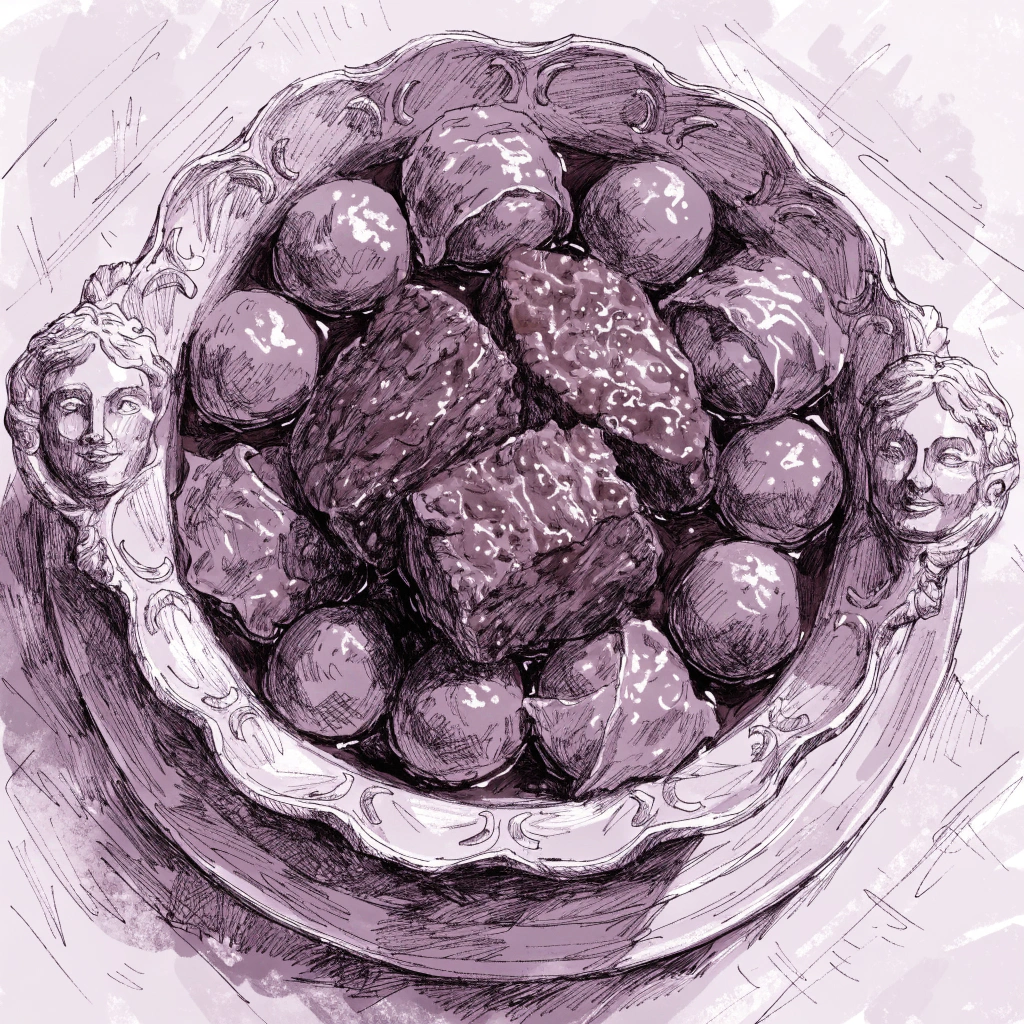
El Sauerbraten: Un Plato de Alemania
El Sauerbraten es un plato típico de Alemania. Es una carne muy rica y especial. La gente en Alemania come Sauerbraten en muchas ocasiones. Para hacer este plato, primero se marina la carne. La carne está en una salsa especial por muchos días, a veces una semana. Esta salsa tiene vinagre y especias. El vinagre hace la carne muy tierna. Después de marinar, se cocina la carne lentamente en una olla. El Sauerbraten es un plato tradicional y muy famoso. Es una comida importante en las fiestas y reuniones familiares. ¡Es delicioso y a todos les gusta mucho!
Gramática destacada
Patrón: El/La + Sustantivo (Artículos Definidos)
"El Sauerbraten es un plato típico de Alemania. La carne está en una salsa especial."
Usamos 'el' antes de sustantivos masculinos singulares (como 'plato'). Usamos 'la' antes de sustantivos femeninos singulares (como 'carne'). Estos artículos son para hablar de algo específico.
Patrón: Verbo 'Ser' en Presente
"El Sauerbraten es un plato típico de Alemania. Es una carne muy rica."
El verbo 'ser' se usa para describir cosas, decir qué son o de dónde son. Para 'él', 'ella' o 'eso' (tercera persona singular), usamos la forma 'es'.
Pon a prueba tu comprensión
10 preguntas · A1 Principiante · 1 vista previa gratis
Pon a prueba lo que aprendiste en este artículo. ¡Responde todas las preguntas para ganar XP!
¿De dónde es el plato Sauerbraten?
¿Quieres terminar el quiz?
9 preguntas más te esperan. ¡Regístrate gratis para desbloquear el quiz completo y ganar XP!
Regístrate gratis¿Ya tienes cuenta? Acceder
Desglose de preguntas
¿De dónde es el plato Sauerbraten?
Tu respuesta:
Respuesta correcta: Alemania
El Sauerbraten es una bebida fría.
Tu respuesta:
Respuesta correcta: Falso
¿Qué significa la palabra 'carne'?
Tu respuesta:
Respuesta correcta: Meat
La carne está en una _____ especial por muchos días.
Tu respuesta:
Respuesta correcta: salsa
A Traditional German Dinner: Sauerbraten
Sauerbraten is a very famous dish from Germany. Many people say it is the national dish because it is popular in every region. It is a special type of pot roast.
In the past, people wanted to make cheap meat soft and tasty. They put the meat in a liquid with vinegar, wine, and many spices. The meat stayed in this liquid for three to ten days. This long time made the meat very tender. It also gave the meat a strong flavor.
Today, most people use beef for Sauerbraten. The sauce is special because it is sweet and sour. It is more delicious than a normal roast because of the spices. People usually eat it with red cabbage and potato dumplings. It is a great meal for a cold winter day because it is warm and heavy.
Gramática destacada
Patrón: Past Simple
"In the past, people wanted to make cheap meat soft and tasty."
We use the past simple to talk about things that happened in the past. To form it, we usually add '-ed' to the end of regular verbs like 'want' or 'stay'.
Patrón: Comparatives
"It is more delicious than a normal roast because of the spices."
We use comparatives to compare two things. For long adjectives like 'delicious', we use 'more' before the adjective and 'than' after it.
Pon a prueba tu comprensión
11 preguntas · A2 Básico · 1 vista previa gratis
Pon a prueba lo que aprendiste en este artículo. ¡Responde todas las preguntas para ganar XP!
How long do people usually keep the meat in the liquid?
¿Quieres terminar el quiz?
10 preguntas más te esperan. ¡Regístrate gratis para desbloquear el quiz completo y ganar XP!
Regístrate gratis¿Ya tienes cuenta? Acceder
Desglose de preguntas
How long do people usually keep the meat in the liquid?
Tu respuesta:
Respuesta correcta: 3 to 10 days
Sauerbraten is only popular in one small city in Germany.
Tu respuesta:
Respuesta correcta: Falso
What does 'tender' mean?
Tu respuesta:
Respuesta correcta: Soft and easy to eat
The sauce is special because it is sweet and _____.
Tu respuesta:
Respuesta correcta: sour
What do people usually serve with Sauerbraten?
Tu respuesta:
Respuesta correcta: Red cabbage and potato dumplings
Sauerbraten: A Traditional Taste of Germany
Sauerbraten is a famous pot roast that is often called the national dish of Germany. It has been a favorite for many generations because of its unique, sour flavor. While it is popular across the whole country, different regions have developed their own special ways of preparing it.
The most important part of making Sauerbraten is the marination process. The meat, which is usually beef nowadays, is soaked in a mixture of vinegar, wine, and water for several days. In the past, horse meat was often used because it was cheaper, but this has changed over time. This long process is necessary because it helps to tenderize the meat, making it very soft and juicy.
Many different spices are added to the liquid, such as bay leaves, cloves, and peppercorns. These ingredients have been used for centuries to create a rich aroma. After the meat has been marinated for three to ten days, it is slowly cooked in a heavy pot. This method ensures that the flavors are fully absorbed by the meat.
Sauerbraten is traditionally served with red cabbage and large potato dumplings, which are called 'Klöße' in German. In some areas, like the Rhineland, the sauce is made slightly sweet by adding raisins or even crumbled gingerbread. This creates a perfect balance between the sour vinegar and the sweet ingredients. If you visit Germany, you should definitely try this classic meal that has survived the test of time.
Gramática destacada
Patrón: Present Perfect
"It has been a favorite for many generations because of its unique, sour flavor."
The present perfect (have/has + past participle) is used here to describe an action or state that started in the past and continues to the present.
Patrón: Passive Voice
"Sauerbraten is traditionally served with red cabbage and large potato dumplings."
The passive voice (be + past participle) is used when the focus is on the dish itself rather than the person serving it.
Pon a prueba tu comprensión
11 preguntas · B1 Intermedio · 1 vista previa gratis
Pon a prueba lo que aprendiste en este artículo. ¡Responde todas las preguntas para ganar XP!
How long is the meat usually marinated for Sauerbraten?
¿Quieres terminar el quiz?
10 preguntas más te esperan. ¡Regístrate gratis para desbloquear el quiz completo y ganar XP!
Regístrate gratis¿Ya tienes cuenta? Acceder
Desglose de preguntas
How long is the meat usually marinated for Sauerbraten?
Tu respuesta:
Respuesta correcta: Three to ten days
Horse meat is the most common meat used for Sauerbraten today.
Tu respuesta:
Respuesta correcta: Falso
What does 'tenderize' mean in the context of the article?
Tu respuesta:
Respuesta correcta: To make meat softer
In the Rhineland, the sauce is sometimes made sweet by adding _____.
Tu respuesta:
Respuesta correcta: raisins
What are 'Klöße' in German cuisine?
Tu respuesta:
Respuesta correcta: Potato dumplings
Sauerbraten: A Culinary Reflection of German Heritage and Patience
Sauerbraten is frequently acknowledged as the national dish of Germany, a distinction it has earned through its profound roots in regional history and its consistent presence on dinner tables across the country. Essentially a pot roast, what distinguishes Sauerbraten from other meat dishes is the extensive marination process, which typically spans between three and ten days. Historically, this method was born out of practical necessity; the acidic marinade, composed of vinegar, wine, and aromatic spices, served to tenderize tougher, less expensive cuts of meat. While horse meat was traditionally utilized in certain regions, modern variations almost exclusively feature high-quality beef.
The preparation of Sauerbraten is a meticulous endeavor that requires significant foresight. The meat must be submerged in a liquid mixture containing cloves, bay leaves, peppercorns, and juniper berries. This prolonged soaking period not only softens the muscle fibers but also allows the complex flavors to penetrate deeply into the roast. Consequently, the resulting dish offers a unique balance of sour and savory notes that is rarely found in other European cuisines. If the marination period were shorter, the meat would fail to achieve its characteristic tenderness and depth of flavor.
Regional diversity plays a pivotal role in how the dish is presented and seasoned. In the Rhineland, for instance, the sauce is often sweetened with raisins or crumbled Lebkuchen (gingerbread) to counteract the sharp acidity of the vinegar. This creates a sophisticated contrast that has become a hallmark of the region’s culinary identity. Conversely, in other parts of Germany, such as Franconia or Swabia, the flavor profile might lean more towards the savory side, often accompanied by potato dumplings or red cabbage. Each region takes immense pride in its specific variation, viewing it as a symbol of local heritage.
In the contemporary era, Sauerbraten has transitioned from a humble meal of necessity to a celebrated gourmet specialty found in high-end restaurants. It represents more than just a culinary technique; it embodies the German values of patience and precision. Despite the convenience of modern fast food, the enduring popularity of such a time-consuming dish suggests a deep-seated appreciation for heritage and slow-cooked quality. Furthermore, the dish continues to evolve as chefs experiment with modern interpretations, ensuring that Sauerbraten remains relevant in a globalized food landscape. Ultimately, whether enjoyed in a rustic tavern or a fine-dining establishment, it remains an essential component of the German cultural fabric.
Gramática destacada
Patrón: Passive Voice
"Sauerbraten is frequently acknowledged as the national dish of Germany."
This pattern is used to focus on the object receiving the action rather than the subject performing it. It is formed using 'to be' + the past participle.
Patrón: Second Conditional
"If the marination period were shorter, the meat would fail to achieve its characteristic tenderness and depth of flavor."
Used to discuss hypothetical or imaginary situations in the present or future. It uses 'if' + past subjunctive (were) and 'would' + base verb.
Patrón: Non-defining Relative Clause
"...what distinguishes Sauerbraten from other meat dishes is the extensive marination process, which typically spans between three and ten days."
This provides extra, non-essential information about a noun. It is separated by commas and uses 'which' for things.
Pon a prueba tu comprensión
11 preguntas · B2 Intermedio alto · 1 vista previa gratis
Pon a prueba lo que aprendiste en este artículo. ¡Responde todas las preguntas para ganar XP!
What was the original practical reason for the long marination process?
¿Quieres terminar el quiz?
10 preguntas más te esperan. ¡Regístrate gratis para desbloquear el quiz completo y ganar XP!
Regístrate gratis¿Ya tienes cuenta? Acceder
Desglose de preguntas
What was the original practical reason for the long marination process?
Tu respuesta:
Respuesta correcta: To tenderize tougher, cheaper cuts of meat
Modern Sauerbraten is still primarily made using horse meat in most regions.
Tu respuesta:
Respuesta correcta: Falso
Which word describes something that is very careful, precise, and detailed?
Tu respuesta:
Respuesta correcta: Meticulous
To prepare the dish properly, the meat must be _____ in a liquid mixture of vinegar and spices.
Tu respuesta:
Respuesta correcta: submerged
How does the Rhineland version of Sauerbraten differ from others?
Tu respuesta:
Respuesta correcta: It is sweetened with raisins or gingerbread
The Temporal Alchemy of Sauerbraten: A Culinary Heritage
Seldom does a culinary tradition demand such unwavering patience as the preparation of Sauerbraten. Regarded by many as the quintessential German pot roast, its status as a national dish is underpinned by a history that mirrors the socio-economic evolution of the German states. The transformation of a humble, often fibrous cut of meat into a succulent delicacy is achieved through an arduous marination process, spanning several days. It is this chemical breakdown, facilitated by the confluence of acidity and time, that distinguishes Sauerbraten from its more contemporary, rapid-fire counterparts in global gastronomy. In a world characterized by the ephemeral nature of modern dining, this dish stands as a testament to the virtue of foresight and slow-cooked heritage.
Historically, the pervasive use of horse meat—a practice now largely relegated to the vestiges of history—necessitated a marinade capable of tenderizing the most resilient of proteins. Not only does the vinegar-based liquid serve a functional purpose in softening the muscle fibers, but it also imparts a complex flavor profile that challenges the modern palate. The historical necessity of using tougher cuts of meat birthed a technique that survived the transition to beef and venison, proving that culinary ingenuity often arises from scarcity. The marinade itself is a sophisticated blend of wine vinegar, water, and aromatic spices, including juniper berries, cloves, and peppercorns, which permeate the meat over the course of three to ten days.
Furthermore, the regional permutations of the recipe illustrate Germany's vast cultural diversity. In the Rhineland, for instance, the inclusion of raisins or Lebkuchen (gingerbread) provides a saccharine counterpoint to the vinegar’s bite, creating a sophisticated Agrodolce effect. Conversely, in the southern regions, the sauce tends to remain more savory, often enriched with sour cream to provide a velvety texture. This regionalism suggests that Sauerbraten is not a monolithic entity but rather a living tradition that adapts to local tastes and available ingredients. The meticulous reduction of the marinade into a glossy, thick gravy is perhaps the most critical stage of the process, requiring the chef to balance acidity with sweetness and salt with precision.
Indeed, the preparation of Sauerbraten is not merely an act of cooking; it is a meticulous exercise in artisanal craft. The chef must navigate the delicate interplay between the robust notes of the spices and the inherent richness of the beef. By demanding a week of preparation, Sauerbraten compels the cook to engage with the temporal dimension of food, acknowledging that some sensory experiences cannot be hurried. It is a dish that requires a dialogue between the past and the present, between the necessity of preservation and the desire for luxury. Consequently, its enduring presence on the German table is not just a matter of nostalgia, but a conscious preservation of a culinary philosophy that values depth over speed.
Gramática destacada
Patrón: Negative Inversion
"Seldom does a culinary tradition demand such unwavering patience as the preparation of Sauerbraten."
When a sentence starts with a negative or restrictive adverbial (like 'seldom'), the subject and auxiliary verb are inverted. This is used in C1 writing to add emphasis and a formal tone.
Patrón: It-Cleft Sentence
"It is this chemical breakdown, facilitated by the confluence of acidity and time, that distinguishes Sauerbraten from its more contemporary, rapid-fire counterparts in global gastronomy."
A cleft sentence divides a single clause into two parts to focus on specific information. Here, it emphasizes 'this chemical breakdown' as the primary reason for the dish's unique nature.
Patrón: Nominalisation
"The transformation of a humble, often fibrous cut of meat into a succulent delicacy is achieved through an arduous marination process."
Nominalisation involves turning verbs (transform) or adjectives into nouns (transformation). This creates a more objective, academic, and sophisticated style suitable for advanced analysis.
Pon a prueba tu comprensión
12 preguntas · C1 Avanzado · 1 vista previa gratis
Pon a prueba lo que aprendiste en este artículo. ¡Responde todas las preguntas para ganar XP!
What was the primary historical reason for the lengthy marination of Sauerbraten?
¿Quieres terminar el quiz?
11 preguntas más te esperan. ¡Regístrate gratis para desbloquear el quiz completo y ganar XP!
Regístrate gratis¿Ya tienes cuenta? Acceder
Desglose de preguntas
What was the primary historical reason for the lengthy marination of Sauerbraten?
Tu respuesta:
Respuesta correcta: To tenderize tough cuts of meat, such as horse meat
The article suggests that Sauerbraten is a monolithic dish with no regional variations across Germany.
Tu respuesta:
Respuesta correcta: Falso
What does the word 'gastronomy' refer to in the context of the article?
Tu respuesta:
Respuesta correcta: The art and practice of high-quality cooking and eating
The inclusion of raisins in the Rhineland version creates a sweet and sour effect described as _____.
Tu respuesta:
Respuesta correcta: Agrodolce
According to the text, what does the preparation of Sauerbraten represent in modern times?
Tu respuesta:
Respuesta correcta: A conscious preservation of slow-cooked heritage
The use of horse meat in Sauerbraten is still a pervasive practice in modern Germany.
Tu respuesta:
Respuesta correcta: Falso
The Gastronomic Alchemy of Sauerbraten: A Sociocultural Dissection of Germany’s Culinary Heritage
To characterize Sauerbraten merely as a pot roast would be to commit a reductive fallacy of the highest order. Rather, this venerated dish represents a sophisticated confluence of historical necessity and culinary artistry. Its nomenclature, derived from the German 'sauer' (sour) and 'braten' (roast), belies the intricate chemical metamorphosis that occurs during its lengthy gestation. Traditionally, the process necessitated a marination period extending up to ten days, a prerequisite originally intended to render the sinewy fibers of older, tougher cuts of meat—historically including equine sources—palatable to the discerning tongue. This temporal investment is not merely a relic of the past; it remains the defining characteristic of the dish’s contemporary preparation.
The crux of Sauerbraten’s identity lies in the deliberate denaturation of proteins through an acidic medium, typically a blend of vinegar, red wine, and a bouquet of aromatics. This chemical intervention, while ostensibly functional, serves a dual purpose: it acts as both a preservative and a flavor enhancer. The resulting equilibrium between the assertive tartness of the marinade and the inherent richness of the beef is what distinguishes the dish from its more pedestrian counterparts. Were the acidity not tempered by the subsequent addition of sweeteners, the dish might risk being abrasive; however, the German culinary tradition masterfully introduces elements such as Soßenkuchen (gingerbread), raisins, or beet syrup to achieve a harmonious complexity. This interplay of sweet and sour is a hallmark of the Rhenish style, though other regions maintain their own distinct profiles.
Regionality further complicates any attempt at a monolithic definition of Sauerbraten. In the Rhineland, the inclusion of raisins and a distinct sweetness is paramount, reflecting the historical influence of trade and the availability of exotic ingredients. Conversely, in the Franconian or Swabian iterations, the profile tends toward a more restrained, savory disposition. These variations are not merely matters of taste but are vestigial markers of local identity and resource availability. One might posit that the Sauerbraten served in a contemporary Munich tavern is as much a historical document as it is a culinary delight. The dish serves as a culinary map, tracing the movements of ingredients and the evolution of the German palate over centuries.
Furthermore, the presentation of Sauerbraten is seldom an isolated affair. It is almost invariably accompanied by Rotkohl (braised red cabbage) and Knödel (potato dumplings), which provide the necessary structural and flavor-balancing components to the meal. The dumplings, in particular, serve as a vehicle for the opulent, velvety gravy—a byproduct of the slow-braising process that captures the very essence of the marinated meat. This amalgamation of textures—the succulent meat, the soft dumpling, and the crunch of the cabbage—creates a sensory experience that transcends mere sustenance. It is in this careful assembly that the dish achieves its quintessential status in the German canon.
In the modern era, where convenience often dictates gastronomic choices, the enduring popularity of Sauerbraten is somewhat anomalous. The temporal investment required for its preparation stands in stark opposition to the ephemeral nature of contemporary fast food. Yet, it is perhaps this very demand for patience that ensures its survival. In a world characterized by rapid change, the slow, deliberate maturation of a Sauerbraten offers a sense of continuity and a tangible link to a heritage that values craftsmanship over speed. Should the dish ever fall into obscurity, it would signal not merely a change in diet, but a profound loss of cultural equilibrium. As long as the aroma of vinegar and spices continues to waft through German kitchens, the legacy of this complex roast remains secure.
Gramática destacada
Patrón: Subjunctive Mood for Hypothetical Situations
"Were the acidity not tempered by the subsequent addition of sweeteners, the dish might risk being abrasive."
The 'were' subjunctive is used here to express a hypothetical condition contrary to fact. It adds a formal, academic tone to the analysis of the dish's flavor profile.
Patrón: Inverted Conditionals
"Should the dish ever fall into obscurity, it would signal not merely a change in diet, but a profound loss of cultural equilibrium."
Inverting 'should' and the subject creates a formal conditional structure (equivalent to 'If the dish should ever fall'). This is common in high-level academic or literary English.
Patrón: Epistemic Modality (Hedging)
"One might posit that the Sauerbraten served in a contemporary Munich tavern is as much a historical document as it is a culinary delight."
The use of 'might posit' allows the author to make a scholarly claim without stating it as an absolute, objective fact, which is a hallmark of C2-level analytical writing.
Pon a prueba tu comprensión
12 preguntas · C2 Dominio · 1 vista previa gratis
Pon a prueba lo que aprendiste en este artículo. ¡Responde todas las preguntas para ganar XP!
What was the primary historical reason for the lengthy marination process of Sauerbraten?
¿Quieres terminar el quiz?
11 preguntas más te esperan. ¡Regístrate gratis para desbloquear el quiz completo y ganar XP!
Regístrate gratis¿Ya tienes cuenta? Acceder
Desglose de preguntas
What was the primary historical reason for the lengthy marination process of Sauerbraten?
Tu respuesta:
Respuesta correcta: To make tough, low-quality meat fibers edible.
The author suggests that the Rhenish style of Sauerbraten is more savory and less sweet than other regional versions.
Tu respuesta:
Respuesta correcta: Falso
Which word describes something that is a small, remaining part of something much larger from the past?
Tu respuesta:
Respuesta correcta: Vestigial
The chemical process of _____ is essential to transforming the meat's texture.
Tu respuesta:
Respuesta correcta: denaturation
According to the article, why is Sauerbraten's popularity considered 'anomalous' today?
Tu respuesta:
Respuesta correcta: Because its long preparation time contradicts the modern preference for speed.
The author views Sauerbraten as a symbol of cultural continuity in a fast-changing world.
Tu respuesta:
Respuesta correcta: Verdadero
Sauerbraten: Comida de Alemania
Hola. Esto es Sauerbraten. Es comida.
Sauerbraten es de Alemania. Es una carne muy buena.
Alemania es un país grande. Sauerbraten es comida típica de Alemania. Es popular. A mí me gusta. Adiós.
Gramática destacada
Patrón: Ser + sustantivo / adjetivo
"Sauerbraten es comida."
Usamos 'es' (del verbo 'ser') para decir qué es algo o cómo es. Por ejemplo, 'Sauerbraten es comida' significa que Sauerbraten es un tipo de alimento. También podemos decir 'Es buena' para describir algo.
Pon a prueba tu comprensión
9 preguntas · A0 Pre-principiante · 1 vista previa gratis
Pon a prueba lo que aprendiste en este artículo. ¡Responde todas las preguntas para ganar XP!
¿De dónde es Sauerbraten?
¿Quieres terminar el quiz?
8 preguntas más te esperan. ¡Regístrate gratis para desbloquear el quiz completo y ganar XP!
Regístrate gratis¿Ya tienes cuenta? Acceder
Desglose de preguntas
¿De dónde es Sauerbraten?
Tu respuesta:
Respuesta correcta: Alemania
Sauerbraten es una bebida.
Tu respuesta:
Respuesta correcta: Falso
Sauerbraten es una _____ muy buena.
Tu respuesta:
Respuesta correcta: carne

