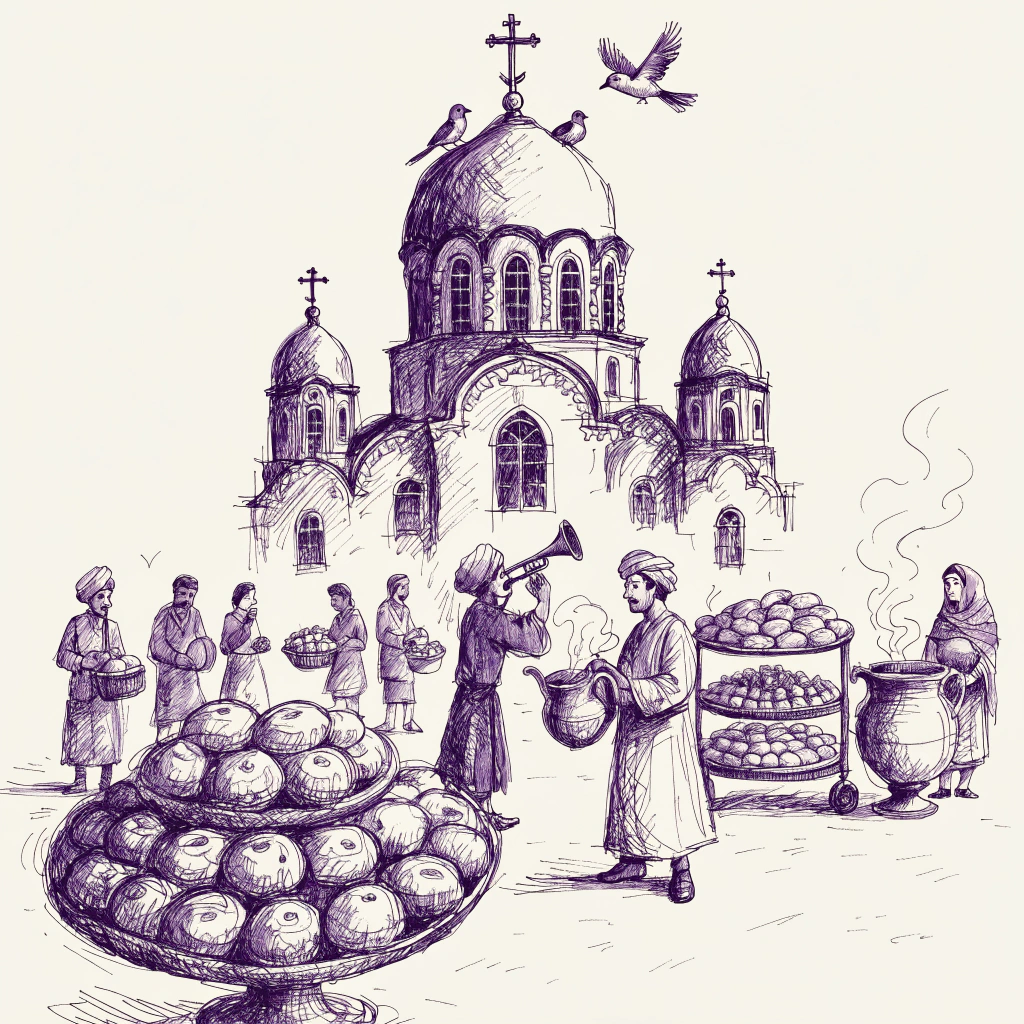
Coptic Christmas in Egypt
Christmas in Egypt is on January 7th. People call it Coptic Christmas. It is a very big holiday for many people. On this day, families go to church together. They wear beautiful clothes.
Before Christmas, people do not eat meat, eggs, or milk. This is a special fast. They eat vegetables, fruit, and bread for forty days.
On Christmas night, families have a big dinner. They eat meat and rice with soup. Children get small gifts and new clothes. Everyone is very happy. It is a beautiful time in Egypt.
语法聚焦
句型: 一般现在时 (be动词)
"It is a very big holiday for many people."
我们用 'is' 和 'it' 来描述事实或状态。它的构成是主语加上 'to be' 动词的正确形式。
句型: 一般现在时 (否定句)
"People do not eat meat, eggs, or milk."
为了构成一般现在时的否定句,我们在主要动词前加 'do not'。我们用它来谈论习惯或规则。
测试你的理解
10 个问题 · A1 初学 · 1 次免费预览
Coptic Christmas: A Special Celebration in Egypt
In Egypt, Christmas is a very special time. Coptic Christians celebrate this holiday on January 7th because they follow the Coptic calendar. This is different from the calendar in many Western countries. Before the big day, people fast for forty-three days. This is the 'Holy Nativity Fast.' During this period, observers do not eat meat, poultry, or dairy. They follow a strictly vegan diet, but the food is still delicious. In 2003, Coptic Christmas became an official national holiday for everyone in Egypt.
On Christmas Eve, families go to the church for a long service. Many people wear beautiful new clothes. The churches are brighter and more colorful than usual. After the church service, everyone goes home to eat a large feast. They usually eat 'Fattah.' This is a traditional dish with meat, rice, and bread. Schools and offices are closed, so all Egyptians can celebrate together. The streets are full of lights and decorations. It is a wonderful time because people feel more generous and kind to each other.
语法聚焦
句型: 比较级
"The churches are brighter and more colorful than usual."
我们用比较级来比较两样东西。对于像 'bright' 这样的短形容词,我们加 '-er'。对于像 'colorful' 这样的长形容词,我们用 'more'。
句型: 一般过去时
"In 2003, Coptic Christmas became an official national holiday."
一般过去时描述过去完成的动作。'Became' 是动词 'become' 的不规则过去式形式。
测试你的理解
11 个问题 · A2 基础 · 1 次免费预览
测试你从这篇文章中学到的知识。回答所有问题即可获得经验值!
题目详情
埃及的科普特基督徒什么时候庆祝圣诞节?
你的回答:
正确答案: 1月7日
在神圣降生斋戒期间,人们吃肉和家禽。
你的回答:
正确答案: 错误
'Vegan' 是什么意思?
你的回答:
正确答案: 不含动物产品
科普特圣诞节在2003年成为了官方的 _____ 节日。
你的回答:
正确答案: national
'Fattah' 是什么?
你的回答:
正确答案: 一道传统菜肴
Coptic Christmas: Egypt’s Unique Holiday Traditions
Egypt is a country with a rich history where different traditions have lived together for centuries. While many people around the world celebrate Christmas in December, Egyptian Christians, known as Coptic Orthodox Christians, celebrate it on January 7th. This special date follows the ancient Coptic calendar, which has been used in Egypt for nearly two thousand years.
Before the big day arrives, believers follow a strict and rigorous tradition called the Holy Nativity Fast. For forty-three days, animal products such as meat, poultry, and dairy are strictly avoided by those who observe the fast. Instead, a vegan diet is followed, which requires great self-discipline and spiritual preparation. This long period of fasting is considered very important because it is believed to prepare the heart for the joy of the celebration.
On Christmas Eve, which falls on January 6th, many people attend church for a beautiful service that often lasts until midnight. The most famous mass is held at St. Mark’s Cathedral in Cairo, where the Pope of the Coptic Church leads the prayers. The cathedral is usually decorated with lights and flowers, creating a peaceful atmosphere. After the service finishes, families return home to enjoy a massive feast. The most popular dish is 'Fatta,' which is a traditional meal made of meat, rice, and crispy bread soaked in a tasty garlic sauce.
In recent years, January 7th has been recognized as a national holiday in Egypt. This means that both Christians and Muslims can enjoy the festive atmosphere together. Even though it is primarily a religious event, the spirit of Christmas is felt across the whole country. Neighbors often visit each other to share special sweets and good wishes, proving that cultural traditions can bring people together in harmony.
语法聚焦
句型: 现在完成被动语态
"In recent years, January 7th has been recognized as a national holiday in Egypt."
这种句型用于谈论过去某个不确定时间发生且现在仍有重要性的动作。它由“has/have + been + 过去分词”构成。
句型: 由“Which”引导的关系从句
"This special date follows the ancient Coptic calendar, which has been used in Egypt for nearly two thousand years."
关系从句提供关于名词的额外信息。在这个句子中,“which”引导一个非限制性关系从句,用来描述科普特历法。
测试你的理解
11 个问题 · B1 中级 · 1 次免费预览
测试你从这篇文章中学到的知识。回答所有问题即可获得经验值!
题目详情
埃及的科普特正教基督徒在哪一天庆祝圣诞节?
你的回答:
正确答案: 1月7日
在神圣降生斋戒期间,遵守者会吃肉和乳制品。
你的回答:
正确答案: 错误
文章中的“harmony”是什么意思?
你的回答:
正确答案: 和平一致的状态
午夜礼拜后最受欢迎的菜肴叫做_____。
你的回答:
正确答案: Fatta
埃及最著名的圣诞弥撒在哪里举行?
你的回答:
正确答案: 在开罗的圣马克大教堂
Coptic Christmas: A Tapestry of Tradition and National Unity in Egypt
While much of the world observes Christmas in late December, Egypt presents a fascinating cultural divergence that highlights its deep-rooted history. In this ancient land, Christmas is celebrated on January 7th, a date that corresponds to the 29th day of the Coptic month of Kiahk. This temporal shift is primarily due to the Coptic Orthodox Church’s steadfast adherence to the Julian calendar, rather than the Gregorian one commonly used in Western nations. Understanding this distinction is crucial for anyone wishing to grasp the complexities of Middle Eastern Christian traditions. Far from being an isolated religious event for the country’s Christian minority, Coptic Christmas has evolved into a recognized national holiday, symbolizing a profound sense of communal unity across the nation's diverse demographic landscape.
The journey toward this festive day is characterized by the Holy Nativity Fast, a rigorous 43-day spiritual preparation that tests the discipline of the faithful. During this period, observers are expected to abstain from all animal products, including meat, poultry, and dairy. This vegan-like regimen, which is not merely about dietary restriction, serves as a vital period of reflection and spiritual purification. It is widely believed that by disciplining the physical body, individuals can achieve a higher state of spiritual readiness for the holy celebration ahead. Consequently, the eventual breaking of the fast becomes an even more significant moment for families and friends who gather to share a rich, meat-based meal.
The centerpiece of this transition is 'Fatta,' a traditional Egyptian dish consisting of bread, rice, and meat topped with a garlic and vinegar sauce. This dish is more than just sustenance; it represents the end of the long fast and the beginning of communal festivities. The heart of the religious celebration, however, remains the midnight mass. This service is often held at the magnificent St. Mark’s Coptic Orthodox Cathedral in Cairo, where thousands of worshippers gather in a display of faith that is frequently broadcast nationwide, reflecting the holiday's societal significance.
Despite the religious roots of the holiday, its impact is undeniably secular and inclusive. Festive decorations and lights frequently adorn the streets of major cities, and children often receive new clothes or small monetary gifts known as 'Eidiya.' Furthermore, the holiday serves as a vital platform for national unification. Government officials and leaders from various faiths typically exchange greetings, reinforcing the message of peaceful coexistence. Ultimately, Coptic Christmas in Egypt is a multifaceted event where ancient ecclesiastical traditions intersect with modern national identity, fostering a spirit of generosity that resonates throughout the entire country.
语法聚焦
句型: Passive Voice (Present Simple)
"The journey toward this festive day is characterized by the Holy Nativity Fast..."
The passive voice is used to focus on the 'journey' rather than the people performing the action. It is formed using the verb 'to be' followed by the past participle of the main verb.
句型: Non-defining Relative Clause
"This vegan-like regimen, which is not merely about dietary restriction, serves as a vital period of reflection."
This clause provides additional information about the 'regimen' without being essential to the sentence's core meaning. It is separated by commas and uses 'which' for objects.
句型: Contrast with 'Despite'
"Despite the religious roots of the holiday, its impact is undeniably secular and inclusive."
'Despite' is a preposition used to show a contrast between two ideas. It is followed by a noun or a noun phrase to indicate that something happens regardless of another factor.
测试你的理解
11 个问题 · B2 中高级 · 1 次免费预览
测试你从这篇文章中学到的知识。回答所有问题即可获得经验值!
Why does the Coptic Christmas celebration occur on January 7th?
题目详情
Why does the Coptic Christmas celebration occur on January 7th?
你的回答:
正确答案: It follows the Julian calendar
The Holy Nativity Fast involves consuming meat but avoiding dairy products.
你的回答:
正确答案: 错误
What does the word 'abstain' mean in the text?
你的回答:
正确答案: To refrain from doing something
The traditional Egyptian dish eaten to break the fast is called _____.
你的回答:
正确答案: Fatta
Where is the main midnight mass service typically held in Cairo?
你的回答:
正确答案: St. Mark's Coptic Cathedral
The Spiritual and Sociocultural Resonance of the Coptic Nativity in Egypt
While much of the Western world has long since concluded its festive revelry by early January, the streets of Egypt begin to pulse with a distinct, ancient energy as the seventh of the month approaches. Coptic Christmas, or the Nativity, is far from a mere repetition of Gregorian festivities; rather, it is a profound manifestation of the Julian calendar's endurance and a testament to the resilience of Egypt’s Christian heritage. Seldom does a tradition so seamlessly weave together the threads of religious asceticism and national jubilation. In a country where history is measured in millennia, this celebration serves as a vital bridge between the Pharaonic past and the contemporary era.
The prelude to the celebration is defined by the Holy Nativity Fast, a forty-three-day period of rigorous abstinence that prioritizes spiritual purification over material indulgence. During this time, the faithful adhere to a strictly vegan diet, eschewing all animal products, including meat, poultry, and dairy. This collective discipline is not merely a dietary choice but a sophisticated psychological preparation, aimed at fostering a heightened state of mindfulness and humility. The nominalization of this struggle—the 'fasting'—becomes a shared identity that transcends individual effort, binding the community in a singular purpose of devotion.
As the sun sets on the evening of January 6th, the atmosphere shifts toward the liturgical. In cathedrals across the nation, most notably the majestic St. Mark’s Cathedral in Cairo, the midnight mass commences. It is the rhythmic chanting of ancient Coptic hymns, some echoing the melodies of Pharaonic times, that transports the congregation into a realm beyond the contemporary world. The liturgy is a sensory experience, characterized by the heavy scent of incense and the visual opulence of golden icons. Not until the Pope of the Coptic Orthodox Church delivers his message of peace does the spiritual intensity reach its zenith, signaling the arrival of the holy day.
The conclusion of the service marks the transition from the sacred to the communal. The breaking of the fast is a grand culinary affair, centered around 'Fatta'—a hearty dish consisting of bread, rice, and meat simmered in a potent garlic and vinegar sauce. The transition from prolonged dietary restriction to communal feasting underscores the cyclical nature of Coptic life. What makes the Egyptian experience particularly unique is its secular resonance. Despite being a religious holiday, the day is a recognized national holiday, where the boundaries between faiths blur in mutual respect. It is this synchronicity between the Christian minority and the Muslim majority that reinforces the broader fabric of Egyptian society.
In an era of rapid globalization and cultural homogenization, Coptic Christmas remains a bulwark of cultural specificity. Only by understanding the depth of its historical roots can one truly appreciate the pervasive sense of belonging it provides to millions. The celebration is not merely a nostalgic look backward at antiquity but a forward-looking affirmation of a pluralistic identity. As the bells chime at midnight, they ring not just for a religious sect, but for the enduring spirit of a nation that finds unity in its diversity, proving that tradition and modernity can coexist in a vibrant, living tapestry.
语法聚焦
句型: Inversion
"Seldom does a tradition so seamlessly weave together the threads of religious asceticism and national jubilation."
Inversion is used here to add emphasis and a formal tone. When a negative or limiting adverb like 'seldom' starts a sentence, the auxiliary verb comes before the subject.
句型: Cleft Sentence
"It is the rhythmic chanting of ancient Coptic hymns [...] that transports the congregation into a realm beyond the contemporary world."
Cleft sentences are used to focus on specific information. By using 'It is... that...', the writer emphasizes the 'rhythmic chanting' as the primary cause of the transformation.
句型: Nominalisation
"The transition from prolonged dietary restriction to communal feasting underscores the cyclical nature of Coptic life."
Nominalisation involves turning verbs or adjectives into nouns (e.g., 'transition', 'restriction'). This makes the writing more concise, abstract, and academic in style.
测试你的理解
12 个问题 · C1 高级 · 1 次免费预览
测试你从这篇文章中学到的知识。回答所有问题即可获得经验值!
Why is Coptic Christmas celebrated on January 7th instead of December 25th?
题目详情
Why is Coptic Christmas celebrated on January 7th instead of December 25th?
你的回答:
正确答案: It follows the Julian calendar rather than the Gregorian
The Holy Nativity Fast involves a diet that excludes all animal-based products.
你的回答:
正确答案: 正确
What does 'Zenith' mean in the context of the article?
你的回答:
正确答案: The highest point or peak of intensity
The traditional dish used to break the fast, consisting of meat and bread in garlic sauce, is called _____.
你的回答:
正确答案: Fatta
Which phrase from the article describes Coptic Christmas as a protection against the loss of cultural identity?
你的回答:
正确答案: A bulwark of cultural specificity
Coptic Christmas is only recognized by the Christian minority and is not a national holiday in Egypt.
你的回答:
正确答案: 错误
Liturgical Continuity and National Identity: The Coptic Nativity in Contemporary Egypt
To the uninitiated observer, the festive landscape of Egypt during the early days of January presents a compelling juxtaposition of ancient liturgical continuity and modern national identity. While much of the Western world has long since concluded its seasonal revelries, the Coptic Orthodox Church of Alexandria—one of the oldest Christian denominations in existence—prepares for its most hallowed celebration. The Coptic Christmas, occurring on the 7th of January, is far from a mere calendarial discrepancy; rather, it represents a profound adherence to the Julian calendar, a temporal framework that predates the Gregorian reforms. Were the Gregorian calendar to be adopted, much of the symbolic connection to the 29th day of the Coptic month of Kiahk would be severed, highlighting the tenacity with which this ecclesiastical institution preserves its heritage.
Central to the spiritual preparation for the Nativity is the Holy Nativity Fast, a forty-three-day period characterized by rigorous asceticism. Seldom does a tradition demand such discipline in the modern era; observers commit to a strictly vegan regimen, eschewing all animal products including meat, dairy, and eggs. This fast is not merely a dietary restriction but a holistic spiritual exercise. The forty-three days are significant: forty days represent the fast of Moses before receiving the Ten Commandments, while the additional three days commemorate the miraculous moving of the Al-Muqattam mountain in Cairo during the tenth century. It could be argued that this prolonged period of abstinence serves to heighten the eventual joy of the feast, creating a dramatic transition from self-denial to communal celebration.
The culmination of this ascetic journey occurs on Christmas Eve, the night of January 6th. The liturgy, often conducted in the ancient Coptic language—a direct descendant of the tongue of the Pharaohs—is a sensory tapestry of incense, rhythmic chanting, and elaborate vestments. In recent decades, the celebration has transcended its purely religious origins to become a cornerstone of Egyptian national unity. Since 2003, January 7th has been recognized as a national holiday, a proclamation that serves to reinforce the pluralistic nature of Egyptian society. The annual attendance of the Egyptian President at the Christmas Mass in the New Administrative Capital’s Cathedral of the Nativity is a potent symbol of this syncretic national identity, where the secular and the sacred converge to promote social cohesion.
Following the conclusion of the midnight mass, the atmosphere shifts from solemnity to jubilant commensality. The breaking of the fast is marked by the consumption of 'Fatta,' a traditional dish composed of rice, bread, and meat, seasoned with a distinct garlic and vinegar dressing. This meal represents more than mere sustenance; it is a manifestation of family bonds and the restoration of physical indulgence after weeks of restraint. Not only does the meal satisfy the palate, but it also reinforces the social fabric of the community as neighbors and friends of various faiths exchange greetings and sweets. In this confluence of tradition, faith, and national pride, Coptic Christmas remains a testament to Egypt's enduring cultural resilience, proving that ancient rhythms still hold significant sway in the twenty-first century.
语法聚焦
句型: 倒装条件句 (Should/Were)
"Were the Gregorian calendar to be adopted, much of the symbolic connection to the 29th day of the Coptic month of Kiahk would be severed."
这种结构用 'were' + 主语 + 'to' + 动词 代替标准的 'if' 从句,以表达假设或不太可能发生的条件。这是正式、学术和 C2 级英语的标志。
句型: 否定倒装 (用于强调)
"Seldom does a tradition demand such discipline in the modern era."
当句子以 'seldom' 等否定或限制性副词开头时,助动词置于主语之前。这创造了一种更具戏剧性和复杂的语气。
句型: 学术委婉语 (使用情态动词)
"It could be argued that this prolonged period of abstinence serves to heighten the eventual joy of the feast."
使用 'it could be argued that' 允许作者提出一种解释,而不是做出绝对的断言。这种谨慎的方法对于学术和高水平写作至关重要。
测试你的理解
12 个问题 · C2 精通 · 1 次免费预览
测试你从这篇文章中学到的知识。回答所有问题即可获得经验值!
题目详情
为什么科普特正教会要在 1 月 7 日庆祝圣诞节?
你的回答:
正确答案: 因为它坚持使用儒略历
神圣降生斋戒是为期 40 天的斋戒,模仿摩西的圣经斋戒。
你的回答:
正确答案: 错误
文章中的 'commensality' 指的是什么?
你的回答:
正确答案: 同桌进餐以建立社会纽带的做法
在这 43 天的斋戒中,额外的三天是为了 _____ 穆卡塔姆山的移动。
你的回答:
正确答案: commemorate
埃及总统参加圣诞弥撒有什么意义?
你的回答:
正确答案: 它是多元民族认同的象征
科普特语被描述为古法老所用语言的语言后裔。
你的回答:
正确答案: 正确

