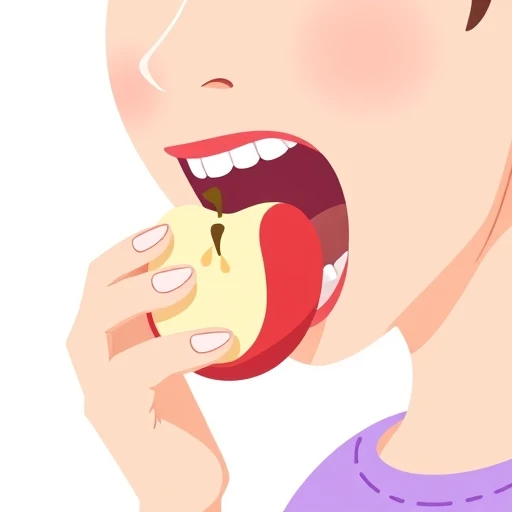
chewed 30秒了解
- Chewed is the past tense of chew, primarily meaning to grind food with teeth during the first stage of the digestive process.
- It is frequently used to describe damage caused by animals biting objects or mechanical wear caused by friction and grinding.
- The word appears in several common idioms, such as 'chewed out' (scolded) and 'chewed over' (thought about deeply).
- As a regular verb, it follows standard English conjugation rules and is versatile across informal, formal, and technical registers.
The word chewed is the past tense and past participle form of the verb 'chew.' At its most fundamental level, it refers to the physiological process of mastication—the act of using one's teeth to grind, crush, and break down substances, typically food, into smaller, more manageable pieces before they are swallowed. This process is the first step of digestion in many animals, including humans. When we say someone 'chewed' their dinner, we are describing a physical action involving the jaw muscles, the teeth (molars, incisors, and canines), and the tongue, which moves the food around to ensure it is evenly processed. However, the utility of the word 'chewed' extends far beyond the dinner table. It is a versatile term that captures a wide range of physical and metaphorical actions involving repetitive pressure, destruction, or deep consideration.
- Biological Context
- In biology, 'chewed' describes the mechanical breakdown of organic matter. For example, a cow that has chewed its cud is performing a vital part of its ruminant digestive cycle. This repetitive action is necessary for extracting nutrients from tough plant fibers.
The puppy chewed on the expensive leather boots until they were completely ruined.
Beyond the physical act of eating, 'chewed' often implies a sense of wear or destruction caused by repetitive friction or biting. If a piece of machinery 'chewed' up a document, it means the gears or rollers mangled the paper in a way that mimics the grinding action of teeth. Similarly, if a rough road 'chewed' up a car's tires, it suggests that the abrasive surface gradually wore down the rubber through constant contact and friction. This sense of 'chewed' conveys a process that is messy, thorough, and often destructive. It is not a clean cut; it is a ragged, forceful transformation of the object in question.
- Idiomatic Usage
- The phrase 'chewed out' is a common American idiom meaning to reprimand someone severely. If a boss chewed out an employee, they delivered a harsh, loud, and thorough scolding.
He chewed the fat with his old neighbors for hours, reminiscing about the good old days.
In social contexts, 'chewed' appears in the phrase 'chew the fat,' which refers to casual, long-winded conversation or gossiping. This usage likely stems from the idea of chewing on a tough piece of fat or gristle, which takes a long time and requires little mental effort, paralleling a relaxed, aimless chat. Furthermore, the word can describe a state of anxiety; a person might have 'chewed' their fingernails down to the quick during a stressful movie. In every instance, the word 'chewed' carries a connotation of persistence and repetitive action, whether the result is nutrition, destruction, or contemplation.
- Material Wear
- In engineering and mechanics, a bolt might be described as 'chewed' if its threads are stripped or damaged by a tool that didn't fit properly, indicating a rough, uneven removal of material.
The lawnmower chewed through the tall grass and several hidden branches.
The director chewed the scenery in every scene, giving an over-the-top performance.
Finally, in the world of theater and film, an actor who 'chewed the scenery' is one who gave an excessively dramatic or exaggerated performance. This colorful use of the word suggests that the actor was so intense they were metaphorically devouring the set around them. Whether used to describe a toddler eating a carrot, a dog destroying a slipper, or a person pondering a difficult life choice, 'chewed' remains a powerful verb that anchors abstract concepts in a very relatable, physical reality.
Using the word chewed correctly requires an understanding of its grammatical role as the past tense and past participle of 'chew.' It can function as the main verb in a sentence to describe a completed action, or as an adjective (participle) to describe the state of an object. Because 'chew' can be both transitive (taking a direct object) and intransitive (not taking an object), 'chewed' follows these same patterns. For instance, 'He chewed' is a complete thought describing the action itself, while 'He chewed the steak' specifies what was being processed. The versatility of 'chewed' allows it to fit into various sentence structures, from simple descriptions to complex metaphorical expressions.
- Transitive Use
- When 'chewed' has an object, it focuses on the effect on that object. 'The child chewed the gum for hours.' Here, the gum is the recipient of the action.
After the accident, the front bumper looked as if it had been chewed by a giant machine.
In the passive voice, 'chewed' is often used to describe damage or the result of a process. 'The pencil was chewed beyond recognition.' This structure emphasizes the state of the pencil rather than the person or animal who did the chewing. This is particularly common in forensic or descriptive writing where the perpetrator might be unknown. Additionally, 'chewed' is frequently paired with prepositions to create phrasal verbs. 'Chewed up' is perhaps the most common, signifying total destruction or consumption. 'The woodchipper chewed up the fallen branches in seconds.' In this context, 'up' adds a sense of completeness or intensity to the action.
- Intransitive Use
- 'Chewed' can stand alone to describe a habit or a momentary action. 'She chewed thoughtfully while staring out the window.'
The coach chewed out the team for their lack of effort during the first half.
When using 'chewed' in a metaphorical sense, the sentence structure remains the same, but the meaning shifts to the abstract. 'He chewed over the proposal before giving his final answer.' Here, 'chewed over' functions as a phrasal verb meaning to contemplate. The object 'the proposal' is not being physically bitten, but mentally processed. This usage is common in professional and academic settings. Another important phrasal construction is 'chewed through,' which can be literal (a mouse chewed through a wire) or figurative (we chewed through our savings during the vacation). In the latter, it implies a rapid or steady consumption of resources.
- Adjectival Use
- 'Chewed' can modify a noun directly. 'He handed me a chewed pen.' This tells us the condition of the pen immediately.
The dog had chewed a hole right through the middle of the new rug.
By the time the meeting ended, she had chewed her lip so much it started to bleed.
In summary, 'chewed' is a robust verb that adapts to its surroundings. Whether you are describing a biological necessity, a destructive mechanical process, a harsh verbal reprimand, or a deep mental exercise, 'chewed' provides a clear, visceral image of repetitive action and its consequences. Pay attention to the prepositions that follow it (out, over, up, through), as they are the keys to unlocking its many idiomatic meanings in English.
The word chewed is a staple of everyday English, appearing in contexts ranging from the mundane to the highly specialized. You will most frequently encounter it in domestic settings, particularly involving children and pets. Parents often ask, 'Have you chewed your food properly?' while pet owners frequently lament, 'The dog chewed my favorite shoes!' In these environments, the word is used literally to describe the physical destruction or processing of objects. It is a word associated with the sensory experiences of home life—the sound of a crunch, the sight of a mangled toy, or the habit of a child chewing on a pencil while doing homework.
- In the Kitchen and Dining Room
- Conversations about food texture often use 'chewed.' A chef might note that a piece of meat was 'tough and had to be chewed for a long time,' indicating poor quality or overcooking.
The food critic complained that the calamari was rubbery and felt like it had been chewed by someone else already.
In professional and industrial environments, 'chewed' takes on a more mechanical meaning. Mechanics and engineers use it to describe components that have been damaged by friction or improper tool use. You might hear a mechanic say, 'The gears are chewed up,' which immediately communicates a specific type of jagged, uneven wear. Similarly, in an office, someone might complain that the old paper shredder 'just chewed the paper instead of cutting it,' describing a malfunction where the machine mangles the document without successfully destroying it. This mechanical usage highlights the word's ability to describe forceful, messy transformation.
- In Sports and Hobbies
- In baseball culture, 'chewed' is often heard in relation to chewing tobacco or sunflower seeds. 'He chewed through a whole bag of seeds during the double-header.'
The mountain bike tires were chewed up by the sharp rocks on the downhill trail.
The word also permeates media and literature. In movie reviews, you might read about an actor who 'chewed the scenery,' a phrase used to describe a performance that is wonderfully (or terribly) over-the-top. In news reports about the economy, a journalist might state that 'inflation chewed through the average family's savings,' using the word to illustrate a relentless, gradual consumption of resources. Even in dental offices, the word is ubiquitous; a dentist might ask if you've chewed on ice recently, looking for the cause of a cracked tooth. From the dentist's chair to the boardroom, 'chewed' is a word that describes the impact of force over time.
- In Literature
- Authors use 'chewed' to create vivid imagery. A character might have 'chewed their lip in nervous anticipation,' a small detail that conveys significant emotion.
The old sea captain chewed on his pipe as he contemplated the approaching storm.
The printer chewed up the last copy of the contract right before the meeting.
Ultimately, 'chewed' is a word that bridges the gap between the physical and the metaphorical. It is heard in the crunch of an apple, the reprimand of a coach, the analysis of a financial expert, and the critique of a theater enthusiast. Its presence in so many different spheres of life is a testament to how fundamental the concept of 'chewing'—the persistent, transformative application of pressure—is to the human experience.
While chewed is a relatively straightforward regular verb, learners and even native speakers occasionally stumble over its usage, particularly when it comes to idioms and phrasal verbs. One of the most common mistakes is confusing the past tense 'chewed' with the past tense of 'choose,' which is 'chose.' Although they sound somewhat similar in rapid speech, they have entirely different meanings. Another frequent error involves the incorrect application of prepositions. For example, saying someone 'chewed on' a person when you mean they 'chewed out' that person completely changes the meaning from a metaphorical scolding to a bizarre physical act.
- The 'Chose' vs. 'Chewed' Confusion
- Incorrect: 'I chewed the red shirt.' Correct: 'I chose the red shirt.' This mistake often happens because both words involve the mouth/jaw area in their pronunciation, but their functions are distinct.
Incorrect: He chewed the problem for a week. Correct: He chewed over the problem for a week.
Another common pitfall is the omission of the preposition in phrasal verbs. In English, 'chewed' by itself usually implies physical mastication. If you want to express deep thought, you must use 'chewed over.' Without the 'over,' the sentence 'He chewed the idea' sounds like he literally put a physical representation of the idea in his mouth. Similarly, 'chewed out' requires the 'out' to mean a reprimand. Saying 'The teacher chewed the student' is not only grammatically incomplete for the intended meaning but also conveys a disturbing physical image that is likely not what the speaker intended.
- Overusing 'Chewed' for Soft Foods
- While not strictly a 'mistake,' using 'chewed' for things like soup or pudding sounds odd. 'Chewed' implies a level of resistance. For soft things, 'swallowed' or 'ate' is better.
Incorrect: The dog chewed the water. Correct: The dog lapped up the water.
Spelling can also be a minor issue. Because the word ends in a consonant-vowel-consonant pattern (c-h-e-w), some might be tempted to double the 'w' before adding '-ed' (chewwed). However, 'w' is a semi-vowel and is never doubled in English verb endings. Therefore, 'chewed' is the only correct spelling. Additionally, learners sometimes confuse 'chewed' with 'gnawed.' While similar, 'gnawed' implies a persistent, slow biting at something hard (like a bone), whereas 'chewed' is the more general term for grinding food or materials. Using 'chewed' when 'gnawed' is more appropriate can make a description feel less precise.
- Idiomatic Precision
- The idiom is 'chew the fat,' not 'chew the meat' or 'chew the bone.' Using the wrong noun in this fixed expression will make the speaker sound non-native.
Incorrect: We chewed the breeze. Correct: We shot the breeze or chewed the fat.
Incorrect: The machine chewed through the electricity. Correct: The machine consumed or used up the electricity.
Finally, be careful with the phrase 'bitten off more than you can chew.' In the past tense, it becomes 'bit off more than he could chew.' A common mistake is to say 'bit off more than he could chewed.' The modal verb 'could' must be followed by the base form of the verb, not the past tense. Keeping these small grammatical and idiomatic rules in mind will help you use 'chewed' with the precision and naturalness of a native speaker.
While chewed is the most common and versatile word for the act of mastication, the English language offers a rich palette of alternatives that can provide more specific imagery or a different level of formality. Choosing the right synonym depends entirely on the context: Are you describing a scientific process, a polite dinner, a hungry animal, or a destructive machine? By understanding the nuances between 'chewed' and its alternatives, you can make your writing more vivid and precise. For example, 'masticated' is the formal, technical term, while 'chomped' suggests a loud, vigorous, and perhaps less polite way of eating.
- Chewed vs. Gnawed
- Chewed: General term for grinding food. Gnawed: Implies persistent, slow biting at something hard over a long period, like a dog with a bone or a mouse with a piece of wood.
The beaver gnawed the tree trunk, while the child chewed his apple.
Another set of alternatives focuses on the sound and manner of chewing. 'Munched' suggests a steady, rhythmic, and often audible chewing, typically of something crisp like crackers or carrots. It carries a slightly more casual and perhaps enjoyable connotation than 'chewed.' 'Crunched,' on the other hand, emphasizes the loud noise made when chewing something hard and brittle, like ice or hard candy. If you want to describe someone eating quickly and noisily, 'chomped' or 'gobbled' (though gobbled implies less chewing and more swallowing) are excellent choices. These words help the reader 'hear' the action taking place.
- Chewed vs. Masticated
- Chewed: Common, everyday use. Masticated: Scientific or medical use. You would find 'masticated' in a biology textbook or a dental report.
The machine mangled the metal, much like a predator might have chewed its prey.
In the context of destruction, 'mangled' or 'shredded' are powerful alternatives to 'chewed up.' While 'chewed up' is descriptive, 'mangled' implies a more violent and severe twisting or crushing of the object. 'Shredded' is best used when the object has been torn into many small strips or pieces, like paper in a shredder or clothes in a rough accident. For the metaphorical 'chewed over' (meaning to think about), you might use 'pondered,' 'contemplated,' 'ruminated,' or 'deliberated.' 'Ruminated' is particularly interesting because its literal meaning is the same as 'chewed the cud,' making it a perfect high-level synonym for deep, repetitive thought.
- Chewed vs. Nibbled
- Chewed: Full action of the jaw. Nibbled: Small, gentle bites, often using only the front teeth.
She ruminated on the decision, just as she had chewed on her pen all afternoon.
The toddler gummed the biscuit since he didn't have many teeth to chew with yet.
Finally, 'gummed' is a specific alternative used when someone (like a baby or an elderly person without teeth) tries to chew using only their gums. This word conveys a very specific physical image that 'chewed' cannot. By expanding your vocabulary to include these alternatives, you can describe the world with much greater nuance, moving from the general 'chewed' to the specific 'gnawed,' 'masticated,' or 'ruminated' as the situation requires.
How Formal Is It?
趣味小知识
The word 'chew' is related to the word 'jaw' in some distant linguistic roots, both tracing back to the physical mechanics of eating.
发音指南
- Pronouncing it as two syllables (chew-ed). It should be one smooth sound.
- Confusing the 'ch' sound with 'sh' (shoe-d).
- Failing to voice the final 'd', making it sound like 'chute'.
难度评级
Easy to recognize in most contexts as it follows regular past tense rules.
Requires knowledge of phrasal verbs and idioms to use effectively.
Simple pronunciation, but requires natural use of idioms.
Easy to hear, though 'chewed out' might be missed by beginners.
接下来学什么
前置知识
接下来学习
高级
需要掌握的语法
Regular Past Tense Formation
Chew + -ed = chewed.
Phrasal Verb Transitivity
'Chew out' is transitive: 'He chewed out the team.'
Passive Voice with Participles
'The bone was chewed by the dog.'
Modal Verbs and Base Forms
After 'could', use 'chew', not 'chewed': 'He could chew' vs 'He chewed'.
Adjectival Participles
Using 'chewed' as an adjective: 'The chewed toy lay on the floor.'
按水平分级的例句
The little boy chewed his bread slowly.
Le petit garçon a mâché son pain lentement.
Past tense of 'chew'.
My dog chewed my old shoe.
Mon chien a mâché ma vieille chaussure.
Subject + verb + object.
She chewed the gum for ten minutes.
Elle a mâché le chewing-gum pendant dix minutes.
Duration with 'for'.
The baby chewed on a plastic toy.
Le bébé a mâché un jouet en plastique.
Use of 'on' for continuous biting.
I chewed the carrot because it was hard.
J'ai mâché la carotte parce qu'elle était dure.
Conjunction 'because'.
The cat chewed a leaf from the plant.
Le chat a mâché une feuille de la plante.
Simple past action.
He chewed his food before he swallowed.
Il a mâché sa nourriture avant d'avaler.
Time clause with 'before'.
We chewed some nuts during the movie.
Nous avons mangé des noix pendant le film.
Preposition 'during'.
The puppy chewed up my homework yesterday.
Le chiot a déchiqueté mes devoirs hier.
Phrasal verb 'chewed up' means destroyed.
The meat was tough, so I chewed it for a long time.
La viande était dure, alors je l'ai mâchée longtemps.
Adjective 'tough' describes the object.
He chewed his pencil while he was thinking.
Il a mâché son crayon pendant qu'il réfléchissait.
Past continuous 'was thinking' for simultaneous action.
The machine chewed the paper into small bits.
La machine a broyé le papier en petits morceaux.
Prepositional phrase 'into small bits'.
She chewed her lip because she was nervous.
Elle s'est mordue la lèvre parce qu'elle était nerveuse.
Reflexive-like action (chewed her [own] lip).
The rabbit chewed a hole in the wooden fence.
Le lapin a rongé un trou dans la clôture en bois.
Resultative phrase 'a hole in...'.
Have you chewed your vitamins yet?
As-tu déjà croqué tes vitamines ?
Present perfect question.
The tires were chewed by the rocky road.
Les pneus ont été abîmés par la route rocailleuse.
Passive voice 'were chewed by'.
The manager chewed out the staff for being late.
Le manager a passé un savon au personnel pour son retard.
Idiomatic phrasal verb 'chewed out'.
I chewed over the job offer before accepting it.
J'ai bien réfléchi à l'offre d'emploi avant de l'accepter.
Phrasal verb 'chewed over' means to consider.
The lawnmower chewed up the hidden rocks in the grass.
La tondeuse a broyé les pierres cachées dans l'herbe.
Phrasal verb 'chewed up' for mechanical damage.
He chewed the fat with his friends at the pub.
Il a taillé le bout de gras avec ses amis au pub.
Idiom 'chew the fat' means casual talk.
The mouse had chewed through the electrical wires.
La souris avait rongé les fils électriques.
Past perfect 'had chewed through'.
She chewed her nails down to the quick during the exam.
Elle s'est rongé les ongles jusqu'au sang pendant l'examen.
Descriptive phrase 'down to the quick'.
The actor really chewed the scenery in that dramatic scene.
L'acteur en a vraiment fait trop dans cette scène dramatique.
Idiom 'chewed the scenery' for overacting.
The gears were chewed because they weren't oiled.
Les engrenages étaient usés parce qu'ils n'étaient pas huilés.
Passive voice with a causal clause.
The inflation chewed through the family's savings in months.
L'inflation a dévoré les économies de la famille en quelques mois.
Metaphorical use of 'chewed through'.
He chewed his words carefully, trying not to sound angry.
Il a pesé ses mots avec soin, essayant de ne pas paraître en colère.
Metaphorical use for careful speech.
The rough terrain chewed up the hikers' expensive boots.
Le terrain accidenté a bousillé les bottes coûteuses des randonneurs.
Phrasal verb 'chewed up' for physical wear.
After the scandal, the press chewed him up and spat him out.
Après le scandale, la presse l'a laminé.
Extended idiom 'chewed up and spat out'.
The cow chewed its cud while resting under the oak tree.
La vache ruminait en se reposant sous le chêne.
Biological term 'chewed its cud'.
She chewed on the problem all night but found no solution.
Elle a retourné le problème dans sa tête toute la nuit sans trouver de solution.
Metaphorical 'chewed on' for contemplation.
The metal was chewed where the wrench had slipped.
Le métal était marqué là où la clé avait glissé.
Adjectival use of the participle.
He chewed through the entire stack of documents by noon.
Il a liquidé toute la pile de documents avant midi.
Metaphorical 'chewed through' for fast work.
The relentless waves chewed away at the soft limestone cliffs.
Les vagues incessantes ont grignoté les falaises de calcaire tendre.
Phrasal verb 'chewed away at' for erosion.
The protagonist chewed on his resentment for years.
Le protagoniste a ruminé son ressentiment pendant des années.
Metaphorical use for long-term emotion.
The industrial shredder chewed through the car chassis with ease.
Le broyeur industriel a déchiqueté le châssis de la voiture avec aisance.
Descriptive use for high-power machinery.
He was chewed out by the sergeant for his sloppy uniform.
Il s'est fait remonter les bretelles par le sergent pour son uniforme négligé.
Passive form of 'chewed out'.
The old manuscript had been chewed by insects over the centuries.
Le vieux manuscrit avait été rongé par des insectes au fil des siècles.
Passive voice with agent 'by insects'.
The corporate culture chewed up many idealistic new recruits.
La culture d'entreprise a broyé de nombreuses nouvelles recrues idéalistes.
Sociological metaphor.
She chewed the end of her pen, a habit she couldn't break.
Elle mâchonnait le bout de son stylo, une habitude dont elle ne pouvait se défaire.
Appositive phrase 'a habit she...'.
The engine chewed through its oil supply due to a leak.
Le moteur a consommé toute sa réserve d'huile à cause d'une fuite.
Metaphorical 'chewed through' for consumption.
The philosophical implications were chewed over by the committee for months.
Les implications philosophiques ont été débattues par le comité pendant des mois.
Passive metaphorical use.
The landscape was chewed up by years of open-cast mining.
Le paysage a été défiguré par des années d'exploitation minière à ciel ouvert.
Environmental metaphor.
He chewed the cud of his past failures, unable to move forward.
Il ressassait ses échecs passés, incapable d'aller de l'avant.
Literary idiom 'chew the cud' for rumination.
The critic noted that the lead actor chewed the scenery with reckless abandon.
Le critique a noté que l'acteur principal en faisait des tonnes avec une totale insouciance.
Idiomatic expression in formal critique.
The software chewed through the massive dataset in record time.
Le logiciel a traité l'énorme ensemble de données en un temps record.
Technological metaphor.
The edges of the ancient coin were chewed, making it hard to date.
Les bords de la pièce antique étaient usés, ce qui la rendait difficile à dater.
Adjectival participle describing wear.
The storm's fury chewed a path of destruction through the coastal town.
La fureur de la tempête a tracé un chemin de destruction à travers la ville côtière.
Personification/Metaphor.
She felt as though the bureaucracy had chewed her up and spat her out.
Elle avait l'impression que la bureaucratie l'avait broyée.
Idiomatic expression for systemic failure.
常见搭配
常用短语
— Completely destroyed by biting or mechanical action.
The document was chewed to bits by the faulty printer.
— Crushed or ground until soft and shapeless.
The fruit was chewed to a pulp by the heavy machinery.
— To be treated poorly and then discarded, often by a system.
Many young athletes are chewed and spat out by the professional leagues.
— Something that has been bitten many times or an idea that has been discussed too much.
That is a well-chewed topic in this office; let's move on.
— To make a path by biting or grinding.
The hamster chewed his way out of the cardboard box.
— To move one's jaws as if chewing, often due to a medical condition or habit.
The old man sat on the porch and silently chewed the air.
— To ponder or reflect on something.
He chewed on the thought of moving abroad for several months.
— Similar to chewed to bits; total destruction.
The lawnmower chewed the tennis ball to pieces.
— A variation of 'chewed out,' meaning a very thorough scolding.
The sergeant chewed him up and down for his lack of discipline.
— To spend money very quickly.
The unexpected repairs chewed through our entire summer budget.
容易混淆的词
Chose is the past tense of choose (to select). Chewed is about teeth.
Gnawed is persistent biting on something hard; chewed is more general.
Stewed means cooked slowly in liquid; sounds similar but unrelated.
习语与表达
— To engage in casual, leisurely conversation or gossip.
We sat on the porch all afternoon just chewing the fat.
informal— To scold or reprimand someone very harshly.
The coach chewed out the players after their embarrassing loss.
informal/colloquial— To take on a task that is way too big or difficult for you.
I think I bit off more than I could chew when I agreed to paint the whole house in a weekend.
neutral— To act in an exaggerated or over-the-top manner.
The villain in the play really chewed the scenery, but the audience loved it.
informal/arts— Think about what I just said; consider this information.
The company is closing next month. Chew on that for a while.
informal— To think deeply or ruminate on something (often used humorously).
He's been sitting there chewing his cud for an hour; he must be making a big decision.
informal— To be used and then discarded heartlessly by a person or organization.
The industry chewed her up and spat her out before she was thirty.
neutral/metaphorical— An older idiom similar to 'chew the fat,' meaning to chat or complain.
The old sailors would sit and chew the rag for hours.
dated/informal— To consider or discuss something thoroughly.
Let's chew over the details before we sign the contract.
neutral— To be impatient or eager to start something (often 'champing at the bit').
The runners were chewing the bit, waiting for the starting gun.
informal容易混淆
Similar vowel sound and both are past tense verbs.
Chose means selected; chewed means bit with teeth.
I chose the steak, then I chewed it.
Both involve biting.
Gnawed is for hard things over time; chewed is for food or general biting.
The dog chewed the toy, but the rat gnawed the wood.
Both mean to eat by chewing.
Munched is often for snacks and implies a crunching sound.
He munched on chips while he chewed his gum.
They mean the exact same thing.
Masticated is technical/medical; chewed is everyday English.
The doctor said the patient hadn't masticated properly.
Both involve using teeth on food.
Nibbled means taking tiny bites; chewed is the full action.
She nibbled the edge of the cookie before she chewed the whole thing.
句型
Subject + chewed + Object.
The dog chewed the ball.
Subject + chewed + up + Object.
The machine chewed up the paper.
Subject + chewed + out + Person.
The boss chewed out the worker.
Subject + chewed + over + Idea.
I chewed over the plan.
Object + was + chewed + by + Agent.
The shoe was chewed by the puppy.
Subject + chewed + through + Resource.
Inflation chewed through our savings.
Metaphorical Subject + chewed + Path.
The storm chewed a path through the city.
Subject + chewed + the cud of + Abstract Noun.
He chewed the cud of his memories.
词族
名词
动词
形容词
相关
如何使用
Very common in daily speech, especially in the US and UK.
-
I chose my food carefully.
→
I chewed my food carefully.
If you are talking about using your teeth, use 'chewed'. 'Chose' means you selected it.
-
The teacher chewed the student.
→
The teacher chewed out the student.
Without 'out', it sounds like the teacher physically bit the student. Use the phrasal verb for scolding.
-
I bit off more than I could chewed.
→
I bit off more than I could chew.
After modal verbs like 'could', you must use the base form 'chew', not the past tense 'chewed'.
-
The dog chewwed the bone.
→
The dog chewed the bone.
Do not double the 'w' when adding '-ed'.
-
We chewed the breeze for an hour.
→
We chewed the fat for an hour.
The idiom is 'chew the fat'. 'Shoot the breeze' is a different idiom with a similar meaning.
小贴士
Regular Verb Rule
Don't overthink the spelling; it's just 'chew' + 'ed'. No letters are dropped or doubled.
Phrasal Verb Power
Master 'chewed up', 'chewed out', and 'chewed over' to sound like a native speaker.
One Syllable
Remember that 'chewed' is one syllable. Don't say 'chew-ed'.
Vivid Imagery
Use 'chewed' to describe mechanical damage to give your writing a more visceral, gritty feel.
Social Chatting
Use 'chew the fat' when you want to describe a relaxed, aimless conversation with friends.
Pet Talk
If you have a dog, 'chewed' will be one of your most-used words for describing their mischief.
Mental Processing
When you need to think about something, tell people you need to 'chew it over' to sound more natural.
Avoid Slang
In a formal essay, use 'reprimanded' instead of 'chewed out' to maintain a professional tone.
No Double W
Even though it ends in a consonant, we never double the 'w' in English. It's 'chewed', not 'chewwed'.
Context Clues
If you hear 'chewed' and 'boss' in the same sentence, it's almost certainly the idiom 'chewed out'.
记住它
记忆技巧
Think of a 'Chew-Chew' train (Choo-Choo) that has already 'chewed' its way through the tracks. The '-ed' tells you the trip is over.
视觉联想
Imagine a dog sitting next to a 'chewed' up shoe. The messy, jagged edges of the leather are the visual definition of the word.
Word Web
挑战
Try to use 'chewed' in three different ways today: once for food, once for an animal, and once as an idiom (like 'chewed over').
词源
Derived from the Old English word 'ceowan,' which means to chew, eat, or gnaw. It has cognates in other Germanic languages, such as the Middle Low German 'kouwen' and the Old High German 'kiuwan.'
原始含义: To bite or grind with the teeth.
Germanic文化背景
Be careful using 'chewed out' in a professional setting; it is quite informal and implies a loss of temper.
The phrase 'chewed out' is much more common in American English than in British English, where 'bollocked' or 'told off' might be used.
在生活中练习
真实语境
Dining and Eating
- chewed thoroughly
- hard to be chewed
- chewed with mouth closed
- well-chewed food
Pet Ownership
- chewed the furniture
- chewed up the toy
- stop being chewed
- chewed to pieces
Workplace/Reprimand
- got chewed out
- chewed him out
- chewed over the report
- chewed through the data
Anxiety/Habits
- chewed her nails
- chewed his lip
- chewed on a pen
- nervously chewed
Mechanical/Industrial
- chewed up the paper
- gears were chewed
- chewed through the metal
- chewed threads
对话开场白
"Has your pet ever chewed something really expensive or important?"
"When was the last time you really chewed over a difficult decision?"
"Have you ever been chewed out by a teacher or a boss? What happened?"
"Do you think it's important that food is chewed a certain number of times?"
"What's a topic you and your friends could chew the fat about for hours?"
日记主题
Describe a time you bit off more than you could chew. How did you handle the situation?
Write about a person who 'chews the scenery' in real life. How do people react to them?
Reflect on a decision you recently chewed over. What were the pros and cons you considered?
Describe the most 'chewed-up' object you own. What is its story?
How do you feel when someone chews loudly? Does it affect your concentration or mood?
常见问题
10 个问题It is a regular verb. You simply add '-ed' to the base form 'chew' to form both the past tense and the past participle. For example: 'I chew' (present), 'I chewed' (past), 'I have chewed' (past participle).
It is an American idiom that means to scold or reprimand someone very severely and loudly. For example, 'The sergeant chewed out the private for having a dirty rifle.' It is informal.
Yes, absolutely. You can use it for animals biting objects ('The dog chewed the shoe'), machines mangling things ('The shredder chewed the paper'), or even metaphorically for thinking ('I chewed over the idea').
Chewed is the general term for grinding something with teeth. Gnawed implies a persistent, slow, and repetitive biting at something hard, like a bone or wood, often over a long period.
Yes, they have the same meaning, but 'masticated' is much more formal and scientific. You would use 'chewed' in a restaurant and 'masticated' in a biology paper or a dental clinic.
You use a form of 'to be' plus 'chewed.' For example: 'The electrical wires were chewed by a mouse.' This focuses on the wires rather than the mouse.
It is a theatrical term for an actor who is giving an excessively dramatic or over-the-top performance. It can be a compliment for a fun performance or a criticism for one that is too much.
Yes, as a past participle, it can function as an adjective. For example: 'He threw away the chewed pencil.' Here, 'chewed' describes the state of the pencil.
Yes, it is still a common idiom in many English-speaking countries, meaning to have a long, casual, and friendly chat with someone.
Not always. When referring to food, it just means the food was processed for eating. However, when referring to objects (like shoes or paper), it almost always implies that the object was damaged.
自我测试 180 个问题
Write a sentence using 'chewed' to describe a pet's behavior.
Well written! Good try! Check the sample answer below.
Write a sentence using the idiom 'chewed out'.
Well written! Good try! Check the sample answer below.
Write a sentence using 'chewed over' in a business context.
Well written! Good try! Check the sample answer below.
Describe a mechanical failure using the word 'chewed'.
Well written! Good try! Check the sample answer below.
Use 'chewed' as an adjective to describe an object.
Well written! Good try! Check the sample answer below.
Write a sentence about a cow using the word 'chewed'.
Well written! Good try! Check the sample answer below.
Use 'chewed through' to describe a loss of resources.
Well written! Good try! Check the sample answer below.
Write a sentence using 'chewed the fat'.
Well written! Good try! Check the sample answer below.
Describe a character's nervousness using 'chewed'.
Well written! Good try! Check the sample answer below.
Use 'chewed the scenery' in a movie review sentence.
Well written! Good try! Check the sample answer below.
Explain why food should be 'chewed thoroughly'.
Well written! Good try! Check the sample answer below.
Write a short story (3 sentences) about a dog that chewed something important.
Well written! Good try! Check the sample answer below.
Use 'chewed away at' to describe erosion.
Well written! Good try! Check the sample answer below.
Write a sentence about a baby and a teething toy.
Well written! Good try! Check the sample answer below.
Use 'chewed to bits' to describe a document.
Well written! Good try! Check the sample answer below.
Describe a person who is 'chewed up and spat out' by an industry.
Well written! Good try! Check the sample answer below.
Write a sentence about chewing tobacco.
Well written! Good try! Check the sample answer below.
Use 'chewed' in a sentence about a bicycle tire.
Well written! Good try! Check the sample answer below.
Write a sentence using 'chewed' and 'carefully'.
Well written! Good try! Check the sample answer below.
Use 'chewed the cud' in a metaphorical sense about a philosopher.
Well written! Good try! Check the sample answer below.
Describe what happens to food in your mouth using the word 'chewed'.
Read this aloud:
你说的:
Speech recognition is not supported in your browser. Try Chrome or Edge.
Tell a story about a time you got 'chewed out'.
Read this aloud:
你说的:
Speech recognition is not supported in your browser. Try Chrome or Edge.
Explain the idiom 'chew the fat' to a friend.
Read this aloud:
你说的:
Speech recognition is not supported in your browser. Try Chrome or Edge.
Talk about a difficult decision you had to 'chew over'.
Read this aloud:
你说的:
Speech recognition is not supported in your browser. Try Chrome or Edge.
Describe the damage a dog might do to a house using 'chewed'.
Read this aloud:
你说的:
Speech recognition is not supported in your browser. Try Chrome or Edge.
What does 'chewing the scenery' mean in acting?
Read this aloud:
你说的:
Speech recognition is not supported in your browser. Try Chrome or Edge.
How does inflation 'chew through' money?
Read this aloud:
你说的:
Speech recognition is not supported in your browser. Try Chrome or Edge.
Why do people chew their fingernails?
Read this aloud:
你说的:
Speech recognition is not supported in your browser. Try Chrome or Edge.
Describe a 'chewed' pencil.
Read this aloud:
你说的:
Speech recognition is not supported in your browser. Try Chrome or Edge.
Use 'chewed' in a sentence about a car accident.
Read this aloud:
你说的:
Speech recognition is not supported in your browser. Try Chrome or Edge.
Tell someone to think about what you said using 'chew'.
Read this aloud:
你说的:
Speech recognition is not supported in your browser. Try Chrome or Edge.
Describe a cow's eating habits.
Read this aloud:
你说的:
Speech recognition is not supported in your browser. Try Chrome or Edge.
What happens if a printer 'chews' paper?
Read this aloud:
你说的:
Speech recognition is not supported in your browser. Try Chrome or Edge.
Use 'chewed' to describe a very tough steak.
Read this aloud:
你说的:
Speech recognition is not supported in your browser. Try Chrome or Edge.
Describe a 'chewed' bolt to a mechanic.
Read this aloud:
你说的:
Speech recognition is not supported in your browser. Try Chrome or Edge.
How do waves 'chew' a coastline?
Read this aloud:
你说的:
Speech recognition is not supported in your browser. Try Chrome or Edge.
What does 'bit off more than you can chew' mean?
Read this aloud:
你说的:
Speech recognition is not supported in your browser. Try Chrome or Edge.
Describe a baby's teething process.
Read this aloud:
你说的:
Speech recognition is not supported in your browser. Try Chrome or Edge.
Use 'chewed' in a sentence about a bike chain.
Read this aloud:
你说的:
Speech recognition is not supported in your browser. Try Chrome or Edge.
What's the difference between 'chewed' and 'chose'?
Read this aloud:
你说的:
Speech recognition is not supported in your browser. Try Chrome or Edge.
Listen: 'The dog chewed the bone.' What did the dog do?
Listen: 'He got chewed out by his boss.' Was the boss happy?
Listen: 'We chewed the fat for hours.' What were they doing?
Listen: 'The machine chewed up the document.' Is the document okay?
Listen: 'I need to chew over your offer.' What does the speaker need?
Listen: 'The tires were chewed by the road.' What happened to the tires?
Listen: 'She chewed her lip nervously.' What emotion is she showing?
Listen: 'The actor chewed the scenery.' How was the acting?
Listen: 'The mouse chewed through the box.' How did the mouse get in?
Listen: 'Inflation chewed through their savings.' What happened to their money?
Listen: 'The cow chewed its cud.' What animal is being described?
Listen: 'He chewed his pencil.' What object was he biting?
Listen: 'The gears were chewed.' Is the machine working?
Listen: 'Don't bite off more than you can chew.' What is this advice about?
Listen: 'The waves chewed the cliff.' What is this an example of?
/ 180 correct
Perfect score!
Summary
The word 'chewed' is a highly versatile verb that describes the physical act of grinding with teeth, mechanical destruction, and metaphorical processes like scolding or deep thinking. Example: 'The dog chewed the bone, while the manager chewed out the late employee.'
- Chewed is the past tense of chew, primarily meaning to grind food with teeth during the first stage of the digestive process.
- It is frequently used to describe damage caused by animals biting objects or mechanical wear caused by friction and grinding.
- The word appears in several common idioms, such as 'chewed out' (scolded) and 'chewed over' (thought about deeply).
- As a regular verb, it follows standard English conjugation rules and is versatile across informal, formal, and technical registers.
Regular Verb Rule
Don't overthink the spelling; it's just 'chew' + 'ed'. No letters are dropped or doubled.
Phrasal Verb Power
Master 'chewed up', 'chewed out', and 'chewed over' to sound like a native speaker.
One Syllable
Remember that 'chewed' is one syllable. Don't say 'chew-ed'.
Vivid Imagery
Use 'chewed' to describe mechanical damage to give your writing a more visceral, gritty feel.