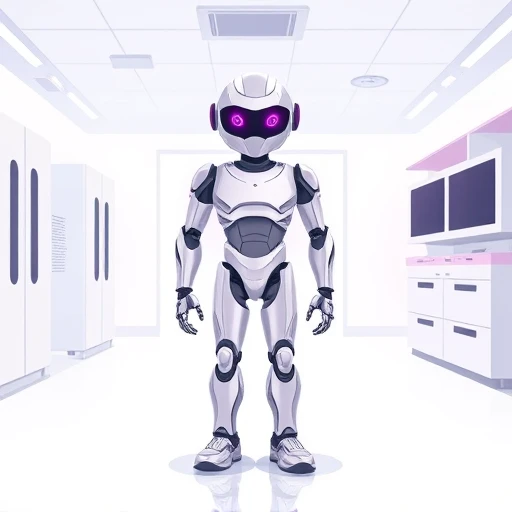
robots
Robots are machines that can do tasks automatically, often following instructions from a computer program.
Explanation at your level:
A robot is a machine. It can move and do things. You can tell a robot what to do with a computer. Some robots help clean houses. Some robots help make cars. They are very smart machines!
A robot is a machine that is designed to do tasks automatically. Many robots are used in factories to build things quickly. Other robots are used in science to explore space or the deep ocean. They are very useful for jobs that are dangerous for humans.
Robots are programmable machines that perform complex actions. They are widely used in manufacturing, healthcare, and even in our own homes. Because they can work without stopping, they are very efficient for repetitive tasks. Today, we see more 'smart' robots that can learn from their environment using sensors.
The term robot refers to an autonomous or semi-autonomous machine that interacts with the physical world. While they were once limited to science fiction, they are now integral to modern industry. We distinguish between industrial robots, which are fixed in one place, and mobile robots, which can navigate their surroundings. The field of robotics continues to advance rapidly.
Robots represent the intersection of mechanical engineering and artificial intelligence. They are no longer just tools for automation; modern systems incorporate machine learning to adapt to unpredictable environments. This shift has profound implications for the labor market, as robots increasingly perform tasks previously thought to be the exclusive domain of human intelligence. From surgical assistants to autonomous vehicles, their presence is ubiquitous in high-tech sectors.
The evolution of the term robot reflects our shifting relationship with technology. Originating from the Czech term for 'forced labor,' the word has transcended its etymological roots to signify advanced computational agency. In contemporary discourse, we often debate the ethics of 'robotics,' questioning the boundaries between human cognition and algorithmic execution. Whether in literature, where they often serve as metaphors for the 'other,' or in industry, where they redefine productivity, robots remain a cornerstone of human innovation and a subject of deep philosophical inquiry.
30秒词汇
- A robot is a programmable machine.
- The word comes from the Czech 'robota'.
- Robots perform tasks automatically.
- Robotics is the field of study.
Hey there! Have you ever wondered how a factory builds a car or how a vacuum cleaner moves around your house without bumping into things? That is the magic of robots!
Essentially, a robot is a machine that can be programmed to do work. Unlike a regular tool, which needs a human to guide it every second, a robot can follow a set of instructions to perform a task autonomously. This means it can repeat the same movement perfectly every time without getting tired or bored.
You will find them everywhere today. Some are big mechanical arms in car factories, while others are small gadgets that help us clean, explore, or even learn. They are truly the bridge between computer software and the physical world!
The word robot has a really cool origin story. It actually comes from the Czech word robota, which means 'forced labor' or 'drudgery.'
It was first introduced to the world in a 1920 science fiction play called R.U.R. (Rossum's Universal Robots) by the Czech writer Karel Čapek. In the play, these machines were artificial people created to do all the hard work for humans. It is fascinating because, at the time, the idea of a machine acting like a human was pure science fiction.
Over the last century, the term has evolved. We moved from thinking of robots as 'mechanical slaves' in stories to using them as essential tools in modern science, medicine, and space exploration. It is a perfect example of how language keeps up with our changing technology!
When we talk about robots, we usually use them in contexts involving technology, manufacturing, or the future. You might hear people say they are 'building a robot' or 'programming a robot' to perform specific duties.
In casual conversation, we often use adjectives like industrial, humanoid, or autonomous to describe them. For example, a 'humanoid robot' looks like a person, while an 'industrial robot' is usually just a specialized arm in a factory.
Remember that the word is pluralized as robots. If you are talking about the field of study, you would use the word robotics instead. It is a very common term in professional, academic, and everyday tech discussions.
While 'robot' is a technical term, we use it in some fun ways in English idioms to describe human behavior:
- To act like a robot: Doing something without emotion or thought. Example: 'He was so tired he was acting like a robot.'
- Robot-like precision: Doing something perfectly every time. Example: 'She performed the surgery with robot-like precision.'
- Robot army: A large group of automated systems working together. Example: 'The company is building a robot army to handle deliveries.'
- Robot mode: A state of mind where you do tasks automatically. Example: 'I put myself in robot mode to finish cleaning the house.'
- Like a well-oiled machine: Often used to describe how efficient robots work. Example: 'The team worked like a well-oiled machine.'
The word robot is a regular countable noun. This means you can say 'a robot' (singular) or 'robots' (plural). It is very straightforward!
Pronunciation-wise, in American English, it is usually ROH-bot. In British English, you might hear it as ROH-bot or ROH-buht. The stress is always on the first syllable.
If you want to rhyme with it, think of words like slow-bot (not a real word, but sounds right!), spot, hot, or plot. Just remember that the 'o' sounds are distinct. It is a great word for learners because it is pronounced almost exactly how it is spelled!
Fun Fact
The word was coined by Josef Čapek, the brother of the author Karel Čapek.
Pronunciation Guide
Starts with a clear 'row' sound, followed by a short 'bot'.
Similar to UK, but the 'bot' is more like 'baht'.
Common Errors
- Pronouncing the 'o' as an 'a'
- Stressing the second syllable
- Adding an extra syllable
Rhymes With
Difficulty Rating
Easy to read
Easy to write
Easy to say
Easy to hear
What to Learn Next
Prerequisites
Learn Next
高级
Grammar to Know
Plural Nouns
robot -> robots
Articles with Nouns
a robot / the robot
Subject-Verb Agreement
The robots are working.
Examples by Level
The robot is fast.
Robot = machine, fast = quick
Simple subject-verb-adjective
I like robots.
I = me, like = enjoy
Simple present tense
The robot cleans.
Cleans = removes dirt
Subject-verb
Look at the robot!
Look = see
Imperative sentence
Is that a robot?
Is = question word
Yes/no question
My robot is blue.
My = belongs to me
Possessive adjective
Robots are fun.
Fun = enjoyable
Plural noun usage
The robot moves.
Moves = goes
Simple present
The robot helps in the kitchen.
Many robots work in large factories.
I want to build my own robot.
The robot has a computer inside.
Some robots can talk to people.
Robots are very helpful for dangerous jobs.
He studies how to fix robots.
The robot stopped moving.
The factory uses robots to assemble cars.
Robotics is a fascinating field of study.
We use a robot to vacuum the living room.
The robot was programmed to follow a path.
Scientists are developing robots for space exploration.
Robots can perform tasks with great accuracy.
She is interested in a career in robotics.
The robot responded to his voice commands.
Industrial robots have revolutionized the manufacturing process.
The humanoid robot walked across the stage.
We need to consider the ethical implications of using robots.
The robot is equipped with advanced sensors.
Autonomous robots can navigate complex environments.
Robots are replacing repetitive human labor.
The software allows the robot to learn from mistakes.
He is an expert in the field of robotics.
The integration of robots into the workforce is a subject of intense debate.
Advanced robots are now capable of delicate surgical procedures.
The robot's movements were indistinguishable from a human's.
We are seeing a shift toward collaborative robots in the workplace.
The robot was designed to operate in extreme conditions.
Artificial intelligence is the brain behind the robot.
Robots are increasingly used for disaster relief efforts.
The company is investing heavily in robotics research.
The proliferation of robots in society challenges our traditional definition of labor.
The robot serves as a poignant metaphor for the alienation of the modern worker.
We must ensure that the development of robots remains human-centric.
His research explores the intersection of soft robotics and biology.
The robot's decision-making process is governed by complex algorithms.
Robots have become indispensable in high-precision manufacturing.
The ethical framework for robots is still in its infancy.
The robot demonstrated a surprising degree of situational awareness.
常见搭配
Idioms & Expressions
"act like a robot"
to behave without emotion or spontaneity
Don't just act like a robot; show some personality!
casual"robot-like"
having the characteristics of a robot
His movements were robot-like and stiff.
neutral"in robot mode"
to perform tasks automatically without deep thought
I was in robot mode while doing the dishes.
casual"like a well-oiled machine"
working perfectly and efficiently
The team worked like a well-oiled machine.
neutral"the robot revolution"
the increase in robots in daily life
We are living through the robot revolution.
journalistic"robotics expert"
someone who knows everything about robots
She is a world-renowned robotics expert.
formalEasily Confused
Both refer to machines.
Androids must look like humans.
A robot arm is not an android.
Often used in sci-fi.
A cyborg is part human, part machine.
A robot is 100% machine.
Sounds similar in function.
Automaton is more formal/archaic.
The robot is a modern automaton.
It is a short version.
Bot is informal and often refers to software.
A chat bot is not a physical robot.
Sentence Patterns
The robot is [adjective].
The robot is efficient.
I use a robot to [verb].
I use a robot to clean.
Robots are designed to [verb].
Robots are designed to help.
The development of robots is [adjective].
The development of robots is rapid.
It is a field of robotics that [verb].
It is a field of robotics that interests me.
词族
Nouns
Adjectives
相关
How to Use It
8
Formality Scale
常见错误
Learners often say 'I study robots' when they mean the academic field of robotics.
There is no verb 'to robot' in standard English.
A toaster is a machine, but not a robot because it lacks autonomous decision-making.
The word comes from Czech, and the 'o' is the correct vowel.
Always add an 's' for the plural.
Tips
Memory Palace Trick
Visualize a robot in your kitchen helping you cook.
When Native Speakers Use It
Use it to talk about future tech or factory work.
Cultural Insight
Notice how movies often show robots as human-like.
Grammar Shortcut
Robot is a regular noun, so just add 's' for plural.
Say It Right
Keep the 'o' clear and crisp.
Don't Make This Mistake
Don't confuse 'robotics' (the field) with 'robots' (the objects).
Did You Know?
The word was invented in a play in 1920!
Study Smart
Read sci-fi stories to see how the word is used creatively.
Writing Tip
Use 'robotic' when you want to describe a person's stiff movement.
Expand Your Range
Learn the word 'automation' to use alongside 'robot'.
Memorize It
Mnemonic
ROB-ots: Remember ROB (the person) doing work.
Visual Association
Imagine a shiny metal robot cleaning your room.
Word Web
挑战
Try describing your day as if you were a robot.
词源
Czech
Original meaning: forced labor
文化背景
None, though some fear robots taking jobs.
Robots are often seen as symbols of the future, sometimes helpful and sometimes scary.
Practice in Real Life
Real-World Contexts
At work
- robotics engineer
- factory automation
- robot-assisted
At home
- robot vacuum
- smart home robot
- automated cleaning
In science
- robotic arm
- autonomous vehicle
- sensor feedback
In movies
- humanoid robot
- robot uprising
- artificial intelligence
Conversation Starters
"Do you think robots will replace human jobs?"
"Would you want a robot to help you at home?"
"What is the coolest robot you have ever seen?"
"Do you think robots should have rights?"
"How does the word 'robot' make you feel about the future?"
Journal Prompts
Write about a day in the life of a robot.
If you could design a robot, what would it do?
Describe the difference between a machine and a robot.
Do you think robots are good or bad for society?
常见问题
8 个问题No, only those that can be programmed to do tasks automatically.
Robots.
Not usually, though it has robotic features.
It comes from the Czech word for forced labor.
Robotics.
They use algorithms to process information, but it is not the same as human thought.
No, they can be made of plastic, rubber, and other materials.
To do tasks that are dangerous, repetitive, or require high precision.
自我测试
The ___ is cleaning the floor.
Robots are machines often used for cleaning.
Which word describes the study of robots?
Robotics is the standard term for the field.
A robot is always a living thing.
Robots are machines, not living things.
Word
意思
These are common types of robots.
The robot was programmed.
What is the origin of the word robot?
It comes from the Czech word 'robota'.
The ___ nature of the machine made it efficient.
We use the adjective 'robotic' here.
All machines are robots.
Only machines with autonomous capabilities are robots.
Word
意思
Register differences matter.
Robots is impacting modern society.
得分: /10
Summary
A robot is an autonomous machine designed to make life easier by doing the work for us.
- A robot is a programmable machine.
- The word comes from the Czech 'robota'.
- Robots perform tasks automatically.
- Robotics is the field of study.
Memory Palace Trick
Visualize a robot in your kitchen helping you cook.
When Native Speakers Use It
Use it to talk about future tech or factory work.
Cultural Insight
Notice how movies often show robots as human-like.
Grammar Shortcut
Robot is a regular noun, so just add 's' for plural.