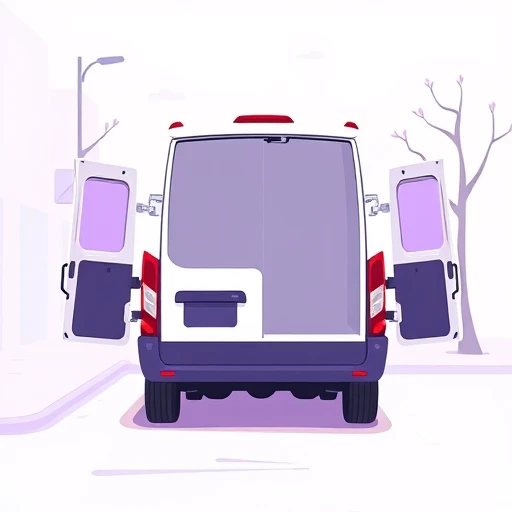
van 30秒了解
- A van is a versatile motor vehicle, larger than a car, used for transporting goods, tools, or large groups of people in various settings.
- Commonly used by delivery services, tradespeople, and families, vans offer significant internal space and a boxy, practical design for maximum utility.
- The term 'van' can refer to commercial cargo vehicles, family minivans, or specialized units like camper vans and mobile offices.
- Essential for urban logistics, vans bridge the gap between small passenger vehicles and heavy-duty trucks, providing a flexible transport solution.
The word van refers to a specific category of motor vehicle designed primarily for the transportation of goods or larger groups of people. In the hierarchy of automotive transport, the van sits comfortably between the standard passenger car and the heavy-duty lorry or truck. Its defining characteristic is its boxy shape, which maximizes internal volume, and its lack of side windows in the rear cargo area in many commercial models. People use vans when a car is simply too small to handle the load, but a full-sized truck would be overkill or too difficult to maneuver through narrow city streets. Whether it is a plumber carrying tools, a delivery driver dropping off packages, or a large family heading on a road trip, the van is the ultimate tool of utility and logistics in modern society.
- Commercial Utility
- Businesses rely on vans for 'last-mile' delivery, ensuring goods reach consumers directly from local hubs.
- Passenger Transport
- Minivans and shuttle vans are essential for transporting groups, such as hotel guests or large families, providing more seating than a standard SUV.
The courier parked his van on the curb to deliver the heavy boxes.
Historically, the term is a shortening of 'caravan,' which originally referred to a covered carriage. Over time, as internal combustion engines replaced horses, the 'van' became the backbone of urban commerce. In the United Kingdom, the 'white van man' has become a cultural archetype, representing the self-employed tradesperson who is often seen as a hardworking, if sometimes aggressive, driver. In North America, the term often evokes images of the 'soccer mom' in a minivan or the 'conversion van' used for camping and long-distance travel. The versatility of the van is unmatched; it can be a mobile workshop, a refrigerated unit for food, or even a tiny home for those following the 'van life' movement, which has gained massive popularity on social media.
We decided to live in a converted van to travel across the country.
- Technical Specs
- Vans typically feature a unibody or body-on-frame construction with a high roofline to maximize vertical storage space.
The band loaded their instruments into the back of the van after the show.
When using the word in conversation, it is important to distinguish between the vehicle types. A 'panel van' has no rear windows and is for cargo. A 'minivan' is a family car with three rows of seats. A 'camper van' is equipped with beds and a small kitchen. The context usually makes it clear which one is being discussed. For instance, if someone says they are 'moving house,' you can assume they are talking about a large transit van. If they are 'taking the kids to practice,' it is likely a minivan. This flexibility makes 'van' one of the most practical nouns in the English language for discussing transportation and logistics.
The security van transported the cash to the bank under heavy guard.
- Logistics Context
- In supply chain management, the 'van' is the primary unit for local distribution networks.
An electric van is much quieter and better for the environment in city centers.
Using the word van in a sentence requires an understanding of its role as a countable noun. This means it almost always requires an article (a, an, the) or a possessive pronoun (my, his, their) unless it is in the plural form. Because it is a physical object, it often functions as the subject of a sentence performing an action (The van sped away) or the object of a preposition describing location or movement (I left my keys in the van). When describing the purpose of the vehicle, we often use compound nouns or attributive adjectives to provide more detail, such as 'delivery van,' 'police van,' or 'refrigerated van.'
- Subject Position
- The van was blocking the driveway, making it impossible for me to leave for work.
- Object Position
- The company purchased a new van to expand its delivery route into the suburbs.
Could you please help me load these crates into the van?
Prepositions are vital when talking about vans. We usually say 'in the van' when referring to the interior space, but 'by van' when referring to the method of transport. For example, 'The goods were sent by van' focuses on the logistics, while 'The children are sitting in the van' focuses on the physical location. Additionally, verbs like 'drive,' 'park,' 'load,' 'unload,' 'hire,' and 'rent' are the most common collocates. In more formal or technical writing, you might see 'van' used as part of a fleet description: 'The fleet consists of twelve light commercial vans.' In informal settings, 'van' is often used as a shorthand for the entire process of moving: 'We’re just doing the van today,' meaning they are loading or driving the van for a move.
They traveled across Europe by van, stopping at various campsites along the way.
- Descriptive Adjectives
- Common adjectives include: rusty, spacious, unmarked, armored, and reliable.
An unmarked van was seen idling near the warehouse late last night.
In complex sentences, 'van' can be part of a relative clause to provide specific identification. For example: 'The van that I rented was much larger than I expected.' Here, the relative clause 'that I rented' specifies which van is being discussed. You can also use it in passive constructions, which is common in news reporting: 'The stolen van was recovered three days later in a remote parking lot.' Understanding these structural variations allows you to use the word accurately in both everyday conversation and professional writing. Remember that 'van' is a very specific term; calling a small hatchback a 'van' would be incorrect, just as calling a massive semi-truck a 'van' would be a significant understatement of its size.
Having a reliable van is essential for any small business that offers home repairs.
- Verb Collocations
- To jump in the van, to back the van up, to kit out a van, to scrap an old van.
The plumber's van is always organized with every tool in its proper place.
You will encounter the word van in a wide variety of real-world contexts, ranging from mundane daily activities to high-stakes news reports. One of the most common places is in the world of e-commerce and logistics. As online shopping has exploded, the sight of delivery vans—Amazon, FedEx, UPS, or local couriers—has become a permanent fixture in residential neighborhoods. You'll hear people say, 'I saw the delivery van pull up,' or 'The van is just around the corner according to the app.' In this context, the van represents the physical link between a digital purchase and its arrival at your doorstep.
- News & Media
- News broadcasts often mention 'surveillance vans,' 'news vans' (equipped with satellite dishes), or 'police vans' used for transport.
- Entertainment
- In movies, the 'mystery van' (like the Mystery Machine) or 'heist van' are common tropes used to move characters or equipment.
The news van arrived at the scene of the accident within minutes.
Another major area where you'll hear this word is in the trades and construction industry. Electricians, plumbers, carpenters, and painters almost exclusively use vans to transport their tools and materials. On a construction site, you might hear a foreman shout, 'Go grab the ladder from the van!' or 'Is the van locked?' For these professionals, the van is more than just a vehicle; it is a mobile office and workshop. Similarly, in the music industry, 'touring in a van' is a rite of passage for many indie bands. You'll hear musicians talk about the 'van days' with a mix of nostalgia and exhaustion, referring to the long hours spent driving between small venues with all their gear crammed in the back.
The band spent six months touring the country in a beat-up old van.
- Public Service
- Blood donation vans, mobile libraries (bookmobiles), and community shuttle vans are common sights in many towns.
The mobile library van visits our village every Tuesday afternoon.
In residential life, the word is frequently heard in the context of family logistics. Parents might discuss whether to buy a 'minivan' for the extra seating and sliding doors, which make loading children and car seats much easier. You'll hear it at school drop-off zones: 'Watch out for that van pulling out!' or 'We can fit everyone in our van if we move the middle seat.' Finally, in the context of security and law enforcement, 'armored vans' are used to transport cash and valuables, and 'surveillance vans' (often depicted in spy movies) are used for covert operations. Whether it's a mundane errand or a high-speed chase in a movie, the van is a ubiquitous element of the modern auditory and visual landscape.
The bank uses an armored van to move large sums of money between branches.
- Airport Context
- Shuttle vans are the primary way passengers get from the terminal to long-term parking or nearby hotels.
We caught the hotel shuttle van right outside the baggage claim area.
One of the most frequent mistakes learners make with the word van is confusing it with other vehicle types, particularly 'truck' or 'lorry.' While the lines can sometimes blur in casual speech, a van is distinct because it is usually fully enclosed and smaller than a heavy-duty truck. Calling a massive 18-wheeler a 'van' would be incorrect. Conversely, in American English, some people might call a large van a 'truck,' but calling a small delivery van a 'lorry' (a British term for a large truck) is a common error for those learning British English. It is important to match the vehicle size and function to the correct term to avoid confusion during logistics or directions.
- Van vs. Truck
- A truck often has an open bed (pickup truck) or is very large. A van is enclosed and medium-sized.
- Van vs. Car
- A car is for passengers and has a lower profile. A van is taller and designed for cargo or many people.
Incorrect: I need a van to tow this 20-ton shipping container. (Correct: I need a truck/lorry.)
Another common mistake involves pronunciation. The 'v' sound in 'van' is a voiced labiodental fricative. This means your top teeth touch your bottom lip and your vocal cords vibrate. Many learners, especially those whose native languages do not distinguish between 'v' and 'b' (like Spanish) or 'v' and 'w' (like German or some Indian languages), might say 'ban' or 'wan.' Saying 'ban' instead of 'van' can lead to significant confusion, as 'ban' means to prohibit something. Similarly, 'wan' is an adjective meaning pale or weak. Practicing the vibration of the 'v' sound is essential for being understood when talking about vehicles.
Incorrect: We are going to travel in the ban. (Correct: We are going to travel in the van.)
- Article Usage
- Incorrect: He drives van for a living. Correct: He drives a van for a living.
The van's engine wouldn't start because of the cold weather.
Learners also sometimes struggle with the plural form and possessive form. The plural is simply 'vans,' but the possessive is 'van's' (singular) or 'vans'' (plural). For example, 'The van's tires are flat' refers to one vehicle, while 'The vans' tires are flat' refers to the tires of multiple vehicles. Furthermore, in the UK, the word 'caravan' is often shortened to 'van' in very informal speech, but this can be confusing for international listeners who might think of a delivery vehicle instead of a mobile home. Always clarify if you are talking about a vehicle for transport or a vehicle for living in. Lastly, avoid using 'van' to describe a SUV (Sport Utility Vehicle); while they are both large, an SUV is built on a different chassis and has a different social connotation.
The company owns five vans, all of which are painted bright blue.
- Preposition Pitfalls
- Use 'on the van' only if you are literally on top of the roof. Use 'in the van' for being inside.
We put the roof rack on the van to carry our surfboards.
While van is a very common and useful word, there are several synonyms and related terms that might be more precise depending on the situation. Understanding these nuances will help you sound more like a native speaker and ensure your descriptions are accurate. The most common alternative is 'minivan,' which specifically refers to a small van designed for families. In professional contexts, you might hear 'light commercial vehicle' (LCV), which is the technical term used by manufacturers and insurance companies. If the van is particularly large and used for heavy goods, 'box truck' or 'step van' might be used in North America.
- Minivan vs. Van
- A minivan is for families and has many windows; a van is often for work and has fewer windows.
- Shuttle vs. Van
- A shuttle is a van used for a specific, repetitive route, like from a hotel to an airport.
Instead of a standard van, they opted for a sleek SUV for their daily commute.
For those interested in camping and travel, 'camper' or 'motorhome' are common alternatives. A 'camper van' is usually a converted van that retains its original size, while a 'motorhome' is often much larger and built on a truck chassis. In the UK, 'caravan' refers to a trailer that is towed behind a car, but in some dialects, people might just say 'van' when they mean their mobile home. Another related term is 'MPV' (Multi-Purpose Vehicle), which is the standard term in many parts of the world for what Americans call a minivan. If you are talking about a very small delivery vehicle, you might use the term 'car-derived van,' which looks like a regular car but has the back seats removed for cargo.
The courier used a small van to navigate the narrow alleyways of the old city.
- Lorry (UK) / Truck (US)
- These are much larger than vans and require a special driver's license in many countries.
The moving company sent a large van to pack up the entire three-bedroom house.
In a more historical or military context, 'vanguard' is a related word that refers to the foremost part of an advancing army. While 'van' is the shortened version of this, it is rarely used this way in modern English outside of specific idioms or literature. If you want to sound more sophisticated in a business setting, you might use 'fleet vehicle' or 'logistics unit.' However, for 99% of daily interactions, 'van' is the perfect, most natural word. Whether you are hiring one for a weekend move or seeing one parked on the street, knowing these alternatives helps you understand the full spectrum of English automotive vocabulary.
The security van is equipped with GPS tracking and reinforced steel doors.
- Panel Van
- A van with no side windows, used exclusively for commercial cargo transport.
The florist's van was filled with the scent of fresh lilies and roses.
How Formal Is It?
趣味小知识
While we think of vans as modern, the term was used for horse-drawn covered wagons long before the internal combustion engine was invented.
发音指南
- Pronouncing it as 'ban' (unvoiced 'b' instead of voiced 'v').
- Pronouncing it as 'wan' (using 'w' instead of 'v').
- Making the 'a' sound too long like 'vahn'.
- Swallowing the 'n' sound at the end.
- Confusing the 'v' with an 'f' sound (fan).
难度评级
Very easy to recognize in text.
Simple spelling, but don't forget the article.
The 'v' sound can be tricky for some learners.
Clear sound, but can be confused with 'fan' or 'ban'.
接下来学什么
前置知识
接下来学习
高级
需要掌握的语法
Countable Nouns
I have *a* van. (Not: I have van.)
Prepositions of Transport
I went *by* van. (No article when using 'by' for method.)
Compound Nouns
The *delivery van* is here. (Noun + Noun)
Possessive S
The *van's* engine is loud.
Pluralization
There are many *vans* on the road.
按水平分级的例句
I see a big van.
Je vois un grand fourgon.
Simple subject-verb-object structure.
The van is white.
Le fourgon est blanc.
Using 'is' to describe color.
My dad has a van.
Mon père a un fourgon.
Possessive 'has'.
The van is fast.
Le fourgon est rapide.
Simple adjective.
Is that your van?
Est-ce ton fourgon ?
Question form.
Put the box in the van.
Mets la boîte dans le fourgon.
Imperative with preposition 'in'.
The van has four wheels.
Le fourgon a quatre roues.
Describing parts of the object.
We like the blue van.
Nous aimons le fourgon bleu.
Plural subject 'we'.
The delivery van is here.
Le fourgon de livraison est là.
Compound noun 'delivery van'.
He drives a van for work.
Il conduit un fourgon pour le travail.
Present simple for habits.
There are seven seats in the van.
Il y a sept sièges dans le fourgon.
'There are' for existence.
The van is parked outside.
Le fourgon est garé dehors.
Passive state 'is parked'.
Can we fit the bike in the van?
Pouvons-nous mettre le vélo dans le fourgon ?
Modal verb 'can' for possibility.
I saw a police van today.
J'ai vu un fourgon de police aujourd'hui.
Past simple 'saw'.
The van is bigger than my car.
Le fourgon est plus grand que ma voiture.
Comparative 'bigger than'.
They bought a new van last week.
Ils ont acheté un nouveau fourgon la semaine dernière.
Past simple with time expression.
We hired a van to move our furniture.
Nous avons loué un fourgon pour déménager nos meubles.
Infinitive of purpose 'to move'.
The van broke down on the highway.
Le fourgon est tombé en panne sur l'autoroute.
Phrasal verb 'broke down'.
Is the van large enough for all these boxes?
Le fourgon est-il assez grand pour toutes ces boîtes ?
Adjective + 'enough'.
She prefers driving a van to a small car.
Elle préfère conduire un fourgon plutôt qu'une petite voiture.
Verb 'prefer' + gerund.
The van was full of equipment for the concert.
Le fourgon était plein d'équipement pour le concert.
Adjective phrase 'full of'.
They are converting the van into a camper.
Ils transforment le fourgon en camping-car.
Present continuous for ongoing action.
You need a special license to drive that van.
Tu as besoin d'un permis spécial pour conduire ce fourgon.
Necessity with 'need to'.
The van is parked in the shade.
Le fourgon est garé à l'ombre.
Prepositional phrase 'in the shade'.
The van's suspension was damaged by the heavy load.
La suspension du fourgon a été endommagée par la lourde charge.
Passive voice with 'by' agent.
Vans are often used for mobile businesses like coffee shops.
Les fourgons sont souvent utilisés pour des commerces mobiles comme les cafés.
Generalizing with plural 'vans'.
The security van was escorted by two police cars.
Le fourgon de sécurité était escorté par deux voitures de police.
Past passive continuous sense.
Despite its size, the van is surprisingly easy to park.
Malgré sa taille, le fourgon est étonnamment facile à garer.
Concession with 'Despite'.
The company decided to replace their diesel vans with electric ones.
L'entreprise a décidé de remplacer ses fourgons diesel par des électriques.
Replacing 'ones' to avoid repetition.
He spent the summer traveling across the country in his van.
Il a passé l'été à voyager à travers le pays dans son fourgon.
Spend time + gerund.
The van provides a cost-effective solution for small deliveries.
Le fourgon offre une solution rentable pour les petites livraisons.
Compound adjective 'cost-effective'.
Make sure the van is locked before you leave.
Assure-toi que le fourgon est verrouillé avant de partir.
Imperative + 'make sure'.
The proliferation of delivery vans has impacted urban traffic flow.
La prolifération des fourgons de livraison a eu un impact sur la fluidité du trafic urbain.
Present perfect with abstract subject.
The van served as a makeshift office during the construction project.
Le fourgon a servi de bureau de fortune pendant le projet de construction.
'Served as' idiomatic usage.
An unmarked van was observed loitering near the restricted area.
Un fourgon banalisé a été observé en train de rôder près de la zone réglementée.
Formal passive 'was observed'.
The van's interior was meticulously organized to maximize storage.
L'intérieur du fourgon était méticuleusement organisé pour maximiser le stockage.
Adverbial modification of passive verb.
The band's old van became a symbol of their early struggles.
Le vieux fourgon du groupe est devenu un symbole de leurs premières difficultés.
Metaphorical usage.
Logistically, using a van is more efficient than multiple smaller cars.
Logistiquement, utiliser un fourgon est plus efficace que plusieurs petites voitures.
Adverb starting a sentence.
The van was kitted out with the latest surveillance technology.
Le fourgon était équipé de la dernière technologie de surveillance.
Phrasal verb 'kitted out'.
They managed to squeeze the entire inventory into a single van.
Ils ont réussi à faire tenir tout l'inventaire dans un seul fourgon.
'Managed to' for difficult success.
The ubiquitous white van has become a staple of the modern cityscape.
L'omniprésent fourgon blanc est devenu un élément de base du paysage urbain moderne.
Advanced adjective 'ubiquitous'.
The van's versatility is its primary asset in the competitive courier market.
La polyvalence du fourgon est son principal atout sur le marché concurrentiel des coursiers.
Abstract noun 'versatility'.
The suspect's van was identified through forensic analysis of tire tracks.
Le fourgon du suspect a été identifié grâce à l'analyse médico-légale des traces de pneus.
Technical/Legal context.
The van, though aging, remained the most reliable vehicle in the fleet.
Le fourgon, bien que vieillissant, restait le véhicule le plus fiable de la flotte.
Concessive clause 'though aging'.
The transition to electric vans represents a significant capital investment.
La transition vers les fourgons électriques représente un investissement en capital important.
Business/Economic terminology.
The van's cargo area was reinforced to withstand potential impacts.
La zone de chargement du fourgon a été renforcée pour résister aux impacts potentiels.
Infinitive of purpose with 'withstand'.
The van acted as a mobile hub for the emergency response team.
Le fourgon a servi de plaque tournante mobile pour l'équipe d'intervention d'urgence.
Metaphorical 'hub'.
The van's silhouette was barely visible against the twilight sky.
La silhouette du fourgon était à peine visible sur le ciel du crépuscule.
Descriptive/Literary style.
近义词
反义词
常见搭配
常用短语
— A person who offers small-scale moving or delivery services.
I found a man with a van to help me move my sofa.
— A lifestyle involving living and traveling in a converted van.
They quit their jobs to pursue van life.
— A stereotypical UK tradesman who drives a white van.
The white van man was honking his horn impatiently.
— A group of people who share a van to commute to work.
The company encourages van pooling to save fuel.
— A van that has been modified for luxury or camping.
His conversion van has a built-in TV.
容易混淆的词
A fan blows air; a van is a vehicle. The 'v' is voiced.
A ban is a prohibition; a van is a vehicle. The 'v' uses teeth on lips.
A wagon is usually a car or a trailer; a van is a tall, boxy vehicle.
习语与表达
— The leading position of a movement or army (short for vanguard).
They were in the van of the environmental movement.
formal/literary— A humorous reference to being unsuccessful or living poorly (from SNL).
If I don't get this job, I'll be living in a van down by the river.
informal/pop-culture— To be at the front or leading a group.
The young activists lead the van of the protest.
literary— The group of people leading the way in new developments or ideas.
The company is at the van guard of AI research.
formal— To follow someone or something closely (often in a literal sense during a move).
You drive the car and just follow the van.
neutral— To fill the vehicle completely, often used metaphorically for being busy.
We've packed the van with activities for the weekend.
informal— Describing something that is roughly the size of a van.
The boulder was van-sized and blocked the road.
descriptive— To start a journey in a van (similar to 'hit the road').
Let's hit the van and get this tour started!
informal— A pun on 'fantastic' used to describe something great related to a van.
That new paint job is van-tastic!
slang/humorous— A pun on 'vandalism' specifically involving a van.
The graffiti on the side of the truck was pure van-dalism.
slang/humorous容易混淆
Both carry goods.
Trucks are usually larger and often have an open bed; vans are enclosed.
He drives a van in the city and a truck on the highway.
Both carry goods (UK).
A lorry is much larger, often with 6 or more wheels.
The van delivered the mail, but the lorry delivered the bricks.
Both are large vehicles.
An SUV is designed for off-road/passenger comfort; a van is for utility/volume.
She bought an SUV for the snow, but he bought a van for his tools.
Both carry many people.
A bus is much larger and follows a public route; a van is private or small-scale.
The school bus was full, so they sent a shuttle van.
Etymologically related.
A caravan is a trailer you live in (UK) or a group of travelers; a van is the motor vehicle.
They towed their caravan with a powerful van.
句型
I have a [color] van.
I have a red van.
The [type] van is [location].
The delivery van is outside.
We hired a van to [verb].
We hired a van to move the sofa.
Is the van [adjective] enough for [noun]?
Is the van big enough for the bed?
Despite being [adjective], the van [verb].
Despite being old, the van runs well.
The van was [verb-ed] by [noun].
The van was driven by a professional.
The [noun] of vans has [verb-ed] [noun].
The proliferation of vans has increased traffic.
The van's [noun] is a testament to [noun].
The van's durability is a testament to its engineering.
词族
名词
动词
形容词
相关
如何使用
Very high in daily conversation and business.
-
I go to work by the van.
→
I go to work by van.
When using 'by' for transport methods, we don't use an article.
-
The ban is full of boxes.
→
The van is full of boxes.
Confusing the 'v' sound with 'b' changes the meaning of the word.
-
We need a van to carry the 50-ton machine.
→
We need a lorry/truck to carry the 50-ton machine.
A van is not strong enough for very heavy industrial loads.
-
He drives a white van man.
→
He is a white van man.
'White van man' is a noun phrase for the person, not the vehicle.
-
The vans tires are flat.
→
The van's tires are flat.
Don't forget the apostrophe for possession.
小贴士
Choose the right type
Always specify 'minivan' for family trips and 'delivery van' for work to be clear.
Vibrate the V
Put your top teeth on your bottom lip and make a buzzing sound for the 'v' in van.
Articles matter
Don't forget to say 'a van' or 'the van' unless you are using 'by van'.
Learn the parts
Knowing words like 'sliding door,' 'cargo area,' and 'tailgate' helps when talking about vans.
Regional terms
Remember 'lorry' in the UK vs 'truck' in the US when comparing sizes.
Simple spelling
It's just V-A-N. Don't add an 'e' at the end.
Context clues
If you hear 'delivery,' the next word is almost certainly 'van'.
Use it in compounds
Try using 'camper van' or 'shuttle van' to sound more specific.
Formal alternatives
Use 'commercial vehicle' in business emails for a better impression.
Van life
Use the hashtag #vanlife if you are posting about travel or camping.
记住它
记忆技巧
Think of a 'V' shaped vehicle that is 'V'ery big. A Van is a Very big Vehicle for Valuable stuff.
视觉联想
Imagine a large white box on wheels with a sliding door. That boxy shape is the classic van.
Word Web
挑战
Try to spot five different types of vans on your way to work or school today and name them (e.g., delivery van, police van).
词源
The word 'van' emerged in the early 19th century as a shortening of the word 'caravan'.
原始含义: A 'caravan' originally referred to a covered carriage or a group of travelers. The shortened 'van' specifically came to mean the vehicle itself.
English (derived from Persian 'karwan' via French 'caravane').文化背景
No major sensitivities, though the 'white van' can sometimes have negative connotations of suspicious activity in urban legends.
In the UK, 'van' is the standard term. In the US, 'van' is common, but 'truck' is sometimes used for larger commercial vans.
在生活中练习
真实语境
Moving House
- rent a van
- load the van
- moving van
- fit the furniture
Work/Trades
- work van
- tools in the van
- van driver
- panel van
Travel
- camper van
- van life
- touring van
- sleep in the van
Delivery
- delivery van
- courier van
- van is outside
- drop off
Family
- minivan
- kids in the van
- van seats
- sliding door
对话开场白
"Have you ever driven a van before? It feels very different from a car."
"Do you think 'van life' looks fun, or would it be too cramped for you?"
"We need to move some heavy boxes; do you know anyone with a van?"
"What's the biggest thing you've ever tried to fit into a van?"
"Do you prefer a minivan or a large SUV for a big family trip?"
日记主题
Imagine you are living in a converted van for a year. Where would you go and what would you see?
Describe the busiest delivery van you've ever seen. What was inside it?
Write about a time you had to move house. Did you use a van? How was the experience?
If you could design the perfect van for your hobby, what features would it have?
Discuss the importance of delivery vans in our modern world of online shopping.
常见问题
10 个问题A van is a general term often used for commercial vehicles, while a minivan is a specific type of smaller van designed for families with multiple rows of seats and windows.
In most countries, you can drive a standard van (up to a certain weight) with a regular license, but very large vans might require a special permit.
Technically, no. In the US, some people call large vans 'trucks,' but they are generally considered separate categories based on their body style and use.
White is the cheapest paint color, it stays cooler in the sun, and it is the easiest color for businesses to apply their logos onto.
It refers to a lifestyle where people live out of a van that has been converted into a small home, often to travel and save money.
Yes, it is short for 'caravan,' which originally meant a covered carriage.
A panel van is a cargo van that has no windows on the sides of the rear cargo area.
In the UK, minivans are often called MPVs (Multi-Purpose Vehicles).
Vans are larger and heavier, which can offer protection, but they can also be more prone to tipping over because of their high center of gravity.
It is an informal term for a person you can hire to do small moving jobs or deliveries using their own van.
自我测试 190 个问题
Write a sentence about a white van.
Well written! Good try! Check the sample answer below.
What is in the van? (Write 3 things)
Well written! Good try! Check the sample answer below.
Describe a delivery van.
Well written! Good try! Check the sample answer below.
Where is the van parked?
Well written! Good try! Check the sample answer below.
Why do people hire vans to move house?
Well written! Good try! Check the sample answer below.
Describe a camper van.
Well written! Good try! Check the sample answer below.
What are the pros and cons of 'van life'?
Well written! Good try! Check the sample answer below.
Explain the term 'white van man'.
Well written! Good try! Check the sample answer below.
Discuss the impact of delivery vans on city traffic.
Well written! Good try! Check the sample answer below.
Write a story about a mystery van.
Well written! Good try! Check the sample answer below.
Do you like vans? Why?
Well written! Good try! Check the sample answer below.
Who drives a van in your town?
Well written! Good try! Check the sample answer below.
How do you load a van safely?
Well written! Good try! Check the sample answer below.
Are electric vans the future?
Well written! Good try! Check the sample answer below.
Analyze the etymology of the word van.
Well written! Good try! Check the sample answer below.
Draw a van and describe it.
Well written! Good try! Check the sample answer below.
Write a dialogue between a driver and a customer.
Well written! Good try! Check the sample answer below.
Compare a van and a car.
Well written! Good try! Check the sample answer below.
Write a review of a new van model.
Well written! Good try! Check the sample answer below.
Describe a surveillance van's equipment.
Well written! Good try! Check the sample answer below.
Say: 'I see a white van.'
Read this aloud:
你说的:
Speech recognition is not supported in your browser. Try Chrome or Edge.
Say: 'The delivery van is outside.'
Read this aloud:
你说的:
Speech recognition is not supported in your browser. Try Chrome or Edge.
Say: 'We hired a van to move our house.'
Read this aloud:
你说的:
Speech recognition is not supported in your browser. Try Chrome or Edge.
Say: 'The security van is armored and safe.'
Read this aloud:
你说的:
Speech recognition is not supported in your browser. Try Chrome or Edge.
Say: 'The proliferation of vans is affecting traffic.'
Read this aloud:
你说的:
Speech recognition is not supported in your browser. Try Chrome or Edge.
Say: 'Van, van, van.'
Read this aloud:
你说的:
Speech recognition is not supported in your browser. Try Chrome or Edge.
Say: 'My dad has a blue van.'
Read this aloud:
你说的:
Speech recognition is not supported in your browser. Try Chrome or Edge.
Say: 'Is the van big enough?'
Read this aloud:
你说的:
Speech recognition is not supported in your browser. Try Chrome or Edge.
Say: 'Van life is a great adventure.'
Read this aloud:
你说的:
Speech recognition is not supported in your browser. Try Chrome or Edge.
Say: 'The van of the army advanced slowly.'
Read this aloud:
你说的:
Speech recognition is not supported in your browser. Try Chrome or Edge.
Say: 'Big van, small car.'
Read this aloud:
你说的:
Speech recognition is not supported in your browser. Try Chrome or Edge.
Say: 'Put the box in the van.'
Read this aloud:
你说的:
Speech recognition is not supported in your browser. Try Chrome or Edge.
Say: 'The van broke down today.'
Read this aloud:
你说的:
Speech recognition is not supported in your browser. Try Chrome or Edge.
Say: 'The van driver was very nice.'
Read this aloud:
你说的:
Speech recognition is not supported in your browser. Try Chrome or Edge.
Say: 'An unmarked van was spotted.'
Read this aloud:
你说的:
Speech recognition is not supported in your browser. Try Chrome or Edge.
Say: 'I like the van.'
Read this aloud:
你说的:
Speech recognition is not supported in your browser. Try Chrome or Edge.
Say: 'Where is the van?'
Read this aloud:
你说的:
Speech recognition is not supported in your browser. Try Chrome or Edge.
Say: 'We go by van.'
Read this aloud:
你说的:
Speech recognition is not supported in your browser. Try Chrome or Edge.
Say: 'The van is full of tools.'
Read this aloud:
你说的:
Speech recognition is not supported in your browser. Try Chrome or Edge.
Say: 'The van's engine is loud.'
Read this aloud:
你说的:
Speech recognition is not supported in your browser. Try Chrome or Edge.
Listen and write: 'The van is white.'
Listen and write: 'A delivery van is here.'
Listen and write: 'We need to hire a van.'
Listen and write: 'The security van is armored.'
Listen and write: 'The van's payload is two tons.'
Listen and write: 'Big van.'
Listen and write: 'Police van.'
Listen and write: 'Camper van.'
Listen and write: 'Van life.'
Listen and write: 'Vanguard.'
Listen and write: 'I see a van.'
Listen and write: 'The van is fast.'
Listen and write: 'Load the van.'
Listen and write: 'Shuttle van.'
Listen and write: 'Unmarked van.'
/ 190 correct
Perfect score!
Summary
The word 'van' is a fundamental noun for discussing transportation and logistics. It specifically describes an enclosed, medium-sized vehicle. Example: 'The band loaded their gear into the van for the tour.'
- A van is a versatile motor vehicle, larger than a car, used for transporting goods, tools, or large groups of people in various settings.
- Commonly used by delivery services, tradespeople, and families, vans offer significant internal space and a boxy, practical design for maximum utility.
- The term 'van' can refer to commercial cargo vehicles, family minivans, or specialized units like camper vans and mobile offices.
- Essential for urban logistics, vans bridge the gap between small passenger vehicles and heavy-duty trucks, providing a flexible transport solution.
Choose the right type
Always specify 'minivan' for family trips and 'delivery van' for work to be clear.
Vibrate the V
Put your top teeth on your bottom lip and make a buzzing sound for the 'v' in van.
Articles matter
Don't forget to say 'a van' or 'the van' unless you are using 'by van'.
Learn the parts
Knowing words like 'sliding door,' 'cargo area,' and 'tailgate' helps when talking about vans.