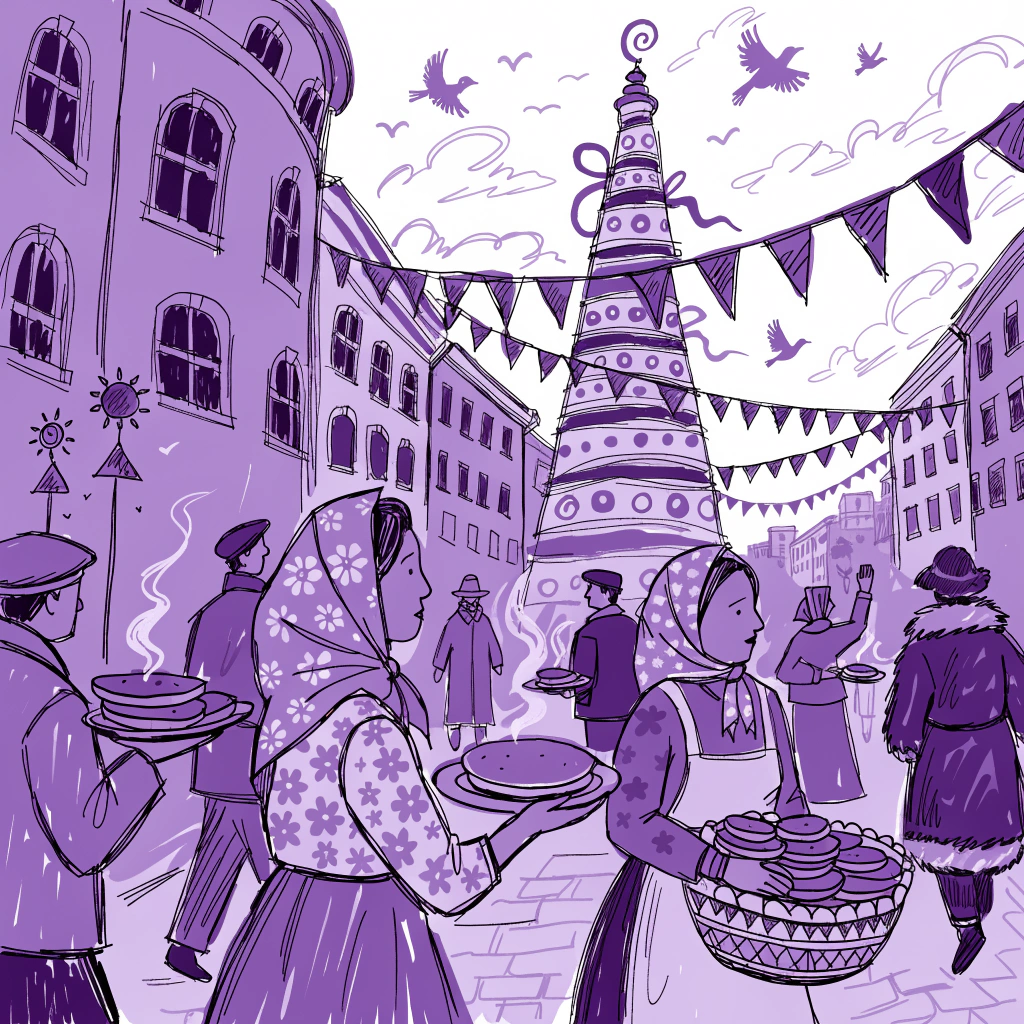
A Special Week: Maslenitsa in Russia
Maslenitsa is a special festival in Russia. It happens at the end of winter. People say goodbye to the cold weather. They welcome the spring.
The festival is one week long. People eat many pancakes. The pancakes are round and yellow. They look like the sun. People eat them with butter, honey, or jam.
In the street, there are games and music. Children play and people sing. At the end, they burn a big straw doll. This means winter is over. It is a happy time for families.
تسليط الضوء على القواعد
نمط: Present Simple (Facts)
"Maslenitsa is a special festival in Russia."
We use the Present Simple to talk about facts or things that happen every year. For the verb 'to be', we use 'is' with singular subjects like 'Maslenitsa'.
نمط: Adjectives before Nouns
"They burn a big straw doll."
In English, we put adjectives (describing words) before the noun. Here, 'big' and 'straw' describe the 'doll'.
اختبر فهمك
10 أسئلة · A1 مبتدئ · معاينة مجانية واحدة
اختبر ما تعلمته من هذا المقال. أجب على جميع الأسئلة لكسب نقاط خبرة!
When does Maslenitsa happen?
هل تريد إنهاء الاختبار؟
9 أسئلة أخرى بانتظارك. سجّل مجاناً لفتح الاختبار الكامل وكسب نقاط خبرة!
سجل مجاناًلديك حساب بالفعل؟ دخول
تفصيل الأسئلة
When does Maslenitsa happen?
إجابتك:
الإجابة الصحيحة: At the end of winter
People eat pancakes during the festival.
إجابتك:
الإجابة الصحيحة: صحيح
What is 'spring'?
إجابتك:
الإجابة الصحيحة: The season after winter
The pancakes look like the _____.
إجابتك:
الإجابة الصحيحة: sun
Maslenitsa: The Russian Pancake Week
Maslenitsa is a famous festival in Russia. It happens every year at the end of winter. People call it 'Pancake Week' because they eat many pancakes during this time. It is a very old tradition that celebrates the end of the cold weather and the start of spring.
The pancakes are called 'blini'. They are round, hot, and yellow. People think blini look like the sun because of their shape and color. They are very delicious! People usually eat them with sweet honey, jam, or butter. In the past, this festival was more popular than it is now, but many families still celebrate it today.
During the week, there are many fun activities. People sing traditional songs and play games in the snow. On the last day, they burn a large straw doll. They do this because they want the winter to finish quickly. It is a happy time for friends to meet and eat together.
تسليط الضوء على القواعد
نمط: Comparatives (More + Adjective + Than)
"In the past, this festival was more popular than it is now."
We use 'more' with long adjectives to compare two things or times. We add 'than' before the second thing we are comparing.
نمط: Past Simple of 'To Be'
"In the past, this festival was more popular than it is now."
We use 'was' for the past simple of 'is' when the subject is singular (this festival). It describes a state in the past.
اختبر فهمك
11 أسئلة · A2 ابتدائي · معاينة مجانية واحدة
اختبر ما تعلمته من هذا المقال. أجب على جميع الأسئلة لكسب نقاط خبرة!
Why do people call this festival 'Pancake Week'?
هل تريد إنهاء الاختبار؟
10 أسئلة أخرى بانتظارك. سجّل مجاناً لفتح الاختبار الكامل وكسب نقاط خبرة!
سجل مجاناًلديك حساب بالفعل؟ دخول
تفصيل الأسئلة
Why do people call this festival 'Pancake Week'?
إجابتك:
الإجابة الصحيحة: Because they eat many pancakes
Pancakes are called 'blini' in Russia.
إجابتك:
الإجابة الصحيحة: صحيح
What does 'delicious' mean?
إجابتك:
الإجابة الصحيحة: Tasting very good
People think blini look like the _____ because they are round and yellow.
إجابتك:
الإجابة الصحيحة: sun
When does Maslenitsa happen?
إجابتك:
الإجابة الصحيحة: At the end of winter
The Magic of Maslenitsa: Russia's Sun Festival
Maslenitsa is a vibrant and ancient Slavic festival that marks the boundary between winter and spring. It is celebrated during the last week before Great Lent, which is a period of fasting before Easter. Because the dates depend on the lunar calendar, the festival moves every year, but it usually falls in late February or early March. This special week has been celebrated for centuries by people who are happy to see the sun again.
The most important part of Maslenitsa is the food. People eat 'blini,' which are thin Russian pancakes. These pancakes are considered a symbol of the sun because they are round, golden, and warm. They are often served with butter, honey, or jam. During this week, meat is already forbidden for some, but dairy products like milk and eggs are allowed. This is why the festival is sometimes called 'Pancake Week.'
There are many traditional activities that take place during the week. In the past, people enjoyed horse-drawn sleigh rides and snowball fights. Today, families often gather in public parks where music is played and traditional games are organized. It is a time for joy and community before the quiet period of Lent begins.
The festival ends with a very famous tradition. A large straw doll, which is called 'Lady Maslenitsa,' is burned on a bonfire. This act is used to represent the end of the cold winter and the arrival of the warm spring. As the doll burns, people look forward to the new life that spring brings. Although it started as a pagan holiday, it was later integrated into the Christian calendar. Today, it remains one of the most popular festivals in Russia, bringing light and warmth to the end of the winter season.
تسليط الضوء على القواعد
نمط: Present Perfect Tense
"This special week has been celebrated for centuries by people who are happy to see the sun again."
The present perfect (have/has + past participle) is used here to describe an action that started in the past and continues to be relevant in the present.
نمط: Passive Voice
"A large straw doll, which is called 'Lady Maslenitsa,' is burned on a bonfire."
The passive voice (is + past participle) is used when the action (burning) is more important than the person performing it.
اختبر فهمك
11 أسئلة · B1 متوسط · معاينة مجانية واحدة
اختبر ما تعلمته من هذا المقال. أجب على جميع الأسئلة لكسب نقاط خبرة!
Why are pancakes (blini) the main food of the festival?
هل تريد إنهاء الاختبار؟
10 أسئلة أخرى بانتظارك. سجّل مجاناً لفتح الاختبار الكامل وكسب نقاط خبرة!
سجل مجاناًلديك حساب بالفعل؟ دخول
تفصيل الأسئلة
Why are pancakes (blini) the main food of the festival?
إجابتك:
الإجابة الصحيحة: Because they represent the sun
Maslenitsa always happens on the exact same dates every year.
إجابتك:
الإجابة الصحيحة: خطأ
What does the word 'ancient' mean in the text?
إجابتك:
الإجابة الصحيحة: Very old and from the past
At the end of the festival, a straw doll is _____ on a bonfire.
إجابتك:
الإجابة الصحيحة: burned
What does the burning of the straw doll represent?
إجابتك:
الإجابة الصحيحة: The arrival of spring and end of winter
Maslenitsa: The Synthesis of Sun Worship and Spiritual Preparation
Maslenitsa, frequently referred to as 'Pancake Week,' represents one of the most vibrant and enduring traditions in Slavic culture. Occurring in the final week before the onset of Great Lent, this festival serves as a symbolic boundary between the harshness of winter and the anticipated warmth of spring. While its origins are deeply rooted in ancient pagan rituals—specifically the worship of the sun—it has been seamlessly integrated into the Orthodox Christian calendar, reflecting a fascinating synthesis of cultural layers.
Central to the festivities is the preparation and consumption of 'blini'—thin, golden pancakes. These circular treats are not merely culinary delights; they are intended to symbolize the sun, embodying its light and life-giving heat. Given that the subsequent Lenten period requires strict abstinence from animal products, Maslenitsa provides a final opportunity for indulgence in dairy, eggs, and butter. Consequently, the week is characterized by generous hospitality and communal banquets where blini are served with various accompaniments, ranging from sour cream and honey to savory caviar.
The week is meticulously structured around specific daily rituals, each fostering social cohesion and reinforcing community ties. For instance, mid-week traditions often involve sons-in-law visiting their mothers-in-law, a practice designed to strengthen familial bonds. Furthermore, the atmosphere in public squares is heightened by outdoor activities such as traditional folk songs, sledding, and theatrical performances. Historically, more vigorous contests like fist-fighting were common, though these have largely evolved into more symbolic displays of strength and agility in modern times.
The climax of the week occurs on 'Forgiveness Sunday,' a day of profound emotional significance. On this day, individuals seek reconciliation with one another, asking for pardon for past grievances to enter the fasting period with a clear conscience. This act of humility is essential for spiritual preparation before the solemnity of Lent. The festivities culminate in the ceremonial burning of a straw effigy, known as Lady Maslenitsa. As the flames consume the figure, spectators bid farewell to winter, symbolically scattering the ashes over fields to ensure a fertile harvest.
Ultimately, Maslenitsa is more than just a culinary celebration; it is a multifaceted event that balances religious devotion with folk merriment. It encourages participants to reflect on the past year while looking forward to the rebirth of nature. By blending ancient myths with modern social practices, Maslenitsa remains a profound celebration of renewal, forgiveness, and the cyclical nature of life.
تسليط الضوء على القواعد
نمط: Passive Voice for Intention
"These circular treats are not merely culinary delights; they are intended to symbolize the sun..."
The passive voice with the verb 'intend' is used here to describe the purpose or symbolic meaning of an object in a formal, objective way.
نمط: Present Participle Clauses
"...asking for pardon for past grievances to enter the fasting period with a clear conscience."
A participle clause (starting with 'asking') is used to describe an action that happens at the same time as the main verb, providing more detail about the event.
نمط: Causal Structures with 'Given that'
"Given that the subsequent Lenten period requires strict abstinence from animal products, Maslenitsa provides a final opportunity..."
This structure is used to introduce a known fact or premise that explains why the situation in the main clause occurs.
اختبر فهمك
11 أسئلة · B2 فوق المتوسط · معاينة مجانية واحدة
اختبر ما تعلمته من هذا المقال. أجب على جميع الأسئلة لكسب نقاط خبرة!
What is the primary symbolic purpose of burning the straw effigy?
هل تريد إنهاء الاختبار؟
10 أسئلة أخرى بانتظارك. سجّل مجاناً لفتح الاختبار الكامل وكسب نقاط خبرة!
سجل مجاناًلديك حساب بالفعل؟ دخول
تفصيل الأسئلة
What is the primary symbolic purpose of burning the straw effigy?
إجابتك:
الإجابة الصحيحة: To bid farewell to winter and ensure fertility
Maslenitsa is a purely pagan festival with no connection to Christianity.
إجابتك:
الإجابة الصحيحة: خطأ
What does 'reconciliation' mean in the context of the article?
إجابتك:
الإجابة الصحيحة: The restoration of friendly relations
The climax of the week occurs on Forgiveness _____.
إجابتك:
الإجابة الصحيحة: Sunday
Why are 'blini' central to the Maslenitsa celebration?
إجابتك:
الإجابة الصحيحة: They symbolize the sun and its life-giving heat
The Solar Synthesis: Deciphering the Liminality of Maslenitsa
Rarely has a cultural phenomenon managed to traverse the centuries with such exuberant resilience as Maslenitsa. Often characterized as a mere 'pancake week,' this Slavic festival represents a sophisticated synthesis of pre-Christian solar worship and Orthodox ecclesiastical traditions. It serves as a liminal period, a temporal bridge where the austerity of the upcoming Great Lent meets the hedonistic vitality of the departing winter. The festival is not merely a celebration of the changing seasons but a complex socio-cultural tapestry woven from threads of mythology, religion, and communal identity.
Central to the festivities is the blin—a golden, circular pancake. It is not merely a culinary staple but a potent celestial metaphor, embodying the warmth and light of the sun whose return is so desperately craved in northern latitudes. The consumption of these pancakes constitutes a ritualistic act of communion with nature. Indeed, the sheer ubiquity of the blin during this week underscores the profound nominalization of tradition, where the act of eating becomes a symbolic reclamation of life over the metaphorical death of winter. Families gather to prepare these treats, sharing recipes that have been passed down through generations, thereby reinforcing familial bonds in the face of the harsh elements.
What makes Maslenitsa particularly compelling to the cultural anthropologist is its inherent duality. It is during this week that the boundaries between the sacred and the profane become porous. While the Church frames the period as 'Cheesefare Week,' a time for gradual abstinence from meat, the folk tradition erupts into carnivalesque chaos. Never before has the tension between religious restraint and pagan revelry been so palpable. It is this very friction that has ensured the festival's longevity; it provides a necessary psychological release before the introspective silence of Lent. The public squares transform into arenas of fistfights, sledding, and theatrical performances, all serving to channel the collective energy of a people emerging from hibernation.
The culmination of the week is marked by the construction and subsequent immolation of Lady Maslenitsa, a straw effigy representing winter. Only through this symbolic destruction can spring be ushered in. This ritualistic purging is not merely about the changing of seasons; it is a manifestation of collective catharsis. By burning the old, the community prepares for spiritual renewal. It is the paradoxical nature of this destruction—the fire that destroys the straw also lightens the path for the future—that defines the festival's philosophical core. The ashes are often scattered over fields to ensure a fertile harvest, linking the festival directly to the agrarian cycles of life and death.
Furthermore, the 'Sunday of Forgiveness' adds a layer of moral complexity to the revelry. It is the human connection, the deliberate seeking of pardon from one's peers, that elevates the festival beyond mere pageantry. This day requires participants to look inward and rectify social fractures, ensuring that the community enters the period of fasting with a clear conscience. In a modern context, Maslenitsa has evolved into a vehicle for national identity and heritage preservation. Despite the encroachment of globalization and the homogenization of culture, the festival remains a bastion of Slavic cultural distinctiveness. It proves that ancient traditions can indeed find a foothold in the contemporary consciousness, provided they offer a meaningful connection to the past while addressing the universal human need for renewal and social cohesion.
تسليط الضوء على القواعد
نمط: Inversion with Negative/Restrictive Adverbs
"Rarely has a cultural phenomenon managed to traverse the centuries with such exuberant resilience as Maslenitsa."
When a negative or restrictive adverbial phrase starts a sentence, the auxiliary verb is placed before the subject. This structure is used for emphasis and is common in formal or literary C1 English.
نمط: Cleft Sentences
"It is the human connection, the deliberate seeking of pardon from one's peers, that elevates the festival beyond mere pageantry."
Cleft sentences use 'It is/was... that' to focus on a specific part of the sentence. This structure highlights the most important information, in this case, the 'human connection'.
نمط: Nominalisation
"The consumption of these pancakes constitutes a ritualistic act of communion with nature."
Nominalisation involves turning verbs or adjectives into nouns (e.g., 'consumption' instead of 'eating'). This creates a more formal, academic tone and allows for more complex ideas to be compressed into single noun phrases.
اختبر فهمك
12 أسئلة · C1 متقدم · معاينة مجانية واحدة
اختبر ما تعلمته من هذا المقال. أجب على جميع الأسئلة لكسب نقاط خبرة!
According to the article, what does the 'blin' primarily symbolize?
هل تريد إنهاء الاختبار؟
11 أسئلة أخرى بانتظارك. سجّل مجاناً لفتح الاختبار الكامل وكسب نقاط خبرة!
سجل مجاناًلديك حساب بالفعل؟ دخول
تفصيل الأسئلة
According to the article, what does the 'blin' primarily symbolize?
إجابتك:
الإجابة الصحيحة: The warmth and light of the sun
The author suggests that the folk traditions of Maslenitsa are perfectly aligned with the Church's vision of restraint.
إجابتك:
الإجابة الصحيحة: خطأ
Which word describes a transitional stage between two different states?
إجابتك:
الإجابة الصحيحة: Liminal
The ritualistic _____ of the straw effigy is necessary for the arrival of spring.
إجابتك:
الإجابة الصحيحة: immolation
What role does the 'Sunday of Forgiveness' play in the festival?
إجابتك:
الإجابة الصحيحة: It provides a moral dimension by requiring participants to seek pardon
The ashes of the burned effigy are used as a symbolic fertilizer for fields.
إجابتك:
الإجابة الصحيحة: صحيح
The Vernal Threshold: Deciphering the Syncretic Tapestry of Maslenitsa
The cultural landscape of Eastern Europe is punctuated by festivities that serve as remnants of a pre-Abrahamic past, yet none are perhaps as evocative or as enduringly complex as Maslenitsa. Often reductive in translation as 'Pancake Week,' Maslenitsa represents a profound liminality—a threshold between the stasis of winter and the nascent vitality of spring. To understand Maslenitsa is to engage with the concept of religious syncretism, wherein the solar-centric rituals of the ancient Slavs were not so much eradicated as they were subsumed by the liturgical rhythms of the Orthodox Church. This amalgamation of the profane and the sacred creates a week that is as much about spiritual preparation as it is about communal revelry.
At its core, Maslenitsa functions as a week of sanctioned hedonism, a necessary psychological precursor to the rigorous asceticism of Great Lent. Should one observe the festivities, the blini—thin, golden pancakes—take center stage. These are not merely culinary staples but potent solar symbols, intended to propitiate the sun and hasten its return. The circularity of the blini mirrors the cyclical nature of time itself, a concept deeply ingrained in the pagan worldview. It is as if by consuming the sun, the celebrant internalizes its warmth, fortifying themselves against the final, biting frosts of February. The consumption is prodigious, a final defiance of the scarcity that winter traditionally imposed upon the agrarian soul.
The week is structured around idiosyncratic rituals that escalate in intensity. From the 'Welcoming' on Monday to the 'Forgiveness Sunday' that concludes the cycle, each day demands specific social interactions. This culminates in the ritualistic destruction of the Lady Maslenitsa, an effigy fashioned from straw and dressed in traditional rags. The burning of this effigy is a symbolic purgation, a fiery disposal of the winter's 'death' to make way for the vernal rebirth. One might argue that this act is vestigial, a shadow of ancient sacrifices meant to ensure the fertility of the soil, yet its persistence in the modern era speaks to a deeper, collective need for catharsis. The smoke rising from the pyre signals the end of the old year and the tentative beginning of the new.
Lest the festival be perceived as merely a quaint folk tradition, one must consider its sociopolitical dimensions. Historically, the 'carnivalesque' nature of Maslenitsa allowed for a temporary subversion of social hierarchies. For a brief period, the rigid structures of feudal or imperial society were suspended, replaced by a chaotic, egalitarian joy. This suspension of normality serves as a safety valve, allowing the populace to vent frustrations before the somber, reflective period of the fast begins. In this sense, the festival is not just a seasonal marker but a vital component of social cohesion, providing a space where the ordinary rules of conduct are momentarily discarded.
Furthermore, the linguistic evolution of the term itself—derived from 'maslo' (butter)—underscores the dietary significance of the period. During the week, meat is already prohibited by the Church, but dairy products are consumed in abundance, hence the 'buttery' nature of the celebration. It is a period of transition, not only spiritually but physically, as the body is prepared for the deprivation to come. The sophistication of this transition is often overlooked by casual observers who see only the revelry. It is a carefully calibrated descent from the heights of indulgence to the depths of penitence.
In contemporary Russia, Maslenitsa has undergone a further metamorphosis, becoming a vehicle for national identity and cultural preservation. Albeit modernized, the essence of the festival remains tied to the soil and the seasons. The juxtaposition of ancient paganism and Christian piety creates a unique cultural synthesis that defies easy categorization. Whether viewed through a theological, sociological, or purely aesthetic lens, Maslenitsa remains a testament to the resilience of folk memory and the human desire to mark the passage of time with beauty and fire. As the final embers of the effigy fade, the silence of Lent descends, marking the end of the ephemeral joy and the beginning of the long wait for the vernal equinox.
تسليط الضوء على القواعد
نمط: Inverted Conditional (Should + Subject + Verb)
"Should one observe the festivities, the blini—thin, golden pancakes—take center stage."
This formal structure replaces 'if' in first conditional sentences to sound more academic or literary. It is formed by placing the auxiliary 'should' before the subject, followed by the base form of the verb.
نمط: Negative Purpose Clause with 'Lest'
"Lest the festival be perceived as merely a quaint folk tradition, one must consider its sociopolitical dimensions."
The word 'lest' is used to express a negative purpose, meaning 'for fear that' or 'to avoid the risk of.' It is typically followed by a verb in the subjunctive mood (e.g., 'be perceived').
نمط: Concessive Clause with 'Albeit'
"Albeit modernized, the essence of the festival remains tied to the soil and the seasons."
The conjunction 'albeit' is used to introduce a concession, similar to 'although' or 'even though,' but it is usually followed by a single word or a short phrase rather than a full clause.
اختبر فهمك
12 أسئلة · C2 إتقان · معاينة مجانية واحدة
اختبر ما تعلمته من هذا المقال. أجب على جميع الأسئلة لكسب نقاط خبرة!
What does the text suggest is the primary symbolic function of the blini during Maslenitsa?
هل تريد إنهاء الاختبار؟
11 أسئلة أخرى بانتظارك. سجّل مجاناً لفتح الاختبار الكامل وكسب نقاط خبرة!
سجل مجاناًلديك حساب بالفعل؟ دخول
تفصيل الأسئلة
What does the text suggest is the primary symbolic function of the blini during Maslenitsa?
إجابتك:
الإجابة الصحيحة: To propitiate the sun and represent its return
The author claims that the Orthodox Church completely eradicated the pagan elements of Maslenitsa.
إجابتك:
الإجابة الصحيحة: خطأ
What does the term 'vestigial' imply in the context of the effigy burning?
إجابتك:
الإجابة الصحيحة: The act is a trace of an ancient, larger ritual
The circularity of the blini mirrors the _____ nature of time itself.
إجابتك:
الإجابة الصحيحة: cyclical
Which term is used to describe the state of being on a threshold between two periods?
إجابتك:
الإجابة الصحيحة: Liminality
Meat is strictly prohibited during the week of Maslenitsa according to the text.
إجابتك:
الإجابة الصحيحة: صحيح

