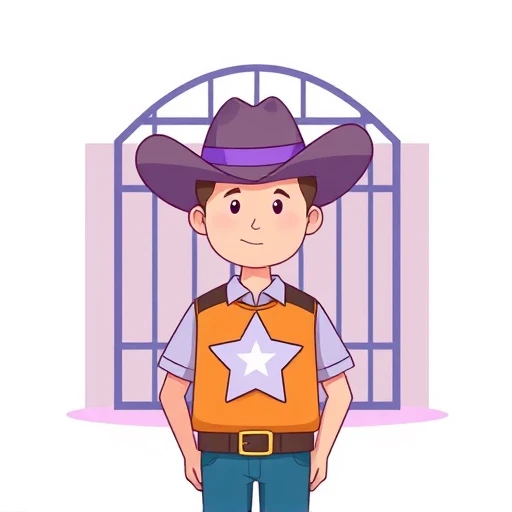
sheriff في 30 ثانية
- A sheriff is a high-level law enforcement official, typically elected at the county level in the United States.
- The role includes policing, managing jails, and providing security for the local court system.
- The word originates from the Old English 'shire-reeve,' meaning a representative of the crown in a county.
- In other countries like Scotland, the term refers to a judge rather than a police officer.
The term sheriff carries a significant historical and administrative weight, primarily within the legal systems of English-speaking countries like the United States, the United Kingdom, and Canada. At its core, a sheriff is a high-ranking law enforcement official. However, the specific duties and the method of obtaining the office vary wildly depending on the geography and the historical era being discussed. In the modern United States, a sheriff is typically an elected official who serves as the chief law enforcement officer of a county. This distinguishes them from a police chief, who is usually an appointed official serving a specific city or municipality. The role of the sheriff is deeply embedded in the democratic process because the citizens of the county vote for this individual, making the office directly accountable to the public. This political nature often means that sheriffs are prominent figures in local politics, representing the values and law enforcement priorities of their specific community.
- Administrative Jurisdiction
- The sheriff operates at the county level, which sits between the city police and the state police. Their jurisdiction covers all areas within the county lines, though they often focus on unincorporated areas that do not have their own municipal police departments.
The local sheriff is responsible for managing the county jail and ensuring the safety of the courthouse.
Historically, the word is a contraction of the Old English terms 'shire' and 'reeve.' A shire was a traditional administrative division (similar to a modern county), and a reeve was a local official or representative of the King. Thus, the 'shire-reeve' was the King's man in the county, responsible for collecting taxes, maintaining order, and raising a 'posse comitatus' (a group of citizens) to pursue criminals. This historical context is vital because it explains why the office of the sheriff often includes duties beyond simple street patrol, such as serving legal papers, conducting foreclosures, and providing security for the court system. In England and Wales today, the role has become largely ceremonial, though 'High Sheriffs' still exist as the oldest secular office under the Crown. In Scotland, however, a sheriff is a type of judge who presides over a 'Sheriff Court,' highlighting how the same word can mean a law enforcer in one country and a judicial officer in another.
- Election and Accountability
- Unlike police officers who are hired employees, a sheriff must run a political campaign every few years. This makes the position unique in law enforcement as it requires both policing skills and political acumen.
After the election, the new sheriff promised to modernize the department's communication systems.
In popular culture, the sheriff is a staple of the 'Wild West' genre. This portrayal has cemented the image of the sheriff as a rugged individualist standing against lawlessness. However, modern sheriffs lead large, sophisticated organizations with hundreds or even thousands of deputies. They manage multi-million dollar budgets and oversee complex operations including search and rescue, narcotics task forces, and emergency management. People use the word today not just to refer to the person, but often to the entire department (e.g., 'The Sheriff's Office is investigating'). It is also used metaphorically to describe someone who takes charge of a chaotic situation or enforces rules strictly in a new environment, as seen in the common idiom 'there is a new sheriff in town.'
- The Posse Comitatus
- Historically, the sheriff had the power to draft any able-bodied man into a 'posse' to help catch a criminal. While rare today, this legal authority still exists in some jurisdictions.
The sheriff of Nottingham is perhaps the most famous fictional antagonist, known for opposing Robin Hood.
In summary, the sheriff is a multifaceted role that bridges the gap between the executive and judicial branches of government. Whether they are managing a jail, serving a subpoena, or patrolling a rural highway, the sheriff remains a cornerstone of local governance in many parts of the world. Their presence ensures that the law is not just a set of abstract rules, but a locally enforced reality that reflects the will of the people who elected them. Understanding the word requires recognizing this blend of historical tradition, political accountability, and modern law enforcement necessity.
Using the word sheriff correctly involves understanding its role as both a title and a common noun. When you are referring to the specific individual who holds the office, you often capitalize the word as a title. For example, 'Sheriff Miller' or 'the Sheriff.' However, when using it generically to describe the profession or the office, it remains lowercase. Because the sheriff is an individual person, the word is a countable noun. You can have one sheriff or several sheriffs from different counties. It is also important to distinguish between the 'Sheriff' (the person) and the 'Sheriff's Office' or 'Sheriff's Department' (the organization). In many American contexts, people will say 'The Sheriff is coming' when they mean a deputy is arriving, though technically the deputy is an agent of the sheriff.
- Subject and Object Usage
- The sheriff acts as the subject in sentences involving law enforcement actions. 'The sheriff arrested the suspect.' As an object, it follows verbs of interaction: 'The townspeople petitioned the sheriff for better security.'
During the press conference, Sheriff Johnson explained the new safety protocols for the upcoming festival.
Grammatically, 'sheriff' is often paired with possessive nouns to indicate jurisdiction or responsibility. You will frequently see phrases like 'the county sheriff' or 'the city's sheriff' (though the latter is less common since sheriffs are usually county-based). When discussing the duties of the office, the word often appears with verbs like 'oversee,' 'enforce,' 'manage,' and 'protect.' For instance, 'The sheriff oversees the county correctional facility.' In legal and formal writing, the sheriff is often the person named in writs or court orders. 'The court ordered the sheriff to seize the property.' This formal usage highlights the sheriff's role as the arm of the court, responsible for carrying out judicial mandates that city police officers might not handle.
- Collective and Plural Forms
- When referring to a group, use 'sheriffs.' 'The state association of sheriffs met to discuss legislative changes.' The possessive plural is 'sheriffs'.' 'The sheriffs' badges were polished for the ceremony.'
It is the sheriff's responsibility to ensure that all court summons are delivered on time.
In descriptive writing, the word 'sheriff' can evoke specific imagery. Authors often use it to establish a setting—rural, Western, or traditional. 'The sheriff leaned against his cruiser, his eyes scanning the dusty horizon.' Here, the word does more than just identify a job; it sets a mood. In metaphorical contexts, you might say someone is 'playing sheriff' if they are acting bossy or trying to enforce rules where they have no authority. This usage is common in informal conversation and workplace settings. 'Stop playing sheriff and just do your own work.' This versatility allows the word to function in high-stakes legal documents, casual storytelling, and everyday idioms alike.
- Prepositional Phrases
- Commonly used with 'by' or 'to.' 'The warrant was signed by the sheriff.' 'The prisoner was handed over to the sheriff.'
The sheriff was accompanied by three deputies when he arrived at the scene of the crime.
Finally, consider the verb forms associated with the office. While 'to sheriff' is not a standard verb, the actions a sheriff performs are diverse. They 'deputize' others (give them the power of a deputy), they 'serve' papers, and they 'sequester' juries. When writing about a sheriff, focus on these specific legal actions to add authenticity to your prose. Whether you are writing a news report, a legal brief, or a fictional story, using 'sheriff' with precision regarding their jurisdiction and specific duties will make your writing more professional and accurate.
You will encounter the word sheriff in a variety of real-world contexts, ranging from the evening news to the silver screen. In the United States, one of the most common places to hear the word is during local election cycles. Because the position is elected, you will see campaign signs on lawns that say 'Vote for Miller for Sheriff' or hear political advertisements debating the current sheriff's record on crime and budget management. This makes the word a frequent topic of conversation in local diners, community centers, and town hall meetings. People discuss the sheriff's policies because those policies directly affect the safety of their neighborhoods and the administration of the local jail.
- News and Media
- Local news broadcasts frequently feature the sheriff giving statements about ongoing investigations, natural disasters, or public safety warnings. 'The Sheriff's Office has issued an evacuation order due to the wildfire.'
In the news report, the sheriff warned residents about a recent string of burglaries in the northern part of the county.
Another major arena for the word is in the entertainment industry. The 'Western' genre of movies and television is perhaps the most famous source. From classic films like 'High Noon' to modern hits like 'Longmire' or 'Justified,' the sheriff is often the protagonist—a lone figure of justice in a harsh landscape. In these contexts, the word carries a heroic, sometimes mythic, quality. You also hear it in crime dramas set in rural areas, such as 'Stranger Things' (Sheriff Hopper) or 'Twin Peaks' (Sheriff Truman). In these shows, the sheriff is often the person who knows everyone in town, bridging the gap between the law and the community's personal secrets. This cultural saturation means that even people who don't live in a county with a sheriff are intimately familiar with the concept.
- Legal and Judicial Settings
- If you ever have to go to court or deal with civil legal matters, you will hear the word 'sheriff' in relation to serving papers. 'The sheriff served the divorce papers yesterday.'
The judge asked the sheriff to remove the disruptive spectator from the courtroom.
In the United Kingdom, you might hear the word in a very different context. In Scotland, 'Sheriff' is the title for a judge in the middle-tier courts. If someone says, 'I have to appear before the sheriff,' they are talking about a legal hearing, not an arrest by a police officer. In England, you might hear about the 'High Sheriff' during ceremonial events involving the Royal Family or local charity openings. This version of the sheriff is a volunteer who represents the Monarch in the county for a year. Furthermore, in the world of finance and debt collection in the UK, 'Sheriff Officers' or 'High Court Enforcement Officers' (formerly called sheriffs) are the people who come to repossess property or collect unpaid debts. Hearing the word in this context usually signals a serious financial or legal crisis.
- Music and Idioms
- Bob Marley's famous song 'I Shot the Sheriff' is a global cultural touchstone. In daily life, you might hear 'There's a new sheriff in town' when a new boss starts at work.
When the new manager arrived, she made it clear that there was a new sheriff in town by changing all the old rules.
Finally, you will hear the word in social media and online forums, especially when discussing civil liberties or police reform. Because sheriffs are elected, they are often at the center of debates about how law enforcement should be held accountable to the public. Whether it is a discussion about a controversial arrest or a debate over the county budget, the 'sheriff' is a word that appears whenever the intersection of law, politics, and community safety is discussed. From the historical 'shire-reeve' to the modern elected official, the word remains a vital part of the English vocabulary for describing authority and order.
One of the most frequent mistakes learners make with the word sheriff is misspelling it. It is very common to see it written as 'sherif' with only one 'f' at the end. However, the correct spelling always requires two 'f's. This mistake often stems from the pronunciation, where the final 'f' sound is short, leading people to believe a single letter is sufficient. Another common spelling error is 'sherrif' with a double 'r.' Remember: one 'r,' two 'f's. Getting the spelling right is crucial, especially in formal writing or when addressing a legal official, as misspelling a title can be seen as a sign of disrespect or lack of attention to detail.
- Confusion with 'Police Chief'
- Many people use 'sheriff' and 'police chief' interchangeably, but they are different roles. A sheriff is usually elected and works for a county; a police chief is usually appointed and works for a city.
Incorrect: The sheriff of the city of New York. (New York City has a Police Commissioner; the sheriff's role there is different and more focused on civil law).
A second major mistake involves misunderstanding the jurisdiction of a sheriff. In the United States, learners often assume that a sheriff has authority over the entire country or a whole state. In reality, a sheriff's power is strictly limited to their specific county. If a sheriff crosses the county line, they generally lose their primary law enforcement authority unless they are in 'hot pursuit' of a suspect or have a special agreement with the neighboring county. Similarly, people often mistakenly call every officer in a brown uniform a 'sheriff.' In fact, the person you see patrolling is almost certainly a 'deputy sheriff' or simply a 'deputy.' The 'Sheriff' is the single person at the top of the organization. Calling a deputy 'Sheriff' is like calling a soldier 'General'—it is a significant overestimation of their rank.
- The 'Sheriff' vs. 'Marshal' Confusion
- In Western movies, these two are often confused. A US Marshal is a federal officer (national), while a sheriff is a local officer (county).
Correct: The sheriff is responsible for the county jail, while the US Marshal handles federal prisoners.
Another mistake is applying the American definition of 'sheriff' to other countries. If you are in Scotland and you call a 'sheriff' to report a crime in progress, you are making a mistake; you should call the police. In Scotland, the sheriff is the judge who will hear the case later. In England, calling the 'High Sheriff' to report a burglary would also be incorrect, as they are a ceremonial figure. This cross-cultural confusion can lead to significant misunderstandings in legal or emergency situations. Furthermore, some learners use the word 'sheriff' as a verb, which is technically incorrect in standard English. You cannot 'sheriff a town,' though you can 'act as the sheriff of a town' or 'police a town.'
- Capitalization Errors
- Do not capitalize 'sheriff' when it is a general noun. 'We need to hire a new sheriff.' Only capitalize it when it is a title. 'I spoke with Sheriff Taylor.'
Incorrect: The Sheriff is a difficult job. Correct: Being a sheriff is a difficult job.
Lastly, avoid the mistake of thinking that all sheriffs are men. While historical depictions often show male sheriffs, there are many female sheriffs in office today. Using gender-neutral language or acknowledging that a sheriff can be of any gender is important for modern accuracy. By avoiding these common pitfalls—spelling, jurisdiction, title vs. role, and cultural context—you will use the word 'sheriff' with the precision of a native speaker and avoid the most frequent errors that plague English learners.
When looking for synonyms or alternatives to the word sheriff, it is important to choose a word that matches the specific context and jurisdiction you are describing. While 'police officer' is the most general term for someone who enforces the law, it lacks the specific nuances of the sheriff's office. If you are talking about the person in charge of a city's law enforcement, the correct term is 'Chief of Police.' If you are referring to the officers who work for a sheriff, the term is 'Deputy' or 'Deputy Sheriff.' Using 'deputy' is often more accurate in daily conversation when referring to the person who pulls you over for speeding in a county area.
- Sheriff vs. Marshal
- A sheriff is a local/county official. A Marshal (specifically a US Marshal) is a federal official. Marshals handle federal fugitives and witness protection, while sheriffs handle local jails and county law.
While the sheriff patrolled the county roads, the US Marshal was busy tracking a fugitive across state lines.
In some jurisdictions, you might encounter the word 'Constable.' A constable is often a lower-level law enforcement officer, sometimes with limited powers compared to a sheriff. In parts of the US and the UK, constables focus on serving legal papers or providing security for specific small districts. Another alternative is 'Ranger,' specifically 'State Ranger' (like the Texas Rangers). Rangers are state-level officers with broad authority, often specializing in major investigations. While a sheriff is tied to a county, a ranger can operate anywhere in the state. If you are writing a historical novel set in England, you might use the term 'Shire-reeve' to refer to the early version of the sheriff, or 'Bailiff' for an official who carries out court orders.
- Sheriff vs. Police Officer
- Police officers are usually employees of a city. Sheriffs are usually elected officials of a county. Police focus on city crime; sheriffs focus on the jail, the courts, and rural areas.
The sheriff and the city police chief coordinated their efforts to catch the bank robber.
For more formal or academic writing, you might use terms like 'Chief Law Enforcement Officer' (CLEO) or 'County Executive for Law Enforcement.' These terms emphasize the administrative and legal responsibilities of the role rather than the cultural image. In the context of the court system, 'Court Officer' or 'Bailiff' are sometimes used as alternatives when the sheriff's primary duty is maintaining order in the courtroom. However, 'sheriff' remains the most precise term for the specific elected county official. When choosing an alternative, always ask: Is this person elected? What is their jurisdiction? What are their primary duties? Answering these questions will help you choose between 'sheriff,' 'police,' 'marshal,' or 'constable.'
- Fictional Alternatives
- In fantasy or sci-fi, you might see 'Peacekeeper,' 'Enforcer,' or 'Watchman.' These words capture the essence of the sheriff's role in maintaining order in a community.
The sheriff of the small mining colony was the only thing standing between the workers and the corporate thugs.
In conclusion, while there are many words for people who enforce the law, 'sheriff' occupies a unique niche. It combines the authority of the law with the accountability of an election and the tradition of the county system. By understanding the subtle differences between a sheriff and their counterparts like marshals or police chiefs, you can use these terms more effectively to describe the specific power structures and legal frameworks in your writing and conversation.
How Formal Is It?
حقيقة ممتعة
The office of the sheriff is one of the oldest in the English-speaking world, dating back over 1,000 years to the time of King Alfred the Great.
دليل النطق
- Pronouncing it as 'she-reef' (incorrectly emphasizing the second syllable).
- Adding an 's' sound at the end when it is singular.
- Confusing the 'sh' sound with a 'ch' sound.
- Mumbling the 'i' so it sounds like 'sher-uff'.
- Failing to pronounce the final 'f' clearly.
مستوى الصعوبة
Easy to recognize in context due to frequent use in media.
Spelling (one 'r', two 'f's) can be tricky for learners.
Pronunciation is straightforward.
Clear phonetic profile makes it easy to hear.
ماذا تتعلّم بعد ذلك
المتطلبات الأساسية
تعلّم لاحقاً
متقدم
قواعد يجب معرفتها
Capitalization of Titles
Use 'Sheriff Jones' but 'the local sheriff'.
Possessive Nouns
The 'sheriff's office' (one sheriff) vs. 'sheriffs' association' (many sheriffs).
Compound Nouns
The term 'deputy sheriff' acts as a single unit.
Prepositional Usage
We say 'The sheriff of [Place]'.
Articles with Occupations
He wants to be a sheriff (general) vs. He is the sheriff (specific).
أمثلة حسب المستوى
The sheriff has a star.
Le shérif a une étoile.
Subject + Verb + Object.
Is he the sheriff?
Est-il le shérif ?
Question form.
The sheriff helps the town.
Le shérif aide la ville.
Present simple.
Look at the sheriff's hat.
Regardez le chapeau du shérif.
Possessive 's.
The sheriff is tall.
Le shérif est grand.
Adjective usage.
We like the sheriff.
Nous aimons le shérif.
Simple pronoun.
The sheriff catches bad men.
Le shérif attrape les méchants.
Third person singular.
Where is the sheriff?
Où est le shérif ?
Wh- question.
The sheriff works in the county.
Le shérif travaille dans le comté.
Prepositional phrase.
People vote for the sheriff.
Les gens votent pour le shérif.
Present simple for facts.
The sheriff's office is near the court.
Le bureau du shérif est près du tribunal.
Possessive noun.
He became the sheriff last year.
Il est devenu shérif l'année dernière.
Past simple.
The sheriff wears a brown uniform.
Le shérif porte un uniforme marron.
Descriptive sentence.
She is the first female sheriff here.
Elle est la première femme shérif ici.
Ordinal number.
The sheriff drives a white car.
Le shérif conduit une voiture blanche.
Simple action.
Can the sheriff help us find the dog?
Le shérif peut-il nous aider à trouver le chien ?
Modal verb 'can'.
The sheriff is responsible for the county jail.
Le shérif est responsable de la prison du comté.
Adjective + preposition.
You should contact the sheriff if you see anything suspicious.
Vous devriez contacter le shérif si vous voyez quelque chose de suspect.
Conditional sentence.
The sheriff's department manages search and rescue missions.
Le département du shérif gère les missions de recherche et de sauvetage.
Compound noun.
The sheriff was elected by a large majority.
Le shérif a été élu à une large majorité.
Passive voice.
A sheriff has more duties than a regular police officer.
Un shérif a plus de devoirs qu'un officier de police ordinaire.
Comparative form.
The sheriff served the legal papers to the homeowner.
Le shérif a remis les documents juridiques au propriétaire.
Specific legal verb 'serve'.
Many sheriffs in the US are very well-known in their communities.
De nombreux shérifs aux États-Unis sont très connus dans leurs communautés.
Plural form.
The sheriff decided to increase patrols in rural areas.
Le shérif a décidé d'augmenter les patrouilles dans les zones rurales.
Infinitive after 'decide'.
The sheriff's authority extends throughout the entire county.
L'autorité du shérif s'étend à l'ensemble du comté.
Abstract noun usage.
The candidate for sheriff promised to reform the department.
Le candidat au poste de shérif a promis de réformer le département.
Noun as a title.
The sheriff's office often collaborates with state police on major cases.
Le bureau du shérif collabore souvent avec la police d'État sur des affaires importantes.
Adverbial frequency.
Despite the controversy, the sheriff maintained his position on the issue.
Malgré la controverse, le shérif a maintenu sa position sur la question.
Concession clause.
The sheriff is tasked with ensuring the security of the local courthouse.
Le shérif est chargé d'assurer la sécurité du tribunal local.
Passive construction 'tasked with'.
Historically, the sheriff was the primary representative of the crown.
Historiquement, le shérif était le principal représentant de la couronne.
Historical context.
The sheriff's budget is approved by the county board of supervisors.
Le budget du shérif est approuvé par le conseil de surveillance du comté.
Complex passive.
In Scotland, the sheriff acts as a judge in civil and criminal cases.
En Écosse, le shérif agit en tant que juge dans les affaires civiles et pénales.
Geographical distinction.
The sheriff's autonomy from the city council allows for independent law enforcement strategies.
L'autonomie du shérif vis-à-vis du conseil municipal permet des stratégies indépendantes d'application de la loi.
Complex noun phrases.
The incumbent sheriff faced a tough challenge in the recent primary election.
Le shérif sortant a dû faire face à un défi de taille lors des récentes élections primaires.
Specific political vocabulary.
The sheriff's role in executing judicial writs is a cornerstone of the civil legal process.
Le rôle du shérif dans l'exécution des ordonnances judiciaires est une pierre angulaire du processus juridique civil.
Gerund phrase.
A sheriff must balance the demands of the electorate with the requirements of the law.
Un shérif doit équilibrer les demandes de l'électorat avec les exigences de la loi.
Modal of obligation.
The sheriff's department has expanded its cybercrime unit to address modern threats.
Le département du shérif a élargi son unité de cybercriminalité pour faire face aux menaces modernes.
Present perfect.
The sheriff's office is often the primary responder in unincorporated territories.
Le bureau du shérif est souvent le premier intervenant dans les territoires non incorporés.
Technical legal term.
The sheriff's decision to implement body cameras was met with mixed reactions.
La décision du shérif de mettre en place des caméras corporelles a suscité des réactions mitigées.
Noun complement clause.
The sheriff's jurisdiction is clearly defined by state statutes.
La juridiction du shérif est clairement définie par les lois de l'État.
Passive with adverb.
The sheriff's office serves as a bulwark of local sovereignty within the state's legal framework.
Le bureau du shérif sert de rempart à la souveraineté locale dans le cadre juridique de l'État.
Metaphorical usage.
The sheriff's historical lineage can be traced back to the administrative reforms of the late Anglo-Saxon period.
La lignée historique du shérif remonte aux réformes administratives de la fin de la période anglo-saxonne.
Passive with 'can be traced'.
The sheriff's mandate to maintain the 'King's Peace' has evolved into a multifaceted modern law enforcement role.
Le mandat du shérif de maintenir la « paix du roi » a évolué vers un rôle moderne et multiforme d'application de la loi.
Historical idiom.
The sheriff's office is frequently embroiled in litigation regarding the conditions within the county jail.
Le bureau du shérif est fréquemment impliqué dans des litiges concernant les conditions au sein de la prison du comté.
Advanced vocabulary 'embroiled'.
The sheriff's power to deputize citizens remains a vestigial but legally potent authority in some regions.
Le pouvoir du shérif de déléguer des citoyens reste une autorité vestigiale mais juridiquement puissante dans certaines régions.
Complex adjective usage.
The sheriff's department must navigate the delicate political landscape of county-level governance.
Le département du shérif doit naviguer dans le paysage politique délicat de la gouvernance au niveau du comté.
Metaphorical verb 'navigate'.
The sheriff's role in Scotland as a professional judge contrasts sharply with the American elected official.
Le rôle du shérif en Écosse en tant que juge professionnel contraste fortement avec celui de l'élu américain.
Contrastive sentence structure.
The sheriff's office is often tasked with the unenviable duty of overseeing property evictions.
Le bureau du shérif est souvent chargé de la tâche peu enviable de superviser les expulsions de propriété.
Advanced adjective 'unenviable'.
تلازمات شائعة
العبارات الشائعة
— Used to say that an authority figure has arrived.
Be careful with your work today; the sheriff is in town.
— To seek help from the county law enforcement.
If you see a prowler, call the sheriff immediately.
— A group of people gathered by a sheriff to help.
The sheriff's posse searched the woods for the lost child.
— To be a candidate in an election for the office.
She decided to run for sheriff on a platform of reform.
— A ceremonial role in England and Wales.
The High Sheriff attended the opening of the new hospital.
— The court where a sheriff (judge) presides in Scotland.
The case will be heard in the Glasgow Sheriff Court.
— An assistant to the sheriff.
The sheriff's deputy took a statement from the witness.
— Working within the jurisdiction or command of the sheriff.
The jail staff works directly under the sheriff.
— The vehicle used by the sheriff's department.
A sheriff's cruiser was parked outside the courthouse.
يُخلط عادةً مع
A police chief is appointed by a city; a sheriff is usually elected by a county.
Marshals are often federal (national) officers, while sheriffs are local (county) officers.
A bailiff is a specific court officer; a sheriff may act as a bailiff or oversee them.
تعبيرات اصطلاحية
— There is a new person in charge who will enforce rules strictly.
The new CEO made it clear there's a new sheriff in town.
Informal— To act as if one has authority over others when they do not.
Stop playing sheriff and let people do their jobs.
Informal— A reference to the Bob Marley song, often used to admit to a specific act while denying another.
He joked, 'I shot the sheriff, but I didn't shoot the deputy.'
Pop Culture— Used to describe a corrupt or greedy official.
The landlord acted like the Sheriff of Nottingham with those fees.
Literary— A sheriff who focuses heavily on strict punishment.
The town elected a law and order sheriff to clean up the streets.
Political— Something that shows a person has power, like a sheriff's badge.
His new title was his badge of authority.
Metaphorical— The person who keeps everyone in line in a small group.
She's the town sheriff of this office; nothing gets past her.
Informal— To support or side with the established authority.
In this debate, I'm going to ride with the sheriff.
Informal— A decision made entirely at the discretion of the leader.
Who gets the promotion is the sheriff's choice.
Informalسهل الخلط
Incorrect spelling.
Sheriff has two 'f's. 'Sherif' is a different word (an Arabic title).
The sheriff (law officer) arrested the man.
Similar sound.
Sheer means thin or steep; sheriff is a person.
The sheer cliff was dangerous for the sheriff.
Similar first syllable.
Share is to divide; sheriff is an official.
The sheriff will share the information.
Both are leaders.
Chief is usually for city police; sheriff is for county.
The chief and the sheriff met.
Both are old law terms.
Constables often have less power or different duties than sheriffs.
The constable helped the sheriff.
أنماط الجُمل
The sheriff is [adjective].
The sheriff is brave.
The sheriff has a [noun].
The sheriff has a car.
The sheriff is responsible for [verb-ing].
The sheriff is responsible for managing the jail.
It is the sheriff's duty to [verb].
It is the sheriff's duty to protect the court.
The sheriff, elected by [noun], must [verb].
The sheriff, elected by the people, must uphold the law.
Notwithstanding the [noun], the sheriff [verb].
Notwithstanding the budget cuts, the sheriff maintained the patrol.
If you see a crime, call the sheriff.
If you see a crime, call the sheriff.
The sheriff's office collaborated with [organization].
The sheriff's office collaborated with the FBI.
عائلة الكلمة
الأسماء
الأفعال
الصفات
مرتبط
كيفية الاستخدام
Common in US English, especially in rural contexts and media.
-
Writing 'sherif'
→
sheriff
The word must end with two 'f's.
-
Writing 'sherrif'
→
sheriff
There is only one 'r' in the middle.
-
Calling a city police officer a sheriff.
→
police officer
Sheriffs work for counties, not cities.
-
Using 'sheriff' as a verb (e.g., 'He sheriffs the town').
→
He is the sheriff of the town.
Sheriff is a noun, not a standard verb.
-
Thinking a sheriff is appointed by the President.
→
elected by the county
In the US, sheriffs are local elected officials.
نصائح
Double F
Always remember the double 'f' at the end. It's the most common spelling error for this word.
County vs City
Use 'sheriff' when talking about a county or rural area, and 'police' when talking about a city.
Western Movies
Watching Westerns is a great way to see the historical image of the sheriff in action.
Titles
Capitalize the word when it's used as a title: 'Sheriff Taylor is here.'
Deputy
If you see a police car that says 'Sheriff' on it, the person driving is likely a 'deputy'.
Stress
Put the emphasis on the first part: SHER-iff.
Court Role
Remember that sheriffs also work in courts, not just on the streets.
Old English
Knowing it comes from 'shire-reeve' helps you remember it's a county (shire) job.
Scotland
If you're in Scotland, a sheriff is a judge. Don't ask them to catch a thief!
The Star
Think of the 'S' in Sheriff and the 'S' in Star.
احفظها
وسيلة تذكّر
Think of a **SHER**iff as the person who **SHER**es (shares) the responsibility of the **SHIRE** (county).
ربط بصري
Imagine a shiny gold star badge pinned to a brown uniform. The star has five points, just like the five letters in 'shire' (the root of the word).
Word Web
تحدٍّ
Try to use the word 'sheriff' in three different ways today: once about a movie, once about a news story, and once as a metaphor for a boss or leader.
أصل الكلمة
The word 'sheriff' comes from the Old English word 'scirgerefa.' This was a combination of two words that described the official's role in the early English government.
المعنى الأصلي: 'Scir' meant 'shire' (a county) and 'gerefa' meant 'reeve' (a high-ranking official or agent). So, a sheriff was the 'shire-reeve.'
Germanic (Old English).السياق الثقافي
Be aware that in some communities, the sheriff's office is viewed through the lens of political controversy due to its elected nature.
The sheriff is a uniquely prominent figure in US local government compared to other English-speaking nations.
تدرّب في الحياة الواقعية
سياقات واقعية
Local Government
- County election
- Budget hearing
- Public safety
- Elected official
Criminal Justice
- County jail
- Arrest warrant
- Patrol duty
- Investigation
Civil Law
- Serving papers
- Eviction notice
- Sheriff's sale
- Court security
Movies/Literature
- Wild West
- Outlaw
- Showdown
- Badge of honor
Scotland/Legal
- Sheriff court
- Summary procedure
- Judicial ruling
- Legal counsel
بدايات محادثة
"Have you ever seen a movie where the sheriff was the main hero?"
"In your country, is the head of the police elected or appointed?"
"What do you think are the most difficult parts of being a sheriff?"
"Why do you think the sheriff is such a popular character in Western films?"
"If you were the sheriff of your town, what is the first rule you would change?"
مواضيع للكتابة اليومية
Imagine you are a sheriff in a small town 100 years ago. Describe your typical day.
Write about a time you felt like you had to 'play sheriff' and enforce rules in a group.
Do you think it is a good idea for law enforcement leaders to be elected by the public? Why or why not?
Compare the role of a sheriff to a regular police officer based on what you have learned.
Describe a fictional sheriff from a book or movie and explain why they are memorable.
الأسئلة الشائعة
10 أسئلةA sheriff is a type of law enforcement officer, but the role is different. In the US, a sheriff is the head of a county department and is usually elected, whereas police officers are typically employees of a city department led by an appointed chief.
The star-shaped badge is a traditional symbol of authority for sheriffs in the United States, dating back to the 19th century. It helps citizens easily identify the sheriff as the primary law official in the area.
Generally, no. A sheriff's authority is limited to their own county and state. However, they may have 'hot pursuit' rights or special agreements with other jurisdictions to make arrests outside their usual area.
In England and Wales, the High Sheriff is a ceremonial role representing the Monarch. In Scotland, a sheriff is a professional judge who hears cases in a Sheriff Court. Neither role is like the American police sheriff.
Most US counties have a sheriff's office, but a few places have merged their city and county police into one department, or use different titles like 'County Police'.
In the United States, a sheriff's term is usually four years, after which they must run for re-election if they want to keep the job.
A sheriff's sale is a public auction where property is sold by the sheriff's office to pay off a legal debt, such as an unpaid mortgage or a court judgment.
You should capitalize 'Sheriff' when it is used as a title before a name (e.g., Sheriff Smith) or when referring to a specific person as 'the Sheriff.' Use lowercase for general mentions (e.g., He wants to be a sheriff).
A deputy sheriff is an officer who works for the sheriff. They perform the daily work of patrolling, investigating crimes, and serving the public under the sheriff's authority.
Yes, absolutely. There are many female sheriffs serving in counties across the United States and in various roles worldwide.
اختبر نفسك 180 أسئلة
Explain the difference between a sheriff and a police chief in your own words.
Well written! Good try! Check the sample answer below.
Describe the historical origin of the word 'sheriff'.
Well written! Good try! Check the sample answer below.
Write a short story about a sheriff in a small town.
Well written! Good try! Check the sample answer below.
Why is the sheriff's office considered a political position in the US?
Well written! Good try! Check the sample answer below.
What are three main duties of a modern sheriff?
Well written! Good try! Check the sample answer below.
Discuss the role of a sheriff in Scotland.
Well written! Good try! Check the sample answer below.
How does a sheriff's jurisdiction differ from a state trooper's?
Well written! Good try! Check the sample answer below.
Describe the symbolic importance of the sheriff's badge.
Well written! Good try! Check the sample answer below.
Write a sentence using the idiom 'there's a new sheriff in town'.
Well written! Good try! Check the sample answer below.
What is a 'posse' and how was it used historically?
Well written! Good try! Check the sample answer below.
Explain the process of a sheriff's sale.
Well written! Good try! Check the sample answer below.
Why might a sheriff be involved in an eviction?
Well written! Good try! Check the sample answer below.
Describe the appearance of a typical American sheriff.
Well written! Good try! Check the sample answer below.
What are the requirements to run for sheriff in most places?
Well written! Good try! Check the sample answer below.
How has the image of the sheriff changed from the Wild West to today?
Well written! Good try! Check the sample answer below.
Discuss the importance of the sheriff in rural communities.
Well written! Good try! Check the sample answer below.
Write a formal letter to a sheriff's office requesting information.
Well written! Good try! Check the sample answer below.
What is the 'High Sheriff' in England?
Well written! Good try! Check the sample answer below.
Why is the spelling of 'sheriff' often confused?
Well written! Good try! Check the sample answer below.
Summarize the impact of Bob Marley's song on the word's popularity.
Well written! Good try! Check the sample answer below.
Pronounce the word 'sheriff' correctly.
Read this aloud:
قلت:
Speech recognition is not supported in your browser. Try Chrome or Edge.
Use 'sheriff' in a sentence about a movie.
Read this aloud:
قلت:
Speech recognition is not supported in your browser. Try Chrome or Edge.
Explain the role of a sheriff to a friend.
Read this aloud:
قلت:
Speech recognition is not supported in your browser. Try Chrome or Edge.
Talk about a famous sheriff you know.
Read this aloud:
قلت:
Speech recognition is not supported in your browser. Try Chrome or Edge.
Describe a sheriff's uniform.
Read this aloud:
قلت:
Speech recognition is not supported in your browser. Try Chrome or Edge.
What would you do if you were the sheriff?
Read this aloud:
قلت:
Speech recognition is not supported in your browser. Try Chrome or Edge.
Say the word 'sheriff' three times quickly.
Read this aloud:
قلت:
Speech recognition is not supported in your browser. Try Chrome or Edge.
Ask a question using the word 'sheriff'.
Read this aloud:
قلت:
Speech recognition is not supported in your browser. Try Chrome or Edge.
Tell a short joke about a sheriff.
Read this aloud:
قلت:
Speech recognition is not supported in your browser. Try Chrome or Edge.
Explain why the sheriff is elected.
Read this aloud:
قلت:
Speech recognition is not supported in your browser. Try Chrome or Edge.
Listen and write the word: [Audio: Sheriff]
Which word did you hear? [Audio: Chief / Sheriff]
Listen to the sentence and fill the blank: 'The ___ is coming.'
How many syllables are in the word you heard? [Audio: Sheriff]
Listen and identify the title: 'Sheriff Miller announced the news.'
Write a sentence about a sheriff's badge.
Well written! Good try! Check the sample answer below.
What is the plural of sheriff?
Read this aloud:
قلت:
Speech recognition is not supported in your browser. Try Chrome or Edge.
Listen: [Audio: Sheriff's Office]
Why do sheriffs have deputies?
Well written! Good try! Check the sample answer below.
Say 'Sheriff of Nottingham'.
Read this aloud:
قلت:
Speech recognition is not supported in your browser. Try Chrome or Edge.
Listen: [Audio: Deputy Sheriff]
What is a sheriff's star?
Well written! Good try! Check the sample answer below.
/ 180 correct
Perfect score!
Summary
The sheriff is a unique law enforcement figure because they are usually elected by the community, making them directly accountable to the public they serve. For example: 'The sheriff was re-elected after promising to reduce crime in the rural parts of the county.'
- A sheriff is a high-level law enforcement official, typically elected at the county level in the United States.
- The role includes policing, managing jails, and providing security for the local court system.
- The word originates from the Old English 'shire-reeve,' meaning a representative of the crown in a county.
- In other countries like Scotland, the term refers to a judge rather than a police officer.
Double F
Always remember the double 'f' at the end. It's the most common spelling error for this word.
County vs City
Use 'sheriff' when talking about a county or rural area, and 'police' when talking about a city.
Western Movies
Watching Westerns is a great way to see the historical image of the sheriff in action.
Titles
Capitalize the word when it's used as a title: 'Sheriff Taylor is here.'